
Canterbury & Kent
Whole Life Carbon Assessments in Building Surveys: RICS PAS 2080:2023 Compliance for 2026 Property Valuations
The built environment accounts for approximately 39% of global carbon emissions — and yet, until recently, most building surveys made no formal attempt to quantify that carbon footprint across a property’s entire lifespan. That gap is closing fast. Whole Life Carbon Assessments in Building Surveys: RICS PAS 2080:2023 Compliance for 2026 Property Valuations has moved from a niche technical discussion to a mainstream professional obligation, reshaping how surveyors, valuers, and property owners approach every transaction.
As 2026 property valuations increasingly reflect ESG risk as a direct driver of market value [5], understanding how PAS 2080:2023 integrates with RICS standards is no longer optional — it is a competitive and regulatory necessity.

Key Takeaways 📌
- PAS 2080:2023 is the UK’s leading framework for managing carbon in infrastructure and buildings, now deeply integrated with RICS professional standards and Red Book valuation requirements.
- Whole life carbon covers both embodied carbon (materials, construction, demolition) and operational carbon (energy use over a building’s life).
- RICS members conducting commercial property valuations must now reflect ESG-related carbon risks as quantifiable value factors. [1][2]
- 2026 property valuations face increasing scrutiny: lenders, investors, and regulators expect carbon performance data to be embedded in survey and valuation reports.
- Practical compliance requires a structured checklist approach — from defect diagnosis through to expert witness reporting.
What Is Whole Life Carbon Assessment and Why Does PAS 2080:2023 Matter?
Whole Life Carbon Assessment (WLCA) is a structured methodology for measuring all carbon emissions associated with a building — from the extraction of raw materials right through to demolition and waste disposal. It is divided into two core categories:
| Carbon Type | What It Covers | Lifecycle Stage |
|---|---|---|
| Embodied Carbon | Materials, manufacturing, transport, construction, maintenance, demolition | Modules A1–A5, B1–B5, C1–C4 |
| Operational Carbon | Energy consumed during building use (heating, cooling, lighting) | Module B6 |
| Biogenic Carbon | Carbon stored in or emitted by biological materials | Modules A–D |
PAS 2080:2023, published by the British Standards Institution, provides the framework for systematically managing and reducing this carbon across the value chain. It was updated in 2023 to reflect advances in net zero policy, aligning with the UK’s legally binding 2050 net zero target and international carbon accounting standards.
For surveyors, the standard is significant because it provides a common language and methodology that bridges the gap between technical carbon science and practical property assessment. When a surveyor identifies defective insulation, inefficient glazing, or end-of-life mechanical systems, PAS 2080:2023 gives them the tools to translate those defects into quantified carbon liabilities — and, critically, into financial risk.
💡 “The standard distinguishes between the roles of valuers and advisers, with valuers focused on quantifying the impact of ESG risks as they currently exist in the asset.” [3]
This distinction matters enormously in practice. A valuer is not expected to design a carbon reduction strategy — but they are expected to identify and price the carbon risk already embedded in the property being assessed.
How Whole Life Carbon Assessments in Building Surveys: RICS PAS 2080:2023 Compliance for 2026 Property Valuations Works in Practice
The RICS Professional Standard on ESG and Sustainability
RICS published its updated global standard on ESG and sustainability in commercial property valuation to align with both the RICS Valuation Global Standards (Red Book) and International Valuation Standards (IVS). [1][2] The standard applies to all RICS members and firms undertaking commercial property valuations globally.
Key obligations for RICS members include:
- ✅ Reflecting capital and operational expenditure linked to ESG factors in valuations [1]
- ✅ Using a consolidated global list of ESG-related KPIs to ensure consistency [1]
- ✅ Identifying where carbon performance data is absent or unreliable and flagging this as a risk
- ✅ Distinguishing clearly between the valuer role (quantifying existing risk) and the adviser role (recommending improvements) [3]
For 2026 property valuations, this means that a commercial building survey that fails to address whole life carbon performance is likely to be considered incomplete — and potentially non-compliant with RICS professional standards.
Integrating WLCA into the Building Survey Process
The practical integration of whole life carbon assessment into a standard building survey follows a logical sequence:
Stage 1 — Pre-Survey Data Gathering
- Obtain existing Energy Performance Certificates (EPCs), Display Energy Certificates (DECs), and any prior carbon assessments
- Review planning history for major refurbishments that may have affected embodied carbon
- Request materials specifications and construction records where available
Stage 2 — On-Site Assessment
- Inspect building fabric for thermal performance indicators (insulation, glazing, air tightness)
- Identify materials with high embodied carbon (e.g., unreinforced concrete, certain cladding systems)
- Note maintenance-intensive elements that will generate future carbon through replacement cycles
- Record M&E systems age, efficiency ratings, and fuel type
Stage 3 — Carbon Quantification
- Apply PAS 2080:2023 lifecycle modules to translate physical observations into carbon estimates
- Cross-reference against CIBSE benchmarks and LETI (London Energy Transformation Initiative) carbon targets
- Flag where data gaps exist and quantify the uncertainty range
Stage 4 — Valuation Integration
- Translate carbon liabilities into capital expenditure requirements
- Assess impact on rental value, yield, and saleability
- Document findings in line with RICS Red Book requirements [2]
For commercial building surveys, this process is now expected as standard practice, particularly for institutional-grade assets where ESG performance directly affects investor appetite.
Carbon Risk in Residential Property Surveys
While the RICS ESG standard focuses primarily on commercial property, the principles of whole life carbon assessment are increasingly relevant to residential surveys too. Research from RICS highlights that ESG criteria will influence future residential property valuations as mortgage lenders begin pricing energy performance risk into their lending decisions. [4]
For a Level 2 HomeBuyer Survey, this may mean flagging the energy performance implications of defects — for example, noting that failed cavity wall insulation represents both a moisture risk and a carbon performance liability. The surveyor may not be required to produce a full WLCA, but they should be able to communicate carbon-relevant findings in accessible terms.
Practical PAS 2080:2023 Compliance Checklist for Surveyors
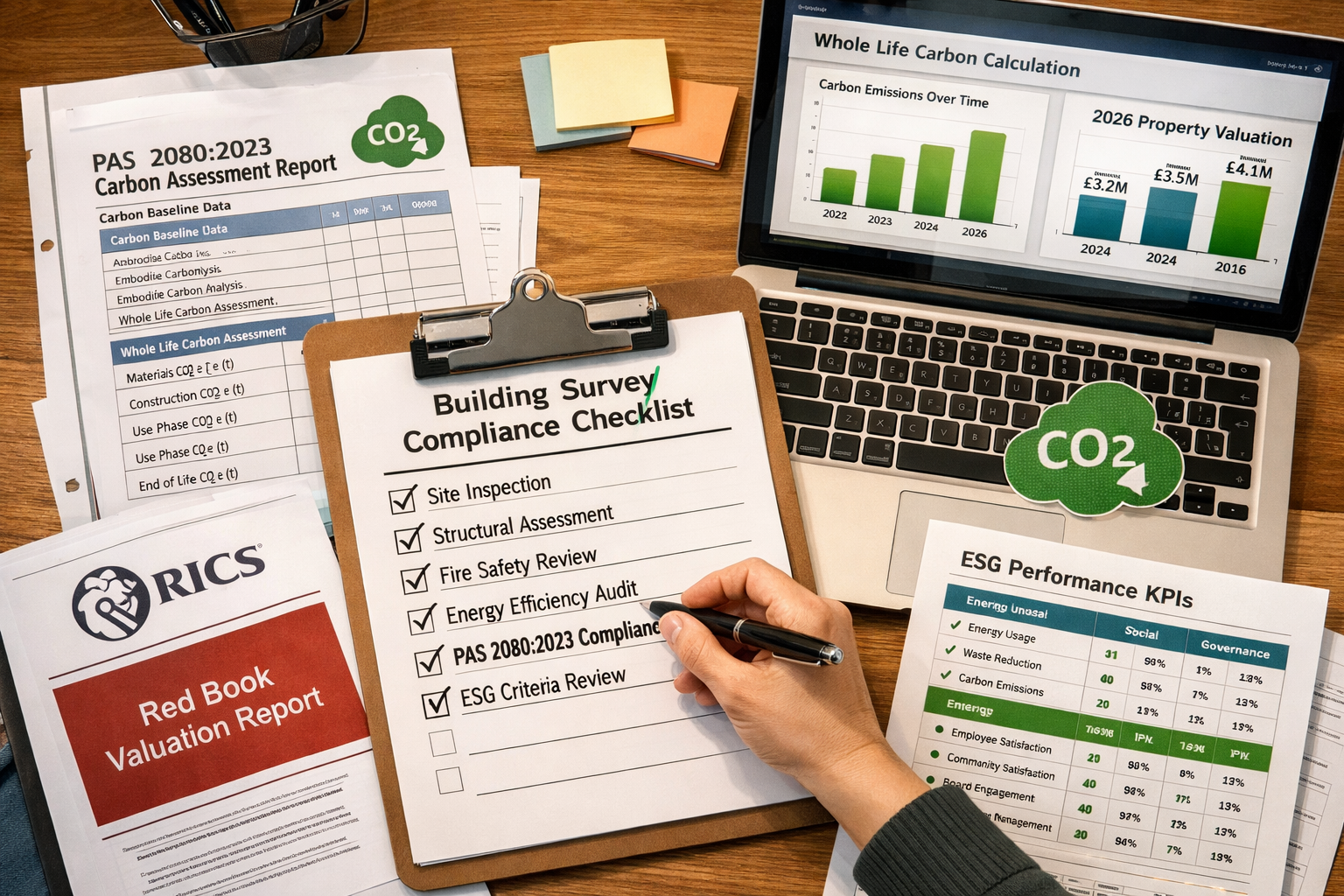
The following checklist supports surveyors in applying Whole Life Carbon Assessments in Building Surveys: RICS PAS 2080:2023 Compliance for 2026 Property Valuations across different instruction types.
🏗️ Pre-Survey Compliance Checklist
- Confirm instruction scope includes ESG/carbon assessment requirements
- Obtain existing carbon data, EPC ratings, and sustainability certifications (BREEAM, LEED, WELL)
- Review any net zero commitments or carbon reduction plans held by the client or occupier
- Identify applicable lifecycle modules under PAS 2080:2023 for the asset type
🔍 On-Site Inspection Checklist
- Assess building fabric thermal performance against current Part L standards
- Identify high embodied carbon materials (concrete, aluminium, certain plastics)
- Note age and efficiency of HVAC, lighting, and hot water systems
- Record renewable energy installations (solar PV, heat pumps, ASHP)
- Identify elements approaching end of life requiring replacement (carbon-generating maintenance cycles)
- Check for on-site EV charging infrastructure (increasingly a valuation factor)
📊 Reporting Checklist
- Quantify embodied and operational carbon estimates using recognised tools (e.g., One Click LCA, EC3)
- Reference PAS 2080:2023 lifecycle modules explicitly in the report
- State clearly where data is incomplete and the impact on carbon estimates
- Translate carbon liabilities into estimated capital expenditure
- Include ESG KPIs aligned with RICS global standard [1]
- Distinguish between current carbon risk (valuer role) and recommended improvements (adviser role) [3]
⚖️ Expert Witness and Specialist Reports
For specialist defect surveys or expert witness instructions, carbon assessment adds an additional layer of technical complexity. An expert witness report involving building defects may now need to address:
- Whether a defect has accelerated carbon emissions (e.g., failed insulation increasing heating demand)
- The whole life carbon cost of remediation versus demolition and rebuild
- Whether the defect represents a stranded asset risk under future carbon regulations
This is particularly relevant in dilapidations disputes, where the carbon performance of reinstatement works is becoming a legitimate point of contention.
ESG Carbon Risk and 2026 Property Valuations: What the Numbers Mean
The Financial Impact of Carbon Performance
The relationship between carbon performance and property value is no longer theoretical. In 2026, the evidence base is growing:
- Properties with EPC ratings of F or G face significantly reduced mortgage availability and buyer pools
- Green premiums of 5–15% have been observed on certified sustainable commercial assets in major UK markets [5]
- Brown discounts — value reductions applied to carbon-intensive or non-compliant assets — are increasingly being applied by institutional investors
- RICS guidance now provides practical guidance on cost assumptions in valuations, clarifying when and how capital and operational expenditure linked to ESG factors may be reflected [1]
For registered RICS valuers, this means that ignoring carbon performance in a 2026 valuation report carries professional risk. If a valuation fails to reflect a material ESG factor that subsequently affects value, the valuer may face negligence claims.
Valuation Factors Affected by Whole Life Carbon
The following property characteristics are now recognised as carbon-linked valuation factors:
| Factor | Carbon Relevance | Valuation Impact |
|---|---|---|
| EPC Rating | Operational carbon proxy | Direct yield and rent adjustment |
| Construction materials | Embodied carbon | Refurbishment cost liability |
| M&E system age/type | Operational carbon | CapEx requirement, stranded asset risk |
| Renewable energy assets | Carbon reduction | Green premium potential |
| Planning constraints on retrofit | Carbon reduction barrier | Increased liability, reduced value |
| Flood/climate risk | Physical climate risk | Insurance cost, capital value risk |
Understanding these valuation factors is essential for any property professional advising clients in 2026’s market.
Commercial Property: The Highest Stakes
For commercial property surveyors working on institutional assets, the stakes are particularly high. Major occupiers — particularly those with their own net zero commitments — are increasingly unwilling to lease space that does not meet minimum carbon performance thresholds. This creates a direct link between a building’s whole life carbon profile and its rental income security, which flows directly into capital value through yield calculations.
The RICS standard explicitly addresses this by requiring valuers to consider how ESG-related risks affect both the income and risk components of a valuation — not just as a qualitative footnote, but as a quantified adjustment. [2]
Whole Life Carbon Assessments in Building Surveys: RICS PAS 2080:2023 Compliance for 2026 Property Valuations — Common Challenges and How to Overcome Them
Challenge 1: Data Availability
Many existing buildings — particularly older stock — have limited or no carbon performance data. Solution: PAS 2080:2023 provides guidance on working with incomplete data, including the use of default values and sensitivity analysis. Surveyors should document data gaps clearly and quantify the uncertainty range in their reports.
Challenge 2: Skill Gaps
Not all surveyors have been trained in carbon accounting methodologies. Solution: RICS CPD requirements now include sustainability and ESG topics. Surveyors should consider specialist training in PAS 2080:2023 and carbon assessment tools. For complex instructions, collaboration with a specialist carbon consultant is appropriate and should be recommended to clients.
Challenge 3: Client Awareness
Many property owners and buyers remain unaware of carbon risk as a financial issue. Solution: Clear, accessible communication in survey reports is essential. Surveyors should translate carbon findings into financial terms — estimated retrofit costs, potential rental impact, stranded asset risk — rather than relying on technical carbon metrics alone. [6]
Challenge 4: Evolving Standards
PAS 2080:2023 is itself subject to ongoing development, and RICS guidance continues to evolve. Solution: Maintain active engagement with RICS updates, subscribe to BSI standards notifications, and ensure report templates are reviewed at least annually for compliance.
Conclusion: Actionable Next Steps for Surveyors and Property Professionals
Whole Life Carbon Assessments in Building Surveys: RICS PAS 2080:2023 Compliance for 2026 Property Valuations is not a future concern — it is a present professional obligation with real financial consequences for clients and practitioners alike.
The built environment’s carbon transition is accelerating, and 2026 marks a pivotal year in which ESG factors move from advisory guidance to embedded valuation methodology. [5] Surveyors and valuers who develop genuine competence in whole life carbon assessment will be better positioned to serve clients, manage professional risk, and contribute to a more sustainable property market.
✅ Actionable Next Steps
- Audit your current survey templates — do they capture carbon-relevant data at each inspection stage?
- Complete RICS-accredited CPD on ESG and sustainability in property valuation
- Familiarise yourself with PAS 2080:2023 — particularly the lifecycle module framework and carbon data hierarchy
- Build relationships with carbon consultants for complex commercial instructions
- Update client communication materials to explain carbon risk in accessible, financial terms
- Review your PI insurance to ensure coverage reflects expanded ESG reporting obligations
- Use the checklist above as a starting point for every building survey instruction in 2026
For clients navigating the complexity of carbon-compliant property transactions, working with experienced chartered surveyors who understand both the technical and financial dimensions of whole life carbon assessment is the most effective way to protect asset value and manage risk in 2026’s evolving market.
References
[1] Rics Publishes Updated Global Standard Esg Sustainability Commercial Property Valuation – rics.org
[2] Esg And Sustainability In Commercial Property Valuation – rics.org
[3] What Rics Updated Global Sustainability Standard Really Means For Property Values 133689 – bisnow.com
[4] Future Property Valuation Influence Esg Criteria Residential Buildings – rics.org
[5] Rics Verschaerft Immobilienbewertung Esg Wird Ab 2026 Wertrelevant – purpose-green.com
[6] Building Survey Quality Standards 2026 Navigating Rics Updates And Enhanced Home Inspection Requirements – https://nottinghillsurveyors.com/blog/building-survey-quality-standards-2026-navigating-rics-updates-and-enhanced-home-inspection-requirements
Related services from Canterbury Surveyors
- Building expert witness surveyors
- Dilapidations surveyors
- RICS property valuations
- RICS Homebuyer Surveys (Level 2)
Get a fixed-fee quote or call 0204 579 8270.