
Mandatory Biodiversity Net Gain requirements now apply to all major UK developments — and from November 2, 2026, they extend to Nationally Significant Infrastructure Projects (NSIPs) as well [8]. Yet one professional sits at a surprisingly underexamined crossroads of this ecological revolution: the party wall surveyor. As BNG reshapes how developers assess, protect, and enhance habitats, the boundary-level work carried out under the Party Wall etc. Act 1996 has become a critical — and often overlooked — compliance checkpoint.
Party Wall Surveyor Roles in Biodiversity Net Gain Projects: 2026 BNG Compliance and Award Clauses is no longer a niche topic. It sits at the intersection of property law, ecological science, and planning policy. Surveyors who understand this overlap can protect their clients, prevent costly disputes, and future-proof their professional practice.
Key Takeaways 📌
- 🌿 BNG is now mandatory for major UK developments, with NSIP compliance beginning November 2026, making ecological awareness essential for party wall surveyors.
- 📋 Party wall awards can — and should — include BNG-relevant clauses covering habitat protection, protected species, and boundary ecology.
- 🔍 Pre-construction ecological surveys near party wall boundaries are increasingly necessary to satisfy both the Party Wall Act and BNG obligations simultaneously.
- ⚠️ New 2026 exemptions and rule changes (small sites, temporary developments, self-build removal) directly affect how surveyors approach BNG documentation.
- 🤝 Collaboration between party wall surveyors and ecologists is becoming a professional best practice, not an optional extra.
What Is Biodiversity Net Gain and Why Does It Matter to Party Wall Surveyors?
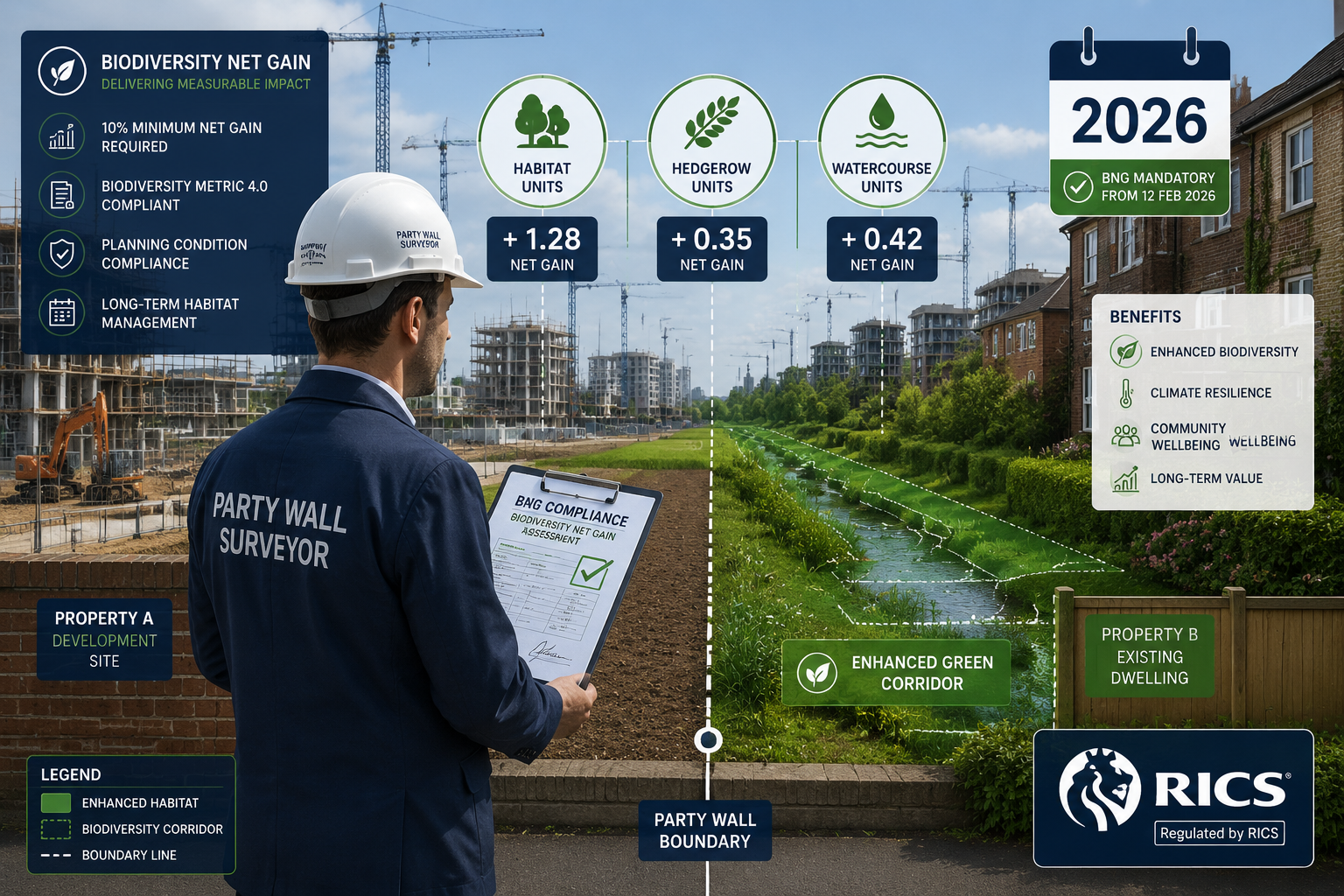
Biodiversity Net Gain (BNG) is a planning requirement that mandates developers leave the natural environment in a measurably better state than before construction began [9]. Under the Environment Act 2021, most major developments in England must deliver a minimum 10% net gain in biodiversity units, verified through the DEFRA Biodiversity Metric.
For most planning professionals, BNG sits firmly in the domain of ecologists and planning consultants. But party wall surveyors are increasingly finding themselves on the front line of BNG compliance — particularly on urban infill sites, terrace extensions, basement developments, and boundary-adjacent construction projects where habitats exist right at the party wall line.
The Boundary Ecology Problem
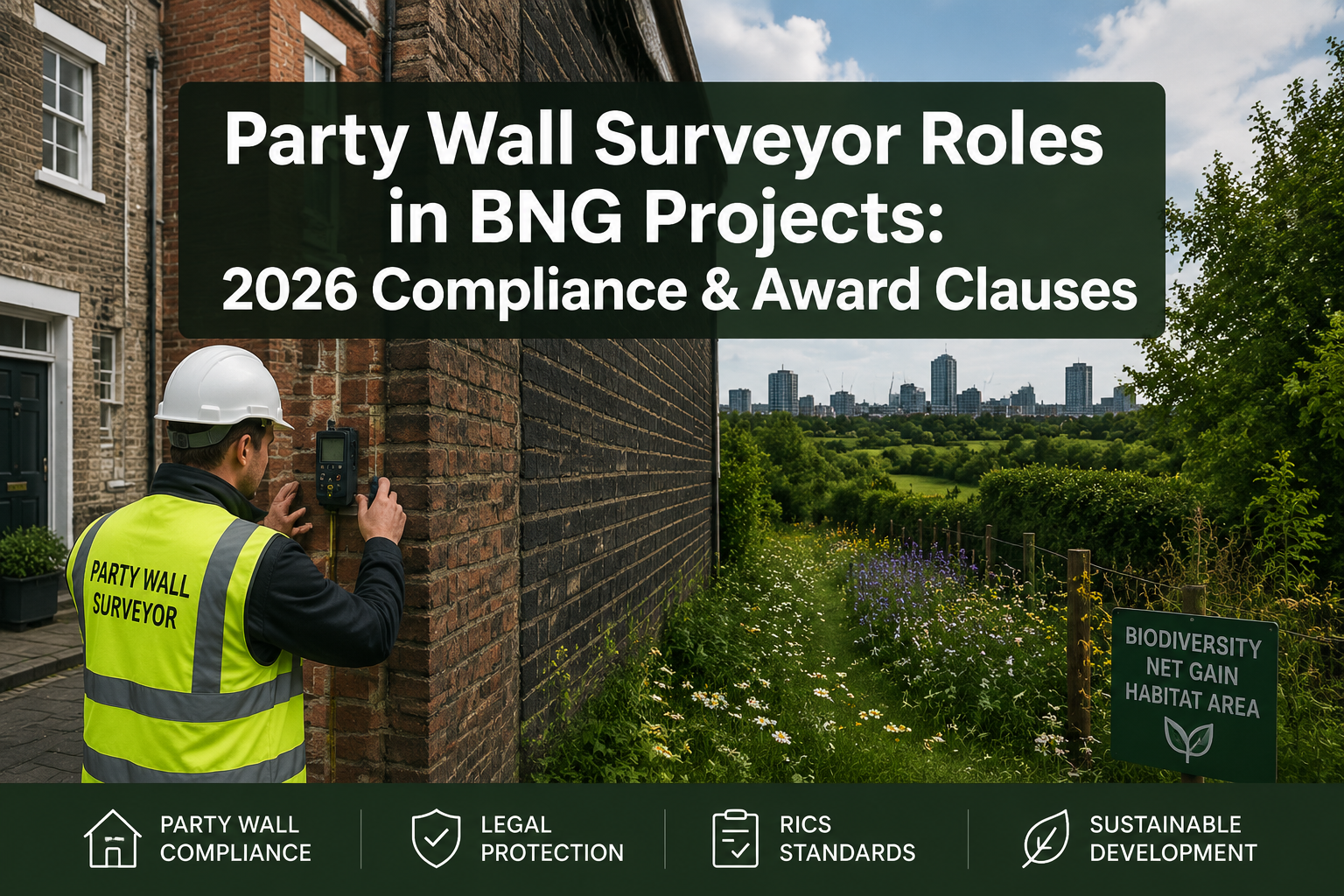
Party walls, garden fences, and boundary structures are often ecological corridors in urban environments. Hedgerows, mature trees, soil banks, and even gaps in brickwork can support protected species including bats, nesting birds, hedgehogs, and slow worms. When construction begins at or near these boundaries, the party wall surveyor's schedule of condition and award documentation becomes the first formal record of the pre-construction ecological baseline.
💬 "The party wall award is, in effect, a legally binding construction management document. In 2026, that document must increasingly reflect ecological as well as structural realities."
Understanding party wall procedures thoroughly is now inseparable from understanding the ecological context in which those walls exist.
2026 BNG Rule Changes: What Party Wall Surveyors Must Know
The regulatory landscape for BNG is shifting significantly in 2026. Several key changes directly affect how party wall surveyors should approach their work [4].
Key 2026 BNG Changes at a Glance
| Change | Date | Impact on Party Wall Work |
|---|---|---|
| BNG extended to NSIPs | 2 November 2026 | Large infrastructure projects near boundaries now require BNG compliance [8] |
| Small site exemption (≤0.2 ha) | By 31 July 2026 | Minor domestic works may be exempt — but boundary ecology still needs checking [4] |
| Temporary development exemption (≤5 years) | By 31 July 2026 | Short-term construction compounds near party walls may be exempt [4] |
| Self-build exemption removed | By 31 July 2026 | Self-build projects now require BNG — party wall surveyors on these jobs must adapt [4] |
| New online map-based metric tool | 2026 | Changes how habitat assessments are documented and shared [4] |
| Spatial risk reform | 2026 | Biodiversity units can be sourced from wider geographic areas [4] |
| Brownfield housing exemption (up to ~1.5 ha in practice) | Consultation ongoing | May reduce BNG burden on urban terrace/infill sites [4] |
The Self-Build Removal: A Significant Shift 🏗️
One of the most impactful 2026 changes for party wall surveyors is the removal of the self-build exemption [4]. Previously, self-build and custom build projects were exempt from BNG requirements. From July 31, 2026, this exemption disappears. Given that self-build projects frequently involve boundary works, extensions, and loft conversions — all classic party wall scenarios — surveyors working on these projects must now factor BNG compliance into their award conditions.
For guidance on party wall obligations in loft conversions, the party wall loft conversions guide provides useful context on how boundary-adjacent works are typically managed.
The NSIP Extension: Front-Loading Ecological Assessment
For large infrastructure projects, BNG will apply from November 2, 2026 [8]. This delayed implementation (originally planned for May 2026) means that pre-application biodiversity impact assessments must now be completed at an earlier stage. Where these projects involve party wall notices — common in linear infrastructure crossing urban boundaries — the ecological baseline established during the party wall process becomes a critical document.
Party Wall Surveyor Roles in Biodiversity Net Gain Projects: Integrating Ecology into Awards
This is where professional practice must evolve. Party Wall Surveyor Roles in Biodiversity Net Gain Projects: 2026 BNG Compliance and Award Clauses requires surveyors to think beyond structural protection and consider the ecological dimension of boundary works.
What Can Be Included in a Party Wall Award?
A party wall award is a legally binding document that governs how construction works are carried out. It can include:
- Method statements for works near ecologically sensitive boundary features
- Timing restrictions to avoid disturbance during nesting seasons (typically March–August)
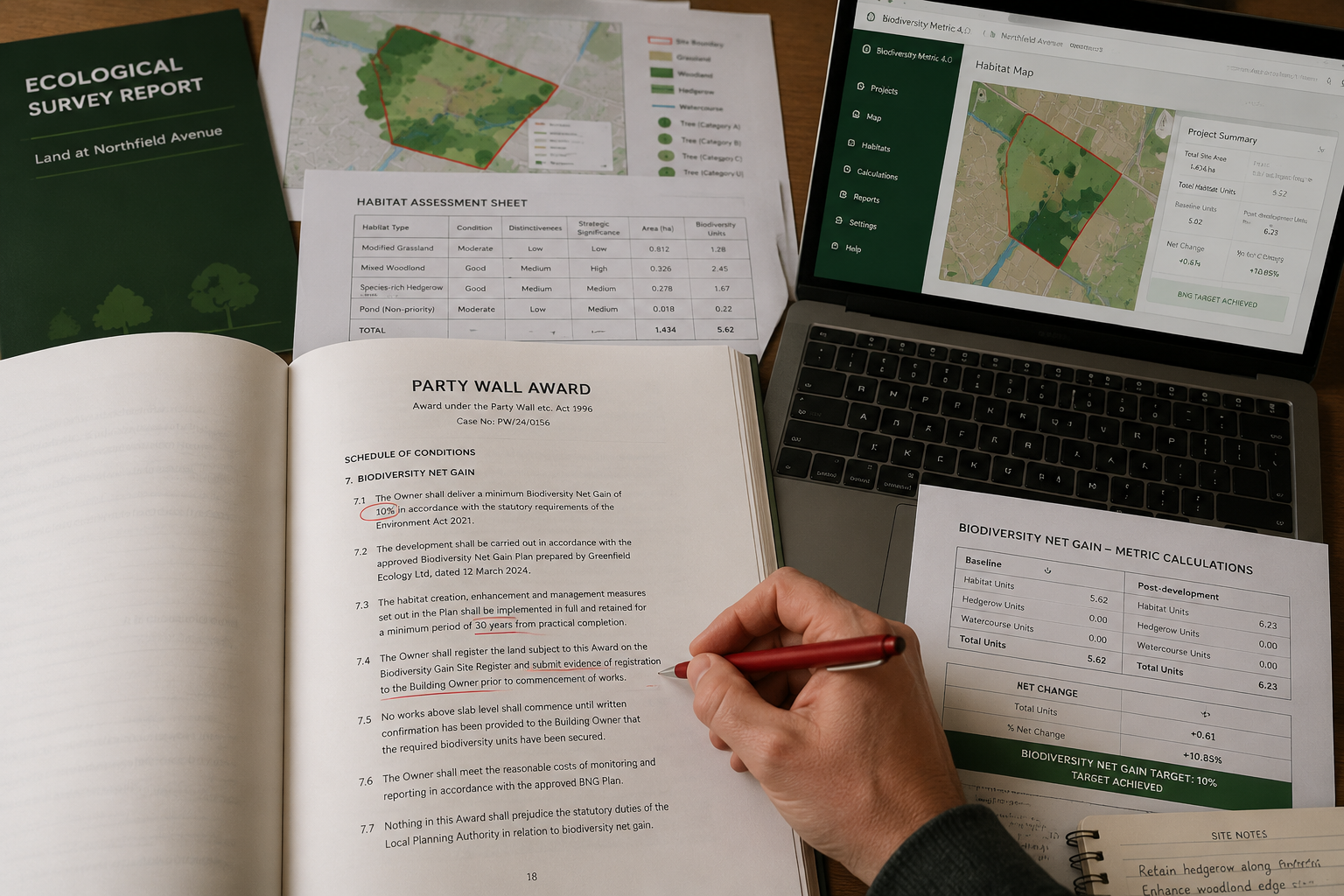
- Habitat protection clauses for hedgerows, mature trees, and soil structures at the boundary
- Ecological survey requirements before and after construction
- Reinstatement obligations for any boundary habitats disturbed during works
- Monitoring conditions tied to BNG metric compliance
💬 "A well-drafted party wall award in 2026 is not just a structural document — it is an ecological safeguard."
Practical Steps for Surveyors 🔍
1. Pre-Award Ecological Screening
Before drafting an award, surveyors should consider whether the boundary area contains habitats or features of ecological value. This doesn't require a full ecological survey in every case, but a preliminary desktop assessment using the new online map-based BNG tool [4] can flag potential issues early.
2. Coordinate with the Planning Ecologist
Where a BNG plan has been submitted as part of the planning application, party wall surveyors should request a copy. The biodiversity metric baseline established in that plan may identify boundary habitats that must be protected during construction.
3. Schedule of Condition: Ecological Baseline
The schedule of condition — a standard party wall document — can be expanded to include photographic and written records of boundary ecology. This creates a defensible baseline if disputes arise about habitat damage. For context on how damage to property in party wall cases is typically handled, ecological damage is increasingly being treated as a parallel concern.
4. Award Clauses for Protected Species
If bats, nesting birds, or other protected species are identified at or near the boundary, the award must include appropriate protective clauses. Failure to do so can expose both the building owner and the surveyor to legal liability under the Wildlife and Countryside Act 1981 and the Conservation of Habitats Regulations 2017.
5. Post-Construction Verification
Awards can require the building owner to provide post-construction ecological verification — confirming that boundary habitats have been reinstated to at least their pre-construction condition, consistent with BNG obligations.
Dispute Prevention: BNG Clauses as a Conflict Resolution Tool
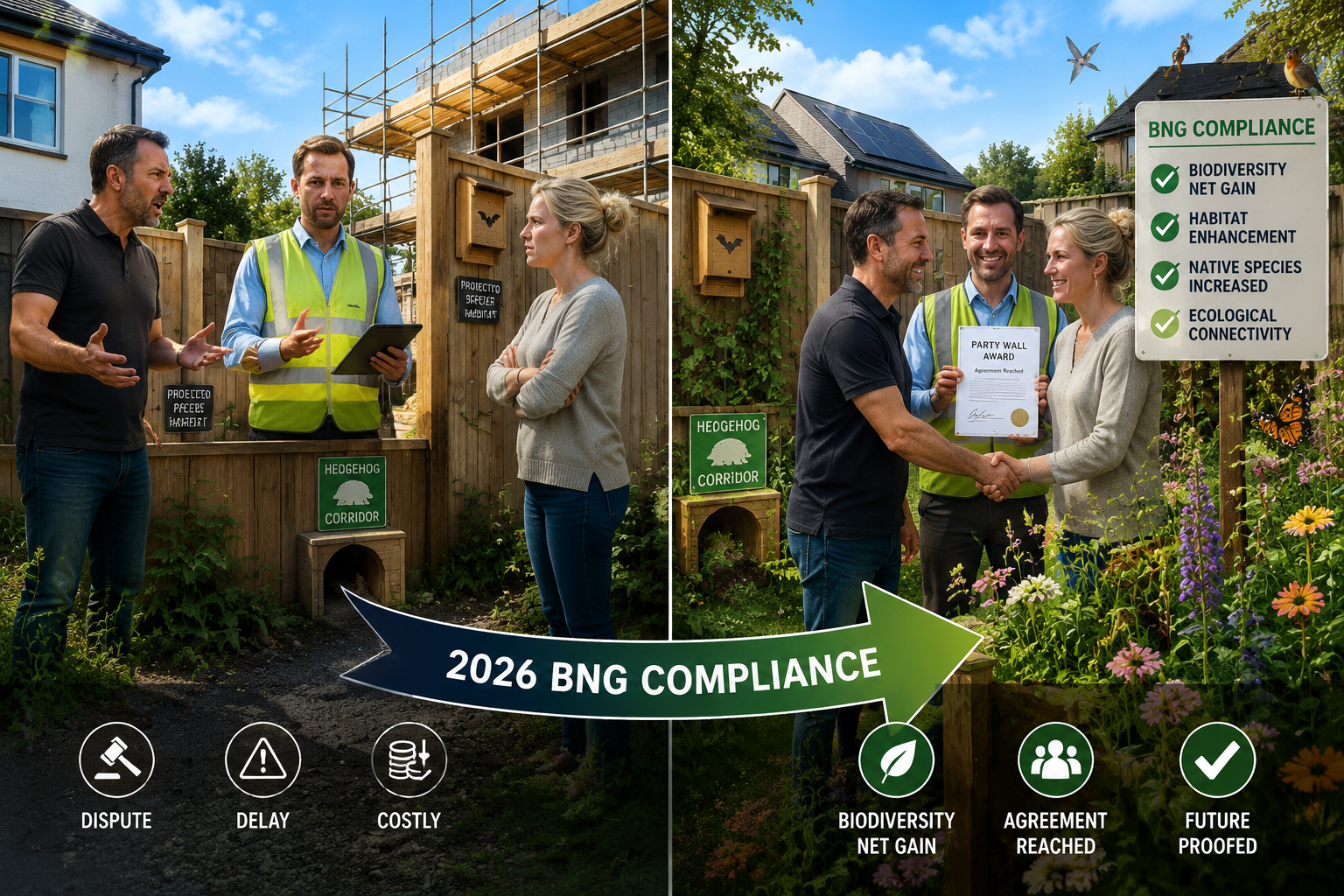
One of the most valuable — and underutilised — aspects of party wall awards in a BNG context is their dispute prevention function. Ecological disputes between neighbours are becoming more common as BNG awareness grows. Adjoining owners increasingly understand that boundary habitats have measurable value under the biodiversity metric system.
Common Ecological Disputes at Boundaries
- 🌳 Tree and hedge removal during construction, reducing biodiversity units
- 🦇 Disturbance to bat roosts in party walls or boundary structures
- 🐦 Destruction of nesting bird habitats in boundary vegetation
- 🌱 Soil compaction and contamination of boundary planting areas
- 💧 Drainage alterations affecting boundary watercourses or wetland habitats
Party wall surveyors are well-positioned to address all of these through proactive award drafting. When an adjoining owner raises ecological concerns — for example, about a hedgerow at the boundary — the surveyor has the authority to include protective conditions in the award, even if the building owner objects.
Obstruction and Ecological Refusal
It is worth noting that adjoining owners sometimes attempt to use ecological arguments to obstruct legitimate party wall works. Surveyors should be aware of the legal boundaries here. As explored in guidance on obstruction in party wall cases, ecological concerns can be a valid reason to modify an award's conditions, but they cannot be used to prevent works that are otherwise lawful under the Party Wall etc. Act 1996.
The surveyor's role is to balance ecological protection with the building owner's statutory rights — a genuinely complex professional judgment in 2026.
Competency Requirements: What Party Wall Surveyors Need to Know
The expanding scope of party wall surveyor roles in BNG projects raises important questions about professional competency. RICS guidance emphasises that surveyors should only act within their areas of competence. This creates a practical challenge: most party wall surveyors are not trained ecologists.
The Collaborative Model
The emerging best practice is a collaborative model in which:
- The party wall surveyor identifies potential ecological issues and includes protective clauses in the award
- A qualified ecologist (often already engaged by the developer for BNG purposes) provides specialist input on habitat assessment and protected species
- The award document reflects both structural and ecological conditions, with clear obligations on the building owner
This model does not require party wall surveyors to become ecologists. It requires them to recognise ecological risk, ask the right questions, and draft awards that reflect the full range of relevant obligations.
Professional Development Considerations
Surveyors working on projects where BNG is likely to be relevant should consider:
- Familiarising themselves with the DEFRA Biodiversity Metric and the new online map-based tool [4]
- Understanding the basic categories of habitats and protected species relevant to urban boundary environments
- Building relationships with local ecological consultants who can provide rapid pre-award screening
For surveyors looking to understand broader party wall costs and how additional ecological work affects fee structures, it is worth noting that BNG-related award drafting may justify additional professional time — and clients should be advised accordingly.
Practical Checklist: BNG-Ready Party Wall Awards in 2026 ✅
Use this checklist when preparing party wall awards on projects where BNG may be relevant:
- Confirm whether the development requires BNG compliance (check exemptions: small site ≤0.2 ha, temporary ≤5 years, brownfield housing consultation outcome) [4]
- Request the developer's BNG plan and biodiversity metric baseline document
- Review the schedule of condition for ecological features at the boundary
- Check for protected species — consult local ecological records or request a preliminary ecological appraisal
- Include timing restrictions for works near nesting habitats (March–August)
- Draft habitat protection clauses for hedgerows, trees, and soil structures
- Include reinstatement obligations for any boundary ecology disturbed during works
- Consider post-construction verification requirements
- Coordinate with the planning ecologist if one has been appointed
- Document all ecological decisions in the award preamble for transparency
The Three-Metre Rule and Ecological Sensitivity Zones
An often-overlooked connection exists between the three-metre rule under the Party Wall etc. Act and BNG ecological buffer zones. The Act's provisions relating to excavation within three metres of an adjoining owner's structure see the guide on the three-metre rule frequently coincide with the ecological sensitivity zones identified in BNG assessments.
Root protection areas for trees, bat foraging corridors, and hedgerow buffer zones often fall within the same three-metre zone that triggers party wall obligations. This spatial overlap means that a single well-drafted party wall award can simultaneously address structural, legal, and ecological concerns — reducing the administrative burden on developers and providing stronger protection for adjoining owners and the natural environment alike.
Conclusion: Acting Now for 2026 BNG Compliance
The integration of biodiversity net gain requirements into party wall practice is not a future possibility — it is a 2026 reality. With BNG mandatory for major developments, extended to NSIPs from November 2026, and the self-build exemption removed from July 2026, party wall surveyors across England face a professional landscape that demands ecological awareness alongside structural expertise [4][8].
Actionable Next Steps for Party Wall Surveyors:
- Review your standard award templates and identify where BNG-relevant clauses can be incorporated
- Build an ecological network — identify local ecological consultants you can refer clients to or collaborate with on complex projects
- Stay current on 2026 exemption thresholds — the small site (≤0.2 ha) and temporary development exemptions will affect the majority of domestic party wall cases
- Educate your clients — building owners and adjoining owners alike benefit from understanding that ecological protection is now a standard part of the party wall process
- Document everything — in a world where biodiversity units have measurable financial value, the ecological baseline established in a party wall schedule of condition may have significant legal and financial implications
For those seeking expert party wall support that keeps pace with 2026 regulatory changes, working with experienced chartered surveyors who understand both the legal and ecological dimensions of boundary works is the most effective way to ensure full compliance and dispute prevention.
The party wall surveyor who masters BNG compliance and award clauses in 2026 is not just protecting structures — they are protecting the ecological fabric of the built environment, one boundary at a time. 🌿
References
[1] Watch – https://www.youtube.com/watch?v=lucVHr-5MBE
[2] Biodiversity Net Gain – https://oneclicklca.com/en/resources/articles/biodiversity-net-gain/
[3] Watch – https://www.youtube.com/watch?v=kSrtveWTmDc
[4] Biodiversity Net Gain Changes 2026 – https://www.biodiverseconsulting.co.uk/post/biodiversity-net-gain-changes-2026
[5] Biodiversity Net Gain For Nationally Significant Infrastructure Projects – https://www.gov.uk/government/consultations/biodiversity-net-gain-for-nationally-significant-infrastructure-projects
[6] Party Wall Surveyor – https://bebee.com/gb/jobs/role/party-wall-surveyor
[7] Offsen Final Consultation on BNG for NSIPs May 2025 – https://consult.defra.gov.uk/biodiversity-net-gain/biodiversity-net-gain-for-nationally-significant-i/supporting_documents/OFFSEN%20FINAL%20Consultation%20on%20BNG%20for%20NSIPs%20%20May%202025.pdf
[8] Biodiversity Net Gain Requirements Extended Nov 2026 – https://www.pinsentmasons.com/out-law/news/biodiversity-net-gain-requirements-extended-nov-2026
[9] Biodiversity Net Gain – https://www.gov.uk/guidance/biodiversity-net-gain