
UK retrofit disputes have surged by over 40% since 2023, with claimants increasingly citing substandard insulation, failed EPC upgrades, and missed carbon targets as grounds for compensation. As the UK's net zero deadlines press closer, the question is no longer whether disputes will arise — it is whether the expert witnesses handling them are equipped to quantify the financial damage accurately. Expert Witness Protocols for Net Zero Retrofit Disputes: Valuing Carbon Compliance Failures in 2026 has become one of the most technically demanding areas of property litigation, sitting at the crossroads of building science, carbon accounting, and RICS-compliant valuation.
Key Takeaways 📋
- Retrofit disputes are rising fast — energy transition litigation is among the fastest-growing categories in UK property law in 2026 [2].
- Expert witnesses must be independent — overriding duty is to the court, not the instructing party, under Civil Procedure Rules Part 35.
- Diminution in value is the core metric — quantifying how carbon compliance failures reduce a property's market value requires RICS Red Book methodology.
- EPC ratings directly affect mortgage lending and saleability — a property stuck at EPC band E or below faces measurable financial penalties.
- RICS-compliant report structures are essential for expert evidence to be admissible and persuasive in tribunal or court settings.
Why Net Zero Retrofit Disputes Are Exploding in 2026
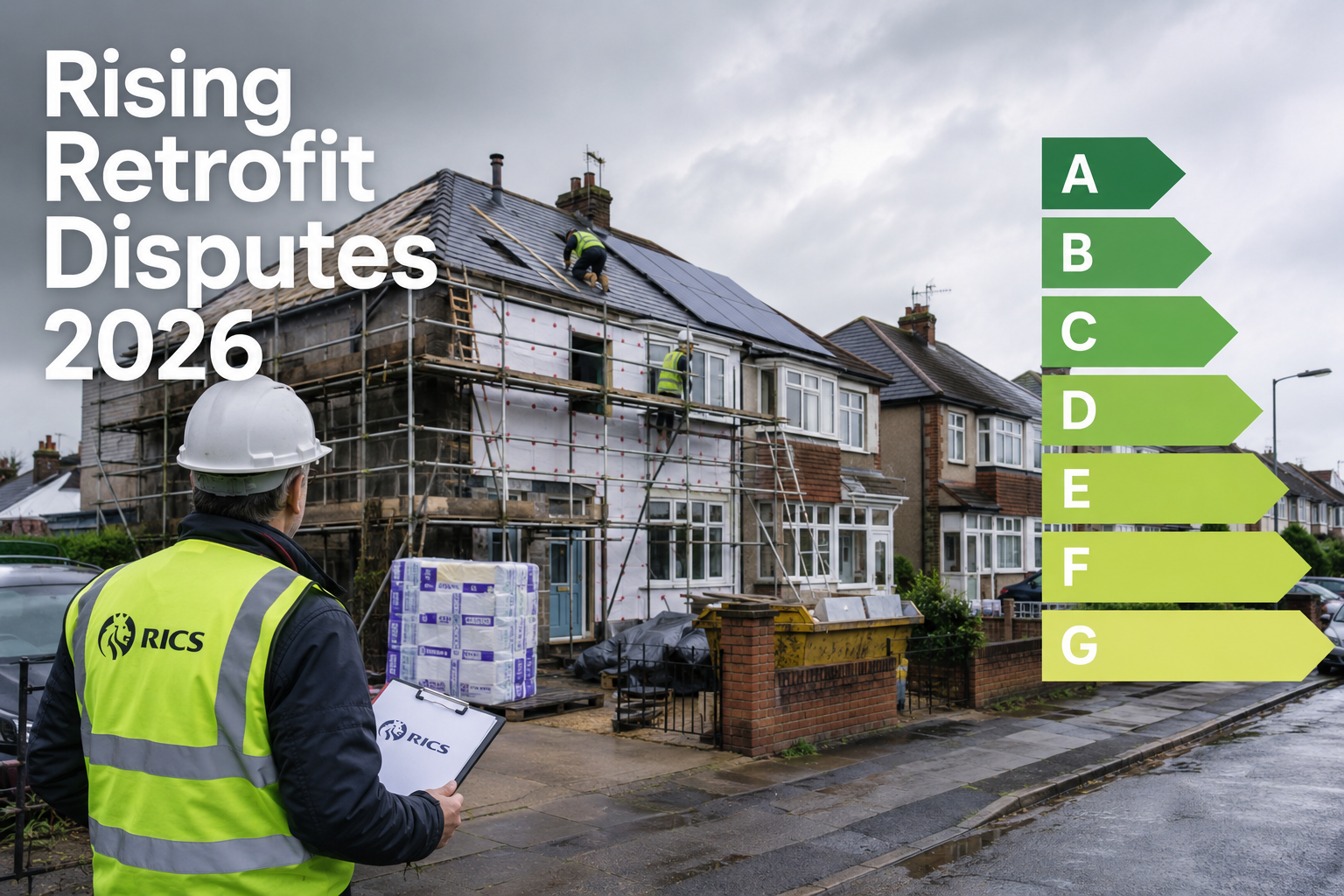
The UK government's push toward net zero has placed enormous pressure on property owners, landlords, and contractors to upgrade buildings to meet minimum energy performance standards. The Energy Security and Net Zero (ESNZ) Committee's inquiry into heating homes found that millions of UK properties remain poorly insulated, with heat pump installations and solid wall insulation programmes frequently falling short of promised outcomes [6].
When a retrofit fails — whether due to poor workmanship, incorrect specification, or outright misrepresentation — the consequences are financial and measurable:
- Lower EPC ratings than contracted, reducing rental eligibility and resale value
- Higher energy bills than projected, creating ongoing loss claims
- Carbon penalty exposure for commercial landlords under MEES (Minimum Energy Efficiency Standards)
- Mortgage lender restrictions on properties below EPC band C
The Vinson & Elkins Disputes Rising report (February 2026) identifies energy transition disputes — including retrofit failures — as one of the fastest-growing categories in international arbitration and litigation [2]. In the UK domestic context, this translates directly into a surge of county court claims, RICS adjudications, and Technology and Construction Court (TCC) proceedings.
💬 "The energy transition is generating a new class of technical dispute that demands expert witnesses with dual competence: engineering knowledge and valuation expertise." [2]
Disputes commonly arise from:
| Dispute Type | Common Cause | Typical Claimant |
|---|---|---|
| EPC under-delivery | Poor insulation installation | Landlord / homeowner |
| Heat pump underperformance | Incorrect sizing or commissioning | Residential buyer |
| Solar PV output shortfall | Shading miscalculation | Commercial property owner |
| Whole-house retrofit failure | Design and coordination errors | Housing association |
| MEES non-compliance | Contractor misrepresentation | Buy-to-let investor |
For landlords and investors, the stakes are especially high. Properties that fail to reach EPC band E (or band C under proposed future rules) cannot be legally let, creating an immediate income loss that must be quantified by a qualified expert.
Expert Witness Protocols for Net Zero Retrofit Disputes: Valuing Carbon Compliance Failures in 2026 — The Legal Framework
The Expert's Overriding Duty
Under Civil Procedure Rules (CPR) Part 35, an expert witness's primary duty is to the court — not to the party that instructed them. This principle is non-negotiable and forms the bedrock of all credible expert evidence in retrofit disputes [4].
Pinsent Masons' guidance on expert witness duties in construction disputes makes clear that experts must:
- Provide objective, unbiased opinions based on their area of expertise
- Confirm in their report that they understand their duty to the court
- Disclose any conflict of interest at the earliest opportunity
- Distinguish clearly between fact and opinion in their reports [4]
In net zero retrofit cases, this independence is particularly important because many experts are also active in the retrofit industry. An expert who has previously worked with the defendant contractor, or who holds commercial interests in specific insulation products, risks having their evidence excluded or heavily discounted.
Tribunal Expectations for Technical Experts
DAC Consulting Services, specialists in expert witness work for energy and industrial projects, highlight that tribunals increasingly expect technical experts to demonstrate [1]:
- Methodological transparency — showing exactly how conclusions were reached
- Peer-reviewed or industry-standard references — citing RICS guidance, ISO standards, or CIBSE methodology
- Quantified uncertainty — acknowledging the margin of error in any projection
- Responsiveness to the single joint expert model — being willing to produce a joint statement identifying agreed and disputed issues
For net zero retrofit disputes specifically, the expert must be able to translate technical findings (e.g., a U-value measurement of 0.45 W/m²K against a specified 0.18 W/m²K) into financial terms that a judge or arbitrator without a building physics background can understand.
RICS Compliance and the Red Book
Valuation evidence in retrofit disputes must follow RICS Valuation — Global Standards (the Red Book). A Red Book valuation provides the methodological rigour that courts expect when assessing diminution in value claims.
The key valuation approaches used in retrofit disputes are:
- Comparable sales analysis — comparing EPC-matched properties to establish value differential
- Income approach — for investment properties, calculating lost rental income due to MEES non-compliance
- Cost approach — quantifying the reasonable cost to remediate the defective retrofit to the contracted standard
An expert witness surveyor must be able to deploy all three approaches and justify which is most appropriate for the specific dispute.
How to Structure an Expert Witness Report for Carbon Compliance Failures
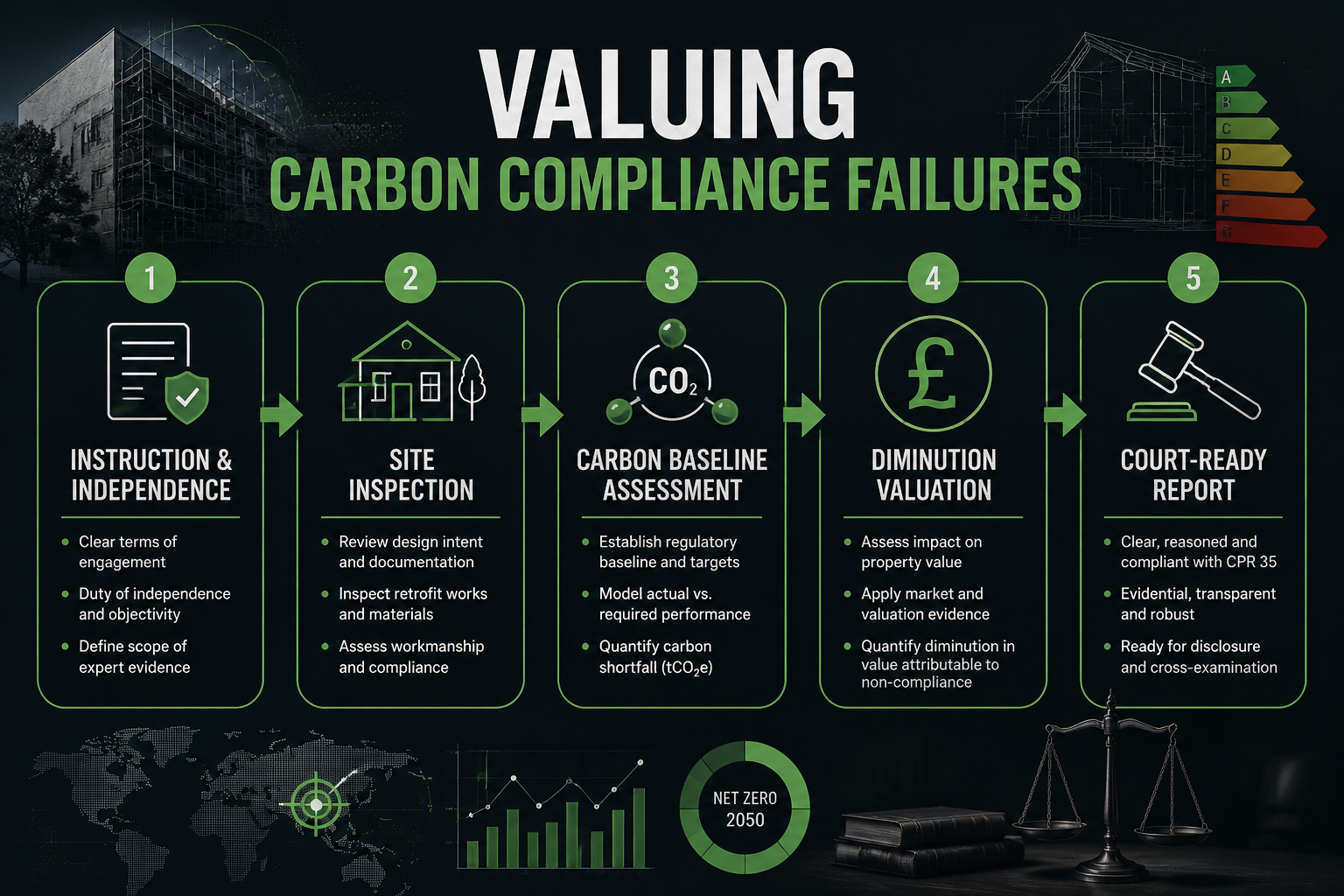
Section-by-Section Report Structure
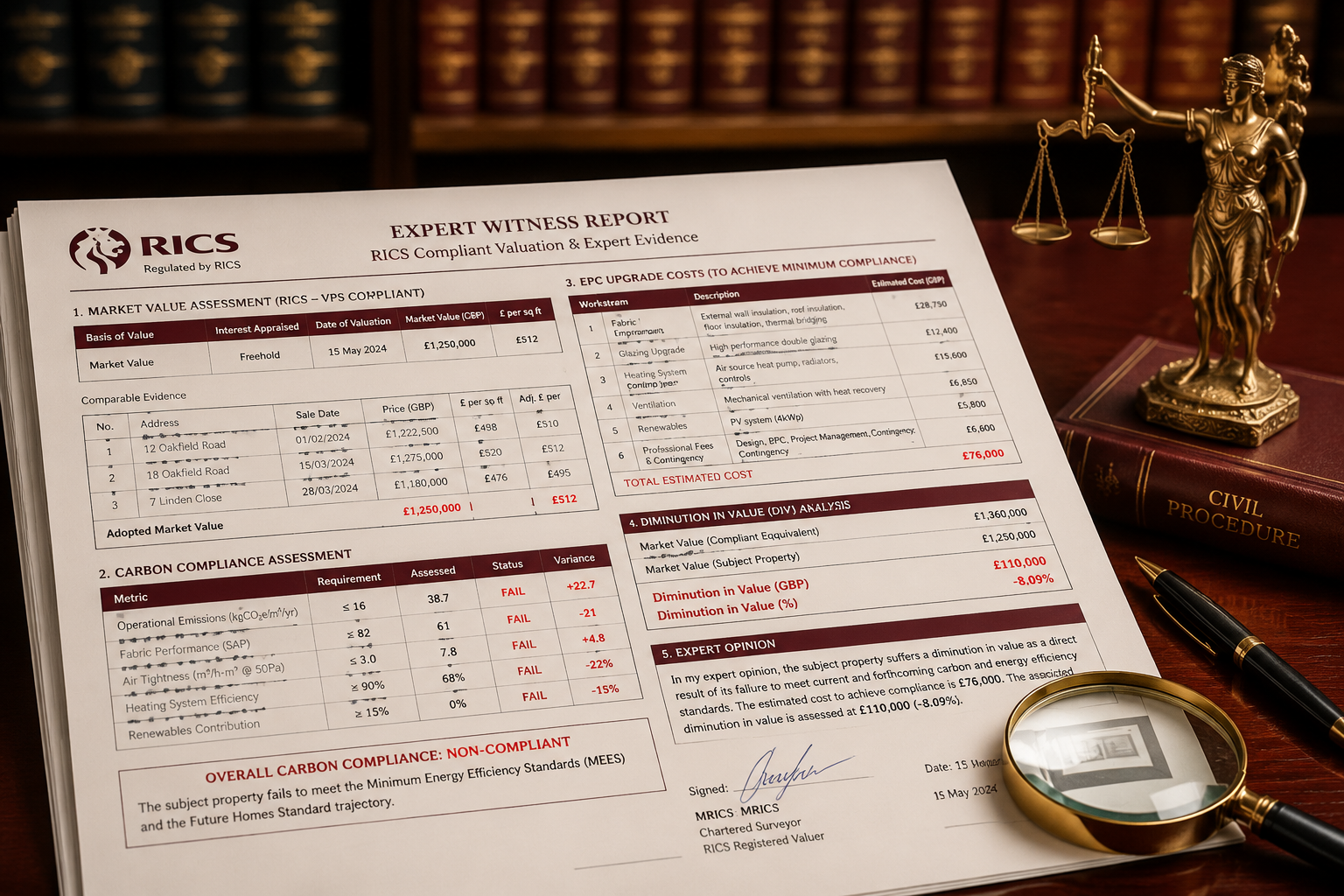
A court-ready expert witness report for a net zero retrofit dispute should follow this structure:
1. Introduction and Instructions
State who instructed the expert, the questions to be answered, and the documents reviewed. Confirm independence and compliance with CPR Part 35.
2. Expert's Qualifications
Demonstrate dual competence: building surveying or engineering credentials plus valuation experience. RICS membership (MRICS or FRICS) is the standard benchmark.
3. Site Inspection Findings
Document the as-built condition of the retrofit works. Use thermal imaging, air permeability test results, and U-value calculations where available. A thorough structural survey of the building fabric may be needed to assess whether retrofit works have caused secondary defects such as damp or condensation.
4. Carbon Baseline and Compliance Assessment
Compare the property's actual post-retrofit EPC rating and carbon emissions against the contracted specification. Reference the GHG Protocol or ISO Net Zero standards where relevant [7]. The expert should calculate:
- Actual vs. projected Energy Performance Certificate band
- Actual vs. projected carbon emissions (kgCO₂/m²/year)
- Shortfall in energy savings (kWh/year)
5. Quantifying Diminution in Value
This is the most critical section. The expert must establish:
💬 "The difference between what the property is worth with the defective retrofit in place, and what it would have been worth had the works been completed to the contracted standard."
Key factors affecting diminution in value include:
- EPC band differential — research consistently shows EPC band C properties command a 5–10% premium over band E equivalents in comparable markets
- MEES compliance risk — for investment properties, the inability to let legally creates a calculable income loss
- Remediation cost — the reasonable cost to bring works up to standard, supported by contractor quotes
- Stigma discount — where a property has a documented retrofit failure, some markets apply an additional discount beyond remediation cost
A commercial property valuation may be needed where the dispute involves offices, retail units, or industrial premises subject to MEES.
6. Causation Analysis
The expert must link the financial loss directly to the specific defect. This requires ruling out alternative causes (e.g., pre-existing damp, occupant behaviour) and demonstrating that the contractor's failure was the proximate cause of the EPC shortfall.
7. Conclusion and Declaration
Summarise findings in plain language. Include the CPR Part 35 declaration of independence. Sign and date.
Common Pitfalls to Avoid ⚠️
- Advocacy creep — subtly favouring the instructing party's position undermines credibility
- Unsupported projections — energy savings estimates must be based on SAP calculations or PHPP modelling, not guesswork
- Ignoring the joint statement process — failing to engage constructively with the opposing expert's report can damage the expert's standing with the court
- Conflating cost and value — the cost to remediate is not automatically equal to the diminution in value; both must be separately assessed
Valuing Specific Carbon Compliance Failures: Practical Examples
Example 1: External Wall Insulation (EWI) Underperformance
A landlord contracts for EWI to bring a Victorian terrace from EPC band F to band C. The installed system achieves band E. The property cannot be legally let under current MEES rules.
The expert's valuation task:
- Calculate lost rental income for the period of non-compliance
- Estimate cost to remediate (strip and replace EWI system)
- Assess whether the property value is diminished beyond remediation cost due to stigma
A dilapidations survey may also be relevant if the EWI installation caused damage to the existing building fabric.
Example 2: Heat Pump Misspecification
A homebuyer is sold a property with a newly installed air source heat pump (ASHP) warranted to meet EPC band B. Post-completion testing shows the system is undersized, achieving band D. The buyer's mortgage lender has placed a retention on the property pending resolution.
The expert must:
- Quantify the value impact of the mortgage lender restriction
- Calculate the cost to upsize or replace the ASHP
- Assess any secondary damage (e.g., damp from inadequate heat distribution)
For disputes involving shared walls or party structures affected by retrofit works, a party wall surveyor may need to be involved alongside the energy expert.
Example 3: Whole-House Retrofit Coordination Failure
A housing association commissions a whole-house retrofit programme across 200 units. The principal contractor fails to coordinate insulation, ventilation, and heating upgrades, resulting in widespread condensation and mould. EPC ratings are lower than specified across the portfolio.
This is a complex multi-party dispute requiring:
- A lead expert witness with project management expertise to assess coordination failures
- A valuation expert to quantify portfolio-level diminution in value
- Potentially a project management specialist to assess whether the contractor's programme was adequately resourced
The Sustainable Atlas 2026 Retrofit Trend Watch notes that whole-house retrofit coordination failures are emerging as a significant risk category, with poorly sequenced works creating building physics problems that outweigh the energy benefits [8].
The Evolving Standards Landscape in 2026
Carbon accounting standards are themselves in flux, adding complexity to expert witness work. The GHG Protocol — the most widely used framework for measuring carbon emissions — is currently under revision, with stakeholder engagement highlighting significant disagreements about scope 3 emissions boundaries and building lifecycle accounting [3].
ISO's Net Zero guidelines provide a parallel framework that some expert witnesses are beginning to reference in their reports [7]. However, courts and tribunals have not yet settled on a single preferred standard for building-level carbon compliance assessment.
Practical implication: Expert witnesses should:
- State clearly which standard they are applying and why
- Acknowledge where standards are contested or evolving
- Avoid presenting any single framework as definitively authoritative
The Parliamentary ESNZ Committee's evidence sessions on heating homes highlighted the gap between government retrofit targets and on-the-ground delivery capacity [5], a gap that is directly generating the disputes that expert witnesses are now being asked to resolve.
Conclusion: Actionable Next Steps for Expert Witnesses and Instructing Solicitors
Expert Witness Protocols for Net Zero Retrofit Disputes: Valuing Carbon Compliance Failures in 2026 demands a new kind of professional — one who combines building physics literacy, RICS valuation rigour, and courtroom credibility. As retrofit disputes continue to rise, the quality of expert evidence will determine outcomes for landlords, homeowners, contractors, and housing associations alike.
Actionable Next Steps ✅
-
Instructing solicitors: Appoint experts with demonstrable dual competence in energy performance assessment and RICS-compliant valuation. Check for conflicts of interest before instruction.
-
Expert witnesses: Invest in CPD covering SAP/EPC methodology, GHG Protocol updates, and the evolving MEES regulatory framework. Ensure your report structure complies with CPR Part 35.
-
Property owners and landlords: Commission a RICS building survey before and after any major retrofit works to create a documented baseline — essential evidence if a dispute arises.
-
Housing associations and developers: Engage project management oversight for large retrofit programmes to reduce coordination failure risk and create contemporaneous records.
-
All parties: Engage early with the joint expert statement process. Disputes that narrow the issues through expert agreement are resolved faster and at lower cost.
The retrofit revolution is creating real financial winners and losers. Expert witnesses who master the protocols outlined above will be indispensable in ensuring that justice — and accurate valuation — prevails.
References
[1] Expert Witness Consulting For Renewable Energy And Industrial Projects What Tribunals Expect From Technical Experts – https://www.dac-consultingservices.co.uk/expert-witness-consulting-for-renewable-energy-and-industrial-projects-what-tribunals-expect-from-technical-experts
[2] Vinson Elkins Disputes Rising Report – https://www.velaw.com/wp-content/uploads/2026/02/Vinson-Elkins-Disputes-Rising-Report.pdf
[3] Revising The Greenhouse Gas Protocol Insights From An Expert Stakeholder Engagement – https://www.energypolicy.columbia.edu/publications/revising-the-greenhouse-gas-protocol-insights-from-an-expert-stakeholder-engagement/
[4] Expert Witness Duties In Construction Disputes – https://www.pinsentmasons.com/out-law/guides/expert-witness-duties-in-construction-disputes
[5] committees.parliament.uk – https://committees.parliament.uk/oralevidence/15095/pdf/
[6] Esnz Committee Heating Our Homes Inquiry Final Report – https://ukgbc.org/wp-content/uploads/2024/12/ESNZ-committee-heating-our-homes-inquiry-final-report.pdf
[7] Netzero – https://www.iso.org/netzero
[8] Trend Watch Net Zero Buildings Retrofits In 2026 Signals Winners And Red Flags 2583 – https://sustainableatlas.org/post/trend-watch-net-zero-buildings-retrofits-in-2026-signals-winners-and-red-flags-2583