

More than 300,000 loft conversions are carried out across England and Wales each year, and a significant share of those projects sit within terraced housing stock where every structural decision affects a shared wall. For homeowners in these space-starved properties, understanding Party Wall Awards for Loft Conversions in Terraced Houses: 2026 Essentials for Structural Works is not optional — it is the difference between a smooth build and a costly legal standstill. The Party Wall etc. Act 1996 governs almost every load-bearing intervention that touches a shared boundary, and in 2026, updated RICS protocols have sharpened the obligations on building owners and their surveyors alike [5].
Key Takeaways
- The Party Wall etc. Act 1996 applies to most structural loft conversion works in terraced houses, including beam insertions, wall raising, and chimney alterations.
- A Party Wall Notice must be served at least two months before work begins on a shared wall; failure to do so risks injunctions and project delays of three to six weeks.
- If a neighbour dissents, both parties appoint surveyors and a formal Party Wall Award is produced — the building owner typically pays both surveyors' fees.
- A Schedule of Condition should be prepared before work starts to protect both parties in any future dispute about damage.
- In 2026, RICS 8th Edition guidance places greater emphasis on vibration monitoring and structural notifiability assessments for loft conversion projects.
Why Terraced Houses Face Unique Party Wall Challenges
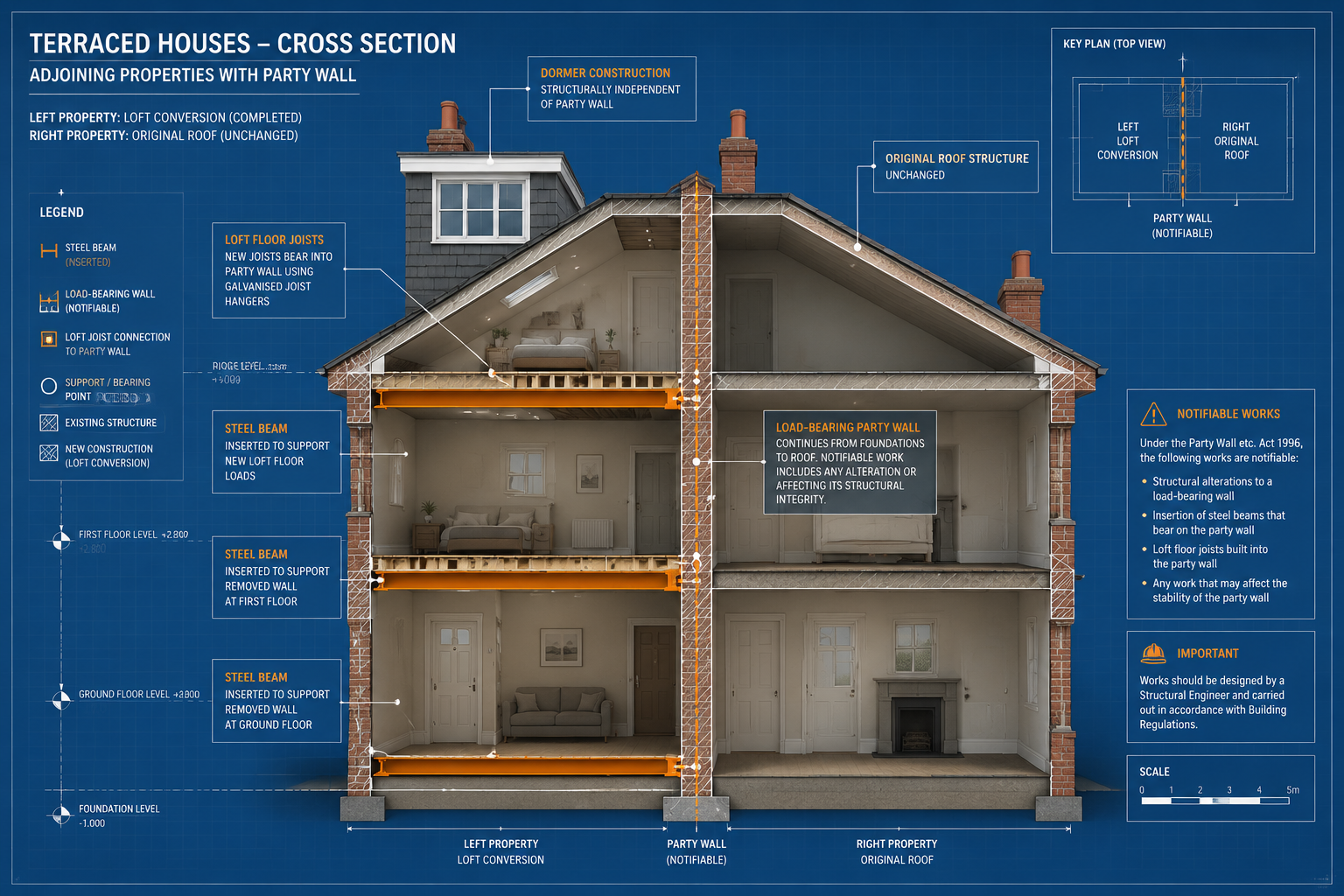
Terraced houses share at least one — and often two — party walls with neighbouring properties. Unlike detached or semi-detached homes, a terrace creates a continuous structural chain. Any alteration to one property's roof or upper floor can transmit loads, vibrations, and movement directly into the adjoining home.
The most common structural tasks in a terraced loft conversion include:
- Inserting steel beams (RSJs) into the party wall to carry the new loft floor or ridge beam
- Raising the party wall to support a mansard or dormer roof structure
- Cutting into or removing part of a shared chimney stack to gain headroom
- Strengthening existing floor joists by notching or bolting into the party wall
Each of these activities falls squarely within the scope of Section 2 of the Party Wall etc. Act 1996, which governs works to existing party structures [1][2]. The Act provides a legal framework that allows building owners to carry out these works without committing trespass, provided the correct process is followed [2].
For a full overview of how the Act applies specifically to loft projects, the detailed guide on party wall loft conversions covers the key triggers and obligations.
Understanding the Party Wall Award: What It Is and What It Contains
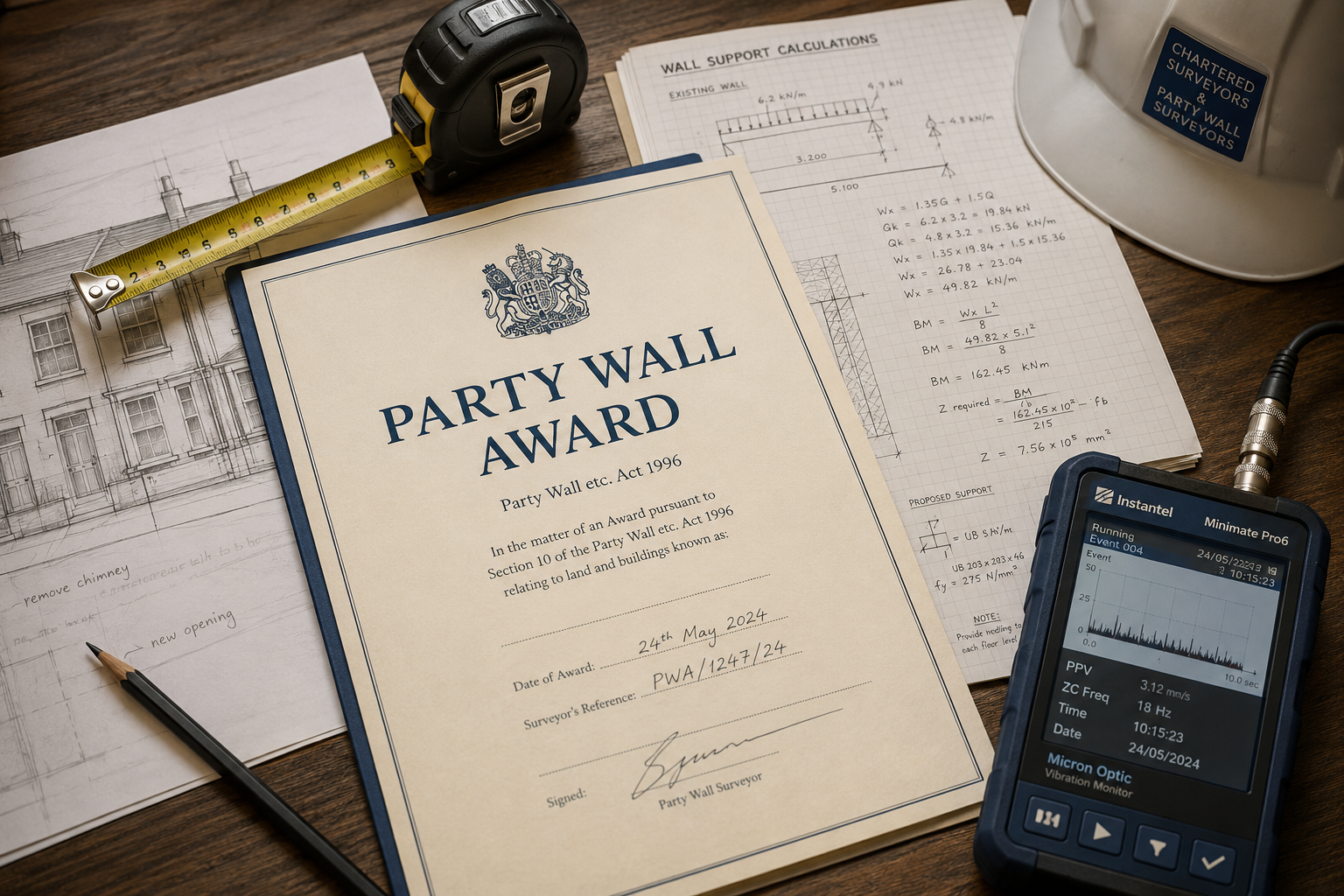
A Party Wall Award — sometimes called a Party Wall Agreement — is a legally binding document produced by one or more appointed surveyors. It sets out the rights and responsibilities of both the building owner and the adjoining owner before, during, and after the notifiable works.
What a Party Wall Award Typically Includes
| Element | Purpose |
|---|---|
| Description of permitted works | Defines exactly what the building owner may do |
| Working hours | Restricts noisy or disruptive activity to agreed times |
| Method of construction | Specifies how beams, fixings, and supports are to be installed |
| Vibration and movement limits | Sets measurable thresholds to protect the adjoining property |
| Schedule of Condition | Records the pre-works state of the neighbour's property |
| Compensation provisions | Establishes how damage claims will be assessed and paid |
| Access rights | Grants the building owner lawful access to the neighbour's property if needed |
The Award is not a planning document — it sits alongside Building Regulations approval and any required planning permission. All three may be needed simultaneously for a terraced loft conversion [3].
A Schedule of Condition for party wall works is one of the most important elements of the Award. Without it, attributing post-works damage becomes a matter of dispute rather than documented fact.
The Step-by-Step Notice and Award Process in 2026
Step 1: Identify Notifiable Works Early
Before any drawings are finalised, the building owner's surveyor should assess which elements of the loft design trigger the Act. In terraced houses, beam calculations almost always result in notifiable works. Consulting a structural engineer at this stage — particularly for beam calculations — ensures the notice accurately describes the scope of works.
Step 2: Serve the Party Wall Notice
The building owner must serve a written Party Wall Notice on each adjoining owner at least two months before work on a party wall begins [3]. The notice must include:
- The building owner's name and address
- The address of the property where works will take place
- A description of the proposed works
- The intended start date
A notice served too late, or not at all, can lead to an injunction halting the project entirely. The consequences of not serving a party wall notice are serious and well-documented — delays of three to six weeks are common, and legal costs can escalate rapidly [3].
Step 3: Await the Neighbour's Response
The adjoining owner has 14 days to respond. Three outcomes are possible:
- Consent in writing — work may proceed without a formal Award (though a Schedule of Condition is still advisable)
- Dissent and agreement to appoint a single Agreed Surveyor — one surveyor acts for both parties
- Dissent and appointment of separate surveyors — each party appoints their own surveyor; the two then appoint a Third Surveyor in case of deadlock
"A neighbour's silence after 14 days is treated as dissent under the Act — it does not mean consent has been given."
Step 4: Produce the Party Wall Award
Once surveyors are appointed, they inspect the site, review the structural drawings, and draft the Award. In 2026, RICS 8th Edition protocols require surveyors to give greater weight to structural notifiability assessments — a formal evaluation of whether specific elements of the design create notifiable risk to the adjoining structure [5].
For loft conversions in terraced houses, this typically means:
- Assessing the load path of any new steel beams bearing onto the party wall
- Evaluating the risk of vibration damage during drilling and cutting operations
- Considering the impact of any chimney stack removal on the shared flue structure
Shared chimney stacks deserve particular attention — they are often structurally integral to both properties. The implications are covered in detail in the guide on shared chimneys and chimney stacks.
Costs, Fees, and Compensation Funds in 2026
Surveyor Fees
The building owner is responsible for paying the reasonable fees of both surveyors in a dispute scenario. In 2026, typical costs for party wall surveyor appointments in loft conversion cases range as follows:
| Scenario | Estimated Cost |
|---|---|
| Neighbour consents (no Award needed) | £0 – £500 (Schedule of Condition only) |
| Agreed Surveyor (single appointment) | £800 – £1,400 |
| Two separate surveyors | £1,200 – £2,800 [3] |
| Third Surveyor referral | Additional £500 – £1,500 |
For a full breakdown of what drives these figures, the guide on party wall costs provides a detailed analysis.
Compensation and Damage Provisions
The Party Wall Award should include a compensation fund mechanism or a clear process for assessing damage claims. This is particularly important in terraced loft conversions where:
- Vibration from cutting operations can crack plaster or disturb existing finishes in the adjoining property
- Temporary removal of roof tiles or flashings may allow water ingress into the neighbour's roof space
- Structural movement during beam insertion can affect door frames and window reveals
The damage to property in party wall works guidance explains how claims are assessed and what documentation is required to support them.
Structural Works Essentials: What Surveyors and Engineers Must Address
Vibration Monitoring
One of the most significant updates in 2026 RICS guidance is the expectation that vibration monitoring should be considered for any terraced loft conversion involving percussive drilling, core cutting, or the use of breakers to create beam pockets in a party wall [5]. Monitoring devices can be placed in the adjoining property — with the neighbour's permission — to record peak particle velocity (PPV) readings throughout the works.
If readings approach or exceed agreed thresholds set in the Award, the contractor must pause and review the method of construction. This protects both the building owner (from a damage claim) and the adjoining owner (from actual structural harm).
Insulation and Fire Separation
When a party wall is opened up for beam insertion, the opportunity arises to improve thermal and acoustic performance. However, any new insulation must not compromise the fire separation between the two properties. The requirements around insulation in a party wall are governed by both the Party Wall Act and Building Regulations Part B (fire safety) and Part E (sound resistance).
The Three-Metre Rule and Excavation
Some terraced loft conversions involve underpinning or drainage works close to the shared boundary. Where any excavation is planned within three metres of the adjoining owner's foundations — and to a depth that would undercut those foundations — a separate notice under Section 6 of the Act is required. Understanding what the three-metre rule means in practice is essential for projects that combine loft works with basement or drainage improvements.
Common Pitfalls That Lead to Injunctions
Despite the clarity of the legal framework, a significant number of terraced loft conversion projects run into trouble. The most frequent causes of injunctions and disputes include:
1. Starting work before the notice period expires
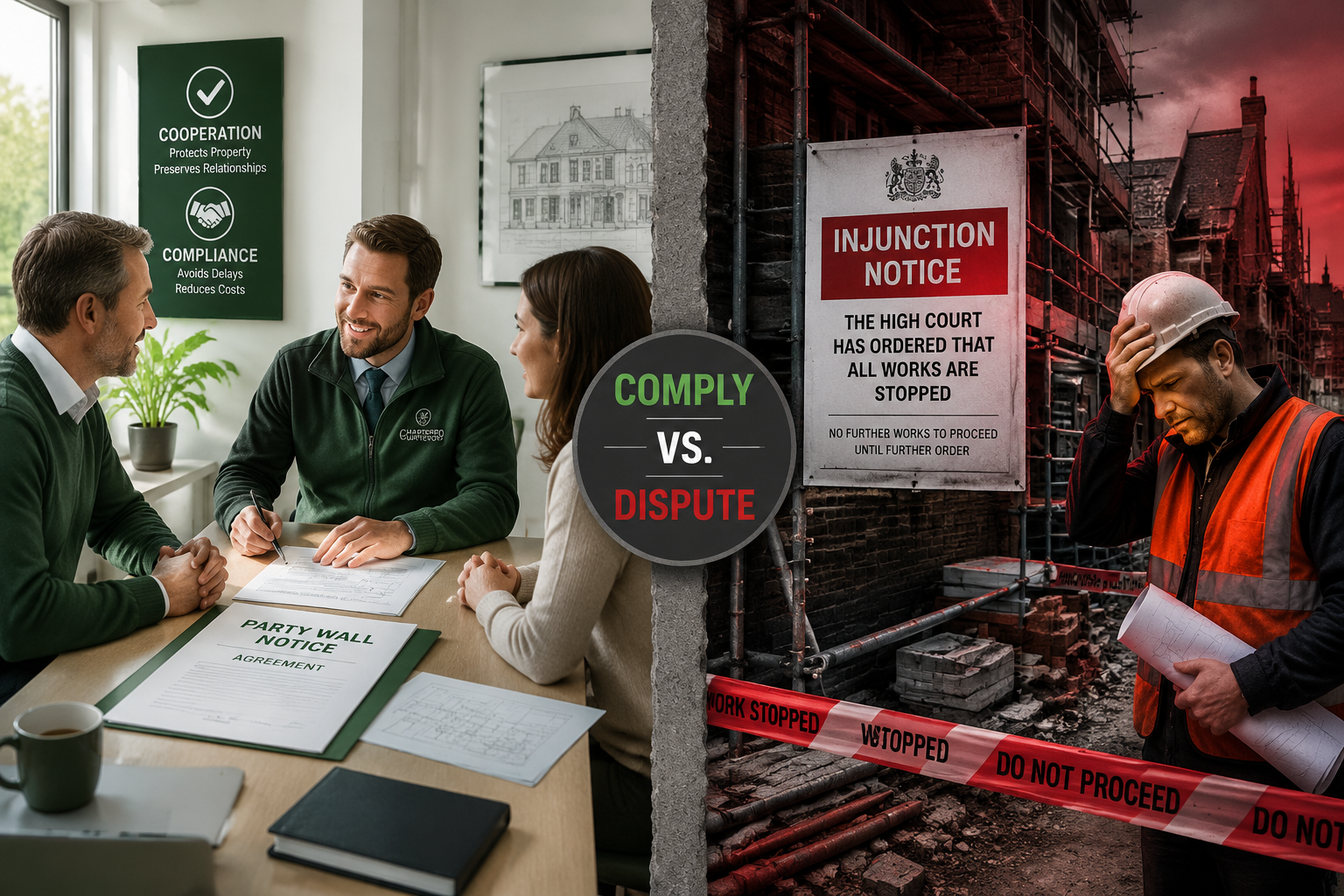
Even if a notice is served correctly, beginning work before the two-month period has elapsed — or before an Award is agreed — is a breach of the Act. Courts have granted injunctions stopping work mid-build in these circumstances [3].
2. Serving notice on the wrong person
In leasehold properties, the notice must be served on the correct party. Freeholders and leaseholders may both have interests that require separate notices. An error here can invalidate the entire process.
3. Failing to record pre-works condition
Without a Schedule of Condition, any damage claim from the neighbour becomes a credibility contest. Surveyors should photograph every room in the adjoining property that could be affected, noting existing cracks, settlement, and decorative condition.
4. Underestimating the scope of notifiable works
Building owners sometimes assume that because a beam is being inserted from their side of the wall only, the Act does not apply. Under Section 2, any work that cuts into, bears onto, or raises a party wall is notifiable — regardless of which side the work is approached from [1][4].
5. Ignoring the dispute resolution process
When disagreements arise, some building owners attempt to proceed without resolving the dispute formally. Understanding what a party wall dispute involves — and how the Third Surveyor mechanism resolves deadlock — is essential knowledge before any project begins.
Building Regulations and Planning Permission: The Parallel Requirements
A Party Wall Award does not replace Building Regulations approval. For terraced loft conversions, a full plans submission to the local authority is strongly recommended over a building notice [3]. Full plans approval provides:
- A detailed check of structural calculations before work begins
- A formal record that the design meets fire escape, thermal, and structural standards
- Greater protection when selling the property, as mortgage lenders require evidence of compliance
Planning permission is not always required for loft conversions — many fall within Permitted Development rights — but any extension beyond the original roof plane, or works in a conservation area, will require a planning application. The Party Wall process runs entirely separately from both planning and Building Regulations; all three must be managed in parallel.
For projects involving complex roof structures, a structural survey prior to design work can identify existing defects in the party wall or roof structure that would affect the design and the scope of notifiable works.
Conclusion: Actionable Next Steps for 2026 Loft Conversion Projects
Party Wall Awards for Loft Conversions in Terraced Houses represent one of the most technically and legally demanding aspects of residential construction in the UK. In 2026, with RICS 8th Edition protocols raising the bar on structural notifiability and vibration management, the margin for procedural error has narrowed further.
Actionable steps to take before breaking ground:
- Commission a structural engineer to assess beam positions and load paths before finalising drawings — this determines the full scope of notifiable works.
- Identify all adjoining owners correctly, including freeholders in leasehold properties, and serve notices at least two months before the planned start date.
- Instruct a qualified Party Wall Surveyor early — ideally before submitting for Building Regulations — so that the Award timeline does not delay the build programme.
- Arrange a Schedule of Condition for every adjoining property, even where consent is given, to protect against future damage claims.
- Include vibration monitoring provisions in the Award for any works involving percussive tools or core drilling into the party wall.
- Budget correctly — allow for surveyor fees of up to £2,800 per neighbour in a dissent scenario, and include a contingency for compensation claims.
Skipping any of these steps does not save time or money — it creates the conditions for injunctions, disputes, and project shutdowns. The legal framework exists to protect all parties, and working within it is the fastest route to a completed loft conversion.
References
[1] Loft Conversion Party Wall – https://ourpartywall.co.uk/guides/loft-conversion-party-wall?utm_source=openai
[2] Understanding Section 2 Of The Party Wall Etc Act 1996 – https://www.partywallslimited.com/blog/understanding-section-2-of-the-party-wall-etc-act-1996?utm_source=openai
[3] How To Plan A Loft Conversion For A Terraced House 2026 – https://www.bestbuilders.co.uk/guides/how-to/how-to-plan-a-loft-conversion-for-a-terraced-house-2026?utm_source=openai
[4] Loft Conversions And The Party Wall Act – https://www.peterbarry.co.uk/blog/loft-conversions-and-the-party-wall-act/?utm_source=openai
[5] Party Wall Surveys For Loft Conversions In 2026 Rics 8th Edition Protocols For Structural Notifiability And Neighbour Protections – https://nottinghillsurveyors.com/blog/party-wall-surveys-for-loft-conversions-in-2026-rics-8th-edition-protocols-for-structural-notifiability-and-neighbour-protections?utm_source=openai