
Over 60% of loft conversion disputes in England and Wales stem from incorrectly served Party Wall Notices or missed procedural deadlines—delays that cost homeowners an average of 3-6 months and thousands in legal fees. [1] Understanding the Party Wall Act for Loft Conversions in Urban UK: Notice Essentials and Surveyor Safeguards isn't just about legal compliance; it's about protecting your project timeline, your budget, and your relationship with neighbours in densely packed urban terraces where shared walls are the norm.
The Party Wall etc. Act 1996 governs all structural work affecting shared walls, boundaries, and excavations in England and Wales, establishing a mandatory framework that many homeowners discover too late. [2] Whether you're converting a loft in a Victorian terrace in Islington or adding dormers to a semi-detached property in Bromley, navigating party wall requirements correctly from day one prevents costly project delays and neighbour disputes.
This comprehensive guide details the legal notice requirements, surveyor appointment procedures, and common pitfalls specific to loft conversions under the Party Wall Act, providing actionable checklists to keep your project on track.

Key Takeaways
- ⏰ Mandatory 2-month notice period required for all party wall works affecting loft conversions—shorter 1-month notice applies only to excavation work
- 📋 Five essential elements must appear in every valid Party Wall Notice: owner details, property address, detailed work description, start date, and formal notice declaration
- 👷 Professional surveyor costs range from £750-£1,800 per affected neighbour in 2026, with total project timelines spanning 2-4 months including statutory notice periods [3]
- ✅ Neighbours cannot permanently veto your loft conversion—the Act provides formal dispute resolution through Party Wall Awards when consent is refused
- 🚫 No work can legally commence before written agreement is secured or a formal Party Wall Award is executed, regardless of project urgency
Understanding the Party Wall Act for Loft Conversions in Urban UK
The Party Wall etc. Act 1996 applies exclusively to England and Wales, with Scotland and Northern Ireland operating under different common law frameworks. [2] This distinction matters significantly for property investors and homeowners managing portfolios across UK borders—what applies in Manchester doesn't necessarily apply in Edinburgh.
What Qualifies as Party Wall Work in Loft Conversions?
Loft conversions trigger party wall requirements when they involve specific structural interventions affecting shared walls or boundaries. The most common scenarios include:
Structural Work Requiring Party Wall Agreements: [1]
- ✂️ Cutting into party walls for steel beam insertion or structural support
- 🏗️ Removing chimney breasts that pass through or sit on party walls
- 🔨 Underpinning foundations adjacent to neighbouring properties
- 📏 Increasing wall height or thickness when building up for additional headroom
- 💧 Inserting full-length damp proof courses through party walls
- 🧱 Demolishing and rebuilding sections of party walls for structural reasons
Conversely, routine maintenance work falls outside the Act's scope. Plastering, electrical installations, or drilling internal walls for kitchen units and shelving do not require party wall agreements, reducing administrative burden for non-structural modifications. [2]
For properties with shared chimneys and shared chimney stacks, removal or alteration work almost always triggers party wall requirements, even when the chimney appears to be entirely within your property boundary.
Jurisdiction and Leasehold Considerations
For leasehold properties, the notification requirements become more complex. Party Wall Notices must be served to both the building owner and resident tenants in adjoining leasehold properties, ensuring all affected parties receive formal notification regardless of ownership structure. [4]
This dual-notification requirement frequently catches leaseholders off guard, particularly in converted flats where multiple parties hold interests in the same building. Missing even one required recipient can invalidate your entire notice process, resetting your 2-month timeline to zero.
Notice Essentials: Serving Valid Party Wall Notices for Loft Conversions
The foundation of Party Wall Act compliance rests on properly served notices with correct content and timing. Getting this right prevents the most common—and most costly—delays in loft conversion projects.
The 2-Month Notice Rule and Timeline Exceptions
All building works affecting a party wall require a minimum 2-month notice period from the date a Party Wall Notice is served, allowing neighbours sufficient time to respond, seek advice, or raise concerns. [2] This timeline is non-negotiable and cannot be shortened by mutual agreement—the Act establishes it as a statutory minimum.
However, excavation work or construction of new walls at boundary lines requires only a 1-month notice period, streamlining timelines for foundation-related projects. [2] This shorter timeline applies specifically to Section 6 notices covering excavation within 3 metres of a neighbouring building where the excavation will go deeper than the neighbour's foundations.
Critical Timeline Considerations:
| Notice Type | Work Covered | Minimum Notice Period | Start Date Calculation |
|---|---|---|---|
| Section 1 | New walls on boundary line | 1 month | From date notice served |
| Section 2 | Work to existing party wall | 2 months | From date notice served |
| Section 6 | Excavation near neighbour | 1 month | From date notice served |
Understanding what is the three-meter rule becomes essential when planning foundation work or underpinning as part of your loft conversion, particularly in terraced properties where excavation depth frequently exceeds neighbouring foundations.
Five Essential Elements of a Valid Party Wall Notice
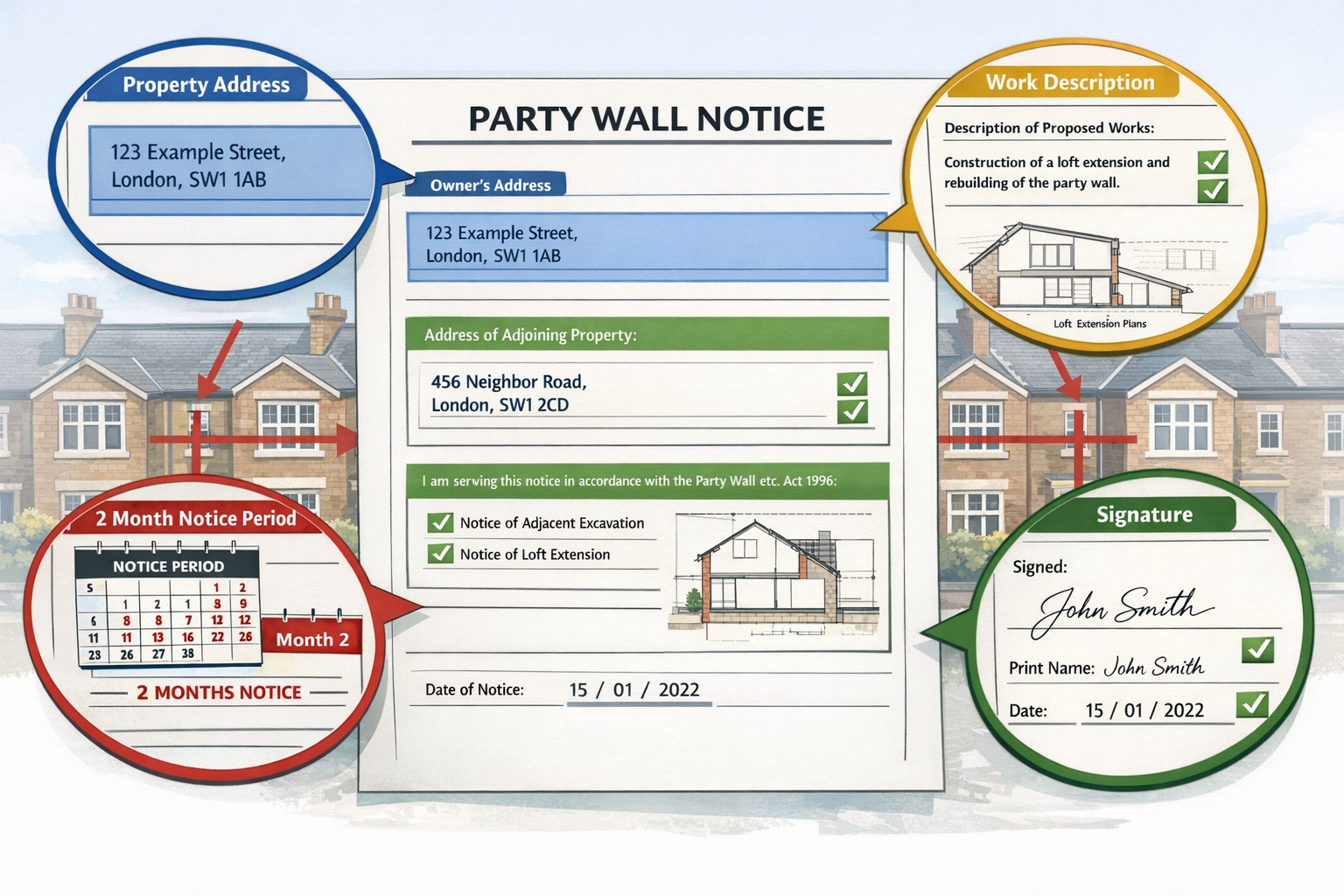
A formal Party Wall Notice must contain specific information to be legally valid. Missing even one element can render your notice invalid, forcing you to restart the entire process. [1]
Mandatory Notice Contents:
- 📝 Your name and address as the building owner initiating the work
- 🏠 Property address where the work will occur (must be precise and unambiguous)
- 📐 Detailed description of proposed works with architectural plans and technical drawings showing extent of party wall involvement
- 📅 Proposed start date (minimum 2 months from service date for party wall work)
- ⚖️ Formal declaration stating explicitly that the document constitutes a "Party Wall Notice" under the Party Wall etc. Act 1996
The work description deserves particular attention. Vague descriptions like "loft conversion work" or "general building work" are insufficient. Your notice must specify exactly which party wall elements will be affected: "Installation of 203x102mm steel beam through party wall at first-floor ceiling level, requiring 300mm x 150mm pocket cut into party wall" provides the precision required. [1]
Professional architectural drawings significantly strengthen your notice, reducing ambiguity and demonstrating professionalism to neighbours. Including cross-sections showing party wall involvement, beam locations, and structural interventions helps neighbours understand exactly what you're proposing.
For comprehensive guidance on the complete notice serving process, review our detailed resource on party wall loft conversions.
Common Notice Service Mistakes That Delay Projects
The most frequent errors in party wall notice service include:
Critical Mistakes to Avoid:
- ❌ Insufficient lead time: Serving notice only 6 weeks before intended start date when 8 weeks (2 months) is the statutory minimum
- ❌ Incomplete neighbour identification: Missing one affected neighbour in a terrace of three or more properties
- ❌ Vague work descriptions: Failing to specify which structural elements of the party wall will be affected
- ❌ Missing leasehold owners: Serving notice only to tenants without notifying the freeholder or vice versa
- ❌ Informal communication: Discussing work verbally or via text message instead of serving formal written notice
What happens when party wall notice not served correctly? Neighbours can seek injunctions to stop work, you may face enforcement action, and any damage claims become significantly more complicated without the protective framework of a Party Wall Award.
Surveyor Safeguards: Appointing and Working with Party Wall Surveyors
When neighbours don't provide written consent within 14 days of receiving your notice, the Act requires appointment of party wall surveyors to prepare a Party Wall Award—a formal agreed document that legally permits work to proceed with appropriate protections. [2]
Understanding the Party Wall Award Process
A Party Wall Award serves as a legally binding agreement outlining how work will progress, what protections will be in place, and how any damage will be addressed. The Award cannot prevent your work from proceeding—it simply establishes the framework for safe execution. [2]
Neighbours cannot permanently stop a loft conversion through party wall disputes. The Act provides a formal dispute resolution mechanism ensuring work can proceed with appropriate safeguards and protections in place, even when neighbours object. [1]
Three Surveyor Appointment Options
The Party Wall Act provides three pathways for surveyor appointment:
Option 1: Agreed Surveyor 🤝
Both parties agree to appoint a single "Agreed Surveyor" who acts impartially for both sides. This is typically the most cost-effective approach, with fees ranging from £750-£1,200 for straightforward loft conversions. [3]
Option 2: Two Surveyors 👥
Each party appoints their own surveyor, who then work together to prepare the Award. This option provides more robust protection but increases costs to £1,500-£3,600 total (covering both surveyors). [3]
Option 3: Three Surveyors 👨👩👦
Each party appoints a surveyor, and those two surveyors appoint a third surveyor to resolve any disputes between them. This option is rarely necessary for residential loft conversions but provides maximum dispute resolution capability.
The building owner (you) typically pays all reasonable surveyor fees, regardless of which option is chosen. [3] This includes your neighbour's surveyor fees if they choose to appoint their own under Option 2.
Understanding party wall cost implications helps budget accurately for the complete project, as surveyor fees represent a significant additional expense beyond construction costs.
What a Party Wall Award Must Include
A comprehensive Party Wall Award documents:
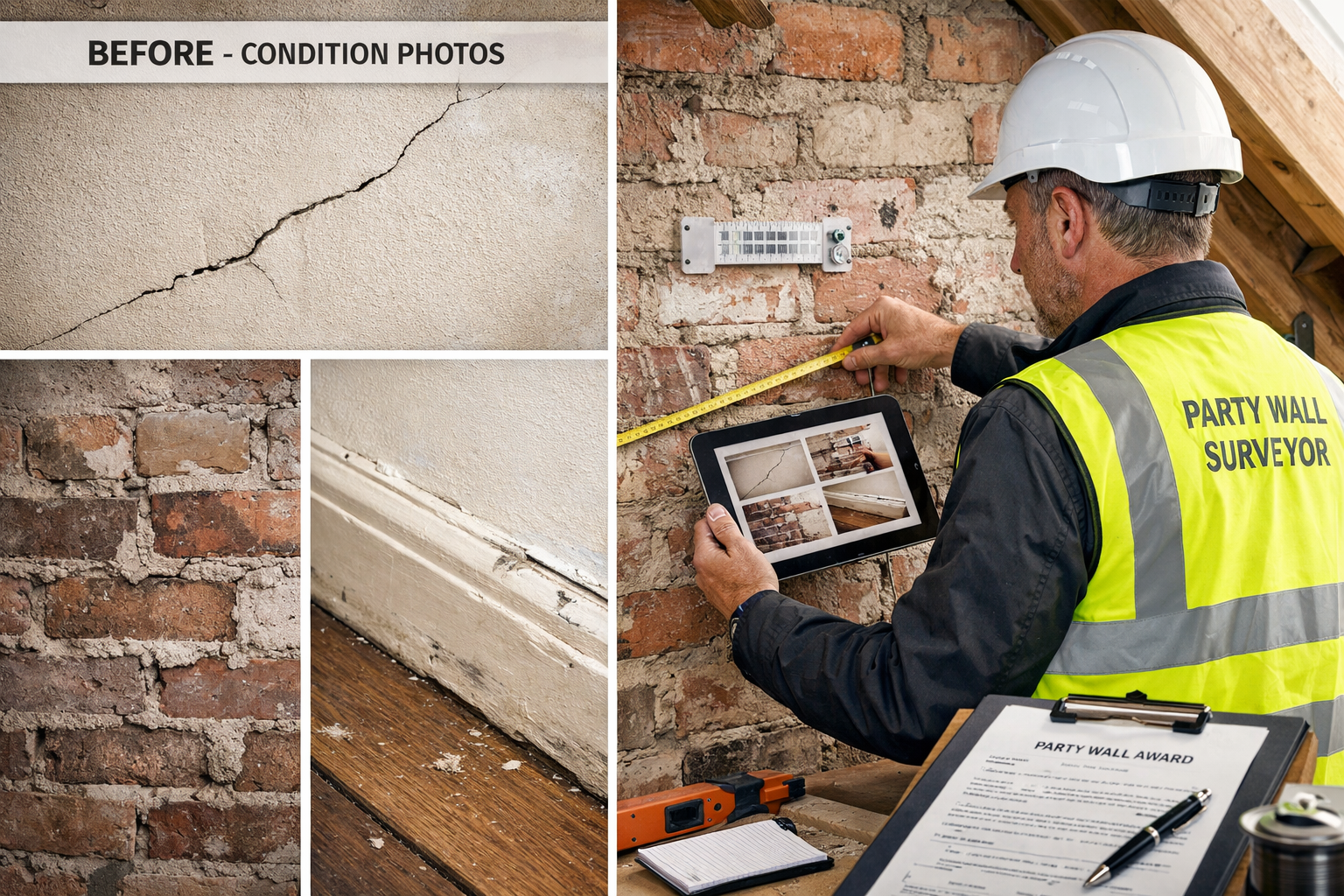
- 📸 Schedule of Condition: Detailed photographic record of the neighbour's property before work commences, establishing baseline condition
- 🏗️ Work specifications: Precise description of permitted work and methodologies
- ⏰ Working hours: Restrictions on when noisy work can occur
- 🚧 Access arrangements: Rights of access for inspections during construction
- 💰 Damage resolution: Process for addressing any damage that occurs during work
- 🔍 Inspection provisions: Surveyor inspection rights at key project stages
The Schedule of Condition deserves particular emphasis. This detailed photographic and written record protects both parties by establishing the pre-work condition of the neighbour's property. Without this baseline documentation, disputes about whether damage was caused by your work become nearly impossible to resolve objectively.
For leasehold properties, understanding schedule of condition leasehold requirements becomes even more critical, as multiple parties may have interests in the documented condition.
Surveyor Selection Checklist
When appointing a party wall surveyor, verify:
✅ RICS membership: Chartered surveyors with Royal Institution of Chartered Surveyors accreditation
✅ Party wall specialism: Specific experience with Party Wall Act procedures, not just general surveying
✅ Local knowledge: Familiarity with construction practices in your urban area
✅ Loft conversion experience: Previous awards for similar loft conversion projects
✅ Clear fee structure: Transparent pricing with no hidden costs
✅ Professional indemnity insurance: Minimum £1 million coverage
✅ Response time commitments: Clear timelines for Award preparation
Professional surveyors typically complete Awards within 2-4 weeks of appointment, though complex situations or multiple neighbours can extend this timeline. [3]
Common Pitfalls and How to Avoid Delays in Loft Conversion Party Wall Procedures
Even with proper notice service and surveyor appointment, specific pitfalls frequently derail loft conversion timelines. Understanding these risks enables proactive prevention.
Pitfall 1: Starting Work Before Agreement is Finalized
Building work covered by the Party Wall Act cannot legally commence before written agreement is reached with all affected neighbours, or until a Party Wall Award is formally executed. [2] This prohibition applies regardless of project urgency, contractor availability, or verbal assurances from neighbours.
Starting work prematurely exposes you to:
- ⚠️ Injunction applications forcing immediate work stoppage
- 💸 Increased liability for any damage claims without Award protections
- 📋 Planning complications if building control becomes aware of non-compliance
- 🏛️ Legal costs defending against neighbour complaints
The temptation to "start carefully" while paperwork finalizes is understandable but legally risky. Even non-structural preparatory work like scaffolding erection can constitute commencement if it facilitates party wall work.
Pitfall 2: Inadequate Work Descriptions in Notices
Vague or incomplete work descriptions create two problems: neighbours can't properly assess impact, and surveyors must spend additional time clarifying scope—both extending timelines unnecessarily.
Insufficient Description:
"Loft conversion with structural alterations to party wall"
Adequate Description:
"Loft conversion including: (1) Installation of 203x102mm steel beam through party wall at first-floor ceiling level, requiring 300mm x 150mm pocket cut 2.4m from front elevation; (2) Removal of chimney breast from loft space, including section sitting on party wall; (3) Insertion of two 150mm x 100mm trimmer joists bearing onto party wall by 75mm"
The adequate description enables neighbours and surveyors to understand precisely what's proposed, facilitating faster agreement or more focused Award preparation.
Pitfall 3: Ignoring Adjacent Properties in Terraces
In terraced properties, party wall work often affects both immediate neighbours. Serving notice to only one side while ignoring the other invalidates your compliance and creates legal exposure.
Consider a mid-terrace property with neighbours at numbers 23 and 27. Steel beam installation through the party wall at number 25 affects both adjacent properties, requiring separate notices to each. Missing number 27 because "the beam mainly goes through the number 23 wall" doesn't satisfy legal requirements.
Pitfall 4: Misunderstanding Neighbour Rights
Neighbours hold specific rights under the Party Wall Act, but these rights don't include the power to permanently prevent your work. Understanding this distinction helps manage expectations and negotiations.
What Neighbours CAN Do:
- ✅ Request detailed information about proposed work
- ✅ Appoint their own surveyor at your expense
- ✅ Require a Schedule of Condition before work starts
- ✅ Specify reasonable working hours and access restrictions
- ✅ Claim compensation for proven damage caused by your work
What Neighbours CANNOT Do:
- ❌ Permanently veto or prevent your loft conversion
- ❌ Demand payment for "permission" to do party wall work
- ❌ Require you to change your design for aesthetic preferences
- ❌ Refuse surveyor appointments indefinitely to delay work
When neighbours refuse to engage with the process, the Act provides mechanisms for surveyor appointment even without their cooperation, ensuring projects can proceed. [2]
Pitfall 5: Failing to Secure Consent for Party Wall Work
While the Act provides dispute resolution mechanisms, obtaining consent for party wall work through early communication and transparent information sharing remains the fastest, most cost-effective path forward.
Best Practices for Securing Consent:
- 🗣️ Pre-notice discussion: Informally discuss your plans before serving formal notice
- 📊 Visual aids: Provide drawings and 3D visualizations showing minimal impact
- 🤝 Address concerns: Listen to neighbour worries and explain mitigation measures
- ⏰ Flexible timing: Offer to schedule noisy work around neighbour commitments
- 📱 Ongoing communication: Provide contact details and commit to regular updates
Approximately 70% of party wall matters resolve through written consent without requiring surveyor appointment when building owners invest in upfront communication and transparency. [3]
Pitfall 6: Overlooking Excavation Notice Requirements
Loft conversions sometimes require foundation work or underpinning, particularly in older properties where increased loading necessitates foundation strengthening. This work triggers separate excavation notice requirements under Section 6 of the Act.
If you're excavating within 3 metres of a neighbouring building and going deeper than their foundations, you must serve a separate 1-month excavation notice in addition to any Section 2 party wall notice. [2] For detailed guidance, see our resource on notice for excavation near a neighbour.
Pitfall 7: Inadequate Documentation and Record-Keeping
Throughout the party wall process, maintain comprehensive records:
- 📧 Proof of notice service: Recorded delivery receipts or hand-delivery acknowledgments
- 📸 Pre-work photographs: Your own photographic record independent of surveyor's Schedule
- 💬 Communication logs: Written records of all neighbour discussions and agreements
- 📄 Surveyor correspondence: All emails and letters from appointed surveyors
- 🧾 Fee payment records: Receipts for all surveyor fees paid
These records prove invaluable if disputes arise months after work completion, particularly for damage claims where memories fade and evidence becomes contested.
Regional Considerations for Urban UK Loft Conversions
Party wall challenges vary significantly across urban UK regions, influenced by housing stock age, property density, and local construction practices.
London-Specific Considerations
London's dense Victorian and Edwardian terraces create unique party wall complexities. Properties often share walls with multiple neighbours, and loft conversions frequently involve chartered surveyors in West London, chartered surveyors in Islington, or chartered surveyors in Hammersmith who understand local construction nuances.
Professional party wall surveyor costs in London range from £750 to £1,800 per affected neighbour in 2026, representing the upper end of national pricing due to higher professional fees and property values. [3]
Outer London and Home Counties
Areas like Bexley, Bromley, and Hertfordshire feature more semi-detached properties where party wall issues affect only one neighbour, simplifying notice requirements and potentially reducing surveyor costs.
Northern Urban Centers
Cities like Manchester, Leeds, and Liverpool have extensive terraced housing stock similar to London, but surveyor fees typically run 20-30% lower, ranging from £600-£1,400 per neighbour in 2026. [3]
Integration with Planning and Building Control
Party wall compliance operates independently from planning permission and building regulations, but the three systems intersect in important ways.
Planning Permission Requirements
Householder planning applications for loft conversions cost £548 as of April 2026, with an 8-week processing timeline. [3] Many loft conversions qualify for permitted development rights, eliminating planning permission requirements entirely—but party wall requirements remain mandatory regardless of whether planning permission is needed.
Key Distinction:
- 🏛️ Planning permission = Local authority approval for the design and appearance of your work
- 🏗️ Building regulations = Technical compliance with construction standards and safety
- ⚖️ Party Wall Act = Neighbour protection and procedure for work affecting shared structures
You might not need planning permission but still require party wall notices. Conversely, obtaining planning permission doesn't exempt you from party wall requirements.
Building Control Inspections
Building control officers increasingly ask to see Party Wall Awards before signing off on completed work, particularly for structural elements like steel beam installations through party walls. Having your Award documentation readily available prevents last-minute compliance scrambles.
Professional Support: When to Engage Specialists
While homeowners can theoretically handle party wall procedures themselves, professional support often proves cost-effective by preventing delays and errors.
Architect or Designer Support
Experienced loft conversion architects provide detailed technical drawings that satisfy party wall notice requirements, reducing ambiguity and facilitating faster neighbour consent or Award preparation.
Specialist Party Wall Surveyors
Engaging a party wall surveyor proactively—before serving notices—enables:
- ✅ Notice drafting: Professionally prepared notices with comprehensive work descriptions
- ✅ Neighbour liaison: Professional communication reducing emotional tensions
- ✅ Process management: Coordinated timeline management across all required notices
- ✅ Award preparation: Efficient Award drafting if disputes arise
For complex projects involving multiple neighbours or valuable properties, upfront surveyor engagement typically saves more in prevented delays than it costs in fees.
Legal Support
Solicitor involvement becomes necessary only in exceptional circumstances:
- ⚖️ Neighbours threatening or pursuing injunctions
- 📋 Complex leasehold situations with multiple freeholders
- 💰 Significant damage claims disputed between parties
- 🏛️ Appeals to County Court regarding Award provisions
For standard residential loft conversions, legal fees are rarely necessary if party wall procedures are followed correctly from the outset.
Cost Summary: Budgeting for Party Wall Compliance
Understanding the complete cost picture enables accurate project budgeting:
| Cost Element | Typical Range (2026) | Notes |
|---|---|---|
| Agreed Surveyor | £750 – £1,200 | Single surveyor acting for both parties |
| Two Surveyors | £1,500 – £3,600 | Each party appoints own surveyor |
| Notice drafting | £150 – £400 | If engaging surveyor for notice preparation |
| Schedule of Condition | Included in surveyor fee | Detailed photographic record |
| Award preparation | Included in surveyor fee | Typically 2-4 weeks timeline |
| Planning application | £548 | If required (many loft conversions use permitted development) |
Total party wall costs for typical urban loft conversion: £750 – £4,000 depending on number of neighbours, surveyor appointment option, and complexity. [3]
These costs represent 2-5% of typical loft conversion project costs (£30,000-£60,000 for London properties), making them a relatively modest investment in legal compliance and neighbour relationship protection.
Action Plan: Your Step-by-Step Party Wall Compliance Checklist
Follow this systematic approach to ensure compliant party wall procedures for your loft conversion:
Phase 1: Pre-Notice Preparation (Weeks 1-2)
- Engage architect to prepare detailed technical drawings showing party wall involvement
- Identify all affected neighbours (both sides in terraces, plus any rear extensions)
- Verify ownership details for leasehold properties (freeholder and leaseholder)
- Consider engaging party wall surveyor for notice drafting and process management
- Informally discuss plans with neighbours to gauge likely response
Phase 2: Notice Service (Week 3)
- Prepare formal Party Wall Notices with all five essential elements
- Serve notices via recorded delivery or hand delivery with acknowledgment
- Retain proof of service for all notices
- Provide neighbours with your contact details and surveyor information (if appointed)
Phase 3: Response Period (Weeks 4-11)
- Monitor for neighbour responses (14-day response window)
- If consent received: Retain written consent and proceed after 2-month notice period expires
- If dissent or no response: Initiate surveyor appointment process
- Cooperate with surveyor requests for additional information or site access
Phase 4: Award Preparation (Weeks 12-15, if required)
- Provide surveyor with comprehensive project information
- Facilitate surveyor access for Schedule of Condition preparation
- Review draft Award and raise any concerns with surveyor
- Obtain final executed Award signed by all parties
Phase 5: Pre-Commencement (Week 16+)
- Verify 2-month notice period has fully expired
- Confirm written consent or executed Award is in place for all affected neighbours
- Provide contractor with copy of Award and Schedule of Condition
- Establish communication protocol with neighbours for construction phase
- Only then commence work
Conclusion
Navigating the Party Wall Act for Loft Conversions in Urban UK requires careful attention to notice essentials and surveyor safeguards, but the process protects both homeowners and neighbours when followed correctly. The 2-month mandatory notice period, five essential notice elements, and structured surveyor appointment procedures create a framework that enables loft conversions to proceed even when neighbours initially object.
The most successful projects share common characteristics: early neighbour communication, professionally prepared notices with detailed technical drawings, realistic timeline planning that accounts for statutory notice periods, and proactive surveyor engagement when consent isn't immediately forthcoming. By avoiding the seven common pitfalls—particularly starting work prematurely or serving inadequate notices—homeowners can navigate party wall requirements efficiently without derailing project timelines.
Your Next Steps
- Assess your project scope against the party wall trigger list to confirm whether your loft conversion requires notices
- Engage an experienced architect to prepare detailed drawings showing party wall involvement
- Identify all affected neighbours including both sides of terraced properties and any leasehold ownership complexities
- Serve formal notices with all five essential elements at least 2 months before your intended start date
- Appoint a qualified party wall surveyor proactively if you anticipate neighbour concerns or want professional process management
For professional support with party wall loft conversions in your area, engaging RICS-qualified surveyors with specific party wall expertise ensures compliant procedures and protects your project investment.
The Party Wall Act isn't an obstacle to your loft conversion—it's a structured framework that enables work to proceed with appropriate neighbour protections. Understanding notice essentials and surveyor safeguards transforms party wall compliance from a source of anxiety into a manageable project phase with predictable timelines and costs.
References
[1] Party Wall Agreement Loft Conversion – https://www.houseup.co.uk/news/party-wall-agreement-loft-conversion
[2] Party Wall Agreement – https://hoa.org.uk/advice/guides-for-homeowners/i-am-improving/party-wall-agreement/
[3] Party Wall Agreement London 2026 – https://www.mayfairstudio.co.uk/blog/party-wall-agreement-london-2026
[4] Party Wall Agreements What You Need To Know – https://www.fmb.org.uk/find-a-builder/ultimate-guides-to-home-renovation/party-wall-agreements-what-you-need-to-know.html