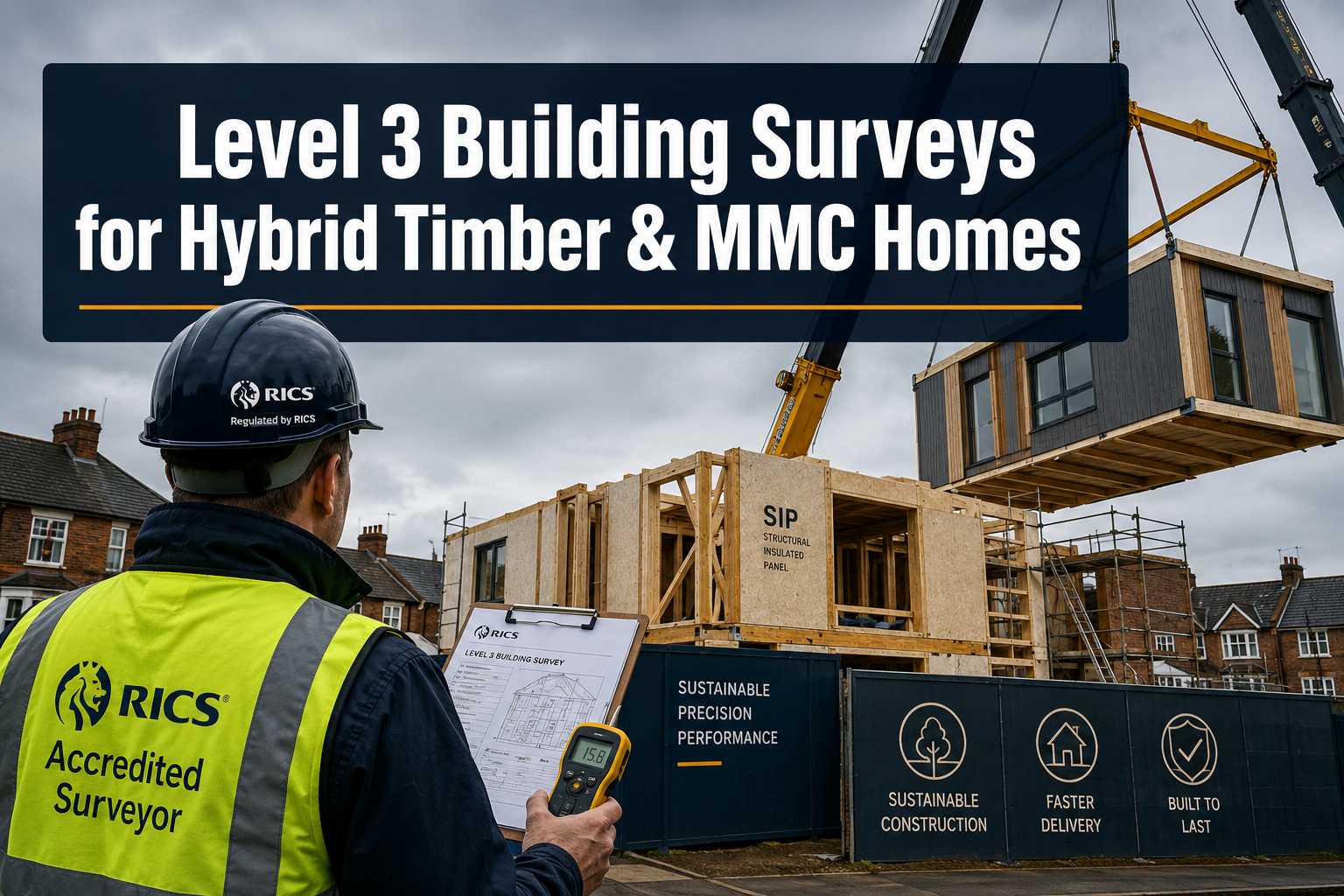
By 2026, roughly one in five new homes built in England uses some form of Modern Methods of Construction — yet the survey frameworks most buyers rely on were designed decades before structural insulated panels, cross-laminated timber, and volumetric modules ever arrived on a British building site. That gap between construction innovation and inspection practice is where costly defects hide.
Level 3 Building Surveys for Hybrid Timber and MMC Homes: Identifying Defects in the UK's New Generation of Construction addresses precisely this gap. This article sets out a practical inspection framework for surveyors and informed buyers — covering what to look for, where traditional templates fall short, and how to report findings that protect both the buyer and the lender.
Key Takeaways 📋
- RICS classifies most MMC and hybrid timber homes as "non-traditional construction," making a Level 3 Building Survey the recommended — and often lender-required — inspection format.
- The defect profile for MMC homes is different: moisture at junctions, vapour control layer failures, differential movement, and fire-stopping gaps replace the damp-and-settlement focus of older property surveys.
- "Hidden" MMC — timber frames behind brick skins — is common in new developments, and surveyors are increasingly upgrading mid-instruction to Level 3 once construction type is confirmed.
- Documentation matters as much as physical inspection: BOPAS accreditation, NHBC Accepts certificates, and manufacturer O&M manuals are integral to a complete Level 3 report on an MMC home.
- Level 3 surveys cost more and take longer than Level 2, but for complex modern construction the additional investment is routinely justified by the risks uncovered.
Why Standard Survey Templates Miss the Point with MMC Homes
A conventional Level 2 Homebuyer Survey was built around brick-and-block construction — cavity walls, concrete floors, and timber pitched roofs. Its colour-coded condition ratings work well for a 1930s semi. They work far less well when the wall behind the brick skin is a factory-made panelised system with a vapour control layer, service void, and airtightness membrane that the surveyor cannot see without specialist investigation.
RICS is clear on this. Its consumer guidance confirms that a Level 3 survey is appropriate for properties that are "unusual or altered" and for "non-traditional construction" — a category that explicitly captures modular, panelised, SIPs, CLT, and hybrid timber-frame homes [8]. The Level 2 format simply does not include the section-by-section narrative commentary needed to document interface defects, airtightness failures, or incomplete fire-stopping in concealed cavities [5].
💡 Pull quote: "The Level 2 template gives you a traffic light. The Level 3 gives you a diagnosis. For MMC homes, you need the diagnosis."
This is not a theoretical concern. Industry commentary through 2023–24 highlights that many homes marketed as "traditional" are actually timber-frame or panelised behind a conventional brick façade. Mortgage underwriters increasingly ask for confirmation of construction type, and when a surveyor suspects non-traditional structure — particularly in properties less than 15 years old — the professional default is now a Level 3 survey, or an upgrade mid-instruction once the system is confirmed [3].
For buyers unsure which survey level fits their property, a useful starting point is this guide to choosing the right property survey, which sets out the key decision criteria clearly.
What Makes Hybrid Timber and MMC Homes Structurally Different?
Before inspecting, a surveyor must understand what they are inspecting. MMC covers a broad family of systems, and the defect risks vary significantly between them.
The Seven MMC Categories — and Why Category Matters
The UK government and NHBC recognise seven MMC categories:
| Category | System Type | Example |
|---|---|---|
| 1 | Volumetric / modular | Factory-built 3D modules craned into position |
| 2 | Panelised | SIPs, CLT panels, timber-frame panels |
| 3 | Hybrid | Combination of Cat 1 and Cat 2 |
| 4 | Sub-assemblies | Roof cassettes, floor cassettes |
| 5 | Non-structural assemblies | Pre-fitted bathroom pods |
| 6 | Traditional + MMC components | Brick-and-block with MMC elements |
| 7 | Site labour reduction | Pre-cut timber, pre-formed foundations |
A Level 3 report on an MMC home should explicitly identify which category (or combination of categories) applies, record any BOPAS, NHBC Accepts, or similar third-party accreditation, and flag unusual construction details — such as CLT structure behind traditional cladding — that could affect valuation or insurability [3].
Failing to identify the MMC category is not a minor omission. It can affect the buyer's ability to obtain a mortgage, get buildings insurance, or sell the property in the future.
The Four Core Defect Themes in Level 3 Surveys for Hybrid Timber and MMC Homes
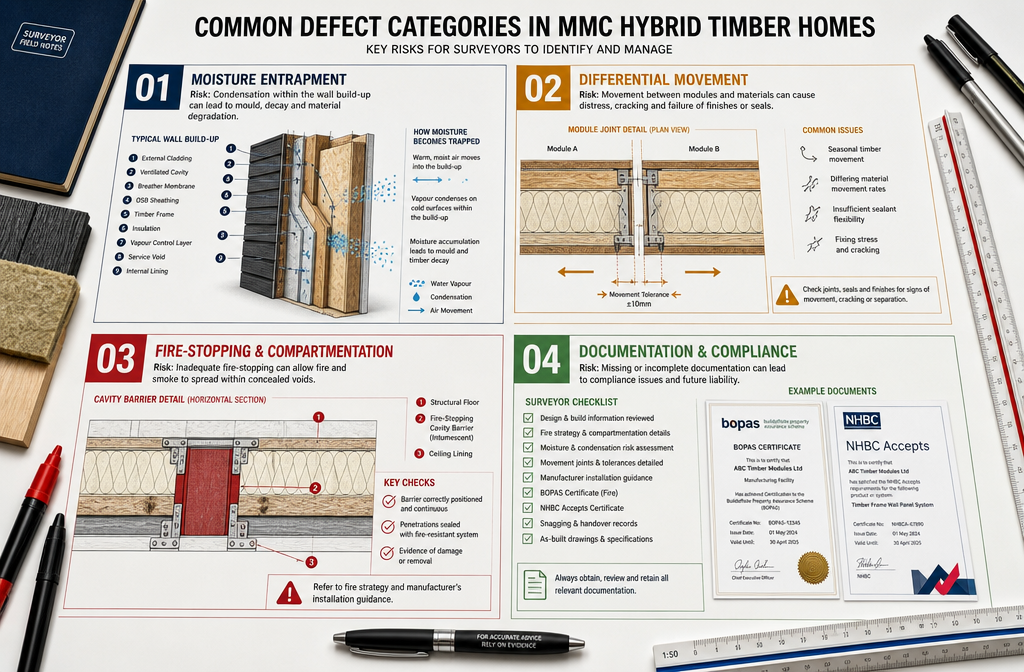
The defect profile for Level 3 Building Surveys for Hybrid Timber and MMC Homes: Identifying Defects in the UK's New Generation of Construction has shifted decisively away from the traditional "damp and settlement" focus. Current CPD materials and practice notes identify four primary risk themes [3]:
1. 💧 Moisture — The Hidden Enemy in Sealed Systems
Moisture risk in MMC homes is qualitatively different from damp in a Victorian terrace. The concern is not rising damp or penetrating rain through a solid wall — it is moisture entrapment within sealed, factory-built assemblies.
Key inspection points:
- Panel-to-foundation interfaces: Where factory-made panels meet site-built foundations, tolerances differ. Gaps or inadequate DPC detailing allow moisture ingress that is invisible from inside.
- Vapour control layers (VCLs): Damaged, incorrectly lapped, or punctured VCLs allow warm, moist internal air to migrate into the panel assembly and condense on cold surfaces — a process called interstitial condensation.
- Window and door reveals: Airtightness detailing around frames is a common weak point, especially where M&E penetrations (pipes, cables) pass through the building envelope.
- Flat or low-pitch roofs on modular units: These are particularly vulnerable to ponding and membrane failure.
A specialist damp survey may be recommended alongside the Level 3 report where moisture readings are elevated, or where VCL integrity cannot be confirmed visually. Understanding the cost implications of a damp and timber report is also useful for buyers budgeting for follow-up investigations.
2. 🏗️ Movement — Where Factory Meets Site
All buildings move. But hybrid MMC homes introduce a specific risk: differential movement between factory-built components and site-built elements. Modules manufactured in controlled factory conditions have different thermal and moisture expansion characteristics from in-situ concrete or masonry.
Surveyors should examine:
- Junction details between volumetric modules — cracking, sealant failure, or misalignment at module-to-module connections
- Connections between panelised walls and traditional foundations — look for gaps, cracking, or racking in the panel system
- Roof-to-wall junctions — particularly where factory-made roof cassettes meet site-built gable ends
- Floor-to-wall interfaces — differential deflection under load can cause cracking at skirting level or door frame distortion
Where movement is suspected, a residential structural engineering assessment or monitoring survey may be warranted to establish whether movement is historic and stable, or ongoing.
3. 🔥 Fire — Continuity in Concealed Cavities
Fire strategy in timber-frame and MMC homes depends critically on cavity barriers and fire-stopping in concealed spaces. Unlike masonry construction, where fire spread through cavities is limited by the inherent density of the material, timber-frame and panelised systems can create pathways for rapid fire spread if barriers are absent, damaged, or incorrectly installed.
Level 3 inspection points for fire:
- Cavity barrier continuity at floor-to-wall junctions, around window openings, and at the eaves
- Fire-stopping around service penetrations — particularly where M&E trades have drilled through fire-rated panels post-installation
- Intumescent seals around pipes and cables passing through compartment walls or floors
- Documentation: Is there an as-built fire strategy drawing? Does it match what is visible on site?
This is an area where the Level 3 narrative format is essential. A Level 2 condition rating cannot adequately capture the complexity of a fire-stopping deficiency in a concealed cavity.
4. 📄 Documentation — The Data Defect
The fourth defect theme is not physical at all — it is missing or incomplete as-built information. MMC homes should come with:
- Manufacturer's technical data sheets and O&M manuals
- BOPAS accreditation certificate (or equivalent)
- NHBC Accepts or similar warranty documentation
- As-built drawings, including cavity barrier layouts
- Factory QA records where available
In practice, many individual purchasers of new or nearly-new MMC homes receive only limited paper documentation [3]. Where the "golden thread" of digital building information (BIM data, factory QA records) exists, it can transform defect diagnosis — but access is patchy, and surveyors often cannot exploit it fully.
A Level 3 report should explicitly note what documentation was provided, what was requested but not received, and what the implications are for future maintenance, repair, and resale.
Practical Inspection Techniques: What Level 3 Adds

Level 3 Building Surveys for Hybrid Timber and MMC Homes: Identifying Defects in the UK's New Generation of Construction require tools and techniques that go beyond a standard visual inspection.
Thermal Imaging and Moisture Metering
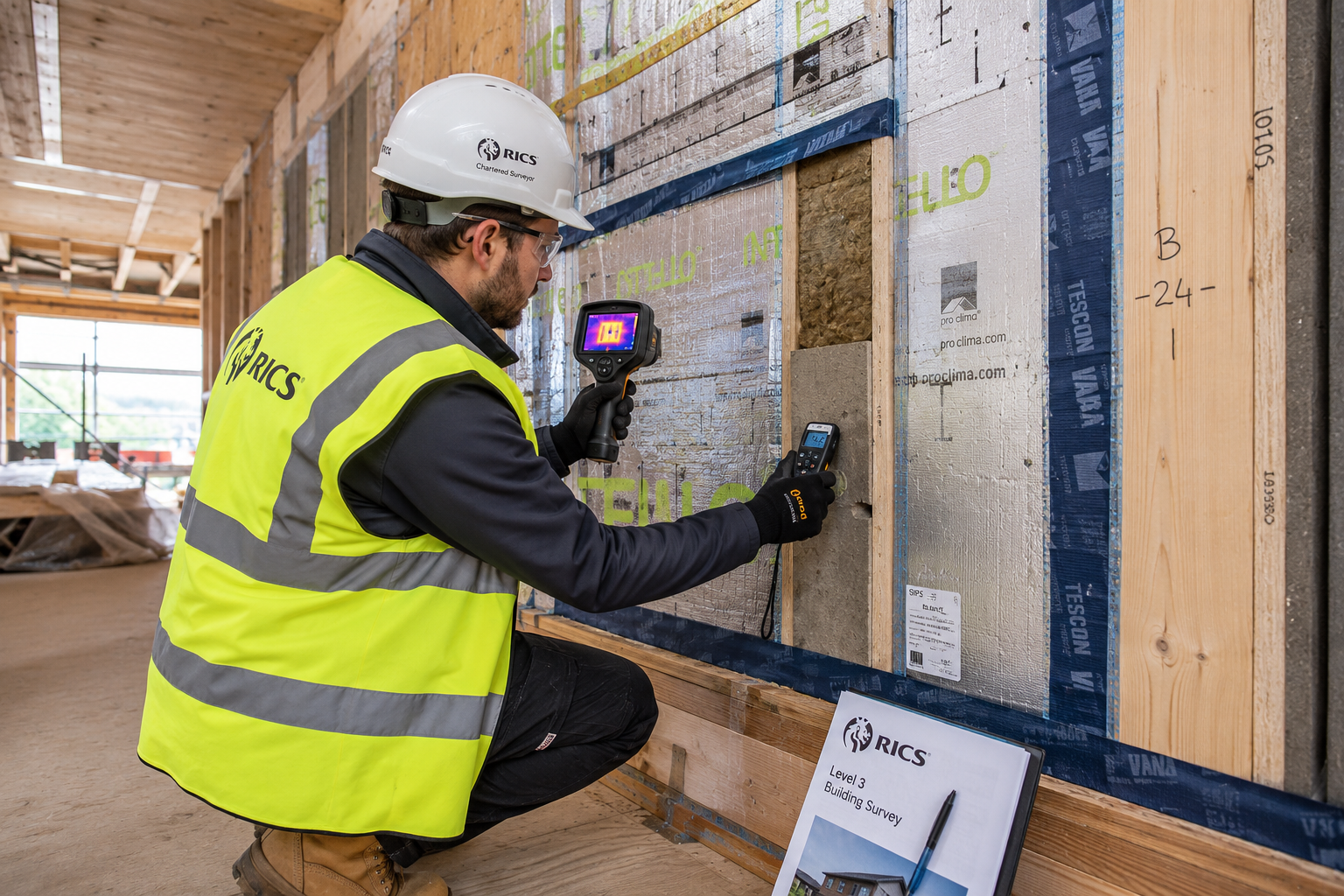
Thermal imaging cameras can reveal:
- Cold bridging at panel junctions (indicating missing or displaced insulation)
- Moisture patterns behind cladding or internal finishes
- Air leakage paths around windows, doors, and service penetrations
Moisture meters should be used systematically at all panel-to-foundation interfaces, around window reveals, and at any location where VCL integrity is in doubt.
Drone-Assisted Roof Inspection
Flat and low-pitch roofs on modular units are difficult to inspect safely from ground level. Drone surveys provide high-resolution imagery of membrane condition, drainage details, and any ponding or debris accumulation — without the cost and delay of scaffold access.
Reviewing the Costed Defect Schedule
A key differentiator of Level 3 surveys is the inclusion of cost estimates for remedial work [2]. For MMC homes, this is particularly important because:
- Contractors unfamiliar with the specific system may over- or under-price repairs
- Some remedial works (e.g., replacing a damaged VCL) require specialist subcontractors
- Costs can be used in purchase price negotiations or to inform a snagging claim against the developer
For a comprehensive comparison of what each survey level includes, the different types of survey comparison page provides a clear breakdown.
Choosing a Surveyor for MMC and Hybrid Timber Homes
Not all RICS-accredited surveyors have equal experience with MMC. When instructing a Level 3 survey on a hybrid timber or modular home, buyers should ask:
- ✅ Has the surveyor inspected properties using the same MMC system before?
- ✅ Are they familiar with BOPAS, NHBC Accepts, and Category 1–7 classification?
- ✅ Do they use thermal imaging as standard, or is it an add-on?
- ✅ Will the report include a costed schedule of defects?
- ✅ Can they advise on follow-up specialist investigations if needed?
Specialist firms now market Level 3 surveys specifically for modern timber and MMC homes, with costed defect schedules as standard output [2]. Turnaround for written reports is typically within 2–5 working days after inspection, even for complex properties.
For buyers in London and the South East, local chartered surveyors with specific MMC experience are available across a wide geographic area.
Cost and Timing: What to Expect in 2026
Level 3 surveys cost more than Level 2 — the inspection is longer, the report is more detailed, and for MMC homes the additional time spent establishing construction type and reviewing documentation pushes costs toward the higher end of typical price bands [8].
| Property Type | Approximate Level 3 Cost Range |
|---|---|
| Small MMC home (up to 100m²) | £600 – £900 |
| Medium hybrid timber home (100–200m²) | £900 – £1,400 |
| Large or complex modular home (200m²+) | £1,400 – £2,000+ |
Costs are indicative for 2026 and vary by region, surveyor, and complexity.
The cost of a Level 3 survey should be weighed against the potential cost of undetected defects. A single VCL replacement, cavity barrier remediation, or module junction repair can run to tens of thousands of pounds — costs that a thorough Level 3 report may identify before exchange [10].
For buyers considering a Level 2 instead, it is worth reviewing what a Level 2 Homebuyer Survey covers — and where its limitations lie for non-traditional construction.
Conclusion: A Practical Framework for the New Generation of Construction
The UK's housing stock is changing faster than its inspection frameworks. Hybrid timber frames, SIPs panels, CLT structures, and volumetric modules are now mainstream — but the survey templates most buyers default to were not designed for them.
Level 3 Building Surveys for Hybrid Timber and MMC Homes: Identifying Defects in the UK's New Generation of Construction is not simply a longer version of a standard survey. It is a fundamentally different inspection process — one that identifies MMC category and certification, investigates moisture at interfaces, assesses differential movement, verifies fire-stopping continuity, and documents the data trail that makes future maintenance and resale viable.
Actionable Next Steps
- Confirm construction type early. Ask the estate agent or developer for BOPAS, NHBC Accepts, or warranty documentation before instructing a survey. If in doubt, instruct a Level 3.
- Choose a surveyor with MMC experience. Ask specific questions about their familiarity with the construction system, thermal imaging capability, and costed defect schedules.
- Request all documentation. O&M manuals, as-built drawings, and cavity barrier layouts should be provided by the developer. Note any gaps in the Level 3 report.
- Budget for follow-up investigations. A Level 3 survey may recommend specialist damp, structural, or fire-stopping assessments. Factor these into purchase costs.
- Use the report in negotiations. A costed defect schedule is a legitimate basis for price renegotiation or a snagging claim against the developer.
The new generation of UK construction deserves a new generation of inspection rigour. A Level 3 survey, properly scoped and expertly delivered, is the tool that provides it.
References
[1] Building Survey – https://www.legalandgeneral.com/surveying-services/choose-a-survey/building-survey/
[2] Watch – https://www.youtube.com/watch?v=1uPxGe4UjaI
[3] Modern Methods Of Construction – https://goreport.com/modern-methods-of-construction/
[4] Level 3 Building Survey – https://jdmproperty.uk/level-3-building-survey
[5] Level 3 Building Survey Faq Costs Quotes Homebuyers – https://residentialsurveying.co.uk/blog/types-of-residential-survey-explained/level-3-building-survey-faq-costs-quotes-homebuyers
[6] Is A Level 3 Building Survey Overkill – https://www.reddit.com/r/HousingUK/comments/pb754g/is_a_level_3_building_survey_overkill/
[7] The Importance Of A Level 3 Building Survey For Older Properties – https://trinitysurveyors.co.uk/2024/10/04/the-importance-of-a-level-3-building-survey-for-older-properties/
[8] House Surveys Uk The Costs Types And Benefits Of An Rics Home Survey – https://www.rics.org/consumer-guides/house-surveys-uk-the-costs-types-and-benefits-of-an-rics-home-survey
[9] facebook – https://www.facebook.com/groups/thevaultcommunity/posts/2920834168079157/
[10] Level 3 Building Survey Is It Worth Investment – https://www.mvsurveying.co.uk/level-3-building-survey-is-it-worth-investment