

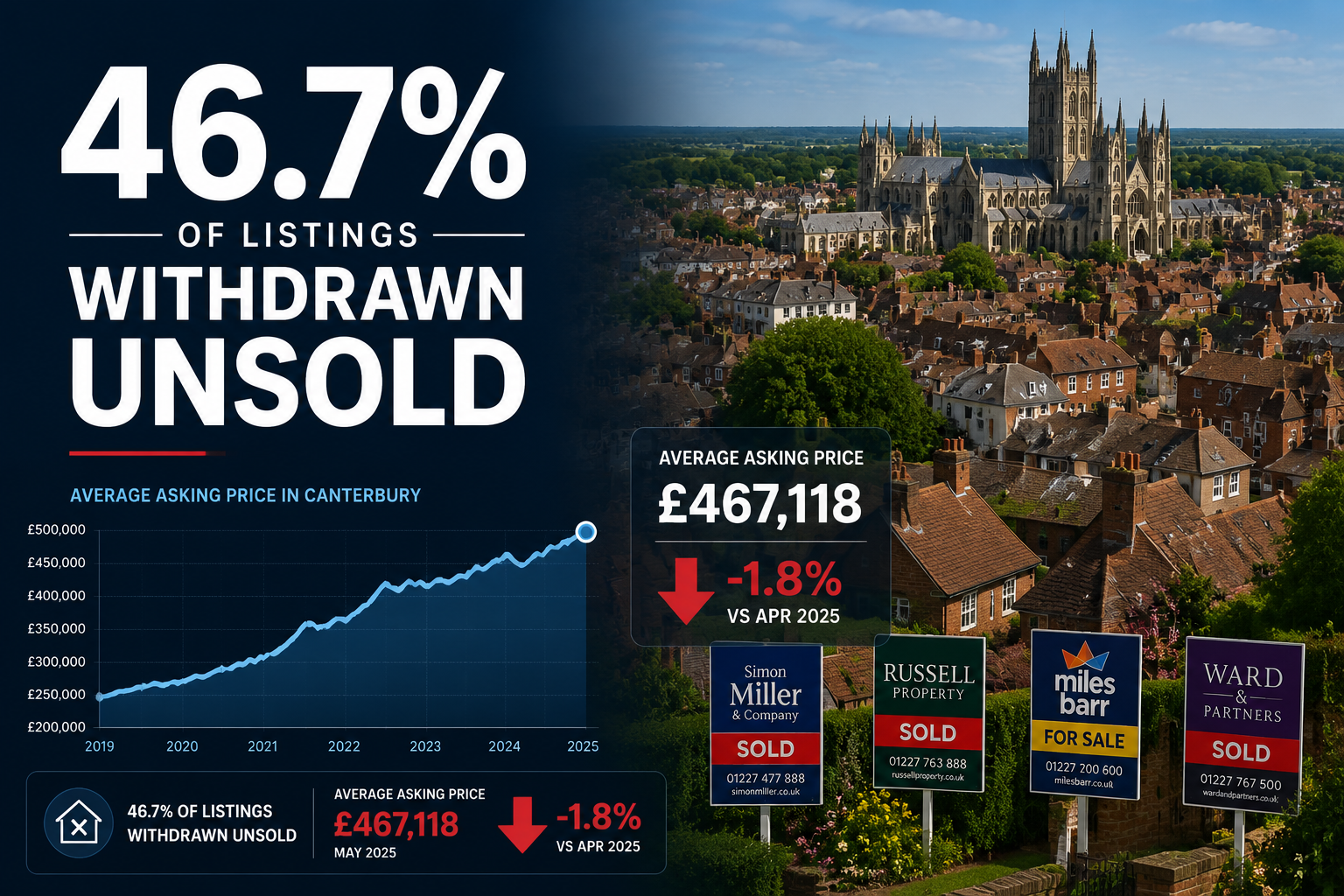
Nearly half of all homes that left estate agents' books in April 2026 were withdrawn unsold — not sold, not under offer, simply pulled from the market. That single statistic tells a story about the Kent property market 2026 sellers withdrawing listings overvaluing trend that every buyer and seller in Canterbury and across Kent needs to understand before they act.
UK residential transactions are running 14.6% higher year-to-date compared with 2025, which sounds encouraging. But beneath that headline figure, a quieter crisis is unfolding: sellers who tested the market with optimistic asking prices are retreating, frustrated that buyers simply aren't biting. With mortgage rates creeping upward on the back of global economic tensions, affordability is tighter than it looks — and overpriced stock is sitting, stagnating, and ultimately disappearing from the portals without a sale.
Key Takeaways 🏡
- 46.7% of homes removed from estate agents' books in April 2026 were withdrawn unsold, predominantly due to overvaluing
- UK transactions are up 14.6% year-to-date, but rising mortgage rates are squeezing buyer affordability
- Overpriced listings in Kent are sitting longer, with days on market increasing and price reductions accelerating
- A RICS HomeBuyer Report (Level 2) or Building Survey (Level 3) gives buyers hard evidence to negotiate price reductions on optimistically priced properties
- Canterbury and Kent's period property stock — timber framing, damp, conservation area constraints — creates genuine valuation complexity that sellers and agents frequently underestimate
What the Data Actually Shows About the Kent Property Market in 2026
The Withdrawal Rate Is Not a Blip
When 46.7% of listings exit estate agents' books without a sale, that is not a seasonal quirk. It reflects a structural mismatch between what sellers want to achieve and what buyers — constrained by affordability and cautious about overpaying — are willing to pay.
Price reductions are accelerating across 2026 as sellers struggle with longer days on market and mounting buyer affordability pressure. Homes that would have sold quickly in the post-pandemic frenzy are now sitting on the market for weeks, then months. Many vendors are making the costly mistake of overpricing and chasing the market down — reducing in increments rather than pricing correctly from day one.
💬 "Overpriced listings don't just fail to sell — they actively damage a property's perceived value the longer they sit on the market."
Why Mortgage Rates Are Making This Worse
The Bank of England's base rate has remained elevated, and global tensions — particularly trade uncertainty and energy price volatility — have kept lenders cautious. Fixed-rate mortgage products have crept upward from their late-2025 lows. For a buyer purchasing a £400,000 property in Canterbury, even a 0.5% increase in their mortgage rate adds roughly £100 per month to repayments. That changes what they can afford — and therefore what they are willing to offer.
Sellers who priced in late 2024 or early 2025 based on then-prevailing conditions are now discovering that the goalposts have shifted.
Why Overvaluing Is So Common in Kent — And How Buyers Can Fight Back
The Kent Valuation Problem
Kent's property market is unusually complex to value accurately. The county contains:
- Medieval and Tudor timber-framed properties throughout Canterbury, Faversham, and the Weald
- Victorian and Edwardian terraces in Whitstable, Herne Bay, and Folkestone
- Oast house conversions and rural properties with agricultural ties
- Conservation area homes where permitted development rights are restricted or removed entirely
Estate agents — particularly those incentivised to win instructions — sometimes provide aspirational valuations to secure the listing. The result is an asking price that looks attractive on paper but does not survive contact with a surveyor's findings or a mortgage lender's valuation.
The Role of a RICS Survey in Price Negotiation
This is where buyers hold genuine power in the current market. A RICS HomeBuyer Report (Level 2) provides a structured assessment of a property's condition, flagging defects using a traffic-light rating system. When a surveyor identifies issues — and in Kent's older stock, they almost always do — buyers have documented, professional evidence to support a renegotiation.
A RICS Building Survey (Level 3) goes further, providing a detailed analysis of construction, materials, and defects. For any property built before 1920 — which covers a substantial portion of Canterbury's housing stock — a Level 3 survey is strongly advisable.
Not sure which survey is right for your purchase? Our guide to choosing the right property survey explains the key differences clearly.
Common Issues Found in Kent Period Properties 🔍
| Issue | Typical Properties Affected | Potential Cost Impact |
|---|---|---|
| Damp ingress | Timber-framed, solid-wall | £2,000–£15,000+ |
| Timber decay / beetle | Pre-1920 oak frames | £5,000–£30,000+ |
| Chimney stack movement | Victorian terraces | £1,500–£8,000 |
| Conservation area restrictions | Canterbury city centre | Limits future works |
| Roof structure defects | Oast conversions, cottages | £8,000–£25,000+ |
| Subsidence / settlement | Clay soils in Weald | £10,000–£50,000+ |
Each of these issues represents a legitimate basis for price renegotiation — but only if you have a professional report documenting them.
Damp: Kent's Most Underestimated Problem
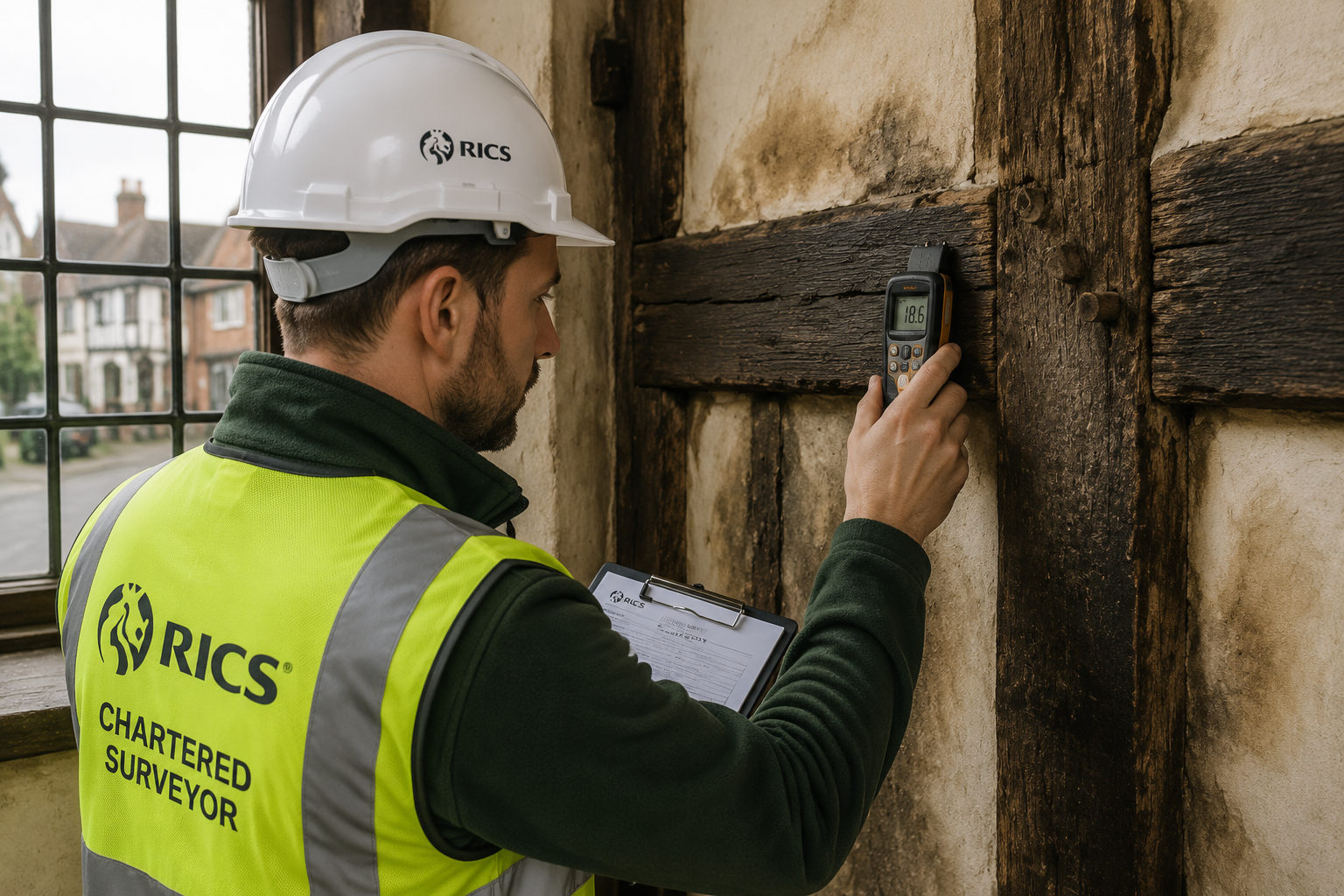
Damp is endemic in Kent's older housing stock. Solid brick walls, flagstone floors, and inadequate subfloor ventilation create conditions where moisture accumulates unseen. Our damp surveys regularly identify issues that sellers — and their agents — have either missed or chosen not to disclose. When an asking price has been set without accounting for a damp remediation programme costing £8,000–£12,000, that is a directly negotiable figure.
Conservation Areas: The Hidden Cost Sellers Ignore
Canterbury's historic core, along with designated areas in Whitstable, Sandwich, and Tenterden, sit within conservation areas. This means:
- Permitted development rights are restricted — extensions, outbuildings, and roof alterations may require full planning consent
- Materials must match existing character — cheaper modern alternatives are often refused
- Permitted development for solar panels or double glazing may be curtailed
A seller who has priced their property as though it has the same development potential as an equivalent home outside the conservation area has made a valuation error. Our Canterbury property valuation service accounts for these constraints properly.
What Sellers Should Do Instead of Withdrawing
The 46.7% withdrawal rate in the Kent property market 2026 sellers withdrawing listings overvaluing landscape is not inevitable. Sellers who take a different approach — realistic pricing, pre-sale surveys, transparent disclosure — are completing transactions while their neighbours' boards come down.
Practical steps for sellers:
- ✅ Commission an independent RICS valuation before instructing an agent — not an agent's free market appraisal
- ✅ Consider a pre-sale building survey to identify issues before buyers find them
- ✅ Price at market value, not aspirational value — the first two weeks of a listing generate the most buyer interest
- ✅ Be transparent about known defects — buyers who discover issues late become nervous buyers who pull out
- ✅ Understand your property's constraints — conservation area status, non-standard construction, or leasehold complications all affect achievable price
How Canterbury Surveyors Can Help Buyers Negotiate
As a RICS chartered firm covering Canterbury and the wider Kent area, we provide local chartered surveyors who understand the specific characteristics of Kent's housing stock. We know what to look for in a Wealden hall house, a Canterbury Victorian terrace, or a converted oast.
When our survey identifies defects in an overpriced property, we provide clear, costed commentary that buyers can take directly to the negotiating table. In the current market — where sellers withdrawing listings and overvaluing is the dominant story — that professional leverage is more valuable than ever.
For buyers considering properties with structural complexity, our structural surveys provide the deepest level of investigation available.
Conclusion: Use the Market Conditions to Your Advantage
The Kent property market in 2026 is sending buyers a clear signal: overpriced properties are vulnerable. With nearly half of all withdrawn listings leaving the market unsold due to overvaluing, and with mortgage rate pressures limiting what buyers can genuinely afford, the balance of negotiating power has shifted.
Actionable next steps:
- 📋 Book a RICS Level 2 or Level 3 survey before exchanging contracts — not after
- 💬 Use survey findings to renegotiate — a documented defect is a legitimate price reduction
- 🏛️ Check conservation area status and permitted development rights on any Canterbury or Kent period property
- 📊 Request an independent valuation if the asking price looks optimistic relative to comparable sales
- 🤝 Work with local RICS surveyors who know Kent's property stock intimately
The sellers who are withdrawing listings in 2026 are not the ones who priced realistically and disclosed openly. They are the ones who chased a number that the market was never going to deliver. As a buyer, a professional survey is your most powerful tool for ensuring you do not pay that inflated price.
Ready to instruct a survey? Contact Canterbury Surveyors today — our RICS chartered team covers Canterbury, Whitstable, Faversham, Folkestone, and the wider Kent area.