Nearly one in three property transactions in the UK that collapse before exchange do so because a survey reveals unexpected defects — defects that a buyer simply was not prepared for. As the housing market recovers momentum in 2026 and transaction volumes climb, the pressure on surveyors and buyers alike to get pre-offer assessments right has never been greater. Defect Diagnosis in Older Properties: Building Pathology Essentials for Pre-Offer Surveys in 2026 is no longer just a professional checklist — it is a financial safeguard that can protect tens of thousands of pounds and prevent months of wasted time.
Older properties, broadly defined as those built before the 1980s, carry a unique set of risks. From subsidence and rising damp to hazardous materials and failing roofs, the catalogue of potential issues is long. Understanding what to look for — and when to instruct the right type of survey — is the foundation of a smart purchase decision.
Key Takeaways 📋
- Pre-offer surveys on older properties should go beyond a standard valuation — structural, damp, and hazardous material checks are essential.
- Stepped cracks, binding doors, and uneven floors are early warning signs of foundation movement that require specialist investigation.
- Damp, asbestos, and lead are the three most costly hidden defects in pre-1980s properties and demand targeted diagnostic reports.
- Energy performance ratings now carry legal and financial weight — a poor rating can reduce property value by up to 20% [1].
- Choosing the right survey level before making an offer can prevent fall-throughs and give buyers powerful negotiating leverage.
Why Older Properties Demand Specialist Defect Diagnosis
The UK housing stock is among the oldest in Europe. Millions of homes were built before modern building regulations existed, using materials and methods that have now reached or exceeded their design life. For buyers, this creates both opportunity and risk.
💬 "An older property can offer character, space, and value — but only if the buyer truly understands what they are purchasing."
When transaction volumes rise, as they are doing in 2026, the temptation to move quickly and skip thorough due diligence increases. Estate agents report faster offer timescales, and competitive bidding can push buyers to commit before surveys are complete. This is precisely when building pathology knowledge becomes critical.
What Makes Older Buildings Different?
Older properties were built with:
- Solid masonry walls rather than modern cavity construction — making them more susceptible to penetrating damp
- Timber frames and joists that may have been affected by rot, woodworm, or beetle infestation over decades
- Original drainage systems that may be clay-pipe, partially collapsed, or tree-root invaded
- Hazardous materials including asbestos (pre-1997 builds) and lead paint (pre-1949 builds)
- Electrical and gas installations that may predate modern safety standards
A RICS Building Survey is the most thorough option for older properties, providing a detailed assessment of condition across all major elements. For buyers uncertain which level of inspection they need, understanding the difference between a Level 2 and Level 3 survey is a valuable first step.
The Core Defects: A Building Pathology Framework for 2026
Effective defect diagnosis in older properties follows a systematic approach. Surveyors trained in building pathology do not simply note what is visible — they trace symptoms back to root causes. The following are the five most consequential defect categories in older home inspections.
1. 🏗️ Foundation Movement and Structural Cracking
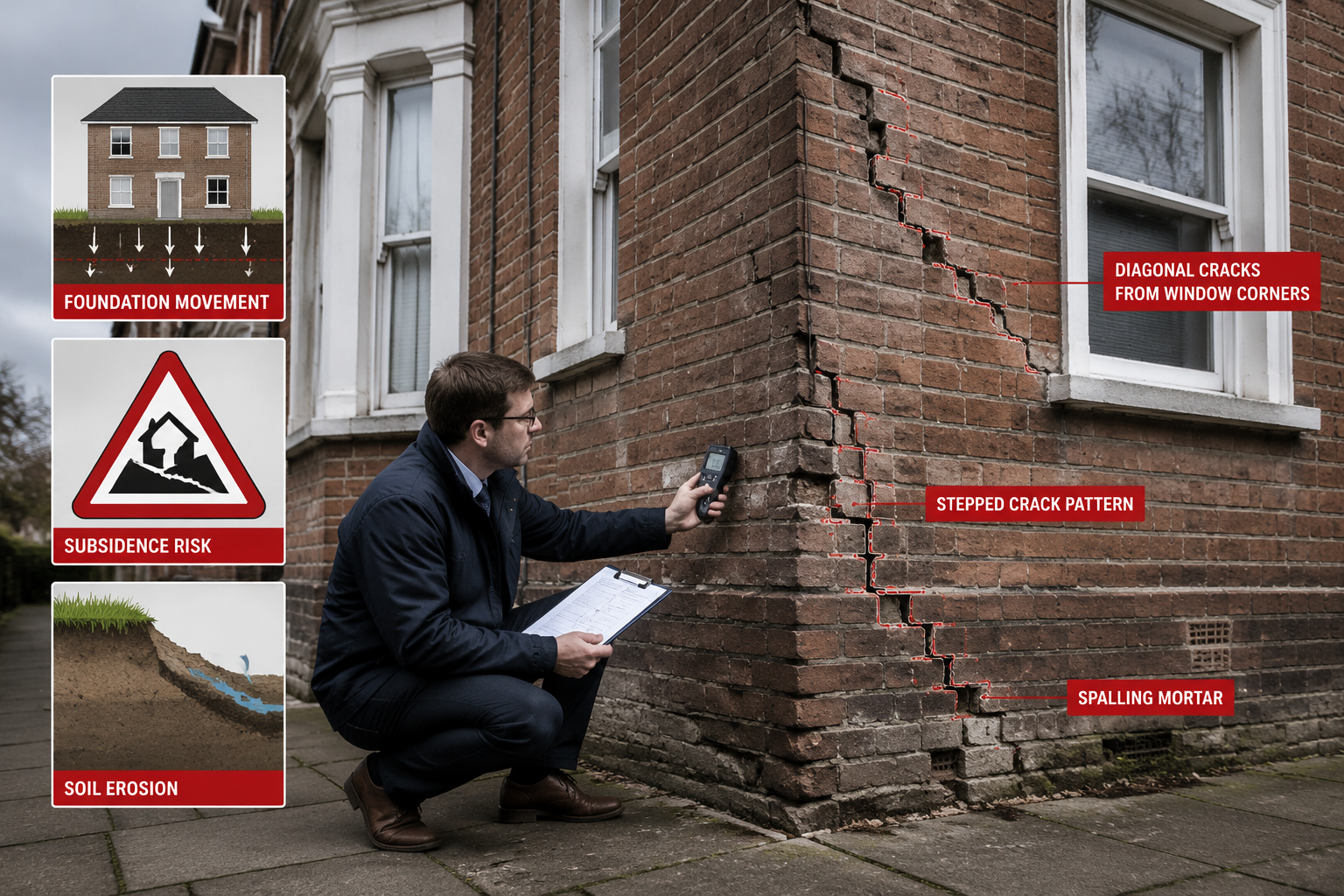
Structural movement is one of the most alarming findings in any pre-offer survey. The key is distinguishing between historic, stable movement and active, progressive movement.
Warning signs include:
| Sign | Likely Cause |
|---|---|
| Stepped cracks in brickwork | Differential settlement or subsidence |
| Diagonal cracks from window corners | Foundation movement or lintel failure |
| Binding or sticking doors and windows | Frame distortion from structural shift |
| Uneven or sloping floors | Joist failure or foundation settlement |
| Cracks wider at top than bottom | Hogging movement (centre sinking) |
These symptoms are commonly caused by soil moisture changes, tree root activity, poor drainage, or historic plumbing leaks [4]. A specialist subsidence survey can determine whether movement is ongoing and what remediation is required.
2. 💧 Damp, Moisture Ingress, and Masonry Decay
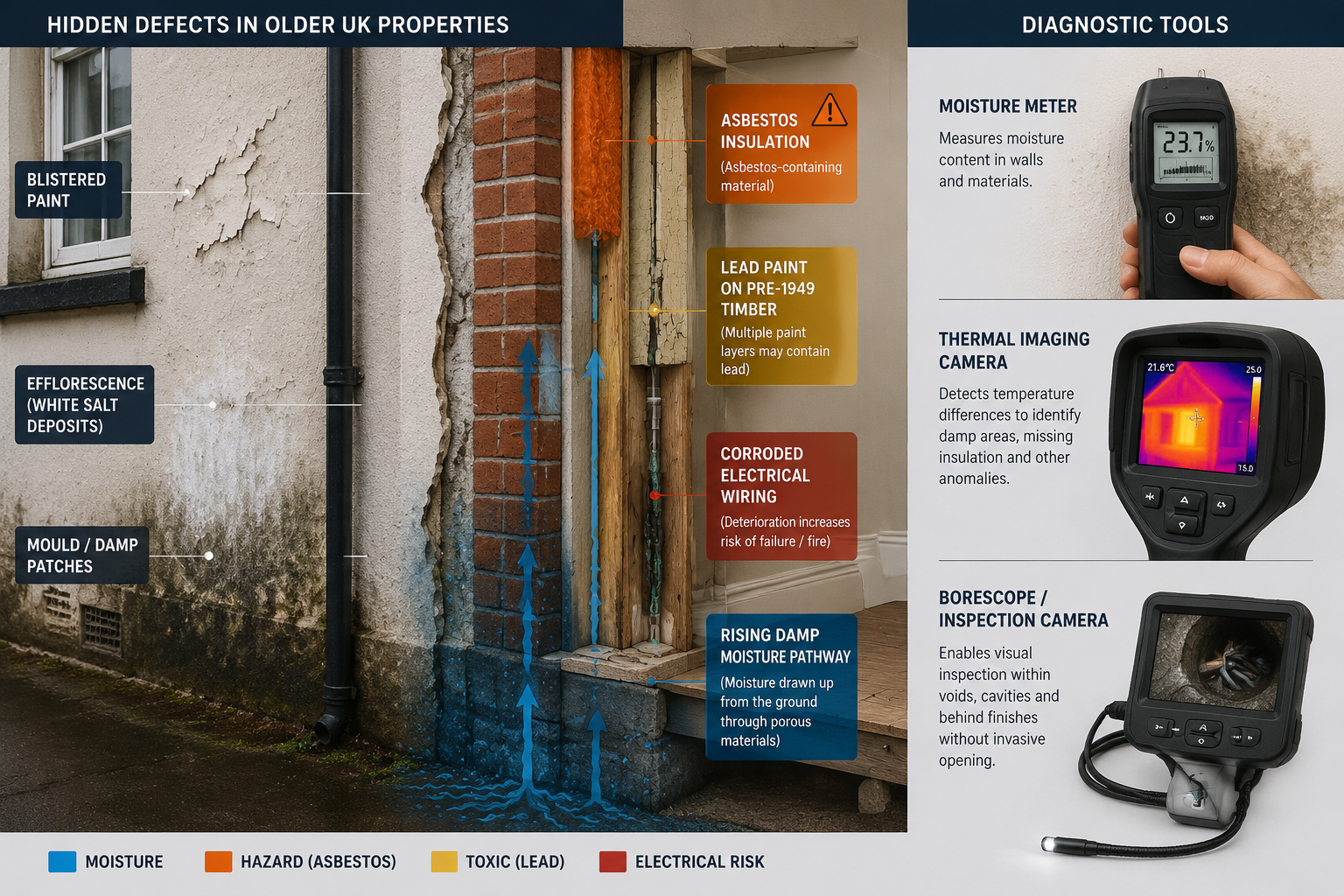
Persistent moisture is the single greatest driver of structural deterioration in older UK properties [4]. Unlike modern cavity-wall construction, solid masonry walls in Victorian and Edwardian homes absorb and transmit moisture in ways that are often invisible until significant damage has occurred.
Key indicators of damp problems:
- 🔹 Tide marks or staining at low level (rising damp)
- 🔹 Blistered or peeling paint at skirting level
- 🔹 Musty or earthy odour in ground floor rooms
- 🔹 Efflorescence (white salt deposits) on external brickwork
- 🔹 Cupped or springy timber floors
- 🔹 Mould growth on internal walls or ceilings
In coastal areas, salt attack accelerates masonry decay significantly, making specialist inspection even more important [4]. A specific defect report targeting damp can isolate the type, cause, and extent of moisture ingress before any offer is made.
3. ☣️ Hazardous Materials: Asbestos and Lead
Two legacy materials continue to pose significant health and financial risks in older properties.
Asbestos was widely used in construction until its ban in 1999. Regulations in comparable markets such as France make asbestos reports mandatory for all properties built before 1997, with costs typically ranging from €80–150 per inspection [2]. In the UK, while not always legally mandated in residential sales, an asbestos survey is strongly recommended for any property built before the late 1990s.
Lead paint is a concern in properties built before 1949. French regulations require a Lead Exposure Risk Report (CREP) for all such properties, with costs ranging from €100–300 [2]. In the UK context, buyers of pre-war properties should request targeted lead paint testing as part of their pre-offer due diligence.
⚠️ Critical note: Disturbing asbestos-containing materials during renovation without prior identification can result in significant health risks and legal liability. Always survey before any works begin.
4. ⚡ Electrical and Gas Installations
Older electrical systems — particularly those with rubber-insulated wiring, round-pin sockets, or fuse boxes without residual current devices (RCDs) — present genuine fire and safety risks. Similarly, gas installations that have not been inspected or updated within the last 15 years require careful scrutiny.
French regulations require mandatory electrical and gas inspections when systems exceed 15 years old, with a 3-year validity period and costs of €100–200 for electrical and €100–170 for gas inspections [2]. While UK requirements differ, the underlying logic is sound: any system over 15 years old in an older property warrants professional assessment.
5. 🏠 Roof Condition and Envelope Integrity
The roof is the primary line of defence against weather. In older properties, original slates, clay tiles, or flat-roof coverings may be approaching or beyond their serviceable life. A professional roof survey can identify:
- Missing, slipped, or cracked tiles/slates
- Failed flashings at chimney stacks and abutments
- Deteriorated felt underlays
- Flat roof membrane failure or ponding
- Gutter and downpipe defects causing wall saturation
Roof replacement costs can range from £5,000 to £30,000+ depending on size and specification — making this one of the highest-value defects to identify before an offer is made.
Energy Performance and the Financial Impact of Poor Ratings
In 2026, energy performance is no longer a peripheral concern — it is a core component of defect diagnosis in older properties: building pathology essentials for pre-offer surveys in 2026. Poor energy efficiency directly affects property value, mortgage availability, and long-term running costs.
The DPE Effect on Property Value
Research from the French regulatory framework — which is ahead of the UK in mandating energy transparency — shows that a poor energy rating (equivalent to an F or G EPC) can lead to a 5% to 20% decrease in property value [1]. The French DPE (Diagnostic de Performance Énergétique) has been legally binding since 2021, allowing buyers to pursue legal action against sellers for errors [1].
The 2026 reform in France has introduced a revised electricity conversion factor that improves the rating of many electrically heated homes [1] — a development that signals the direction of travel for UK energy regulation as well.
In the UK, homes rated F or G on the EPC scale face:
- Restrictions on rental to new tenants (already in force for landlords)
- Reduced mortgage options from some lenders
- Buyer resistance and price negotiation pressure
- Mandatory energy audits in some transaction scenarios
Energy audits have been mandatory for F and G-rated homes in France since April 2023, a requirement continuing in 2026 [2]. UK buyers purchasing older properties with poor EPC ratings should commission an independent energy assessment to understand the true cost of improvement.
What Poor Insulation Really Costs
Older buildings frequently have:
- Solid walls with no cavity for insulation
- Single-glazed or early double-glazed windows
- Uninsulated loft spaces or flat roofs
- Inefficient heating systems
These factors combine to produce significantly higher utility bills compared to modern equivalents [6]. A buyer who does not account for insulation upgrade costs in their purchase price calculation may find themselves substantially out of pocket within the first year of ownership.
Choosing the Right Survey: Matching Diagnosis to Property Risk
Not every older property requires the same level of investigation. The key is matching the survey type to the specific risk profile of the building.
| Property Type | Recommended Survey | Key Focus Areas |
|---|---|---|
| Victorian/Edwardian terraced house | Level 3 Building Survey | Structure, damp, drainage, hazardous materials |
| 1930s semi-detached | Level 3 Building Survey | Subsidence, electrical, roof |
| Post-war (1945–1970) | Level 2 or Level 3 | Flat roof, asbestos, drainage |
| Pre-offer (any older property) | Specific Defect Report | Targeted issue investigation |
| Non-standard construction | Specialist structural report | Frame integrity, material condition |
For properties showing specific symptoms — such as visible cracking, damp staining, or suspected asbestos — a RICS specialist defect survey provides targeted, expert-level diagnosis before any financial commitment is made.
Buyers who are still weighing their options can use the guide to choosing the right property survey to understand which level of inspection is appropriate for their specific circumstances.
The Pre-Offer Advantage 🎯
Commissioning a survey before making a formal offer — rather than after — provides several strategic advantages:
- Negotiating power: Documented defects support a lower offer or price reduction request
- Informed decision-making: Buyers can walk away without financial penalty if defects are severe
- Reduced fall-through risk: Surprises discovered post-offer are a leading cause of transaction collapse
- Budget accuracy: Knowing remediation costs upfront allows realistic financial planning
The complete diagnostic package for an older home in regulated markets ranges from €400 to €800, depending on property size and the number of diagnostics required [2]. In the UK, equivalent comprehensive survey costs vary but represent a fraction of the potential cost of undetected defects.
Defect Diagnosis in Older Properties: Building Pathology Essentials for Pre-Offer Surveys in 2026 — Regulatory and Market Context
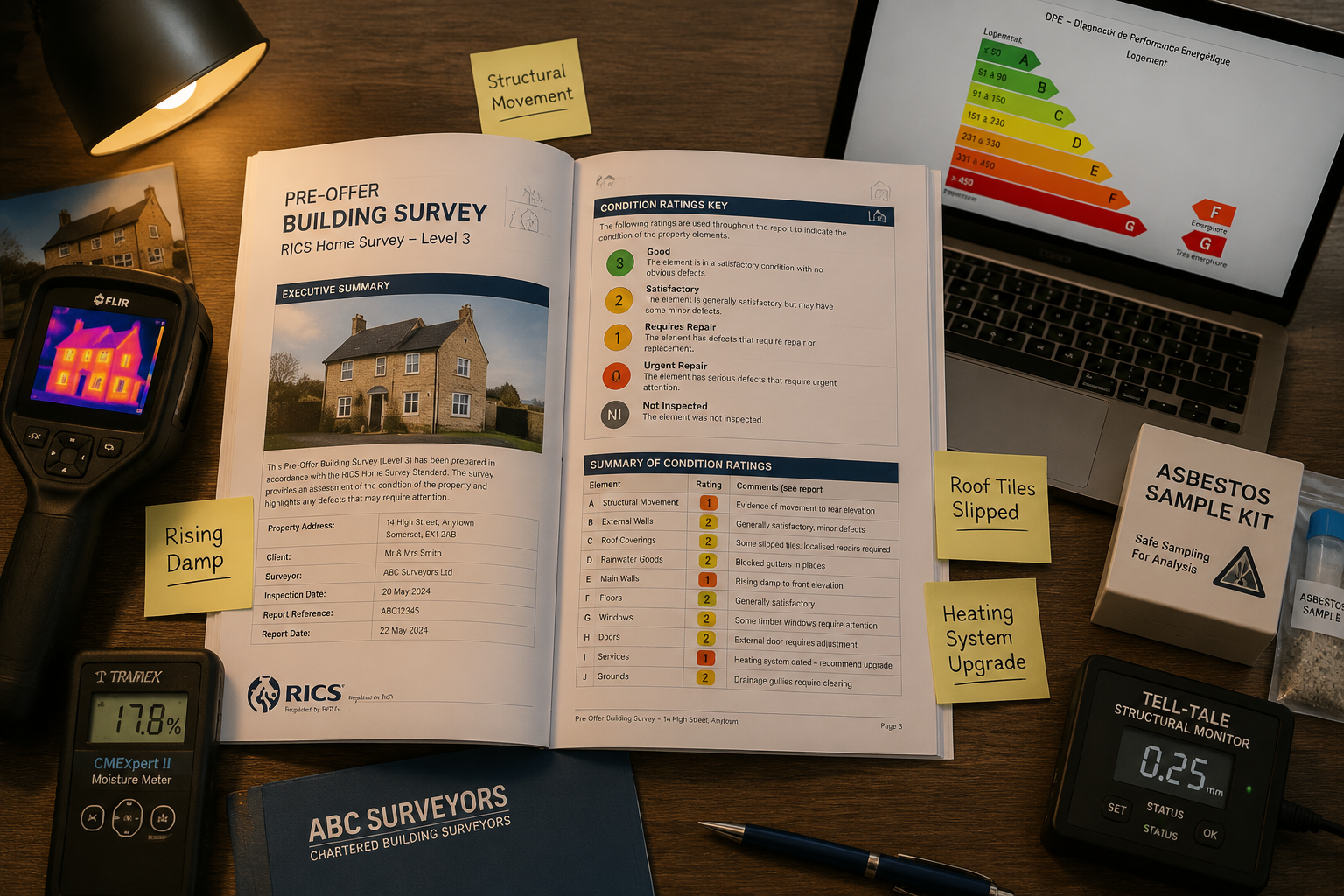
The regulatory environment surrounding property diagnostics is tightening globally. In France, 2026 regulations have been specifically strengthened to improve transparency and combat fraud in property transactions [1], with between 7 and 11 mandatory diagnostics now required depending on property type, age, and location [1][2].
The UK market is moving in a similar direction. Increased scrutiny of EPC ratings, growing awareness of hazardous materials liability, and the financial consequences of undisclosed defects are all driving demand for more thorough pre-purchase investigation.
For buyers working with local chartered surveyors, the 2026 landscape means:
- Greater accountability for survey accuracy and completeness
- More sophisticated diagnostic tools including thermal imaging, damp mapping, and drone roof inspection
- Stronger buyer rights in cases of undisclosed defects
- Higher demand for specialist reports on specific defect categories
The structural survey remains the gold standard for older properties where structural integrity is in question, while drainage surveys are increasingly recommended for any property with original clay-pipe drainage systems.
Conclusion: Actionable Next Steps for Buyers in 2026
Defect diagnosis in older properties is not an optional extra — it is the foundation of a sound property purchase decision. As transaction volumes increase and competitive pressure mounts, the temptation to cut corners on due diligence grows. Resisting that temptation is what separates buyers who complete successfully from those who face costly surprises post-completion.
✅ Actionable Next Steps
- Commission a pre-offer survey on any older property before submitting a formal offer — ideally a Level 3 Building Survey for properties built before 1980.
- Request specific defect reports for any visible symptoms: cracking, damp staining, or suspected hazardous materials.
- Check the EPC rating and factor improvement costs into your offer price — poor ratings can affect value by up to 20% [1].
- Instruct a drainage survey on properties with original drainage systems or mature trees nearby.
- Verify the age of electrical and gas installations and budget for upgrades if systems are over 15 years old.
- Work with a RICS-accredited surveyor who specialises in older properties and building pathology.
The investment in thorough pre-offer diagnosis is small relative to the financial exposure of an uninspected purchase. In 2026, with the tools, expertise, and regulatory frameworks now available, there is no good reason to buy blind.
References
[1] Mandatory Property Diagnostics In Real Estate Transactions The Complete 2026 Guide – https://www.new-place.com/mandatory-property-diagnostics-in-real-estate-transactions-the-complete-2026-guide/
[2] Mandatory Diagnostics Sale – https://guide-maison-habitat.com/en/blog/mandatory-diagnostics-sale/
[3] 5 Common Defects In Older Properties – https://www.simonlevy.net/5-common-defects-in-older-properties
[4] Top 5 Structural Defects Found In Older Home Inspections – https://broadbuildinginspections.com.au/insights/top-5-structural-defects-found-in-older-home-inspections/
[5] What Defects Do Building Surveys Usually Reveal And Why You Should Care – https://lloyddixongroup.com/what-defects-do-building-surveys-usually-reveal-and-why-you-should-care/
[6] Essential Guide Defects Older Buildings Buyers – https://montskyrealestate.com/essential-guide-defects-older-buildings-buyers/