From 9 March 2026, every RICS member and RICS-regulated firm worldwide became subject to the first global mandatory professional standard on artificial intelligence in surveying. The question of how RICS' new Responsible Use of AI standard will reshape building surveys and valuation reports is no longer theoretical — it is a live compliance obligation that touches every inspection, every condition rating, and every figure entered into a valuation report where AI has played any material role. [1][3][9]
Key Takeaways
- The RICS Responsible Use of AI standard became mandatory on 9 March 2026, applying globally to all RICS members and regulated firms.
- Surveyors remain fully accountable for all AI-assisted outputs; AI cannot replace professional judgement or skill.
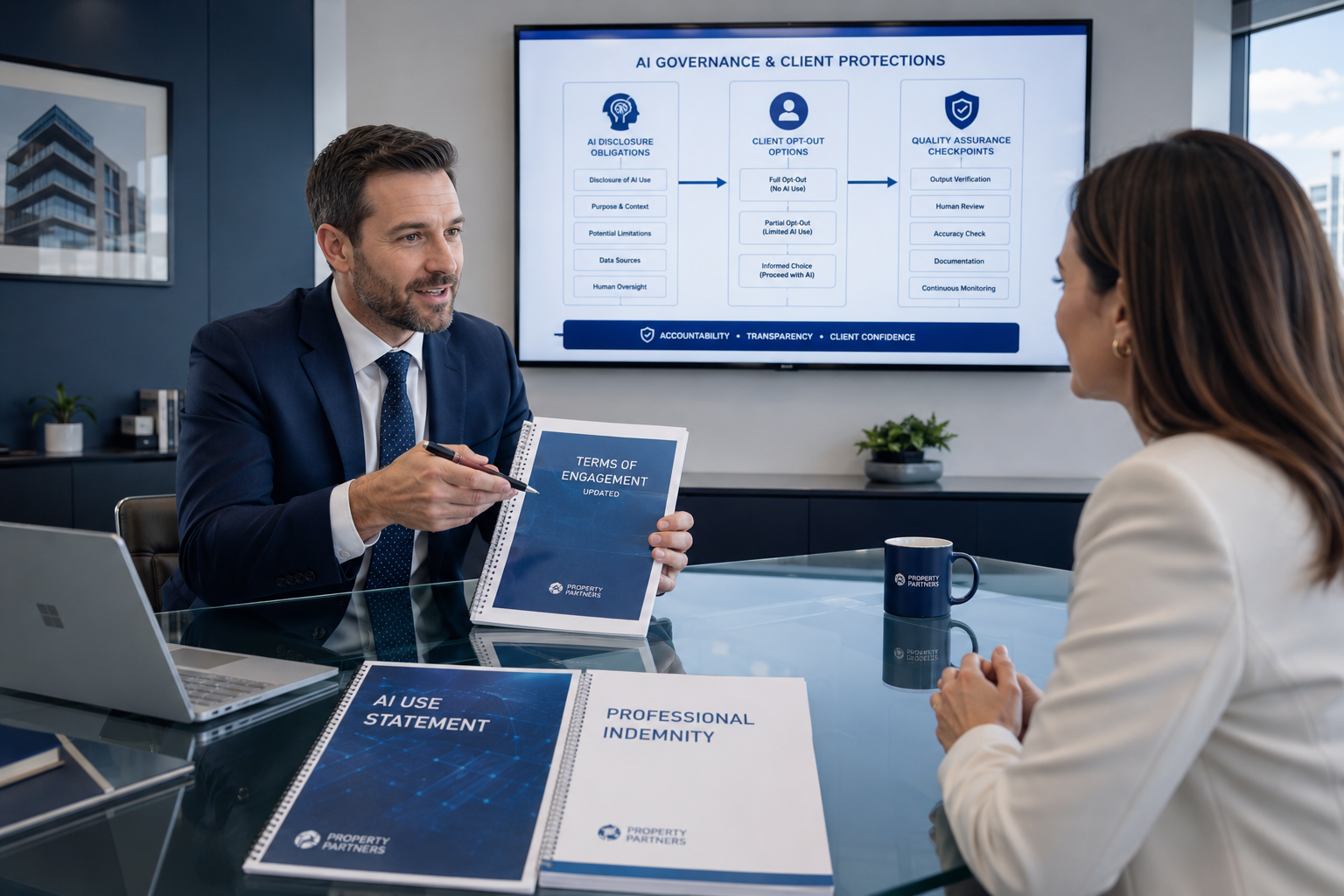
- Clients must receive written disclosure explaining when and how AI is used, with options to limit or opt out.
- Terms of engagement must be updated to cover AI use, professional indemnity arrangements, and redress mechanisms.
- Valuers must apply professional scepticism to AI-driven models such as automated valuation models (AVMs), consistent with Red Book Global Standards.
What the RICS Responsible Use of AI Standard Actually Says
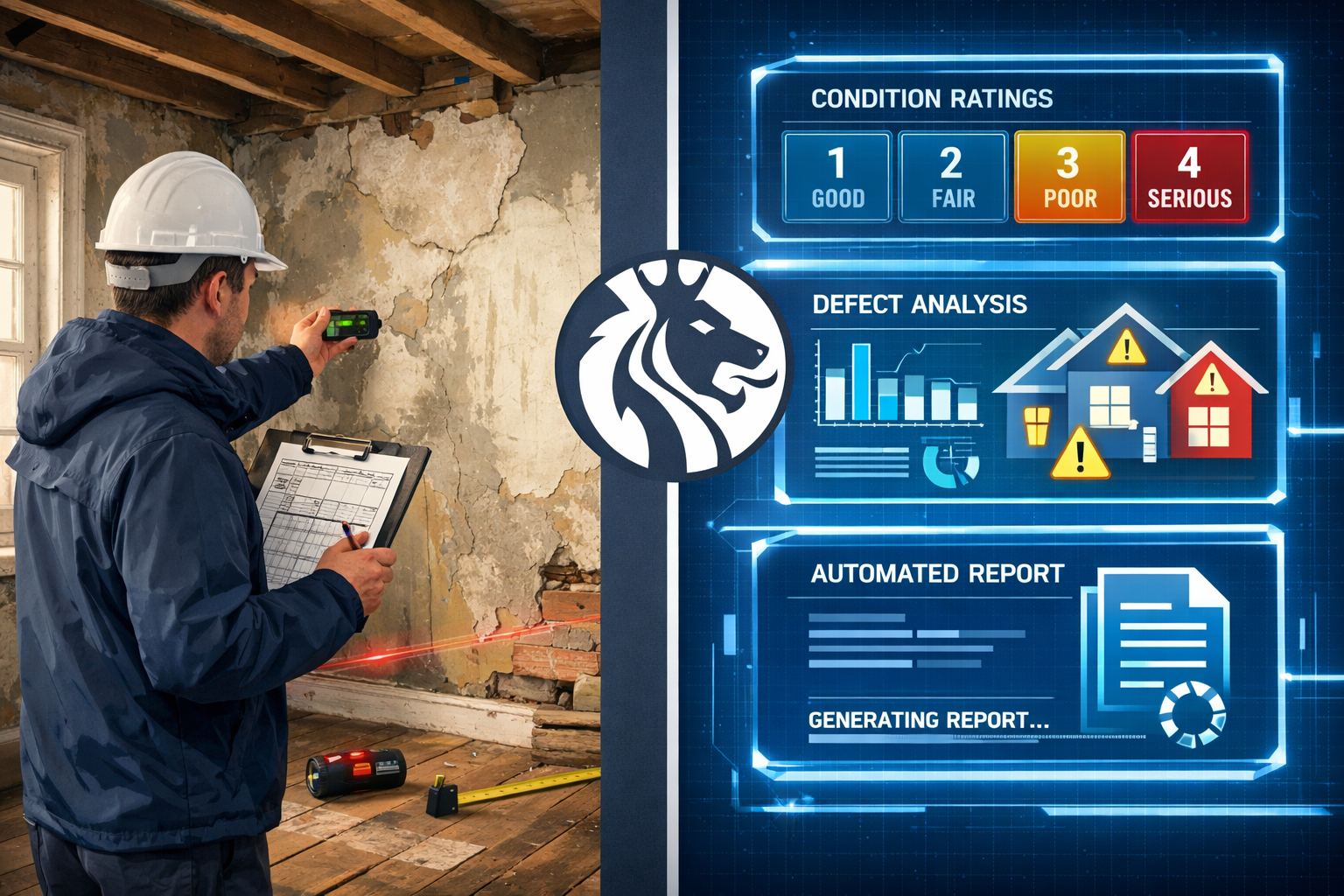
RICS describes this as the first global professional standard governing the responsible use of AI in surveying practice. [3][9] It applies wherever AI materially affects the delivery of a surveying service — which, in practical terms, covers a wide range of activities: defect identification during a building inspection, condition ratings in a Level 3 survey, comparable analysis in a residential valuation, and automated outputs from valuation modelling software. [1][9][10]
The standard does not prohibit AI use. Instead, it sets a framework of obligations built around three core themes:
- Accountability: The surveyor, not the AI system, is responsible for every output included in a report.
- Transparency: Clients must be told, in writing, when and how AI is being used.
- Compliance: Members must satisfy both the RICS standard and any applicable local legislation, including data protection and AI-specific laws in their jurisdiction. [1][9]
The standard was published in September 2025 and given a six-month implementation window before becoming enforceable. [10] That lead time was deliberate — RICS anticipated that firms would need to revise internal workflows, update terms of engagement, and train staff before the March 2026 deadline. [7]
How RICS' New Responsible Use of AI Standard Will Reshape Building Surveys
Surveyors Cannot Outsource Judgement to an Algorithm
The most significant shift for building surveyors is the explicit confirmation that AI must not replace professional judgement, skill, or scepticism. [2][3][10] This matters because AI-assisted tools are already embedded in parts of the survey workflow — from drone-based roof inspections to software that flags potential damp or structural anomalies from photographs.
Under the new standard, a surveyor cannot simply reproduce an AI-generated condition rating or defect diagnosis without documenting how that output was critically assessed and, where necessary, adjusted. [4][10] The human professional must be able to demonstrate that they applied their own expertise to verify the AI's conclusions.
For clients commissioning a RICS Level 3 building survey, this means the surveyor's professional narrative carries greater weight than ever. An AI tool might flag a crack pattern as potentially structural, but the surveyor must assess that finding against their direct observations, the age of the building, construction type, and wider context before including it in the report.
"The surveyor remains accountable for all outputs used in a building survey or valuation report, even if generated by AI." — RICS Responsible Use of AI Standard [10]
Documentation of AI Checks Becomes Part of the Survey Process
The standard requires surveyors to document how AI outputs were checked and adjusted before inclusion in defect diagnoses and condition ratings. [4][10] This is a meaningful operational change. Firms using AI-assisted inspection tools will need internal quality assurance processes that create an auditable trail — showing not just what the AI produced, but how the surveyor engaged with that output.
For specific defect reports and damp surveys, where AI image analysis tools are increasingly used to identify moisture patterns or timber deterioration, this documentation requirement adds a new layer of professional rigour. It is not an administrative burden for its own sake — it is the mechanism by which professional accountability is evidenced.
Terms of Engagement Must Be Updated
Every surveying firm using AI in its building survey work must update its terms of engagement. [4][7] The updated terms need to set out:
| Required Element | What It Means in Practice |
|---|---|
| Points in the process where AI is used | Identify which stages — inspection, reporting, analysis — involve AI tools |
| Professional indemnity insurance arrangements | Confirm PI cover extends to AI-assisted work |
| Internal quality assurance processes | Describe how AI outputs are reviewed before inclusion |
| Redress mechanisms | Explain what clients can do if they have concerns about AI use |
This table reflects the four key disclosure elements RICS has identified as mandatory in terms of engagement. [4][7] For firms offering RICS building surveys across a range of property types, this may mean creating service-specific engagement templates rather than relying on a single standard document.
How RICS' New Responsible Use of AI Standard Will Reshape Valuation Reports
Professional Scepticism and Automated Valuation Models
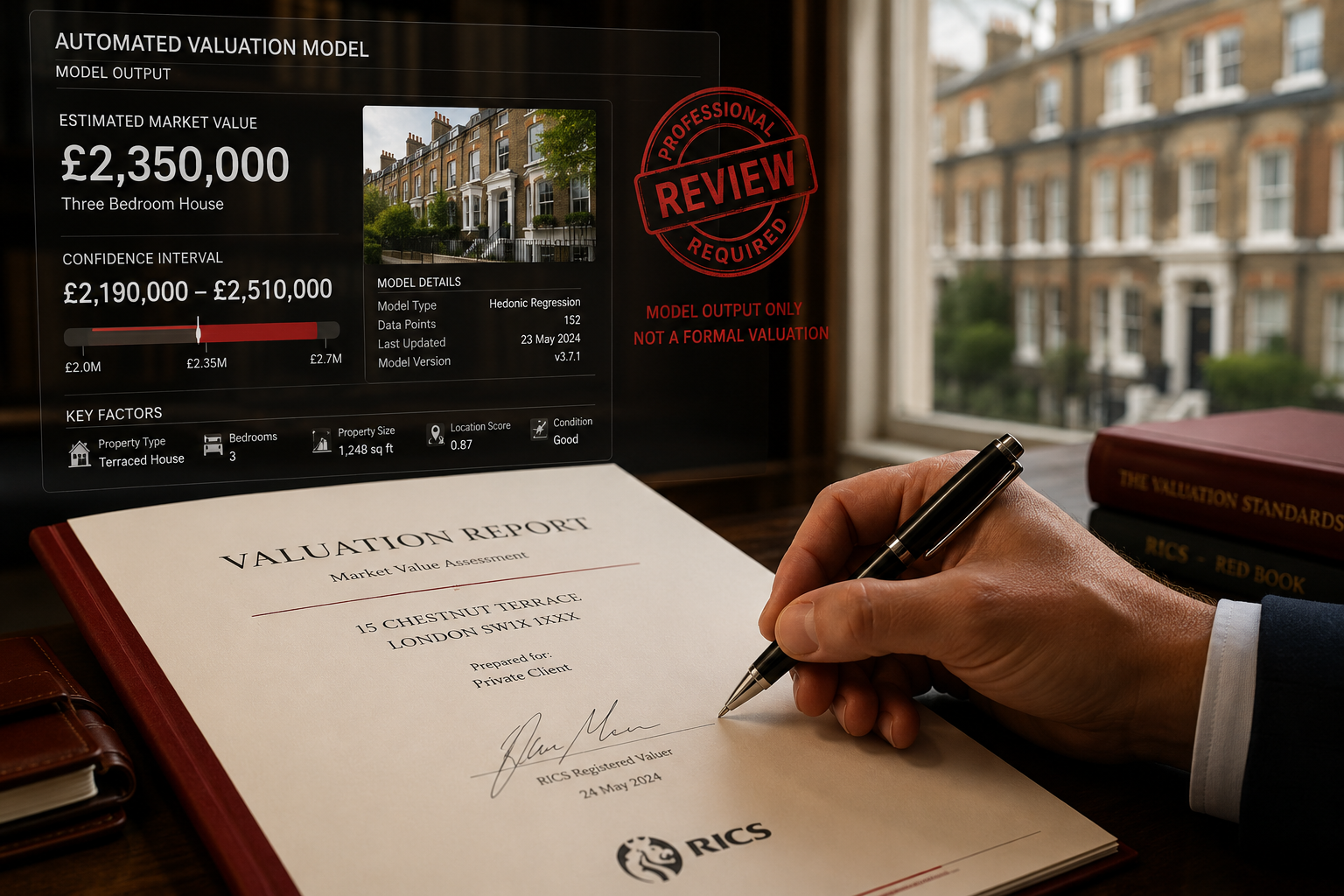
Valuation work presents some of the sharpest tensions between AI capability and professional responsibility. Automated valuation models (AVMs) are already widely used in mortgage lending, portfolio analysis, and desktop valuations. The new RICS standard links directly to the "professional scepticism" concept embedded in the Red Book Global Standards, which governs RICS-regulated valuers worldwide. [4][7][10]
In practice, this means a registered RICS valuer cannot simply adopt an AVM output as their valuation figure without critical assessment. They must interrogate the model's assumptions, check comparable evidence independently, and be prepared to depart from the AI-generated figure where their professional judgement demands it. [4][10]
This applies equally to specialist valuation work. Whether the instruction involves a probate valuation, a capital gains tax valuation, or an insurance reinstatement valuation, the valuer must be able to demonstrate that any AI-assisted analysis was subject to independent professional scrutiny before the final figure was adopted.
Standardised AI Disclosure Sections in Valuation Reports
One of the most visible changes for clients will be the appearance of standardised AI disclosure statements in valuation reports. [3][4][7] RICS anticipates that lender-facing valuations and pre-purchase surveys will develop consistent "AI use" sections, making it clear to all parties — buyer, lender, and solicitor — what role AI played in producing the report.
This is a significant shift in report structure. For years, valuation reports have followed broadly consistent formats, but the AI disclosure requirement introduces a new category of information that clients have a right to receive. [3][9] The disclosure must explain:
- Whether AI was used in the valuation process
- At which stage or stages it was applied
- What professional review was applied to AI outputs
- How clients can raise concerns or request further explanation
For commercial building surveys and dilapidations surveys, where AI tools may be used to assess large portfolios or model repair cost schedules, these disclosures will need to be proportionate to the complexity and materiality of the AI's contribution.
Jurisdiction-Specific Legal Compliance
RICS is explicit that its standard does not override local law — it sits alongside it. [1][9] This means that in the UK, AI-assisted valuation and survey work must comply with the UK GDPR, the Data Protection Act 2018, and any emerging domestic AI regulation, in addition to the RICS professional standard. Firms operating across multiple jurisdictions face the additional challenge of mapping RICS requirements against differing national frameworks.
For most UK-based surveying practices, the immediate priority is ensuring that data processed through AI tools — including property photographs, client information, and comparable transaction data — is handled in accordance with existing data protection obligations. [1][7]
What This Means for Clients Commissioning Surveys and Valuations in 2026
Clients Have New Rights
The mandatory disclosure requirement is not just an obligation on surveyors — it creates new rights for clients. [3][4][9] From March 2026, anyone commissioning a building survey or valuation report has the right to know:
- Whether AI will be used in producing their report
- What safeguards are in place to ensure accuracy
- What options they have to limit AI use or seek further explanation
This is a meaningful consumer protection development. Clients who are uncomfortable with AI involvement in, for example, a lease extension valuation or a divorce valuation — where the financial stakes are high and the figures may be contested — now have a formal basis to ask questions and receive answers before the work begins.
Quality Assurance Becomes Visible
Previously, a client receiving a survey or valuation report had limited visibility into the process behind it. The new standard changes this by requiring firms to describe their internal quality assurance processes in their terms of engagement. [4][7] Clients can now ask directly: how does your firm check AI outputs before they appear in my report?
This transparency requirement is likely to become a differentiator in the market. Firms with robust, well-documented AI governance processes will be better placed to demonstrate compliance and build client confidence than those treating the standard as a box-ticking exercise.
Practical Steps for Surveyors and Firms
The following actions are the most immediate priorities for RICS members and regulated firms in 2026:
- Audit current AI tool use — identify every point in the survey and valuation workflow where AI plays a material role.
- Update terms of engagement — add the four required disclosure elements: AI use points, PI arrangements, QA processes, and redress mechanisms.
- Create documentation protocols — establish a consistent method for recording how AI outputs were reviewed and adjusted before inclusion in reports.
- Train staff — ensure all fee earners understand the standard's requirements and can apply professional scepticism to AI-generated outputs.
- Check PI cover — confirm with insurers that professional indemnity policies extend to AI-assisted work.
- Monitor local legislation — track developments in UK and jurisdiction-specific AI regulation that may impose additional requirements. [1][7][9]
Conclusion
The question of how RICS' new Responsible Use of AI standard will reshape building surveys and valuation reports has a clear answer: it raises the bar for professional accountability, client transparency, and documented quality assurance across the entire surveying profession. [3][9][10]
AI is not going away, and the RICS standard does not ask surveyors to abandon it. What it does require is that every AI-assisted output — whether a condition rating in a building survey or a figure in a valuation report — is subject to genuine professional scrutiny before it reaches the client. The surveyor's name on the report means the surveyor owns the conclusions, regardless of how those conclusions were reached.
Actionable next steps for property owners and buyers in 2026:
- When instructing a surveyor, ask directly whether AI tools will be used and how outputs are reviewed.
- Review the updated terms of engagement carefully before signing — the AI disclosure elements should now be present.
- If commissioning a valuation for a high-stakes purpose — probate, litigation, tax, or lease extension — ask the valuer to explain how any AVM or AI-assisted analysis was checked against their own professional judgement.
- If you have concerns about AI use in a completed report, use the redress mechanisms that the RICS standard now requires firms to make available.
The March 2026 standard marks a turning point. Surveyors who treat it as a genuine professional commitment — rather than a compliance formality — will be better positioned to serve clients, manage risk, and maintain the trust that underpins the value of RICS accreditation.
References
[1] AI Responsible Use Standard – https://ww3.rics.org/uk/en/journals/construction-journal/ai-responsible-use-standard.html
[2] New RICS Standard On The Responsible Use Of AI – https://www.reddit.com/r/buildingsurveying/comments/1s0nbag/new_rics_standard_on_the_responsible_use_of_ai/
[3] RICS Releases First Global Standard For Responsible Use Of AI In Surveying – https://www.gim-international.com/content/news/rics-releases-first-global-standard-for-responsible-use-of-ai-in-surveying
[4] Watch – https://www.youtube.com/watch?v=PmaGA7HTZJs
[7] RICS Introduces Mandatory AI Standard For Surveyors: What Insurers And Their Clients Need To Know – https://cms.law/en/gbr/legal-updates/rics-introduces-mandatory-ai-standard-for-surveyors-what-insurers-and-their-clients-need-to-know
[9] Responsible Use Of AI – https://www.rics.org/profession-standards/rics-standards-and-guidance/conduct-competence/responsible-use-of-ai
[10] Responsible Use Of Artificial Intelligence In Surveying Practice September 2025 – https://www.rics.org/content/dam/ricsglobal/documents/standards/Responsible-use-of-artificial-intelligence-in-surveying-practice_September-2025.pdf