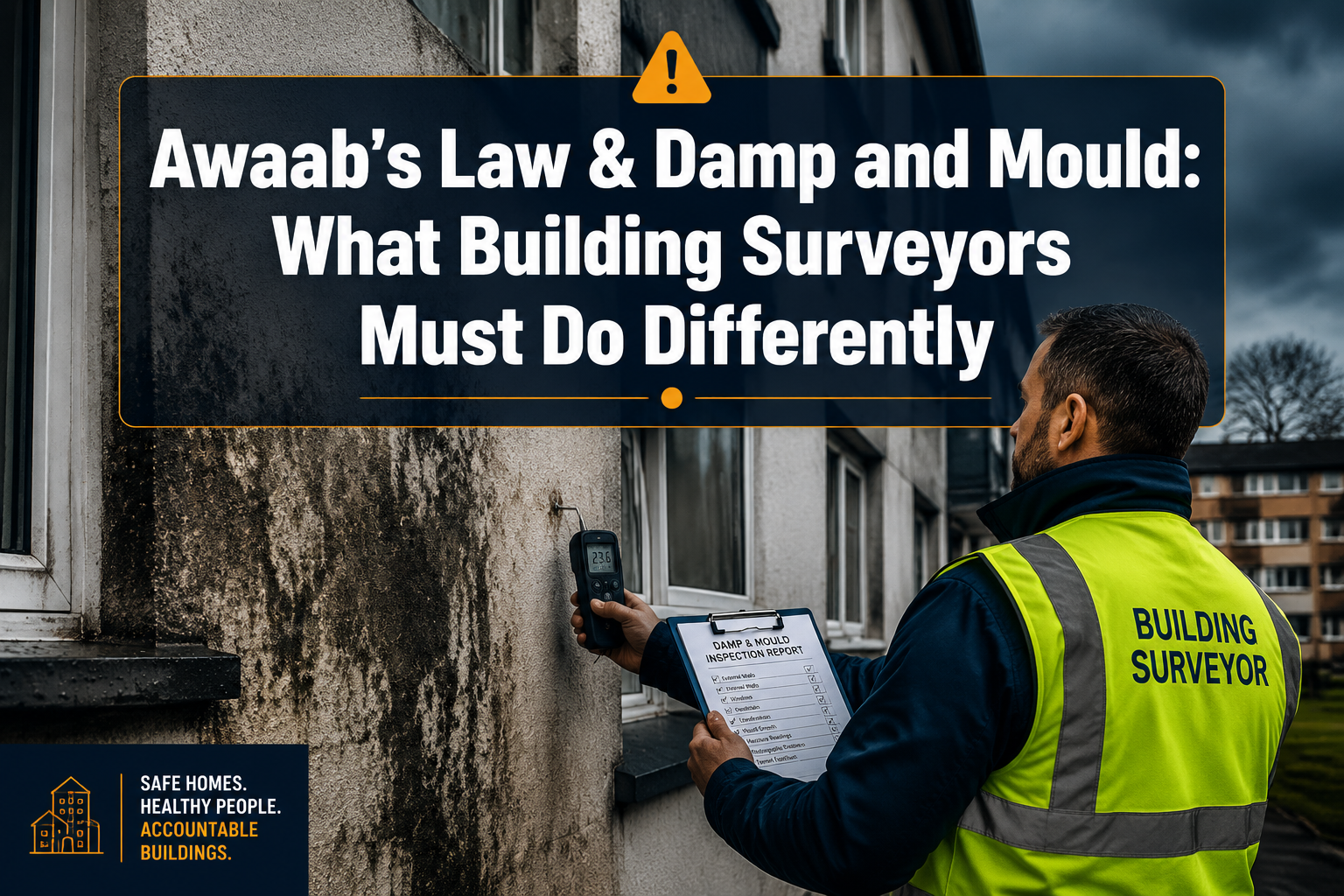

Nearly 4 million social housing tenants in England live in properties with damp or mould problems, according to data cited by the Housing Ombudsman. That figure is not a background statistic — it is the legal and professional landscape that now defines what building surveyors must produce every time they set foot in a social housing property. Awaab's Law and damp & mould: what building surveyors must do differently in social housing reports is no longer an abstract professional debate. Since October 2025, it is a matter of statutory compliance, enforceable deadlines, and audit-ready documentation.
The Hazard in Social Housing Regulations enacted under Awaab's Law are driving intense scrutiny of damp and mould findings in surveys and expert witness reports for social landlords. Surveyors who continue to produce vague, hedged, or incomplete reports risk exposing their clients — and themselves — to serious legal and regulatory consequences.
Key Takeaways
- Awaab's Law came into force on 27 October 2025, with mandatory investigation and repair timelines for damp, mould, and emergency hazards in social housing.
- Surveyors must now produce audit-ready reports with photographic evidence, root-cause analysis, and clearly stated remediation recommendations.
- Emergency hazards must be investigated and made safe within 24 hours; significant damp and mould must be investigated within 10 working days.
- Written summaries of findings must be provided to tenants within 3 working days of completing an investigation.
- The law is expanding in 2026 to cover additional hazards including excess cold, excess heat, falls, structural collapse, fire, and electrical hazards.
The Legal Framework: What Awaab's Law Actually Requires
Awaab's Law takes its name from Awaab Ishak, a two-year-old boy who died in 2020 as a direct result of prolonged exposure to black mould in a social housing flat in Rochdale. The subsequent inquest, coroner's findings, and public outcry led to Section 42 of the Social Housing (Regulation) Act 2023, which introduced the framework now known as Awaab's Law [3].
The law was enacted on 27 October 2025. Its initial scope focused on damp, mould, and emergency hazards. In 2026, the scope expanded significantly to include excess cold, excess heat, falls, structural collapse, fire, and electrical hazards. By 2027, the legislation will cover all Housing Health and Safety Rating System (HHSRS) hazards, with the sole exclusion of overcrowding [1].
Mandatory Response Timelines
The most operationally significant aspect of the law for surveyors is the strict timeline framework it imposes on social landlords [2]:
| Hazard Type | Investigation Deadline | Make-Safe Deadline | Written Summary to Tenant |
|---|---|---|---|
| Emergency hazard (e.g., major leak, dangerous electrical fault) | Within 24 hours | Within 24 hours | Within 3 working days |
| Significant damp and mould | Within 10 working days | Within 5 working days after investigation | Within 3 working days after investigation |
| Other significant hazards (2026 onwards) | Within 10 working days | Within 5 working days after investigation | Within 3 working days after investigation |
These are not aspirational targets. They are legally enforceable obligations. Social landlords who fail to meet them face enforcement action by the Regulator of Social Housing, potential legal proceedings, and reputational damage [3]. The surveyor's report is the document that either supports or undermines a landlord's ability to demonstrate compliance.
Why Standard Survey Reports Are No Longer Sufficient
Traditional building survey reports were designed primarily to inform purchasing decisions or maintenance planning. They described conditions, assigned condition ratings, and offered general recommendations. That format is inadequate under Awaab's Law.
A standard RICS home survey or a generic stock condition survey will not, by default, include the root-cause analysis, photographic evidence schedules, hazard classification, or remediation timelines that Awaab's Law now demands. Surveyors working in the social housing sector must understand that the report format itself needs to change.
What Is Missing from Legacy Reports
The following elements are commonly absent from older-style survey reports but are now essential for Awaab's Law compliance:
- Root-cause identification: Is the damp caused by condensation, rising damp, penetrating damp, or a plumbing defect? The cause determines the remedy. A report that simply notes "damp present" is legally insufficient.
- Hazard severity classification: Reports must align findings with HHSRS categories, distinguishing between Category 1 (serious and immediate risk) and Category 2 hazards.
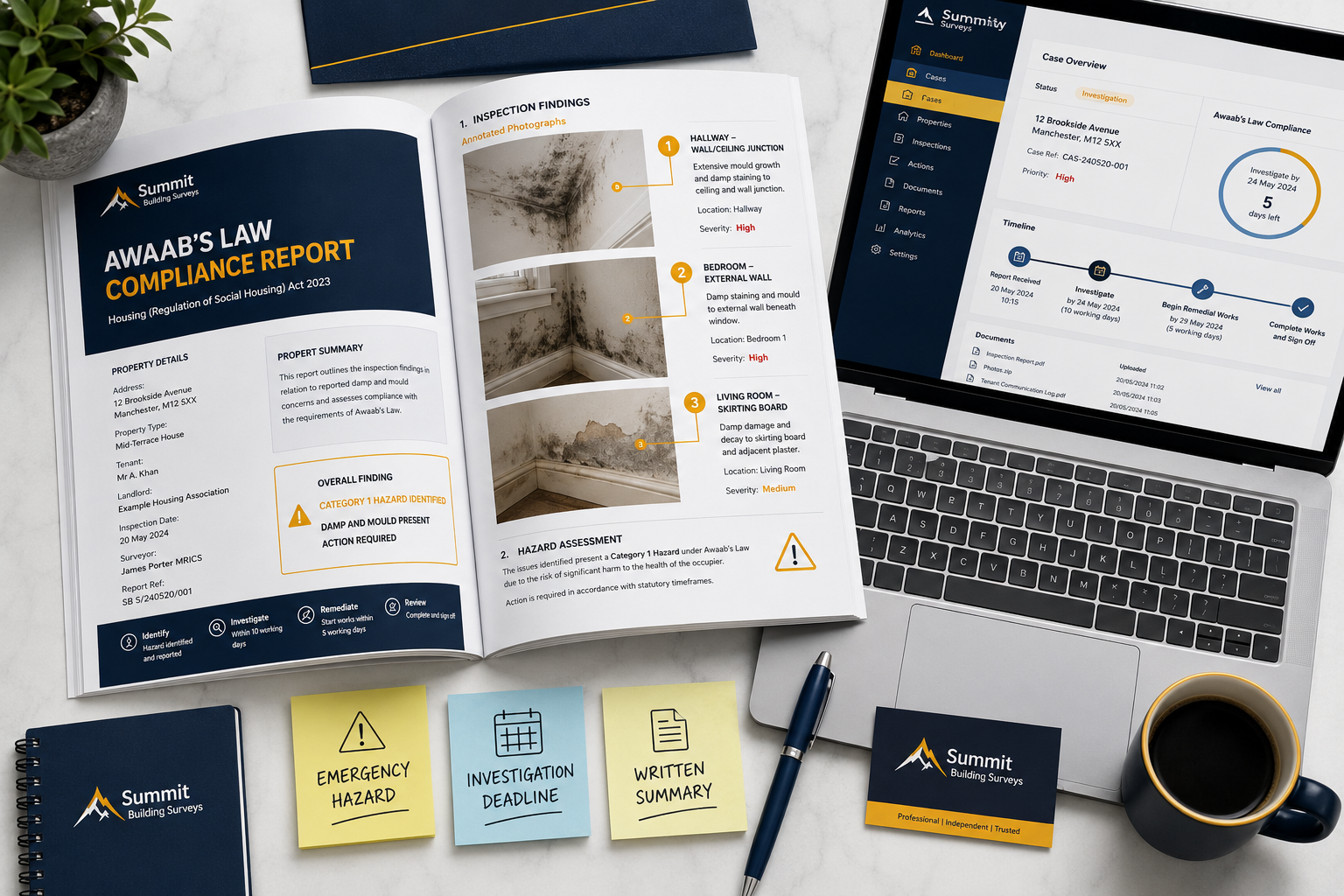
- Photographic evidence: Dated, geotagged photographs of affected areas must be embedded in the report, not held separately [4].
- Remediation recommendations with timelines: Vague phrases such as "monitor and review" are no longer acceptable. Reports must specify what action is needed and how urgently.
- Tenant communication records: Evidence that findings were communicated to the tenant within the statutory 3-working-day window [2].
"Surveyors play a critical role in ensuring that properties meet the required standards. Accurate documentation and prompt reporting are essential to meet legal obligations." — RPC Legal [3]
For surveyors who regularly carry out damp surveys or specific defect reports, adapting existing report templates to meet these requirements is achievable — but it requires deliberate and structured revision.
Awaab's Law and Damp & Mould: What Building Surveyors Must Do Differently in Social Housing Reports
The shift required is both technical and procedural. Surveyors must approach social housing inspections as compliance exercises as much as technical assessments. The following areas represent the most significant changes to professional practice.
1. Conduct a Structured Root-Cause Investigation
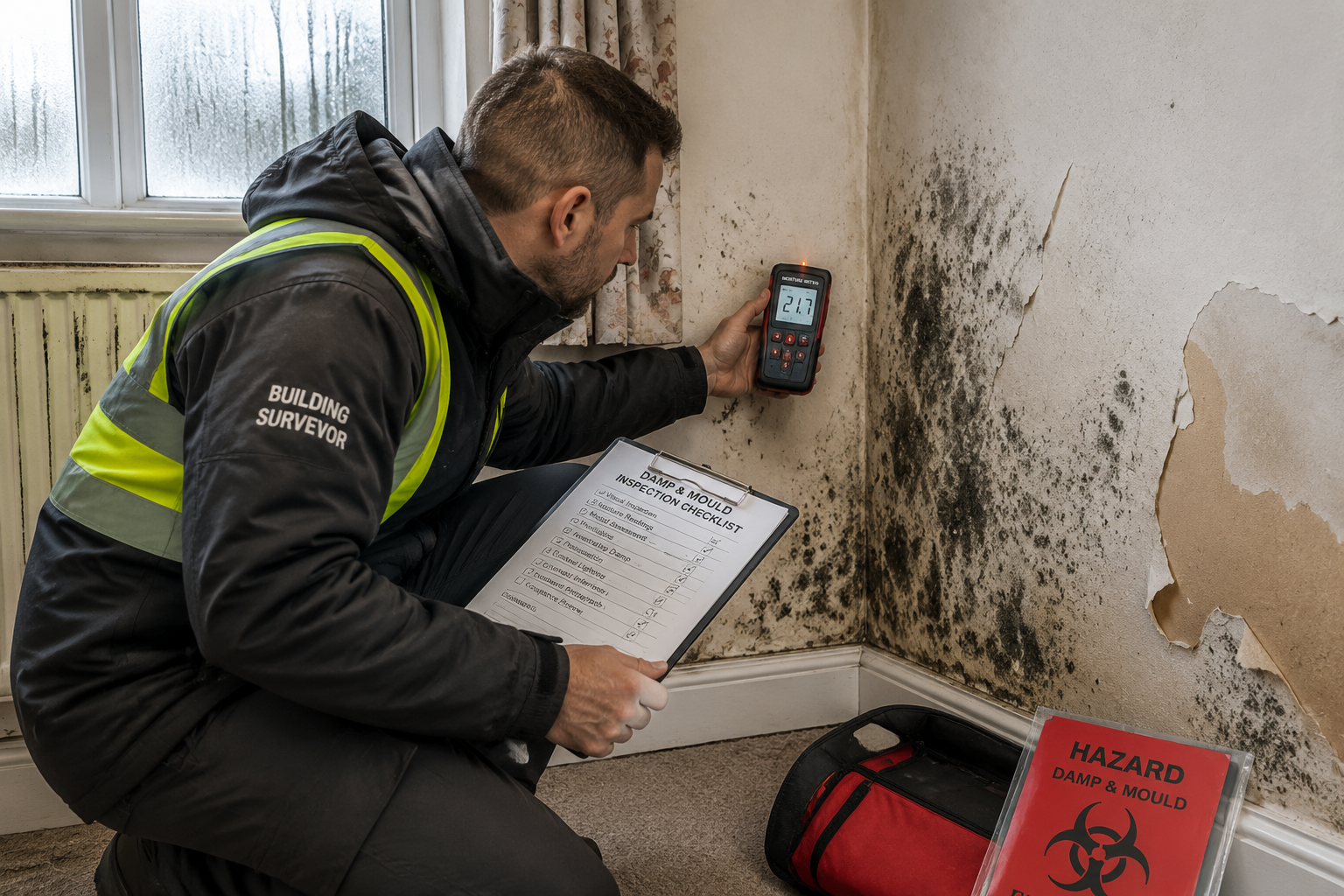
Moisture meters and visual inspection remain the foundation of any damp assessment. However, under Awaab's Law, surveyors must go further. A structured investigation should include:
- Thermal imaging where available, to identify cold bridges and hidden moisture pathways
- Ventilation assessment, including mechanical extract fan performance in kitchens and bathrooms
- Fabric inspection, covering wall ties, cavity insulation condition, pointing, render integrity, and guttering
- Internal moisture mapping, recording relative humidity levels across multiple rooms and comparing to baseline thresholds
Understanding the cost of a damp survey is relevant here because social landlords need to budget appropriately for this more thorough level of investigation. A superficial survey that misses a root cause is not a cost saving — it is a liability.
2. Align Reports with HHSRS Hazard Categories
The HHSRS is the scoring system used by local authorities to assess housing conditions. Awaab's Law is built on HHSRS classifications. Surveyors must therefore be fluent in this framework and apply it explicitly in their reports.
A report that identifies significant black mould in a bedroom occupied by a young child must classify that finding as a potential Category 1 hazard — one that poses a serious and immediate risk to health — and trigger the corresponding 10-working-day investigation and 5-working-day make-safe timeline [1].
Failing to classify correctly has two risks:
- The landlord underestimates urgency and misses statutory deadlines.
- In the event of a legal dispute, the surveyor's report becomes evidence of professional inadequacy.
3. Produce Audit-Ready Documentation
The term "audit-ready" is now central to professional practice in this sector. Reports must be structured so that a regulator, legal representative, or Housing Ombudsman can quickly verify that every step of the compliance process was followed [4].
Audit-ready documentation includes:
- A clearly dated inspection record
- Photographic evidence with timestamps and location references
- A written findings summary suitable for sharing with tenants
- A record of the hazard classification applied
- Recommended remediation actions with priority ratings
- A sign-off confirming the report was completed within the statutory investigation window
Surveyors carrying out stock condition surveys across large social housing portfolios should consider whether their current reporting platforms can produce this level of documentation at scale.
4. Leverage Digital Survey Tools
Digital reporting platforms are increasingly important in meeting Awaab's Law requirements. Tools that offer AI-assisted voice input, real-time photographic integration, and automatic hazard classification can significantly reduce the administrative burden while improving accuracy [6].
The key advantage of digital tools is the audit trail they create. Every entry is timestamped, every photograph is geotagged, and every report is version-controlled. This matters enormously when a social landlord is required to demonstrate compliance to a regulator or defend a legal claim.
Surveyors should evaluate their current tools against the documentation requirements of the law and upgrade where necessary. The investment in better software is modest compared to the cost of a compliance failure.
5. Communicate Findings Clearly to Tenants
Awaab's Law places a specific obligation on landlords to provide tenants with a written summary of investigation findings within 3 working days of completing the investigation [2]. In practice, the surveyor's report is the primary input for that written summary.
Reports must therefore be written in plain English, avoiding excessive technical jargon. A tenant who receives a summary referencing "hygroscopic salt contamination in the substrate" without further explanation has not been meaningfully informed.
Best practice is to include a plain-language summary section in every report, covering:
- What was found
- Why it is a problem
- What will be done about it
- When the tenant can expect work to begin
This is not simply a courtesy — it is a compliance requirement that the surveyor's report must support.
The Expanding Scope of Awaab's Law in 2026
In 2026, the law's reach has grown considerably. Surveyors working in social housing are now required to assess and report on a broader range of hazards beyond damp and mould. The newly included categories are [1]:
- Excess cold: Properties failing to achieve adequate thermal performance, particularly relevant in older social housing stock
- Excess heat: Overheating in upper-floor flats and properties with poor solar shading
- Falls: Staircase condition, floor surface integrity, and bathroom safety
- Structural collapse: Structural defects presenting an immediate risk
- Fire hazards: Including means of escape, fire door condition, and compartmentation
- Electrical hazards: Outdated wiring, overloaded circuits, and unsafe installations
For surveyors, this expansion means that a social housing inspection in 2026 is a substantially more comprehensive exercise than it was in 2024. The building survey scope must now encompass structural, electrical, thermal, and fire safety elements alongside the traditional damp and mould assessment.
Surveyors who specialise in residential work should consider whether they need to extend their competence or work alongside specialist consultants — for example, a structural engineer for collapse risk assessments or an electrical inspector for wiring condition reports.
Awaab's Law and Damp & Mould: What Building Surveyors Must Do Differently — Training and Professional Development
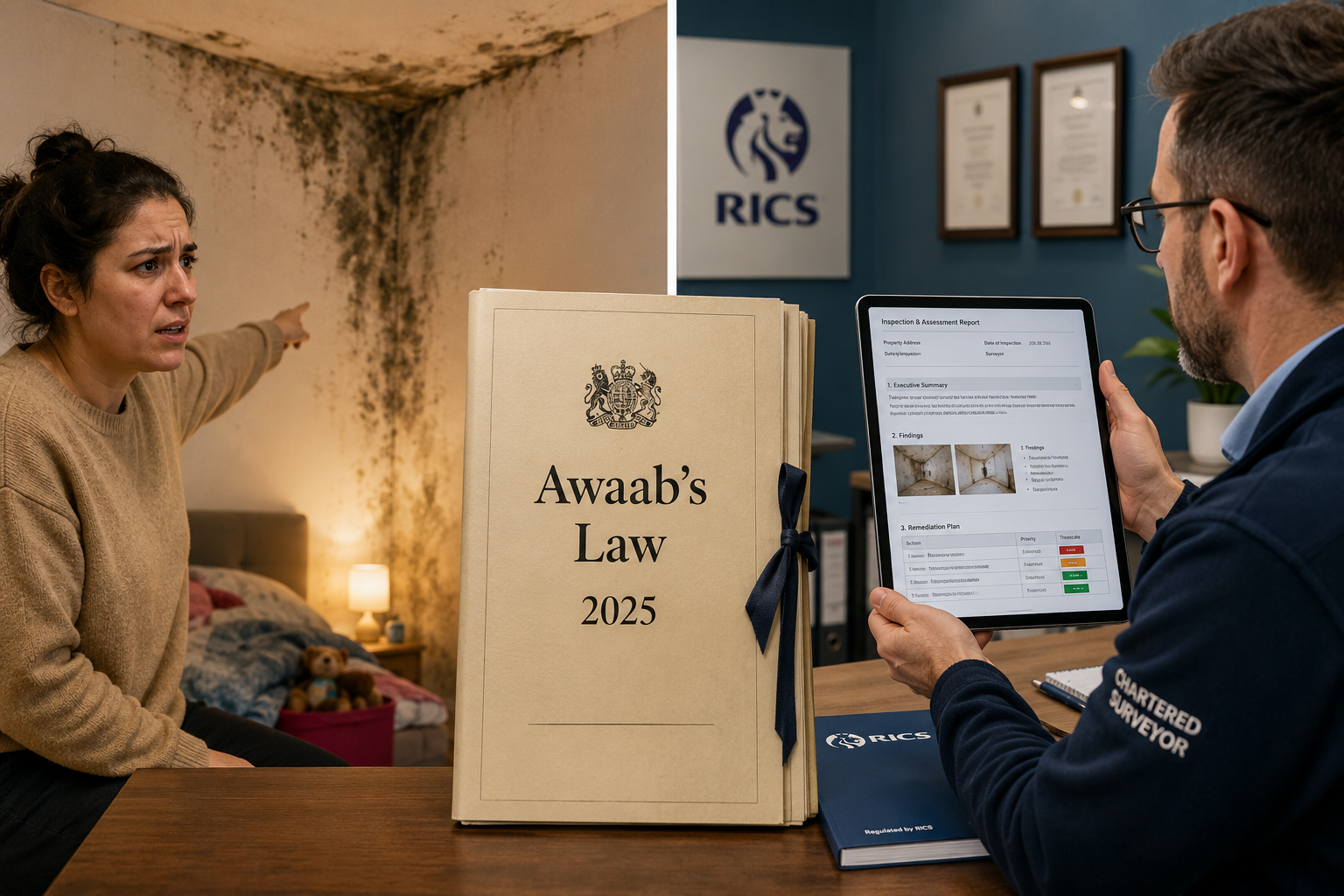
Compliance with Awaab's Law is not a one-time adjustment. The law is evolving, with the full HHSRS hazard suite coming into scope by 2027. Continuous professional development is therefore not optional — it is a professional obligation [5].
The Housing Ombudsman operates a Centre for Learning that provides specific guidance and training materials on Awaab's Law. Surveyors working in the social housing sector should engage with these resources regularly. The Ombudsman's published case studies are particularly valuable because they illustrate the types of failures — including inadequate surveys and delayed reporting — that have led to formal findings against landlords [5].
Key CPD activities for surveyors in 2026 include:
- Completing HHSRS assessor training or refresher courses
- Attending RICS-accredited seminars on social housing compliance
- Reviewing Housing Ombudsman case studies relevant to damp and mould
- Updating report templates to reflect the expanded 2026 hazard scope
- Familiarising with digital survey platforms that support audit-ready reporting
Looking Ahead: Private Sector Implications
While Awaab's Law currently applies exclusively to social housing, the direction of travel is clear. The Renters' Rights Bill, progressing through Parliament, is expected to introduce comparable standards for the private rented sector [7]. Surveyors who establish robust compliance practices now — in response to Awaab's Law — will be well-positioned when similar obligations extend to private landlords.
For surveyors working across both sectors, the investment in updated report templates, digital tools, and HHSRS training will deliver value across their entire practice, not just their social housing caseload.
Legal Consequences of Non-Compliance
The legal implications of failing to meet Awaab's Law standards are significant and extend beyond the landlord. Surveyors who produce inadequate reports may find themselves named in legal proceedings as contributing to a landlord's failure to identify and address hazards within the statutory timeframe [3].
Specific risks include:
- Expert witness liability: In disputes before the Housing Ombudsman or courts, a surveyor's report may be scrutinised as evidence. A poorly structured or incomplete report can undermine a landlord's defence.
- Regulatory enforcement: The Regulator of Social Housing has powers to impose financial penalties and management interventions on landlords who fail to comply. Surveyors whose reports contributed to non-compliance may face professional conduct investigations.
- Reputational damage: In a sector where social landlords commission surveys repeatedly from trusted professionals, a single compliance failure can end a long-standing professional relationship.
The most effective protection for any surveyor is a report that is thorough, clearly structured, HHSRS-aligned, and audit-ready. There is no legal substitute for getting the report right the first time.
Conclusion
Awaab's Law has fundamentally changed the professional obligations of building surveyors working in social housing. The combination of strict statutory timelines, mandatory written summaries for tenants, HHSRS hazard classification requirements, and the expanding scope of covered hazards in 2026 means that the old approach to damp and mould reporting is no longer fit for purpose.
Actionable next steps for building surveyors in 2026:
- Audit your current report templates against the HHSRS hazard classification framework and identify gaps in root-cause analysis, photographic evidence, and plain-language summaries.
- Invest in digital survey tools that create automatic audit trails, timestamp photographs, and support structured hazard reporting.
- Complete HHSRS assessor training or a refresher course to ensure competence across the full range of hazards now in scope.
- Review Housing Ombudsman case studies to understand the types of reporting failures that have led to formal findings against social landlords.
- Update your scope of service agreements with social housing clients to reflect the expanded inspection requirements introduced in 2026.
- Begin preparing for private sector obligations by applying the same compliance-grade reporting standards across all residential survey work.
The professional surveyors who adapt quickly will not only protect their clients from regulatory risk — they will build a reputation as the go-to experts in a sector that is under greater scrutiny than ever before. For organisations seeking expert guidance on damp and mould assessments that meet current legal standards, working with experienced chartered surveyors who understand the full scope of Awaab's Law requirements is the most reliable starting point.
References
[1] Awaab's Law – https://www.westberks.gov.uk/article/45590/Awaab-s-Law?utm_source=openai
[2] Awaab's Law Guidance for Tenants in Social Housing – https://www.gov.uk/government/publications/awaabs-law-guidance-for-tenants-in-social-housing/awaabs-law-guidance-for-tenants-in-social-housing?utm_source=openai
[3] Awaab's Law – https://www.rpclegal.com/thinking/construction/awaabs-law/?utm_source=openai
[4] Damp Mould Remediation – https://www.dampsafe.co.uk/damp-mould-remediation?utm_source=openai
[5] Awaab's Law – https://www.housing-ombudsman.org.uk/centre-for-learning/key-topics/awaabs-law/?utm_source=openai
[6] Awaab's Law Damp Mould Survey Compliance Guide – https://www.swiftreporter.com/blog/awaabs-law-damp-mould-survey-compliance-guide?utm_source=openai
[7] Awaab's Law – https://www.thedampologists.co.uk/awaabs-law?utm_source=openai