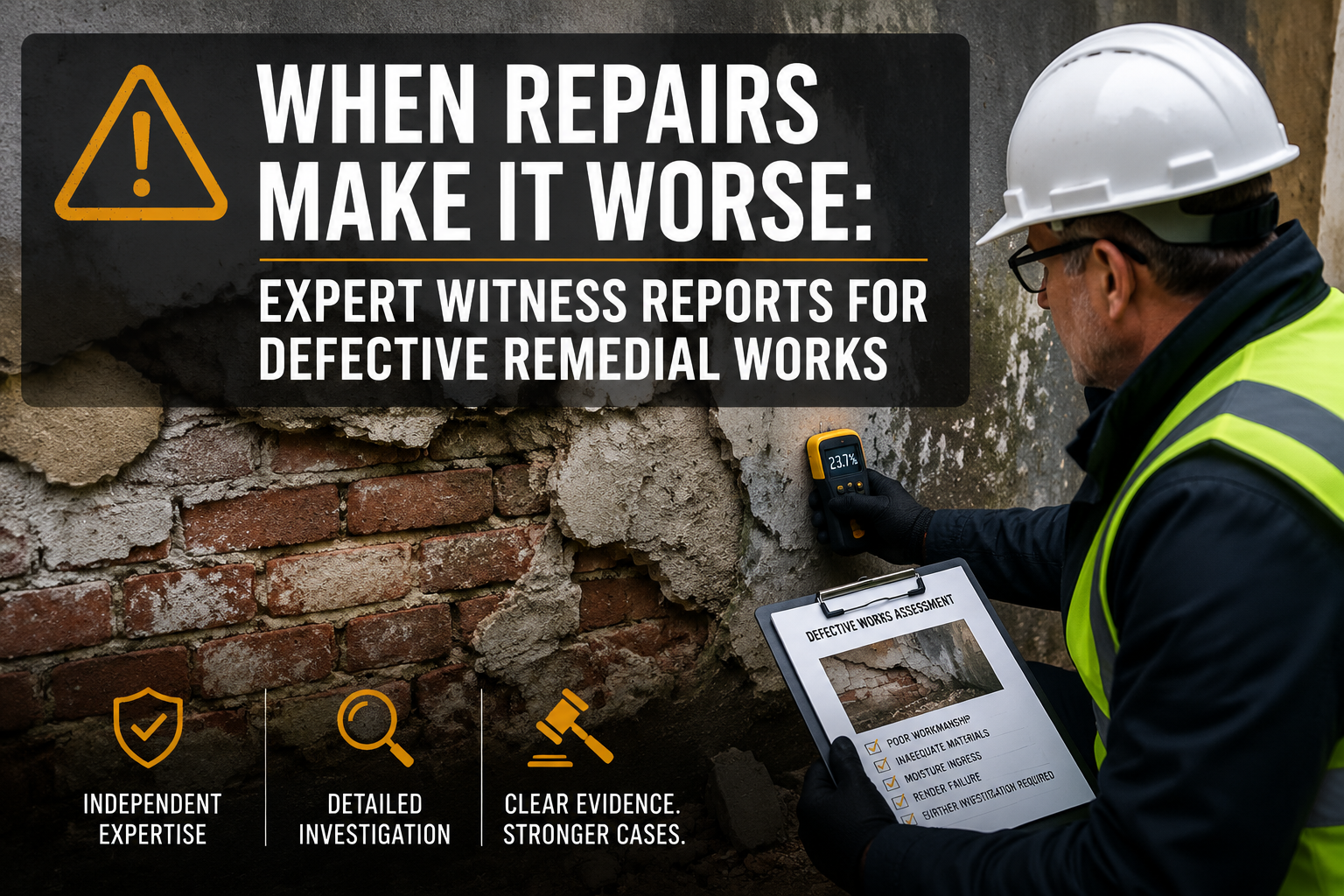
Nearly one in three construction defect disputes reaching UK courts in recent years involves not the original building fault — but the failed attempt to fix it. Botched remedial works are quietly one of the most damaging and legally complex problems in property litigation, yet they remain poorly understood by homeowners and landlords until significant harm has already occurred. Expert Witness Reports for Defective Remedial Works: When Repairs Make a Property Worse sit at the heart of resolving these disputes, providing courts, tribunals, and insurers with the independent, evidence-based analysis needed to establish what went wrong, who is responsible, and what it will cost to put right.
Key Takeaways 📋
- Botched repairs can create entirely new defects that are legally and technically separate from the original problem — and potentially more expensive to resolve.
- Expert witness reports in these cases must establish a clear causal chain: original defect → remedial works → new or worsened damage.
- CPR-compliant reports are essential; courts have dismissed substantial claims where expert evidence failed to meet procedural standards. [3]
- Avoiding "betterment" — ensuring remedial schemes restore but do not upgrade a property beyond its pre-defect condition — is a critical requirement in these reports.
- Instructing a qualified chartered surveyor early preserves evidence and strengthens any legal or insurance claim significantly.
What Are Defective Remedial Works?
Defective remedial works occur when an attempt to repair a building defect either fails to resolve the original problem, introduces new damage, or both. The scope is broad and includes: [1]
- Inappropriate materials — using modern cement renders on older lime-built walls, causing trapped moisture and spalling
- Incomplete works — addressing symptoms rather than root causes, such as re-pointing without resolving underlying structural movement
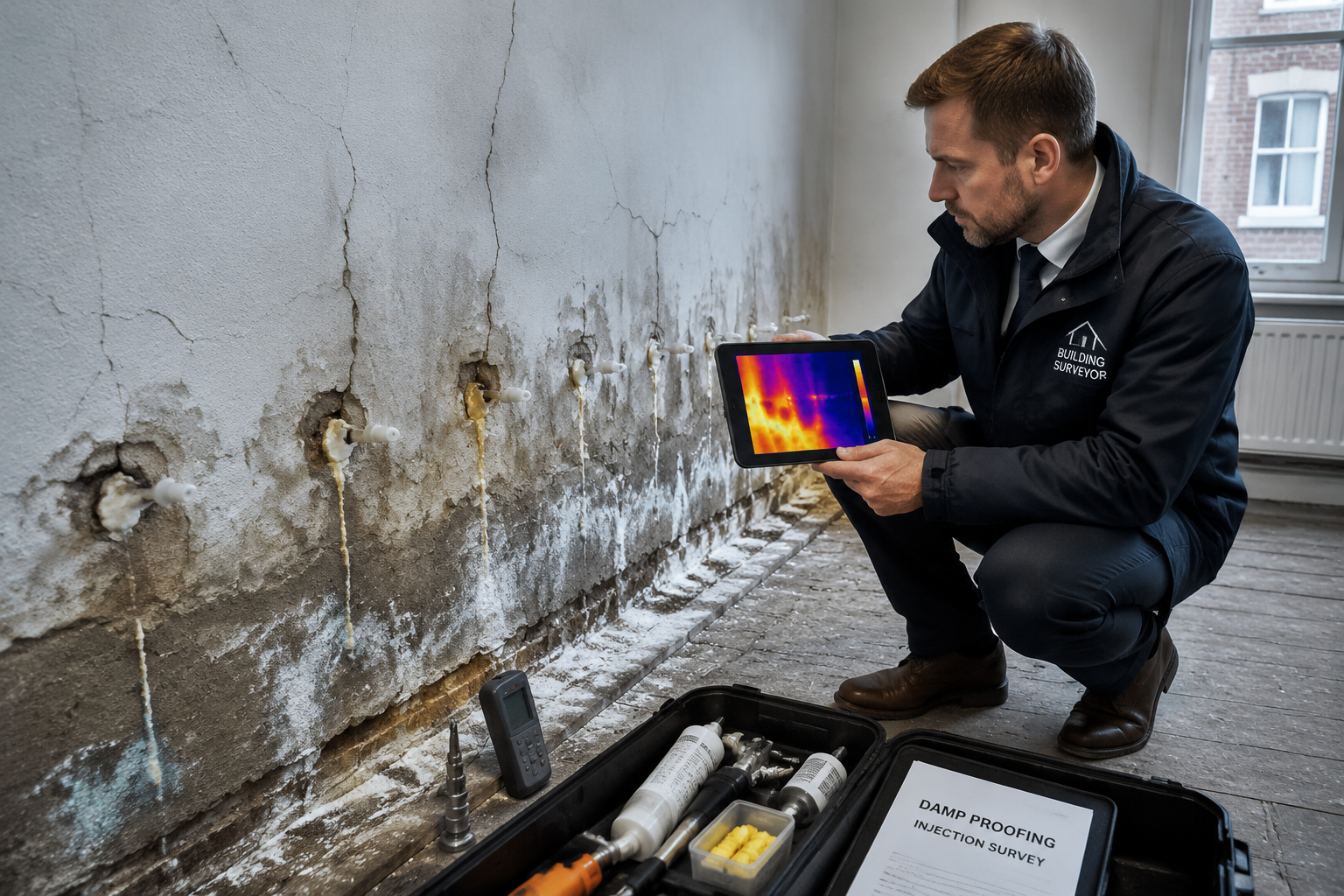
- Incorrect specification — applying chemical damp-proof injection in properties where the actual cause is condensation, not rising damp
- Poor workmanship — inadequate surface preparation, incorrect mixing ratios, or failure to follow manufacturer guidelines
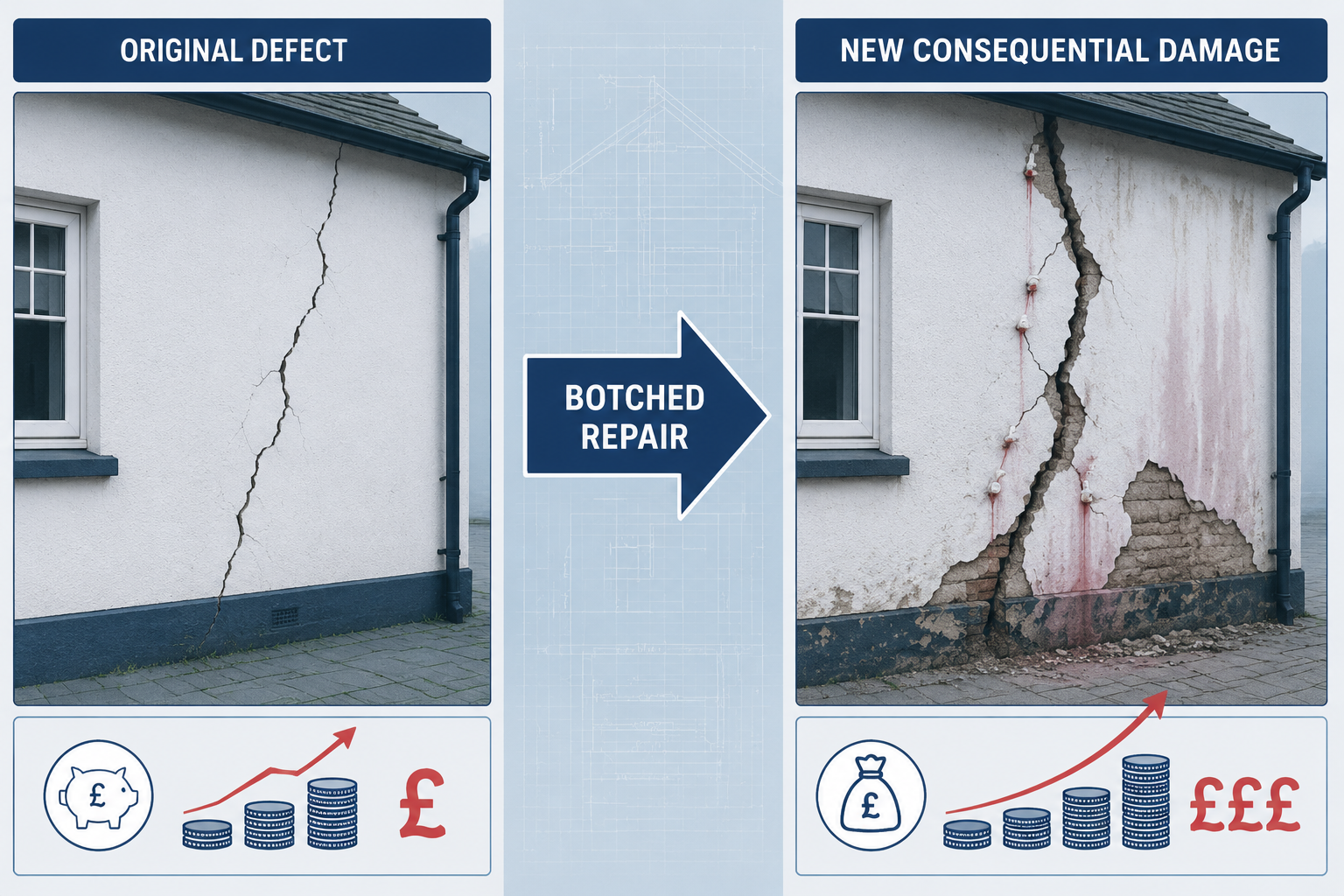
- Consequential damage — new cracks, water ingress, or timber decay caused directly by the repair process itself
💬 "The most damaging repairs are often those that appear superficially successful — until the next winter, when the underlying problem returns with new companions."
These scenarios are especially common after insurance claims, following a property purchase where a seller has attempted a quick fix, or after a landlord has instructed unqualified contractors to carry out works. In each case, the legal and financial consequences can far exceed the cost of the original defect.
For property owners dealing with suspected damp or timber issues that have been incorrectly treated, understanding the cost of a damp and timber report is a useful first step before pursuing any claim.
The Legal Framework: What Courts Expect
Establishing Causation in Defective Remedial Works Claims
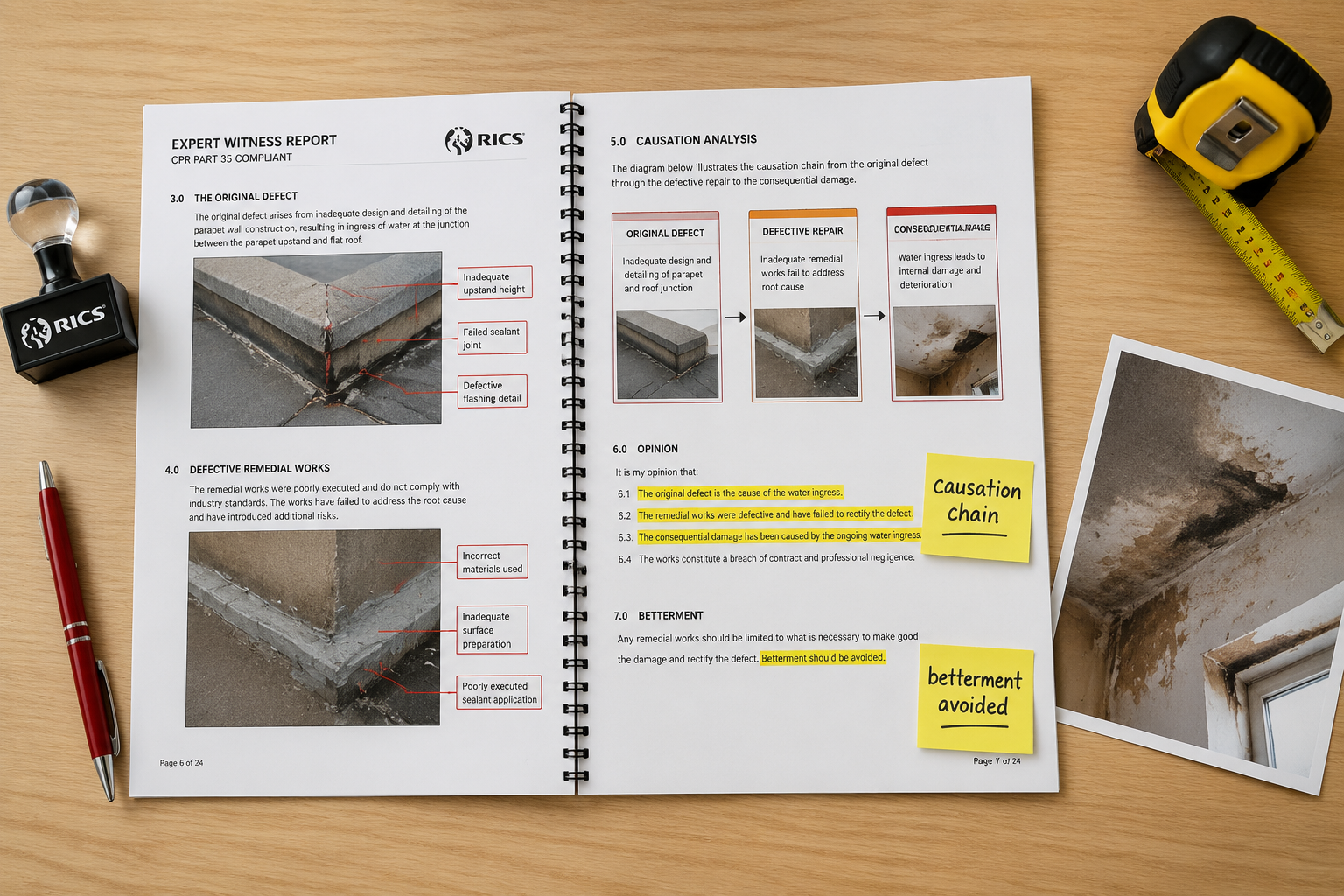
Courts do not simply want to know that a repair failed. They require a precise causal chain that connects the original contractual obligation, the specific defect in the remedial works, and the consequences that followed. [2] This three-part chain — contract → defect → consequences — is the structural backbone of any successful claim.
In practice, this means the expert must demonstrate:
- What the contractor was obliged to do (based on the specification, contract, or implied terms under the Supply of Goods and Services Act 1982)
- How the works departed from that obligation (the technical failure)
- What damage directly resulted from that departure — distinguishing pre-existing conditions from new harm
This distinction matters enormously. A court will not award damages for pre-existing deterioration that the remedial works failed to reverse. It will, however, award damages for new damage that the remedial works actively caused. [4]
CPR Compliance: A Non-Negotiable Standard
Under the Civil Procedure Rules (CPR) Part 35, expert witnesses in England and Wales owe their primary duty to the court — not to the party instructing them. This is not merely a formality. A NSW Supreme Court case highlighted how a substantial construction defect claim was lost entirely because the expert reports failed to meet acceptable evidentiary standards. [3] The same principle applies in English courts.
A CPR-compliant expert witness report for defective remedial works must include:
| Requirement | Detail |
|---|---|
| Statement of truth | Confirming the report is accurate and the expert understands their duty to the court |
| Qualifications | Demonstrating relevant expertise in the specific defect type |
| Factual basis | Clear separation of facts, assumptions, and opinions |
| Methodology | Explanation of inspection methods, tests, and analysis used |
| Causation analysis | Evidence-based reasoning linking works to damage |
| Remedial scheme | Costed schedule of works to rectify the defect |
| Betterment consideration | Confirmation that the proposed remedy does not over-compensate |
Failure on any of these points can result in the report being given little or no weight by the court — or excluded entirely. [2]
Expert Witness Reports for Defective Remedial Works: The Surveyor's Methodology
How Surveyors Document Causation and Extent
When instructed to prepare Expert Witness Reports for Defective Remedial Works: When Repairs Make a Property Worse, a qualified chartered surveyor follows a structured forensic process. This is not a standard property inspection — it is an evidence-gathering exercise conducted with litigation in mind.
Stage 1: Document Review
The surveyor begins by reviewing all available documentation: the original defect report, the specification for remedial works, contractor invoices, warranties, and any photographic evidence taken before, during, or after the works. [5] Gaps in this record are themselves significant — a contractor who cannot produce a specification may have worked without one, which is relevant to the standard of care question.
Stage 2: Physical Inspection
The on-site inspection is methodical and recorded. Surveyors use a combination of:
- 🔍 Visual inspection with photographic record
- 💧 Moisture meters and hygrometers (for damp-related remedial failures)
- 🔬 Borescope cameras (for concealed voids or failed injections)
- 📐 Crack monitors and level surveys (for structural movement)
- 🌡️ Thermal imaging (to identify moisture patterns and thermal bridges)
For complex structural matters, a residential structural engineering assessment may be required alongside the expert witness report to quantify the extent of structural consequences.
Stage 3: Causation Analysis
This is the most technically demanding part of the report. The surveyor must distinguish between: [6]
- Damage that pre-dated the remedial works
- Damage caused by the remedial works themselves
- Damage that would have occurred regardless of the remedial works
This analysis draws on the surveyor's professional knowledge, any available pre-works survey data, and — where available — a schedule of condition report prepared before the works commenced. This is one reason why commissioning a schedule of condition before any significant repair programme is strongly advisable.
Stage 4: The Remedial Scheme
The expert must propose a costed remedial scheme that will genuinely resolve the defects caused by the failed works. This scheme must be proportionate and must avoid betterment — the legal principle that a claimant should not be placed in a better position than they would have been had the defect never occurred. [1]
For example, if a contractor applied the wrong waterproofing product to a basement, the remedial scheme should specify the correct product and application method — not a premium upgrade system that exceeds the original specification.
Common Scenarios: When Repairs Genuinely Make Things Worse
Damp-Proofing Failures
Damp-proofing is one of the most frequently litigated areas of remedial works. Chemical injection damp-proof courses, incorrectly specified or applied, can drive moisture upward into previously unaffected masonry. Specialist damp surveys are often required to map the full extent of moisture migration following a failed treatment.
Structural Crack Repairs
Resin injection or stitching repairs to structural cracks that fail to address the underlying cause — typically ongoing ground movement or inadequate foundations — can mask active movement until a more serious failure occurs. In subsidence cases, a survey for subsidence may be necessary to establish whether movement is ongoing.
Roof Repairs
Poorly executed roof repairs — particularly the use of inappropriate sealants or the failure to replace damaged sarking felt — can redirect water ingress rather than eliminate it, causing damage to previously unaffected areas of the roof structure and interior.
Party Wall Works
Remedial works carried out under a party wall agreement that cause damage to an adjoining owner's property are a common source of expert witness instructions. Understanding what constitutes a party wall dispute is essential context for any surveyor preparing reports in this area.
Expert Witness Reports for Defective Remedial Works: Specific Defect Reports vs. Full Expert Reports
Not every situation involving defective remedial works requires a full CPR Part 35 expert witness report. It is important to understand the distinction:
| Report Type | Purpose | When to Use |
|---|---|---|
| Specific Defect Report | Diagnoses a single defect and recommends remediation | Pre-litigation; insurance claims; contractor disputes |
| Expert Witness Report (CPR Part 35) | Provides independent expert opinion for court proceedings | Active litigation; formal dispute resolution |
| Schedule of Condition | Records property condition at a point in time | Before works commence; tenancy disputes |
A specific defect report is often the appropriate first step — it establishes the technical picture clearly and can support a letter of claim without the full formality of a CPR report. If the matter proceeds to litigation, the specific defect report can inform the more detailed expert witness document.
For cases already in or approaching litigation, a fully qualified expert witness is essential. The expert witness services provided by experienced chartered surveyors are specifically structured to meet CPR requirements and withstand cross-examination. [7]
What Makes an Expert Witness Credible?
Courts and opposing counsel will scrutinise the expert's qualifications and independence closely. Key markers of credibility include: [8]
- RICS membership (MRICS or FRICS) with relevant specialism
- Demonstrable experience in the specific defect type (structural, damp, roofing, etc.)
- No financial interest in the outcome of the case
- Willingness to acknowledge limitations in the evidence or their own expertise
- Consistency between written reports and oral evidence under cross-examination
💬 "An expert who overstates their case does their client no favours — courts value measured, evidence-based opinions over advocacy dressed as expertise." [2]
The Cost of Getting It Wrong: Consequences of Inadequate Expert Evidence
The financial stakes in defective remedial works cases can be substantial. Construction defect claims — including those involving failed repairs — frequently involve damages in the tens or hundreds of thousands of pounds when consequential losses, loss of amenity, and professional fees are included. [9]
Yet the cost of inadequate expert evidence can be even higher. A poorly prepared report can:
- ❌ Undermine an otherwise strong claim by failing to establish causation clearly
- ❌ Expose the instructing party to adverse costs orders if the report is found to be unreliable
- ❌ Result in an unfavourable settlement because the opposing party's expert goes unchallenged on key technical points
- ❌ Delay resolution by requiring supplementary reports or joint expert meetings to fill evidential gaps [10]
Investing in a properly qualified, CPR-compliant expert witness report from the outset is not merely good practice — it is often the difference between a successful claim and a costly failure.
Conclusion: Protecting Your Position When Remedial Works Go Wrong
Defective remedial works represent a particularly insidious category of property damage. Unlike original building defects, they arrive with the false assurance that the problem has been solved — only to reveal new and sometimes more serious consequences weeks, months, or years later.
Expert Witness Reports for Defective Remedial Works: When Repairs Make a Property Worse provide the forensic, legally robust evidence needed to hold contractors accountable, recover losses, and ensure that genuinely effective repairs are carried out. In 2026, with construction costs and litigation expenses both running high, the quality of expert evidence has never mattered more.
Actionable Next Steps ✅
- Preserve all evidence immediately — do not carry out further works until the defective remedial works have been documented by a qualified surveyor
- Commission a specific defect report as a first step to establish the technical picture before incurring litigation costs
- Check your surveyor's qualifications — ensure they hold RICS membership and have direct experience with the defect type in question
- Consider a schedule of condition before any future repair programme commences, to create a clear evidential baseline
- Instruct a CPR Part 35 compliant expert witness as soon as formal dispute resolution or litigation becomes likely
- Seek legal advice early — a solicitor experienced in construction disputes can help frame the expert's instructions correctly and maximise the report's evidential value
References
[1] Defective Works Expert Witness Reports – https://mpgqs.com/services/expert-witness-reports/defective-works-expert-witness-reports/
[2] What Does A Court Want From An Expert Report – https://gatehouselaw.co.uk/what-does-a-court-want-from-an-expert-report/
[3] NSW Supreme Court Confirms Need For Properly Prepared Building Experts Reports Substantial Claim Lost Due To Unacceptable Expert Evidence – https://watsonandwatson.com.au/document-75/nsw-supreme-court-confirms-need-for-properly-prepared-building-experts-reports-substantial-claim-lost-due-to-unacceptable-expert-evidence
[4] Construction Defects Expert Witness – https://www.seakexperts.com/specialties/construction-defects-expert-witness
[5] Expert Witness Reports For Building Defects – https://mjengineeringprojects.com.au/blogs/expert-witness-reports-for-building-defects/
[6] Construction Defect – https://www.expertinstitute.com/expert-witness/construction-defect/
[7] The Role Of Expert Witnesses In Construction Defect Litigation – https://www.macyhanson.com/blog/the-role-of-expert-witnesses-in-construction-defect-litigation/
[8] Construction Defects – https://www.law.com/expert-witness/directory/construction-defects/
[9] Construction Defects – https://repone.net/construction-defects/
[10] Construction Defects – https://www.experts.com/expert-witnesses/categories/construction-defects