
Over 4.4 million private rented sector (PRS) properties in England share party walls with neighboring homes, yet until 2026, no systematic legal framework required landlords to assess electrical hazards that could migrate through shared structures during building works. With Awaab's Law expanding beyond its initial damp and mould focus to include electrical hazards later this year, surveyors preparing party wall awards now face unprecedented responsibilities for protecting adjoining rental property occupants from electrical risks created during construction activities.
The Electrical Hazard Assessments in Party Wall Awards: Awaab's Law 2026 Protocols for Adjoining PRS Properties framework establishes strict timelines and assessment procedures that fundamentally change how surveyors document, monitor, and respond to electrical safety concerns when building works affect shared walls between rental properties. This regulatory expansion transforms party wall surveying from primarily structural documentation into a comprehensive safety assessment discipline with legal liability implications.
Key Takeaways
- 🔌 Emergency electrical hazards identified in adjoining PRS properties during party wall works require 24-hour investigation and remediation under Awaab's Law 2026 protocols, with mandatory rehousing if hazards cannot be immediately controlled[3][7]
- ⏱️ Significant electrical hazards trigger a 10-working-day investigation requirement once surveyors or building owners become aware of potential risks in neighboring rental properties[7]
- 👥 Person-centered assessment approaches allow vulnerable residents (children under five, elderly occupants, pregnant women, those with respiratory or cardiovascular conditions) to escalate electrical hazards to emergency status regardless of HHSRS category ratings[7]
- 📋 Comprehensive surveyor protocols must now document pre-existing electrical conditions, monitor hazard creation during works, and establish clear responsibility chains between building owners and adjoining property landlords
- ⚖️ Expert witness standards are emerging for electrical hazard assessments in party wall disputes, requiring systematic documentation that meets courtroom admissibility requirements[5]
Understanding Awaab's Law 2026 Electrical Hazard Expansion
Awaab's Law initially came into force on October 27, 2025, focusing exclusively on damp and mould hazards in social housing. The legislation memorializes two-year-old Awaab Ishak, who died from prolonged exposure to mould in his family's social housing flat. However, the law's Phase 2 expansion extends these protective timeframes to electrical hazards, fire risks, and excess heat conditions throughout 2026[2][7].
Timeline Requirements for Electrical Hazards
The government guidance establishes two distinct classification levels with corresponding response requirements:
| Hazard Classification | Investigation Deadline | Remediation Deadline | Alternative Action |
|---|---|---|---|
| Emergency Electrical Hazard | 24 hours | 24 hours | Rehouse tenants if hazard cannot be controlled[3][7] |
| Significant Electrical Hazard | 10 working days | Varies by assessment | Document mitigation plan |
These timeframes apply from the moment landlords, managing agents, or their appointed surveyors become aware of the potential hazard—not from when tenants first report concerns. This "awareness trigger" creates significant implications for party wall surveyors conducting inspections in adjoining properties.
Person-Centered Assessment Approach
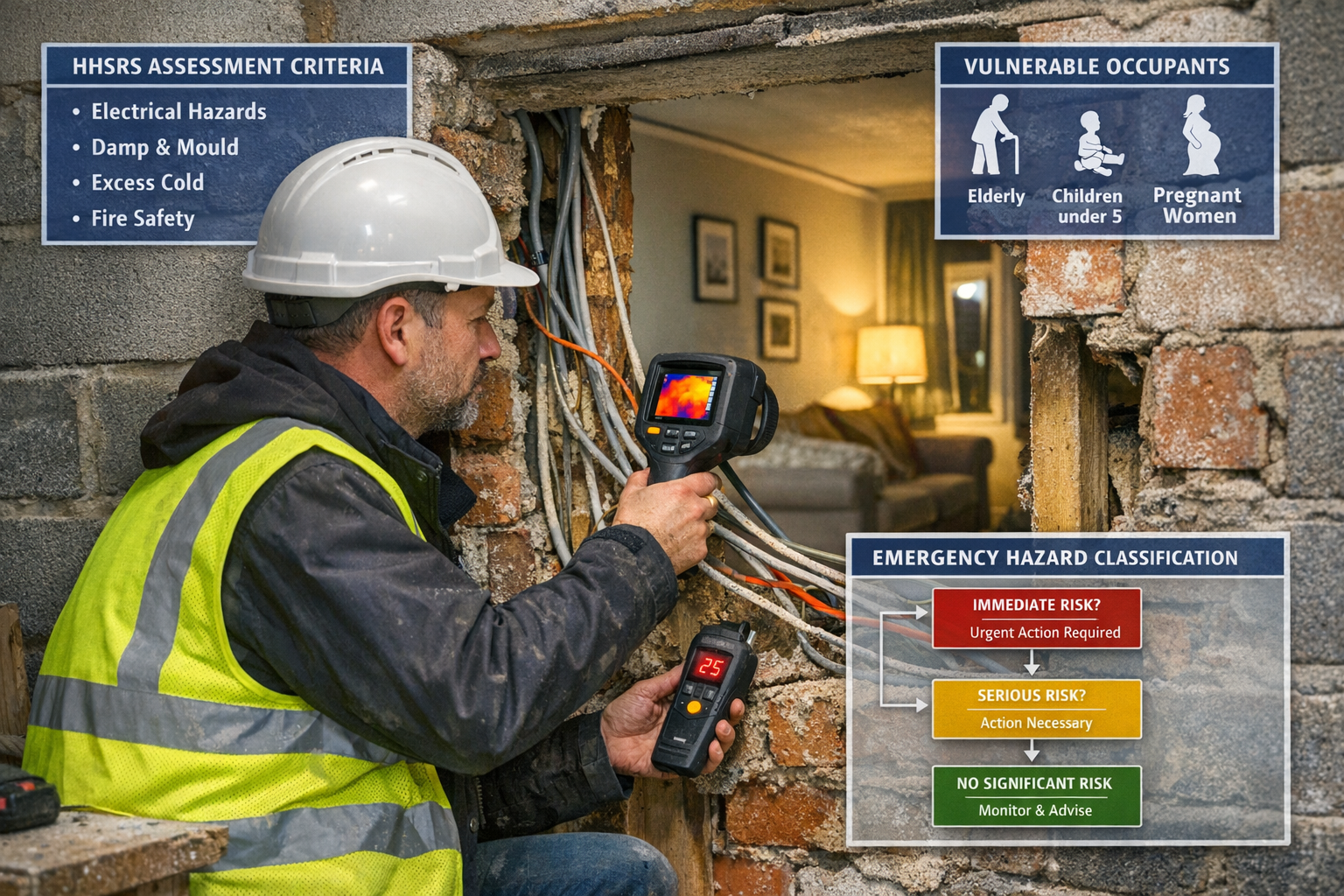
Unlike traditional Housing Health and Safety Rating System (HHSRS) assessments that classify hazards based on statistical likelihood of harm to a hypothetical vulnerable person, Awaab's Law introduces a person-centered approach that considers actual occupant characteristics[7].
"Awaab's Law does not require hazards to meet Category 1 HHSRS standards; vulnerable residents can escalate hazards to emergency status based on individual circumstances."
For party wall surveyors, this means an electrical condition that might constitute a "significant" hazard in a property occupied by healthy adults could immediately become an "emergency" hazard if the adjoining property houses:
- Children under five years old 👶
- Elderly residents (typically over 65) 👴
- Pregnant women 🤰
- Individuals with respiratory conditions
- Persons with cardiovascular conditions
Electrical Hazard Assessments in Party Wall Awards: Protocol Development
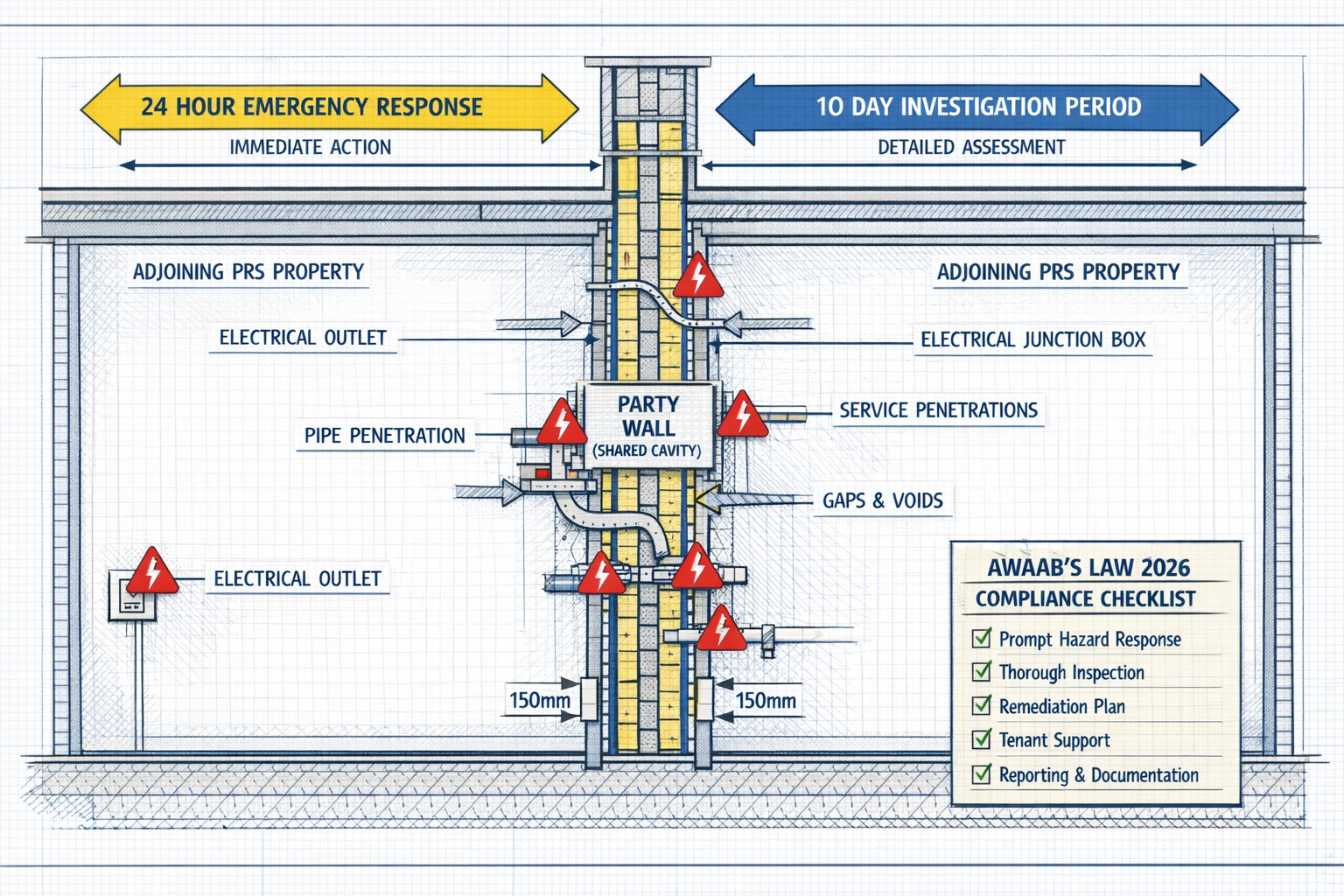
The integration of electrical hazard assessments into party wall procedures requires surveyors to develop systematic protocols that satisfy both the Party Wall etc. Act 1996 requirements and the new Awaab's Law obligations. These protocols must address three distinct temporal phases: pre-works assessment, during-works monitoring, and post-completion verification.
Pre-Works Electrical Safety Documentation
Before commencing any party wall works that could affect electrical installations or create electrical hazards in adjoining PRS properties, surveyors preparing awards should now include:
Electrical System Inventory:
- Location and condition of all electrical service penetrations through the party wall
- Age and compliance status of electrical installations within 3 meters of the party structure
- Presence of shared electrical services (increasingly rare but still found in converted properties)
- Documentation of any existing electrical hazards in both the building owner's and adjoining owner's properties
Vulnerable Occupant Assessment:
- Formal inquiry to adjoining property landlords regarding tenant demographics
- Documentation of any vulnerable occupants as defined by Awaab's Law criteria
- Establishment of communication protocols for emergency notifications
- Alternative accommodation contingency planning if emergency hazards arise
Responsibility Matrix:
- Clear delineation between building owner's obligations for hazards created by works
- Adjoining property landlord's existing obligations for pre-existing electrical defects
- Surveyor's duty to report identified hazards to appropriate parties
- Timeline triggers for each party's response obligations
This comprehensive documentation approach aligns with emerging expert witness standards for party wall disputes and creates an evidentiary foundation if subsequent electrical hazard claims arise[5].
During-Works Electrical Hazard Monitoring
The construction phase presents the highest risk period for creating electrical hazards that affect adjoining PRS properties. Surveyors should establish monitoring protocols that include:
Regular Inspection Schedule:
- Weekly inspections during active works affecting the party wall structure
- Immediate inspection following any works involving electrical systems, cable routing, or service penetrations
- Thermal imaging surveys to detect hidden electrical heating or fault conditions
- Moisture ingress monitoring that could compromise electrical safety
Hazard Creation Prevention:
- Review of contractor method statements for electrical safety implications
- Verification that electrical isolation procedures protect adjoining properties
- Monitoring of drilling, cutting, or demolition activities near electrical services
- Documentation of any temporary electrical arrangements during works
Immediate Response Protocols:
- 24-hour contact procedures for emergency electrical hazard identification
- Pre-established relationships with qualified electricians for rapid assessment
- Authority to halt works if emergency electrical hazards are identified
- Notification chains to adjoining property landlords and managing agents
For properties where damage to property in party wall works has occurred, electrical system integrity should receive particular scrutiny, as structural damage frequently compromises electrical installations.
Post-Completion Electrical Verification
Upon completion of party wall works, the award should document:
- Electrical Installation Condition Certificate (EICR) for any electrical work undertaken
- Thermal imaging verification showing no abnormal heating patterns in party wall electrical installations
- Photographic evidence of proper electrical service protection and routing
- Written confirmation from adjoining property landlord acknowledging satisfactory electrical condition
- Amendment to party wall award documenting any electrical modifications made during works
Electrical Hazard Assessments in Party Wall Awards: Surveyor Checklists for PRS Properties
Systematic checklists ensure consistent application of Awaab's Law 2026 protocols across different party wall scenarios. These checklists should be customized based on the specific works contemplated and the characteristics of adjoining properties.
Initial Assessment Checklist
When first appointed to prepare a party wall award involving adjoining PRS properties, surveyors should complete:
✅ Property Classification Verification
- Confirm adjoining property is within PRS sector (not owner-occupied)
- Identify landlord entity and managing agent contacts
- Determine if property is social housing (full Awaab's Law application) or private rental (Phase 2 expansion applicability)
- Verify current tenancy status and occupancy
✅ Vulnerable Occupant Identification
- Request demographic information from adjoining property landlord
- Document presence of any Awaab's Law vulnerable categories
- Establish appropriate hazard classification thresholds
- Plan enhanced communication protocols if vulnerable occupants present
✅ Existing Electrical Condition Baseline
- Review most recent EICR for adjoining property (if available)
- Conduct visual inspection of accessible electrical installations
- Document any pre-existing electrical defects or hazards
- Photograph electrical service entry points and party wall penetrations
✅ Works Impact Assessment
- Identify all proposed works that could affect electrical systems
- Assess risk of creating electrical hazards in adjoining property
- Determine appropriate monitoring frequency during works
- Establish hazard response protocols with building owner
Emergency Electrical Hazard Response Checklist
If an emergency electrical hazard is identified during party wall works:
⚡ Immediate Actions (Within 24 Hours)
- Halt all works that could exacerbate the electrical hazard
- Notify adjoining property landlord via documented communication (email, text, phone with follow-up written confirmation)
- Arrange qualified electrician inspection to assess hazard severity
- Implement temporary safety measures (isolation, barriers, warning notices)
- Document hazard discovery circumstances with timestamped photographs
⚡ Landlord Obligations Trigger
- Confirm landlord awareness of emergency electrical hazard
- Verify landlord has initiated 24-hour investigation requirement
- Document landlord's proposed remediation approach
- Establish monitoring protocol for remediation completion
- Prepare alternative accommodation arrangements if hazard cannot be immediately controlled[3][7]
⚡ Building Owner Responsibilities
- Determine if building owner's works created or contributed to hazard
- Assess building owner's liability for remediation costs
- Suspend works authorization if building owner caused hazard
- Document causation evidence for potential dispute resolution
- Coordinate with building owner's insurance if applicable
⚡ Award Amendment Documentation
- Prepare formal amendment to party wall award documenting hazard
- Establish clear responsibility allocation between parties
- Set remediation verification requirements
- Define conditions for works resumption
- Update schedule of condition party wall documentation
Significant Electrical Hazard Investigation Checklist
For electrical hazards classified as "significant" rather than "emergency":
🔍 10-Working-Day Investigation Period
- Document hazard identification date and circumstances
- Notify adjoining property landlord of significant hazard status
- Arrange qualified electrician assessment within investigation period
- Conduct thermal imaging survey of affected areas
- Review electrical installation history and maintenance records
🔍 Causation Analysis
- Determine whether party wall works created or revealed hazard
- Assess contribution of pre-existing conditions versus works impact
- Document evidence supporting causation conclusions
- Identify responsible party for remediation costs
- Prepare causation report for potential dispute resolution[5]
🔍 Remediation Planning
- Obtain qualified electrician's remediation recommendations
- Establish reasonable timeframe for hazard correction
- Coordinate remediation with ongoing party wall works schedule
- Define interim safety measures during remediation period
- Set verification requirements for remediation completion
🔍 Ongoing Monitoring
- Establish inspection frequency during remediation period
- Define hazard escalation criteria (significant to emergency)
- Maintain communication log with all parties
- Document any changes in occupant vulnerability status
- Update party wall award with remediation progress
Special Considerations for Common Party Wall Scenarios
Different types of party wall works present distinct electrical hazard profiles requiring tailored assessment approaches.
Loft Conversions and Roof Extensions
Loft conversions frequently involve routing new electrical circuits through party walls and require particular attention to:
- Cable routing through party wall structures: Ensure proper fire-stopping and protection of cables penetrating shared walls
- Load increases on shared electrical infrastructure: Verify capacity of electrical service entry equipment if shared
- Thermal insulation effects on electrical installations: Prevent cable overheating from insulation installation
- Ventilation changes affecting electrical equipment: Maintain proper cooling for electrical distribution boards near party walls
When works involve shared chimneys and shared chimney stacks, particular attention should be given to electrical installations that may have been historically routed through chimney breasts, as these are often disturbed during loft conversion works.
Basement Excavations and Underpinning
Deep excavation works trigger the three meter rule and create specific electrical hazards:
- Groundwater ingress affecting electrical systems: Monitor for moisture penetration that could compromise electrical safety in adjoining properties
- Vibration damage to electrical installations: Assess whether excavation vibration has damaged electrical connections or equipment
- Service cable exposure during excavation: Ensure proper protection and support of electrical service cables revealed during excavation
- Temporary power arrangements: Verify that temporary electrical supplies during works do not create hazards in adjoining properties
Internal Wall Removal and Structural Alterations
When removing or altering party walls internally:
- Concealed electrical installations: Use cable detection equipment before any cutting or drilling
- Load-bearing wall removal affecting cable support: Ensure proper re-routing and support of electrical cables when structural elements are removed
- Dust and debris ingress: Prevent construction dust from compromising electrical equipment in adjoining properties
- Temporary openings creating electrical exposure: Protect exposed electrical installations during works
Legal and Liability Implications for Surveyors
The integration of Awaab's Law electrical hazard protocols into party wall practice creates new professional liability considerations for surveyors.
Duty of Care Expansion
Traditionally, party wall surveyors owed duties primarily related to structural protection and fair award preparation. The Awaab's Law expansion potentially extends this duty to include:
Identification Obligations: Surveyors may be held liable for failing to identify obvious electrical hazards during inspections, particularly where vulnerable occupants are present in adjoining PRS properties.
Notification Duties: Once aware of potential electrical hazards, surveyors have clear obligations to notify appropriate parties within timeframes that enable landlords to meet their statutory deadlines[7].
Monitoring Responsibilities: Awards should establish clear monitoring protocols, and surveyors may face liability if inadequate monitoring allows hazard creation or escalation.
Documentation Standards: Expert witness preparation standards suggest that electrical hazard assessments must meet evidentiary admissibility requirements, necessitating systematic, contemporaneous documentation[5].
Professional Indemnity Insurance Considerations
Surveyors should review their professional indemnity insurance coverage to ensure it adequately addresses:
- Claims arising from electrical hazard identification failures
- Liability for inadequate monitoring during party wall works
- Costs of emergency response and tenant rehousing if hazards escalate
- Expert witness and legal defense costs for Awaab's Law-related disputes
Many standard surveyor insurance policies were written before Awaab's Law expansion and may not explicitly cover these new liability categories. Surveyors should discuss policy amendments with insurers to ensure adequate protection.
Dispute Resolution and Expert Witness Roles
As Awaab's Law electrical hazard disputes emerge, surveyors may increasingly serve as expert witnesses in proceedings involving:
Causation Disputes: Determining whether party wall works created electrical hazards or merely revealed pre-existing conditions requiring landlord remediation.
Timeline Compliance: Assessing whether landlords met 24-hour emergency or 10-day significant hazard investigation requirements.
Hazard Classification: Evaluating whether identified electrical conditions properly constituted "emergency" or "significant" hazards under the person-centered assessment approach.
Remediation Adequacy: Determining whether landlord remediation efforts adequately addressed identified electrical hazards.
Expert witness preparation requires systematic documentation that meets courtroom admissibility standards, including contemporaneous notes, photographic evidence with metadata, qualified electrician reports, and clear causation analysis[5][6].
Integration with Existing Party Wall Procedures
Incorporating electrical hazard assessments into established party wall procedures requires practical workflow modifications while maintaining compliance with the Party Wall etc. Act 1996.
Notice Procedures and Electrical Hazard Disclosure
Party wall notices should be enhanced to include:
- Statement of building owner's awareness of Awaab's Law electrical hazard obligations
- Request for adjoining property landlord to disclose vulnerable occupant status
- Notification of building owner's intention to conduct electrical hazard assessments
- Establishment of communication protocols for hazard identification during works
This enhanced disclosure approach helps establish the "awareness" trigger point for Awaab's Law timeline requirements and creates documentation of good faith compliance efforts.
Award Drafting Modifications
Party wall awards should now incorporate:
Electrical Hazard Assessment Provisions:
- Requirement for pre-works electrical condition documentation
- During-works inspection and monitoring protocols
- Emergency response procedures and contact information
- Responsibility allocation for hazard remediation costs
- Award amendment procedures if hazards are identified
Vulnerable Occupant Provisions:
- Documentation of vulnerable occupant status in adjoining properties
- Enhanced notification requirements if vulnerable occupants present
- Accelerated response timelines for hazard identification
- Alternative accommodation cost allocation provisions
Coordination with Landlord Obligations:
- Clear delineation between building owner and landlord responsibilities
- Integration of Awaab's Law statutory timeframes into award timelines
- Procedures for landlord access to conduct hazard investigations
- Cost recovery mechanisms for hazard remediation
These modifications ensure that party wall awards function as comprehensive safety management documents rather than purely structural protection instruments.
Coordination with Other Professionals
Effective electrical hazard assessment requires coordination among multiple professionals:
Qualified Electricians: Surveyors should establish relationships with qualified electricians who can provide rapid assessment services when electrical hazards are identified. These electricians should understand Awaab's Law requirements and be capable of producing reports suitable for expert witness purposes.
Building Control Officers: Coordination with building control ensures that electrical work compliance verification aligns with party wall award requirements and Awaab's Law protocols.
Managing Agents: For adjoining PRS properties managed by letting agents, surveyors should establish direct communication channels to ensure rapid notification of hazard identification and vulnerable occupant information sharing.
Legal Advisors: Complex cases involving vulnerable occupants, emergency hazards, or causation disputes may require early legal advice to ensure proper protocol compliance and liability protection.
Cost Implications and Fee Structures
The expanded scope of party wall surveying under Awaab's Law electrical hazard protocols creates legitimate cost increases that should be reflected in fee structures.
Additional Services Requiring Compensation
Surveyors should consider separate fee provisions for:
- Pre-works electrical hazard assessment and baseline documentation
- Enhanced inspection frequency during works (weekly rather than milestone-based)
- Thermal imaging surveys of electrical installations
- Vulnerable occupant identification and documentation
- Emergency response services (24-hour availability)
- Award amendment preparation if hazards are identified
- Expert witness report preparation for dispute resolution
- Coordination with qualified electricians and other specialists
Understanding party wall cost structures helps building owners budget appropriately for these enhanced services.
Allocation of Electrical Hazard Remediation Costs
Awards should clearly establish cost allocation principles:
Building Owner Responsibility: Where party wall works create or exacerbate electrical hazards, building owners should bear remediation costs as part of their obligation to prevent damage to adjoining properties.
Landlord Responsibility: Where electrical hazards pre-existed party wall works and are merely identified during surveyor inspections, adjoining property landlords retain responsibility for remediation under their existing Awaab's Law obligations.
Shared Responsibility: In cases where party wall works reveal latent electrical defects that become hazardous only due to the works disturbance, cost allocation may be negotiated between parties or determined through dispute resolution.
Emergency Accommodation Costs: If emergency electrical hazards require tenant rehousing, cost allocation depends on causation analysis and may involve building owner liability insurance if works created the hazard.
Practical Implementation Strategies for Surveyors
Surveyors can implement Awaab's Law electrical hazard protocols through systematic practice modifications:
Template Development
Create standardized templates for:
- Enhanced party wall notices with electrical hazard disclosure provisions
- Pre-works electrical hazard assessment checklists
- Vulnerable occupant identification forms
- Emergency electrical hazard notification letters
- Award amendments for electrical hazard documentation
- Expert witness reports for causation disputes
Standardized templates ensure consistent protocol application and reduce the risk of oversight or omission.
Technology Integration
Leverage technology to enhance electrical hazard assessment capabilities:
Thermal Imaging Equipment: Investment in thermal imaging cameras enables identification of electrical heating anomalies not visible during standard inspections.
Digital Documentation Systems: Cloud-based documentation platforms with timestamp and geolocation metadata create robust evidence trails for expert witness purposes.
Hazard Tracking Software: Specialized software can track hazard identification, notification, investigation, and remediation timelines to ensure Awaab's Law compliance.
Communication Platforms: Secure messaging systems with read receipts and delivery confirmation provide documentation of timely hazard notifications.
Professional Development
Surveyors should pursue continuing professional development in:
- Electrical installation fundamentals and hazard identification
- Awaab's Law regulatory requirements and case law developments
- Expert witness preparation and courtroom testimony skills
- Vulnerable population health impacts and person-centered assessment
- Thermal imaging interpretation for electrical fault detection
Professional development ensures surveyors maintain competence in this expanded practice area and can provide credible expert testimony if disputes arise.
Network Development
Building professional networks facilitates effective protocol implementation:
- Qualified electricians capable of rapid response assessment
- Legal advisors specializing in party wall and housing law
- Managing agents for major PRS portfolio landlords
- Local authority environmental health officers
- Expert witness training organizations
These networks provide resources for complex cases and enhance surveyors' ability to deliver comprehensive services under the expanded regulatory framework.
Future Regulatory Developments and Preparedness
Awaab's Law represents an evolving regulatory framework likely to undergo further expansion and refinement.
Anticipated Phase 3 Expansions
Government guidance suggests potential future expansions to include:
- Fire safety hazards in party wall structures
- Excess heat and thermal comfort issues
- Structural safety concerns beyond traditional party wall scope
- Ventilation and indoor air quality hazards
Surveyors should monitor regulatory developments and prepare for progressive expansion of hazard assessment obligations beyond the current electrical focus.
Private Rented Sector Regulation Convergence
The Awaab's Law framework for PRS properties is converging with other regulatory initiatives:
- Decent Homes Standard expansion to private rentals
- Energy Performance Certificate minimum requirements
- Electrical Installation Condition Report mandatory frequencies
- Smoke and carbon monoxide alarm regulations
This regulatory convergence suggests that party wall surveyors will increasingly function as comprehensive property safety assessors rather than specialists in narrow structural protection.
Case Law Development
As Awaab's Law electrical hazard disputes proceed through courts and tribunals, case law will establish important precedents regarding:
- Surveyor duty of care scope and standards
- Causation analysis methodologies
- Hazard classification criteria and thresholds
- Remediation adequacy standards
- Cost allocation principles
Surveyors should monitor reported cases and adjust protocols based on emerging legal standards to ensure continued compliance and liability protection.
Conclusion
The integration of Electrical Hazard Assessments in Party Wall Awards: Awaab's Law 2026 Protocols for Adjoining PRS Properties represents a fundamental transformation of party wall surveying practice. No longer limited to structural protection documentation, surveyors now bear responsibility for comprehensive safety assessment that protects vulnerable rental property occupants from electrical hazards created or revealed during building works.
The 24-hour emergency response requirement and 10-working-day investigation timeline create unprecedented urgency in party wall practice, demanding systematic protocols, enhanced professional competence, and robust documentation standards. Surveyors who adapt their practices to incorporate these requirements will not only achieve regulatory compliance but also provide superior service that protects all parties' interests and reduces dispute risk.
Actionable Next Steps
For surveyors preparing to implement Awaab's Law electrical hazard protocols:
- Review and update party wall notice and award templates to incorporate electrical hazard assessment provisions and vulnerable occupant identification procedures
- Establish relationships with qualified electricians capable of providing rapid assessment services when electrical hazards are identified during party wall works
- Invest in thermal imaging equipment and training to enhance electrical hazard identification capabilities during inspections
- Review professional indemnity insurance coverage with insurers to ensure adequate protection for expanded electrical hazard assessment duties
- Develop standardized documentation protocols that meet expert witness admissibility standards for potential dispute resolution
- Pursue continuing professional development in electrical installation fundamentals, Awaab's Law requirements, and person-centered hazard assessment approaches
Building owners contemplating party wall works affecting adjoining PRS properties should engage surveyors early in the planning process to ensure comprehensive electrical hazard assessment and protocol compliance. Understanding these requirements prevents costly delays, protects vulnerable occupants, and reduces legal liability risk.
For expert guidance on party wall procedures incorporating Awaab's Law 2026 electrical hazard protocols, consider consulting with experienced party wall surveyors who understand the complexities of protecting adjoining rental property occupants during building works. Professional surveying services ensure compliance with evolving regulatory requirements while facilitating successful project completion. For immediate assistance, contact our team to discuss your specific party wall requirements and electrical hazard assessment needs.
References
[1] Awaabs Law 2026 Hazard Expansions Surveyor Protocols For Electrical Fire And Excess Heat Risks In Rentals – https://nottinghillsurveyors.com/blog/awaabs-law-2026-hazard-expansions-surveyor-protocols-for-electrical-fire-and-excess-heat-risks-in-rentals
[2] Awaabs Law Guide – https://wordnerds.ai/awaabs-law-guide
[3] How Digital Tools Help Social Landlords Meet Awaabs Law – https://www.trimble.com/blog/construction/en-US/article/how-digital-tools-help-social-landlords-meet-awaabs-law
[4] Awaabs Law Policy Web Version 10 – https://www.southernhousing.org.uk/media/cxvlllnp/awaabs-law-policy-web-version-10.pdf
[5] Expert Witness Preparation For Awaabs Law 2026 Expansions Testifying On New Rental Hazards Like Fire And Electrical Risks – https://nottinghillsurveyors.com/blog/expert-witness-preparation-for-awaabs-law-2026-expansions-testifying-on-new-rental-hazards-like-fire-and-electrical-risks
[6] Expert Witness Preparation For Awaabs Law Expansion Disputes 2026 Hazard Assessments In Rental Valuations – https://nottinghillsurveyors.com/blog/expert-witness-preparation-for-awaabs-law-expansion-disputes-2026-hazard-assessments-in-rental-valuations
[7] Awaabs Law Guidance For Social Landlords Timeframes For Repairs In The Social Rented Sector – https://www.gov.uk/government/publications/awaabs-law-guidance-for-social-landlords/awaabs-law-guidance-for-social-landlords-timeframes-for-repairs-in-the-social-rented-sector
[8] Awaabs Law Phase 2 What It Covers And What Housing Providers Should Be Doing Now – https://www.madetech.com/blog/awaabs-law-phase-2-what-it-covers-and-what-housing-providers-should-be-doing-now/