

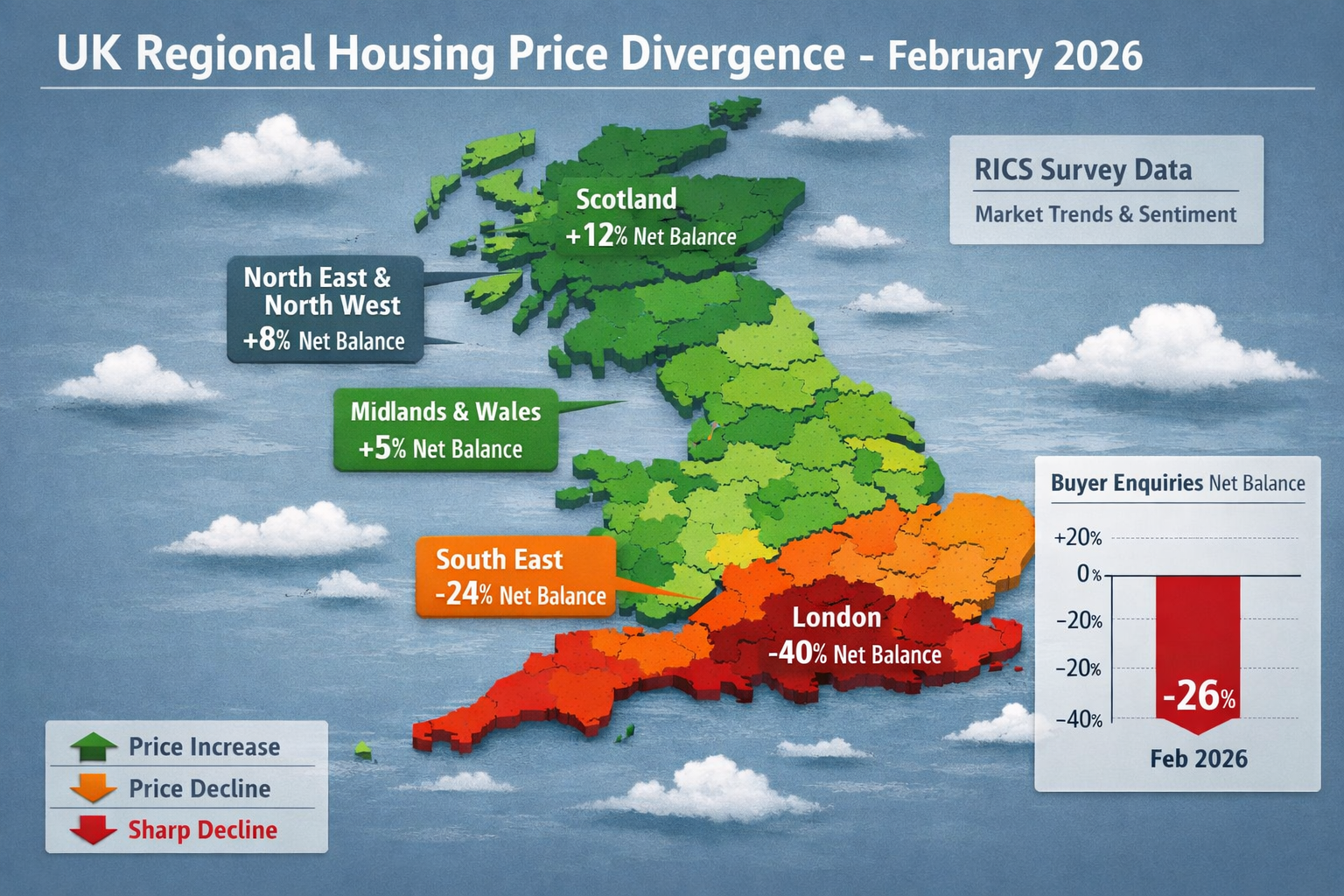
Buyer enquiries across the UK fell to a net balance of -26% in February 2026 — the sharpest single-month drop in recent memory — and yet thousands of property transactions are still progressing every week. That gap between a cooling market and continued buyer activity is precisely where structural risk concentrates. The Cautious Spring 2026 Housing Market: Level 3 Building Survey Red Flags from RICS February Insights is not just a headline; it is a practical warning about what happens when buyers push forward in flat-price conditions without commissioning the right level of professional inspection.
The RICS UK Residential Survey for February 2026 paints a picture of hesitation, regional divergence, and affordability pressure [1]. For buyers still committed to purchasing — particularly in London and the South East, where price sentiment is most negative — a Level 3 Building Survey is no longer optional. It is the single most important tool for protecting a purchase when market conditions make renegotiation difficult and mortgage costs remain elevated.
Key Takeaways 📌
- Buyer demand dropped sharply to -26% net balance in February 2026, the weakest reading in months [1]
- Regional price divergence is extreme: London fell -40%, South East -24%, while Northern Ireland and Scotland held firmer [1]
- Mortgage rates spiked to 4.51% by mid-March 2026, adding further affordability pressure [3]
- A Level 3 Building Survey identifies structural defects, damp, roofing failures, and other red flags that can cost tens of thousands to remedy
- Flat-price markets are the highest-risk environment for buyers — sellers are less likely to reduce further, making pre-purchase due diligence critical
Understanding the RICS February 2026 Data: Why the Market Is Cautious
The Cautious Spring 2026 Housing Market: Level 3 Building Survey Red Flags from RICS February Insights begins with understanding exactly what the data is telling buyers on the ground.
Buyer Demand Has Weakened Significantly
The headline figure from the RICS February 2026 survey is stark: new buyer enquiries registered a net balance of -26%, down from -15% in January [1]. This is not a minor fluctuation. It represents a meaningful pull-back from prospective purchasers who are weighing affordability, economic uncertainty, and geopolitical instability before committing.
Agreed sales followed the same trajectory, posting a -12% net balance in February, with near-term sales expectations at just -2% — the softest reading since November 2025 [1][2].
Regional Divergence Creates Uneven Risk
Perhaps the most important data point for buyers is the extreme regional variation in price sentiment:
| Region | Price Net Balance (Feb 2026) |
|---|---|
| London | -40% |
| South East | -24% |
| East Anglia | -26% |
| Northern Ireland | Positive |
| Scotland | Positive |
| North West England | Positive |
Source: RICS UK Residential Survey, February 2026 [1]
💬 "Near-term price expectations fell to -18% in February, down sharply from -6% in January — yet the 12-month outlook remains positive at +33%." [1][2]
This divergence matters enormously for survey decisions. In London and the South East, where prices are falling and sellers face genuine pressure, buyers may feel they have negotiating leverage. But that leverage disappears entirely if a survey reveals significant defects after exchange — or if the buyer has not commissioned a thorough enough inspection to identify them in the first place.
Mortgage Costs Add Further Pressure
Rightmove reported that average two-year fixed mortgage rates rose to 4.51% by mid-March 2026, up from 4.24% just a week earlier, driven by geopolitical uncertainty [3]. Many forecasts see rates lingering around 6% for much of 2026 [4]. With HMRC recording just 94,680 residential transactions in January 2026 — down 5% from December 2025 [3] — the market is operating at reduced volume with heightened financial stakes per transaction.
In this environment, every pound spent on a comprehensive survey is insurance against a far more expensive mistake.
Level 3 Building Survey Red Flags: What RICS Insights Reveal for Spring 2026 Buyers
The Cautious Spring 2026 Housing Market: Level 3 Building Survey Red Flags from RICS February Insights demands a detailed look at the specific defect categories that a Level 3 Building Survey is designed to uncover — and why these matter more in the current market than in a rising one.
A Level 3 survey (formerly known as a Full Structural Survey) is the most comprehensive residential survey available. It is strongly recommended for:
- Properties built before 1900 🏛️
- Properties with visible defects or unusual construction
- Properties that have been significantly extended or altered
- Any property where the buyer has concerns about structural integrity
🔴 Red Flag #1: Structural Movement and Subsidence
Structural cracking is one of the most commonly missed issues in lower-level surveys. A Level 3 survey examines crack patterns, their width, direction, and likely cause — distinguishing between harmless settlement and active subsidence. In London's clay-heavy soils, subsidence risk is materially higher, making this especially relevant given the capital's -40% price sentiment reading [1].
Warning signs a Level 3 survey investigates:
- Diagonal cracks at window and door corners
- Cracks wider than 5mm
- Sticking doors and windows with no obvious cause
- Sloping floors
🔴 Red Flag #2: Damp and Timber Decay
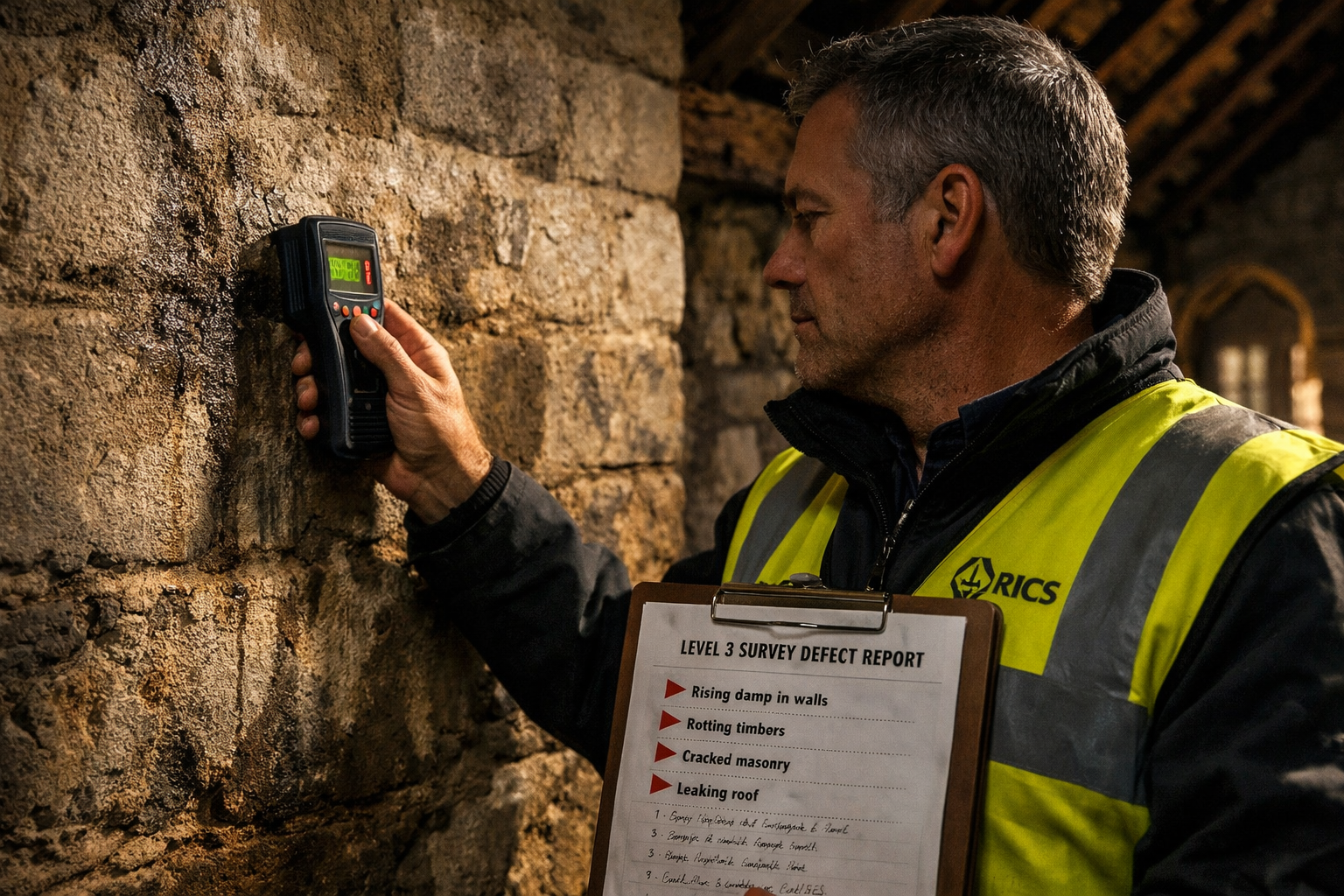
Damp is the most frequently identified defect in UK residential surveys. It encompasses rising damp, penetrating damp, and condensation — each with different causes and remediation costs. A Level 3 survey uses moisture meters, thermal imaging where appropriate, and visual inspection to assess all accessible areas.
Timber decay often accompanies damp: wet rot, dry rot, and woodworm infestations can compromise floor joists, roof timbers, and structural beams. A damp survey as part of a Level 3 assessment can prevent buyers from inheriting remediation costs running into the tens of thousands.
💡 Tip: Always ask your surveyor whether the Level 3 report includes a specific assessment of roof timbers and subfloor void conditions — these are common omission areas in less thorough inspections.
🔴 Red Flag #3: Roof Condition
Roof failures are among the most expensive defects to remedy. A Level 3 survey examines:
- Tile and slate condition — cracked, slipped, or missing coverings
- Flat roof integrity — blistering, ponding, and membrane failure
- Chimney stacks — pointing, flaunching, and structural stability
- Gutters and downpipes — blockages causing water ingress
A professional roof survey can identify issues that are entirely invisible from ground level and that a standard Level 2 HomeBuyer Report may not fully investigate.
🔴 Red Flag #4: Asbestos-Containing Materials
Properties built or refurbished before 2000 may contain asbestos in textured coatings (Artex), floor tiles, pipe lagging, and roof sheets. A Level 3 survey flags suspected asbestos-containing materials for specialist testing. This is particularly relevant for the large stock of inter-war and post-war housing that dominates many of the regions showing negative price sentiment in the RICS data. Buyers should also consider a dedicated asbestos survey where risk is elevated.
🔴 Red Flag #5: Drainage and Services Condition
Older properties frequently have clay or cast-iron drainage that has deteriorated, root-invaded, or collapsed. A Level 3 survey recommends CCTV drain surveys where appropriate, and assesses the visible condition of electrical installations, heating systems, and plumbing — flagging any that require urgent attention or specialist investigation.
Level 3 vs. Level 2: Choosing the Right Survey
| Feature | Level 2 HomeBuyer Report | Level 3 Building Survey |
|---|---|---|
| Condition ratings | ✅ | ✅ |
| Structural analysis | Limited | ✅ Full |
| Roof space inspection | External only | ✅ Internal |
| Damp/timber detail | Basic | ✅ Comprehensive |
| Older/unusual properties | ❌ Not recommended | ✅ Recommended |
| Remediation cost guidance | Sometimes | ✅ Detailed |
For buyers uncertain about which level is appropriate, reviewing the comparison of different survey types provides a clear framework for decision-making.

How to Use Survey Findings Strategically in a Cautious Spring 2026 Market
Understanding the Cautious Spring 2026 Housing Market: Level 3 Building Survey Red Flags from RICS February Insights is only half the equation. The other half is knowing how to act on survey findings in a market where sellers are under pressure but buyers face their own affordability constraints.
Using Defects as a Renegotiation Tool
In a flat or falling price environment, survey defects carry significant renegotiation weight. A well-documented Level 3 report with estimated remediation costs provides:
- Objective evidence for a price reduction request
- Scope for specialist quotes to support renegotiation figures
- Legal protection if defects are later found to have been concealed
With London prices at a net balance of -40% and South East prices at -24% [1], sellers in these regions are already aware that the market is not in their favour. A credible survey report strengthens the buyer's negotiating position considerably.
When to Commission a Specific Defect Report
Where a Level 3 survey identifies a particular area of concern — such as a suspected structural crack, chimney movement, or unexplained floor deflection — a specific defect report provides a focused, expert assessment of that single issue. This is often the most cost-effective next step before renegotiating or withdrawing from a purchase.
Rental Market Implications for Landlord Buyers
The RICS February 2026 data shows landlord instructions at a firmly negative -27%, while +20% of respondents expect rents to rise over the next three months [1][2]. For investors considering buy-to-let purchases in this environment, the survey calculus is even more critical: a property with undisclosed structural or compliance issues can generate significant dilapidations liability. A schedule of condition report at purchase creates a documented baseline that protects landlords from future disputes.
The Long-Term Outlook: Patience Rewarded, Diligence Essential
The 12-month sales activity outlook remains positive at +17% of respondents expecting improvement [2], and the 12-month price expectation holds at +33% [1][2]. The market is not broken — it is paused. The buyers who will benefit most from the eventual recovery are those who:
- ✅ Commission the appropriate level of survey before exchange
- ✅ Use survey findings to negotiate accurately, not speculatively
- ✅ Understand the full cost of ownership — including remediation — before committing
The 2026 market forecast of "modest movement rather than major recovery" [3] means that overpaying for a defective property carries a longer correction timeline than in previous cycles.
Conclusion: Protect Your Purchase in a Cautious Market
The RICS February 2026 data confirms what many buyers already sense: this is a market defined by caution, not confidence. Buyer enquiries at -26%, agreed sales at -12%, mortgage rates rising sharply, and pronounced regional price weakness in London and the South East [1][3] all point to a market where due diligence is the most valuable investment a buyer can make.
A Level 3 Building Survey is the professional standard for identifying the structural, damp, roofing, and services defects that can turn a cautious purchase into a costly liability. In flat-price conditions, there is no rising market to absorb the cost of undiscovered defects.
Actionable Next Steps for Spring 2026 Buyers:
- Commission a Level 3 Building Survey for any property built before 1980, extended, or showing visible defects — before exchange of contracts
- Request specialist reports for flagged concerns: subsidence investigations, asbestos assessments, or CCTV drain surveys
- Use survey findings to renegotiate — in a -40% London price sentiment environment, documented defects carry real leverage [1]
- Engage a local chartered surveyor with specific knowledge of regional construction types and common defects in your target area
- Review the 12-month outlook — with price expectations turning positive at +33% [1], buying right now (at the right price, with full information) positions buyers well for the recovery ahead
The spring 2026 housing market rewards preparation. A thorough survey is not a cost — it is the most reliable form of buyer protection available.
References
[1] UK Residential Survey February 2026 – https://www.rics.org/news-insights/uk-residential-survey-february-2026
[2] UK Residential Market Survey February 2026 – https://www.rics.org/content/dam/ricsglobal/documents/market-surveys/uk-residential-market-survey/UK-Residential-Market-Survey_February-2026.pdf
[3] UK Residential Property Market Update Spring 2026 – https://www.vailwilliams.com/uk-residential-property-market-update-spring-2026/
[4] Spring 2026 Housing Market Outlook – https://www.mtb.com/library/article/spring-2026-housing-market-outlook