
Nearly one in five homebuyers in the UK discovers a significant defect in their property only after completion — a costly lesson that a properly matched survey could have prevented. Choosing the Right Building Survey Level: RICS Guidance for Homebuyers in 2026 has never been more relevant, particularly following RICS's publication of the second edition of the Home Survey Standard in April 2026, which introduced clearer language and tighter professional requirements across all three survey levels [1]. Whether buying a modern flat or a centuries-old farmhouse, selecting the wrong survey level can leave buyers either overpaying for unnecessary detail or dangerously under-informed about structural risks.
Key Takeaways
- RICS defines three residential survey levels: Level 1 (basic), Level 2 (intermediate), and Level 3 (advanced), each suited to different property types and conditions.
- The April 2026 second edition of the Home Survey Standard introduced clearer terminology and enhanced consistency across all survey levels.
- Level 2 suits conventionally built properties in reasonable condition; Level 3 is essential for older, altered, or structurally complex homes.
- Property age, construction type, planned alterations, and regional environmental risks should all inform the survey level chosen.
- Commissioning the right survey level before exchange of contracts can save thousands of pounds in unexpected repair costs.
Understanding the Three RICS Survey Levels in 2026
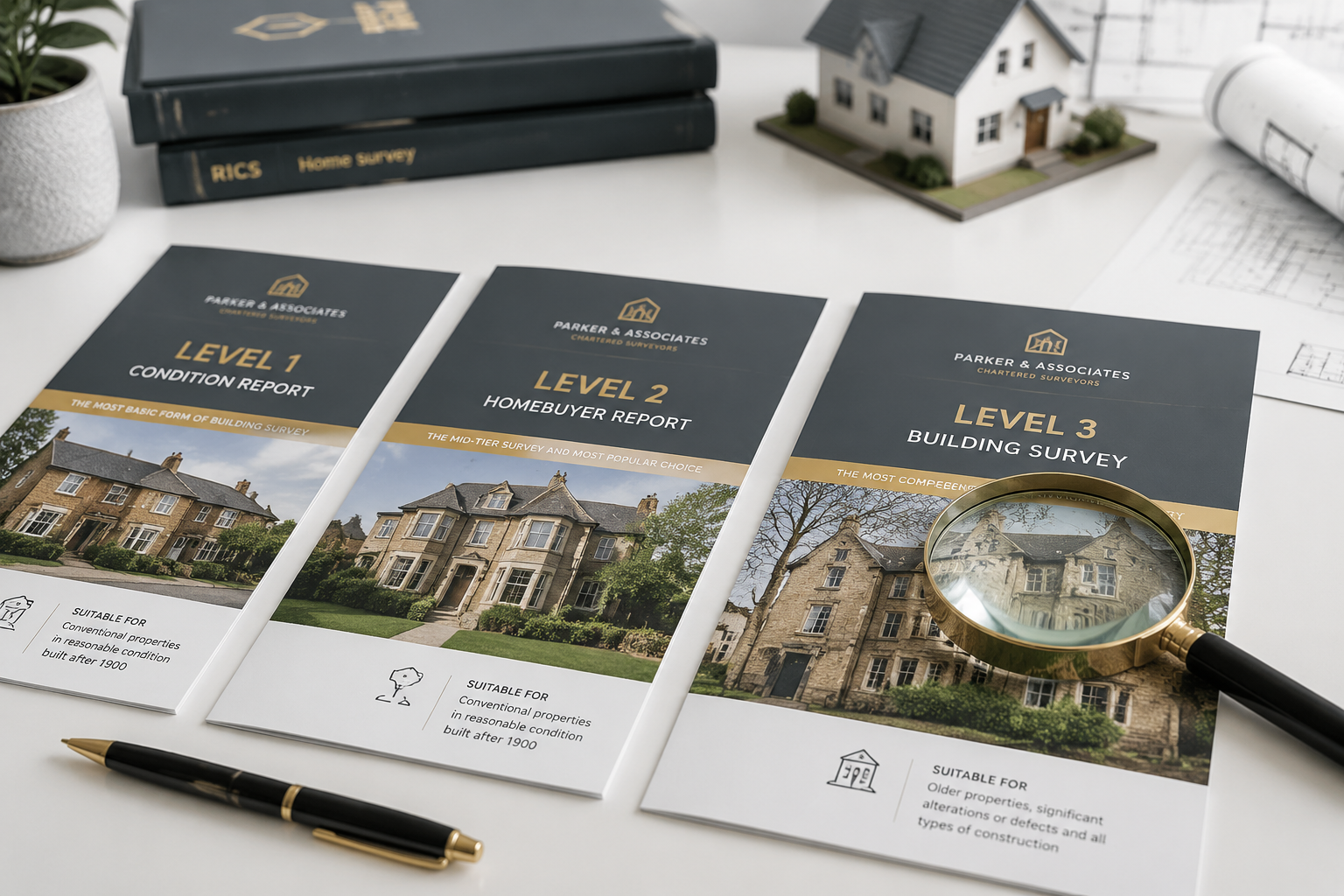
The Royal Institution of Chartered Surveyors structures residential property surveys into three distinct tiers. The updated Home Survey Standard, effective from April 2026, describes these as "basic," "intermediate," and "advanced" to help consumers immediately grasp the difference in depth and scope [3].
Level 1: The Condition Report (Basic)
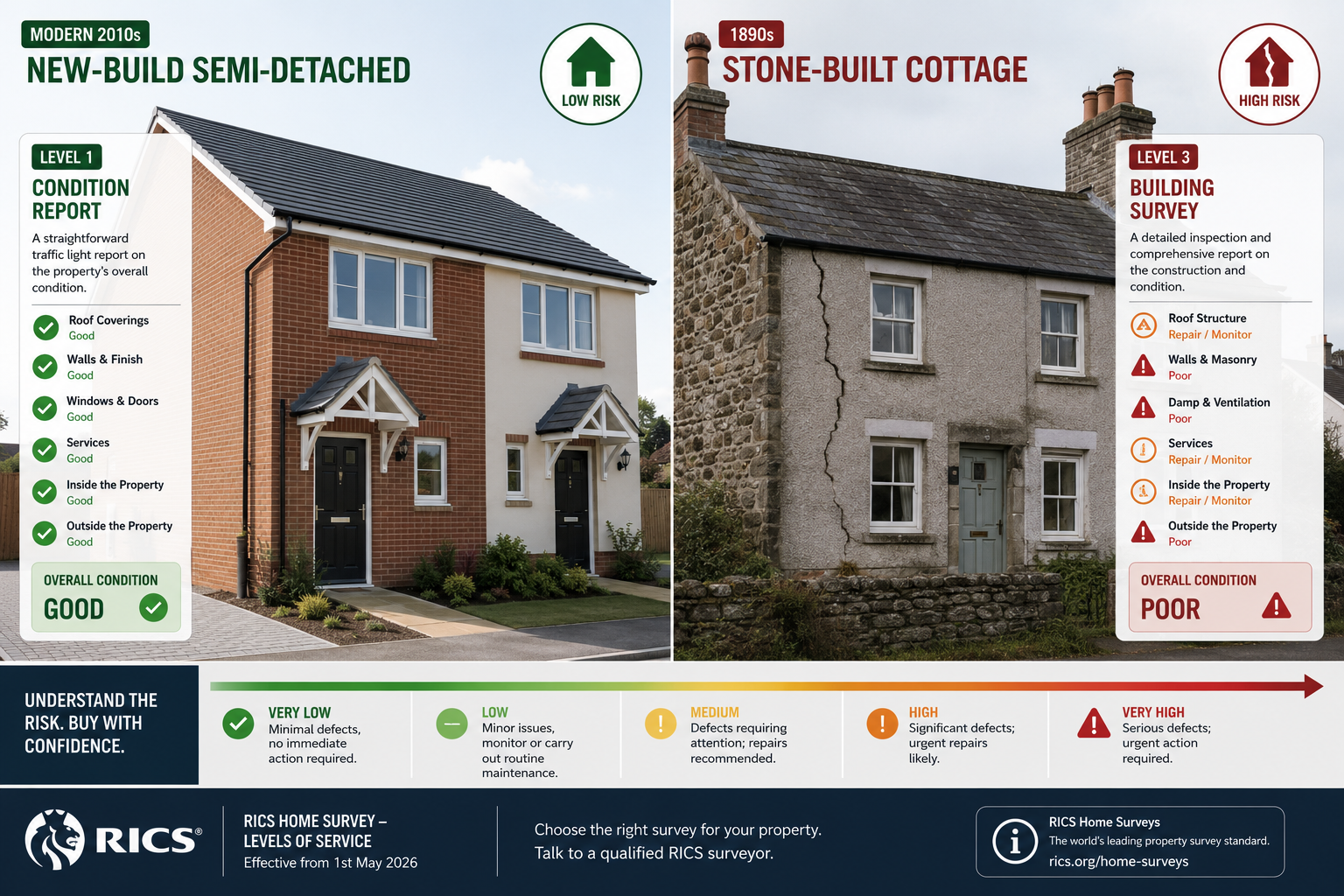
The Level 1 Condition Report is the most concise option. It provides a high-level overview of a property's visible condition, using a simple traffic-light rating system to flag areas of concern [2]. No advice on repairs or maintenance is included, and the surveyor does not provide a market valuation.
Best suited for:
- Newly built or recently converted properties
- Modern homes (typically post-2000) in good condition
- Properties where the buyer simply wants a documented snapshot before purchase
The Level 1 report is not appropriate for older homes, properties showing signs of damp or movement, or any building that has been significantly extended or altered. Its low cost reflects its limited scope, and buyers should not mistake brevity for thoroughness.
Level 2: The HomeBuyer Report (Intermediate)
The Level 2 HomeBuyer Report is the most commonly commissioned survey in England and Wales. It involves a more extensive visual inspection of the building, its services, and the grounds, covering all readily accessible areas [5]. The surveyor identifies defects, assesses their urgency, and provides maintenance advice. An optional market valuation can be added.
Best suited for:
- Conventionally constructed properties in reasonable condition
- Standard brick-built houses and flats built after approximately 1900
- Properties where no major structural concerns are immediately visible
The Level 2 survey does not include opening up of floors, detailed investigation of concealed areas, or in-depth analysis of complex construction methods. For a homebuyer survey on a standard 1970s semi-detached, this level typically provides sufficient information to negotiate on price or request remedial works.
Level 3: The Building Survey (Advanced)
The Level 3 Building Survey is the most comprehensive residential inspection available. It covers all accessible areas including roof spaces, under-floor voids, and outbuildings, and delivers detailed advice on defects, their likely causes, and remedial options [4]. The surveyor also comments on construction materials, identifies risks from non-standard building methods, and can advise on the implications of planned alterations.
For a full overview of what this level entails, the RICS Building Survey Level 3 provides an in-depth analysis that goes far beyond a standard visual inspection.
Best suited for:
- Properties built before 1919
- Homes that have been substantially extended, converted, or altered
- Properties showing visible defects such as cracking, damp, or settlement
- Unusual or non-standard construction (timber frame, stone, cob, listed buildings)
"A Level 3 Building Survey is not a luxury — for the right property, it is the minimum due diligence a buyer should undertake."
Matching Survey Level to Property Type: Practical Scenarios
Choosing the Right Building Survey Level: RICS Guidance for Homebuyers in 2026 is most useful when applied to real-world property scenarios. The table below illustrates how the three levels map to common purchase situations.
| Property Type | Typical Age | Recommended Level | Key Reason |
|---|---|---|---|
| New-build flat | Post-2015 | Level 1 or Snagging | Warranty period; defect liability with developer |
| 1980s brick semi-detached | 40-45 years | Level 2 | Standard construction; no major visible defects |
| 1930s bay-fronted terrace | ~90 years | Level 2 or Level 3 | Age warrants closer inspection; potential for damp |
| Victorian or Edwardian terrace | Pre-1919 | Level 3 | Original fabric; likely alterations; hidden defects |
| Stone-built cottage | Pre-1850 | Level 3 | Non-standard materials; moisture risk; structural complexity |
| Extended 1960s bungalow | ~60 years + extension | Level 3 | Extension interfaces; potential structural changes |
| Listed building | Variable | Level 3 + specialist | Consent requirements; specialist materials |
New-Build Properties: Snagging Over Surveys
For newly completed homes, a traditional survey is rarely the most appropriate tool. Instead, a snagging list inspection identifies cosmetic and minor defects that the developer is obligated to rectify before or shortly after handover. New-build warranties (such as NHBC Buildmark) cover structural defects for ten years, which reduces — but does not eliminate — the need for independent inspection.
Properties Showing Damp or Structural Movement
If a property displays visible signs of damp penetration, rising damp, or cracks in walls or ceilings, a Level 2 survey may be insufficient. A damp survey or specialist structural investigation may be needed alongside or instead of a standard Level 2 report. Buyers should not assume a HomeBuyer Report will provide the diagnostic depth required to understand the cause and cost of remediation.
Similarly, roofs on older properties warrant close attention. A roof survey can provide targeted detail on coverings, flashings, and structural timbers that a general survey may only reference in passing.
Regional Risks and Bespoke Survey Considerations
Choosing the Right Building Survey Level: RICS Guidance for Homebuyers in 2026 also requires buyers to think beyond the building itself. Regional environmental and geological factors can significantly affect what a survey should cover.
Ground Conditions and Subsidence Risk
Parts of the UK are more susceptible to ground movement than others. Clay-heavy soils in London and the South East are prone to shrink-swell subsidence, particularly following dry summers. Properties in former mining areas — large parts of the North, Midlands, and South Wales — may be affected by historic underground workings. In these cases, a Level 3 survey should be considered even for relatively modern properties, and buyers may wish to commission additional ground investigation or a specialist structural report.
Flood Risk
Properties in flood-prone areas require careful assessment of drainage, floor levels, and any flood mitigation measures in place. A drainage survey can complement a building survey by identifying vulnerabilities in below-ground drainage that a visual inspection cannot detect.
Asbestos in Pre-2000 Properties
Any property built or refurbished before 2000 may contain asbestos-containing materials (ACMs). A Level 3 survey will note the presence of suspected ACMs, but will not test or remove them. Buyers of older properties — particularly those planning renovations — should consider a dedicated asbestos survey to understand the scope and cost of any management or removal works.
Bespoke and Specialist Surveys
Some properties fall outside the scope of any standard RICS survey level. These include:
- Listed buildings: Require understanding of conservation obligations, approved repair methods, and the implications of any unauthorised alterations.
- Properties with solar panels: Structural loading and roof integrity assessments may be needed, particularly where panels have been retrofitted.
- Commercial-to-residential conversions: May require a commercial building survey approach even when the end use is residential.
In these cases, a chartered surveyor should be briefed on the specific concerns before the inspection, allowing the report to be tailored accordingly. RICS's ongoing public consultation on residential stock condition surveys, which ran from December 2025 to February 2026, reflects the profession's commitment to raising standards in exactly these more complex scenarios [6].
How Long Does a Survey Take, and What Does It Cost?
Survey duration varies considerably by level and property size. A Level 1 report on a small modern flat may take under an hour on-site, while a Level 3 survey of a large Victorian house can take a full day or more. For a detailed breakdown, the guide on how long a homebuyers survey takes covers typical timeframes across property types.
Indicative cost ranges in 2026:
| Survey Level | Typical Cost Range (UK) |
|---|---|
| Level 1 (Condition Report) | £300 – £500 |
| Level 2 (HomeBuyer Report) | £450 – £900 |
| Level 3 (Building Survey) | £700 – £1,800+ |
Costs vary by region, property size, and surveyor. London and the South East typically attract higher fees. RICS emphasises that the cost of a survey should always be weighed against the potential cost of undiscovered defects — a roof replacement alone can cost £10,000 to £30,000 [2].
For buyers concerned about structural survey pricing specifically, a dedicated guide to structural survey costs provides further context on what influences fees.
Choosing a Qualified Surveyor
All RICS-regulated surveyors must adhere to the Home Survey Standard. When commissioning any survey, buyers should:
- Confirm the surveyor is MRICS or FRICS qualified
- Ask whether the surveyor has experience with the specific property type and age
- Request a sample report to assess the level of detail provided
- Clarify exactly what is and is not included in the agreed scope
When to Upgrade Your Survey Level
Several triggers should prompt a buyer to commission a higher-level survey than they initially planned:
- The property is older than expected: Vendors sometimes underestimate or misrepresent the age of extensions or alterations.
- The asking price is high: The higher the financial commitment, the greater the value of thorough due diligence.
- The vendor has declined to make repairs: This suggests known defects that may be more serious than disclosed.
- The mortgage lender flags concerns: A lender's valuation is not a survey; if the valuer notes concerns, a full building survey is advisable.
- Planning to renovate: Any buyer intending structural alterations should understand the existing condition in full before committing.
RICS consumer guidance is clear that the survey level should reflect the property's characteristics, not simply the buyer's budget [2]. Cutting costs at the survey stage is one of the most common — and most expensive — mistakes made by first-time buyers.
Conclusion
Selecting the right survey level is one of the most consequential decisions a homebuyer makes before exchange. The RICS framework — updated in April 2026 with the second edition of the Home Survey Standard — provides a clear structure: Level 1 for modern, straightforward properties; Level 2 for conventionally built homes in reasonable condition; and Level 3 for older, complex, or potentially defective buildings [1][3].
Actionable next steps for homebuyers in 2026:
- Assess the property's age, construction type, and visible condition before deciding on a survey level.
- Consider regional risks such as subsidence, flood exposure, or former mining activity that may require specialist input.
- Commission a Level 3 Building Survey for any property built before 1919 or showing signs of defect — do not rely on a Level 2 report to provide structural reassurance.
- For new-builds, prioritise a snagging inspection over a standard condition report.
- Always use an MRICS or FRICS-qualified surveyor and confirm their experience with the specific property type.
- Factor survey cost into the overall purchase budget as essential due diligence, not an optional extra.
The right survey does not just protect a buyer's finances — it provides the knowledge needed to make a fully informed decision about one of the largest investments most people will ever make.
References
[1] Home Survey Standards – https://www.rics.org/profession-standards/rics-standards-and-guidance/sector-standards/building-surveying-standards/home-surveys/home-survey-standards?utm_source=openai
[2] House Surveys UK The Costs Types And Benefits Of An RICS Home Survey – https://www.rics.org/consumer-guides/house-surveys-uk-the-costs-types-and-benefits-of-an-rics-home-survey?utm_source=openai
[3] Understanding The RICS Home Survey Standard Proposal – https://www.rics.org/news-insights/understanding-the-rics-home-survey-standard-proposal?utm_source=openai
[4] Scope Of Inspection Home Survey Level Three – https://www.rics.org/profession-standards/rics-standards-and-guidance/sector-standards/building-surveying-standards/home-surveys/scope-of-inspection-home-survey-level-three?utm_source=openai
[5] Scope Of Inspection Home Survey Level Two – https://www.rics.org/profession-standards/rics-standards-and-guidance/sector-standards/building-surveying-standards/home-surveys/scope-of-inspection-home-survey-level-two?utm_source=openai
[6] Residential Stock Condition Surveys – https://www.rics.org/profession-standards/rics-standards-and-guidance/sector-standards/real-estate-standards/residential-stock-condition-surveys?utm_source=openai
[7] Understanding RICS Survey Levels – https://www.surreysurveyor.com/blog/understanding-rics-survey-levels.html?utm_source=openai
[8] What Survey Do I Need L1 L2 L3 – https://www.propertypassport.uk/guides/what-survey-do-i-need-l1-l2-l3?utm_source=openai