

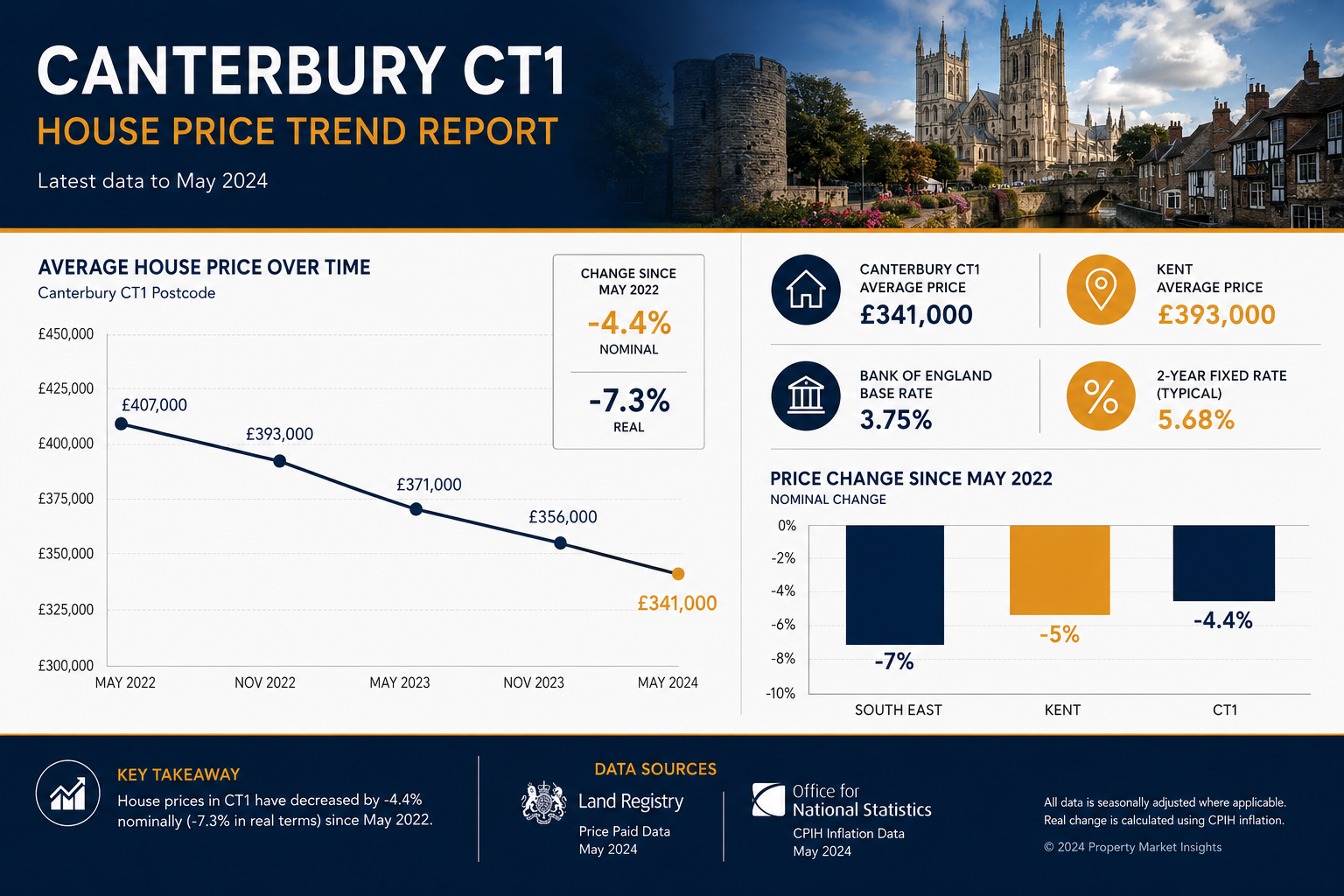
A nominal 4.4% price fall in Canterbury's CT1 postcode over the past twelve months translates to a real-terms loss of 7.3% once inflation is stripped out — a figure that should prompt every buyer, seller, and homeowner in east Kent to reassess their position before exchanging contracts this summer. This Canterbury CT1 house prices fall 4.4% Kent commuter belt June 2026 surveyor analysis sets out what the data means in practice, why a professional building survey is more important than ever, and how to protect yourself in a market where lenders are increasingly cautious.
Key Takeaways
- Canterbury CT1 prices are down 4.4% nominally and 7.3% in real terms over the past year (May 2026 analysis).
- The average Canterbury house price stands at £341,000 (ONS provisional, March 2026), broadly flat year-on-year at city level but masking sharper falls in CT1.
- Kent's average house price is £393,000 (May 2026); the county is down roughly 5%, outperforming the wider South East at -7%.
- Down-valuations by mortgage lenders are a growing risk; a RICS survey provides independent evidence to challenge or negotiate them.
- Period properties near Canterbury Cathedral — Kentish ragstone, peg-tile roofs, historic timber frames — carry specific survey risks that a Level 2 or Level 3 inspection must address.
Table of Contents
- The Canterbury and Kent Price Picture in June 2026
- Why CT1 Is Falling Faster Than the Canterbury Average
- Down-Valuations: The Practical Risk for Buyers and Sellers
- RICS Surveys and Kent Period Property
- Conservation Areas, Article 4 Directions and Listed Building Consent
- What Commuter Belt Demand Means for East Kent
- FAQ
- Conclusion
The Canterbury and Kent Price Picture in June 2026
ONS provisional data for March 2026 puts the average Canterbury house price at £341,000, broadly unchanged year-on-year at city level. Beneath that headline, however, Land Registry transaction data analysed in May 2026 shows the CT1 1 sub-sector down 4.4% in nominal terms — and 7.3% in real terms after accounting for ongoing inflation.
Kent as a whole averages £393,000 in May 2026, with county-wide prices down approximately 5%. That compares favourably with the wider South East, where prices have dropped around 7%, suggesting Kent retains relative resilience — but "less bad" is not the same as stable.
| Geography | Average Price (2026) | Annual Change (Nominal) |
|---|---|---|
| Canterbury city | £341,000 | ~0% (flat) |
| Canterbury CT1 1 | Below city average | -4.4% |
| Kent county | £393,000 | ~-5% |
| South East region | N/A | ~-7% |
Sources: ONS provisional (March 2026), Land Registry, Kent Property Market Report (May 2026)
The Bank of England base rate sits at 3.75%, with the typical 2-year fixed mortgage rate at 5.68% (May 2026, Rightmove mortgage data). Affordability remains stretched relative to the pre-2022 era, keeping transaction volumes subdued and giving buyers negotiating leverage they have not enjoyed for several years.
Why CT1 Is Falling Faster Than the Canterbury Average
CT1 encompasses the city centre, the Cathedral Quarter, and the streets immediately surrounding the World Heritage Site. These are predominantly Victorian and Edwardian terraces, Georgian townhouses, and converted flats — all of which attract a premium in rising markets but can be illiquid when sentiment turns.
Several factors are compressing CT1 values specifically:
- Leasehold flat exposure. A concentration of converted Victorian properties with short or mid-length leases is deterring mortgage lenders and cash buyers alike.
- Higher stamp duty burden. Properties priced above £300,000 face a proportionally heavier tax bill following the March 2025 threshold changes, reducing net purchasing power.
- Oversupply of city-centre stock. Rightmove data shows Canterbury city-centre listings up year-on-year, lengthening average days-to-sale and increasing vendor price reductions.
- Student and HMO saturation. Parts of CT1 near the universities have seen buy-to-let investors exit following tighter licensing rules, adding further supply.
Down-Valuations: The Practical Risk for Buyers and Sellers
When a lender's valuer assesses a property at less than the agreed purchase price, the buyer must either renegotiate, increase their deposit, or walk away. In a market where Canterbury CT1 house prices fall 4.4% Kent commuter belt June 2026 surveyor instructions are rising sharply, down-valuations are no longer exceptional — they are a routine feature of transactions on period stock.
For buyers: A RICS Home Survey commissioned independently of the lender's valuation provides a second, detailed opinion on condition. Where defects are identified — damp penetration, roof spread, failed pointing on ragstone — the survey report gives concrete grounds to renegotiate the purchase price downward before exchange.
For sellers: Commissioning a Canterbury property valuation before listing helps set a realistic asking price that survives lender scrutiny. Overpriced properties in the current market are sitting unsold for three to five months, then suffering forced reductions that attract further downward pressure.
Key actions to reduce down-valuation risk:
- Obtain a pre-sale RICS valuation and address obvious defects beforehand.
- Provide buyers with documentation: planning consents, listed building consents, damp treatment guarantees.
- Price realistically from day one — Rightmove data confirms that properties reduced within 60 days achieve, on average, 3.2% less than their final asking price.
RICS Surveys and Kent Period Property
Canterbury's housing stock is dominated by buildings that pre-date modern construction standards. Kentish ragstone, handmade peg-tile roofs, historic timber frames, and lime-mortar pointing are beautiful — but they require a surveyor with specific local knowledge.
Understanding the difference between a Level 2 and Level 3 survey is the first practical decision a buyer must make:
RICS Home Survey Level 2 (Homebuyer Report)
- Suitable for properties in reasonable condition built after approximately 1900.
- Covers visible defects, damp readings, and a market valuation if requested.
- Less appropriate for pre-Victorian stock or properties with known structural alterations.
RICS Home Survey Level 3 (Building Survey)
- Recommended for all pre-1900 Canterbury properties, any ragstone construction, timber-framed buildings, and properties within Conservation Areas.
- Provides a detailed analysis of construction method, defect causation, and repair specification.
- Essential where the lender's valuer has flagged concerns or where the property has been extended or converted.
A Level 3 building survey on a Canterbury period property will typically examine:
- Ragstone walls: Spalling, sulphate attack, failed repointing with cement rather than lime mortar.
- Peg-tile roofs: Nail fatigue, delamination, valley lead condition, and rafter spread.
- Timber frames: Beetle infestation, fungal decay at sole plates, inadequate lateral restraint.
- Damp: Rising damp versus condensation versus penetrating damp — a distinction that affects both repair cost and mortgage eligibility. See the firm's guide to damp surveys for more detail.
Conservation Areas, Article 4 Directions and Listed Building Consent
Much of central Canterbury — particularly the streets within the World Heritage buffer zone and the Wincheap and Northgate Conservation Areas — is subject to planning controls that go beyond standard permitted development rights.
Article 4 Directions remove certain permitted development rights, meaning works that would be unrestricted elsewhere require a full planning application. This affects:
- Replacement windows and doors (materials and style must match the original).
- External cladding or render changes.
- Satellite dish installation on front elevations.
- Outbuildings visible from the highway.
Listed Building Consent is required for any works — internal or external — that affect the character of a listed building. Canterbury has a high density of Grade II and Grade II* listed properties, particularly in CT1. Buyers who purchase without understanding these restrictions can find themselves liable for unauthorised works carried out by previous owners.
A specialist defect survey can identify whether unauthorised alterations have been made and advise on regularisation. Sellers should obtain a schedule of condition report to document the property's state before marketing, reducing the risk of retrospective claims.
What Commuter Belt Demand Means for East Kent
Despite the CT1 correction, Canterbury's position as a Kent commuter belt hub continues to underpin demand from London buyers. The Canterbury to London St Pancras International journey takes approximately 56 minutes on Southeastern high-speed services, making it competitive with many inner London boroughs for price-to-commute value.
Grammar school catchments — Canterbury's selective schools remain heavily oversubscribed — add a structural demand floor that purely residential markets lack. Whitstable, Herne Bay, and Faversham are experiencing similar dynamics: coastal lifestyle appeal combined with reasonable rail access keeps these markets more resilient than the county average.
The Canterbury CT1 house prices fall 4.4% Kent commuter belt June 2026 surveyor picture is therefore nuanced: city-centre flats and leasehold stock are under pressure, while well-presented family houses in grammar school catchments with good rail access are still achieving close to asking price. Understanding which micro-market a property sits in — and commissioning the right survey — is the difference between a sound investment and an expensive mistake.
For buyers considering choosing the right property survey in east Kent, local chartered surveyor expertise is not optional — it is essential.
FAQ
Q: What does a 4.4% nominal fall in CT1 mean for a property I agreed to buy six months ago?
A: If you agreed a purchase price based on comparable sales from mid-2025, the property may now be worth less than your agreed figure. A current RICS valuation will confirm whether your lender is likely to down-value the property and by how much, giving you grounds to renegotiate.
Q: Do I need a Level 3 survey on a Victorian terrace in Canterbury city centre?
A: In most cases, yes. Victorian terraces in CT1 frequently feature original timber floors, lime-mortar pointing, and single-skin rear additions that carry defect risks a Level 2 survey may not fully explore. A Level 3 report provides the repair cost estimates needed to make an informed decision.
Q: Can I carry out renovation works on a listed property in Canterbury's Conservation Area without consent?
A: No. Listed Building Consent is required for any works affecting the character of a listed building, including internal alterations. Article 4 Directions also restrict external changes in many Canterbury Conservation Areas. Always obtain written confirmation from Canterbury City Council's planning department before starting work.
Q: How does the BoE base rate of 3.75% affect my Canterbury purchase?
A: The base rate directly influences lender pricing. With 2-year fixed rates at 5.68%, a £341,000 purchase with a 25% deposit results in a mortgage of approximately £255,750, costing roughly £1,560 per month on a 25-year repayment basis. Buyers should stress-test affordability at rates up to 7% before committing.
Q: Are Whitstable and Herne Bay also seeing price falls?
A: Both towns are experiencing modest softening in line with the Kent average of approximately -5%, though coastal premium properties with sea views have held value better than city-centre flats. Local Land Registry data should be reviewed property-by-property rather than relying on headline averages.
Q: How long does a Level 3 building survey take on a Canterbury period property?
A: A thorough Level 3 inspection of a typical Canterbury Victorian terrace or Georgian townhouse takes three to five hours on site. The written report is usually delivered within five to seven working days.
Conclusion
The Canterbury CT1 house prices fall 4.4% Kent commuter belt June 2026 surveyor data is a clear signal that the post-pandemic price surge has unwound in the city's most densely traded postcode. In real terms, buyers who purchased CT1 property a year ago have lost 7.3% of their investment's purchasing power — a sobering figure in a market where mortgage rates remain above 5.5%.
Actionable next steps for buyers and sellers in June 2026:
- Commission a RICS valuation before agreeing or accepting any price — independent evidence is your strongest negotiating tool in a falling market.
- Instruct a Level 3 building survey on any pre-1920 Canterbury property, any ragstone construction, or any property within a Conservation Area.
- Check planning history for unauthorised works, particularly on listed buildings — retrospective consent is costly and not always granted.
- Stress-test your mortgage at rates 1.5 percentage points above your current offer before exchanging contracts.
- Seek local expertise — a chartered surveyor with direct knowledge of Canterbury's period stock, Conservation Area rules, and current transaction evidence is worth every penny of the fee.
The commuter belt fundamentals — grammar schools, high-speed rail, coastal lifestyle — remain intact. But in a market where CT1 prices are falling and lenders are tightening, professional survey advice is not a box-ticking exercise. It is the most cost-effective insurance a buyer or seller can buy.