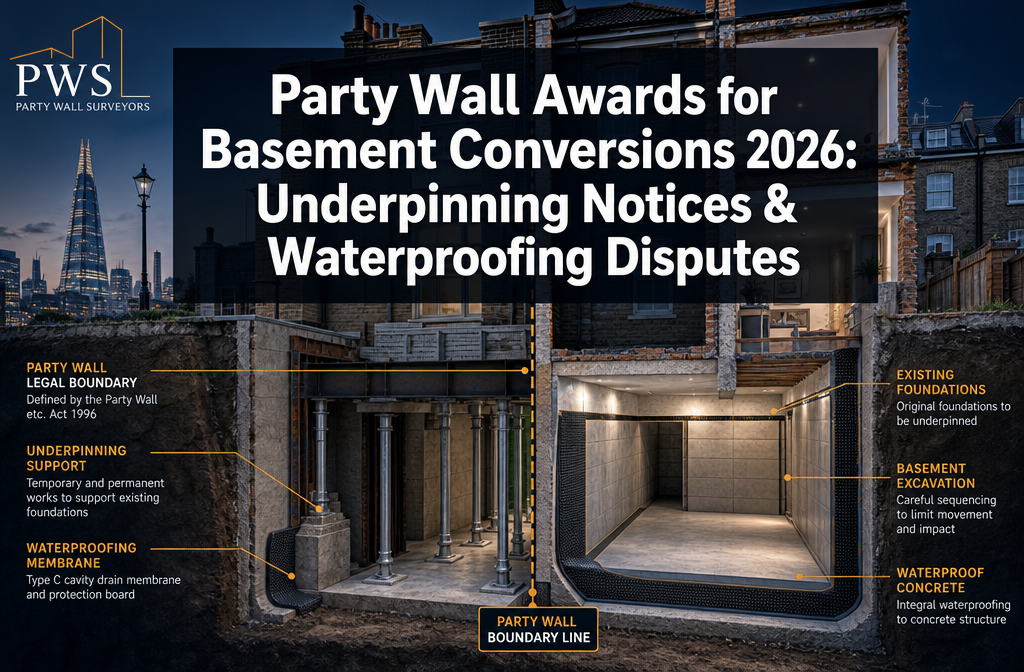

Basement conversions have surged by an estimated 40% across London and the South East over the past five years — and in 2026, with housing supply still critically constrained, that trend shows no sign of slowing. Yet for every homeowner who gains a stunning lower-ground-floor living space, there is often a neighbour bracing for vibration, cracked plasterwork, and damp creeping through a shared wall. Party Wall Awards for Basement Conversions in 2026: Underpinning Notices and Waterproofing Disputes sit at the intersection of construction law, structural engineering, and neighbour relations — and getting any one element wrong can halt a project, trigger injunctions, or land both parties in costly expert witness hearings.
This guide cuts through the complexity. Whether you are a building owner planning a dig-down project or an adjoining owner worried about what is happening beneath your feet, understanding the legal framework, the correct notice procedures, and how waterproofing disputes are resolved is essential reading for 2026.
Key Takeaways 📋
- Basement conversions are legally notifiable under multiple sections of the Party Wall etc. Act 1996 — failing to serve the correct notices can stop your project entirely.
- The 3-metre rule triggers a mandatory excavation notice whenever proposed digging falls within three metres of a neighbour's foundations and goes deeper than those foundations.
- A Party Wall Award is a legally binding document that governs how works proceed — it protects both the building owner and the adjoining owner.
- Waterproofing failures are one of the most disputed issues in basement conversion cases and can escalate to expert witness hearings if not addressed early.
- A pre-construction schedule of condition is your single most important protective document — for both sides.
Understanding the Legal Framework in 2026
The Party Wall etc. Act 1996 remains the governing legislation for all notifiable works in England and Wales. Basement conversions are among the most technically complex projects this Act covers, frequently involving underpinning, deep excavation close to neighbouring foundations, and sustained groundwork that generates significant vibration and ground movement [1].
Three sections of the Act are typically engaged during a basement conversion:
| Act Section | Trigger | Notice Period |
|---|---|---|
| Section 1 | New wall on or at the boundary | 1 month |
| Section 6 | Excavation within 3m or 6m of neighbour's foundations | 1 month |
| Section 2 | Works to an existing party wall or structure | 2 months |
Most basement conversions engage Section 6 (excavation notice) and Section 2 (party wall notice) simultaneously. Missing either notice is a serious legal error [2].
💡 Pull Quote: "Non-compliance with the Party Wall Act can lead to injunctions to stop work, claims for damages, and significant delays — all of which are entirely avoidable with proper preparation." [7]
For a broader overview of your obligations, the Party Wall Act guidance from Canterbury Surveyors provides a clear starting point for building owners and adjoining owners alike.
Party Wall Awards for Basement Conversions in 2026: What Notifiable Works Actually Mean
What Triggers a Party Wall Notice?
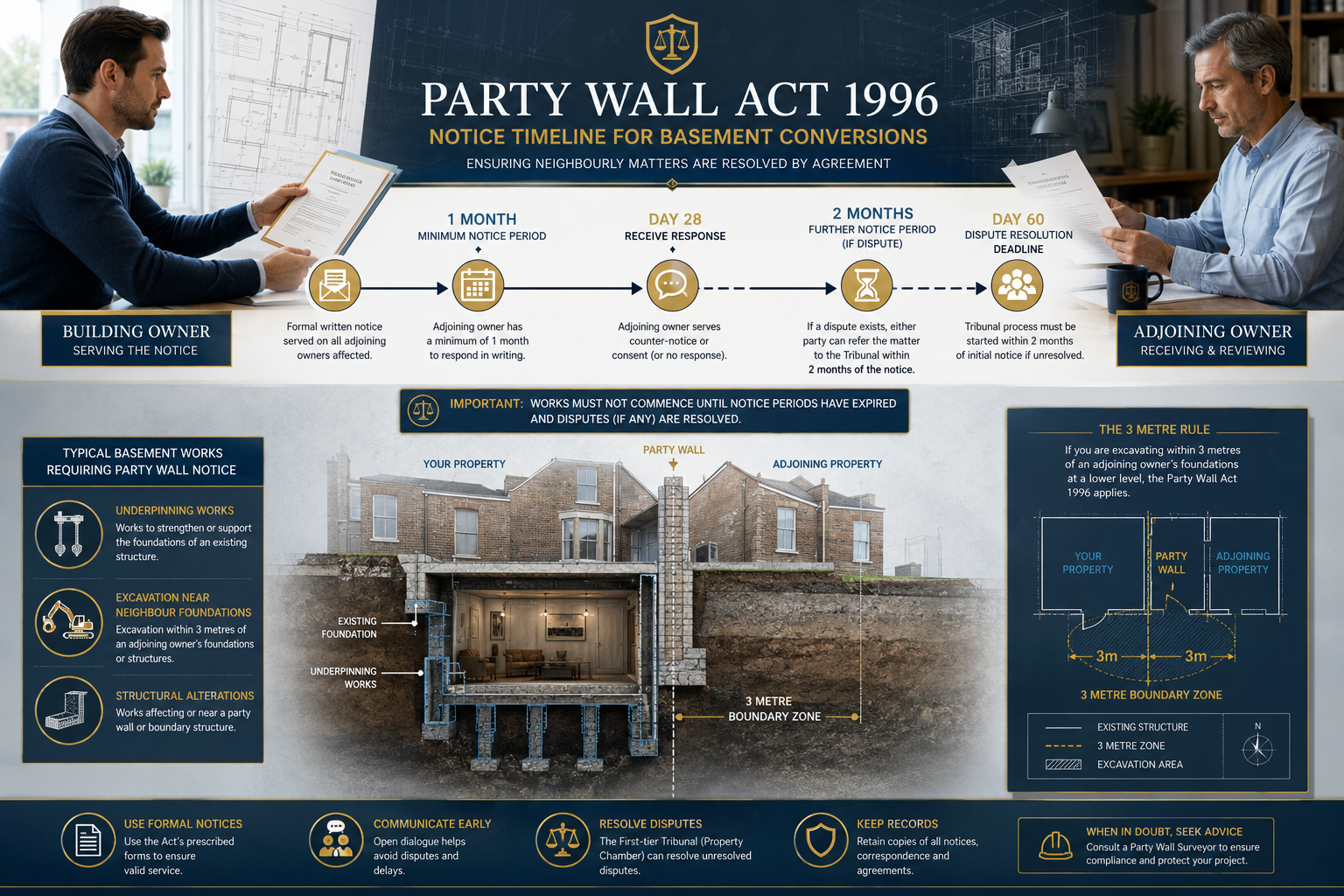
Not every basement project automatically requires party wall procedures — but the vast majority do. A notice becomes mandatory when:
- Underpinning is required to lower or strengthen foundations beneath or adjacent to a party wall
- Excavation is planned within three metres of an adjoining owner's building, and the new foundations will be deeper than the neighbour's existing ones [5]
- Excavation falls within six metres of a neighbour's building if the new works cut a line drawn downward at 45° from the bottom of their foundations
- Structural work is carried out on a shared party wall, including cutting in for beams or inserting damp-proof courses
The 3-metre rule explained is particularly relevant here: it catches most basement dig-down projects in terraced and semi-detached properties because the excavation depth almost always exceeds neighbouring foundation depths.
Common Mistakes When Serving Notices 🚨
Research published in 2026 highlights that the most costly errors in basement extension party wall cases include [3]:
- Starting the process too late — notices must be served before work begins, not during
- Failing to identify all adjoining owners — this includes freeholders, leaseholders, and mortgagees in some cases
- Serving incomplete or incorrect notices — missing details about the nature of the works
- Not serving a separate excavation notice alongside the party wall notice
- Assuming verbal consent is sufficient — it is not; consent must be in writing
If an adjoining owner does not respond within 14 days of a notice being served, a dispute is deemed to have arisen automatically under the Act. At that point, surveyors must be appointed. For more on what happens when the process breaks down, see this guide on what a party wall dispute involves.
The Role of the Party Wall Award
A Party Wall Award (also called an Award) is a formal, legally binding document drawn up by appointed surveyors. It sets out:
- The scope and method of the proposed works
- Working hours and access arrangements
- Protective measures to be taken during construction
- Compensation or remediation obligations if damage occurs
- The schedule of condition of the adjoining property before works begin
The Award is not optional — it is the mechanism through which both parties' rights are protected and enforced [4].
The Surveyor's Role: Schedule of Condition and Dispute Prevention
Why a Schedule of Condition Is Non-Negotiable
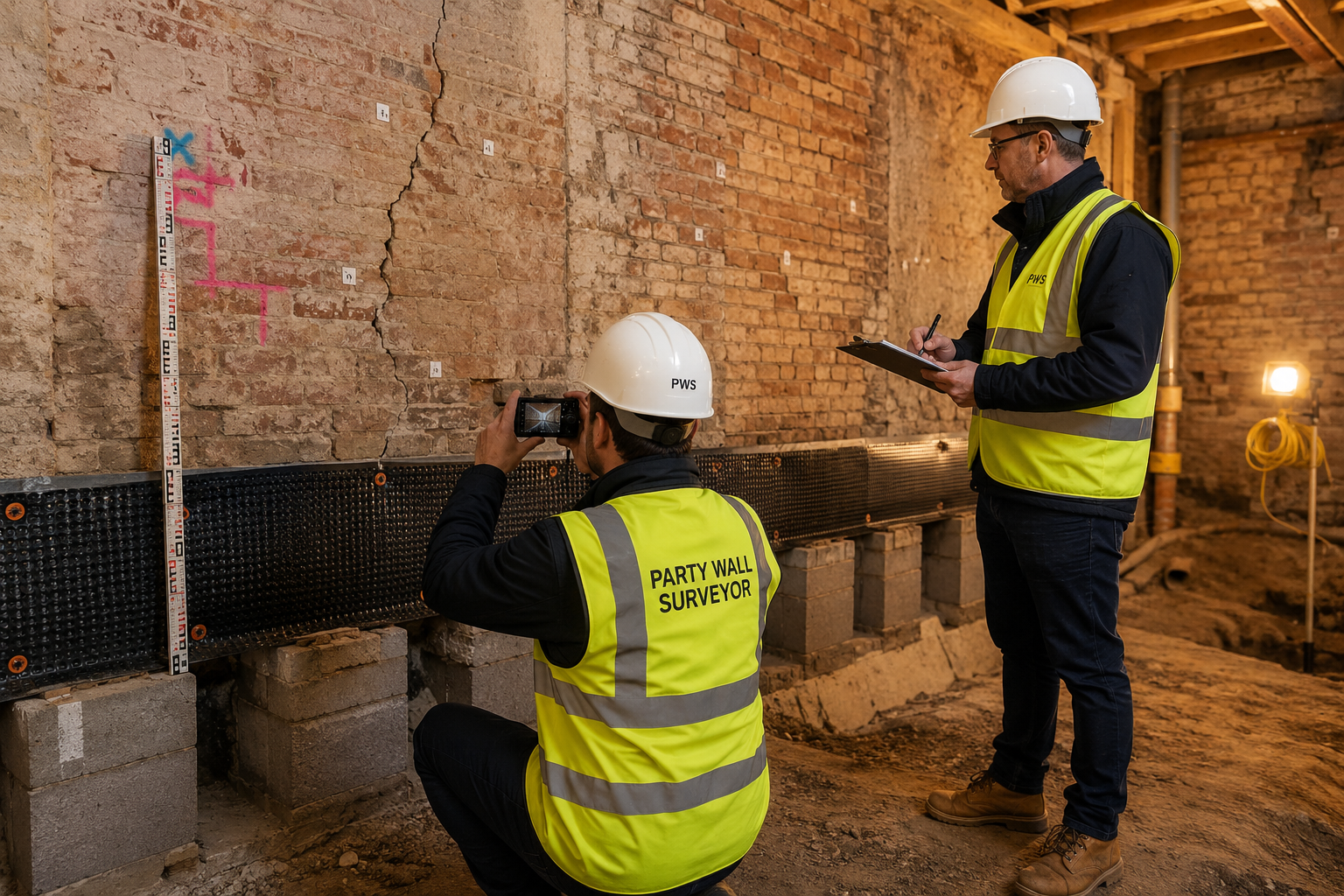
A schedule of condition is a detailed photographic and written record of the adjoining property's state before any basement works begin. It documents every crack, damp patch, and structural imperfection already present. Without it, attributing new damage to the basement conversion becomes a matter of argument rather than evidence [2].
🔑 Key Point: A thorough pre-construction condition survey is the single most effective tool for preventing — and resolving — disputes about damage caused by basement works.
Canterbury Surveyors provides detailed guidance on schedule of condition reports for party wall matters, which explains exactly what should be recorded and how.
Appointing Surveyors: Three Options
When a dispute is deemed to have arisen, the Act provides three appointment routes:
| Option | Description | Best For |
|---|---|---|
| Agreed Surveyor | One surveyor acts for both parties | Straightforward projects with cooperative neighbours |
| Two Surveyors | Each party appoints their own surveyor | More complex projects or where trust is limited |
| Third Surveyor | A third surveyor is selected in advance to resolve disagreements between the two appointed surveyors | High-stakes or contentious cases |
For basement conversions involving underpinning, the two-surveyor route is most common because the technical complexity and financial stakes justify independent representation for each party [4].
Costs and Who Pays
Generally, the building owner bears the cost of party wall proceedings, including the adjoining owner's surveyor's fees. This is a statutory obligation under the Act. However, if an adjoining owner makes unreasonable demands or appoints an unnecessarily expensive surveyor, costs can be challenged.
Understanding party wall costs upfront helps building owners budget accurately and avoid unpleasant surprises mid-project.
Party Wall Awards for Basement Conversions in 2026: Waterproofing Disputes and Expert Witness Hearings
Why Waterproofing Is a Flashpoint
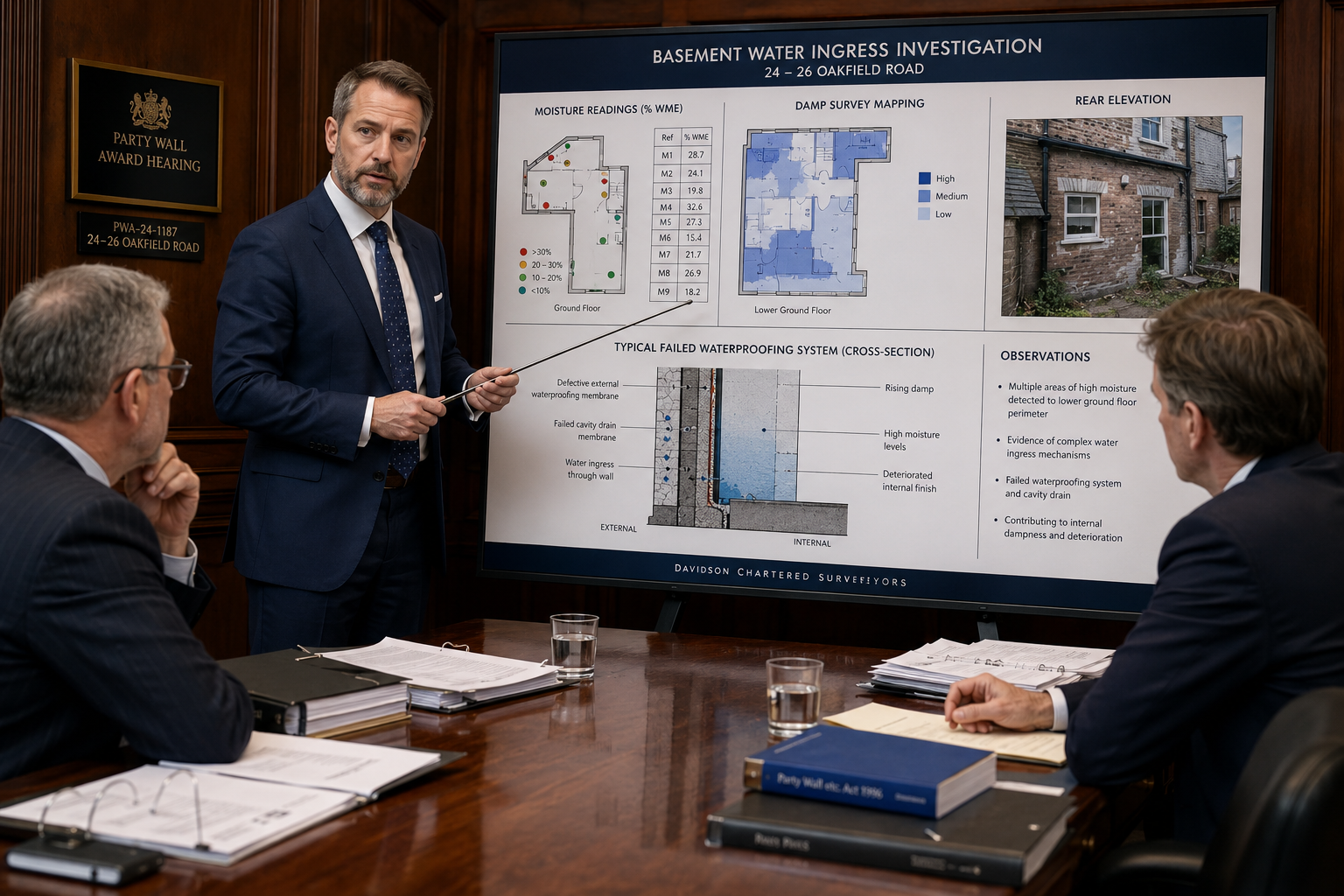
Waterproofing failures in basement conversions are among the most contentious issues that arise under the Party Wall Act — and in 2026, they represent a growing proportion of formal disputes. The reason is straightforward: water does not respect property boundaries. Improper waterproofing in a new basement can redirect groundwater into neighbouring foundations, cause rising damp in shared walls, and create mould conditions in adjoining properties [6].
Three waterproofing systems are commonly used in UK basement conversions:
- Type A (Barrier protection): Tanking membranes applied to the structure — effective but vulnerable to hydrostatic pressure
- Type B (Structurally integral protection): Waterproof concrete construction — relies on build quality
- Type C (Drained protection): Cavity drain membrane systems with sump pumps — most resilient but requires ongoing maintenance
The choice of system and its correct installation are often the subject of party wall disputes. An adjoining owner may argue that a Type A system is inadequate given local groundwater conditions, or that a Type C sump pump installation creates vibration nuisance.
How Waterproofing Disputes Escalate
A typical escalation path looks like this:
- Basement works complete — adjoining owner notices damp or cracking
- Informal complaint to building owner — no resolution
- Surveyors engaged — dispute formally raised under the Award
- Technical disagreement between surveyors — third surveyor invoked
- Expert witness hearing — if the matter cannot be resolved through the Award mechanism, it may proceed to the County Court
At the expert witness stage, a surveyor or structural engineer is appointed to provide independent technical evidence on whether the waterproofing failure caused the alleged damage and what remediation is required. This is a formal legal process with significant cost implications for both parties [7].
For cases involving potential subsidence or structural movement caused by groundwater changes, a subsidence survey may be required to establish causation before any claim can proceed.
What the Award Can and Cannot Resolve
A Party Wall Award can address:
- ✅ Requirements for specific waterproofing specifications
- ✅ Obligations to monitor groundwater levels during works
- ✅ Compensation for damage caused by water ingress attributable to the works
- ✅ Requirements to install monitoring equipment on the party wall
A Party Wall Award cannot address:
- ❌ Disputes about planning permission or building regulations compliance
- ❌ Claims for consequential losses (loss of rental income, for example) — these require separate legal action
- ❌ Pre-existing damp conditions that predated the works (hence the importance of the schedule of condition)
Preventing Waterproofing Disputes Before They Start
The most effective prevention strategy combines three elements:
- Specify the waterproofing system in the Award — do not leave it vague. The Award should reference the BS 8102:2022 standard for waterproofing below ground.
- Commission a ground investigation report before works begin to understand local groundwater conditions — this informs the waterproofing specification and removes ambiguity [7].
- Include monitoring obligations in the Award — requiring the building owner to install crack monitors and moisture sensors on the party wall provides early warning of any problems.
For complex cases involving soil and water conditions, a soil and water contamination assessment can provide critical baseline data that protects both parties.
Practical Steps for Building Owners and Adjoining Owners in 2026
For Building Owners: A Pre-Works Checklist ✅
- Appoint a specialist party wall surveyor before instructing contractors
- Identify all adjoining owners — including upstairs flat owners in converted properties
- Serve the correct notices with the required notice periods (minimum 1–2 months depending on section)
- Agree or appoint surveyors promptly once responses are received
- Ensure the Party Wall Award includes a detailed waterproofing specification
- Commission a schedule of condition of all adjoining properties
- Budget for party wall surveyor fees as part of the overall project cost [8]
For Adjoining Owners: Protecting Your Position 🛡️
- Do not ignore notices — a non-response triggers a deemed dispute, which is actually more protective than consent in most cases
- Appoint your own surveyor — the building owner pays for this, so there is no financial reason not to
- Request a thorough schedule of condition of your property before works begin
- Keep records of any changes you notice during the works — photographs with timestamps are invaluable
- Raise concerns early — the Award mechanism is designed to resolve issues before they become expensive legal disputes
If works have already started without proper notice, the guide on proceeding without a party wall agreement explains the options available to adjoining owners.
When to Seek Expert Witness Support
Expert witness involvement becomes appropriate when:
- Technical disagreement between appointed surveyors cannot be resolved through the third surveyor mechanism
- The dispute involves significant alleged damage (typically above £10,000–£15,000)
- Causation is disputed — i.e., whether the basement works actually caused the damage claimed
- The matter is heading toward County Court proceedings
Canterbury Surveyors offers expert witness services for party wall and construction disputes, providing independent technical evidence that meets the requirements of Civil Procedure Rules Part 35.
Conclusion: Taking Action Before the First Spade Goes In
Party Wall Awards for Basement Conversions in 2026: Underpinning Notices and Waterproofing Disputes represent one of the most legally and technically demanding areas of residential construction law. The good news is that the vast majority of disputes — including waterproofing claims that might otherwise reach expert witness hearings — are entirely preventable with the right preparation.
Actionable Next Steps
- Start the party wall process early — at least two to three months before your planned start date to allow for notice periods and Award preparation
- Appoint a specialist party wall surveyor with demonstrable experience in basement and underpinning works
- Insist on a detailed schedule of condition for all adjoining properties — this protects you whether you are the building owner or the neighbour
- Specify waterproofing requirements explicitly in the Award, referencing current British Standards
- Budget realistically — party wall costs for a basement conversion typically range from £1,500 to £5,000+ depending on complexity and the number of adjoining owners
- Do not attempt to proceed without notices — the risk of injunction, damages claims, and project delays far outweighs any time saved
The notice for excavation near a neighbour is often the first formal step in this process — getting it right sets the tone for everything that follows.
References
[1] partywallspecialists – https://partywallspecialists.com/?p=29490&utm_source=openai
[2] Basement Conversions – https://iconsurveyors.co.uk/party-wall/basement-conversions/?utm_source=openai
[3] Party Wall Notice Mistakes Basement Extensions London 2026 The Complete Guide To Avoiding Costly Disputes – https://partywallsurveyorlondon.uk/blogs/party-wall-notice-mistakes-basement-extensions-london-2026-the-complete-guide-to-avoiding-costly-disputes/?utm_source=openai
[4] The Role Of A Party Wall Surveyor In Basement Conversions – https://www.expresspartywall.com/post/the-role-of-a-party-wall-surveyor-in-basement-conversions?utm_source=openai
[5] Party Wall Act 3 Metre Rule – https://www.aylingassociates.com/knowledge/party-wall-act-3-metre-rule?utm_source=openai
[6] Party Wall Extensions And Conversions – https://www.squarepointsurveyors.co.uk/party-wall-extensions-and-conversions/?utm_source=openai
[7] Basement Underpinning – https://www.partywall-expert.com/basement-underpinning/?utm_source=openai
[8] Basement Conversion Party Wall Surveyors In London – https://www.houricanassociates.com/party-wall-news/basement-conversion-party-wall-surveyors-in-london/?utm_source=openai