Over 40% of all new Airbnb listings added in England between 2019 and 2024 were concentrated in just twelve local authority areas — a statistic that should be sitting at the front of every valuer's mind when instructed on a flat in a tourist-heavy city block. The rapid growth of short-term letting platforms has quietly redrawn the risk landscape for residential property valuation, yet many survey reports still treat STR-heavy blocks as if they were ordinary residential assets. That gap between market reality and professional commentary is increasingly untenable.
Valuing Properties Affected by Short-Term Letting and AirDNA Data: What UK Surveyors Should Say About Airbnb-Heavy Blocks is no longer a niche concern. Whether acting for a lender, a private buyer, or a tribunal, RICS-registered valuers are expected to identify, analyse, and clearly explain how short-term letting activity distorts comparable evidence, alters yield assumptions, creates regulatory risk, and affects the pool of willing buyers. This article sets out a structured framework for doing exactly that.
Key Takeaways 📋
- Comparable evidence is contaminated when STR-inflated sale prices are used without adjustment — valuers must strip out income-driven premiums to find the "conventional use" value.
- AirDNA and similar platforms provide useful occupancy and revenue data, but must be treated as supporting evidence, not primary valuation inputs, without proper qualification.
- London's 90-day rule and the incoming national registration scheme create hard income ceilings that must be reflected in any income-based valuation approach.
- Business rates vs council tax status can vary unit by unit within the same block, materially affecting net operating income and yield calculations.
- Lenders are increasingly cautious about Airbnb-heavy blocks — surveyors must flag concentration risk, leasehold covenant breaches, and material uncertainty explicitly.
Why Short-Term Letting Changes the Valuation Equation

The Comparable Evidence Problem
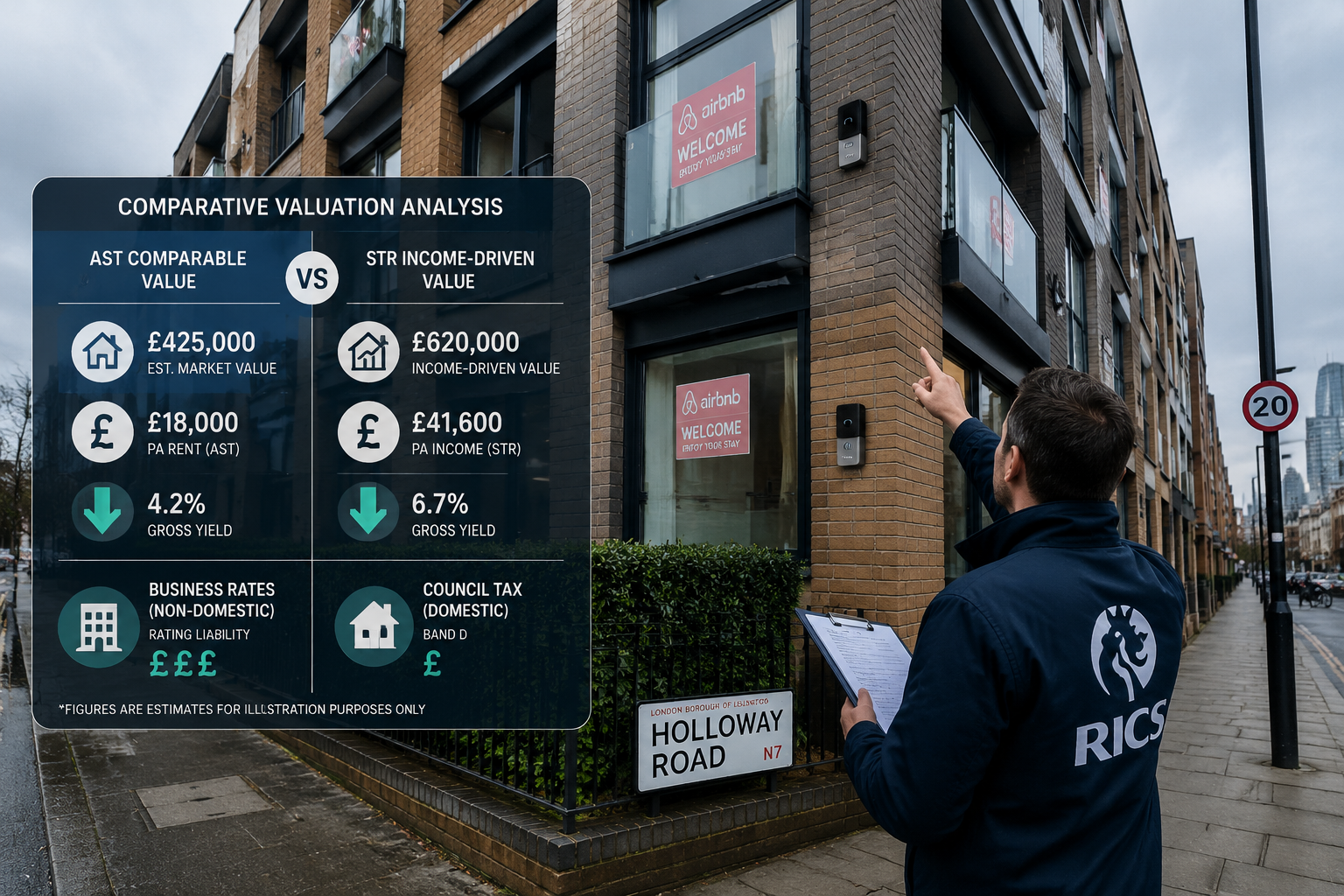
Every residential valuation rests on comparable sales evidence. When a significant proportion of sales in a postcode are driven by buyers purchasing for STR income — rather than owner-occupation or conventional assured shorthold tenancy (AST) letting — the comparable pool becomes unreliable for standard mortgage or market value purposes.
Evidence from auction and agency markets shows buyers paying a clear premium for properties with strong short-term rental income potential, particularly in tourism hotspots and city centres. Auction vendors now routinely market "Airbnb potential" as an explicit value driver [1]. In areas with high STR demand, property values have risen faster than in comparable areas where conventional letting dominates [1]. This creates a two-tier market that valuers must disaggregate.
"Where pricing appears to be driven by short-term-let income assumptions rather than conventional owner-occupier or AST comparables, the valuer must say so — explicitly, in writing."
The practical implication: when selecting comparables, surveyors should:
- ✅ Identify whether each comparable sale was marketed with STR income projections
- ✅ Apply a downward adjustment where STR-driven premiums are detectable
- ✅ Provide a parallel "conventional use" value based on AST-comparable evidence
- ✅ Note where the comparable pool is thin or distorted, triggering a material uncertainty caveat
Using AirDNA Data: Opportunity and Obligation
AirDNA aggregates listing, occupancy, and revenue data from Airbnb and Vrbo, giving valuers access to granular market intelligence — average daily rates, occupancy percentages, revenue per available night (RevPAN), and seasonal demand curves at postcode level. Used carefully, this data can support income-based valuations for properties where STR use is the established and legally compliant purpose.
However, AirDNA data carries important limitations that must be disclosed:
| AirDNA Data Point | Valuation Use | Key Caveat |
|---|---|---|
| Occupancy rate (%) | Gross income modelling | Includes non-compliant listings; may overstate achievable nights |
| Average daily rate (£) | Revenue benchmarking | Varies sharply by season and listing quality |
| RevPAN | Yield cross-check | Does not account for management fees, voids, or regulatory caps |
| Market penetration rate | Demand assessment | Lags real-time regulatory changes |
Where a valuer relies on AirDNA data, the report should state the data source, the date of extraction, the specific metrics used, and any adjustments made to reflect local regulatory constraints — particularly London's 90-day cap or any local authority licensing conditions.
Regulatory Risk: What the 90-Day Rule and National Registration Scheme Mean for Valuers
London's 90-Day Rule and Its Income Impact
In London, the Deregulation Act 2015 permits short-term letting of an entire dwelling for up to 90 nights per year without requiring change-of-use planning permission. Beyond that threshold, a material change of use occurs, and planning consent is required [3]. This is not a theoretical risk — it is an active enforcement priority in several London boroughs.
For valuing properties affected by short-term letting and AirDNA Data, this rule creates a hard ceiling on gross income that must be reflected in any income-based approach:
- A property achieving £200 per night, fully occupied for 365 nights, generates £73,000 gross
- The same property capped at 90 nights generates a maximum of £18,000 gross — a 75% reduction
- After management fees (typically 15–25%), cleaning, and maintenance, net income falls further
Where an Airbnb-heavy block is operating beyond the 90-night limit without planning consent, surveyors should treat current income as non-compliant and model valuation on the legally permissible income — typically a blended figure between the 90-night STR cap and an AST equivalent [3]. This assumption must be stated explicitly in the report.
The Incoming National Registration Scheme 🏛️
The UK Government has confirmed plans for a mandatory national register of short-term lets, designed to allow local authorities to monitor and manage concentrations of STR activity [2]. The policy explicitly aims to improve the availability of long-term housing and address rising prices in markets where STRs are saturated [2].
The House of Commons Library has documented the key concerns driving these reforms: commercial operators running de-facto hotels in residential stock, breaches of planning rules, and measurable impacts on housing supply and rents in affected markets [6]. For surveyors, this legislative trajectory has direct valuation implications:
- Future caps on STR intensity within specific blocks or postcodes could abruptly reduce income assumptions
- Local authority licensing conditions may impose additional costs (fire safety upgrades, HMO-style standards)
- Planning enforcement against non-compliant operators could trigger forced reversion to AST use
Surveyors valuing blocks with heavy STR use should flag the heightened risk of planning enforcement or future caps as a key risk factor in their reports [6]. This is not speculation — it is a material consideration under RICS Red Book Global Standards (VPS 3 and VPGA 10).
For those working in areas with significant STR concentrations, engaging a specialist valuation team with experience in complex residential assets is strongly advisable.
Business Rates vs Council Tax: The Unit-by-Unit Variable
One of the most technically complex aspects of valuing Airbnb-heavy blocks is the taxation status of individual units. In England, a property is assessed for business rates as self-catering or holiday let accommodation if, over the last 12 months, it was:
- Available to let for at least 140 nights, and
- Actually let for at least 70 nights,
with an intention to meet the 140-night availability threshold in the coming year [4].
Where a flat crosses this threshold, it moves from council tax to business rates and may qualify — or cease to qualify — for small business rates relief [4]. This creates a patchwork of taxation within a single block that directly affects net operating income and, therefore, yield-based valuations.
Surveyors valuing Airbnb-heavy blocks should:
- ☑️ Confirm each unit's current rating status (council tax or business rates)
- ☑️ Model net operating income after the correct local taxation for each unit type
- ☑️ Highlight the risk that HMRC or the Valuation Office Agency (VOA) could retrospectively reclassify units
- ☑️ Note that reclassification could alter net yields and trigger back-payments
Tax changes are already biting: Furnished Holiday Lettings (FHL) tax advantages were abolished from April 2025, removing mortgage interest relief and capital allowances that previously supported STR investment returns [5]. This structural shift further reduces the income case for STR investment and should be reflected in any discounted cash flow or yield-based analysis.
What Surveyors Must Say: Report Language, Lender Risk, and Marketability

Structuring the Report: Special Assumptions and Material Uncertainty
Valuing Properties Affected by Short-Term Letting and AirDNA Data: What UK Surveyors Should Say About Airbnb-Heavy Blocks ultimately comes down to clear, defensible report language. RICS Red Book requirements provide the framework — but the specific content must reflect the STR context.
Where the valuation is instructed on the basis that STR use will continue, this should be stated as a Special Assumption (RICS VPS 4.2), with explicit acknowledgement that:
- The value stated assumes continued lawful STR operation within applicable planning and licensing limits
- If regulatory conditions change, the value may be materially different
- The assumption has not been independently verified against planning records
Where comparable evidence is thin, distorted by STR-driven premiums, or where regulatory risk is elevated, a Material Uncertainty declaration (RICS VPGA 10) is appropriate. This is not a weakness in the report — it is a professional obligation that protects both the valuer and the client.
A RICS Red Book valuation conducted by a qualified surveyor will incorporate these clauses correctly, ensuring the report withstands scrutiny from lenders, courts, or tribunals.
Communicating Risk to Lenders 🏦
Lenders have become increasingly cautious about Airbnb-heavy blocks, and for good reason. The key risks that mortgage underwriters are focused on include:
| Risk Factor | Lender Concern | Surveyor's Role |
|---|---|---|
| High STR concentration in block | Reduced owner-occupier demand; limited resale market | Report % of units in STR use; comment on marketability |
| Leasehold covenant breaches | STR use may violate lease terms; enforcement risk | Check lease; flag if STR use appears to breach covenants |
| Income-inflated purchase price | LTV calculation based on inflated comparable | Provide "conventional use" value as primary figure |
| Planning non-compliance | Enforcement could force reversion to AST | State compliance status; apply income cap if non-compliant |
| Business rates reclassification | Increased running costs reduce net yield | Confirm rating status; model both scenarios |
Many lenders now apply concentration limits — declining to lend where more than a specified percentage of units in a block (often 25–40%) are in STR use. Surveyors should check lender-specific requirements in their instructions and comment where concentration appears to approach or exceed typical thresholds.
For complex leasehold valuation questions in blocks with mixed use, a lease extension valuation specialist can provide additional insight into how STR use affects ground rent and service charge dynamics.
Marketability and the Buyer Pool
A block where 60% of units are operating as Airbnb lets has a fundamentally different buyer profile than a conventional residential building. The pool of willing, able, and mortgage-eligible buyers is materially narrower because:
- Owner-occupiers may be deterred by transient neighbours, noise, and security concerns
- Buy-to-let investors seeking AST income may find yields compressed by high purchase prices
- STR investors face regulatory uncertainty and financing challenges (many lenders will not lend on explicit STR business cases)
This narrowing of the buyer pool is a direct valuation input. A property that can only be sold to a specialist investor community commands a liquidity discount relative to a conventional residential asset. Surveyors should quantify this discount — even if only as a range — and explain the reasoning clearly.
For properties in London and other major urban centres where STR concentration is highest, this marketability assessment is particularly important. Surveyors working across North London, Chelsea, Islington, and Camden — areas with high tourist footfall and dense STR activity — should be particularly alert to these dynamics.
Where a dispute arises from a valuation of an STR-affected property, the report's clarity on these points becomes critical. An expert witness surveyor with experience in contested valuations can provide the structured analysis that tribunals and courts require.
A Practical Checklist for Surveyors 📝
Before finalising any valuation report on an Airbnb-heavy block, work through the following:
- Planning compliance — Has the property or block exceeded the 90-day limit (London) or any local authority cap? Is planning consent in place for STR use?
- Lease review — Does the lease permit short-term letting? Are there management company restrictions?
- Rating status — Is each unit on council tax or business rates? Has the VOA threshold been met?
- Comparable adjustment — Have STR-inflated comparables been identified and adjusted?
- AirDNA data — If used, is the source, date, and methodology disclosed? Are regulatory caps applied?
- Income modelling — Does the income approach use legally compliant income only?
- Special assumptions — Are STR continuation assumptions stated as Special Assumptions per RICS VPS 4?
- Material uncertainty — Is a VPGA 10 declaration warranted given regulatory risk or thin comparables?
- Lender concentration limits — Does the block's STR concentration approach lender thresholds?
- Marketability commentary — Is the narrowed buyer pool and any liquidity discount explained?
Conclusion: Raising the Standard of STR Valuation Commentary
The growth of short-term letting has created a genuine valuation challenge that the profession cannot afford to sidestep. Valuing Properties Affected by Short-Term Letting and AirDNA Data: What UK Surveyors Should Say About Airbnb-Heavy Blocks requires a structured, evidence-based approach that goes well beyond standard residential valuation methodology.
The core obligations are clear: strip STR-driven premiums from comparable evidence, apply legally compliant income caps, confirm rating and planning status unit by unit, and communicate all material risks through properly structured Special Assumptions and Material Uncertainty declarations. Lenders, buyers, and courts increasingly expect this level of rigour — and the regulatory environment is only tightening.
Actionable next steps for surveyors:
- 🔍 Review your standard report template — does it have a dedicated section for STR risk factors?
- 📊 Build an AirDNA data protocol — establish how and when platform data will be used, qualified, and disclosed
- 📋 Check lender panels — understand the concentration limits of your key panel lenders before inspection
- ⚖️ Engage specialist support for complex or disputed STR valuations, particularly where expert witness evidence may be required
- 🗺️ Stay current on legislation — the national registration scheme and local authority licensing conditions are evolving rapidly
For professional valuation support on complex residential assets, including properties in Airbnb-heavy blocks, Canterbury Surveyors provides RICS-compliant Red Book valuations and expert witness services across London and the South East.
References
[1] How Short Term Rentals Are Impacting Property Values – https://www.smartauctionuk.co.uk/how-short-term-rentals-are-impacting-property-values
[2] New UK Legislation For Short Term Lets – https://ds-a.co.uk/new-uk-legislation-for-short-term-lets/
[3] 2026 Short Term Let Rules – https://www.buyassociationgroup.com/en-gb/news/2026-short-term-let-rules/
[4] Self Catering And Holiday Let Accommodation – https://www.gov.uk/introduction-to-business-rates/self-catering-and-holiday-let-accommodation
[5] Owners Urged To Review Holiday Lets As Tax Changes Bite – https://www.sjp.co.uk/individuals/news/owners-urged-to-review-holiday-lets-as-tax-changes-bite
[6] CBP-8395 House of Commons Library Briefing – https://researchbriefings.files.parliament.uk/documents/CBP-8395/CBP-8395.pdf