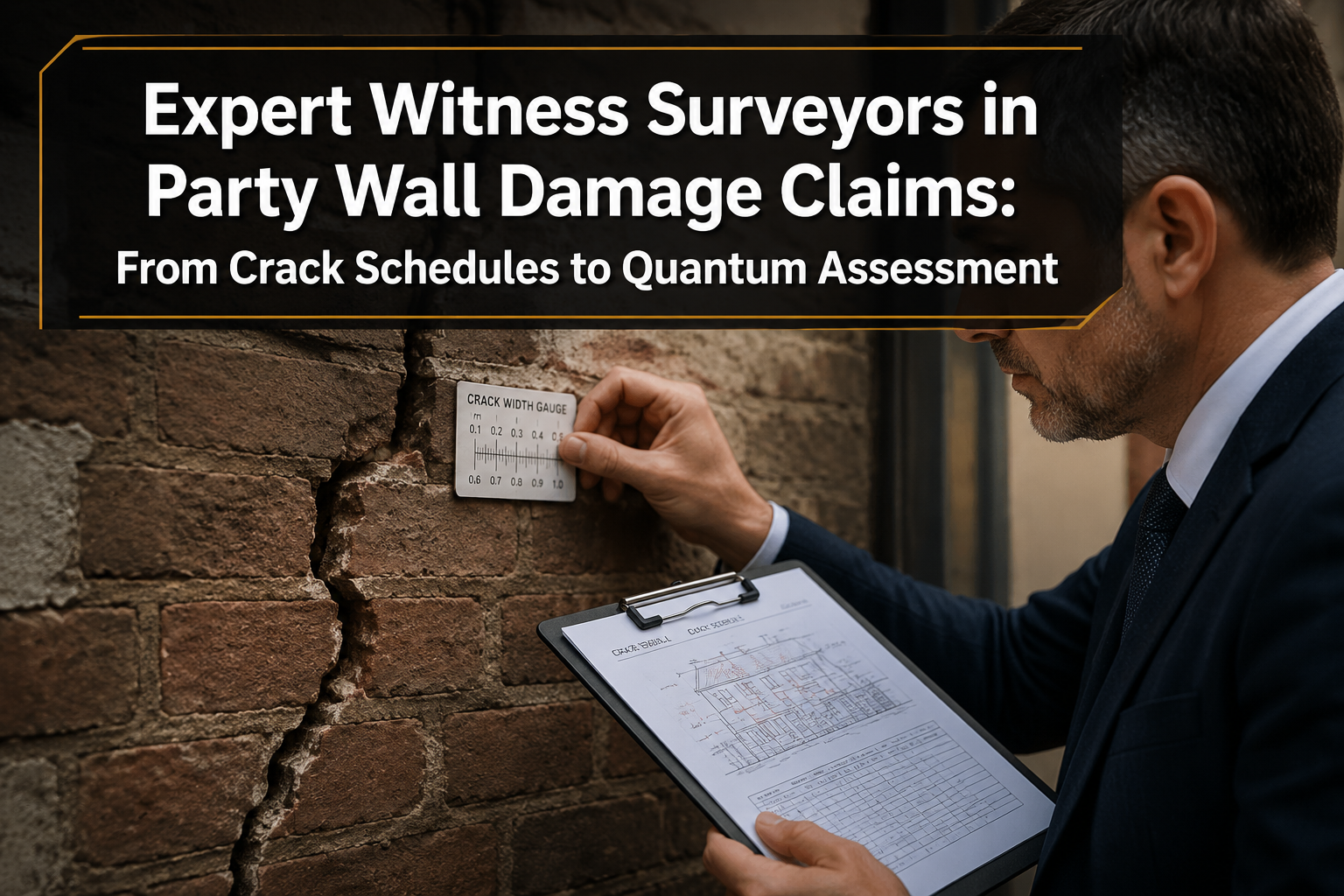

Nearly one in three party wall disputes that progress beyond the initial award stage now involves an allegation of physical damage to an adjoining property — yet fewer than half of those claims are supported by the kind of rigorous, independently verified evidence that courts and tribunals actually expect. [1] That gap between what claimants allege and what expert witness surveyors can objectively demonstrate is precisely where the role of the qualified surveyor becomes critical — and where the quality of crack schedules, causation analysis, and quantum evidence can make or break a case.
This article examines how expert witness surveyors in party wall damage claims: from crack schedules to quantum assessment should approach the full lifecycle of a damage dispute — from the pre-works inspection through to a CPR Part 35–compliant expert report with fully costed remedial schemes.
Key Takeaways 📋
- A pre-works Schedule of Condition is now considered best practice (effectively mandatory) for any notifiable party wall works where damage risk exists.
- Crack schedules must reference recognised technical benchmarks (e.g., BRE Digest 251) to carry weight in dispute proceedings.
- Expert witness surveyors must independently verify all cost data — courts will not accept figures that are simply "passed on" from contractors without scrutiny.
- CPR Part 35 governs how experts give evidence in civil proceedings; independence and transparency are non-negotiable obligations.
- Both causation and quantum must be addressed in separate, clearly reasoned sections of any expert report.
The Foundation of Every Damage Claim: Schedules of Condition and Crack Schedules
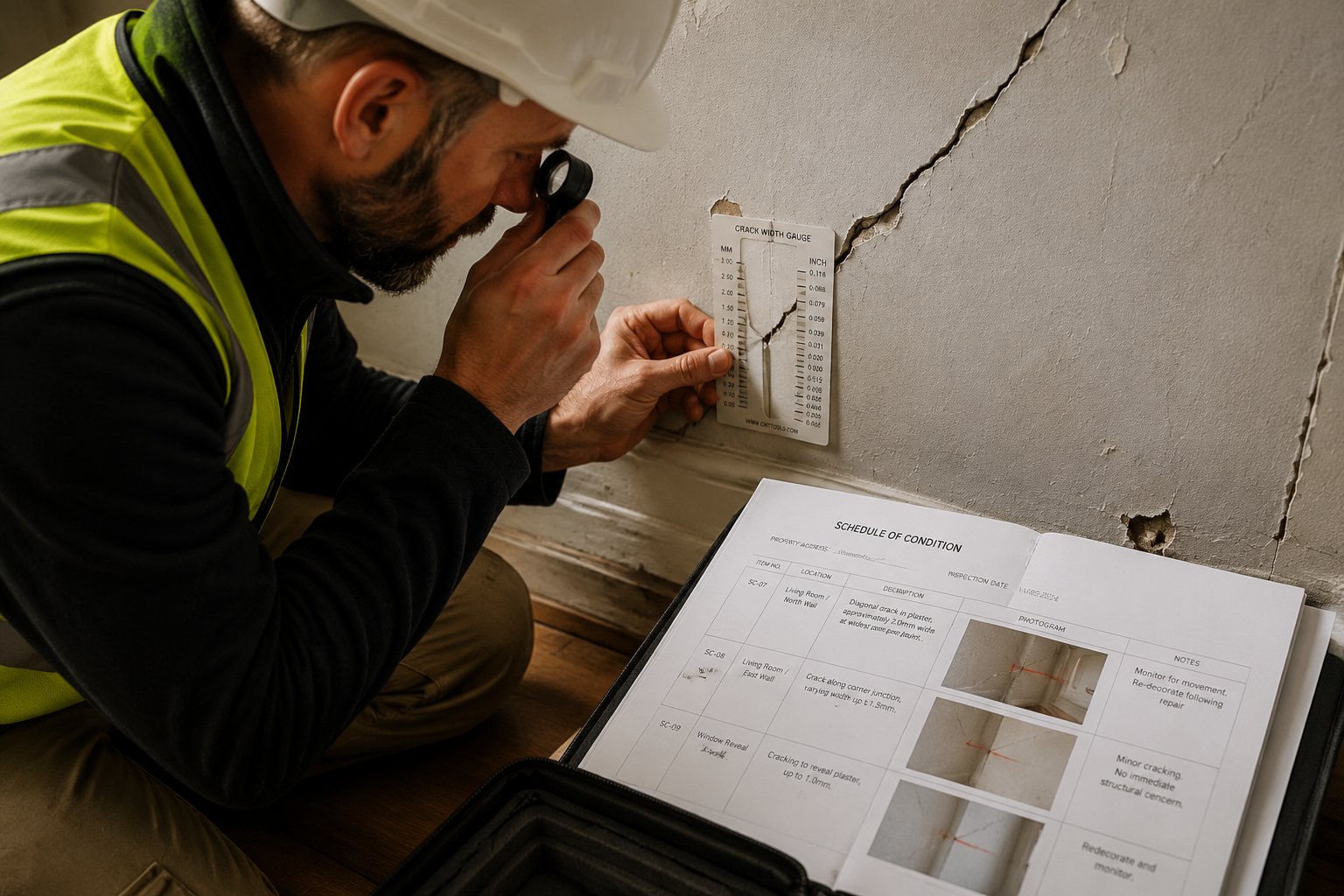
The single most powerful tool available to an expert witness surveyor in a party wall damage claim is documentation that was created before the disputed works began. Without a robust pre-works Schedule of Condition, any post-works damage allegation becomes a battle of credibility rather than a battle of evidence. [5]
What a Schedule of Condition Must Contain
A properly prepared Schedule of Condition is far more than a few photographs taken on a smartphone. Best practice in 2026 requires:
| Element | Minimum Standard |
|---|---|
| Photographic record | High-resolution, date-stamped, geo-tagged images |
| Crack annotations | Measured widths, lengths, orientation, location plan |
| Structural context | Identification of load-bearing elements, lintels, and junctions |
| Surface condition notes | Plaster, pointing, render, and decorative finishes |
| External elevations | All faces of the adjoining property within the zone of influence |
| Drainage and waterproofing | Existing defects noted to avoid future conflation |
💡 Pull Quote: "A Schedule of Condition is not a formality — it is the baseline against which every future damage allegation will be judged."
For more detail on how damage claims interact with the statutory framework, the party wall damage to property guidance provides a clear overview of the adjoining owner's rights and the building owner's obligations.
Crack Schedules: The Technical Language of Damage
Once works are complete (or where damage is alleged mid-works), the expert surveyor must produce a post-works crack schedule that mirrors the pre-works document in format and scope. The comparison between the two schedules — the "delta" — forms the evidential core of any damage claim. [5]
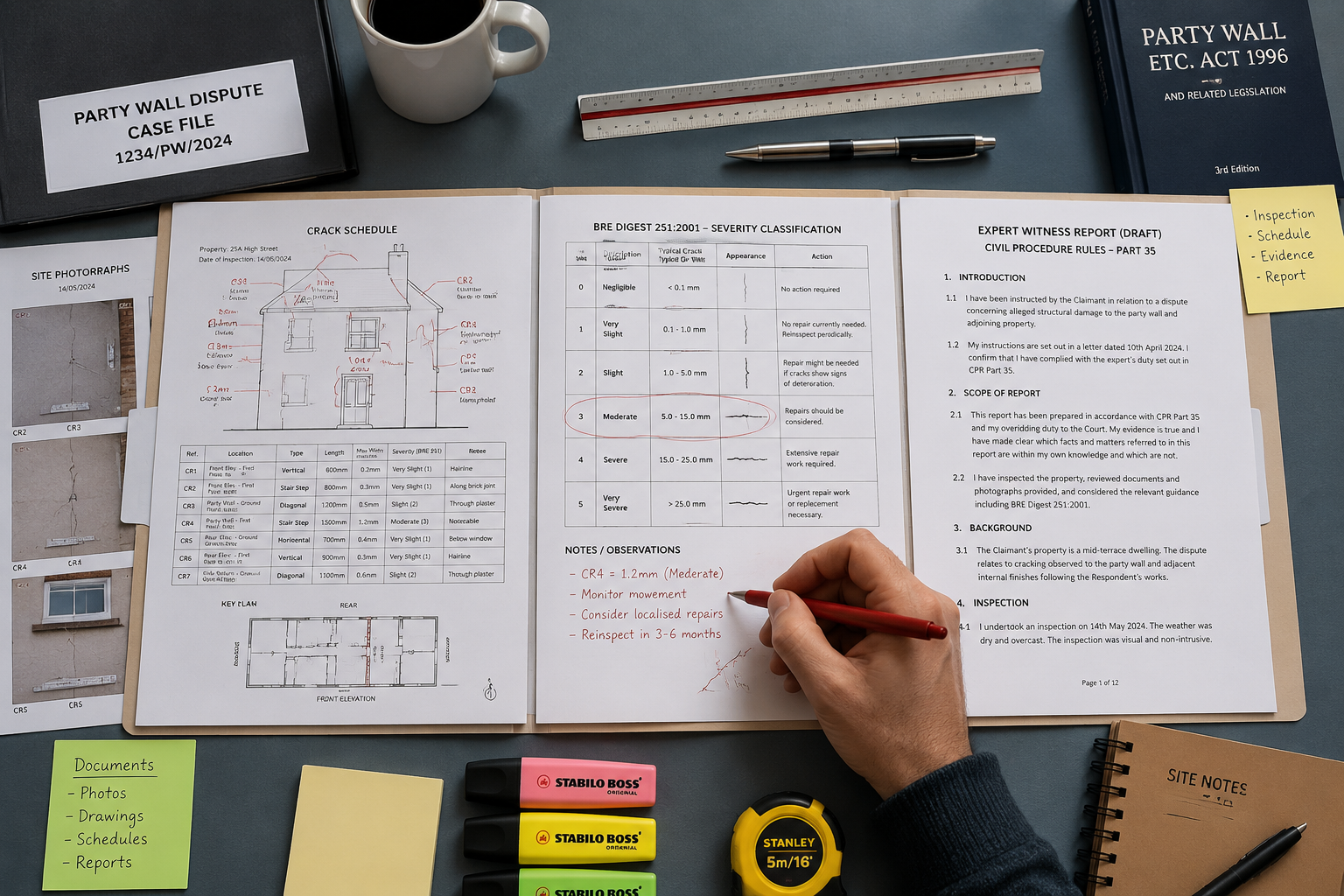
Crack classification should follow BRE Digest 251, which grades damage on a scale from Category 0 (hairline, negligible) through to Category 5 (very severe, requiring partial or complete rebuilding). This classification system:
- Provides an objective, defensible framework that courts recognise
- Links crack severity directly to appropriate repair methods
- Prevents exaggeration of minor, pre-existing defects as "new" damage
- Supports proportionate quantum assessments
Surveyors should also note crack orientation (diagonal cracks often indicate differential settlement; horizontal cracks may suggest lateral pressure) and activity (are cracks live and progressing, or historic and stable?). This distinction is vital for causation analysis.
Causation Analysis: Linking Works to Damage
Establishing that damage exists is only the first step. The expert witness surveyor must then demonstrate — to the civil standard of proof (balance of probabilities) — that the alleged damage was caused or materially contributed to by the notifiable works. [4]
This is where many claims founder. Adjoining properties in dense urban areas, particularly Victorian and Edwardian terraces common in London and the South East, frequently carry pre-existing defects. An expert who fails to distinguish between:
- Pre-existing defects (present before works, unchanged in character or severity)
- Exacerbated defects (pre-existing but worsened by works)
- New damage (not present before works, directly attributable to them)
…will produce a report that a competent opposing expert — or a judge — will dismantle. [1]
Common Causation Scenarios in Party Wall Disputes
Basement conversions and underpinning: Excavation adjacent to shared foundations is one of the highest-risk activities under the Party Wall etc. Act 1996. Ground movement, even within "acceptable" tolerances, can cause cracking in older masonry that was already at or near its elastic limit. [8]
Loft conversions: Structural alterations to a shared roof structure or chimney stack can redistribute loads in ways that cause cracking at wall junctions, around window openings, or at the base of chimney breasts. For context on how loft works interact with party wall obligations, see the party wall loft conversions guidance.
Demolition and rebuilding: Vibration from breaking out masonry or concrete can propagate through a shared wall and cause plaster cracking, tile debonding, or movement in existing structures.
The Role of Monitoring Data
Where works are prolonged or involve significant ground disturbance, a competent expert will seek to obtain:
- Vibration monitoring records (if installed during works)
- Settlement monitoring data from tell-tales or crack monitors
- Groundwater level records (relevant where dewatering occurred)
- Structural engineer's records from the building owner's team
The absence of monitoring data where it should have been installed can itself be evidentially significant — and an expert should say so. [2]
Quantum Assessment: Costing the Damage with CPR-Compliant Rigour
The quantum section of an expert report is where many otherwise competent surveyors fall short. Expert witness surveyors in party wall damage claims: from crack schedules to quantum assessment must understand that a court or tribunal does not simply want a contractor's quote — it wants an independently reasoned, verifiable assessment of the reasonable cost of making good. [6]
What Judicial Expectations Now Require
A May 2026 construction law update has sharpened the expectations placed on professionals providing quantum evidence. The key principle: experts must independently review and verify cost information. Simply passing on a contractor's figure without scrutiny can amount to a breach of professional duty. [6] Specifically, experts are now expected to:
- Obtain multiple quotes or benchmark against recognised cost data (e.g., BCIS, Spon's)
- Disaggregate the schedule of works so that each repair item can be assessed individually
- Document the verification process — keep an audit trail of how each figure was derived
- Identify and exclude betterment where new works would improve on the pre-damage condition
- Disclose any conflicts of interest before accepting an instruction [6]
⚠️ Important: Experts who simply adopt a single contractor's quote without independent verification risk having their quantum evidence rejected — and potentially face professional disciplinary consequences.
Components of a Complete Quantum Assessment
A well-structured quantum section should address:
🔧 Direct repair costs
- Like-for-like reinstatement of damaged elements
- Specialist trades (e.g., lime plastering, historic brickwork repointing)
- Preliminaries, access, and protection
🏠 Consequential losses
- Temporary accommodation if the property is uninhabitable during repairs
- Storage of contents
- Loss of rental income (with market evidence)
📉 Diminution in value
- Where damage has caused a permanent or long-term reduction in market value
- Must be supported by comparable transaction evidence and RICS Red Book–aligned methodology [2]
😔 Loss of amenity
- Disruption, inconvenience, and loss of enjoyment during the damage period and repair works
- Courts are cautious about speculative figures; a reasoned, modest assessment is more persuasive than an inflated one
For properties where valuation evidence is required alongside repair costs, working with registered RICS valuers can strengthen the overall quantum case.
The Single Joint Expert vs. Party-Appointed Expert
In many party wall damage disputes that reach the County Court, the court will direct the appointment of a Single Joint Expert (SJE) under CPR Part 35. This carries specific obligations:
| Role | Key Obligations |
|---|---|
| Single Joint Expert | Owes duty to the court, not either party; must answer written questions from both sides |
| Party-Appointed Expert | Owes duty to the court but instructed by one party; may be cross-examined |
| Agreed Expert | Appointed by agreement; report often carries significant weight |
Regardless of appointment type, the expert's overriding duty is to the court — not to the party paying the fee. This is a fundamental principle that cannot be compromised. [4]
Preparing a CPR Part 35–Compliant Expert Report
The expert report is the culmination of all inspection, analysis, and quantum work. For expert witness surveyors in party wall damage claims: from crack schedules to quantum assessment, the report must meet the formal requirements of CPR Part 35 and Practice Direction 35. [10]
Mandatory Report Structure
A compliant expert report must include:
- ✅ A statement of the expert's qualifications and relevant experience
- ✅ A statement of the facts and instructions relied upon
- ✅ A clear distinction between facts, assumptions, and opinions
- ✅ The expert's reasoning, not just conclusions
- ✅ Where there is a range of opinion, a summary of the range and reasons for the expert's position
- ✅ A summary of conclusions
- ✅ A declaration of truth (the Part 35 statement)
- ✅ Disclosure of any conflicts of interest
Reports that lack clear reasoning, rely on undisclosed assumptions, or present conclusions without supporting analysis are vulnerable to challenge — and can damage the credibility of an otherwise strong case. [2]
Common Pitfalls to Avoid
- Advocacy: An expert who argues the client's case rather than giving an independent opinion will be identified and discredited.
- Scope creep: Straying into areas outside the expert's competence (e.g., a building surveyor opining on geotechnical matters without appropriate qualification).
- Unverified cost data: As noted above, simply adopting contractor figures without independent verification is no longer acceptable. [6]
- Failure to consider alternative causation: A credible expert acknowledges and addresses alternative explanations for the damage.
For those considering whether to instruct an expert witness surveyor, it is worth understanding the full scope of what a properly qualified expert can and cannot do within the CPR framework.

Practical Guidance for Adjoining Owners and Building Owners
Whether acting for the party alleged to have caused damage or the party claiming it, there are clear steps that both sides should take to protect their position.
For Adjoining Owners (Claimants) 🏘️
- Insist on a Schedule of Condition before works begin — do not rely on the building owner's surveyor to prepare one that adequately protects your interests. For an overview of the full party wall process, the party wall FAQs are a useful starting point.
- Document any damage promptly — photograph, measure, and record the date of discovery.
- Do not carry out repairs before the damage has been inspected by an independent surveyor — this destroys evidence.
- Instruct a qualified expert early — delay can complicate causation arguments.
For Building Owners (Respondents) 🔨
- Ensure a thorough pre-works Schedule of Condition is prepared — this is your primary defence against exaggerated or spurious claims. [5]
- Retain all monitoring data, engineer's records, and site diaries from the works.
- Do not ignore a damage claim — failure to engage can result in a court making adverse inferences.
- Understand your obligations under the Party Wall etc. Act 1996 — if no party wall notice was served, liability exposure increases significantly. See the guidance on what happens when no party wall agreement is in place.
When to Seek Expert Witness Input
Not every damage allegation requires formal expert witness involvement. However, expert input is advisable where:
- The alleged damage is structural in nature
- The quantum of the claim exceeds £5,000–£10,000
- There is a genuine dispute about causation
- The matter is likely to proceed to court or arbitration
- The building owner's insurer requires independent assessment
For a broader understanding of the party wall award process and how damage claims interact with it, specialist guidance is available.
Conclusion: Turning Technical Evidence into Decisive Outcomes
The role of expert witness surveyors in party wall damage claims — from crack schedules to quantum assessment — has never been more demanding or more consequential. Courts are no longer willing to accept vague damage allegations or unverified cost figures. The bar for expert evidence has risen sharply in 2026, driven by judicial decisions that place independent verification and transparent reasoning at the centre of what it means to be a credible expert. [6]
Actionable Next Steps
If you are an adjoining owner facing damage after party wall works:
- Instruct a qualified, RICS-accredited surveyor to inspect and document the damage immediately
- Request a copy of the pre-works Schedule of Condition
- Obtain independent repair cost estimates — do not rely solely on the building owner's contractor
If you are a building owner defending a damage claim:
- Locate and review the pre-works Schedule of Condition
- Gather all site records, monitoring data, and engineer's reports
- Instruct an expert witness surveyor to provide an independent causation and quantum assessment before the matter escalates
If you are a surveyor building an expert witness practice:
- Ensure all quantum assessments include a documented verification trail
- Familiarise yourself with CPR Part 35 and Practice Direction 35
- Reference BRE Digest 251 and RICS guidance in all crack severity assessments
The difference between a claim that succeeds and one that fails often comes down to the quality of the evidence prepared by the expert surveyor. Rigorous documentation, independent analysis, and transparent reasoning are not optional extras — they are the professional standard.
References
[1] Expert Witness Surveyor Specializations In 2026 Building Your Practice Across Land Property And Construction Disputes – https://wimbledonsurveyors.com/expert-witness-surveyor-specializations-in-2026-building-your-practice-across-land-property-and-construction-disputes/
[2] Building Your Expert Witness Practice In 2026 Specializations In Party Wall Defects And Valuations – https://www.canterburysurveyors.com/blog/building-your-expert-witness-practice-in-2026-specializations-in-party-wall-defects-and-valuations/
[4] Expert Witness Surveyors For Party Wall Act Disputes Profiles Case Wins And 2026 Selection Guide 2 – https://manchestersurveyors.com/expert-witness-surveyors-for-party-wall-act-disputes-profiles-case-wins-and-2026-selection-guide-2/
[5] Schedules Of Condition In Party Wall Disputes Protecting Against Spurious Claims Post 2026 Works – https://kingstonsurveyors.com/schedules-of-condition-in-party-wall-disputes-protecting-against-spurious-claims-post-2026-works/
[6] Legal Developments In Construction Law 8940445 – https://www.jdsupra.com/legalnews/legal-developments-in-construction-law-8940445/
[8] Underpinning Works And Party Wall Agreements 2026 Surveyor Protocols For Foundation Stability Disputes – https://wimbledonsurveyors.com/underpinning-works-and-party-wall-agreements-2026-surveyor-protocols-for-foundation-stability-disputes/
[10] Expert Witness Preparation For 2026 Party Wall Disputes Building Cases Amid Rising Construction Activity – https://partywallsurveyorlondon.uk/blogs/expert-witness-preparation-for-2026-party-wall-disputes-building-cases-amid-rising-construction-activity/