
Over 10,000 enforcement actions were taken against private landlords in England in a single year for hazardous living conditions — yet structural collapse risks and dangerous electrical installations still routinely escaped formal documentation. That gap is now closing fast. Awaab's Law 2026 Hazard Extensions in Level 3 Surveys: Protocols for Excess Cold, Fire, and Structural Risks represent the most significant shift in residential survey obligations in a generation, and every surveyor, landlord, and tenant needs to understand exactly what has changed.
This article breaks down the new hazard categories, the specific checklist protocols surveyors must follow, and how evidence gathered during a Level 3 survey can make or break a compliance dispute.
Key Takeaways 📋
- Awaab's Law Phase 2 (2026) extends mandatory hazard response obligations beyond damp and mould to include excess cold, fire, electrical risks, and structural defects [2]
- Level 3 surveys must now follow a four-part assessment mandate: identify the hazard, assess severity, determine required action, and specify urgency [5]
- Root cause investigation is legally required — surface fixes like repainting do not satisfy the standard [3]
- Private landlords face enforceable duties, fixed timescales, and evidence-based accountability from 2026 onwards [3]
- Documentation quality is the cornerstone of compliance; inadequate survey records are the primary vulnerability in enforcement disputes [1]
What Awaab's Law 2026 Actually Changes for Level 3 Surveys
Awaab's Law originated from the tragic death of two-year-old Awaab Ishak in 2020, caused by prolonged exposure to severe mould in a social housing flat. The initial legislative response focused on damp and mould. However, Phase 2 of Awaab's Law, taking full effect in 2026, dramatically broadens the scope of hazards that surveyors must identify and document during property inspections [1].
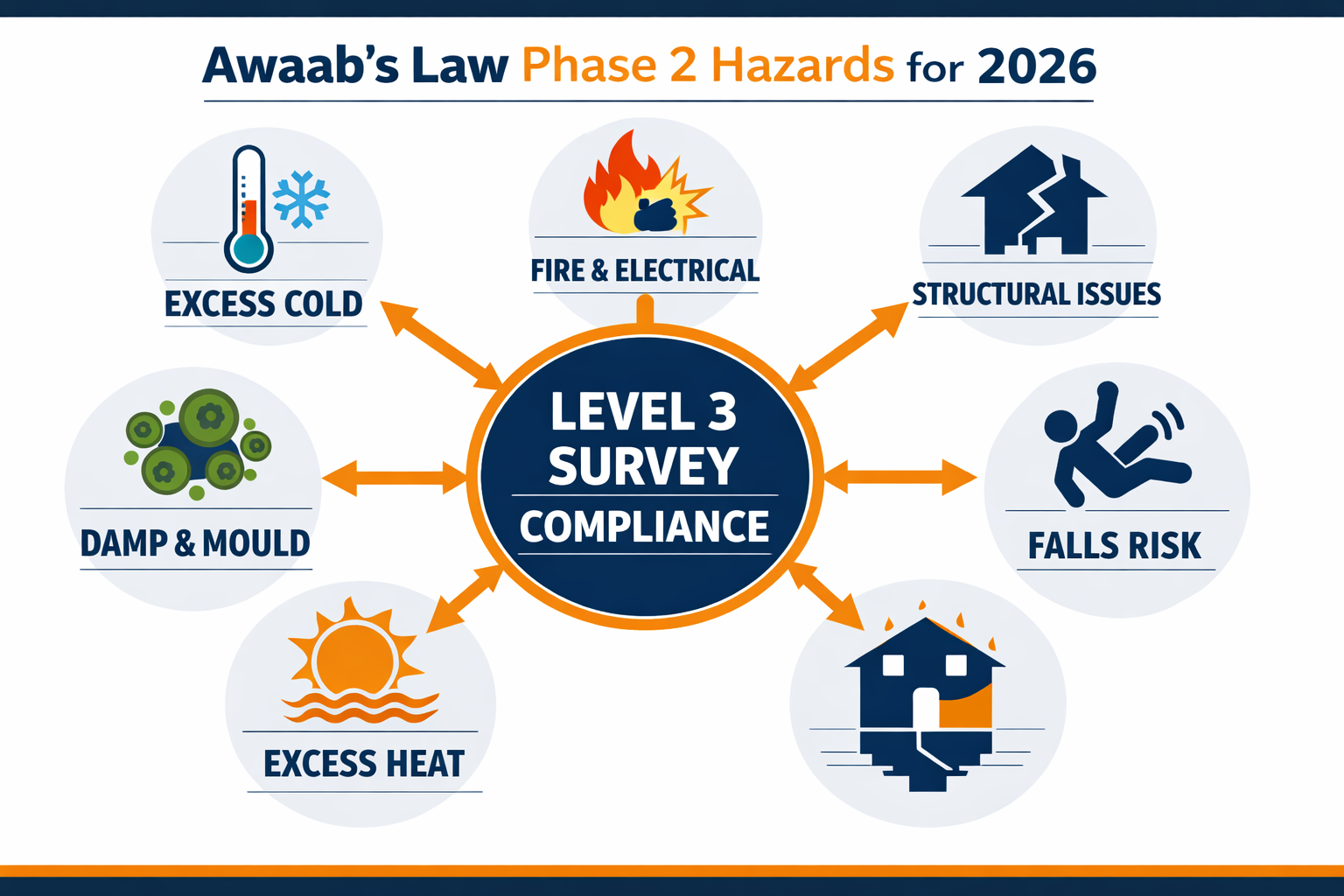
For RICS Level 3 building surveys, this is not a minor update. The 2026 extensions require surveyors to apply structured, evidence-based protocols to an expanded list of hazard categories that now includes:
| Hazard Category | 2026 Status | Risk Basis |
|---|---|---|
| Damp & Mould | ✅ Original | Health harm |
| Excess Cold | 🆕 Extended | Significant risk of harm |
| Excess Heat | 🆕 Extended | Significant risk of harm |
| Fire Hazards | 🆕 Extended | Life safety |
| Electrical Issues | 🆕 Extended | Life safety |
| Structural Defects | 🆕 Extended | Structural collapse risk |
| Falls Risks | 🆕 Extended | Physical injury |
Sources confirm that the 2026 regulations extend to cover excess cold and excess heat where they present a significant risk of harm, alongside falls and other categories [4]. This is not guidance — these are enforceable duties with fixed timescales and accountability measures attached [3].
Why Level 3 Surveys Are the Critical Instrument
A Level 3 building survey is the most thorough residential inspection available. Unlike a Level 2 homebuyer report, it includes assessment of concealed areas, structural elements, and specialist defect identification. Given the new hazard scope, it is now the appropriate survey type for any rental property where compliance with Awaab's Law obligations may be disputed.
For landlords and tenants seeking to understand which survey type fits their situation, reviewing guidance on choosing the right property survey is a useful starting point.
Surveyor Checklists: Protocols for Excess Cold, Fire, and Structural Risks Under Awaab's Law 2026
The four-part assessment mandate now governs how surveyors approach every notifiable hazard category [5]:
- Does the hazard exist?
- How severe is the risk?
- What action is required?
- How urgently must that action take place?
Each of the three primary new hazard groups — excess cold, fire/electrical, and structural — demands its own specialist checklist approach.
🌡️ Excess Cold: Checklist Protocol
Excess cold is defined under the Housing Health and Safety Rating System (HHSRS) as a hazard when indoor temperatures cannot be maintained at safe levels. For a Level 3 survey, the protocol now requires:
Thermal Performance Assessment
- Inspection of insulation in roof spaces, walls, and floors
- Identification of thermal bridging at junctions and window reveals
- Assessment of glazing type (single, double, secondary)
- Evaluation of heating system capacity and condition
- Review of boiler age, efficiency rating, and service records
Evidence Documentation Requirements
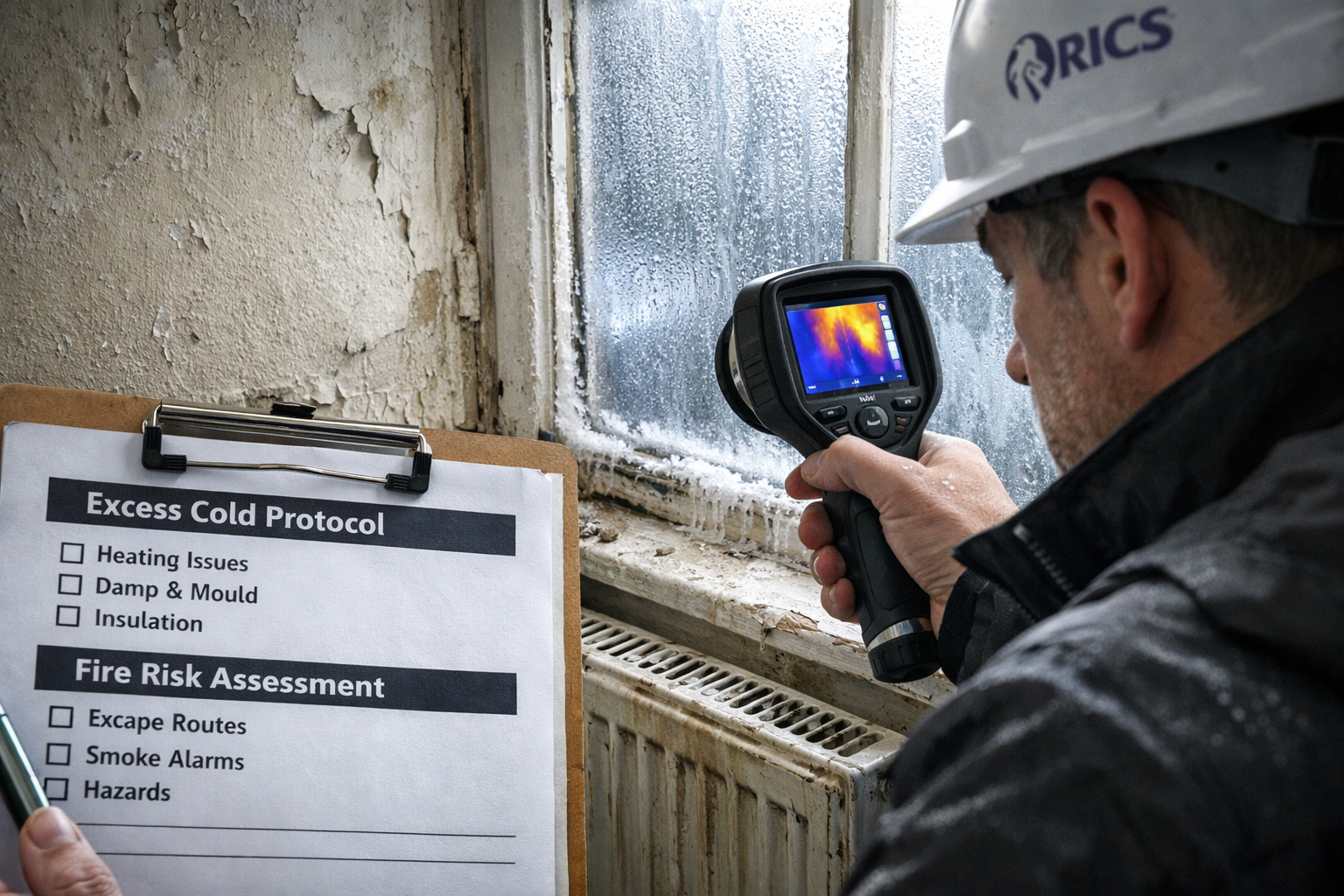
- Thermal imaging where accessible (supports root cause identification)
- Photographic evidence of insulation deficiencies
- Written assessment of whether the heating system can achieve 18°C in living rooms and 21°C in bathrooms in winter conditions
- Identification of draught penetration points
💬 "From 2026, private landlords will be judged not on intent, but on evidence — how quickly issues were investigated, how thoroughly causes were identified, and how effectively risks were removed." [3]
For properties with suspected insulation failures in floor slabs, a solid floor slab survey may be required as a supplementary investigation to establish root cause.
Root Cause Obligation: The law is clear that surface-level responses do not satisfy the investigation standard [3]. A surveyor who notes "cold rooms" without identifying whether the cause is insulation failure, heating system inadequacy, or structural air infiltration has not met the required standard.
🔥 Fire and Electrical Hazards: Checklist Protocol
Fire hazards represent one of the most significant additions to the 2026 extended scope [2]. The survey protocol for this category is demanding because fire risk can arise from multiple independent sources within the same property.
Fire Hazard Assessment Checklist
- ☐ Condition and age of electrical installation (EICR status)
- ☐ Identification of overloaded circuits or DIY wiring
- ☐ Presence and condition of smoke and CO alarms
- ☐ Assessment of fire separation between floors and units
- ☐ Condition of fire doors (where applicable)
- ☐ Escape route viability assessment
- ☐ Identification of combustible materials in roof voids
- ☐ Gas installation condition and ventilation adequacy
Electrical-Specific Documentation
Surveyors must note whether an Electrical Installation Condition Report (EICR) is current and whether visible installation components show signs of deterioration, damage, or non-compliant modification. Where asbestos is suspected near electrical installations — particularly in older properties — a specialist asbestos survey should be recommended as part of the compliance evidence chain.
Evidence for Compliance Disputes: In enforcement proceedings, a surveyor's documented observation that a specific fire hazard existed, was identified on a specific date, and required urgent remediation within a defined timescale carries significant legal weight. Vague commentary such as "some electrical concerns noted" will not withstand scrutiny.
🏗️ Structural Risks: Checklist Protocol
Structural defects under Awaab's Law 2026 hazard extensions encompass risks that could result in partial or total structural failure. This is where the Level 3 survey's depth of investigation becomes most critical.
Structural Assessment Checklist
- ☐ Inspection of foundations for movement or settlement
- ☐ Assessment of load-bearing walls for cracking, bulging, or leaning
- ☐ Roof structure inspection (rafters, purlins, ridge, wall plates)
- ☐ Assessment of lintels above openings
- ☐ Identification of unauthorised structural alterations
- ☐ Chimney stack stability assessment
- ☐ Retaining wall condition (where applicable)
For properties showing signs of ground movement, a subsidence survey provides the specialist evidence needed to distinguish between cosmetic cracking and genuine structural risk — a distinction that is central to hazard severity assessment under the four-part mandate.
Where structural alterations have been made without proper engineering oversight, beam calculations may be required to confirm whether existing structural members are adequate.
Severity Classification: Structural hazards must be classified by severity. The HHSRS scoring system remains the reference framework, but surveyors must now explicitly link their severity score to the required action timescale. A Category 1 hazard (highest risk) triggers the most urgent response obligations.
Documentation Standards: Building the Evidence File for Awaab's Law Compliance
The 2026 extensions dramatically broaden the scope of hazards that surveyors must identify and document during property inspections [1]. But documentation is not just about completeness — it is about evidential quality.
In a compliance dispute, the survey report is the primary piece of evidence. Landlords who can demonstrate that a qualified surveyor investigated a reported hazard, identified its root cause, and specified a remediation plan with a clear timescale are in a fundamentally stronger position than those who cannot.
What an Adequate Survey Report Must Include in 2026
Drawing on the four-part assessment mandate [5], every hazard identified in a Level 3 survey must be documented with:
- Hazard identification: Clear description of what was observed, where, and when
- Severity assessment: HHSRS band or equivalent risk classification
- Required action: Specific remediation steps, not generic recommendations
- Urgency timescale: Defined timeframe linked to severity classification
Additionally, an adequate investigation must include professional assessment of moisture sources (where relevant), clear reporting and recommendations, and evidence-based remediation plans [3].
The Root Cause Imperative ⚠️
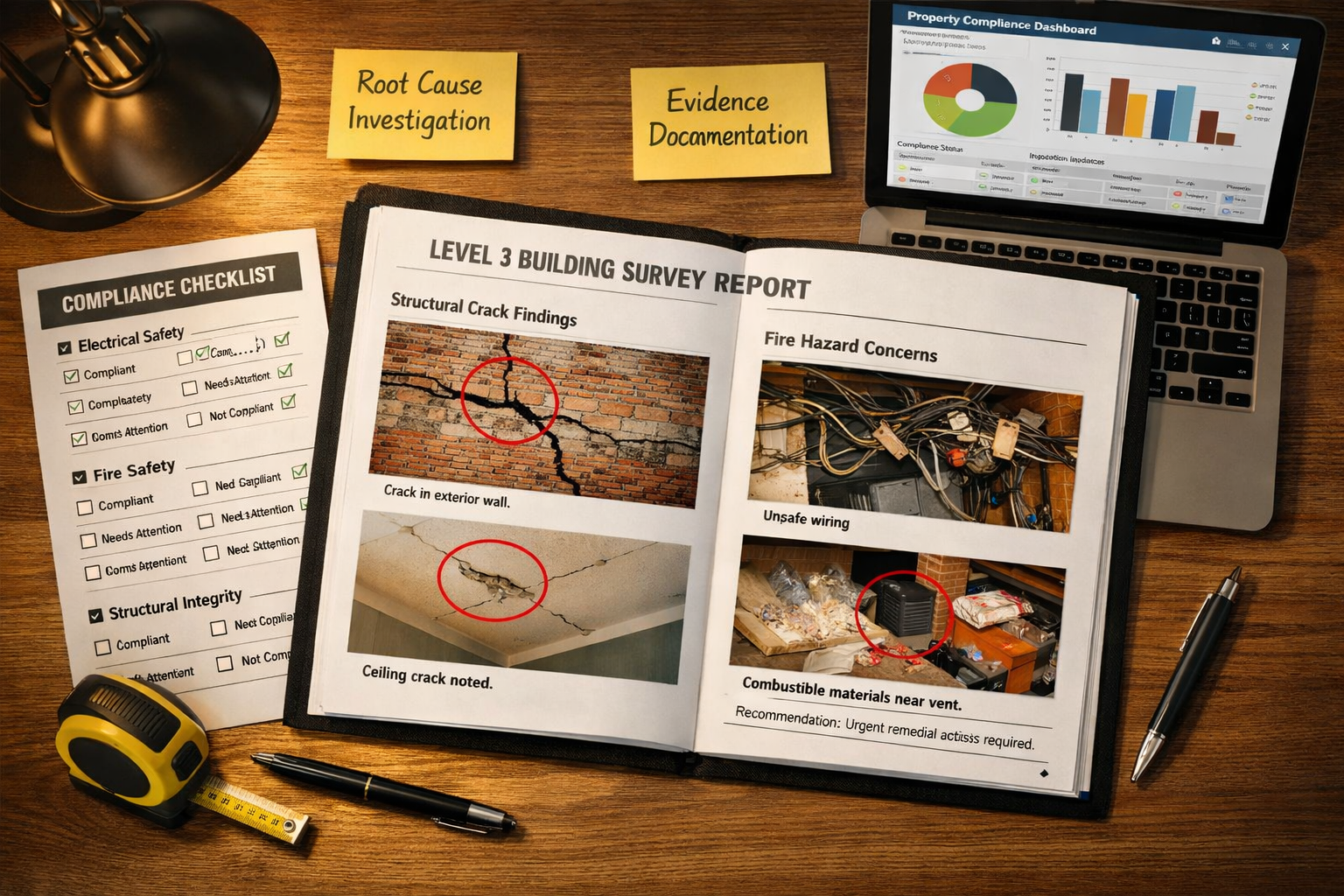
One of the most important principles embedded in Awaab's Law is the root cause obligation. The law is concerned with underlying causes, not surface appearance. Repainting a damp wall, replacing a smoke alarm battery, or applying filler to a crack does not constitute an adequate investigation [3].
For structural surveys, this means:
- Cracking must be categorised (crack width, pattern, location)
- Movement must be assessed as active or historic
- Cause must be identified (settlement, subsidence, thermal movement, loading failure)
For fire hazard surveys, this means:
- Electrical faults must be traced to their source
- Fire separation failures must be attributed to specific construction defects
- Escape route inadequacies must be linked to specific building features
Private Landlord Obligations: Enforcement, Timescales, and Risk
From 2026 onwards, private landlords are subject to mandatory investigation of hazard complaints, defined timescales for action, and stronger enforcement by local authorities [3]. This is a fundamental shift from the previous regime, where enforcement was often reactive and inconsistent.
Key Enforcement Points for Private Landlords
- Local authorities have strengthened powers to issue improvement notices
- Fixed timescales apply from the point a hazard is reported
- Evidence of investigation and remediation must be retained
- Compliance is judged on evidence, not on stated intent [3]
💬 "Waiting until enforcement begins increases cost, disruption, and risk. Compliance depends on speed, documentation, and specialist insight." [3]
The practical implication is clear: landlords who commission a thorough RICS Level 3 building survey at the point a hazard is reported — rather than waiting — are building their compliance evidence file from day one.
For landlords managing multiple properties or housing stock, a stock condition survey provides a systematic baseline assessment across a portfolio, enabling proactive identification of excess cold, fire, and structural hazards before complaints are received.
Awaab's Law 2026 Hazard Extensions in Level 3 Surveys: Practical Compliance Workflow
Bringing the protocols together, the following workflow reflects best practice for surveyors and landlords operating under the 2026 extended obligations:
Step 1 — Hazard Report Received
Document the date, nature of complaint, and property details immediately. The compliance clock starts here.
Step 2 — Commission Level 3 Survey
Instruct a RICS-qualified surveyor with experience in the specific hazard category. Generic inspections are insufficient for Awaab's Law compliance.
Step 3 — Four-Part Assessment
The surveyor applies the four-part mandate to each identified hazard: existence, severity, action, urgency [5].
Step 4 — Root Cause Investigation
Where specialist investigation is needed (subsidence, asbestos, structural engineering), commission supplementary reports immediately. Do not delay specialist referral.
Step 5 — Evidence-Based Report Issued
The survey report must meet the documentation standards outlined above. Vague or incomplete reports create compliance vulnerability.
Step 6 — Remediation Executed Within Timescale
Remediation must address root causes, not symptoms. Retain all contractor invoices, completion certificates, and post-remediation evidence.
Step 7 — Record Retention
All survey reports, remediation records, and communications must be retained for the duration of the tenancy and beyond.
Conclusion: Acting Now Is the Only Compliant Position
Awaab's Law 2026 Hazard Extensions in Level 3 Surveys: Protocols for Excess Cold, Fire, and Structural Risks have fundamentally changed what it means to investigate a housing hazard. The days of cosmetic fixes and vague survey commentary are over.
The law judges landlords on evidence — the quality of investigation, the speed of response, and the effectiveness of remediation [3]. For surveyors, the standard has risen: every Level 3 survey touching a rental property must now apply structured, documented protocols to excess cold, fire, electrical, and structural hazard categories [2].
Actionable Next Steps:
✅ Landlords: Commission a RICS Level 3 building survey at the first sign of any hazard complaint — do not wait for enforcement action
✅ Surveyors: Review your reporting templates against the four-part assessment mandate and ensure root cause documentation is standard practice [5]
✅ Portfolio landlords: Arrange a stock condition survey to establish a proactive baseline across all properties
✅ Properties with structural concerns: Instruct specialist structural surveys and subsidence assessments before hazard severity escalates
✅ All parties: Retain every document — survey reports, remediation records, communications — as your compliance evidence file
The cost of a thorough survey is a fraction of the cost of an enforcement dispute. The time to act is before the complaint, not after.
References
[1] Awaabs Law Extensions To Prs In 2026 Party Wall And Building Survey Protocols For New Hazard Categories – https://nottinghillsurveyors.com/blog/awaabs-law-extensions-to-prs-in-2026-party-wall-and-building-survey-protocols-for-new-hazard-categories
[2] Building Surveys For Excess Cold And Fire Hazards In Prs Post Awaabs Law 2026 Protocols For Private Landlord Compliance – https://nottinghillsurveyors.com/blog/building-surveys-for-excess-cold-and-fire-hazards-in-prs-post-awaabs-law-2026-protocols-for-private-landlord-compliance
[3] Awaabs Law Private Landlords 2026 – https://www.idealresponse.co.uk/blog/awaabs-law-private-landlords-2026/
[4] Awaabs Law Timeframes And The Dfg – https://www.foundations.uk.com/awaabs-law-timeframes-and-the-dfg/
[5] Awaabs Law And Surveyors What Your Reports Must Include In 2026 – https://goreport.com/awaabs-law-and-surveyors-what-your-reports-must-include-in-2026/