Only 38% of property owners who go through a divorce, bereavement, or tax audit ever commission a specialist valuation — yet the financial consequences of getting that figure wrong can run into tens of thousands of pounds. Valuation Services Beyond Mortgages: Expert Valuations for Matrimonial Disputes, Probate, and Tax Liabilities is a field that demands a different level of rigour, independence, and legal awareness than a standard mortgage valuation. Chartered surveyors operating in this space are not simply estimating a sale price — they are producing defensible, court-ready evidence that can determine how an estate is divided, how much tax is owed, and who wins a legal dispute.
Key Takeaways 📌
- Property valuations for matrimonial disputes, probate, and tax purposes carry legal weight that mortgage valuations do not — methodology and independence matter enormously.
- Incorrect probate valuations can trigger capital gains tax exposure, HMRC penalties, and bitter inter-heir disputes. [2]
- As of 2026, estate tax exemptions have reached $15 million per person in the US, making accurate valuation more critical than ever for high-net-worth estates. [3]
- Courts place significant weight on rigorous valuation analysis and credible expert testimony — a poorly supported report can be dismissed entirely. [4]
- Only RICS-registered valuers have the professional standing to produce valuations accepted in UK courts, HMRC submissions, and legal proceedings.
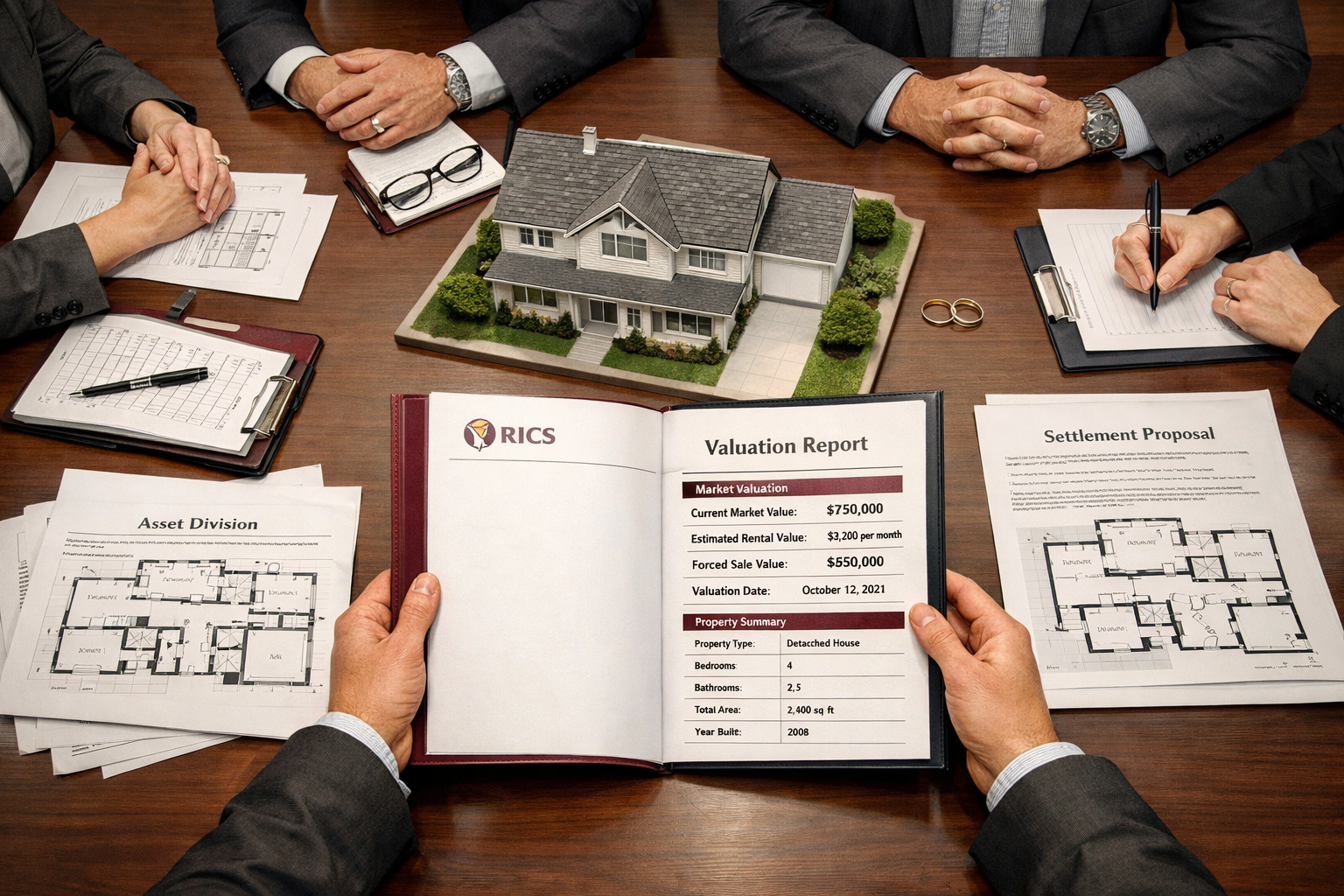
Why Valuation Services Extend Far Beyond the Mortgage World
Most people associate property valuations with one thing: getting a mortgage approved. But the reality is that property value is contested in dozens of legal and financial contexts where the stakes are far higher than a lender's risk assessment.
A mortgage valuation protects the lender. A specialist valuation for a matrimonial dispute, a probate estate, or a tax liability protects the individual — and must withstand scrutiny from solicitors, barristers, HMRC inspectors, and judges.
The key differences are:
| Feature | Mortgage Valuation | Specialist Legal/Tax Valuation |
|---|---|---|
| Primary audience | Lender | Court / HMRC / Beneficiaries |
| Level of detail | Basic | Comprehensive |
| Independence required | Moderate | Absolute |
| Methodology documented | Rarely | Always |
| Legally defensible | No | Yes |
| Valuation date flexibility | Current | Specific historical or future date |
Understanding the factors that affect a property's value is the starting point — but specialist valuers must go further, applying recognised methodologies, documenting comparable evidence, and presenting findings in a format that holds up under cross-examination.
💡 Pull Quote: "A specialist valuation is not an opinion — it is a professionally evidenced conclusion that must survive legal and regulatory scrutiny."
Matrimonial Disputes: Valuation as the Battleground for Asset Division
When a marriage or civil partnership breaks down, the family home is almost always the largest single asset on the table. Valuation Services Beyond Mortgages: Expert Valuations for Matrimonial Disputes, Probate, and Tax Liabilities are at their most emotionally charged in this context — and also at their most technically demanding.
What Courts Require in Matrimonial Valuations
Family courts in England and Wales require valuations that are:
- Independent — the valuer must have no financial or personal interest in the outcome.
- Methodology-transparent — the report must explain how the figure was reached, not just state it.
- Comparable-supported — recent sales of similar properties in the same area must be cited.
- Date-specific — the valuation must reflect value at a defined point in time, which may be the date of separation, the date of hearing, or another agreed date.
Courts place significant weight on rigorous valuation analysis and credible expert testimony. [4] A valuation that lacks comparable evidence or relies on subjective judgement alone will be challenged — and may be replaced by a court-appointed valuer at additional cost to both parties.
When Both Parties Disagree
It is common for divorcing couples to commission competing valuations. When these differ materially, the court may:
- Appoint a Single Joint Expert (SJE) — a neutral valuer agreed by both parties.
- Require both valuers to produce a joint statement identifying areas of agreement and disagreement.
- Hold a valuation hearing where methodology is scrutinised in detail.
A chartered surveyor with expert witness experience is essential in contested cases. The ability to present findings clearly, defend methodology under cross-examination, and remain impartial under pressure distinguishes a competent expert witness from one who will be discredited in court.
Practical Considerations for Matrimonial Valuations
- Leasehold properties require additional analysis — short leases significantly reduce value and must be factored in. See our guide to collective enfranchisement for context on how lease length affects value.
- Rental income properties require a different valuation approach than owner-occupied homes.
- Properties with structural issues may need a full building survey to establish condition before value can be accurately assessed.
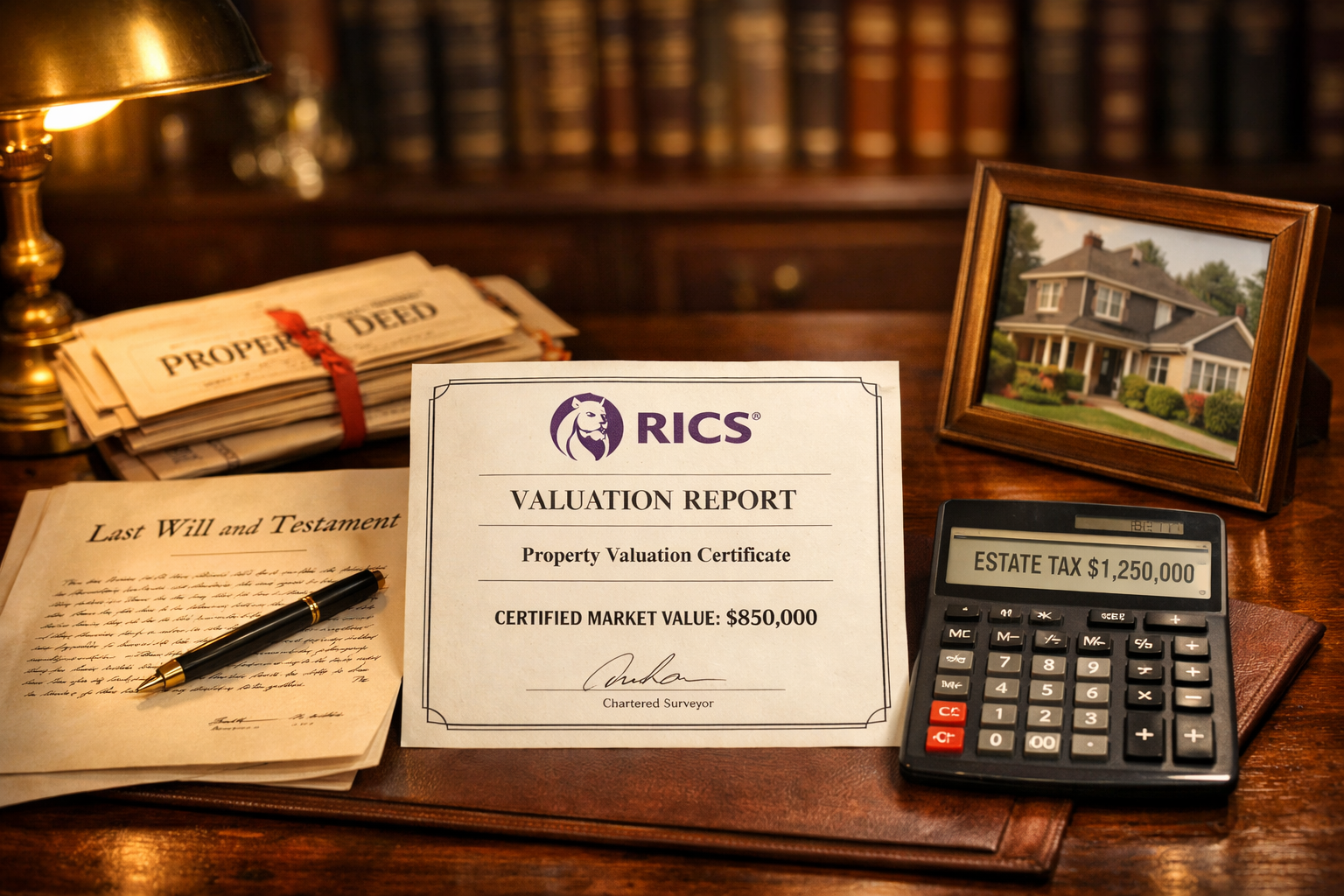
Probate Valuations: Getting the Figure Right When It Matters Most
When someone dies, their estate must be valued before it can be distributed. This is not a formality — incorrect probate valuations can cost thousands in lost equity, tax exposure, and inter-heir disputes. [2]
What Probate Valuations Determine
The valuation figure submitted to HMRC and the Probate Registry affects:
- Inheritance Tax (IHT) liability — calculated on the gross value of the estate above the nil-rate band threshold.
- Capital Gains Tax (CGT) basis — the probate value becomes the base cost for beneficiaries. A low valuation today can create a larger CGT bill when the property is eventually sold.
- Equity distribution — beneficiaries negotiating their share of an estate rely on accurate valuations to ensure fair treatment.
⚠️ Critical point: HMRC actively reviews probate property valuations and can challenge figures it considers too low. If challenged and revised upward, the estate faces not only additional tax but potential interest and penalties.
The Importance of the Valuation Date
For UK probate purposes, the valuation must reflect open market value at the date of death — not the current date, and not an aspirational asking price. This requires the valuer to reconstruct market conditions as they existed on a specific historical date, using comparable sales data from that period.
This is a technically demanding exercise. In the US, the IRS applies similar rules: the default valuation date for federal estate tax is the date of death, though an alternate valuation date (six months after death) is available if it reduces both the gross estate value and tax liability. [6] The Form 706 filing deadline is nine months after death, with a six-month extension available — though tax payments are generally due at the original deadline regardless of extensions. [6]
In the UK, HMRC's equivalent processes are equally time-sensitive, making early engagement with a qualified valuer essential.
Common Probate Valuation Mistakes to Avoid 🚫
- Using an estate agent's market appraisal instead of a formal RICS valuation
- Submitting a valuation without comparable evidence
- Failing to account for condition issues that would affect value (damp, structural defects, etc.)
- Overlooking the impact of tenancies in place at the date of death
- Ignoring leasehold complications that reduce value
A formal RICS valuation, supported by documented comparables and a clear methodology statement, is the only reliable protection against HMRC challenge. Understanding the price of a professional valuation is a small cost relative to the tax exposure it protects against.
Tax Liabilities: Valuation as the Foundation of HMRC Compliance
Beyond probate, property valuations are required for a range of tax-related purposes across the property lifecycle.
Capital Gains Tax (CGT) Valuations
CGT is triggered when a property is sold for more than it was acquired for. In cases where the acquisition was not a standard purchase — inheritance, gift, transfer between connected parties — the base cost must be established by a formal valuation.
Common CGT valuation scenarios include:
- Inherited property subsequently sold by beneficiaries
- Gifts of property to family members (market value at date of transfer is used)
- Part-disposal of land or property
- Change of use (e.g., converting a main residence into a rental property)
For gift tax purposes, the valuation date is the date of transfer — a critical distinction that affects the tax calculation significantly. [6]
Inheritance Tax Planning Valuations
With estate tax exemptions in the US now permanently set at $15 million per person ($30 million for married couples) under the One Big Beautiful Bill, high-net-worth families have more planning flexibility — but accurate valuations remain essential to demonstrate compliance and optimise strategy. [3]
In the UK, IHT planning similarly depends on accurate property valuations to:
- Establish the value of gifts made within seven years of death
- Value business property relief (BPR) eligible assets
- Support agricultural property relief (APR) claims
- Document trust asset values for periodic and exit charges
The Second Circuit Court of Appeals' decision in the Estate of Kalikow case (March 2025) affirmed that settlements resolving undistributed income claims against QTIP trusts do not reduce estate asset values — a reminder that complex trust structures require specialist valuation expertise. [5]
Stamp Duty Land Tax (SDLT) and Other Transaction Taxes
Valuations are also required where SDLT is calculated on non-cash consideration, linked transactions, or transfers at below-market value between connected parties. HMRC expects these to reflect genuine open market value, and will challenge figures that appear artificially low.

The Standard of Evidence: What Makes a Valuation Court-Ready and HMRC-Proof
Valuation Services Beyond Mortgages: Expert Valuations for Matrimonial Disputes, Probate, and Tax Liabilities are only as strong as the evidence and methodology behind them. A federal appellate court case on valuation methodology was featured as a cover story in the March/April 2026 Valuation and Litigation Briefing — a clear signal that courts at the highest level are scrutinising how valuers reach their conclusions. [1]
What a Robust Specialist Valuation Report Must Include
✅ Clear statement of purpose — the report must specify the legal or tax context it is prepared for
✅ Defined valuation date — with a clear rationale for that date
✅ Market analysis — evidence of comparable transactions in the relevant market
✅ Condition assessment — any defects or issues that affect value must be noted
✅ Methodology statement — explaining the approach used (comparable method, investment method, etc.)
✅ RICS compliance — prepared in accordance with the RICS Red Book (Valuation – Global Standards)
✅ Independence declaration — confirming no conflict of interest
Well-structured, properly supported valuations continue to withstand HMRC and court scrutiny — while poorly evidenced reports are routinely challenged and revised. [4]
The Role of RICS Registration
Only RICS-registered valuers are qualified to produce Red Book-compliant valuations accepted by HMRC, the Probate Registry, and UK courts. RICS registration signals:
- Adherence to professional standards and ethics
- Mandatory continuing professional development
- Professional indemnity insurance
- Accountability to a regulatory body
When selecting a valuer for a legal or tax purpose, RICS registration is not optional — it is the minimum standard.
Desktop vs. In-Person Valuations
For some purposes, a desktop valuation may be sufficient — but for contested matrimonial cases, probate submissions, and tax disputes, an in-person inspection is almost always required. The valuer must be able to confirm condition, note any material defects, and demonstrate that their figure reflects the actual property — not just an algorithm's estimate.
Choosing the Right Valuer for Non-Mortgage Purposes
Not every surveyor who conducts mortgage valuations is equipped to handle the complexity of matrimonial, probate, or tax work. The selection criteria should include:
| Criteria | Why It Matters |
|---|---|
| RICS registration | Ensures Red Book compliance and professional accountability |
| Experience in the specific context | Matrimonial, probate, and tax work each have distinct requirements |
| Expert witness capability | Essential for contested cases |
| Local market knowledge | Comparable evidence must be drawn from the relevant area |
| Clear fee structure | Understand valuation costs upfront to avoid surprises |
For properties with complex characteristics — unusual construction, structural concerns, or significant condition issues — a RICS Level 3 Building Survey may be recommended alongside the valuation to fully document condition.
Charities and non-profit organisations disposing of or acquiring property have additional obligations under the Charities Act — a Charities Act valuation ensures compliance with those specific statutory requirements.
Conclusion: Act Early, Act Precisely
Property valuation for legal and tax purposes is not a box-ticking exercise — it is a professional discipline that can determine financial outcomes worth hundreds of thousands of pounds. Whether navigating a divorce settlement, administering a deceased estate, or defending a tax position before HMRC, the quality of the valuation evidence is often the deciding factor.
Actionable Next Steps ✅
- Identify the purpose of the valuation before instructing anyone — matrimonial, probate, CGT, IHT, and SDLT each have different requirements.
- Engage a RICS-registered valuer with specific experience in the relevant legal or tax context.
- Establish the correct valuation date with your solicitor or tax adviser before the valuation is commissioned.
- Request a Red Book-compliant report — confirm this is what will be delivered, not a market appraisal.
- Act early — rushed valuations under deadline pressure are more likely to be challenged.
- Consider a building survey if the property has known condition issues that could affect value.
The breadth of expertise required for Valuation Services Beyond Mortgages: Expert Valuations for Matrimonial Disputes, Probate, and Tax Liabilities positions chartered surveyors as essential advisors in some of life's most complex and consequential moments. Choosing the right expert at the outset is not a cost — it is an investment in a defensible, accurate outcome.
References
[1] Valuation And Litigation Briefing March April 2026 – https://wm-cpa.com/accounting-insight/valuation-and-litigation-briefing-march-april-2026/
[2] Atlanta Probate Appraisal Mistakes 2026 Executors – https://www.rei-valuations.com/rei-valuations-insights/atlanta-probate-appraisal-mistakes-2026-executors
[3] Gift Estate Valuation 2026 – https://www.msgcpa.com/forensicperspectives/gift-estate-valuation-2026/
[4] Heckerling 2026 Key Estate And Gift Valuation Insights – https://www.valuationresearch.com/insights/heckerling-2026-key-estate-and-gift-valuation-insights/
[5] Qtip Trust Liabilities And Estate Tax 1597895 – https://www.jdsupra.com/legalnews/qtip-trust-liabilities-and-estate-tax-1597895/
[6] April 2026 Valuation Date Discipline – https://mercercapital.com/insights/newsletters/value-matters-newsletter/2026/april-2026-valuation-date-discipline/