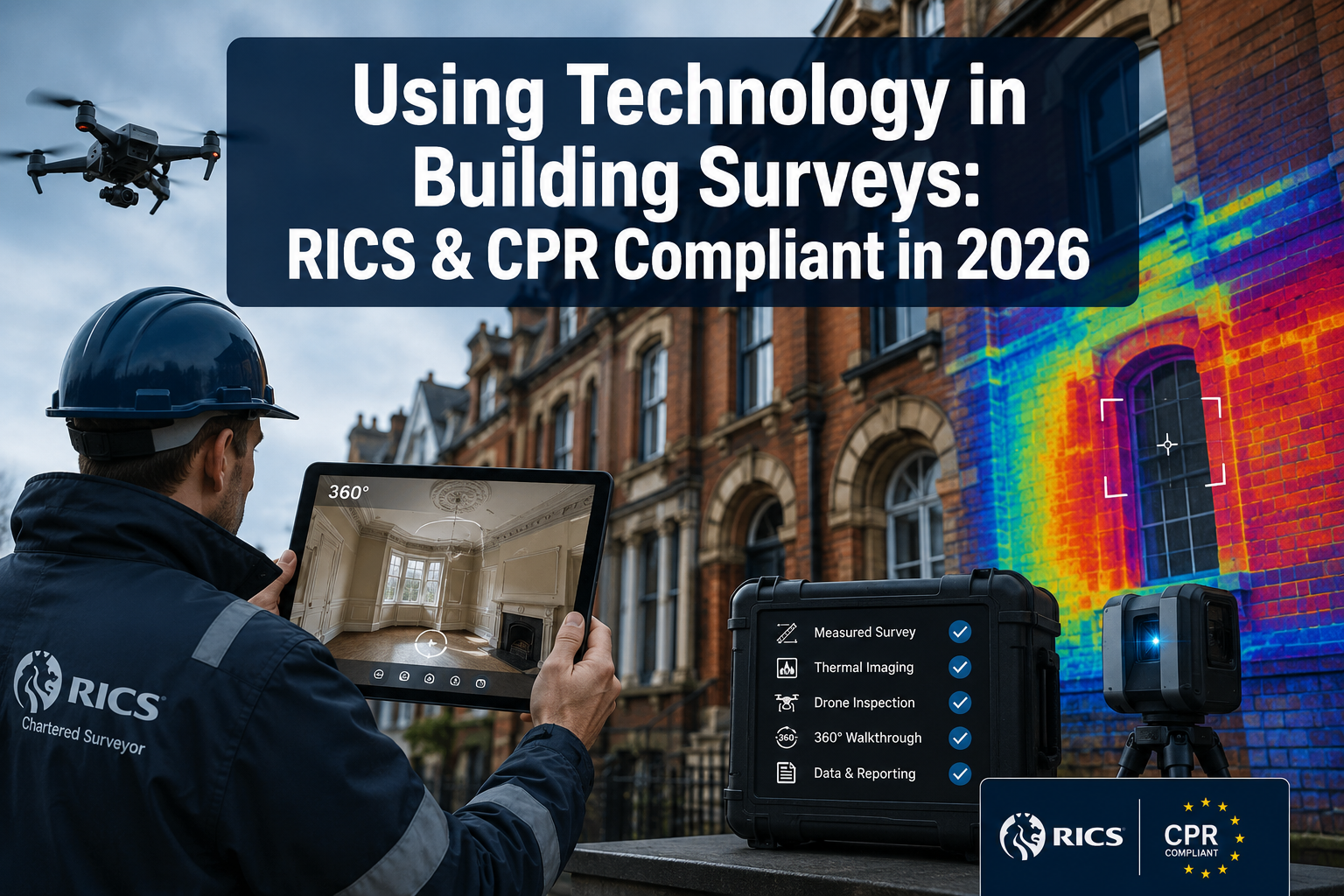
Over 40% of party wall disputes in England and Wales involve damage that a pre-construction condition record failed to anticipate. That sobering figure explains why the arrival of AI-powered defect prediction tools — and the RICS framework governing their use — matters so much to surveyors, developers, and property owners in 2026.
The intersection of AI Tools for Party Wall Defect Prediction: Ethical RICS Compliance in 2026 High-Risk Projects is no longer a theoretical discussion. Since March 9, 2026, RICS' first-ever global professional standard for responsible AI use has been in effect, fundamentally reshaping how chartered surveyors may deploy machine learning models to assess structural risk [1]. For party wall practitioners working on basement excavations, steel beam insertions, or close-proximity demolitions, the stakes — financial, structural, and professional — have never been higher.
Key Takeaways 📋
- RICS' AI standard (effective March 9, 2026) mandates governance, transparency, and human oversight for all AI tools used in surveying practice [1].
- AI can meaningfully enhance defect recognition and structural risk prediction in party wall contexts — but surveyors remain fully accountable for every recommendation.
- High-risk projects (deep excavations, beam installations, underpinning) present the most compelling use cases for AI-assisted prediction.
- Ethical compliance requires human-in-the-loop workflows, not just AI output acceptance.
- Firms must maintain risk registers and responsible-use policies covering all AI procurement and deployment.
What AI Defect Prediction Actually Means for Party Wall Work
Party wall surveying has always been a discipline where small oversights carry outsized consequences. A missed crack pattern, an underestimated vibration load, or a poorly documented schedule of condition can trigger party wall disputes that cost tens of thousands of pounds to resolve.
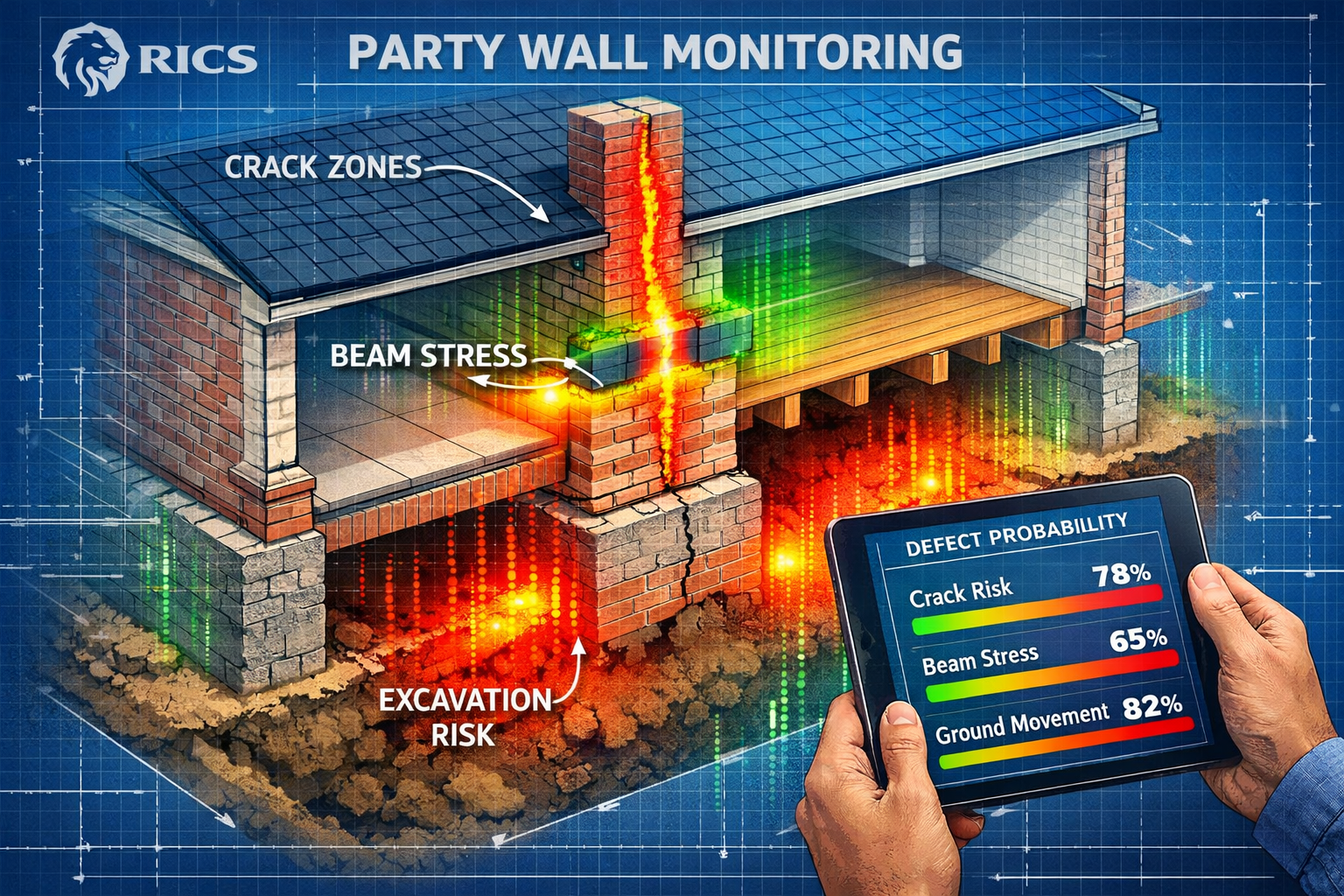
AI defect prediction tools change the information landscape available to surveyors before, during, and after notifiable works. These systems typically combine:
- Computer vision models trained on thousands of crack, spalling, and settlement images
- Structural data inputs (soil type, foundation depth, proximity of works)
- Historical defect databases from comparable projects
- Sensor-fed monitoring streams from IoT devices attached to party structures
The result is a probability-weighted risk profile — not a definitive answer, but a significantly richer dataset than visual inspection alone provides.
💡 "AI's promise in surveying includes enhanced defect detection, faster data analysis, and more comprehensive property assessments." [2]
Where AI Adds the Most Value in Party Wall Contexts
| Risk Scenario | Traditional Approach | AI-Enhanced Approach |
|---|---|---|
| Basement excavation near shared wall | Manual crack survey + engineer estimate | Predictive settlement modelling + real-time sensor alerts |
| Steel beam insertion through party wall | Visual inspection + structural calculation | Load-path analysis + historical failure pattern matching |
| Demolition of attached structure | Schedule of condition photography | AI image comparison + vibration risk scoring |
| Underpinning adjacent to boundary | Soil report + surveyor judgement | Ground movement prediction + automated monitoring |
For projects falling within the three-metre rule — where excavations near neighbouring foundations trigger Party Wall Act obligations — AI tools can model subsidence risk with a granularity that manual methods simply cannot match.
The RICS AI Standard: Four Pillars Every Surveyor Must Understand
The RICS global AI standard, effective March 9, 2026, is not optional guidance. It is a mandatory professional standard binding on all RICS members and regulated firms [1]. For anyone deploying AI tools for party wall defect prediction, understanding its four governance pillars is essential.
1. Governance and Risk Management
Firms must implement formal risk registers specifically covering AI tool use. This means documenting:
- Which AI systems are in use
- What data they process
- Known limitations and failure modes
- Escalation procedures when AI outputs are uncertain
For party wall practices, this translates to maintaining a register that covers defect prediction software, automated schedule of condition tools, and any AI-assisted structural monitoring platforms.
2. Professional Judgement and Oversight
This is the most critical pillar for day-to-day practice. RICS is explicit: "AI assists professional practice; it does not replace it." Surveyors remain accountable for every piece of professional advice, regardless of what tools generated the underlying analysis [1].
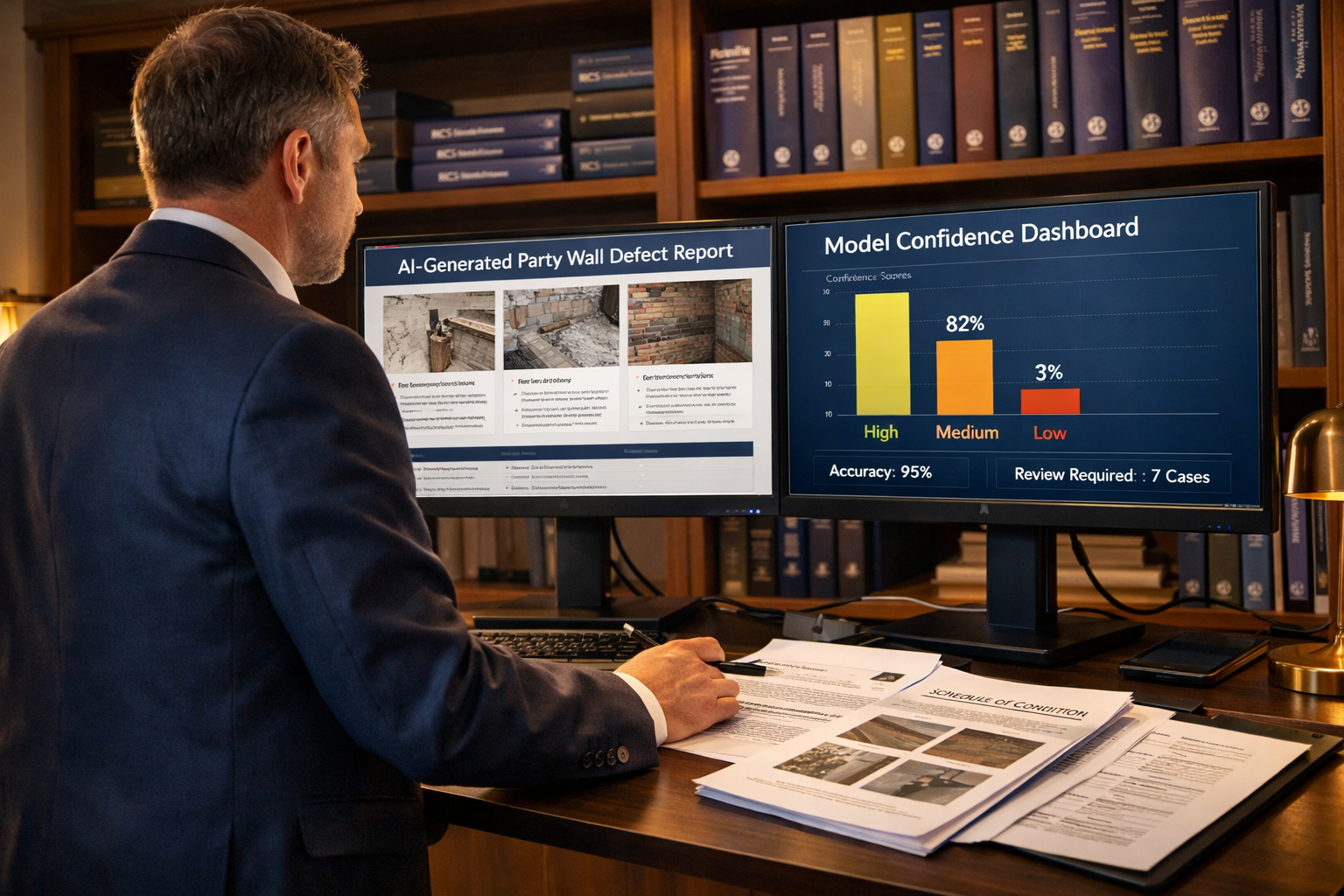
The best-practice model here is the human-in-the-loop workflow. Construction industry evidence from 2026 demonstrates that mandatory human review of AI-generated drafts — with feedback loops that continuously improve the model — represents the gold standard for responsible implementation [3].
In party wall terms, this means:
- ✅ AI flags a high-probability crack propagation risk → surveyor reviews, contextualises, and makes the professional call
- ❌ AI flags a risk → surveyor accepts output without independent verification
3. Transparency and Client Communication
Clients must be told when AI tools have been used in producing their survey or advice. This is particularly relevant when damage to property in party wall situations arise and the basis of defect assessment is scrutinised in dispute proceedings.
Transparency requirements include:
- Disclosing AI tool use in survey reports
- Explaining the confidence levels and limitations of AI outputs
- Ensuring clients understand that professional judgement — not AI — is the final authority
4. Responsible Development and Procurement
Even when surveyors are using rather than building AI tools, RICS requires procurement due diligence. Before deploying any defect prediction software on a high-risk party wall project, firms should verify:
- Training data provenance and bias risks
- Accuracy benchmarks on comparable building types
- Data security and GDPR compliance
- Vendor transparency about model limitations
Applying AI Tools for Party Wall Defect Prediction: Ethical RICS Compliance in 2026 High-Risk Projects
High-risk party wall projects — those involving deep excavations, structural alterations, or works to shared chimneys and chimney stacks — are precisely where AI defect prediction delivers the most measurable value. They are also where ethical pitfalls are most acute.
Case Study Framework: Basement Excavation in a Victorian Terrace
Consider a common London scenario: a developer excavating a full-width basement beneath a mid-terrace Victorian property, with party walls shared on both sides. The Party Wall etc. Act 1996 requires notices, schedules of condition, and potentially a party wall award.
An AI-compliant workflow for this project might look like this:
Pre-works phase:
- AI computer vision tool processes photographic survey of adjoining owners' properties
- Model generates baseline defect map with severity scores
- Surveyor reviews, annotates, and approves the schedule of condition
- AI structural model ingests soil data, excavation depth, and proximity parameters to generate settlement risk probability
During works phase:
- IoT sensors on party walls feed real-time movement data to AI monitoring platform
- Automated alerts trigger when displacement exceeds pre-set thresholds
- Human engineer reviews every alert before any site instruction is issued
- AI model updates risk profile as works progress
Post-works phase:
- AI image comparison tool identifies new defects against baseline photographs
- Surveyor conducts independent physical inspection
- Final report attributes defects to works using professional judgement, informed — not replaced — by AI analysis
This workflow directly reflects the Digital Construction Awards 2026 criteria, which specifically sought AI implementations demonstrating "measurable, tangible benefits and genuine impact" rather than theoretical applications [3].
Ethical Pitfalls to Avoid
Several failure modes have emerged as AI adoption has accelerated in surveying practice:
🚫 Automation bias — Accepting AI defect classifications without independent verification. This is the single most common compliance failure and directly contradicts RICS' accountability principle [1].
🚫 Opaque AI procurement — Using defect prediction tools without understanding their training data. A model trained predominantly on modern construction may perform poorly on pre-1919 stock — exactly the building type most commonly involved in party wall disputes.
🚫 Inadequate disclosure — Failing to tell clients or opposing surveyors that AI tools contributed to defect assessments. In dispute contexts, this can undermine the credibility of a party wall award.
🚫 Over-reliance on probability scores — Treating a 78% crack propagation probability as a definitive finding rather than one input among many.
Building an Ethical AI Framework for Your Party Wall Practice
Translating RICS requirements into practical firm-level processes requires structured effort. The following framework provides a starting point for practices of any size.
Step 1: Audit Current AI Tool Use
Many firms are already using AI-adjacent tools — automated report writers, image analysis plugins, monitoring dashboards — without formally recognising them as AI systems subject to the new standard. A complete audit is the necessary first step.
Step 2: Establish a Risk Register
Document every AI tool used in party wall and structural surveying work. For each tool, record:
- Purpose and scope of use
- Known limitations
- Human oversight procedures
- Review and update schedule
This register supports the governance requirements of the RICS standard [1] and provides a defensible record if professional conduct is ever questioned.
Step 3: Update Client-Facing Documentation
Survey reports, engagement letters, and party wall notices should be updated to include appropriate AI disclosure language. This need not be lengthy — a clear, plain-English statement of which tools were used and what role they played is sufficient.
Step 4: Train Staff on Human-in-the-Loop Principles
Every surveyor using AI defect prediction tools must understand that their professional judgement is not optional — it is mandatory. Training should cover:
- How to critically evaluate AI outputs
- When to override or escalate AI recommendations
- Documentation requirements for AI-assisted decisions
Step 5: Implement Feedback Loops
The most sophisticated implementations use surveyor corrections and post-project outcomes to improve AI model performance over time [3]. Even smaller practices can contribute to this by maintaining structured records of cases where AI predictions proved inaccurate.
AI Defect Prediction and the Broader Survey Ecosystem
AI tools for party wall defect prediction do not exist in isolation. They connect to a broader ecosystem of structural assessment services that chartered surveyors provide.
A RICS specialist defect survey may now incorporate AI-assisted analysis as a matter of course, while structural surveys for properties adjacent to proposed works benefit from AI-generated risk profiles that inform the surveyor's independent assessment. Monitoring surveys — particularly relevant during excavation and underpinning works — are a natural integration point for real-time AI alerting systems.
The key principle across all these contexts remains consistent with RICS guidance: AI enriches the data available to the professional; it does not substitute for the professional's judgement, expertise, or accountability [1].
RICS has noted significant industry interest in "how AI can help with report writing, defect recognition or valuation modelling" — confirming that defect detection is a prioritised use case across the profession [4]. The party wall sector, with its high-stakes structural assessments and legally binding outputs, is well-positioned to benefit — provided ethical guardrails remain firmly in place.
Conclusion: Responsible AI Is a Competitive Advantage, Not Just a Compliance Burden
The arrival of binding RICS AI standards in 2026 might feel like additional regulatory weight for already busy party wall practitioners. The more accurate framing is the opposite: firms that implement AI tools for party wall defect prediction within an ethical RICS compliance framework are building a demonstrable competitive advantage.
They can offer clients richer pre-works condition records, more accurate risk assessments for high-stakes excavations and beam works, and faster identification of post-works damage. They can defend their professional judgements with a documented, auditable AI governance trail. And they can do all of this while remaining squarely within the accountability framework that protects both clients and practitioners.
Actionable Next Steps ✅
- Audit your current AI tool use against the four RICS governance pillars — governance, professional judgement, transparency, and responsible procurement.
- Create or update your firm's AI risk register before deploying any defect prediction tool on a high-risk party wall project.
- Update client documentation to include clear AI disclosure language in survey reports and engagement letters.
- Implement mandatory human review of all AI-generated defect assessments before they inform professional advice or party wall awards.
- Engage with RICS guidance and stay current as the standard evolves — this is a fast-moving area of professional practice.
The structural risks in party wall work are real and consequential. AI tools, deployed responsibly, make those risks more visible and more manageable. The RICS framework ensures that visibility translates into better professional outcomes — not just faster ones.
References
[1] Rics First Ever Standard On Responsible Ai Use Now In Effect – https://www.rics.org/news-insights/rics-first-ever-standard-on-responsible-ai-use-now-in-effect
[2] Rics Ai Standards In Building Surveys 2026 Implementing Responsible Use While Maintaining Professional Judgment – https://nottinghillsurveyors.com/blog/rics-ai-standards-in-building-surveys-2026-implementing-responsible-use-while-maintaining-professional-judgment
[3] Best Use Of Ai Shortlist 2026 – https://constructionmanagement.co.uk/best-use-of-ai-shortlist-2026/
[4] Modus By Rics January 2026 – https://www.rics.org/content/dam/ricsglobal/documents/to-be-sorted/MODUS-by-RICS-January-2026.pdf