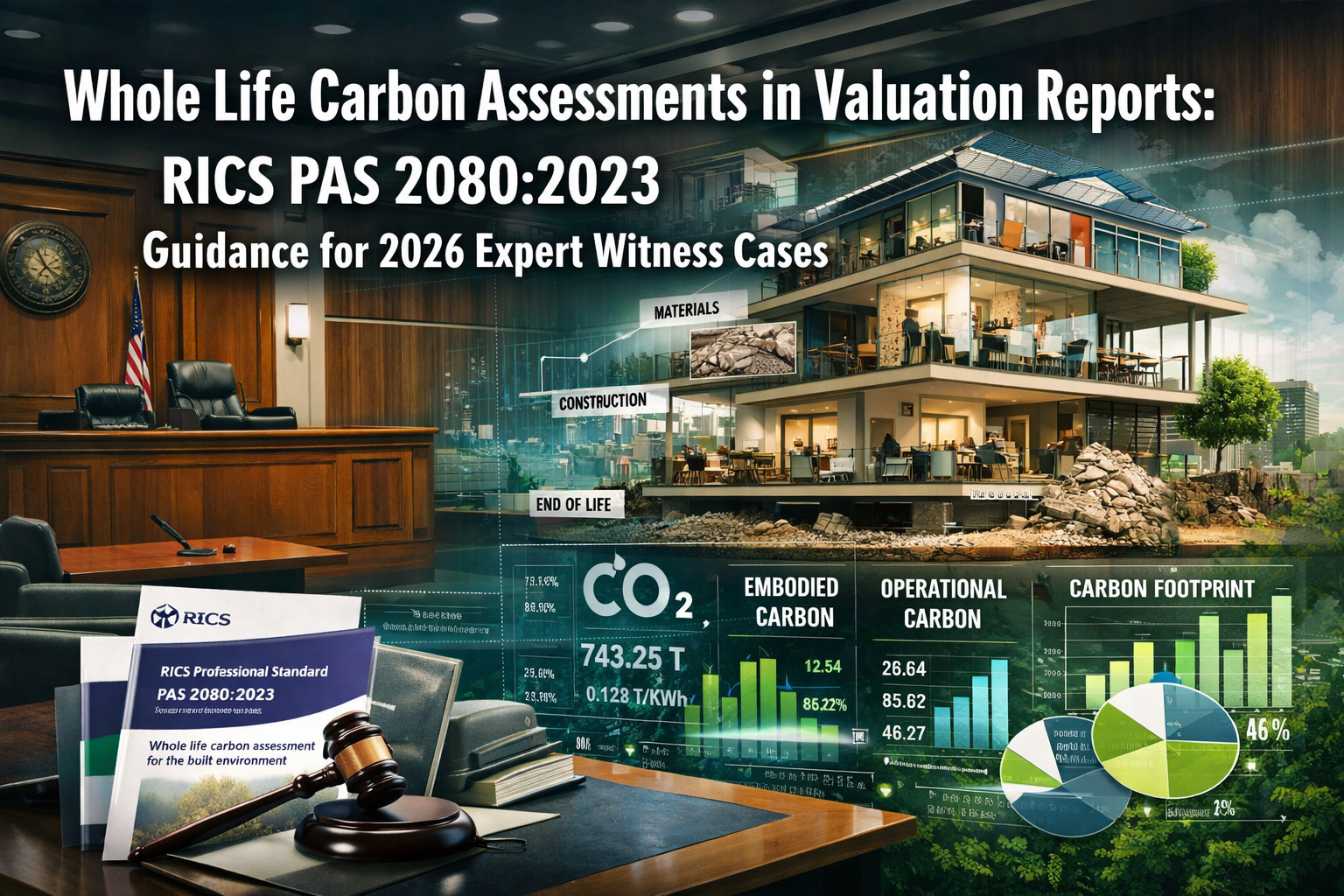
The built environment sector accounts for 39% of global carbon emissions, yet only 15% of valuation reports in 2025 incorporated whole life carbon metrics—a gap that's creating unprecedented liability exposure for property professionals. As sustainability-driven disputes surge through arbitration and litigation channels in 2026, Whole Life Carbon Assessments in Valuation Reports: RICS PAS 2080:2023 Guidance for 2026 Expert Witness Cases has become the critical framework separating defensible expert testimony from professional negligence claims.
The convergence of the RICS Whole Life Carbon Assessment (WLCA) 2nd Edition, which became fully effective July 1, 2024, and PAS 2080:2023's carbon management protocols has fundamentally transformed how expert witness surveyors approach valuation disputes. This integration establishes a dual-standard framework where WLCA provides the measurement methodology while PAS 2080 defines the governance and management processes across the entire building lifecycle.[1][2]
Key Takeaways
- Dual-Standard Framework: RICS WLCA 2nd Edition and PAS 2080:2023 work as complementary standards—WLCA measures carbon while PAS 2080 manages the process and governance requirements throughout project lifecycles.
- Expert Witness Obligation: Carbon assessment data is now material to property valuation, requiring expert witnesses to demonstrate competency in whole life carbon methodology or risk professional liability.
- Lifecycle Scope Expansion: PAS 2080:2023 mandates quantification of embodied carbon, operational CO₂, and use-stage impacts from options appraisal through delivery and handover—not just operational emissions.
- Market Value Impact: Properties with verified carbon performance data command premium valuations in stabilising markets, creating measurable financial consequences for carbon transparency gaps.
- Global Application: While WLCA methodology applies globally, UK practitioners benefit from comprehensive guidance, with the framework adaptable for international jurisdictions facing similar sustainability-driven disputes.
Understanding Whole Life Carbon Assessment Standards in 2026 Valuation Practice
The landscape of property valuation has undergone seismic shifts as carbon accountability becomes legally enforceable across multiple jurisdictions. Whole Life Carbon Assessments in Valuation Reports: RICS PAS 2080:2023 Guidance for 2026 Expert Witness Cases represents the intersection of environmental accountability and financial valuation—a nexus that expert witnesses can no longer ignore.
The RICS WLCA 2nd Edition Framework
The RICS Whole Life Carbon Assessment 2nd Edition established a global benchmark for consistent carbon measurement at all project stages, becoming the foundational measurement framework that complements PAS 2080:2023.[1] This standard provides:
- 📊 Standardised calculation methodologies for embodied and operational carbon
- 🌍 Global applicability with UK-specific numerical assumptions and detailed guidance
- 🔄 Lifecycle stage definitions aligned with EN 15978 standards
- ✅ Verification protocols for carbon data accuracy and reliability
The methodology encompasses modules A through D of the building lifecycle:
| Lifecycle Stage | Carbon Components | Valuation Impact |
|---|---|---|
| A1-A3 Product Stage | Raw material extraction, transport, manufacturing | Embodied carbon baseline affects replacement cost valuations |
| A4-A5 Construction | Transport to site, installation processes | Construction phase emissions impact development appraisals |
| B1-B7 Use Stage | Maintenance, repair, replacement, operational energy | Ongoing carbon liability affects net present value calculations |
| C1-C4 End of Life | Deconstruction, transport, waste processing | Decommissioning costs and carbon debt consideration |
| D Beyond Life | Reuse, recovery, recycling potential | Asset residual value and circular economy benefits |
For professionals preparing valuation reports, this comprehensive scope means carbon assessment can no longer be treated as an optional sustainability appendix—it's material information affecting property value.
PAS 2080:2023 Carbon Management Requirements
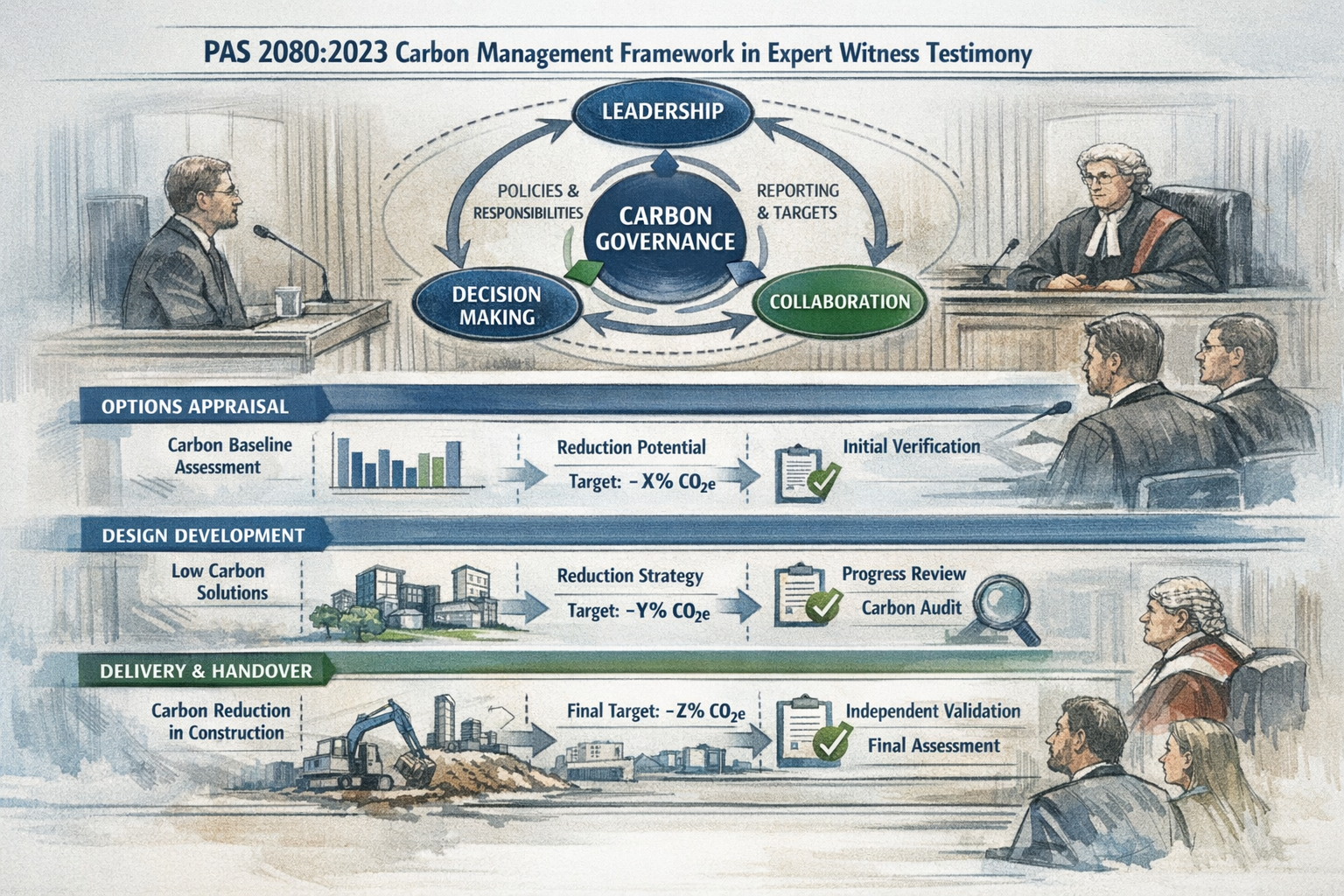
While WLCA provides the measurement standard, PAS 2080:2023 specifies the management process and governance requirements for carbon across the entire building and infrastructure lifecycle.[2] This standard establishes:
🎯 Leadership and Governance Principles
- Defined roles for carbon management across the value chain
- Decision-making frameworks that prioritise carbon reduction
- Accountability structures for carbon budget compliance
🤝 Collaboration Requirements
- Shared responsibility model across the supply chain
- Integrated team approaches to carbon management
- Transparent data sharing protocols
📈 Implementation Systems
- Carbon budget setting and tracking mechanisms
- Performance monitoring at project milestones
- Verification and reporting procedures
The standard requires project teams to quantify embodied carbon, operational CO₂, and use-stage impacts through a consistent process from options appraisal through delivery and handover—pushing beyond operational emissions only.[1] This comprehensive scope creates new obligations for expert witnesses who must demonstrate how carbon management processes were (or were not) followed in disputed projects.
Applying Whole Life Carbon Assessments in Valuation Reports: RICS PAS 2080:2023 Guidance for 2026 Expert Witness Cases
Expert witness testimony in 2026 increasingly centres on whether carbon assessment was properly integrated into valuation methodology. The application of Whole Life Carbon Assessments in Valuation Reports: RICS PAS 2080:2023 Guidance for 2026 Expert Witness Cases requires understanding three critical integration points.
Carbon Data as Material Valuation Information
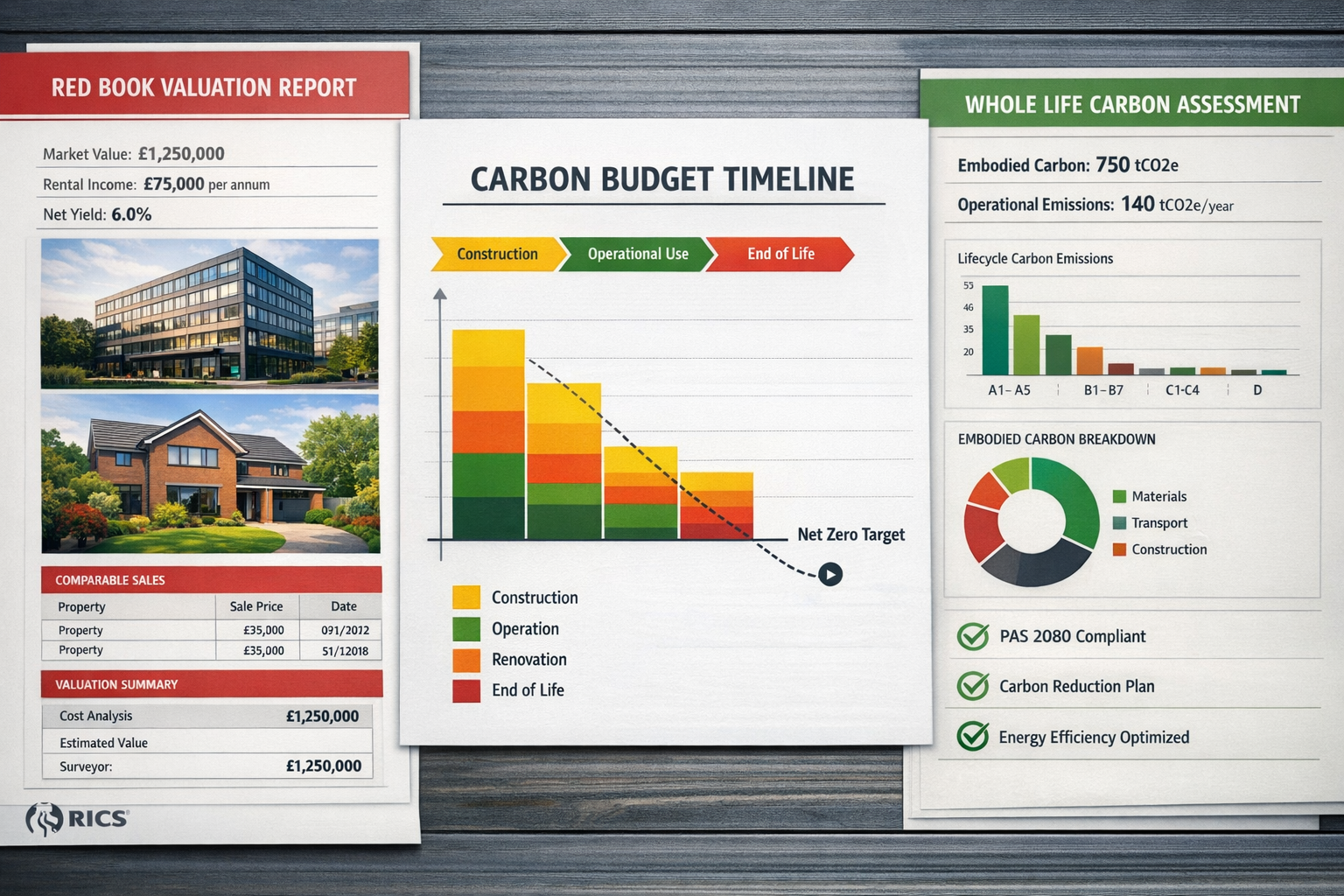
The fundamental shift in 2026 valuation practice recognises that carbon performance data materially affects property value. This creates new obligations for expert witnesses preparing Red Book valuations in dispute contexts:
Market Value Adjustments
Properties with verified whole life carbon assessments demonstrating superior performance command measurable premiums in stabilising markets. Expert witnesses must:
- Quantify the market value differential between carbon-assessed and non-assessed comparable properties
- Demonstrate how carbon performance affects lettability, tenant demand, and rental values
- Account for regulatory risk premiums where carbon disclosure becomes mandatory
- Consider obsolescence factors for high-carbon buildings facing retrofit requirements
Depreciated Replacement Cost Considerations
For specialised properties valued using DRC methodology, carbon assessment affects:
- Modern equivalent asset specifications incorporating current carbon standards
- Obsolescence adjustments for carbon-intensive construction methods
- Replacement cost calculations reflecting low-carbon materials and techniques
Investment Method Implications
Carbon performance impacts capitalisation rates and yield expectations:
- Lower yields for buildings with verified carbon credentials reflecting reduced risk
- Rental growth assumptions affected by sustainability performance
- Exit value projections considering future carbon regulation
Demonstrating PAS 2080:2023 Compliance in Expert Reports
Expert witnesses must demonstrate whether project teams followed PAS 2080:2023's governance requirements. This involves evaluating:
✅ Leadership and Decision-Making
- Was carbon reduction embedded in project governance from inception?
- Were carbon budgets established and monitored throughout the project?
- Did leadership prioritise carbon outcomes in value engineering decisions?
✅ Collaboration and Supply Chain Management
- Were carbon responsibilities clearly allocated across the supply chain?
- Did procurement processes prioritise low-carbon solutions?
- Was carbon data transparently shared among project stakeholders?
✅ Measurement and Verification
- Were carbon assessments conducted at appropriate project stages?
- Did measurement follow RICS WLCA 2nd Edition methodology?
- Were independent verification processes implemented?
Documented applications of PAS 2080:2023 in infrastructure projects demonstrate how Carbon Management Plans should be structured and implemented.[7] Expert witnesses can reference these precedents when evaluating whether disputed projects met reasonable carbon management standards.
Integration with Traditional Valuation Methods
The challenge for expert witnesses lies in seamlessly integrating carbon assessment with established methods of valuation. This requires:
Comparable Evidence Adjustment
When using market comparison approaches:
- Identify carbon performance data for comparable properties
- Quantify value adjustments based on carbon credentials
- Explain methodology for carbon-related comparable adjustments
- Address data gaps where carbon information is unavailable
Investment Appraisal Modification
For income-producing properties:
- Incorporate carbon-related operational cost differentials
- Adjust discount rates to reflect carbon risk profiles
- Model future carbon pricing impacts on net operating income
- Consider stranded asset risks for high-carbon properties
Residual Valuation Enhancement
For development appraisals:
- Include whole life carbon assessment costs in development budgets
- Adjust gross development value for carbon performance premiums
- Account for carbon-related planning requirements and costs
- Model carbon reduction strategies' impact on development viability
Expert Witness Strategies for Whole Life Carbon Assessments in Valuation Reports: RICS PAS 2080:2023 Guidance for 2026 Expert Witness Cases
As sustainability-driven disputes proliferate in 2026, expert witnesses require robust strategies for addressing carbon assessment challenges in valuation contexts.
Establishing Professional Competency in Carbon Assessment
The RICS and ICE have harmonised messaging on carbon assessment and management, emphasising that professionals must demonstrate competency in these areas.[2][5] For expert witnesses, this means:
📚 Formal Training Requirements
The Global Certificate in Whole Life Carbon Assessment training programme provides comprehensive introduction to principles and practical application.[8] Expert witnesses should:
- Complete accredited WLCA training programmes
- Maintain continuing professional development in carbon assessment
- Stay current with evolving standards and guidance
- Document competency through professional certifications
⚖️ Scope of Competence Declarations
Expert witnesses must clearly define their competency boundaries:
- State qualifications in carbon assessment methodology
- Identify when specialist carbon consultants should be engaged
- Acknowledge limitations in carbon measurement expertise
- Collaborate with environmental specialists on complex carbon issues
🔍 Due Diligence Protocols
Robust carbon assessment in expert witness work requires:
- Verification of carbon data sources and calculation methodologies
- Cross-checking against RICS WLCA 2nd Edition standards
- Assessment of PAS 2080:2023 compliance in project governance
- Documentation of assumptions and limitations in carbon analysis
Addressing Data Gaps and Uncertainty
A persistent challenge in 2026 valuation disputes involves incomplete or absent carbon data. Expert witnesses must develop strategies for addressing these gaps:
Hierarchy of Evidence Approach
- Primary Data: Actual project-specific carbon assessments following RICS WLCA methodology
- Secondary Data: Industry benchmarks and comparable project carbon performance
- Modelled Data: Estimated carbon performance based on building characteristics and construction methods
- Qualitative Assessment: Professional judgement where quantitative data is unavailable
Transparency in Assumptions
Expert witnesses must explicitly state:
- Which carbon data points are verified versus estimated
- Assumptions underlying carbon performance projections
- Sensitivity of valuation conclusions to carbon data uncertainty
- Impact of data gaps on reliability of carbon-adjusted valuations
Reasonable Professional Standards
When evaluating historic projects predating current standards:
- Apply contemporaneous carbon assessment expectations
- Avoid retrospective application of 2026 standards to earlier projects
- Consider what a reasonable professional would have done at the time
- Distinguish between professional negligence and evolving best practice
Presenting Carbon Evidence in Dispute Proceedings
Effective communication of carbon assessment findings requires tailored approaches for different dispute contexts:
Arbitration Proceedings
- Prepare technical appendices with detailed carbon calculations
- Use visual representations of lifecycle carbon profiles
- Provide sensitivity analyses showing valuation impacts under different carbon scenarios
- Anticipate cross-examination on carbon methodology and assumptions
Court Proceedings
- Simplify carbon concepts for non-specialist judges and juries
- Use analogies and visual aids to explain whole life carbon principles
- Focus on materiality of carbon factors to valuation conclusions
- Prepare robust responses to challenges on carbon competency
Expert Determination
- Provide comprehensive carbon data and methodology documentation
- Address specific carbon-related terms of reference
- Demonstrate compliance with both RICS WLCA and PAS 2080:2023
- Support conclusions with industry precedents and comparable evidence
Case Study: Carbon Assessment in Development Viability Disputes
Consider a 2026 dispute involving a mixed-use development where the developer claims that mandatory carbon reduction requirements render the scheme financially unviable. The expert witness approach involves:
Step 1: Baseline Carbon Assessment
- Quantify whole life carbon of the proposed scheme using RICS WLCA methodology
- Identify which lifecycle stages contribute most significantly to carbon footprint
- Compare against relevant carbon budgets and regulatory requirements
Step 2: PAS 2080:2023 Compliance Review
- Evaluate whether the project team followed carbon management governance requirements
- Assess whether carbon reduction was embedded in design decisions from inception
- Determine if alternative low-carbon solutions were properly evaluated
Step 3: Valuation Impact Analysis
- Model development costs with carbon reduction measures implemented
- Assess gross development value premium for enhanced carbon performance
- Calculate revised residual land value and development profit
- Compare against developer's viability threshold
Step 4: Expert Opinion Formation
- Determine whether carbon requirements genuinely affect viability or reflect design inefficiencies
- Identify opportunities for carbon reduction without compromising financial viability
- Provide opinion on whether a reasonable developer would proceed under revised parameters
This systematic approach demonstrates how Whole Life Carbon Assessments in Valuation Reports: RICS PAS 2080:2023 Guidance for 2026 Expert Witness Cases translates into practical expert witness methodology.
Future Trajectory: Carbon Assessment in Valuation Practice Beyond 2026
The integration of whole life carbon assessment into valuation practice will continue evolving as regulatory frameworks tighten and market expectations shift. Several trends are shaping the future landscape:
Regulatory Mandates and Disclosure Requirements
Jurisdictions worldwide are implementing mandatory carbon disclosure requirements for commercial and residential properties. Expert witnesses should anticipate:
- Enhanced Energy Performance Certificate (EPC) regimes incorporating whole life carbon metrics
- Planning condition requirements for carbon assessments on major developments
- Financial reporting standards requiring carbon risk disclosure in property portfolios
- Transaction-based disclosure mandates for property sales and lettings
These regulatory developments will increase the materiality of carbon assessment in valuation disputes and raise professional standards for carbon competency.
Technology-Enabled Carbon Assessment
Digital tools are streamlining whole life carbon assessment, making it more accessible and accurate:
- 🖥️ Building Information Modelling (BIM) integration enabling automated carbon calculations
- 📱 Mobile assessment applications facilitating on-site carbon data collection
- 🤖 Artificial intelligence improving carbon performance predictions
- ⛓️ Blockchain verification enhancing carbon data transparency and reliability
Expert witnesses who embrace these technologies will deliver more robust and defensible carbon assessments in dispute contexts.
Market Maturation and Carbon Pricing
As carbon markets mature, the financial implications of carbon performance become more explicit:
- Shadow carbon pricing in investment appraisals reflecting future carbon cost expectations
- Carbon offset markets creating quantifiable values for carbon reduction achievements
- Green financing premiums offering preferential lending terms for low-carbon properties
- Insurance pricing differentials based on climate risk and carbon performance
These market mechanisms will make carbon-adjusted valuations increasingly sophisticated and financially material.
Professional Standards Evolution
The RICS and other professional bodies continue refining carbon assessment standards:
- Periodic updates to WLCA methodology reflecting technological advances
- Sector-specific guidance tailored to different property types and use cases
- International harmonisation reducing jurisdictional variations in carbon assessment
- Enhanced competency requirements for valuers and expert witnesses
Staying current with these evolving standards remains essential for expert witnesses working in this dynamic field.
Conclusion
Whole Life Carbon Assessments in Valuation Reports: RICS PAS 2080:2023 Guidance for 2026 Expert Witness Cases represents a fundamental transformation in property valuation practice. The dual-standard framework established by RICS WLCA 2nd Edition and PAS 2080:2023 creates clear methodological and governance requirements that expert witnesses must navigate in sustainability-driven disputes.
The materiality of carbon performance to property value is no longer debatable—it's demonstrable through market evidence, regulatory requirements, and financial impacts. Expert witnesses who fail to integrate whole life carbon assessment into their valuation methodology face increasing professional liability exposure and diminished credibility in dispute proceedings.
Actionable Next Steps for Expert Witnesses
-
Invest in Competency Development: Complete the Global Certificate in Whole Life Carbon Assessment training programme to establish formal credentials in carbon methodology.[8]
-
Develop Technical Protocols: Create standardised procedures for integrating RICS WLCA and PAS 2080:2023 requirements into valuation reports and expert witness instructions.
-
Build Collaborative Networks: Establish relationships with carbon specialists, environmental consultants, and sustainability professionals who can support complex carbon assessment requirements.
-
Document Methodology: Maintain detailed records of carbon assessment approaches, assumptions, and data sources to withstand cross-examination and professional scrutiny.
-
Monitor Regulatory Developments: Track evolving carbon disclosure requirements and market practices across relevant jurisdictions to ensure contemporary compliance.
-
Update Standard Reports: Revise valuation report templates to incorporate carbon assessment sections and carbon-adjusted valuation methodologies.
-
Engage with Professional Bodies: Participate in RICS consultations and industry forums shaping future carbon assessment standards and guidance.
The convergence of environmental accountability and property valuation creates both challenges and opportunities for expert witnesses in 2026 and beyond. Those who proactively develop carbon assessment competency and integrate whole life carbon principles into their valuation practice will establish themselves as authoritative voices in this critical area of professional practice. The framework established by RICS WLCA 2nd Edition and PAS 2080:2023 provides the foundation—expert witnesses must now build the practical expertise to apply these standards effectively in dispute contexts.
References
[1] Pas 2080 Carbon Management For Energy Infrastructure One Click Lca – https://oneclicklca.com/en-gb/resources/articles/pas-2080-carbon-management-for-energy-infrastructure-one-click-lca
[2] Rics And Ice Harmonise Messaging On Carbon Assessment And Manage – https://www.rics.org/news-insights/rics-and-ice-harmonise-messaging-on-carbon-assessment-and-manage
[4] Whole Life Carbon Assessment – https://www.rics.org/profession-standards/rics-standards-and-guidance/sector-standards/construction-standards/whole-life-carbon-assessment
[5] Rics And Ice Harmonise Messaging On Carbon Assessment And Management – https://wholelifecarbon.com/article/rics-and-ice-harmonise-messaging-on-carbon-assessment-and-management
[7] 44%20 %20environmental Statement Chapter 14 Climate Change Greenhouse Gas Emissions 8163857 – https://www.communities.heidelbergmaterials.co.uk/system/files/2025-04/44%20-%20ENVIRONMENTAL_STATEMENT__CHAPTER_14_CLIMATE_CHANGE_-_GREENHOUSE_GAS_EMISSIONS-8163857.pdf
[8] Certificate In Whole Life Carbon Assessment Training Programme – https://www.rics.org/training-events/training-courses/certificate-in-whole-life-carbon-assessment-training-programme