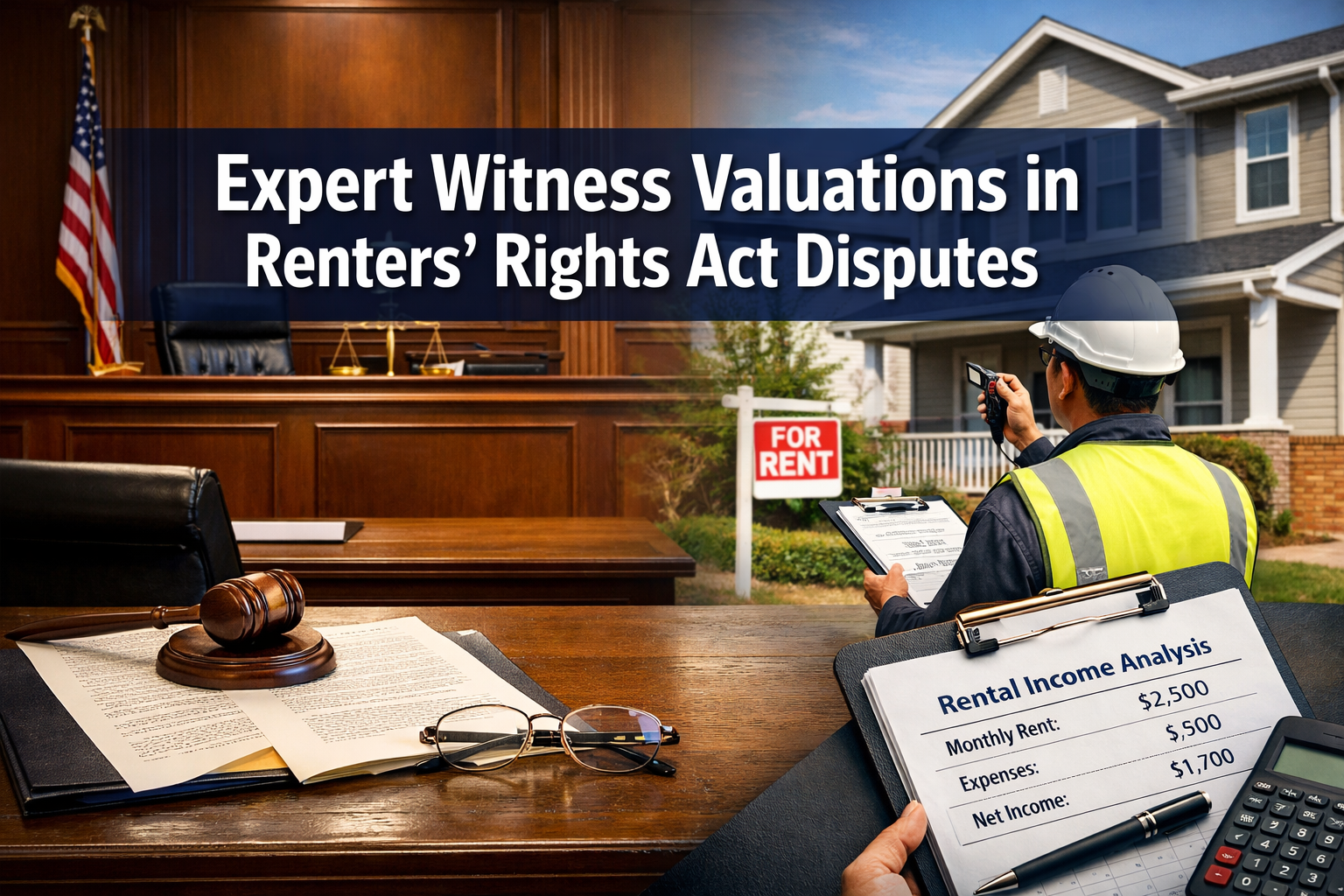
The Renters' Rights Act 2026, which came into force on May 1, 2026, has fundamentally altered property valuation methodology across England's private rental sector. With all fixed-term tenancies now converted to periodic arrangements and rent increases capped at annual intervals, expert witnesses face unprecedented challenges when defending property assessments under constrained rental income assumptions. This legislative shift has created a new battleground where traditional valuation methods collide with statutory rent controls, forcing property professionals to rebuild their evidentiary frameworks from the ground up[1].
Key Takeaways
- Periodic tenancy conversions eliminate long-term rental income certainty, requiring expert witnesses to adopt new valuation methodologies that account for rolling month-to-month arrangements
- Annual rent review caps fundamentally change investment property valuations, with tribunal benchmarking now central to dispute resolution rather than market-driven assessments
- Section 21 abolition shifts expert witness focus from possession strategies to detailed property condition assessments and statutory compliance documentation
- Tribunal-based dispute resolution replaces traditional litigation routes, demanding different preparation standards and presentation formats from expert witnesses
- Awaab's Law expansion creates approximately 40% more landlord-tenant disputes, significantly increasing demand for expert testimony on rental property hazards[2]
Understanding the Renters' Rights Act 2026 Framework
The Renters' Rights Act 2026 represents the most comprehensive overhaul of private rental legislation in decades. The Act's implementation on May 1, 2026, introduced several key provisions that directly impact how expert witnesses approach property valuations in dispute scenarios[1].
Core Legislative Changes Affecting Valuations
Abolition of Section 21 Evictions
The removal of "no-fault" evictions means landlords must now demonstrate statutory grounds for possession. This fundamental change shifts expert witness testimony from straightforward possession proceedings to complex assessments of property condition, tenant behavior, and regulatory compliance. Expert witnesses must now build comprehensive cases that demonstrate clear grounds for eviction rather than relying on contractual termination rights[1].
Mandatory Periodic Tenancies
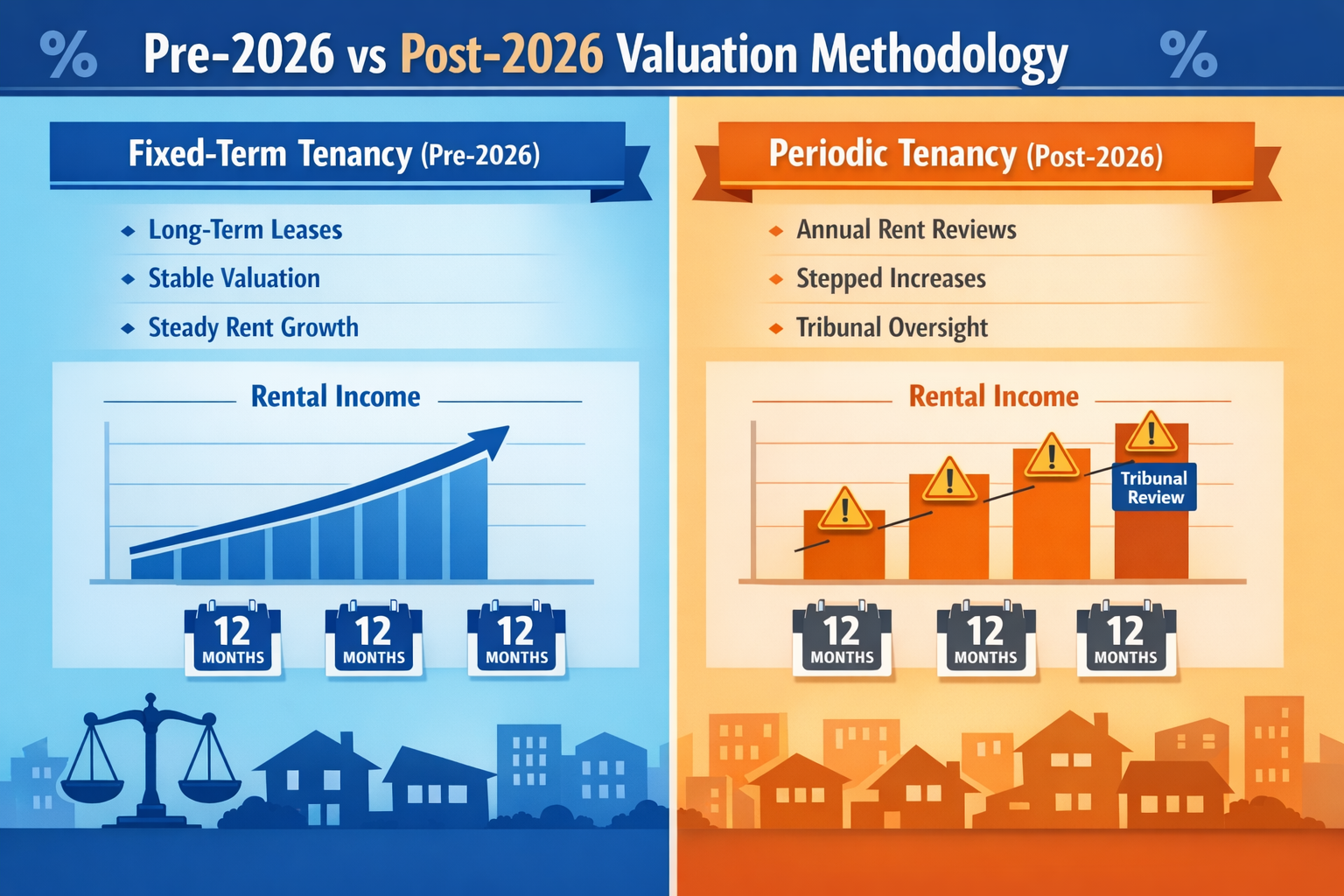
All existing fixed-term agreements became void under the new legislation, automatically converting to rolling month-to-month arrangements. This conversion creates significant valuation challenges because traditional methods of valuation that relied on secured long-term rental income streams no longer apply. Expert witnesses must now factor in the increased risk profile associated with tenancies that can theoretically terminate with minimal notice[1].
Annual Rent Increase Restrictions
Rent increases are now limited to once per 12-month period, with any contractual clauses permitting more frequent increases becoming void. When disputes arise over proposed rent increases, tribunal benchmarking becomes the primary resolution mechanism. Expert witnesses must prepare comparative market analyses that align with tribunal expectations rather than purely market-driven assessments[1].
Impact on Valuation Methodology
The shift from fixed-term to periodic tenancies fundamentally alters the income capitalization approach that many registered RICS valuers traditionally employ. Where previously an expert witness could project rental income over a defined lease term with reasonable certainty, the new framework introduces significant uncertainty variables.
Risk Premium Adjustments 📊
Expert witnesses must now incorporate higher risk premiums into their valuations to account for:
- Increased tenant mobility under periodic arrangements
- Limited ability to adjust rents in response to market conditions
- Potential tribunal intervention in rent review disputes
- Enhanced tenant rights that extend notice periods
These risk factors typically translate to yield adjustments of 0.5% to 1.5% in investment property valuations, depending on location and property type. Expert witnesses must document and justify these adjustments with robust market evidence when presenting cases in tribunal settings.
Building Expert Witness Cases Under Periodic Tenancy Constraints
The conversion to mandatory periodic tenancies creates unique challenges for expert witnesses preparing valuation evidence. Traditional approaches that emphasized lease security and predictable income streams must be completely reconsidered.

Establishing Comparable Evidence
When preparing expert witness testimony for disputes involving periodic tenancies, the selection of comparable properties becomes more complex. Expert witnesses must identify comparables that reflect:
- Similar tenancy structures – Properties operating under periodic arrangements rather than historical fixed-term comparables
- Post-May 2026 transaction dates – Evidence reflecting the new legislative framework
- Tribunal-adjusted rents – Where available, properties with rent levels determined or influenced by tribunal decisions
- Risk-adjusted yields – Investment sales that demonstrate market pricing under the new uncertainty profile
The challenge lies in the limited transaction data available since May 2026. Expert witnesses often need to make reasoned adjustments to pre-Act comparables, clearly documenting the methodology used to account for the legislative changes. This documentation becomes critical when defending valuations under cross-examination in tribunal proceedings.
Quantifying Income Uncertainty
One of the most significant challenges in expert witness valuations under the Renters' Rights Act involves quantifying the income uncertainty created by periodic tenancies. Traditional valuation factors must be supplemented with new analytical frameworks.
Income Stability Analysis
Expert witnesses should prepare detailed income stability assessments that consider:
- Historical void periods in the local market for similar properties
- Average tenancy duration under periodic arrangements (emerging data suggests 18-24 month average tenancies despite monthly rolling terms)
- Tenant turnover costs including marketing, void periods, and re-letting expenses
- Rent collection reliability under the new framework where benefit-dependent tenants cannot be discriminated against[1]
"The shift to periodic tenancies doesn't mean tenants will necessarily move more frequently, but the valuation must reflect the increased theoretical risk and the landlord's reduced ability to secure long-term income certainty." – Property Valuation Expert
Rent Control Impact Assessment
The annual rent increase cap creates a fundamental constraint on rental income growth that expert witnesses must carefully analyze. When building cases for tribunal disputes, expert witnesses need to demonstrate:
Market Rent vs. Controlled Rent Analysis
A comprehensive comparison showing:
- Current passing rent under the tenancy
- Open market rent for similar properties
- Historical rent increase patterns in the local market
- Projected rent trajectory under annual review constraints
- Impact on property value of any rent gap between passing and market rent
This analysis becomes particularly important in scenarios where properties have been let at below-market rents for extended periods. The annual increase limitation means landlords cannot quickly adjust to market levels, creating a "rent drag" that expert witnesses must quantify in their valuations.
Expert Witness Preparation for Tribunal-Based Dispute Resolution
The Renters' Rights Act 2026 has shifted property disputes away from traditional litigation toward tribunal-based resolution. This change significantly impacts how expert witnesses prepare and present their evidence[1].
Tribunal Evidence Standards
Tribunal proceedings operate under different evidentiary standards compared to traditional court litigation. Expert witnesses must adapt their preparation to meet tribunal expectations, which typically emphasize:
Accessibility and Clarity
Tribunal panels often include lay members alongside legal professionals. Expert witness reports must be written at a level that non-specialists can understand while maintaining technical rigor. This means:
- Avoiding unnecessary jargon without oversimplifying
- Providing clear explanations of valuation methodology
- Using visual aids like charts and comparison tables
- Summarizing key conclusions in plain language
Proportionality
Tribunals expect expert evidence to be proportionate to the value in dispute. A rent review dispute involving £50 per month should not generate a £5,000 expert witness report. Expert witnesses must calibrate their investigation depth and reporting detail to match the dispute scale.
Addressing Rent Control Valuation Conflicts
When periodic tenancies intersect with rent control provisions, valuation conflicts inevitably arise. Expert witnesses must navigate these conflicts by clearly distinguishing between different valuation scenarios:
Multiple Valuation Bases
Expert witnesses should prepare valuations on multiple bases to address different legal questions:
- Market value with vacant possession – What the property would sell for if vacant
- Investment value with sitting tenant – Value reflecting the actual tenancy constraints
- Market rent assessment – Open market rental value for tribunal rent review purposes
- Restricted rent value – Value assuming continued rent control constraints
Each basis serves a different purpose in dispute resolution. For example, in possession proceedings where statutory grounds exist, the vacant possession value becomes relevant for assessing landlord damages. In rent review disputes, the market rent assessment guides tribunal decisions on appropriate rent levels.
Documentation Requirements
The tribunal system places heavy emphasis on documentary evidence. Expert witnesses must ensure their case files include comprehensive documentation:
Essential Documentation Checklist ✅
- Title documents and lease agreements (or tenancy agreements for periodic tenancies)
- Complete rent payment history
- Correspondence regarding rent reviews or proposed increases
- Comparable evidence with full property details and transaction dates
- Market data supporting rental value conclusions
- Photographs documenting property condition
- Any relevant compliance certificates (EPC, gas safety, electrical safety)
- Previous tribunal decisions involving similar properties in the area
The absence of key documentation can significantly undermine an expert witness's credibility. Tribunals expect thorough preparation, and gaps in the evidence base raise questions about the reliability of valuation conclusions.
Handling Cross-Examination on Methodology
Expert witnesses should anticipate challenges to their methodology, particularly regarding how they've accounted for the constraints imposed by periodic tenancies and rent controls. Common areas of cross-examination include:
Yield Selection Justification
Opposing parties frequently challenge the yield or capitalization rate applied to rental income. Expert witnesses must be prepared to defend their yield selection with reference to:
- Comparable investment transactions
- Market reports from credible sources
- Adjustments made for specific risk factors associated with periodic tenancies
- How the yield reflects the annual rent review constraint
Comparable Selection Criteria
The selection of comparable properties often becomes a focal point in cross-examination. Expert witnesses should document why specific comparables were included or excluded, addressing factors such as:
- Location similarity and local market dynamics
- Property size, condition, and specification
- Tenancy structure and terms
- Transaction timing relative to the May 2026 Act implementation
Integration with Awaab's Law Compliance
The expansion of Awaab's Law in 2026 introduced five new hazard categories, creating an estimated 40% increase in landlord-tenant disputes[2]. Expert witnesses must now integrate hazard assessments into their valuation work, particularly when property condition disputes intersect with valuation questions.
When building cases involving properties with identified hazards, expert witnesses should:
- Quantify the cost of remediation for any hazards
- Assess the impact of hazards on rental value
- Consider whether hazards provide statutory grounds for tenant claims
- Evaluate compliance with the expanded hazard categories
This integration of safety compliance with valuation work represents a significant expansion of the expert witness role. Many disputes now involve both valuation questions and hazard assessment issues, requiring expert witnesses to coordinate with other specialists or expand their own competency areas.
Specialized Valuation Scenarios in Renters' Rights Act Disputes
Beyond standard rental valuations, expert witnesses encounter several specialized scenarios under the Renters' Rights Act framework that require adapted approaches.

Portfolio Valuation Challenges
Landlords with multiple properties face compounded valuation challenges under the new framework. Expert witnesses valuing rental portfolios must consider:
Portfolio Risk Concentration
The conversion to periodic tenancies creates correlated risk across a portfolio. Unlike fixed-term leases with staggered expiry dates, periodic tenancies theoretically expose landlords to simultaneous tenant departures. While unlikely in practice, this theoretical risk affects portfolio valuations and should be addressed in expert witness reports.
Economies of Scale vs. Management Burden
The Renters' Rights Act increases administrative burdens through enhanced compliance requirements and more frequent tribunal interactions. Expert witnesses must assess whether portfolio size creates management efficiencies or amplifies compliance costs, with implications for overall portfolio valuation.
Mixed-Use Property Complications
Properties with both residential and commercial valuation components present unique challenges. The Renters' Rights Act applies only to residential tenancies, creating a bifurcated regulatory environment within a single property.
Expert witnesses must:
- Separately value residential and commercial components
- Assess the impact of residential tenancy constraints on overall property value
- Consider whether commercial tenants are affected by residential tenant protections
- Evaluate management complexity arising from mixed regulatory frameworks
Leasehold Properties and Ground Rent Implications
The intersection of the Renters' Rights Act with leasehold property rights creates additional complexity. Expert witnesses must distinguish between:
- The leasehold interest held by the landlord (which may itself be time-limited)
- The periodic tenancy granted to the residential tenant
- Any ground rent obligations affecting the landlord's position
This multi-layered structure requires careful analysis, particularly when valuing freehold interests or assessing enfranchisement claims where rental income forms part of the valuation.
Best Practices for Expert Witnesses in 2026 and Beyond
As the rental market adjusts to the Renters' Rights Act framework, expert witnesses should adopt best practices that enhance the credibility and defensibility of their valuations.
Continuous Professional Development
The rapid evolution of tribunal case law and market adaptation to the new framework requires ongoing professional development. Expert witnesses should:
- Monitor tribunal decisions to understand emerging precedents
- Track market data showing how yields and rental values are adjusting
- Participate in professional forums discussing valuation methodology under the Act
- Update their knowledge of the expanded Awaab's Law hazard categories[2][4]
Methodology Transparency
Given the novelty of valuing properties under the Renters' Rights Act constraints, expert witnesses should prioritize transparency in their methodology. Reports should clearly explain:
Assumption Documentation
- What assumptions have been made about tenant behavior under periodic tenancies
- How rent control constraints have been factored into income projections
- What adjustments have been applied to pre-Act comparable evidence
- How risk premiums have been quantified and justified
Alternative Scenario Analysis
Where significant uncertainty exists, expert witnesses should consider presenting alternative valuation scenarios based on different assumptions. This approach demonstrates thoroughness and helps tribunals understand the range of reasonable valuation conclusions.
Coordination with Legal Representatives
The shift to tribunal-based dispute resolution increases the importance of coordination between expert witnesses and legal representatives. Expert witnesses should:
- Understand the specific legal questions their valuation evidence must address
- Align their report structure with the legal framework of the dispute
- Anticipate legal arguments that may challenge their methodology
- Prepare for questions that bridge legal and valuation issues
Quality Assurance Processes
Given the high stakes and novel valuation challenges, expert witnesses should implement robust quality assurance processes:
- Peer review – Having valuations reviewed by colleagues before submission
- Methodology checklist – Ensuring all required adjustments for periodic tenancies and rent controls have been considered
- Documentation audit – Verifying that all comparable evidence and supporting data is properly referenced
- Compliance verification – Confirming alignment with RICS standards and tribunal expectations
Emerging Trends and Future Considerations
As the market continues adapting to the Renters' Rights Act, several trends are emerging that expert witnesses should monitor.
Market Segmentation
Early evidence suggests the rental market is segmenting based on landlord responses to the new framework:
- Professional landlords with larger portfolios are adapting their business models and accepting lower yields
- Smaller landlords are exiting the market, reducing rental supply in some areas
- Build-to-rent operators are expanding, viewing the new framework as favoring institutional landlords
Expert witnesses must understand which market segment their subject property falls within, as valuation approaches may differ significantly across segments.
Technology Integration
Tribunal proceedings are increasingly incorporating technology for evidence presentation and remote hearings. Expert witnesses should develop competency in:
- Virtual tribunal appearances and evidence presentation
- Digital documentation systems for organizing case materials
- Data visualization tools for presenting complex valuation analyses
- Electronic bundle preparation meeting tribunal requirements
Regulatory Evolution
The Renters' Rights Act framework will likely continue evolving through:
- Tribunal precedents establishing interpretation of key provisions
- Potential legislative amendments addressing implementation issues
- Guidance from professional bodies on valuation methodology
- Market practice development as stakeholders adapt
Expert witnesses must remain agile, updating their approaches as the regulatory and market landscape evolves.
Conclusion
Expert witness valuations in Renters' Rights Act disputes represent one of the most challenging areas of property valuation practice in 2026. The conversion to mandatory periodic tenancies, combined with annual rent increase caps, has fundamentally altered the income certainty that underpinned traditional valuation approaches. Expert witnesses must rebuild their methodologies from first principles, incorporating new risk assessments, tribunal-focused evidence standards, and integration with expanded safety compliance requirements under Awaab's Law.
Success in this evolving field requires expert witnesses to maintain rigorous documentation standards, transparent methodology, and continuous professional development as case law and market practice develop. The shift from litigation to tribunal-based dispute resolution demands different preparation approaches, with emphasis on accessibility, proportionality, and comprehensive documentary evidence.
Actionable Next Steps
For expert witnesses preparing for Renters' Rights Act disputes:
- Review and update valuation templates to incorporate periodic tenancy risk assessments and rent control impact analysis
- Build a database of post-May 2026 comparable evidence reflecting transactions under the new legislative framework
- Develop tribunal-specific reporting formats that prioritize clarity and accessibility while maintaining technical rigor
- Establish quality assurance processes including peer review and methodology checklists
- Invest in professional development focusing on tribunal procedures, emerging case law, and Awaab's Law hazard assessment
- Strengthen coordination with legal representatives to ensure valuation evidence addresses the specific legal questions in dispute
The Renters' Rights Act has created a new valuation landscape where traditional approaches must be adapted to reflect constrained rental income assumptions and enhanced tenant protections. Expert witnesses who master these new methodologies and evidence standards will find significant demand for their services as the market continues adjusting to this fundamental legislative change. For those seeking professional valuation services, consulting with registered RICS valuers experienced in post-Act methodology is essential for building credible cases in tribunal proceedings.
References
[1] Watch – https://www.youtube.com/watch?v=HHwBPDxJlF0
[2] Expert Witness Preparation For Awaabs Law Expansion Disputes 2026 Hazard Assessments In Rental Valuations – https://nottinghillsurveyors.com/blog/expert-witness-preparation-for-awaabs-law-expansion-disputes-2026-hazard-assessments-in-rental-valuations
[3] Renters Rights – https://www.nrla.org.uk/resources/renters-rights
[4] Expert Witness Preparation For Awaabs Law 2026 Expansions Testifying On New Rental Hazards Like Fire And Electrical Risks – https://nottinghillsurveyors.com/blog/expert-witness-preparation-for-awaabs-law-2026-expansions-testifying-on-new-rental-hazards-like-fire-and-electrical-risks