As the property market emerges from years of volatility, a new challenge confronts the valuation profession: how do expert witnesses provide credible, defensible evidence when market signals conflict and recovery trajectories diverge across regions? In 2026, Expert Witness Valuations in Stabilising Markets: RICS Evidence Standards for 2026 Price Recovery Disputes represent a critical intersection of professional practice, legal obligation, and market complexity that demands unprecedented rigor and transparency.
The timing couldn't be more significant. With RICS implementing its updated 5th edition Professional Standard for Surveyors Acting as Expert Witnesses alongside new Basel 3.1 bank lending valuation requirements, registered RICS valuers face heightened scrutiny in price recovery disputes where comparable evidence remains ambiguous and market stabilization proves uneven.
Key Takeaways
- 🌍 Global Standards: The RICS 5th edition expert witness standard now applies worldwide, expanding from UK-only coverage to accommodate diverse legal systems while maintaining core professional principles
- ⚖️ Tribunal Duty First: Enhanced emphasis on the expert's primary duty to the tribunal rather than the client, with stricter independence requirements and conflict disclosure protocols
- 📊 Market Complexity: Stabilising markets in 2026 present unique challenges for baseline comparables and recovery trajectory analysis, requiring sophisticated evidence frameworks
- 🤖 Digital Integration: New provisions address AI-assisted valuations, digital evidence, and contemporary legal procedures reflecting technological advancement
- 💰 Fee Framework Clarity: Updated guidance on conditional and deferred fees protects professional independence while managing high-volume dispute cases
Understanding the 2026 Market Context for Expert Witness Valuations
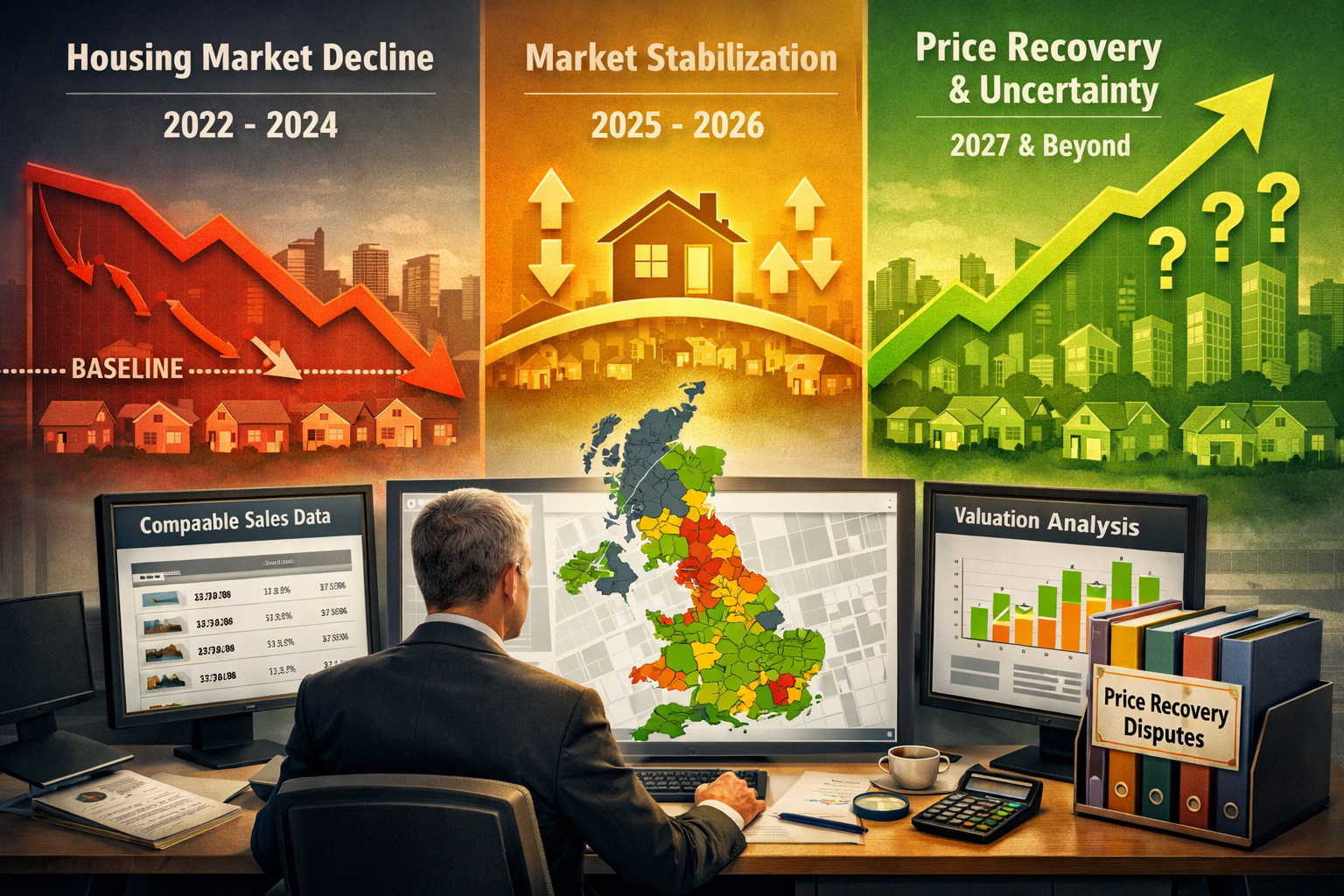
The property market landscape of 2026 presents unique challenges that distinguish current Expert Witness Valuations in Stabilising Markets: RICS Evidence Standards for 2026 Price Recovery Disputes from previous dispute environments. Unlike the clear directional markets of boom or bust cycles, stabilisation creates ambiguity that expert witnesses must navigate with exceptional care.
Regional Recovery Disparities 🗺️
Market recovery has proven far from uniform across the UK. While some areas demonstrate robust price growth returning to pre-correction levels, others remain depressed or show only marginal improvement. This regional divergence creates particular challenges when:
- Selecting comparable evidence from different geographic markets
- Establishing baseline valuations for dispute reference dates
- Projecting forward recovery trajectories in litigation contexts
- Justifying valuation conclusions when adjacent markets show conflicting trends
Valuation factors in stabilising markets require more nuanced analysis than traditional approaches, with expert witnesses needing to demonstrate why specific comparables were selected over alternatives that might suggest different value conclusions.
Conflicting Market Signals
The stabilisation phase generates inherently contradictory indicators that complicate expert evidence:
| Market Indicator | Conflicting Signals in 2026 |
|---|---|
| Transaction Volume | Increasing activity but below historical norms |
| Price Trends | Modest growth masking significant volatility |
| Lending Standards | Easing restrictions but conservative valuations |
| Sentiment Indices | Improving confidence amid economic uncertainty |
| Supply-Demand | Regional imbalances creating localized distortions |
Expert witnesses must acknowledge these conflicting signals transparently in their reports, explaining how they weighted different indicators and why their conclusions remain defensible despite market ambiguity. This transparency becomes even more critical under the enhanced RICS standards taking effect in 2026.
Comparable Evidence Challenges
Perhaps the most significant practical challenge involves establishing reliable comparable evidence when:
- Recent transactions may reflect distressed circumstances rather than market normalization
- Historic comparables predate market corrections and overstate current values
- Limited transaction volumes reduce the statistical reliability of market evidence
- Comparable properties sold during different phases of market recovery
Commercial valuation disputes particularly suffer from these comparable evidence limitations, as commercial property markets often lag residential recovery and show greater volatility during stabilisation phases.
The Updated RICS Expert Witness Standards: What's Changed for 2026
The RICS 5th edition Professional Standard for Surveyors Acting as Expert Witnesses represents the first major update since 2014, with implementation beginning in 2026 following consultation completed in late 2025.[1] Understanding these changes is essential for anyone involved in Expert Witness Valuations in Stabilising Markets: RICS Evidence Standards for 2026 Price Recovery Disputes.
Global Application and Local Flexibility
The most significant structural change involves global scope. While the 4th edition focused exclusively on UK practice, the 5th edition applies worldwide while recognizing local legal differences.[1] This expansion reflects:
- The international nature of property investment and dispute resolution
- RICS's global membership requiring consistent professional standards
- Recognition that core expert witness principles transcend jurisdictional boundaries
- Need for flexibility accommodating different legal systems and procedural rules
For UK practitioners, this means standards now explicitly address how international best practices integrate with domestic legal requirements, particularly relevant for cross-border property disputes and international arbitration cases.
Reinforced Independence and Tribunal Duty ⚖️
The updated standard strengthens the fundamental principle that expert witnesses owe their primary duty to the tribunal, not the client.[1] This reinforcement includes:
- Explicit statements that all reports and evidence must be independent and unbiased
- Clearer requirements for identifying and disclosing conflicts of interest
- Enhanced guidance on maintaining independence when facing client pressure
- Explicit explanation of legal consequences for non-compliance with duty obligations
This emphasis on independence proves particularly important in price recovery disputes where clients naturally prefer valuations supporting their litigation positions. Valuation reports prepared for expert witness purposes must demonstrably prioritize objective analysis over client advocacy.
Fee Framework and Independence Protection 💷
The 5th edition provides clear guidance on fee arrangements designed to protect professional independence:[1]
- Conditional fees: Explicit prohibition on success-based fee arrangements that could compromise objectivity
- Deferred fees: Guidance on when payment deferral remains acceptable without creating conflicts
- High-volume cases: Framework for managing template-based reports while maintaining individual case analysis
- Fee disclosure: Requirements for transparent fee arrangement disclosure to tribunals when relevant
Understanding the price of valuation services becomes more complex in expert witness contexts, where fee structures must align with independence requirements while remaining commercially viable for practitioners.
AI, Digital Evidence, and Contemporary Practice 🤖
Perhaps most forward-looking, the updated standard addresses technological advancement in valuation practice:[1]
- AI-assisted analysis: Guidance on using artificial intelligence tools while maintaining professional judgment
- Digital evidence: Standards for presenting and authenticating digital valuation evidence
- Data analytics: Framework for incorporating big data analysis in expert reports
- Technology disclosure: Requirements for explaining technological tools used in reaching conclusions
These provisions recognize that 2026 expert witnesses increasingly rely on sophisticated technology platforms for comparable analysis, market trend identification, and valuation modeling. The standard requires experts to explain these tools' role in their analysis while demonstrating that professional judgment rather than algorithmic output drives final conclusions.
Conflict of Interest Requirements
The 5th edition establishes clearer requirements for identifying and disclosing conflicts:[1]
- Previous relationships with parties or properties involved in disputes
- Financial interests in dispute outcomes
- Professional relationships that might create bias perceptions
- Concurrent instructions that could generate conflicts
For freehold valuation disputes involving properties where the expert previously provided services, disclosure requirements now demand explicit explanation of how previous involvement doesn't compromise current objectivity.
Housing Disrepair and Evolving Legislation
RICS members acting as expert witnesses in housing disrepair claims must note evolving legislation including Awaab's Law (effective October 2025) and ongoing Housing Health and Safety Rating System (HHSRS) developments.[2] These legislative changes affect:
- Standards against which property conditions are assessed
- Timelines for remedial action that impact valuation diminution calculations
- Liability frameworks affecting damage quantification
- Expert evidence requirements in housing tribunal proceedings
Applying RICS Standards to Price Recovery Dispute Valuations
Translating the updated RICS framework into practical application for Expert Witness Valuations in Stabilising Markets: RICS Evidence Standards for 2026 Price Recovery Disputes requires systematic approaches addressing both professional standards and market complexity challenges.
Establishing Baseline Valuations in Uncertain Markets
Price recovery disputes typically require baseline valuations at specific reference dates, often during market decline or early stabilisation phases. Best practices include:
Multiple Valuation Approaches
Rather than relying on single methodologies, expert witnesses should employ multiple approaches:
- Comparable method: Using adjusted transaction evidence despite limitations
- Income approach: For investment properties, capitalizing stabilized income streams
- Cost approach: Particularly relevant for specialized properties lacking comparables
- Residual method: For development properties accounting for market timing risks
Presenting multiple approaches with reconciliation demonstrates thoroughness and acknowledges market uncertainty inherent in stabilisation phases.
Sensitivity Analysis and Range Valuations
Given market ambiguity, sensitivity analysis proves essential:
- Testing how valuation conclusions change with different comparable selections
- Analyzing impact of alternative adjustment factors on comparable evidence
- Demonstrating valuation ranges rather than false precision point estimates
- Explaining which assumptions most significantly affect conclusions
This approach aligns with the RICS emphasis on transparency and objectivity, showing tribunals how market uncertainty affects valuation confidence levels.
Temporal Adjustments and Market Trajectory
Price recovery disputes often involve temporal adjustments—projecting values forward or backward from comparable transaction dates. Expert witnesses must:
- Explain market trajectory assumptions with supporting evidence
- Distinguish between market-wide trends and property-specific factors
- Address regional variations in recovery timing and magnitude
- Acknowledge uncertainty in trajectory projections
RICS building surveys conducted at baseline dates provide valuable contemporaneous property condition evidence supporting valuation conclusions.
Comparable Selection and Adjustment Methodology
The comparable selection process requires exceptional rigor in stabilising markets:
Geographic Boundaries
Defining appropriate geographic search areas becomes more complex when:
- Immediate locality shows limited transaction evidence
- Adjacent areas demonstrate different recovery trajectories
- Expanded search areas introduce comparability questions
- Regional market variations require explanation
Expert witnesses must justify geographic boundaries transparently, explaining why included comparables remain relevant despite potential differences from subject properties.
Temporal Boundaries
Selecting an appropriate time period for comparable evidence involves balancing:
- Recency requirements ensuring comparables reflect current market conditions
- Sufficient transaction volume for statistical reliability
- Market phase consistency avoiding mixing recovery stages
- Seasonal adjustment requirements
In stabilising markets, the optimal temporal window may differ from traditional six-month or twelve-month standards, requiring expert explanation of selection rationale.
Adjustment Transparency 📊
The RICS standards demand transparent adjustment methodology:
| Adjustment Category | Documentation Requirements |
|---|---|
| Location | Specific factors justifying adjustments with market evidence |
| Size | Analysis of size-value relationships in current market |
| Condition | Detailed condition comparisons with cost-supported adjustments |
| Time | Market trend evidence supporting temporal adjustments |
| Terms | Explanation of financing or sale term impacts on value |
Each adjustment should include supporting rationale rather than unexplained percentage modifications, with cumulative adjustments remaining within reasonable bounds that maintain comparable relevance.
Addressing Conflicting Evidence
Stabilising markets inevitably generate conflicting evidence that expert witnesses must address:
Acknowledging Contradictions
Rather than ignoring contradictory evidence, best practice requires:
- Explicit acknowledgment of evidence suggesting different conclusions
- Analysis of why certain evidence receives greater weight
- Explanation of evidence reliability variations
- Transparency about uncertainty inherent in conclusions
This approach demonstrates the objectivity emphasized in updated RICS standards, showing tribunals that experts considered alternative interpretations.
Explaining Weight Attribution
When evidence conflicts, experts must explain their weighting methodology:
- Why certain comparables receive greater consideration
- How market indicators were prioritized
- What factors made specific evidence more reliable
- How professional judgment resolved ambiguities
This transparency distinguishes defensible expert analysis from advocacy-driven opinions designed to support predetermined conclusions.
Integration with Basel 3.1 Bank Lending Standards
For disputes involving lending valuations, the updated RICS Bank Lending Valuations standard (effective January 1, 2026) introduces additional considerations:[3]
Prudently Conservative Valuation Criteria
Basel 3.1 implementation requires prudently conservative valuation approaches:[3]
- More cautious comparable selection during market uncertainty
- Conservative adjustment factors when evidence ranges exist
- Downward bias in stabilising markets reflecting lending risk
- Explicit explanation of conservatism application
Expert witnesses must distinguish between market value (the standard basis for most disputes) and mortgage lending value (the prudently conservative basis for certain lending contexts), explaining how these differ in stabilising market conditions.
Documentation and Audit Trail
The bank lending standard emphasizes comprehensive documentation:[3]
- Complete comparable analysis with rejected alternatives explained
- Detailed adjustment calculations with supporting evidence
- Market analysis demonstrating stabilisation assessment
- Risk factor identification affecting value reliability
While prepared for lending purposes, these documentation standards represent best practices for all expert witness valuations, providing the transparency and rigor RICS standards demand.
Practical Implementation: Checklist for Expert Witnesses
To ensure compliance with Expert Witness Valuations in Stabilising Markets: RICS Evidence Standards for 2026 Price Recovery Disputes, practitioners should follow this systematic checklist:
Pre-Instruction Phase ✅
- Competence assessment: Confirm expertise in relevant property type, location, and dispute context
- Conflict check: Identify any relationships, interests, or prior involvement creating conflicts
- Disclosure preparation: Document any matters requiring disclosure to instructing party and tribunal
- Fee agreement: Establish fee structure complying with independence requirements
- Instruction clarity: Ensure terms of reference clearly define scope, assumptions, and deliverables
Evidence Gathering Phase
- Comparable research: Conduct comprehensive search within justified geographic and temporal boundaries
- Market analysis: Research market trends, indicators, and recovery trajectory evidence
- Property inspection: Conduct thorough inspection documenting condition and characteristics
- Document review: Analyze all relevant documentation including prior valuations and transaction evidence
- Stakeholder interviews: When appropriate, gather information from relevant parties with documented methodology
Analysis and Valuation Phase
- Multiple approaches: Apply varied valuation methodologies appropriate to property and dispute context
- Comparable adjustment: Calculate and document all adjustments with supporting rationale
- Sensitivity analysis: Test conclusion robustness under alternative assumptions
- Range consideration: Determine whether point estimate or range valuation better reflects market uncertainty
- Conflicting evidence: Identify and analyze evidence suggesting alternative conclusions
Report Preparation Phase 📝
- Independence statement: Include explicit confirmation of primary duty to tribunal
- Conflict disclosure: Disclose all relevant conflicts or confirm none exist
- Qualifications: Clearly state professional qualifications and relevant experience
- Instruction terms: Summarize terms of reference and scope limitations
- Methodology transparency: Explain all approaches, assumptions, and analytical techniques
- Comparable presentation: Present comparables with complete information and adjustment explanations
- Technology disclosure: Identify any AI tools or technology platforms used in analysis
- Conclusion clarity: State conclusions clearly with appropriate caveats about uncertainty
- Alternative scenarios: Address how conclusions might differ under alternative assumptions
Post-Report Phase
- Supplementary questions: Respond to questions maintaining independence and objectivity
- Joint statement: Participate in expert discussions identifying agreement and disagreement areas
- Evidence preparation: Prepare for tribunal testimony maintaining report consistency
- Professional conduct: Maintain independence when facing cross-examination or client pressure
Common Pitfalls and How to Avoid Them
Even experienced practitioners can encounter challenges when providing Expert Witness Valuations in Stabilising Markets: RICS Evidence Standards for 2026 Price Recovery Disputes. Awareness of common pitfalls helps avoid professional and legal complications.
Advocacy Rather Than Independence ⚠️
The Problem: Allowing client preferences to influence conclusions, selecting evidence supporting client positions while ignoring contradictory information.
The Solution: Systematically analyze all available evidence before forming conclusions. Document evidence consideration process showing balanced analysis. Remember that the primary duty to the tribunal supersedes client relationship.
Insufficient Comparable Adjustment Documentation
The Problem: Applying percentage adjustments without supporting rationale, using "rules of thumb" without market evidence, or making cumulative adjustments that strain credibility.
The Solution: Document each adjustment with specific supporting evidence. Explain adjustment magnitude relative to market evidence. Ensure cumulative adjustments don't exceed reasonable bounds. Consider whether heavily adjusted comparables remain sufficiently comparable.
Ignoring Market Uncertainty
The Problem: Presenting point estimates with false precision when market conditions warrant range valuations or significant caveats.
The Solution: Acknowledge market uncertainty explicitly. Consider range valuations when appropriate. Conduct sensitivity analysis showing how alternative assumptions affect conclusions. Explain confidence level in conclusions given market conditions.
Inadequate Conflict Disclosure
The Problem: Failing to identify or disclose conflicts of interest, previous relationships with parties or properties, or circumstances creating bias perceptions.
The Solution: Conduct thorough conflict checks before accepting instructions. Disclose any matters that might reasonably be perceived as creating conflicts. When uncertain whether disclosure is required, err on the side of transparency.
Technology Over-Reliance 🤖
The Problem: Allowing AI tools or automated valuation models to drive conclusions without appropriate professional judgment overlay.
The Solution: Use technology as an analytical tool rather than decision-maker. Explain technology's role in analysis. Demonstrate that professional judgment informed final conclusions. Disclose technology use as required by updated RICS standards.
Inadequate Market Stabilisation Analysis
The Problem: Failing to analyze whether markets have genuinely stabilised, assuming uniform recovery across regions, or ignoring conflicting market signals.
The Solution: Conduct comprehensive market analysis addressing stabilisation indicators. Acknowledge regional variations in recovery. Address conflicting signals transparently. Explain how market phase affects valuation approach and conclusion confidence.
Future Outlook: Expert Witness Practice Beyond 2026
As Expert Witness Valuations in Stabilising Markets: RICS Evidence Standards for 2026 Price Recovery Disputes become established practice, several trends will likely shape the profession's evolution:
Enhanced Technology Integration
Expect continued advancement in AI-assisted valuation tools, big data analytics, and digital evidence presentation. Expert witnesses will need to maintain technological competence while ensuring human judgment remains central to valuation conclusions. The RICS standards will likely evolve to address emerging technologies and their appropriate use in expert evidence.
Greater Scrutiny of Independence
Courts and tribunals will likely apply heightened scrutiny to expert independence, particularly regarding fee arrangements, prior relationships, and evidence selection processes. The updated RICS standards reflect this trend, and practitioners should expect continued emphasis on demonstrable objectivity.
Standardization of Uncertainty Communication
As markets continue experiencing volatility and stabilisation challenges, expect development of standardized approaches for communicating valuation uncertainty, including range valuations, confidence intervals, and sensitivity analysis presentation formats.
International Harmonization
The RICS 5th edition's global scope suggests continued movement toward international harmonization of expert witness standards, even as local legal systems maintain procedural differences. Cross-border disputes will increasingly reference common professional standards while accommodating jurisdictional variations.
Specialization and Credentialing
Expect growth in specialized credentialing for expert witnesses, with enhanced training requirements, peer review processes, and quality assurance mechanisms. The distinction between general valuation practice and expert witness work will likely become more pronounced.
Conclusion
Expert Witness Valuations in Stabilising Markets: RICS Evidence Standards for 2026 Price Recovery Disputes represent a critical intersection of professional responsibility, market complexity, and evolving regulatory frameworks. The updated RICS 5th edition Professional Standard provides essential guidance for navigating these challenges while maintaining the independence, transparency, and rigor that effective expert evidence demands.
As property markets continue their uneven recovery through 2026 and beyond, expert witnesses must balance competing pressures: client expectations, tribunal requirements, market ambiguity, and professional obligations. Success requires not merely technical valuation competence but also unwavering commitment to the fundamental principle that expert witnesses serve tribunals first, providing objective analysis even when conclusions disappoint instructing parties.
Key Action Steps for Practitioners 🎯
- Review the updated standards: Thoroughly study the RICS 5th edition Professional Standard and related guidance documents
- Assess current practices: Evaluate existing expert witness procedures against new requirements, identifying gaps requiring modification
- Enhance documentation: Strengthen comparable analysis documentation, adjustment explanations, and methodology transparency
- Develop technology protocols: Establish clear policies for AI tool use, digital evidence handling, and technology disclosure
- Strengthen conflict procedures: Implement robust conflict identification and disclosure processes
- Continue professional development: Pursue training on stabilising market valuation challenges and expert witness best practices
- Engage with peers: Participate in professional discussions about standard implementation and practical challenges
For property professionals seeking to provide expert witness services or parties requiring expert valuation evidence in price recovery disputes, understanding these standards and their practical application proves essential. The combination of updated professional requirements and challenging market conditions demands expertise that goes beyond traditional valuation practice.
Whether you need comprehensive valuation reports for dispute resolution or expert witness services navigating complex market recovery scenarios, working with registered RICS valuers who understand both the technical requirements and professional standards ensures your evidence meets the rigorous demands of 2026 dispute resolution.
The stabilising markets of 2026 present unprecedented challenges, but they also offer opportunities for expert witnesses to demonstrate the value of rigorous, independent, transparent analysis. By embracing the updated RICS standards and applying them thoughtfully to complex market conditions, the profession can maintain and enhance its credibility in dispute resolution contexts where objective evidence proves more essential than ever.
References
[1] Rics Launches Global Consultation On Updated Expert Witness Standard – https://www.rics.org/news-insights/rics-launches-global-consultation-on-updated-expert-witness-standard
[2] Rics Consultation On Professional Standard For Surveyors Acting As Expert Witnesses 5th Edition 2025 – https://www.ewi.org.uk/News/rics-consultation-on-professional-standard-for-surveyors-acting-as-expert-witnesses-5th-edition-2025
[3] Rics Updates Global Guidance On Bank Lending Valuations With Two Key Publications – https://www.rics.org/news-insights/rics-updates-global-guidance-on-bank-lending-valuations-with-two-key-publications