
The London property market faces unprecedented challenges in 2026, with RICS data revealing a staggering -40% decline in price sentiment across the capital. As property disputes intensify amid this downturn, Expert Witness Valuations in London Price Stagnation Cases: RICS Strategies for 2026 Southern Slump have become critical tools for resolving conflicts. Chartered surveyors acting as expert witnesses must now navigate complex valuation challenges while defending their assessments against downward pressures from stamp duty reforms and deteriorating affordability ratios.
This market turbulence has created a perfect storm for property litigation. Buyers challenge purchase prices, sellers dispute negligent valuations, and matrimonial cases hinge on accurate asset assessments. The role of expert witness surveyors has never been more vital—or more scrutinized.
Key Takeaways
- 📉 London property prices show -40% negative sentiment according to RICS 2026 data, creating unprecedented valuation disputes requiring expert witness testimony
- ⚖️ RICS accreditation standards ensure credibility through the Expert Witness Accreditation Service (EWAS-UK), providing CPR-compliant reports for legal proceedings
- 🏘️ Southern England market slump demands adapted methodologies that account for stamp duty impacts, affordability constraints, and regional price stagnation
- 📊 Expert witnesses must balance technical accuracy with persuasive evidence presentation while maintaining independence and professional objectivity
- 🔍 Strategic preparation and documentation are essential for defending valuations against aggressive cross-examination in stagnant market conditions
Understanding the 2026 London Property Market Crisis
The London property market has entered what many economists describe as a prolonged stagnation phase. Unlike previous corrections that affected specific segments, the 2026 downturn represents a systemic shift driven by multiple converging factors.
The Perfect Storm: What's Driving Price Stagnation
Several interconnected forces have created the current market conditions:
Stamp Duty Impact 💷
Recent stamp duty reforms have significantly increased transaction costs for properties above £500,000—a threshold that captures most London residential real estate. This tax burden has effectively priced out many potential buyers, creating a demand vacuum.
Affordability Crisis
With average London property prices still hovering around 12-15 times median household income, even stagnant prices remain fundamentally unaffordable for most buyers. This affordability gap has frozen market activity, particularly in prime central London areas.
Economic Uncertainty
Post-pandemic economic volatility, inflation concerns, and employment uncertainties have made buyers cautious. The traditional London property market confidence has evaporated, replaced by a "wait-and-see" mentality.
Regional Variations
While London struggles, the stagnation extends throughout southern England. Chartered surveyors across South East London report similar challenges, with some suburban areas experiencing even sharper declines than central zones.
Why Expert Witness Valuations Matter Now More Than Ever
In stagnant markets, property valuations become contentious battlegrounds. Disputes arise across multiple scenarios:
- Purchase disputes where buyers claim overpayment based on subsequent price declines
- Negligent valuation claims against surveyors who valued properties before the downturn
- Matrimonial proceedings where divorcing parties contest asset values
- Probate and inheritance tax cases requiring precise market value assessments
- Lease extension and enfranchisement disputes involving property value calculations
Each scenario demands rigorous, defensible valuations from qualified professionals. Registered RICS valuers with expert witness accreditation provide the credibility and technical expertise courts require.
RICS Standards for Expert Witness Valuations in London Price Stagnation Cases

The Royal Institution of Chartered Surveyors (RICS) maintains rigorous standards for professionals acting as expert witnesses. These standards become particularly crucial during market turbulence when valuations face intense scrutiny.
The RICS Expert Witness Accreditation Service (EWAS-UK)
RICS operates a voluntary Expert Witness Accreditation Service designed to raise professional regulation standards across the property sector.[1] This accreditation provides several critical benefits:
Enhanced Credibility ⭐
Courts and tribunals recognize RICS-accredited expert witnesses as meeting elevated professional standards. This recognition can prove decisive in contentious cases where opposing parties challenge witness qualifications.
Standardized Training Requirements
Accredited experts must complete specific training covering:
- Civil Procedure Rules (CPR) compliance
- Expert witness duties and obligations
- Report writing standards
- Cross-examination preparation
- Professional ethics and independence
Ongoing Professional Development
Accreditation requires continuous professional development (CPD) specific to expert witness work, ensuring practitioners remain current with legal requirements and market conditions.
CPR Compliance: The Legal Framework
Expert witness valuations must comply with Civil Procedure Rules, particularly Part 35, which governs expert evidence in civil proceedings. Key requirements include:
| CPR Requirement | Application to Valuations |
|---|---|
| Overriding Duty to Court | Expert's primary duty is to the court, not the instructing party |
| Independence | Must provide objective opinion regardless of who pays fees |
| Factual Basis | All opinions must be supported by verifiable facts and data |
| Range of Opinion | Where uncertainty exists, must present range of possible values |
| Material Changes | Must inform all parties of any changes to opinion |
London-based firms specializing in expert witness services ensure their reports meet these exacting standards, providing CPR-compliant documentation that withstands legal scrutiny.[2]
RICS Dispute Resolution Services
RICS maintains a current register of accredited expert witnesses and offers nomination services through their Dispute Resolution Service (DRS).[1] When parties cannot agree on an expert, the RICS President can nominate specialists in required areas, ensuring:
- Impartiality: No pre-existing relationships with parties
- Expertise: Specific knowledge of relevant property types and markets
- Availability: Capacity to complete instructions within required timeframes
- Conflicts Check: Absence of conflicts of interest
This nomination service proves particularly valuable in high-stakes London property disputes where both parties seek demonstrably neutral expertise.
Professional Indemnity Insurance Requirements
Expert witnesses must maintain adequate professional indemnity insurance (PII) covering their expert witness activities. Given the potential liability exposure in high-value London property cases, minimum coverage typically ranges from £1 million to £10 million depending on property values involved.
Valuation Methodologies for Stagnant London Markets
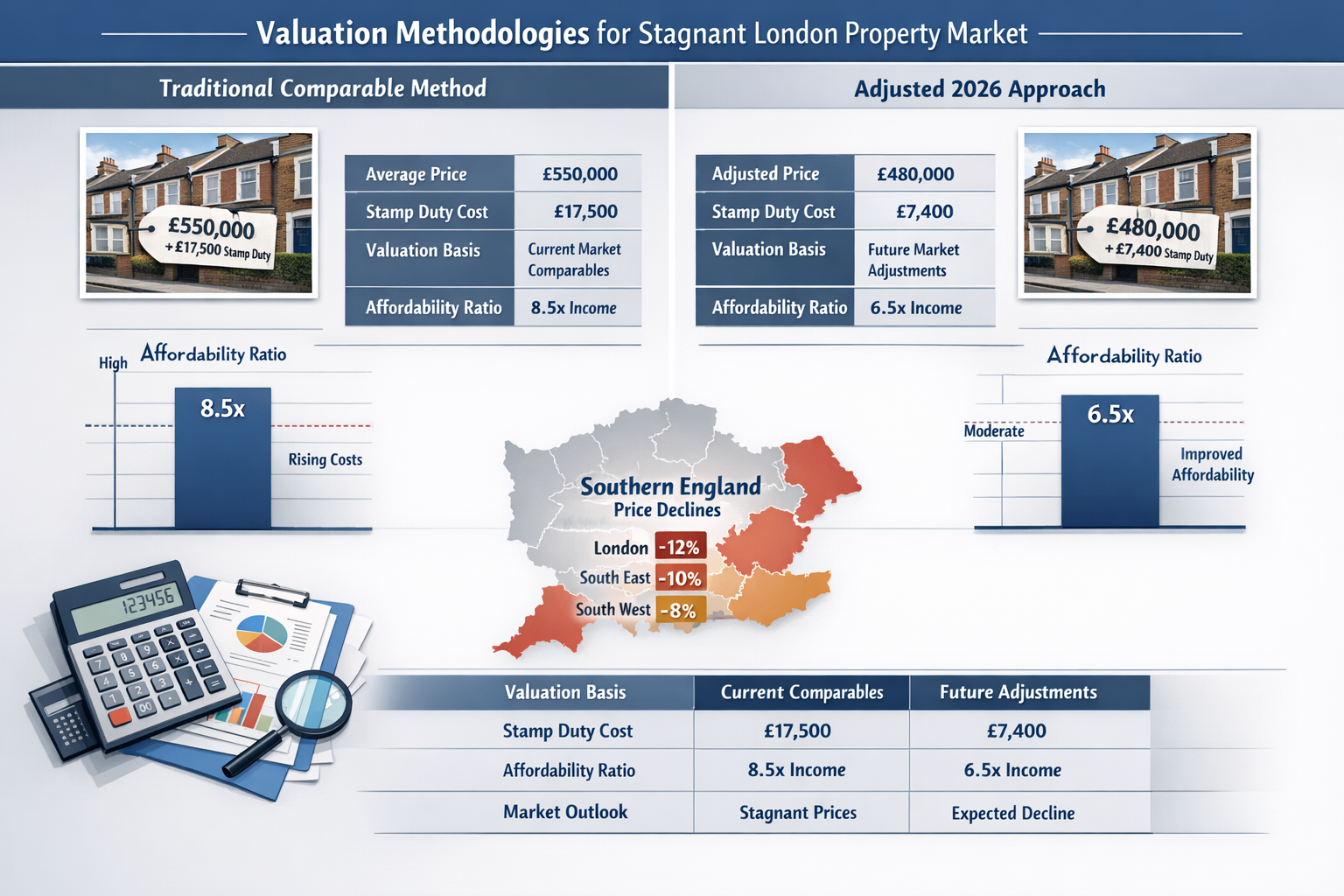
Traditional valuation approaches require significant adaptation when applied to stagnant or declining markets. Expert witnesses must employ sophisticated methodologies that account for unusual market conditions while remaining defensible under cross-examination.
The Comparable Sales Method: Challenges and Adaptations
The comparable sales approach remains the primary valuation methodology for residential property, but stagnant markets create unique challenges:
Limited Recent Transactions 📊
Reduced market activity means fewer comparable sales. Expert witnesses must cast wider geographic nets or use older comparables, requiring careful adjustment for time and market conditions.
Distressed Sales Contamination
Stagnant markets often include distressed or forced sales that don't represent true market value. Experts must identify and exclude these outliers while documenting their reasoning.
Valuation Date Precision
In declining markets, values can shift significantly over short periods. Expert witnesses must precisely establish valuation dates and adjust comparables accordingly.
Adjusting for Stamp Duty and Affordability Impacts
The 2026 London market requires explicit consideration of tax and affordability factors:
Stamp Duty Land Tax (SDLT) Adjustments
Higher SDLT rates effectively reduce what buyers can afford to pay for properties. Expert witnesses should:
- Calculate total acquisition costs including SDLT
- Demonstrate how tax burden affects buyer behavior
- Compare pre- and post-reform transaction patterns
- Adjust valuations to reflect reduced effective demand
Affordability Ratio Analysis
Traditional price-to-income ratios help establish sustainable value levels:
Sustainable Value = (Median Household Income × Affordable Multiple) + Deposit
Where affordable multiples typically range from 4-5× income for sustainable markets, versus London's current 12-15× ratio indicating overvaluation.
The Income Approach for Investment Properties
For commercial valuations and buy-to-let residential properties, the income capitalization approach provides crucial insights:
Yield Compression Analysis
Stagnant capital values combined with stable or rising rents create yield expansion, making properties more attractive on income metrics even as capital values decline.
Discounted Cash Flow (DCF) Modeling
Expert witnesses can employ DCF analysis to demonstrate:
- Projected rental income streams
- Operating expense forecasts
- Capital expenditure requirements
- Terminal value assumptions
- Appropriate discount rates for current market conditions
The Residual Method for Development Sites
Development site valuations in stagnant markets require particularly careful analysis:
Gross Development Value (GDV) Reassessment
Stagnant end-values dramatically impact development viability. Expert witnesses must:
- Use current, not historic, GDV assumptions
- Apply appropriate sales rate projections
- Account for extended development timelines
- Incorporate realistic profit margins reflecting increased risk
Cost Inflation Considerations
Construction costs often remain elevated even as property values stagnate, further squeezing development viability and reducing land values.
Expert Witness Strategies for Defending Valuations in 2026 Southern Slump

Successfully defending valuations in the current market environment requires meticulous preparation, robust documentation, and strategic presentation of evidence.
Comprehensive Documentation Standards
Evidence Trail Creation 📝
Expert witnesses must maintain detailed records demonstrating their valuation process:
- Inspection notes: Comprehensive property condition documentation with photographs
- Comparable research: Detailed analysis of all comparables considered, including those rejected
- Market research: Local market reports, RICS surveys, Land Registry data
- Calculation worksheets: Transparent adjustment calculations with clear reasoning
- Correspondence: All communications with instructing parties and other experts
This documentation serves dual purposes: supporting the valuation conclusion and demonstrating thorough professional process.
Addressing Market Volatility in Reports
Expert witness reports must explicitly address the unusual market conditions:
Market Context Section
Include dedicated sections covering:
- Regional and local market trends
- Transaction volume analysis
- Price trend data from multiple sources
- Affordability and demand indicators
- Regulatory and tax environment impacts
Uncertainty Acknowledgment
Professional credibility requires honest acknowledgment of valuation uncertainty:
"In stagnant markets characterized by limited transactions and high volatility, all valuations carry increased uncertainty. This valuation represents the expert's best professional judgment based on available evidence, but a range of ±5-10% should be considered reasonable given current market conditions."
Preparing for Cross-Examination
Aggressive cross-examination represents the ultimate test of expert witness valuations. Preparation strategies include:
Anticipating Challenges ⚖️
Common attack vectors in stagnation cases:
- "Your comparables are too old/distant/dissimilar"
- "You failed to account for declining market conditions"
- "Your adjustments lack objective support"
- "You've been influenced by your instructing party"
Response Frameworks
Effective responses demonstrate:
- Methodology transparency: Clear explanation of approach and alternatives considered
- Professional standards compliance: Reference to RICS guidance and accepted practice
- Independence: Documentation of objective analysis regardless of outcome
- Limitation acknowledgment: Honest discussion of valuation constraints and uncertainties
Regional Considerations Across London and Southern England
The southern slump affects different areas distinctly. Expert witnesses must understand regional variations:
Prime Central London
Luxury properties face unique challenges including:
- International buyer retreat
- Non-domicile tax changes affecting demand
- Oversupply in new-build luxury segment
Chartered surveyors across North London, West London, and East London must adapt valuations to their specific submarkets.
Suburban and Commuter Belt Areas
Outer London and southern counties experience different dynamics:
- Reduced commuting demand post-pandemic
- Affordability pressures affecting first-time buyers
- Variable local market conditions requiring granular analysis
Commercial Property Considerations
Commercial property valuations face additional complexities including:
- Changing workspace requirements
- Retail sector transformation
- Industrial and logistics property resilience
Coordinating with Legal Teams
Successful expert witness work requires effective collaboration with instructing solicitors:
Early Engagement Benefits
Involving expert witnesses early in disputes enables:
- Clearer understanding of legal issues requiring valuation evidence
- Identification of additional evidence or information needs
- Strategic case assessment informing settlement discussions
- Coordinated expert witness selection when multiple disciplines required
Report Timing and Iteration
Expert witnesses should provide:
- Draft reports for legal team review (while maintaining independence)
- Supplementary reports addressing new evidence or opposing expert opinions
- Joint statements with opposing experts identifying areas of agreement and disagreement
Practical Case Studies: Expert Witness Valuations in Action
Case Study 1: Matrimonial Dispute in Declining Market
Scenario: Divorcing couple disputes valuation of £2.5 million Hampstead property. Husband's expert values at £2.3 million citing market decline; wife's expert maintains £2.5 million based on purchase price 18 months earlier.
Resolution Strategy:
- Detailed comparable analysis showing 8-12% price declines in prime North London
- Adjustment calculations demonstrating impact of increased stamp duty on buyer affordability
- Market context evidence from RICS surveys and Land Registry data
- Joint expert discussion narrowing dispute to £2.35 million agreed value
Case Study 2: Negligent Valuation Claim
Scenario: Buyer claims surveyor overvalued property at £850,000 in 2024; subsequent sale in 2026 achieves only £720,000. Buyer seeks damages for overpayment.
Defense Strategy:
- Demonstration that 2024 valuation reflected market conditions at that time
- Evidence of general market decline affecting all properties, not specific overvaluation
- Comparable sales from 2024 supporting original valuation
- Expert testimony explaining market unpredictability and valuation limitations
Case Study 3: Lease Extension Valuation Dispute
Scenario: Leaseholder seeks lease extension on flat valued at £600,000. Freeholder's expert values at £650,000, creating £15,000+ difference in premium calculation.
Expert Witness Approach:
- Detailed analysis of flat sales in same building and immediate vicinity
- Adjustment for lease length, condition, and specific attributes
- Transparent calculation of marriage value and relativities
- Reference to established valuation graphs and tribunal precedents
Future-Proofing Expert Witness Practice for Market Recovery
While 2026 presents significant challenges, expert witnesses must also prepare for eventual market recovery:
Maintaining Market Knowledge
Continuous Market Monitoring 📈
Expert witnesses should:
- Subscribe to multiple data sources (Land Registry, Rightmove, Zoopla)
- Maintain transaction databases for key geographic areas
- Network with active estate agents and property professionals
- Track economic indicators affecting property demand
Technology Integration
Valuation Technology Tools
Modern expert witnesses leverage:
- Automated valuation models (AVMs) for comparable identification
- Geographic information systems (GIS) for spatial analysis
- Data visualization tools for presenting complex evidence
- Digital evidence management systems
Professional Development Priorities
Essential CPD Topics for 2026-2027:
- Market cycle analysis and valuation in volatile conditions
- Advanced comparable adjustment techniques
- Expert witness communication and presentation skills
- Emerging legal precedents in property valuation disputes
- Climate risk and ESG factors in property valuation
Selecting the Right Expert Witness for Your Case
For solicitors and parties requiring expert witness valuations, selection criteria include:
Essential Qualifications Checklist
✅ RICS Chartered Surveyor status (MRICS or FRICS)
✅ RICS Expert Witness Accreditation (EWAS-UK)
✅ Relevant property type expertise (residential, commercial, specialized)
✅ Geographic knowledge of specific London/southern England areas
✅ Expert witness experience with demonstrable track record
✅ Professional indemnity insurance adequate for case value
✅ Availability to meet case timeline requirements
✅ No conflicts of interest with parties or properties involved
Questions to Ask Potential Experts
When interviewing potential expert witnesses, consider:
- How many expert witness cases have you completed?
- What percentage of your work involves expert witness services?
- Have you provided evidence in similar market conditions?
- Can you provide references from solicitors you've worked with?
- What is your typical timeline from instruction to report delivery?
- How do you approach valuations in stagnant or declining markets?
- What is your fee structure and estimated total cost?
Red Flags to Avoid
⚠️ Warning signs of unsuitable experts:
- Guaranteeing specific valuation outcomes before inspection
- Lack of relevant accreditation or qualifications
- Unwillingness to acknowledge valuation uncertainty
- Poor communication or unavailability
- Defensive attitude when discussing methodology
- No professional indemnity insurance
Conclusion
The 2026 southern property slump has created unprecedented challenges for property valuations across London and surrounding regions. With RICS data showing -40% negative price sentiment, Expert Witness Valuations in London Price Stagnation Cases: RICS Strategies for 2026 Southern Slump have become essential tools for resolving the surge in property disputes arising from market turbulence.
Success in this environment requires expert witnesses to combine rigorous technical analysis with strategic evidence presentation. RICS accreditation standards provide the professional framework, while CPR compliance ensures legal admissibility. Adapted valuation methodologies account for stamp duty impacts, affordability constraints, and limited transaction evidence, while comprehensive documentation and preparation enable experts to defend their conclusions under aggressive cross-examination.[3]
For property professionals, maintaining current market knowledge, investing in continuous professional development, and leveraging appropriate technology tools will prove essential throughout the market downturn and eventual recovery. For solicitors and parties requiring expert valuations, selecting properly qualified and experienced RICS expert witnesses with specific London market expertise remains paramount.
Actionable Next Steps
For Property Professionals:
- Obtain RICS Expert Witness Accreditation if not already qualified
- Develop specialized knowledge of stagnant market valuation techniques
- Build comprehensive comparable databases for your geographic areas
- Invest in CPD focused on expert witness skills and market analysis
- Network with legal professionals to understand their expert witness requirements
For Solicitors and Parties in Disputes:
- Engage expert witnesses early in dispute processes
- Verify RICS accreditation and relevant experience before instruction
- Provide comprehensive instructions including all relevant documentation
- Facilitate expert access to properties and information sources
- Consider joint expert appointments where appropriate to narrow disputes
For Property Owners and Buyers:
- Commission independent valuations from registered RICS valuers before major transactions
- Understand market conditions affecting property values in your area
- Seek early advice if disputes arise regarding valuations
- Maintain documentation of property condition and comparable evidence
- Consider mediation before pursuing formal legal proceedings
The London property market will eventually recover, but until then, robust expert witness valuations grounded in RICS standards and adapted to current market realities remain essential for fair resolution of property disputes. By understanding these strategies and selecting qualified professionals, parties can navigate the 2026 southern slump with confidence and achieve equitable outcomes.
References
[1] Rics Register Of Accredited Expert Witnesses March 2026 – https://www.rics.org/content/dam/ricsglobal/documents/surveying/RICS-Register-of-Accredited-Expert-Witnesses_March-2026.pdf
[2] Expert Witness Valuations – https://winfieldssurveyors.london/property-valuation/expert-witness-valuations/
[3] Expert Witness Valuations In 2026s Stabilizing Market Rics Standards For Mortgage Disputes And Property Disagreements – https://nottinghillsurveyors.com/blog/expert-witness-valuations-in-2026s-stabilizing-market-rics-standards-for-mortgage-disputes-and-property-disagreements