The property valuation landscape across the United Kingdom has never been more polarized. As of early 2026, Expert Witness Roles in Regional Valuation Disputes: North-South Divides Post-RICS February 2026 have become increasingly critical as surveyors navigate unprecedented regional price disparities. Recent RICS survey data from January 2026 reveals remarkable regional variations in property valuations, with the national house price net balance standing at -10%.[2] These stark differences between Northern and Southern property markets have created a surge in valuation disputes requiring specialized expert witness testimony to resolve complex litigation.
The challenge facing property professionals today extends beyond simple number-crunching. Expert witnesses must now develop tailored evidence strategies that account for regional economic factors, local market dynamics, and the widening prosperity gap between regions. This article explores how RICS-accredited professionals are adapting their courtroom approaches to address these geographical disparities effectively.

Key Takeaways
- 🏛️ RICS standards for expert witnesses have evolved significantly, with the fifth edition of professional guidance currently in production, emphasizing impartiality and pre-report collaboration[1]
- 📊 Regional price variations documented in January 2026 show substantial North-South disparities requiring specialized valuation approaches in dispute resolution
- ⚖️ Expert witness testimony must now incorporate region-specific market evidence, local economic indicators, and comparative analysis across geographical boundaries
- 📋 The RICS Register of Accredited Expert Witnesses (March 2026) provides vetted professionals with demonstrated expertise in regional valuation complexities[3]
- 🎯 Courtroom strategies demand comprehensive understanding of both technical valuation methodology and regional market characteristics to withstand cross-examination
Understanding the North-South Property Divide in 2026
The geographical disparity in UK property values has reached historic proportions in 2026. Southern England continues to command premium prices driven by London's economic gravitational pull, established infrastructure, and concentrated wealth. Meanwhile, Northern regions have experienced different market trajectories influenced by industrial heritage, regeneration initiatives, and evolving economic opportunities.
Current Market Indicators
Recent data reveals these striking contrasts:
| Region | Average Property Value | Year-on-Year Change | Market Sentiment |
|---|---|---|---|
| South East | £425,000 | -2.5% | Cautious |
| London | £535,000 | -3.8% | Declining |
| North West | £215,000 | +1.2% | Stable |
| North East | £165,000 | +0.8% | Recovering |
| Yorkshire | £195,000 | +1.5% | Positive |
These figures demonstrate that while Southern markets experience price corrections, Northern regions show resilience and modest growth. This divergence creates fertile ground for valuation disputes, particularly in cases involving:
- Divorce settlements where parties relocated between regions
- Inheritance disputes with properties in multiple geographical areas
- Commercial lease reviews for national retail or office portfolios
- Compulsory purchase compensation where comparable evidence spans regions
- Portfolio valuations for investment funds with nationwide holdings
Economic Drivers Behind Regional Variations
The North-South divide reflects deeper economic realities. Southern England benefits from:
✅ Higher average incomes and accumulated generational wealth
✅ Concentrated professional services and financial sectors
✅ International investment and foreign buyer interest
✅ Established transport links and infrastructure investment
✅ Prestigious educational institutions and cultural amenities
Conversely, Northern regions face different dynamics:
📍 Lower cost of living attracting young professionals and families
📍 Regeneration programs creating new investment opportunities
📍 Growing tech hubs in Manchester, Leeds, and Newcastle
📍 Improved affordability ratios for first-time buyers
📍 Government leveling-up initiatives targeting regional development
Understanding these valuation factors becomes essential for expert witnesses preparing evidence for regional disputes.
Expert Witness Roles in Regional Valuation Disputes: Standards and Responsibilities Post-RICS February 2026
The role of expert witnesses in property valuation disputes has undergone significant refinement following updated RICS guidance. The fifth edition of Surveyors acting as expert witnesses emphasizes heightened professional standards and procedural requirements.[1]

Core Responsibilities of Expert Witnesses
Expert witnesses in regional valuation disputes must fulfill several critical functions:
1. Impartial Analysis
The expert's primary duty is to the court, not to the instructing party. This means:
- Providing objective opinions based on evidence rather than advocacy
- Acknowledging limitations in available data or methodology
- Presenting alternative interpretations where reasonable
- Avoiding selective use of comparable evidence
"The expert witness must remain wholly independent and objective, providing opinions that assist the court rather than advancing a particular party's position."
2. Regional Market Expertise
Effective expert testimony requires deep knowledge of both regions involved in the dispute. This includes:
- Current market conditions and recent transaction evidence
- Local economic factors influencing property values
- Regional planning policies and development trends
- Area-specific property characteristics and buyer preferences
- Historical price movements and cyclical patterns
For disputes involving Red Book valuations, experts must demonstrate compliance with RICS Valuation Standards while accounting for regional variations.
3. Pre-Report Collaboration
Recent RICS guidance mandates that expert witnesses should meet or communicate before producing reports to:
- Narrow the scope of disagreement
- Test competing assumptions
- Identify common ground on methodology
- Clarify areas requiring additional evidence
- Establish agreed facts to streamline proceedings[1]
This collaborative approach reduces litigation costs and focuses court time on genuine areas of dispute.
The RICS Register of Accredited Expert Witnesses
The March 2026 Register provides courts and solicitors with vetted professionals demonstrating:
✔️ Appropriate qualifications and professional standing
✔️ Proven experience in expert witness work
✔️ Understanding of Civil Procedure Rules and expert duties
✔️ Professional indemnity insurance coverage
✔️ Continuing professional development in expert witness skills[3]
Accreditation offers credibility advantages in court, particularly when opposing experts lack formal recognition. For complex regional disputes, parties increasingly seek specialists with demonstrated expertise in both geographical areas under consideration.
Avoiding Common Pitfalls
Expert witnesses must guard against several professional hazards:
⚠️ Perceived partisanship – Appearing to advocate for the instructing party undermines credibility
⚠️ Inadequate comparable evidence – Using inappropriate comparables from different regional markets
⚠️ Methodology inconsistency – Applying different valuation approaches between regions without justification
⚠️ Overconfidence in opinions – Failing to acknowledge uncertainty or alternative interpretations
⚠️ Poor report presentation – Unclear reasoning or inadequate explanation of regional adjustments
Professional chartered surveyors with regional expertise understand these challenges and structure their evidence accordingly.
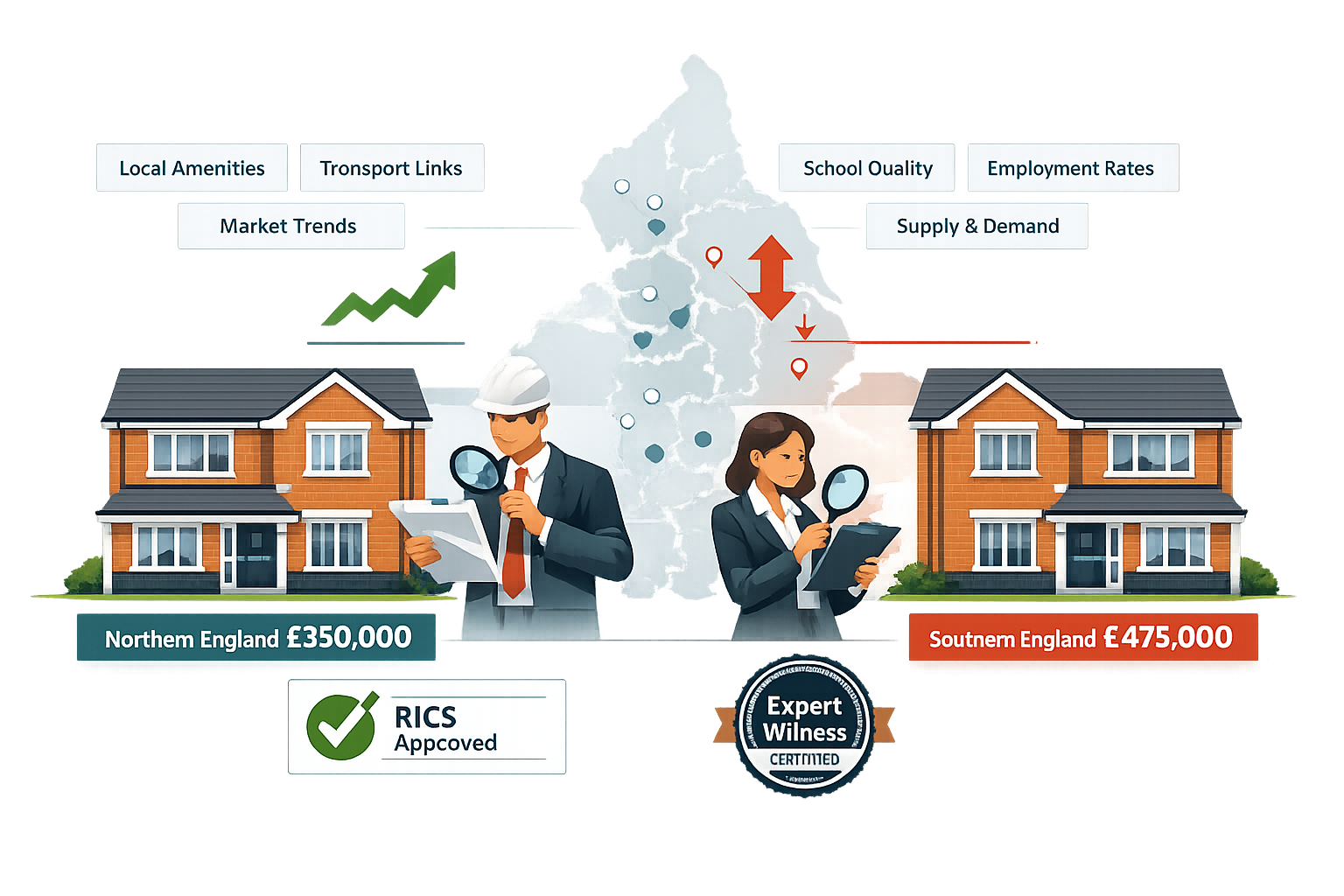
Developing Effective Evidence Strategies for North-South Valuation Disputes
Successfully navigating Expert Witness Roles in Regional Valuation Disputes: North-South Divides Post-RICS February 2026 requires sophisticated evidence preparation and courtroom strategy. The geographical complexity demands methodical approaches that withstand rigorous cross-examination.
Building Robust Comparable Evidence
The foundation of any valuation dispute lies in comparable evidence. For regional disputes, this becomes particularly challenging:
Northern Property Comparables
When valuing Northern properties, experts should:
- Source recent transactions within the specific locality (ideally within 1-2 miles)
- Consider the property's position within the local market hierarchy
- Account for regional economic indicators affecting demand
- Recognize affordability constraints specific to local income levels
- Acknowledge regeneration impacts on emerging areas
Southern Property Comparables
Southern valuations require different considerations:
- Wider geographical search areas due to market heterogeneity
- Greater weight to micro-location factors (postcode premiums)
- International buyer influence on specific property types
- Transport link proximity (particularly to London)
- School catchment area impacts on residential values
For freehold valuations spanning multiple regions, experts must clearly articulate their methodology for selecting and adjusting comparable evidence.
Regional Adjustment Methodology
When direct comparables are unavailable, experts must apply regional adjustments to evidence from other areas. This process requires:
Step 1: Establish Baseline Comparison
Identify properties with similar physical characteristics:
- Property type and size
- Age and construction quality
- Accommodation layout
- Condition and specification
- Plot size and position
Step 2: Quantify Regional Premium/Discount
Calculate the regional value differential using:
- Statistical analysis of price per square foot/metre
- Land Registry data for similar property types
- Local market reports and indices
- Economic indicators (income levels, employment rates)
- Supply and demand dynamics
Step 3: Apply Specific Adjustments
Refine the regional adjustment for:
- Micro-location factors within each region
- Property-specific advantages or disadvantages
- Market timing differences
- Transaction circumstances
Step 4: Validate Results
Cross-check adjusted values against:
- Alternative valuation methodologies
- Market participant feedback
- Professional judgment and experience
- Sensitivity analysis showing adjustment impact
Presenting Technical Evidence Clearly
Courts require expert evidence to be accessible and comprehensible to non-specialist judges and juries. Effective presentation includes:
📊 Visual aids – Maps, charts, and graphs illustrating regional variations
📊 Comparable schedules – Tabulated evidence with clear adjustment explanations
📊 Market context – Economic data supporting regional valuation differences
📊 Methodology transparency – Step-by-step explanation of valuation approach
📊 Sensitivity analysis – Showing how different assumptions affect conclusions
For commercial property valuations, experts may need to explain yield differentials, rental value variations, and investment market differences between regions.
Preparing for Cross-Examination
Effective expert witnesses anticipate challenges to their evidence:
Common Cross-Examination Themes
- Comparable selection bias – "Why did you choose comparables that support your client's position?"
- Regional adjustment justification – "How did you calculate the 40% regional premium?"
- Alternative methodology – "Why didn't you use the residual method instead?"
- Professional experience – "Have you actually valued properties in this Northern location?"
- Instruction bias – "Isn't your opinion influenced by who's paying your fees?"
Defensive Strategies
✅ Maintain comprehensive working papers documenting all decisions
✅ Consider and address alternative approaches in the report
✅ Acknowledge limitations and uncertainties candidly
✅ Base opinions on objective evidence rather than assertion
✅ Remain calm, professional, and non-defensive under questioning
Expert witnesses involved in lease extension valuations or collective enfranchisement matters must be particularly prepared for technical challenges regarding relativity, deferment rates, and hope value—all of which may vary regionally.
Specialized Regional Dispute Scenarios
Different types of valuation disputes present unique challenges when regional variations are involved:
Matrimonial Property Disputes
Divorce proceedings often involve parties who have relocated between regions. Consider:
- A couple purchased a property in North West London for £800,000 in 2020
- They separated in 2024, with one party relocating to Manchester
- The property is now valued at £750,000 due to Southern market correction
- The Northern party argues for immediate sale while the Southern party wants to retain
Expert witnesses must address:
- Whether the property should be valued for immediate sale or continued occupation
- Regional market timing considerations
- Alternative housing costs in each party's chosen location
- Tax implications of sale versus retention
Inheritance and Probate Valuations
Probate valuations become contentious when beneficiaries reside in different regions with contrasting property market experiences. An estate with properties in both Sussex and Yorkshire may generate disputes over:
- Appropriate valuation dates
- Whether properties should be sold or distributed in specie
- Fair division when property values have diverged significantly
- Regional rental income potential if properties are to be retained
Commercial Lease Disputes
Rent review disputes for national retailers or office occupiers require experts to analyze:
- Regional variations in retail rental values
- Footfall and trading patterns in different locations
- Yield compression or expansion trends
- Tenant covenant strength and regional market depth
A retail chain with stores in Central London and Northern cities faces vastly different rental values, requiring sophisticated analysis of location-specific trading potential.
Compulsory Purchase and Compensation
Infrastructure projects spanning multiple regions create valuation challenges:
- HS2 impacts on properties in Buckinghamshire versus Northern termini
- Motorway widening affecting properties in different regional markets
- Regeneration schemes with varying land values across regions
Expert witnesses must justify compensation levels that reflect genuine regional market differences while ensuring fair treatment across geographies.
Best Practices for Expert Witnesses in 2026
As Expert Witness Roles in Regional Valuation Disputes: North-South Divides Post-RICS February 2026 continue to evolve, professionals should adopt these best practices:
Continuing Professional Development
Stay current with:
- Regional market trends through regular monitoring
- RICS guidance updates and professional standards
- Court procedure changes and legal precedents
- Valuation methodology developments
- Technology tools for comparable analysis
Building Regional Networks
Develop relationships with:
- Local agents and valuers in key regions
- Fellow RICS members with complementary geographical expertise
- Legal professionals specializing in property disputes
- Market data providers covering multiple regions
Technology and Data Analytics
Leverage modern tools:
- Property databases with comprehensive regional coverage
- Statistical analysis software for market trend identification
- Geographic information systems (GIS) for location analysis
- Virtual inspection technology for remote property assessment
- Collaborative platforms for expert-to-expert communication
Documentation and Record-Keeping
Maintain meticulous records:
- Comparable property research and selection rationale
- Market data sources and collection dates
- Calculation methodologies and assumptions
- Communications with instructing parties
- Peer review and quality assurance processes
Ethical Conduct
Uphold professional standards:
- Decline instructions where conflicts of interest exist
- Resist pressure to modify opinions inappropriately
- Acknowledge when matters fall outside expertise
- Maintain independence from instructing parties
- Report professional misconduct when encountered
Conclusion
The landscape of Expert Witness Roles in Regional Valuation Disputes: North-South Divides Post-RICS February 2026 presents both challenges and opportunities for property professionals. As regional disparities in UK property markets become more pronounced, the demand for sophisticated expert witness testimony continues to grow.
Successful expert witnesses must combine technical valuation expertise with deep regional market knowledge, presenting evidence that is both rigorous and accessible. The updated RICS standards emphasize impartiality, collaboration, and transparency—principles that serve both the profession and the administration of justice.
For surveyors and valuers navigating these complex disputes, the path forward requires:
🎯 Continuous learning about regional market dynamics and evolving professional standards
🎯 Methodological rigor in comparable selection, adjustment, and valuation approach
🎯 Clear communication that makes technical evidence understandable to non-specialists
🎯 Professional integrity maintaining independence regardless of instructing party pressures
🎯 Collaborative engagement with opposing experts to narrow disputes efficiently
Actionable Next Steps
For property professionals seeking to enhance their expert witness capabilities:
- Review the RICS Register – Consider pursuing accreditation through the formal RICS expert witness program[3]
- Expand regional knowledge – Develop expertise in markets beyond your primary geographical area
- Update professional standards – Familiarize yourself with the forthcoming fifth edition of RICS expert witness guidance[1]
- Build comparable databases – Establish comprehensive records of regional transaction evidence
- Seek mentorship – Connect with experienced expert witnesses for guidance and peer review
- Invest in training – Attend courses on courtroom procedure, report writing, and cross-examination techniques
The North-South divide in UK property markets shows no signs of diminishing in 2026. As regional variations persist and potentially intensify, expert witnesses who can navigate these geographical complexities with professionalism and precision will remain in high demand.
Whether you're involved in building surveys, specialized valuations, or dispute resolution, understanding the regional dimensions of property valuation has never been more critical. The expert witnesses who succeed will be those who combine technical excellence with regional insight, delivering evidence that serves justice while advancing professional standards.
References
[1] Surveyors Expert Witness Telecoms Disputes – https://ww3.rics.org/uk/en/journals/land-journal/surveyors-expert-witness-telecoms-disputes.html
[2] Expert Witness Strategies For Northern Housing Boom Disputes Leveraging 2026 Rics Data In Courtroom Valuations – https://nottinghillsurveyors.com/blog/expert-witness-strategies-for-northern-housing-boom-disputes-leveraging-2026-rics-data-in-courtroom-valuations
[3] Rics Register Of Accredited Expert Witnesses March 2026 – https://www.rics.org/content/dam/ricsglobal/documents/surveying/RICS-Register-of-Accredited-Expert-Witnesses_March-2026.pdf