
The landscape of residential construction in England is undergoing its most dramatic transformation in decades. As sustainable new builds accelerate with stricter energy-efficiency standards and low-carbon heating systems, building surveyors must develop expertise in evaluating emerging technologies and compliance risks that traditional survey checklists miss. Sustainable New Builds and Building Survey Priorities in 2026: Assessing Future Homes Standard Compliance and Hidden Defects represents a critical knowledge gap that both property professionals and homebuyers must bridge as December 2026 approaches—the hard deadline for Future Homes Standard (FHS) implementation.
The stakes have never been higher. New homes must now achieve 75-80% lower carbon emissions compared to 2013 Building Regulations standards[2], gas grid connections are prohibited[1], and technical specifications for everything from window U-values to airtightness have tightened significantly. Yet the real challenge lies not just in meeting these standards on paper, but in ensuring actual as-built performance matches design intentions—a persistent "performance gap" that government guidance explicitly acknowledges as a critical compliance risk[3].
Key Takeaways
- 🏗️ December 2026 marks the mandatory FHS implementation deadline, with all new building regulation applications required to meet the new standard regardless of planning permission dates
- 🔍 Building surveys must now assess low-carbon heating systems, enhanced airtightness, and mechanical ventilation—technologies rarely encountered in traditional property inspections
- ⚠️ Performance gaps between design and reality pose significant compliance risks, requiring surveyors to verify actual installation quality rather than relying solely on certification documents
- 🌡️ Overheating risk is emerging as a critical hidden defect in highly insulated, airtight homes that weren't properly modeled during design phases
- 📋 Quality assurance has shifted from reactive to preventative, with comprehensive as-built documentation now essential for both regulatory compliance and future property transactions
Understanding the Future Homes Standard: What Changed in 2026
The Regulatory Timeline and Transition Period
December 2026 represents the culmination of years of regulatory development aimed at decarbonizing England's residential building stock. Projects without existing planning permission must meet FHS requirements by this deadline, with a transition period extending to December 2027 when all new homes must fully comply[1]. This phased approach creates a dual-compliance landscape during 2026-2027, where some properties continue under Part L 2021 standards while others pioneer the new requirements.
The transitional arrangements allow homes with pre-FHS planning permission to be built to Part L 2021 standards, provided construction begins within 12 months[2]. However, there's a critical distinction: building regulation applications submitted after the FHS date must comply regardless of planning permission timing[2]. This means surveyors conducting RICS building surveys must first establish which regulatory framework applies to each property.
Core Technical Requirements
The Future Homes Standard introduces several non-negotiable technical specifications that fundamentally alter building survey priorities:
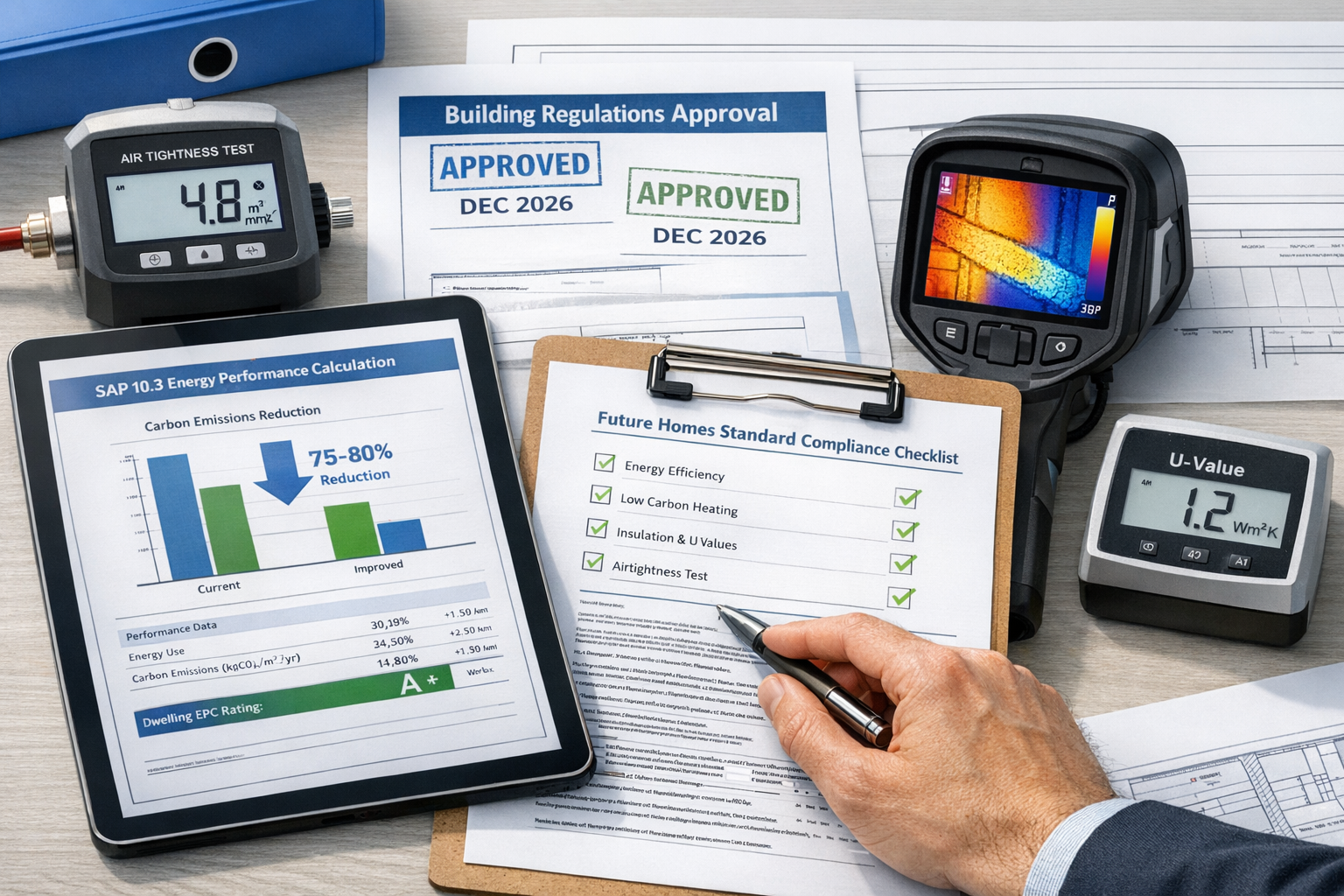
| Component | FHS Requirement | Previous Standard (Part L 2021) | Survey Implications |
|---|---|---|---|
| Heating Systems | Low-carbon only (heat pumps mandatory) | Gas boilers permitted | Assess heat pump installation quality, sizing, commissioning |
| Windows | U-value ≤1.2 W/m²K | U-value ≤1.40 W/m²K | Verify triple-glazing specifications, thermal performance certificates |
| Airtightness | ≤5 m³/hr/m² | ≤8 m³/hr/m² | Review airtightness test results, identify potential breach points |
| Ventilation | MEV or MVHR systems mandatory | Various options | Inspect system commissioning, ductwork installation, filter maintenance access |
| Carbon Reduction | 75-80% vs. 2013 baseline | 31% vs. 2013 baseline | Verify SAP/HEM calculations match actual installation |
Gas grid connections are now completely prohibited under FHS[1], making air source heat pumps (ASHP) or ground source heat pumps (GSHP) the default heating solution. The Boiler Upgrade Scheme offers up to £7,500 to offset installation costs[1], but surveyors must verify that these systems are correctly sized, properly commissioned, and installed according to manufacturer specifications—expertise that extends well beyond traditional boiler assessments.
The Performance Gap Challenge
Government guidance explicitly acknowledges that small defects in insulation continuity, airtightness, or system commissioning can have disproportionate impact on energy performance[3]. This "performance gap"—the difference between designed and actual energy performance—has plagued sustainable construction for years. A property may achieve compliance certification yet still underperform due to:
- Incomplete insulation coverage at junctions and penetrations
- Air leakage through poorly sealed service entries
- Incorrectly commissioned heating or ventilation systems
- Thermal bridging at structural connections
- Inadequate quality control during construction phases
"Quality assurance has shifted from reactive to preventative discipline. Housebuilders must maintain clear as-built records, traceable evidence of compliance, and accessible information supporting both regulators and homeowners."[3]
This shift demands that building surveyors adopt investigative approaches that go beyond visual inspection, incorporating thermal imaging, airtightness verification, and system performance testing into their assessment protocols.
Building Survey Priorities for Sustainable New Builds in 2026
Heat Pump Installation and Performance Assessment
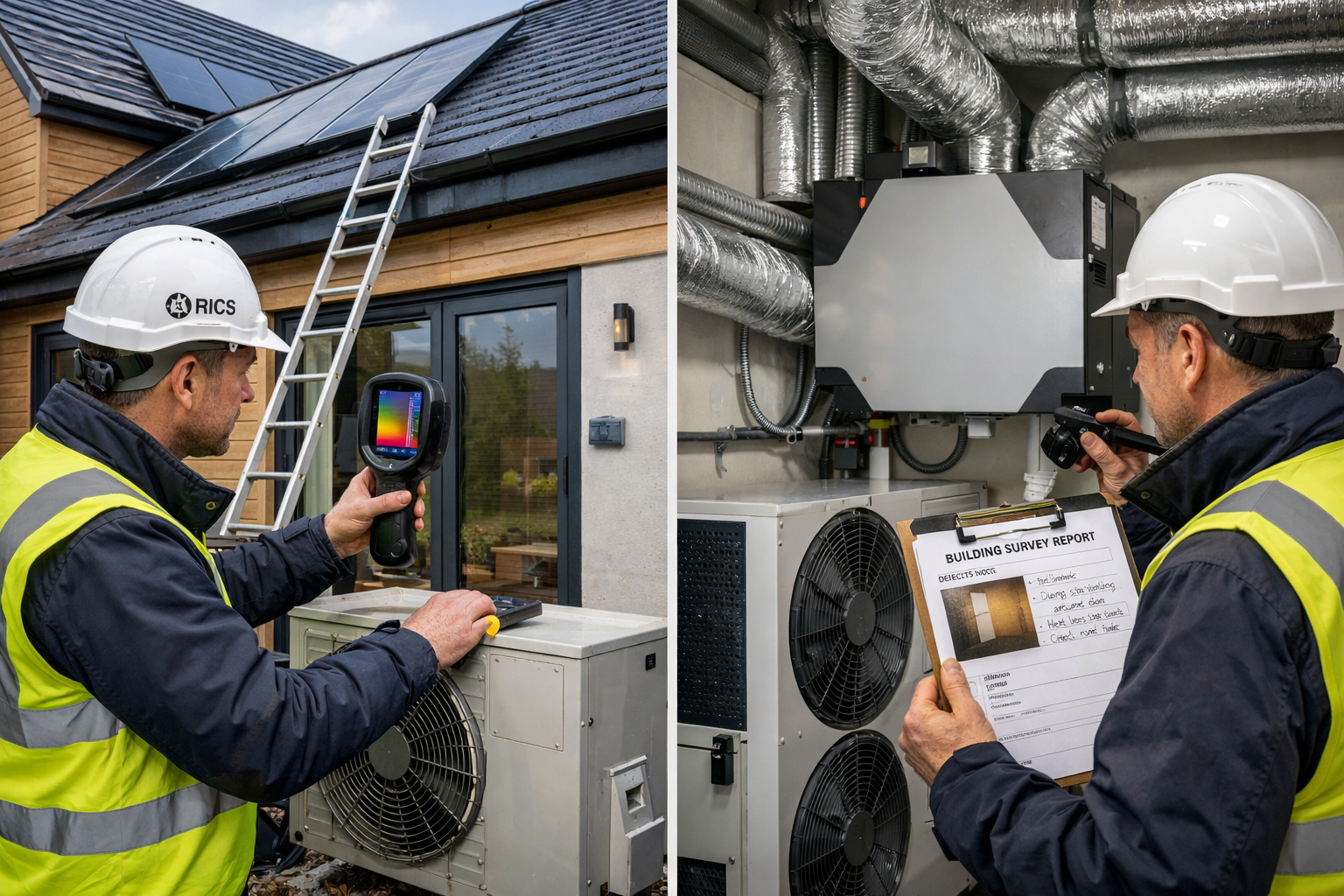
Heat pumps represent the most significant departure from traditional heating systems, and their proper installation is critical to both comfort and energy efficiency. When conducting a Level 3 building survey on a sustainable new build, surveyors should prioritize:
External Unit Positioning and Installation:
- Adequate clearance for airflow (minimum 1 meter from walls/obstructions)
- Proper mounting to minimize vibration transmission
- Appropriate drainage for condensate discharge
- Protection from prevailing weather conditions
- Compliance with permitted development noise limits (42dB at 1 meter)
Internal Components and Distribution:
- Hot water cylinder sizing appropriate for household needs
- Buffer tank installation where required by system design
- Distribution pipework insulation quality and continuity
- Radiator or underfloor heating sizing matched to heat pump output temperatures
- Control system programming and user interface accessibility
Commissioning Evidence:
- Manufacturer commissioning certificates
- System performance testing results
- Refrigerant charge verification
- Flow temperatures and pressures within specification
- Seasonal performance factor (SPF) projections vs. actual measurements
A poorly installed heat pump can consume 30-50% more electricity than a correctly commissioned system, directly impacting running costs and carbon performance. Surveyors should request commissioning documentation and, where possible, review actual energy consumption data if the property has been occupied.
Airtightness and Ventilation System Verification
The tightened airtightness standard of ≤5 m³/hr/m²[2] makes air leakage a critical defect category. Unlike older properties where some air infiltration was expected, FHS-compliant homes rely on controlled mechanical ventilation to maintain indoor air quality. This creates a interdependent relationship: poor airtightness undermines ventilation system effectiveness, while inadequate ventilation in an airtight building can lead to condensation, mold, and indoor air quality problems.
Airtightness Assessment Priorities:
- Review certified airtightness test results (mandatory for Building Control approval)
- Inspect common leakage points: service penetrations, window/door seals, loft hatches, electrical outlets
- Verify continuity of airtightness membrane in roof and wall constructions
- Check junction details between different building elements
- Assess quality of sealant application around openings
Mechanical Ventilation Systems:
- Identify system type (MEV or MVHR) and verify appropriate for building size
- Inspect ductwork routing for optimal efficiency (minimal bends, appropriate sizing)
- Check external intake/exhaust terminals for proper positioning and bird guards
- Verify filter access points and maintenance requirements
- Review commissioning certificates showing airflow rates in each room
- Test control systems and boost functions
Mechanical Ventilation with Heat Recovery (MVHR) systems are increasingly common in FHS homes due to their ability to recover up to 90% of heat from extracted air. However, they require regular filter maintenance (typically every 3-6 months) and proper user understanding—factors that should be documented in specific defect reports when issues are identified.
Thermal Performance and Insulation Continuity
Windows achieving U-values of 1.2 W/m²K or lower[1] typically require triple-glazing, representing a significant upgrade from standard double-glazing. Surveyors should verify:
- Glazing specifications match certification documents
- Proper installation with continuous sealing around frames
- Absence of condensation between panes (indicating seal failure)
- Appropriate ventilation trickle vents where specified
- Thermal bridging minimization at frame/wall junctions
Insulation Assessment:
Enhanced insulation levels are fundamental to FHS compliance, but effectiveness depends entirely on continuous, gap-free installation. Traditional visual inspection is insufficient; thermal imaging surveys can reveal:
- Missing or compressed insulation in wall cavities
- Thermal bridging at structural elements
- Air leakage paths visible as temperature anomalies
- Inadequate insulation at junctions and penetrations
For properties showing signs of thermal performance issues, commissioning a dedicated structural survey with thermal imaging capabilities provides definitive evidence of installation quality.
Overheating Risk Assessment
An emerging concern in highly insulated, airtight homes is summer overheating[4]. The same features that retain heat in winter can trap solar gains in summer, potentially creating uncomfortable or even dangerous indoor temperatures. This risk is particularly acute in:
- South-facing properties with large glazed areas
- Upper-floor bedrooms with limited ventilation options
- Homes without adequate solar shading (overhangs, external blinds)
- Properties where MVHR systems lack summer bypass functions
Surveyors should assess overheating risk by evaluating:
- Glazing orientation and area relative to floor space
- Presence and effectiveness of solar shading devices
- Ventilation system capacity for summer cooling
- Thermal mass in construction (concrete vs. timber frame)
- Occupant control options for managing solar gains
While overheating isn't currently a Building Regulations failure criterion, it represents a significant habitability defect that will impact property value and occupant satisfaction. Government guidance acknowledges this requires more accurate thermal modeling and rigorous commissioning[4], but many early FHS properties may not have undergone adequate overheating analysis during design.
Hidden Defects in Sustainable New Builds: What Surveyors Must Investigate
The Documentation-Reality Gap
Quality assurance for FHS compliance has shifted toward preventative discipline with clear as-built records and traceable evidence[3]. However, the existence of documentation doesn't guarantee actual compliance. Surveyors must critically evaluate:
Energy Performance Certificates (EPCs):
- Compare predicted energy consumption against actual utility bills (if available)
- Verify that installed specifications match EPC assumptions
- Identify any post-construction modifications that might affect performance
- Check that SAP 10.3 or Home Energy Model (HEM) calculations were used[5]
Building Control Completion Certificates:
- Confirm all inspection stages were completed
- Review any conditions or observations noted
- Verify that final airtightness testing occurred
- Check compliance certificate dates align with construction timeline
Manufacturer Warranties and Commissioning Records:
- Heat pump manufacturer warranties (typically 5-10 years)
- Ventilation system commissioning certificates
- Window and door performance certifications
- Insulation material specifications and installation records
The challenge for surveyors is that many of these documents may be missing, incomplete, or based on design intentions rather than as-built reality. Where documentation gaps exist, physical inspection and testing become essential.

Condensation and Moisture Management
The combination of enhanced airtightness and mechanical ventilation creates a fundamentally different moisture management environment compared to traditional homes. Condensation risks shift from obvious cold spots to subtle system failures:
Interstitial Condensation:
Moisture vapor can condense within wall or roof constructions if vapor control layers are improperly installed or breached. This hidden moisture accumulation can lead to:
- Insulation performance degradation
- Timber frame rot in structural elements
- Mold growth within concealed spaces
- Long-term structural damage
Surveyors should look for indirect indicators such as external staining, interior mold patterns, or musty odors that suggest concealed moisture problems. Damp surveys using moisture meters and thermal imaging can identify problem areas before visible damage occurs.
Surface Condensation and Mold:
Inadequate or poorly commissioned ventilation systems can lead to surface condensation, particularly in bathrooms, kitchens, and bedrooms. Check for:
- Mold growth in corners, window reveals, or behind furniture
- Condensation staining on windows or walls
- Ventilation system airflow rates (should match design specifications)
- Extract fan operation in wet rooms
- Occupant complaints about air quality or humidity
System Integration and Control Issues
FHS homes incorporate multiple interdependent systems—heating, ventilation, hot water, and potentially solar PV—that must work together efficiently. Common integration defects include:
- Incompatible control systems: Heat pump and ventilation controls that don't communicate effectively
- Poor user interfaces: Overly complex controls that occupants can't operate correctly
- Inadequate commissioning: Systems installed but not optimized for the specific building
- Missing documentation: Occupants lacking manuals or guidance for system operation
These issues may not constitute Building Regulations failures but significantly impact energy performance and occupant satisfaction. Surveyors should assess whether systems are user-friendly and properly documented, particularly for first-time buyers unfamiliar with low-carbon technologies.
Structural and Construction Quality Concerns
Sustainable construction methods sometimes introduce new structural considerations:
Modern Methods of Construction (MMC):
Timber frame, structural insulated panels (SIPs), and modular construction are increasingly common in sustainable builds. These require specific survey expertise:
- Junction details between modules or panels
- Structural adequacy of fixing systems
- Fire barrier integrity between units
- Moisture protection during construction phase
Foundation and Ground Works:
Ground source heat pumps require extensive ground works that, if improperly executed, can affect both system performance and structural stability. Surveyors should verify:
- Adequate separation from building foundations
- Proper backfilling and compaction
- Drainage considerations
- Long-term settlement risks
For properties showing structural concerns, engaging specialists who provide residential structural engineering services ensures comprehensive assessment.
Practical Guidance for Homebuyers and Property Professionals
Selecting the Appropriate Survey Level
For sustainable new builds in 2026, the survey level should reflect both the property's complexity and the buyer's risk tolerance:
RICS Level 2 (HomeBuyer Report):
Suitable for straightforward new builds from established developers with:
- Full NHBC or equivalent warranty coverage
- Complete documentation package
- No visible defects or concerns
- Standard construction methods
RICS Level 3 (Building Survey):
Recommended for properties with:
- Innovative or untested construction methods
- First-generation FHS compliance (early adopters)
- Smaller or less-established developers
- Any visible concerns or documentation gaps
- High-value purchases where detailed assessment justifies cost
A comprehensive RICS home survey provides peace of mind that goes beyond warranty coverage, identifying issues that may not become apparent until after the warranty period expires.
Questions to Ask Developers and Sellers
When purchasing a sustainable new build, buyers should request:
- Complete energy performance documentation: SAP/HEM calculations, EPC, airtightness test results
- System commissioning certificates: Heat pump, ventilation, hot water, solar PV (if installed)
- Manufacturer warranties: For all major systems and components
- Operation and maintenance manuals: User-friendly guides for all installed systems
- As-built drawings: Showing actual construction details, not just design intentions
- Building Control completion certificate: Confirming all regulatory requirements met
- NHBC or equivalent warranty documentation: Including coverage terms and claims process
Developers who cannot provide comprehensive documentation may indicate quality control issues or incomplete compliance verification.
The Role of Professional Surveyors in 2026
The complexity of Sustainable New Builds and Building Survey Priorities in 2026: Assessing Future Homes Standard Compliance and Hidden Defects demands that surveyors continuously update their technical knowledge. Professional development should include:
- Understanding heat pump technology and installation standards
- Thermal imaging interpretation for building diagnostics
- Airtightness testing principles and common failure modes
- Ventilation system types, commissioning, and maintenance requirements
- Overheating risk assessment methodologies
- Modern Methods of Construction (MMC) structural considerations
Surveyors who develop these specialized skills position themselves as essential advisors in the sustainable construction market, providing value that extends far beyond traditional visual inspection.
Long-Term Considerations and Maintenance
FHS-compliant homes require different maintenance approaches compared to traditional properties:
Annual Maintenance Tasks:
- MVHR filter replacement (2-4 times annually)
- Heat pump system service and refrigerant check
- Airtightness seal inspection around doors and windows
- Ventilation duct cleaning (every 5 years)
- Solar PV panel cleaning and inverter checks (if installed)
5-Year Review Points:
- Comprehensive system performance assessment
- Energy consumption analysis vs. design predictions
- Warranty renewal considerations
- Technology upgrade opportunities (controls, efficiency improvements)
Buyers should budget for these ongoing costs, which differ from traditional gas boiler maintenance but are essential for maintaining system efficiency and warranty coverage.
Navigating the Transition Period: 2026-2027 Compliance Landscape
Dual Assessment Frameworks
During the transition period, both SAP 10.3 and the Home Energy Model (HEM) will assess compliance[5], offering flexibility but also creating potential confusion. Surveyors must understand which assessment method was used for each property and the implications:
SAP 10.3:
- Established methodology with extensive industry experience
- Known limitations in modeling heat pump performance
- May overestimate or underestimate actual energy consumption
Home Energy Model (HEM):
- New assessment framework designed for low-carbon technologies
- More accurate heat pump and renewable energy modeling
- Limited industry familiarity during early adoption
Properties assessed under different frameworks may show different predicted energy costs and carbon emissions for identical specifications—a factor that should be explained to buyers.
Local Authority Variations and National Standards
A significant FHS provision is that no local authority can set energy standards differing from the national Future Homes Standard[2]. This creates regulatory consistency across England but eliminates the previous patchwork of local requirements. Surveyors operating across multiple local authority areas benefit from this standardization, though must still verify that specific properties meet the national standard rather than assuming compliance.
New Build Warranties and FHS Compliance
NHBC and other warranty providers have updated their standards to align with FHS requirements, but warranty coverage doesn't eliminate the need for independent survey verification. Key considerations:
- Warranty coverage typically excludes: Design deficiencies, inadequate system sizing, performance gaps
- Claims processes require: Evidence of defect, proof of impact, timely notification
- Warranty periods vary: Structural (10 years), systems (2 years), finishes (1 year)
An independent survey identifies issues before purchase, providing negotiating leverage and ensuring buyers understand any limitations or concerns before committing to the transaction.
Conclusion
Sustainable New Builds and Building Survey Priorities in 2026: Assessing Future Homes Standard Compliance and Hidden Defects represents a fundamental shift in how property professionals must approach new construction. The December 2026 implementation deadline brings mandatory requirements for 75-80% carbon reduction, low-carbon heating systems, enhanced airtightness, and mechanical ventilation—technologies that demand specialized assessment expertise beyond traditional survey checklists.
The critical challenge lies not in the standards themselves, but in the performance gap between design intentions and as-built reality. Small defects in insulation continuity, airtightness breaches, or inadequate system commissioning can have disproportionate impacts on energy performance, running costs, and occupant comfort. Building surveyors must adopt investigative approaches that combine document verification, thermal imaging, system testing, and critical evaluation of installation quality.
For homebuyers, the message is clear: comprehensive professional surveys are more important than ever for sustainable new builds. While Building Control approval and warranty coverage provide baseline assurance, independent verification identifies hidden defects, confirms compliance, and ensures that cutting-edge technologies are properly installed and commissioned.
Actionable Next Steps
For Homebuyers:
- Commission a comprehensive building survey from a surveyor with sustainable construction expertise
- Request complete documentation packages from developers before exchange
- Budget for ongoing maintenance of heat pumps, ventilation systems, and other low-carbon technologies
- Verify that all systems are properly commissioned with accessible user manuals
For Property Professionals:
- Invest in continuous professional development covering FHS technologies and assessment methods
- Acquire or partner for thermal imaging and airtightness testing capabilities
- Develop standardized checklists for FHS-specific compliance verification
- Build relationships with specialist consultants for complex technical assessments
For Developers and Builders:
- Maintain comprehensive as-built documentation and commissioning records
- Implement rigorous quality assurance processes that verify actual performance
- Provide buyers with complete operation and maintenance guidance
- Consider independent third-party verification to demonstrate quality commitment
The transition to sustainable new builds represents the most significant change in residential construction standards in decades. Those who develop expertise in Sustainable New Builds and Building Survey Priorities in 2026: Assessing Future Homes Standard Compliance and Hidden Defects will be best positioned to navigate this new landscape successfully, whether as buyers, surveyors, or construction professionals.
References
[1] The Impact Of The Future Homes Standard In 2026 – https://www.sbhonline.co.uk/news/the-impact-of-the-future-homes-standard-in-2026/
[2] Future Homes Standard Explained – https://www.new-builds.co.uk/blog/future-homes-standard-explained
[3] Future Homes Standard 2025 What 2026 Means For Housebuilders On Qa Documentation Handover – https://www.planradar.com/gb/future-homes-standard-2025-what-2026-means-for-housebuilders-on-qa-documentation-handover/
[4] Watch – https://www.youtube.com/watch?v=2_QoEvsmZI4
[5] Future Homes Standard What It Means For Your Projects And How To Stay Ahead – https://www.gsap.co.uk/blog/future-homes-standard-what-it-means-for-your-projects-and-how-to-stay-ahead