

The property markets across London and the South East have endured a challenging period, significantly underperforming their northern counterparts throughout 2025. However, as 2026 unfolds, early signs of stabilisation are emerging. Buyer enquiries are improving, transaction volumes show recovery potential, and sentiment indicators suggest the worst may be behind us. For surveyors operating in these regions, this transitional phase presents unique Valuation Challenges in Stabilising Southern Markets: How Surveyors Should Adjust Assessments as Buyer Confidence Returns to London and the South East. Understanding how to recalibrate assessment methodologies during this recovery period is essential for delivering accurate, defensible valuations that reflect both current market realities and emerging trends.
Key Takeaways
- 📊 Southern markets continue to lag nationally but are showing early stabilisation signs with improving buyer enquiry levels and transaction activity in early 2026
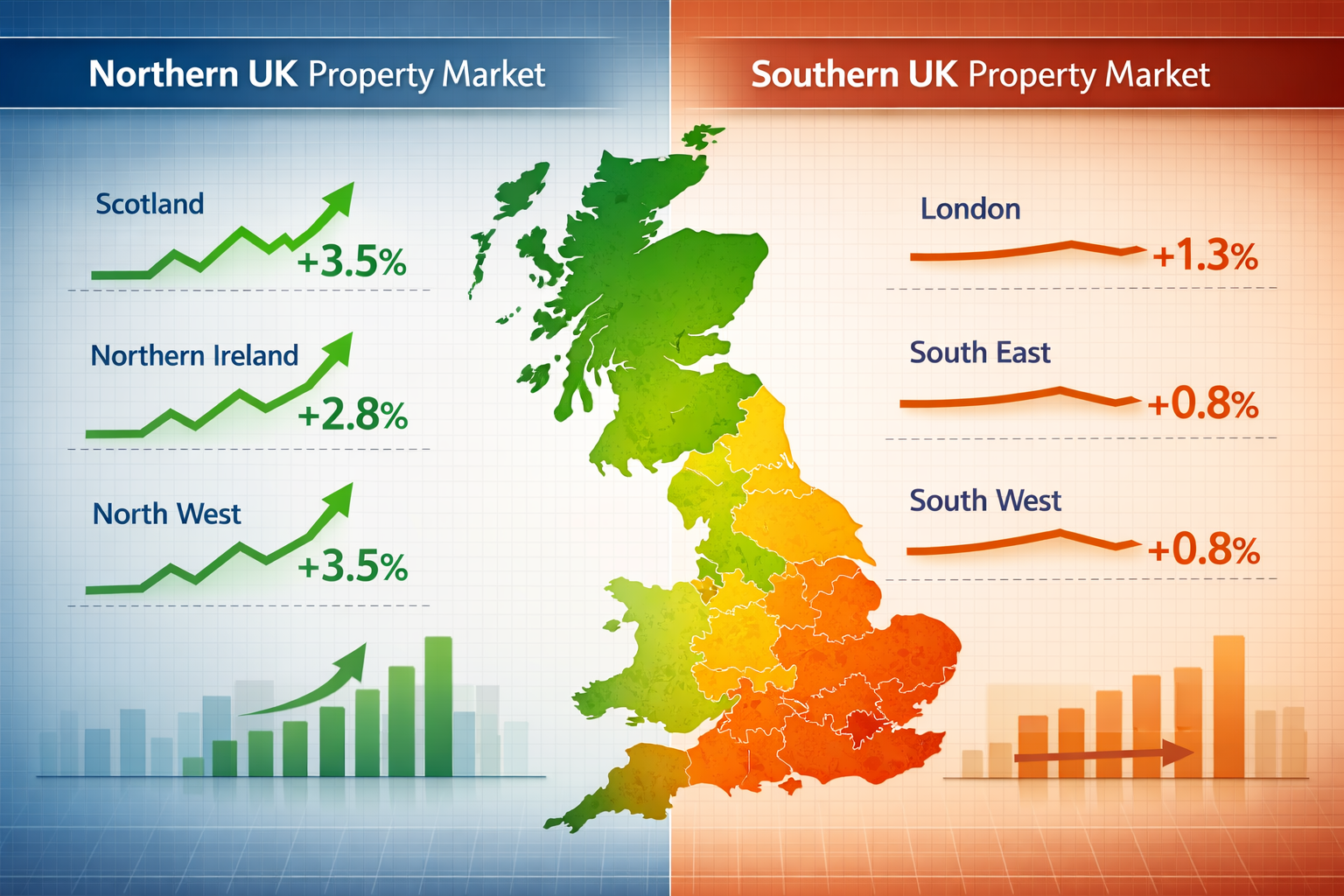
- 🏘️ Regional performance divergence remains stark, with London forecast at just +1.3% growth in 2026 while northern regions show stronger momentum
- 🔍 High-value property segments face intensified pressure, with 83% of offers near the £2 million threshold coming in below asking prices in February 2026
- 💡 Surveyors must adopt enhanced assessment approaches including comprehensive early-stage property profiling, technology integration, and longer-term resilience evaluation
- 📈 Twelve-month sentiment shows recovery potential, with 43% of RICS respondents anticipating higher prices ahead—the strongest outlook since February 2025
Understanding the Current State of Southern Property Markets
The North-South Divide in 2026
The geographical disparity in UK property performance has become increasingly pronounced. According to the RICS January 2026 survey, price growth remains strongest in Scotland and Northern Ireland, with upward trends continuing in the North West and North of England [1]. Meanwhile, London, the South East, South West, and East Anglia continue to lag behind the national average due to persistent affordability challenges.
This divergence creates specific valuation challenges for surveyors working across chartered surveyors in London and surrounding regions. The HomeOwners Alliance analysis reveals that London is expected to see only +1.3% growth in 2026, with average prices at £553,258, but projects a concerning -1.2% decline over the five-year period [2]. Paula Higgins, HomeOwners Alliance CEO, confirms that while UK house prices overall are likely to be around 2% higher in 2026, "higher growth is expected in the north of England than in the south" [2].
Signs of Market Stabilisation
Despite the challenging backdrop, several indicators suggest the southern markets are beginning to stabilise:
- Improved buyer enquiries: The net balance for new buyer enquiries rose to -15% in January 2026, up from -21% in December and -29% in November [1]
- Recovering transaction activity: Agreed sales showed a net balance of -9%, the least negative reading since June 2025 [1]
- Stabilising prices: The net balance for prices over the past three months stood at -10%, improving steadily from a low of -19% in October 2025 [1]
- Positive forward sentiment: 43% of RICS respondents anticipate higher prices over the year ahead, the most positive outlook since February 2025 [1]
These metrics indicate that while southern markets remain subdued compared to northern regions, the downward pressure is easing, creating a transitional environment that demands careful surveyor attention.
Valuation Challenges in Stabilising Southern Markets: Key Considerations for Surveyors
Challenge 1: Assessing Properties in a Transitional Market Phase
When markets shift from decline to stabilisation, comparable evidence becomes particularly complex. Surveyors must navigate:
Recent transaction data reflecting weakness that may no longer accurately represent current sentiment, alongside emerging buyer interest that hasn't yet translated into sufficient completed sales to establish new pricing norms.
For chartered surveyors across South West London and other southern regions, this requires:
✅ Weighted comparable analysis: Giving greater consideration to more recent transactions while acknowledging limited sample sizes
✅ Sentiment integration: Incorporating forward-looking indicators from RICS surveys and local market intelligence
✅ Time-adjustment sensitivity: Applying careful time adjustments to comparables that may span both declining and stabilising periods
✅ Geographic granularity: Recognising that recovery patterns vary significantly across London boroughs and South East locations
Challenge 2: High-Value Property Segment Pressures
The premium property market presents particularly acute challenges. Analysis from February 2026 reveals that 83% of offers on homes priced within 10% of £2 million came in below the threshold, compared to just 64% a year earlier [3]. This represents intensified valuation pressure in segments common across Central London, Chelsea, and Hampstead.
Key considerations for high-value assessments:
| Challenge Area | Surveyor Response |
|---|---|
| Asking price inflation | Focus on achieved prices rather than listing prices; analyse time-on-market data |
| Buyer negotiation leverage | Document typical discount patterns; consider multiple offer scenarios |
| Liquidity constraints | Assess realistic marketing periods; factor in holding costs for vendors |
| Stamp duty thresholds | Understand psychological pricing barriers around £2m and other duty bands |
Challenge 3: Property-Specific Complexity in Southern Housing Stock
Southern markets, particularly London, feature diverse and often non-standard housing stock: period conversions, leasehold flats, mixed-use buildings, and properties with unclear refurbishment histories. According to industry analysis, "the main challenge facing surveying is not access to data but how well information is gathered and used upfront" [4].
Many homes are old with varying build types and unclear refurbishments that can create valuation delays if not identified early [4]. For surveyors conducting homebuyer surveys or more detailed assessments, this necessitates:
🔍 Enhanced early-stage property profiling
🔍 Comprehensive building pathology assessment
🔍 Title and leasehold investigation (particularly relevant for lease extension valuations)
🔍 Planning and alteration history verification
How Surveyors Should Adjust Assessment Methodologies

Adopting Technology-Enhanced Valuation Processes
The integration of technology into valuation workflows has become essential for managing complexity in southern markets. Tools designed to bring together property-specific information from multiple sources at the point of instruction help surveyors understand the property comprehensively before choosing a valuation route [4].
Technology applications for stabilising markets:
📱 Digital data aggregation platforms: Consolidating Land Registry data, EPC records, planning history, and local market intelligence
📱 Automated comparable analysis: Using AI-enhanced tools to identify and weight relevant transactions across transitional periods
📱 Visual documentation systems: Employing drone surveys and 360-degree photography for comprehensive property recording
📱 Client communication portals: Providing transparent, real-time updates on assessment progress and preliminary findings
For chartered surveyors in Surrey, Sussex, and other South East locations, these tools enable more efficient processing of the diverse property types characteristic of these markets.
Prioritising Comprehensive Early-Stage Assessment
The importance of thorough upfront investigation cannot be overstated when dealing with Valuation Challenges in Stabilising Southern Markets. Surveyors should implement structured pre-inspection protocols:
Phase 1: Desktop Analysis (Before Site Visit)
- Title investigation and ownership verification
- Planning history and building control records review
- EPC and energy performance data collection
- Local authority searches and environmental screening
- Comparable transaction research with time-trend analysis
Phase 2: Enhanced Site Inspection
- Detailed building fabric assessment
- Non-invasive defect investigation
- Photographic and measurement documentation
- Neighbourhood and location quality evaluation
- Access and amenity verification
Phase 3: Post-Inspection Validation
- Comparable evidence refinement
- Adjustment calculation and sensitivity testing
- Risk factor identification and disclosure
- Valuation range determination with confidence intervals
This structured approach is particularly valuable for different types of surveys across varying property types and client requirements.
Evaluating Long-Term Property Resilience
As markets stabilise, surveyors must assess longer-term property resilience, not just current value. Energy standards, ongoing maintenance requirements, and future use potential are becoming increasingly relevant to lending decisions [4]. This is particularly critical for properties falling outside the standard mould, such as conversions and mixed-use buildings common in North West London and West London areas.
Resilience factors to incorporate:
🌱 Energy efficiency and sustainability: Current EPC ratings and realistic improvement potential
🌱 Maintenance liability: Deferred maintenance identification and future capital expenditure forecasting
🌱 Adaptability: Potential for reconfiguration, extension, or alternative use
🌱 Location durability: Infrastructure development, transport links, and neighbourhood trajectory
🌱 Regulatory compliance: Building safety, fire regulations, and emerging standards
Implementing Scenario-Based Valuation Approaches
Given the uncertainty inherent in transitional markets, scenario-based valuation provides valuable context for clients and lenders. Rather than presenting a single point estimate, surveyors can offer:
Scenario 1: Conservative (Continued Weakness)
Based on recent comparable evidence with minimal time adjustment, assuming limited buyer competition and continued negotiation pressure.
Scenario 2: Central (Stabilisation)
Reflecting current market conditions with moderate forward-looking adjustments, incorporating improving sentiment indicators and transaction activity.
Scenario 3: Optimistic (Recovery)
Anticipating continued improvement in buyer confidence and activity levels, with comparables adjusted to reflect emerging pricing strength.
This approach provides transparency about market uncertainty while giving clients actionable intelligence for decision-making. It's particularly valuable for expert witness work where valuation methodology must withstand scrutiny.
Regional Variations Within Southern Markets
London Borough Differentiation
Not all London locations are experiencing identical market conditions. Surveyors must recognise micro-market variations:
- Prime Central London: Continued international buyer caution; stamp duty sensitivity; longer marketing periods
- Inner London residential: Improving first-time buyer activity; Help to Buy scheme impacts; leasehold complexity
- Outer London suburbs: Stronger family market; commuter belt appeal; relative affordability driving interest
Chartered surveyors operating across North London, Islington, Clapham, and other specific boroughs must calibrate assessments to local dynamics rather than applying broad London-wide assumptions.
South East Commuter Belt Considerations
The South East presents distinct characteristics:
- Proximity premium: Distance from London stations affecting value differentials
- School catchment sensitivity: Primary and secondary school quality driving location choices
- Green belt constraints: Limited supply supporting values in established locations
- New build competition: Development schemes affecting resale market dynamics
For surveyors working in Guildford, Epsom, St Albans, and similar commuter locations, these factors require explicit consideration in comparable selection and adjustment.

Practical Recommendations for Surveyors
1. Enhance Market Intelligence Gathering
Develop systematic local market monitoring:
- Subscribe to RICS regional surveys and analysis
- Maintain relationships with local estate agents for real-time intelligence
- Track listing-to-sale conversion rates and time-on-market trends
- Monitor mortgage approval data and lending criteria changes
- Participate in professional networks and knowledge-sharing forums
2. Refine Comparable Analysis Techniques
Apply sophisticated comparable weighting:
- Prioritise transactions from the past 3 months over older data
- Apply explicit time adjustments with documented methodology
- Consider withdrawn listings and failed transactions as negative indicators
- Weight arm's-length transactions more heavily than distressed sales
- Document all adjustments transparently for client and lender review
3. Communicate Uncertainty Transparently
Provide context alongside valuations:
- Explain market transition dynamics in valuation reports
- Highlight data limitations and confidence levels
- Offer valuation ranges where appropriate
- Discuss potential value trajectories under different scenarios
- Recommend review periods for volatile or uncertain assessments
4. Invest in Professional Development
Stay current with evolving practices:
- Complete CPD focused on valuation in transitional markets
- Engage with RICS guidance updates and technical standards
- Develop proficiency with valuation technology platforms
- Understand emerging regulatory requirements (EPC, building safety)
- Build expertise in specialist property types common to your operating area
5. Document Methodology Rigorously
Create defensible valuation files:
- Maintain comprehensive comparable databases with source verification
- Document all assumptions, adjustments, and limitations
- Retain correspondence and market intelligence sources
- Create clear audit trails for quality assurance and peer review
- Prepare files anticipating potential future scrutiny or dispute
Looking Ahead: Market Outlook for Southern Regions
While the immediate outlook for southern markets remains modest compared to northern regions, several factors support cautious optimism:
Positive indicators:
- Improving buyer enquiry levels suggesting pent-up demand
- Stabilising price trends indicating bottoming process
- Strong twelve-month sentiment among property professionals
- Potential for interest rate moderation supporting affordability
- Limited supply in many desirable locations providing price support
Ongoing challenges:
- Persistent affordability constraints, particularly in London
- Stamp duty burden affecting transaction volumes
- Economic uncertainty influencing buyer confidence
- Competition from higher-yielding northern markets for investors
- Regulatory changes affecting landlord and leasehold sectors
For surveyors, this mixed picture reinforces the importance of nuanced, evidence-based assessment that acknowledges both challenges and emerging opportunities.
Conclusion
The Valuation Challenges in Stabilising Southern Markets: How Surveyors Should Adjust Assessments as Buyer Confidence Returns to London and the South East require a sophisticated, adaptive approach. As 2026 progresses, the transition from market weakness to stabilisation demands that surveyors recalibrate their methodologies, enhance their use of technology, and provide transparent, well-documented assessments that reflect both current conditions and emerging trends.
Success in this environment requires:
✔️ Comprehensive early-stage property assessment to identify complexity before it creates valuation delays
✔️ Technology-enhanced workflows that aggregate diverse data sources efficiently
✔️ Scenario-based valuation approaches that acknowledge market uncertainty transparently
✔️ Long-term resilience evaluation considering energy performance, maintenance, and adaptability
✔️ Rigorous comparable analysis with explicit time adjustments and confidence indicators
Next Steps for Surveyors
- Review current valuation processes against the recommendations outlined above
- Invest in technology platforms that support comprehensive property profiling
- Enhance market intelligence systems for real-time southern market monitoring
- Update report templates to incorporate scenario analysis and uncertainty disclosure
- Engage with professional development focused on valuation in transitional markets
- Build specialist knowledge of the specific property types and locations within your practice area
By implementing these adjustments, surveyors can deliver accurate, defensible valuations that serve clients, lenders, and the broader market effectively during this critical transitional phase. As buyer confidence gradually returns to London and the South East, those who have refined their assessment methodologies will be best positioned to support sustainable market recovery.
References
[1] Uk Resi Survey Jan 2026 Report Shows Early Signs Market Recovery Despite Caution – https://www.rics.org/news-insights/uk-resi-survey-jan-2026-report-shows-early-signs-market-recovery-despite-caution
[2] House Price Forecast – https://hoa.org.uk/advice/guides-for-homeowners/i-am-buying/house-price-forecast/
[3] Post Budget 2026 Valuation Challenges Surveyor Strategies For High Value Properties Over 2 Million – https://nottinghillsurveyors.com/blog/post-budget-2026-valuation-challenges-surveyor-strategies-for-high-value-properties-over-2-million
[4] 2026 Forecasts Technology And Surveying – https://mortgagesoup.co.uk/2026-forecasts-technology-and-surveying/