

The UK rental market in 2026 presents a paradox that every buy-to-let investor must navigate: while tenant demand remains robust and rental supply stays constrained, affordability pressures are simultaneously cooling rent growth and extending void periods. For building surveyors, this shifting landscape demands a recalibrated approach to property assessments—one that balances traditional structural integrity concerns with the commercial realities of rental yield optimization. Understanding Rental Market Pressures and Building Survey Implications: What Surveyors Should Highlight for Buy-to-Let Investors Amid Rising Tenant Demand has never been more critical as investors seek properties that can weather regulatory changes while maintaining competitive rental returns.

Key Takeaways
- 📊 Annual rent growth has moderated to 3.5% in early 2026, down from pandemic-era peaks, with Rightmove forecasting just 2% growth for the year ahead[1][3]
- 🏠 Rental supply improved 9% year-on-year but remains one-third below decade-ago levels, creating ongoing competition for quality properties[3]
- 🔍 Building surveys must prioritize maintenance-intensive defects that directly impact rental yields, void periods, and tenant retention in competitive markets
- ⚖️ The Renters' Rights Act implementation in May 2026 may trigger landlord exits, making property condition and compliance features more valuable
- 💷 Regional variations are significant, with London showing just 0.8% growth while the North West achieved 3.6%, requiring location-specific survey priorities[3]
Understanding Current Rental Market Pressures in 2026
The rental landscape has undergone substantial transformation since the pandemic-driven surge of 2021-2023. Annual rent growth has decelerated to 3.5% in the 12 months to January 2026, representing the lowest growth rate since March 2022[1]. More tellingly, February 2026 witnessed a month-on-month decline, with average UK rents falling to £1,301 from £1,302 in January—a subtle but significant indicator that tenant affordability limits are being reached[2].
The Supply-Demand Imbalance Persists
Despite improvements, the fundamental supply shortage continues to define the market. Available rental properties have increased 9% compared to a year ago, yet inventory remains approximately one-third lower than a decade ago[3]. This structural deficit explains why tenant competition, though easing from 14 enquiries per property in 2024 to 10 in 2025, still exceeds the pre-pandemic average of 6 enquiries[3].
For surveyors conducting building surveys on potential buy-to-let acquisitions, this context matters enormously. Properties that minimize void periods through superior condition and tenant appeal command premium positioning in markets where supply constraints persist but tenant selectivity increases.
Regional Divergence Shapes Investment Priorities
The national averages mask dramatic regional variations that should inform survey priorities. The North East recorded anaemic growth of just 0.4% annually, while the North West achieved 3.6% and Yorkshire/Humber reached 3.1%[3]. London, historically volatile, showed the weakest performance among major markets with only 0.8% annual growth and a 0.7% decline in the final quarter of 2025, with average rents at £2,716 monthly[3].
Surveyors operating in different regions must calibrate their recommendations accordingly. Properties in high-growth areas like the North West may justify more aggressive renovation investments to capture rising rents, while London properties require meticulous attention to cost control and tenant retention features given the softening market.
Building Survey Implications for Buy-to-Let Investors
Traditional building surveys focus primarily on structural integrity, safety, and long-term maintenance obligations. While these remain essential, Rental Market Pressures and Building Survey Implications: What Surveyors Should Highlight for Buy-to-Let Investors Amid Rising Tenant Demand requires an expanded analytical framework that integrates commercial rental performance metrics.
Prioritizing Defects by Rental Yield Impact
Not all defects carry equal weight for buy-to-let investors. Surveyors should categorize findings based on their impact on:
- Immediate lettability – Defects preventing legal occupation or tenant appeal
- Void period risk – Issues likely to extend marketing time or deter quality tenants
- Ongoing maintenance costs – Problems requiring repeated intervention that erode net yields
- Regulatory compliance – Defects affecting EPC ratings, safety certificates, or upcoming legislation
- Long-term capital preservation – Structural issues threatening asset value
A comprehensive RICS commercial building survey approach adapted for residential buy-to-let should explicitly quantify these impacts wherever possible.
Critical Survey Focus Areas for 2026 Rental Markets
🔥 Heating Systems and Energy Efficiency
With average void periods increasing to 23 days in December 2025 (up from 21 days in December 2024)[4], properties must present competitively. Inefficient or unreliable heating systems represent a dual threat: they increase void risk through poor EPC ratings and create ongoing maintenance call-outs that frustrate tenants.
Surveyor recommendations should include:
- Boiler age, efficiency rating, and expected replacement timeline
- Heating system capacity relative to property size
- Insulation quality in walls, loft, and floors
- Window condition and thermal performance
- Estimated costs to achieve EPC rating improvements
Properties with EPC ratings below 'C' face increasing regulatory pressure, and tenants increasingly prioritize energy costs when selecting rentals.
💧 Damp, Drainage, and Water Ingress
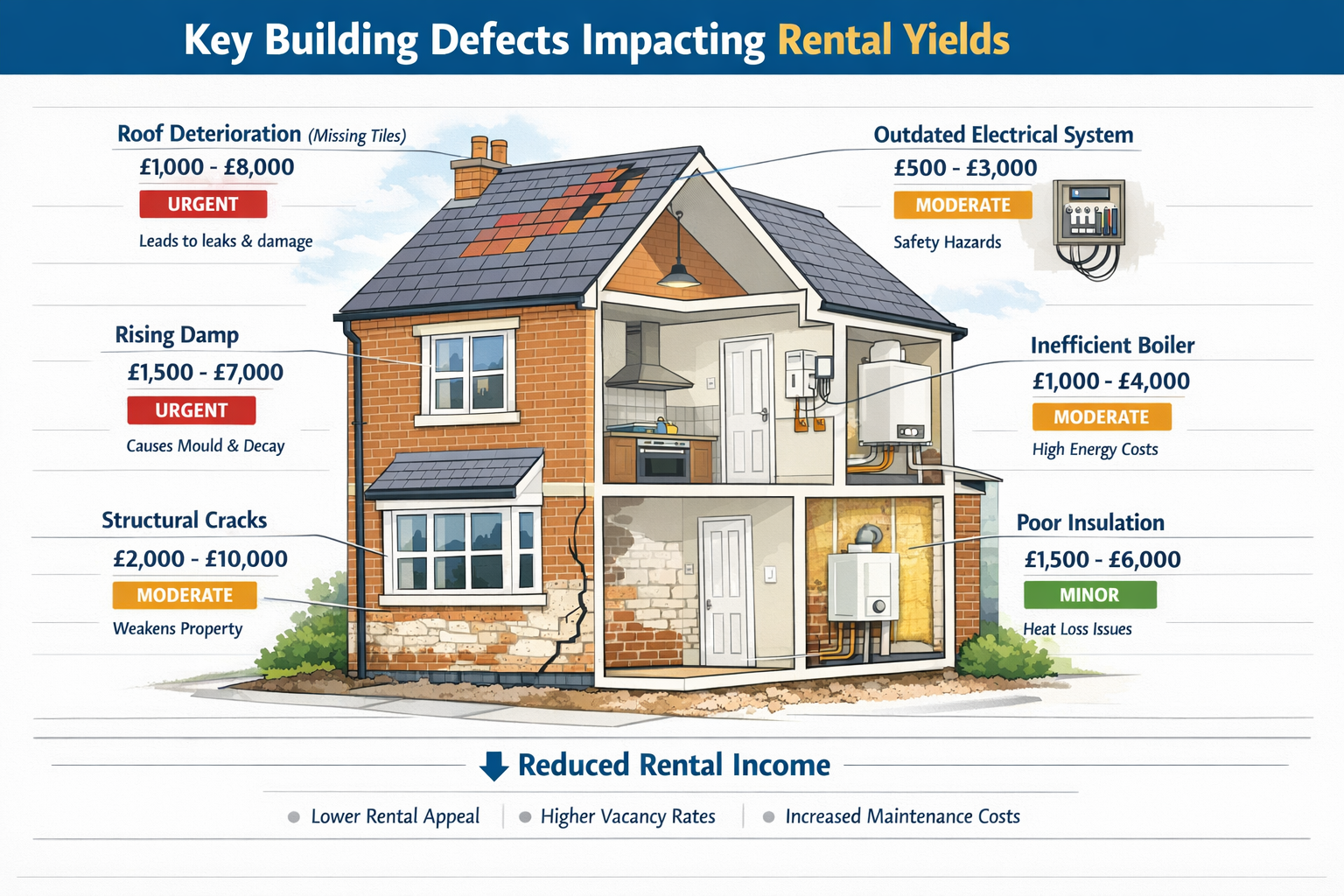
Damp issues remain among the most common tenant complaints and survey findings. Beyond structural concerns, moisture problems directly impact tenant health, satisfaction, and retention. Damp surveys should distinguish between:
- Rising damp requiring DPC installation or renewal
- Penetrating damp from roof, wall, or window defects
- Condensation damp from inadequate ventilation
Each type carries different cost implications and urgency levels. A property with condensation issues might require £2,000-£5,000 in ventilation improvements, while rising damp remediation can exceed £15,000 for a typical terraced house. Understanding damp survey costs helps investors budget appropriately.
⚡ Electrical Safety and Compliance
The Electrical Safety Standards in the Private Rented Sector (England) Regulations 2020 require landlords to ensure electrical installations are inspected and tested at least every five years. Surveyors should note:
- Date of last electrical inspection (EICR certificate)
- Presence of modern consumer unit with RCD protection
- Condition of visible wiring and fixtures
- Adequacy of socket provision for modern tenant needs
- Estimated costs for remedial work or full rewire
Outdated electrical systems not only pose safety risks but can trigger immediate capital expenditure requirements that dramatically affect investment returns.

What Surveyors Should Highlight for Buy-to-Let Investors
Effective surveying for rental investments requires clear communication of findings in language that resonates with investor priorities. Beyond technical descriptions, surveyors should provide actionable intelligence that informs acquisition decisions and negotiation strategies.
Quantifying Repair Costs Against Rental Yields
Investors think in terms of gross and net yields. A property purchased for £250,000 generating £15,600 annual rent (£1,300 monthly) delivers a 6.24% gross yield. However, if survey findings reveal £25,000 in essential repairs, the effective purchase price becomes £275,000, reducing gross yield to 5.67%.
Surveyors should structure reports to include:
| Defect Category | Estimated Cost | Urgency | Impact on Lettability | Yield Impact |
|---|---|---|---|---|
| Roof repairs | £8,000 | High | Prevents letting | -0.29% |
| Boiler replacement | £3,500 | Medium | Reduces tenant appeal | -0.13% |
| Damp remediation | £6,000 | High | Prevents letting | -0.22% |
| Electrical upgrade | £4,500 | High | Legal requirement | -0.16% |
| Cosmetic updates | £3,000 | Low | Improves marketability | -0.11% |
| Total | £25,000 | – | – | -0.91% |
This presentation format allows investors to immediately grasp the financial implications and prioritize negotiations or remediation strategies.
Highlighting Regulatory Compliance Risks
The impending Renters' Rights Act scheduled for May 2026 implementation has created uncertainty among landlords, with industry experts warning of potential landlord exits that could further constrain supply[4]. Surveyors should explicitly address compliance with current and anticipated regulations:
- Minimum Energy Efficiency Standards (MEES) – Current EPC 'E' minimum, potential future 'C' requirement
- Smoke and carbon monoxide alarms – Compliance with current regulations
- Gas safety certificates – Boiler and appliance condition
- Electrical safety standards – EICR validity and required remediation
- HMO licensing – If applicable, compliance with enhanced standards
Properties requiring significant work to meet regulatory standards face both immediate costs and potential void periods during remediation, directly impacting the investment case.
Assessing Tenant Appeal and Void Period Risk
With tenant enquiries per property declining from pandemic highs but still above historical averages, property presentation matters more than ever. Surveyors should comment on factors affecting tenant appeal:
✅ Positive factors:
- Modern kitchen and bathroom fixtures
- Adequate storage space
- Natural light and room proportions
- Garden or outdoor space (particularly post-pandemic)
- Parking availability
- Proximity to transport and amenities
❌ Negative factors:
- Dated or poor-quality finishes
- Awkward layouts or small rooms
- Noise issues (traffic, neighbors, commercial premises)
- Security concerns
- Limited natural light
- Absence of modern conveniences (dishwasher space, shower over bath)
While subjective, these observations help investors understand whether a property will achieve asking rents quickly or face extended void periods that erode annual returns.
Maintenance Liability Assessment
Buy-to-let investors increasingly focus on net yields after accounting for ongoing maintenance. Properties with high maintenance liability—period features, complex roofs, aging systems, or structural movement—require larger reserve funds and generate more tenant management issues.
Surveyors should explicitly categorize properties as:
- Low maintenance – Modern construction, recent systems, minimal ongoing intervention required
- Medium maintenance – Some aging components, periodic replacement cycles predictable
- High maintenance – Period features, ongoing structural issues, frequent intervention likely
A Victorian terrace with original sash windows, aging roof, and evidence of historic movement might generate attractive rents but require 15-20% of rental income for ongoing maintenance versus 5-10% for a modern property. This distinction fundamentally affects net yields and investor suitability.
Regional Considerations for Rental Market Pressures and Building Survey Implications
The divergent regional performance across UK rental markets demands location-specific survey approaches. What constitutes a sound investment in Guildford differs markedly from opportunities in Islington or Hertfordshire.
London and South East: Quality Over Quantity
With London rental growth slowing to just 0.8% and rents declining 0.7% in Q4 2025[3], the capital's market has shifted from a landlord's to a more balanced environment. Surveyors assessing properties in North West London, Battersea, or Hampstead should emphasize:
- Premium finishes and specification – Tenants have more choice and demand higher standards
- Transport connectivity – Proximity to tube/rail stations commands premium rents
- Space efficiency – Every square meter must justify its cost
- Energy efficiency – Higher-earning tenants increasingly prioritize sustainability
Properties requiring significant investment to achieve competitive specification may struggle to justify costs in a moderating market.
Regional Growth Markets: Value-Add Opportunities
Areas like the North West (3.6% growth) and Yorkshire/Humber (3.1% growth) present different dynamics[3]. Surveyors working in these markets can afford to be more optimistic about value-add strategies, as rising rents may justify renovation investments that wouldn't work in London.
Key survey considerations include:
- Potential for reconfiguration to add bedrooms or improve layouts
- Scope for cosmetic improvements to justify premium rents
- Opportunities to improve EPC ratings cost-effectively
- Comparison to local rental stock standards
A property requiring £15,000 in improvements might be viable in a rising market where rents are growing 3-4% annually, but questionable in a flat or declining market.
The Impact of Improved Landlord Affordability on Survey Priorities
Buy-to-let mortgage activity has recovered significantly, with new mortgages up 13% year-on-year to October 2025 and remortgaging activity up 23%[3]. Average two-year fixed buy-to-let rates have fallen to 4.84% (for 25% deposit) from 5.51% a year earlier[3], improving investor affordability and potentially supporting additional rental supply.
Financing Implications for Survey Recommendations
Lower borrowing costs change the calculus for renovation investments. At 5.5% mortgage rates, a £20,000 renovation financed through additional borrowing costs £1,100 annually in interest. At 4.84%, this falls to £968—a £132 annual saving that improves the business case for improvements.
Surveyors should consider:
- Whether defects are better addressed pre-purchase (negotiated price reduction) or post-purchase (financed renovation)
- The impact of renovation timelines on void periods
- Whether improvements can be staged to maintain rental income
- The potential for increased rental income to justify borrowing costs
Understanding surveyor pricing helps investors budget for professional assessments that inform these decisions.
Preparing for the Renters' Rights Act: Survey Considerations
The May 2026 implementation of the Renters' Rights Act represents the most significant regulatory change to the private rental sector in years. While full details continue to emerge, surveyors should help investors understand compliance implications.
Anticipated Regulatory Changes
Expected provisions include:
- Abolition of Section 21 "no-fault" evictions
- Strengthened tenant rights to request property improvements
- Enhanced enforcement powers for local authorities
- Potential minimum standards beyond current MEES requirements
Survey implications include:
- Properties must be maintained to higher standards to avoid tenant complaints
- Defects that tenants can legitimately request repairs for should be identified
- Compliance with all current regulations becomes more critical
- Properties with marginal economics may become unviable
Investors considering properties with significant deferred maintenance should understand that the regulatory environment increasingly favors tenant rights, making proactive property improvement more important than ever.
Property Selection in a Changing Regulatory Environment
Surveyors can add value by helping investors identify properties that will thrive under enhanced regulation:
🏆 Preferred characteristics:
- Modern construction with lower maintenance requirements
- Good EPC ratings (C or above)
- Compliant electrical and gas systems
- Quality fixtures and fittings
- Sound structural condition
⚠️ Higher-risk characteristics:
- Period properties with ongoing maintenance needs
- Poor EPC ratings requiring significant investment
- Evidence of structural movement or subsidence
- Aging mechanical and electrical systems
- Properties in areas with active local authority enforcement
Integrating Survey Findings Into Investment Decisions
The ultimate value of a building survey lies in how effectively it informs the investment decision. Surveyors should present findings in formats that facilitate clear decision-making.
The Three-Scenario Approach
For each significant property, surveyors might present three scenarios:
Scenario 1: Minimum Intervention
- Essential repairs only (safety, legal compliance)
- Estimated cost: £X
- Expected rental income: £Y
- Gross yield: Z%
- Void period risk: Medium-High
Scenario 2: Standard Refurbishment
- Essential repairs plus cosmetic improvements
- Estimated cost: £X
- Expected rental income: £Y (10-15% premium)
- Gross yield: Z%
- Void period risk: Low-Medium
Scenario 3: Premium Specification
- Comprehensive renovation to premium standard
- Estimated cost: £X
- Expected rental income: £Y (20-30% premium)
- Gross yield: Z%
- Void period risk: Low
This framework allows investors to understand the relationship between investment level, rental income potential, and risk—critical for making informed decisions in competitive markets.
Timing Considerations
Survey reports should address timing implications:
- Immediate pre-letting work (1-2 weeks): Essential safety and compliance items
- Short-term improvements (1-3 months): Value-add renovations before first letting
- Medium-term maintenance (1-2 years): Predictable component replacements
- Long-term capital items (3-10 years): Major systems requiring future investment
Understanding the timeline for various interventions helps investors plan cash flows and void periods strategically.
Leveraging Specialist Surveys for Rental Properties
Beyond standard homebuyer surveys, certain specialist assessments add particular value for buy-to-let investors:
Drainage Surveys
Drainage issues can be catastrophic for rental properties, creating uninhabitable conditions and expensive emergency repairs. A drainage survey using CCTV inspection can identify:
- Root ingress in older clay pipes
- Collapsed or misaligned sections
- Inadequate falls or drainage capacity
- Shared drainage arrangements with neighbors
The £300-£600 cost of a drainage survey is negligible compared to the £5,000-£15,000 cost of major drainage repairs discovered after purchase.
Structural Engineering Assessments
Properties showing evidence of movement, cracking, or structural alterations benefit from specialist structural surveys that can:
- Distinguish between historic settled movement and ongoing issues
- Assess adequacy of previous structural repairs
- Evaluate structural implications of alterations
- Provide monitoring recommendations if needed
For buy-to-let investors, the key question is whether structural issues will require ongoing intervention or represent stable historic movement. The distinction dramatically affects maintenance budgets and insurability.
Specific Defect Reports
When initial surveys identify particular concerns—damp, subsidence, roofing issues—targeted specific defect reports provide detailed analysis and remediation cost estimates that inform negotiation strategies.
The Surveyor's Role in Competitive Offer Situations
With rental supply improving but still constrained, desirable buy-to-let properties often attract multiple investor interest. Surveyors can support competitive offers through:
Rapid Turnaround Assessments
Understanding how long a homebuyer's survey takes helps investors plan timelines, but rental market pressures may require accelerated assessments. Surveyors offering 48-72 hour turnaround on reports provide competitive advantage in fast-moving markets.
Pre-Offer Desktop Assessments
For experienced investors considering multiple properties, desktop assessments using available information (EPC, listing photos, local knowledge, property age and type) can provide preliminary risk assessment before committing to full surveys on shortlisted properties.
Clear Risk Categorization
Busy investors benefit from executive summary formats that clearly categorize properties:
🟢 Low Risk – Proceed with confidence, minor issues only
🟡 Medium Risk – Viable with budgeted repairs, negotiate price reduction
🔴 High Risk – Significant issues, reconsider or substantial price adjustment required
This clear communication facilitates rapid decision-making in competitive situations.
Conclusion
The UK rental market in 2026 presents both opportunities and challenges for buy-to-let investors. While rent growth has moderated from pandemic peaks and tenant affordability pressures are evident, the fundamental supply-demand imbalance persists, maintaining structural support for rental investments. However, success increasingly depends on property selection, condition, and management rather than simply benefiting from rising markets.
Rental Market Pressures and Building Survey Implications: What Surveyors Should Highlight for Buy-to-Let Investors Amid Rising Tenant Demand requires surveyors to evolve beyond traditional structural assessments toward comprehensive investment analysis. By quantifying repair costs against rental yields, highlighting regulatory compliance risks, assessing tenant appeal factors, and providing clear scenario-based recommendations, surveyors become invaluable partners in investment decision-making.
Actionable Next Steps for Investors
-
Engage qualified surveyors early – Commission comprehensive building surveys before committing to purchases, ensuring reports address rental-specific considerations
-
Request yield-impact analysis – Ask surveyors to quantify how identified defects affect investment returns, not just describe technical issues
-
Consider regional dynamics – Align survey priorities with local market conditions, recognizing that London, regional cities, and rural markets require different approaches
-
Budget for regulatory compliance – Ensure survey reports explicitly address current and anticipated regulatory requirements, particularly ahead of the May 2026 Renters' Rights Act implementation
-
Plan maintenance reserves – Use survey findings to establish realistic ongoing maintenance budgets, typically 10-20% of rental income depending on property age and condition
-
Prioritize tenant appeal – Focus on properties and improvements that minimize void periods, as extended vacancies increasingly erode returns in moderating markets
The rental market of 2026 rewards investors who combine thorough due diligence with strategic property selection. Building surveys remain the cornerstone of this due diligence, but their value multiplies when surveyors understand and address the commercial realities of rental investment in an evolving regulatory and economic landscape.
References
[1] February2026 – https://www.ons.gov.uk/economy/inflationandpriceindices/bulletins/privaterentandhousepricesuk/february2026
[2] Uk Rents Dip In February Led By London Falls – https://www.property118.com/uk-rents-dip-in-february-led-by-london-falls/
[3] Uk Rents Rightmove Forecast 2026 – https://propertyportfolioinvestor.co.uk/investment-insights/uk-rents-rightmove-forecast-2026/
[4] Market Rent Growth Edges Up 2 As Landlords Brace For 2026 Shift – https://landlordknowledge.co.uk/market-rent-growth-edges-up-2-as-landlords-brace-for-2026-shift/