

As the UK property market transitions from uncertainty to cautious optimism in 2026, a fundamental shift is occurring in how buyers approach building surveys. Building Survey Defect Prioritization in 2026's Recovering Market: What Buyers Care About as Confidence Returns has become the critical differentiator between successful property purchases and costly mistakes. During the market downturn, many buyers overlooked significant defects just to secure a property. Now, with renewed confidence and improved negotiating power, purchasers are scrutinizing every crack, damp patch, and structural concern with unprecedented attention to detail.
This transformation reflects a market where buyers no longer feel pressured to compromise. Instead, they're demanding comprehensive surveys with clear defect hierarchies that distinguish between urgent structural issues and minor cosmetic concerns. The question is no longer whether to conduct a survey, but rather how to interpret and prioritize the findings to make informed decisions in a recovering marketplace.
Key Takeaways
- 🏠 Buyers now have significant negotiating leverage to request price reductions, demand repairs, or walk away from properties with serious defects as market confidence returns
- 📊 Clear defect prioritization systems (critical/urgent/routine) are essential for distinguishing between structural emergencies and minor maintenance issues
- 🔍 Structural integrity concerns including subsidence, damp penetration, and roof failures take absolute priority over cosmetic defects in 2026's recovering market
- 💰 Survey findings directly influence purchase negotiations, with buyers using detailed defect reports to secure price adjustments averaging 5-15% on properties with significant issues
- ⚡ Professional survey reports must deliver actionable intelligence with cost estimates, urgency ratings, and repair timelines to support confident decision-making
Understanding Building Survey Defect Prioritization in 2026's Recovering Market
The property market landscape of 2026 presents unique opportunities for informed buyers. As confidence returns following the cooling period, purchasers are discovering they have considerably more agency than in previous years. This shift has fundamentally changed how building survey defects should be evaluated and prioritized[1].
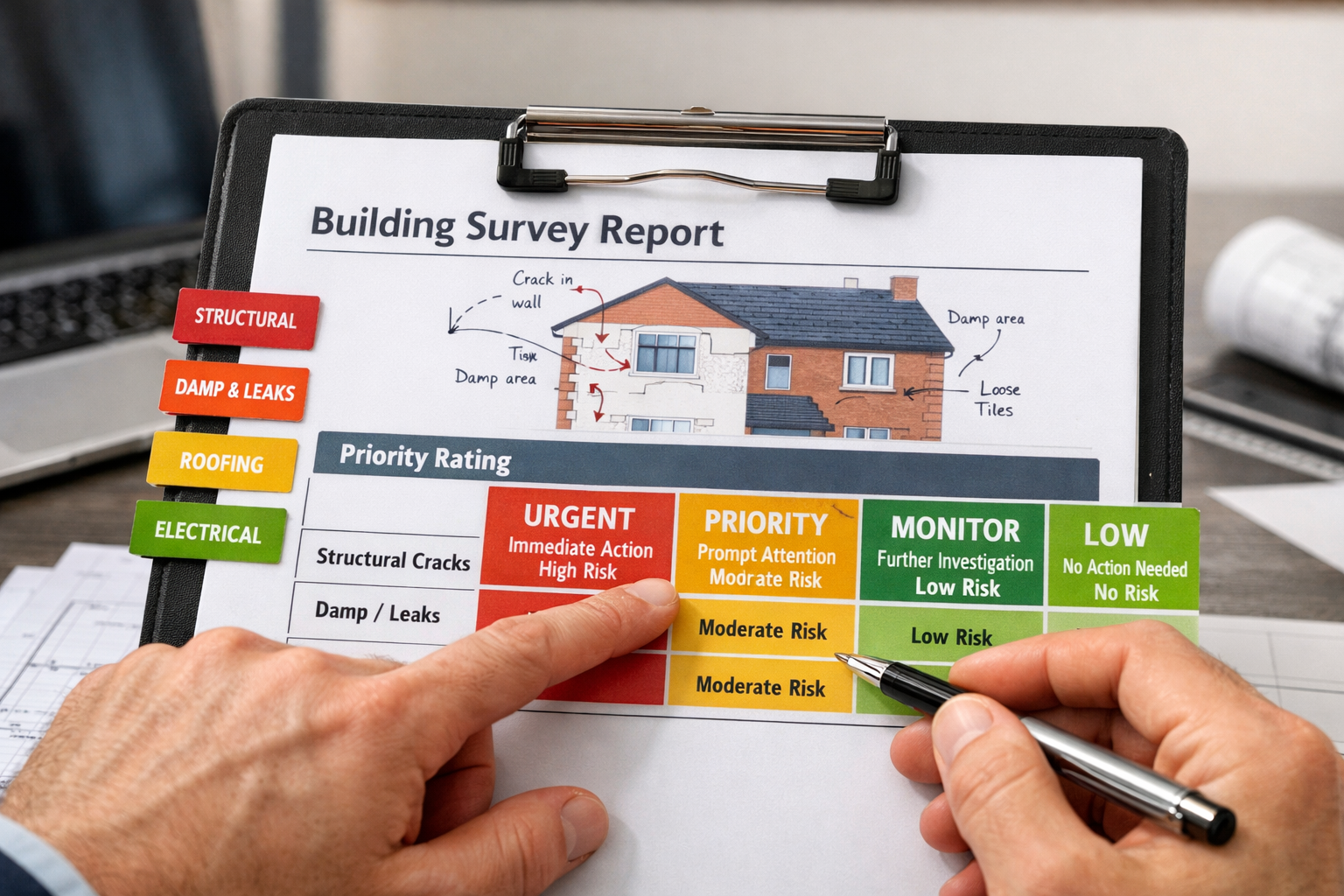
The Three-Tier Priority System
Modern building surveys now employ a sophisticated classification system that helps buyers understand exactly what they're facing:
Critical Defects (Red Flag Issues) 🚨
- Structural movement and subsidence requiring immediate investigation
- Active water penetration causing ongoing damage
- Roof failures with imminent collapse risk
- Electrical systems presenting safety hazards
- Defective drainage causing foundation undermining
Urgent Defects (Amber Warnings) ⚠️
- Progressive dampness requiring intervention within 12 months
- Deteriorating timber elements showing early decay
- Aging heating systems approaching end-of-life
- External envelope failures allowing weather ingress
- Outdated wiring requiring modernization
Routine Maintenance (Green Observations) ✅
- Cosmetic decoration requirements
- Minor surface cracks from settlement
- Aging but functional fixtures
- Recommended upgrades for efficiency
- Preventative maintenance suggestions
This hierarchical approach enables buyers to make rational decisions about which properties warrant further investigation, which require price negotiation, and which should be avoided entirely.
How Market Recovery Changes Defect Priorities
During the market downturn, buyers often felt compelled to accept properties with significant defects simply to secure ownership. The recovering market of 2026 has reversed this dynamic entirely. Buyers now possess the leverage to negotiate repairs, request substantial price reductions based on survey findings, or simply walk away from problematic properties[1].
This newfound power means that defect prioritization serves a dual purpose:
- Risk Assessment: Understanding which issues pose genuine threats to property value and safety
- Negotiation Strategy: Identifying defects that justify price adjustments or repair conditions
A comprehensive RICS building survey provides the detailed defect analysis necessary for both purposes, delivering clear prioritization that distinguishes between issues requiring immediate attention versus lower-priority concerns[1].
Critical Defects That Demand Immediate Attention in 2026
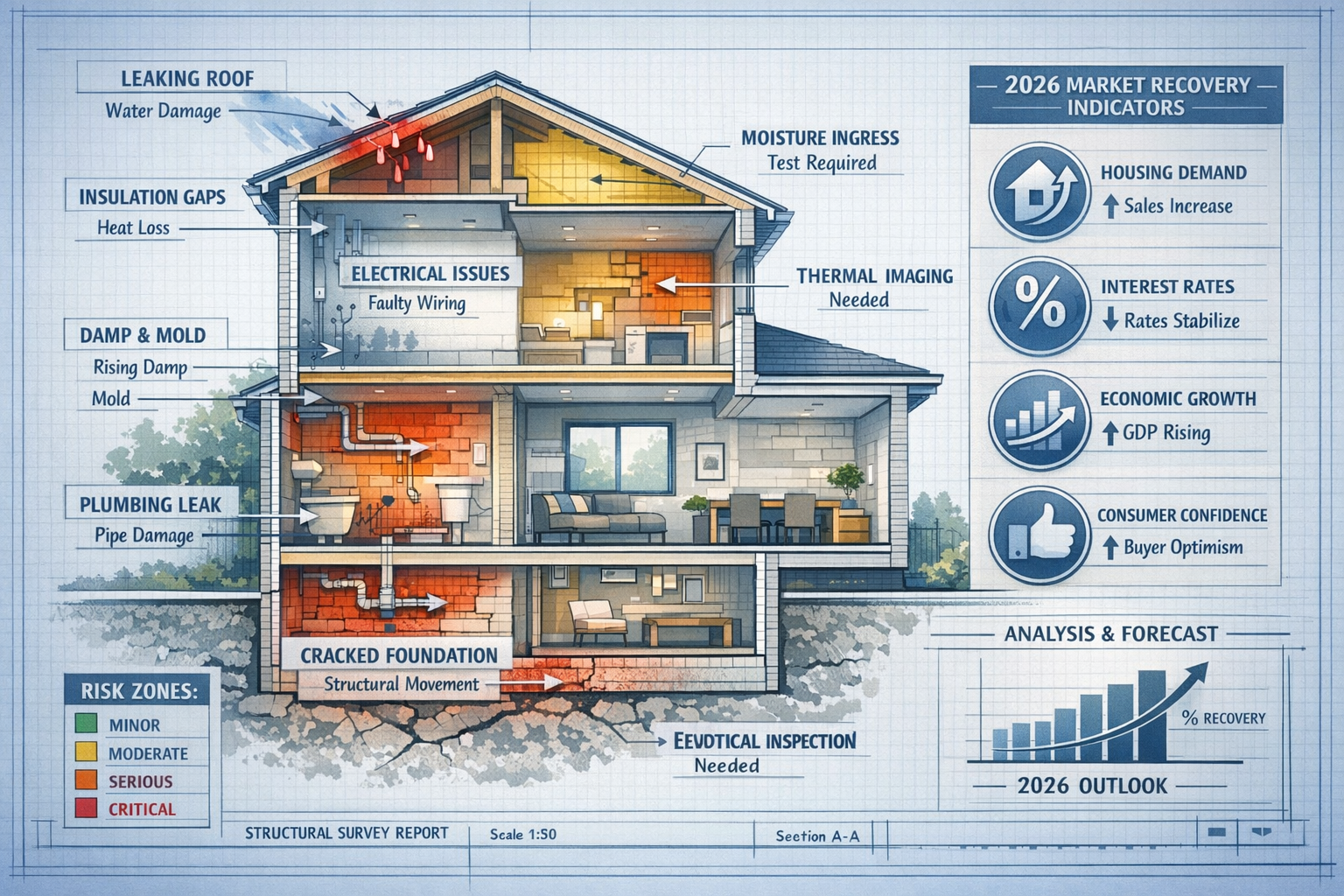
Not all building defects are created equal. In the recovering market of 2026, certain issues have emerged as absolute deal-breakers or significant negotiation points that buyers simply cannot afford to overlook.
Structural Integrity Issues
Subsidence and Foundation Movement
Subsidence remains the most serious defect category, potentially costing £10,000-£50,000+ to remediate. Signs include:
- Progressive cracking wider than 3mm
- Diagonal cracks near doors and windows
- Stepped cracking in brickwork
- Doors and windows binding in frames
- Visible floor level changes
Buyers discovering subsidence evidence should immediately commission a specialist subsidence survey to determine the cause, extent, and remediation requirements. In 2026's market, subsidence findings typically result in either significant price reductions (15-25%) or complete withdrawal from purchase.
Roof Structure Failures
Roof defects represent both immediate safety concerns and substantial financial liabilities. Critical roof issues include:
| Defect Type | Urgency Level | Typical Cost Range |
|---|---|---|
| Structural timber decay | Critical | £15,000-£40,000 |
| Sagging ridge lines | Urgent | £8,000-£20,000 |
| Failed roof covering | Urgent | £5,000-£15,000 |
| Inadequate support | Critical | £12,000-£35,000 |
| Water ingress damage | Urgent | £3,000-£12,000 |
Professional roof surveys using drone technology can identify these issues before they become catastrophic failures, providing buyers with accurate cost estimates for negotiation purposes.
Damp and Water Penetration
Rising Damp and Failed Damp Proof Courses
Rising damp affects approximately 15% of UK properties and requires prompt intervention. Indicators include:
- Tide marks on internal walls (typically up to 1 meter height)
- Peeling wallpaper and damaged plaster
- Musty odors and mold growth
- Salt deposits (efflorescence) on masonry
- Rotting skirting boards and floor timbers
The cost of installing or repairing damp proof courses ranges from £1,500-£5,000 for typical properties, but associated repairs to damaged plaster, timber, and decorations can triple this figure.
Penetrating Damp and Envelope Failures
Unlike rising damp, penetrating damp enters through defective external walls, roofs, or windows. In 2026's recovering market, buyers are particularly cautious about:
- Cavity wall tie failure (£3,000-£8,000 to remedy)
- Defective pointing and rendering (£2,000-£10,000)
- Failed window seals and frames (£500-£1,500 per window)
- Chimney stack deterioration (£1,500-£5,000)
These defects often appear minor initially but can cause extensive internal damage if left unaddressed. A comprehensive Level 3 building survey provides the detailed investigation necessary to identify all moisture ingress routes.
Electrical and Heating System Deficiencies
Outdated and Unsafe Electrical Installations
Electrical systems more than 25-30 years old typically require complete replacement. Critical concerns include:
- Absence of RCD protection (£500-£1,200 to install)
- Aluminum wiring (£3,000-£8,000 for full rewire)
- Insufficient earthing arrangements
- Overloaded circuits and inadequate capacity
- Non-compliant consumer units
Buyers should insist on an EICR (Electrical Installation Condition Report) for any property with electrical concerns, using findings to negotiate price reductions or require remediation before completion.
Failing Heating Systems
Boilers approaching 15+ years of age represent significant replacement liabilities:
- New boiler installation: £2,000-£4,000
- Full central heating system: £4,000-£8,000
- Heat pump conversion: £8,000-£15,000
In 2026's market, buyers increasingly request heating system warranties or price adjustments to account for imminent replacement costs.
Secondary Defects: Important But Negotiable Issues
While critical defects demand immediate attention, secondary issues still significantly impact property value and livability. Understanding how to prioritize these concerns helps buyers make informed decisions about which battles to fight during negotiations.
Progressive Deterioration Issues
Timber Decay and Infestation
Timber defects fall into a middle category—serious enough to address but rarely deal-breakers:
- Wet rot: Localized decay from moisture exposure (£500-£3,000 per area)
- Dry rot: More serious fungal attack requiring extensive treatment (£2,000-£10,000+)
- Woodworm: Active infestation requiring treatment (£500-£2,000)
The key distinction is between active and historic issues. Active timber decay requires prompt treatment, while evidence of previous treatment (with guarantees) may require no action.
External Envelope Deterioration
External maintenance issues that will require attention within 2-5 years include:
- Aging render and external coatings
- Deteriorating fascias and soffits
- Weathered external joinery
- Aging flat roof coverings
- Defective guttering and downpipes
These items typically cost £5,000-£15,000 collectively to address and represent reasonable negotiation points, particularly when multiple issues exist simultaneously.
Building Services Approaching End-of-Life
Modern buyers in 2026 recognize that aging building services represent deferred costs that should influence purchase price:
Plumbing Systems
- Lead pipes requiring replacement (£1,500-£4,000)
- Aging galvanized steel pipework
- Outdated bathroom and kitchen installations
- Inefficient or failing water heating
Drainage and Below-Ground Services
- Aging clay drainage pipes prone to root ingress
- Defective inspection chambers
- Inadequate surface water disposal
- Soakaway failures
For properties with drainage concerns, buyers should consider commissioning a specialized drainage survey using CCTV technology to identify defects before they cause expensive emergencies.
Energy Efficiency and Compliance Issues
With increasing focus on energy costs and environmental performance, buyers in 2026 are prioritizing:
- EPC ratings below 'C' (potentially affecting future saleability)
- Absence of cavity wall insulation (£500-£2,500 to install)
- Single-glazed windows (£5,000-£15,000 for replacement)
- Inadequate loft insulation (£300-£1,000 to upgrade)
- Inefficient heating systems
While not critical safety issues, these defects significantly impact running costs and future property value, making them legitimate negotiation points in the recovering market.
Leveraging Survey Findings for Negotiation in 2026's Market
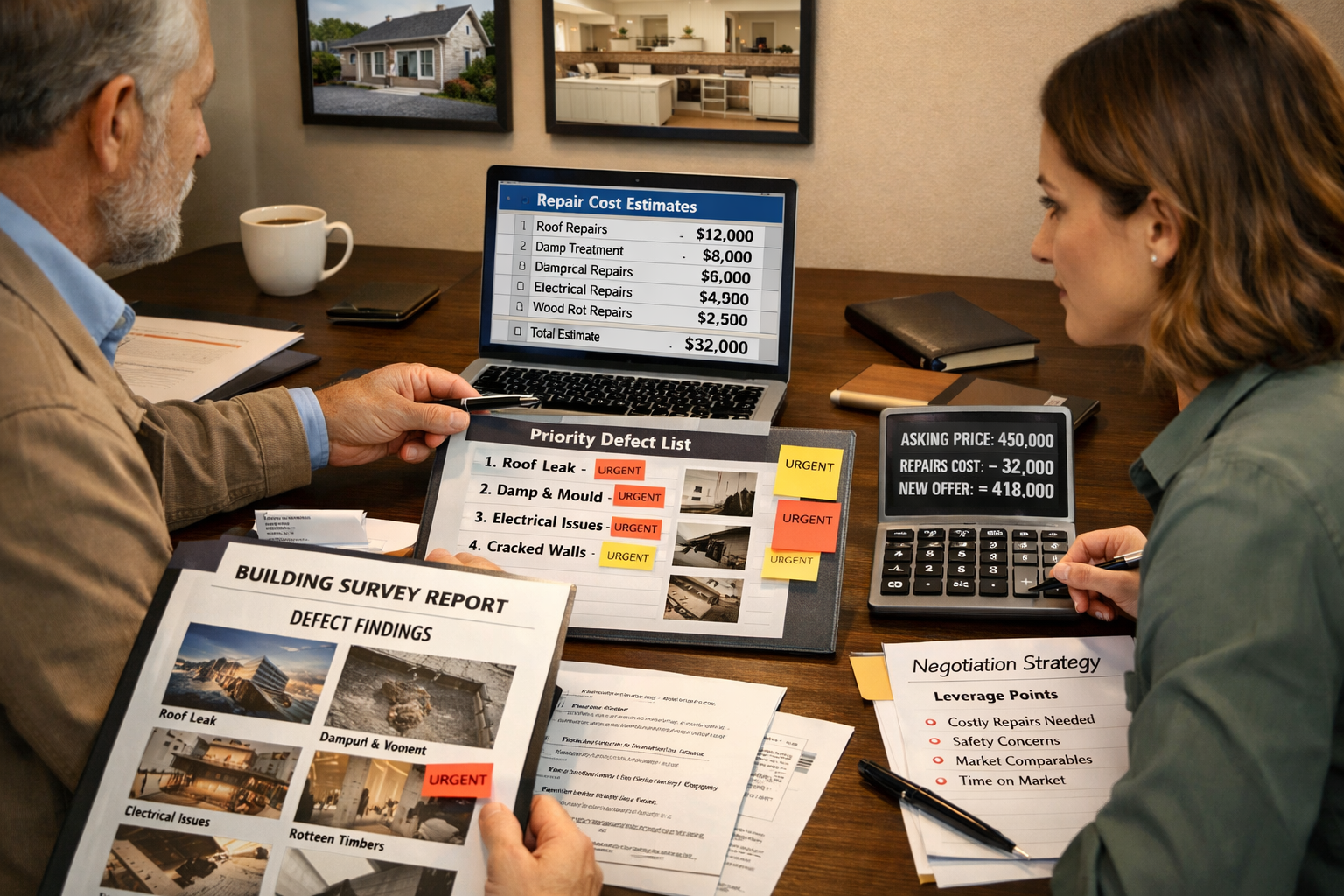
The true value of Building Survey Defect Prioritization in 2026's Recovering Market: What Buyers Care About as Confidence Returns lies not just in identifying problems, but in converting that knowledge into negotiating advantage.
Converting Defects into Price Adjustments
Buyers now possess significant leverage to negotiate repairs, request price reductions based on defect findings, and walk away from problematic properties[1]. The key is presenting a logical, evidence-based case:
The Negotiation Framework
- Quantify All Defects: Obtain contractor quotes for all significant repairs
- Categorize by Priority: Use the three-tier system to demonstrate urgency
- Calculate Total Exposure: Sum all remediation costs
- Apply Negotiation Factor: Request 50-100% of critical defects, 30-50% of urgent issues
- Present Professional Evidence: Use the detailed survey report as authoritative support
Example Negotiation Scenario
Consider a property offered at £450,000 with survey findings revealing:
- Subsidence requiring underpinning: £25,000
- Roof timber decay and re-covering: £18,000
- Damp proof course failure: £6,000
- Electrical rewiring required: £7,000
- Total remediation cost: £56,000
A reasonable negotiation approach might request:
- 75% of critical structural costs (£18,750 for subsidence)
- 50% of urgent roof and damp issues (£12,000)
- 30% of electrical work (£2,100)
- Total reduction request: £32,850 (approximately 7.3% of asking price)
This approach acknowledges that buyers accept some repair responsibility while ensuring major defects don't create unfair financial burden.
When to Walk Away
Despite improved negotiating power, some defect combinations justify complete withdrawal:
Red Flag Combinations 🚫
- Multiple structural issues indicating fundamental instability
- Extensive concealed defects suggesting poor maintenance history
- Remediation costs exceeding 15-20% of purchase price
- Defects requiring access to neighboring properties
- Issues that will affect future insurance or saleability
Understanding the difference between Level 2 and Level 3 surveys helps buyers select the appropriate investigation depth for their target property, ensuring all significant defects are identified before commitment.
Using Survey Timelines to Your Advantage
One often-overlooked aspect of defect prioritization is timing. Understanding how long a homebuyer survey takes allows buyers to schedule inspections strategically within the transaction timeline, maximizing negotiating leverage while maintaining momentum.
Strategic Timing Considerations:
- Commission surveys early to allow time for specialist follow-up investigations
- Use survey findings to pause exchange while negotiating remediation
- Request vendor-commissioned specialist reports for significant defects
- Consider retention clauses for works to be completed post-purchase
- Build contingency periods into offer conditions
Professional Survey Selection: Matching Investigation to Property Risk
Not all properties require the same level of investigation. Building Survey Defect Prioritization in 2026's Recovering Market: What Buyers Care About as Confidence Returns depends fundamentally on selecting the appropriate survey type.
Survey Type Selection Matrix
| Property Characteristics | Recommended Survey | Typical Cost | Defect Detection Level |
|---|---|---|---|
| Modern (post-1990), good condition | Level 2 Homebuyer | £400-£800 | Standard defects |
| Pre-1980, standard construction | Level 3 Building Survey | £600-£1,200 | Comprehensive |
| Pre-1900, altered, or unusual | Level 3 + Specialists | £800-£2,000+ | Exhaustive |
| Specific concerns identified | Targeted specialist surveys | £300-£800 each | Issue-specific |
When to Commission Specialist Investigations
Comprehensive building surveys identify issues requiring specialist follow-up. In 2026's recovering market, buyers routinely commission:
- Structural engineers for movement, cracking, or load-bearing concerns
- Damp specialists for moisture issues requiring invasive investigation
- Electrical contractors for EICR testing on older installations
- Drainage surveyors for below-ground defects
- Timber specialists for decay and infestation assessment
The cost of these additional investigations (typically £300-£800 each) pales compared to the financial protection they provide through accurate defect identification and remediation costing.
Understanding Survey Report Formats
Modern survey reports should deliver clear defect prioritization that distinguishes between issues requiring immediate attention versus lower-priority concerns[1]. Look for reports that provide:
✅ Color-coded priority systems (red/amber/green classifications)
✅ Estimated cost ranges for all significant defects
✅ Urgency timelines indicating when action is required
✅ Photographic evidence documenting all defects
✅ Recommendations for specialist follow-up where needed
✅ Executive summary highlighting critical issues
Professional surveyors should also be available to discuss findings and support negotiation strategy, providing clarity on which defects justify price adjustments.
The Future of Defect Prioritization: Trends Shaping 2026 and Beyond
As the property market continues its recovery trajectory, several emerging trends are reshaping how buyers approach building survey defect prioritization.
Technology-Enhanced Defect Detection
Thermal Imaging and Moisture Mapping
Advanced diagnostic tools now enable surveyors to identify defects invisible to conventional inspection:
- Thermal cameras revealing insulation gaps and air leakage
- Moisture meters providing precise dampness readings
- Drone surveys accessing difficult roof areas safely
- 3D scanning creating detailed property models
These technologies improve defect detection accuracy while providing compelling visual evidence for negotiation purposes.
Climate Resilience Considerations
Buyers in 2026 increasingly prioritize climate-related vulnerabilities:
- Flood risk and drainage adequacy
- Overheating potential in summer months
- Storm resilience of roof and envelope
- Adaptation potential for future climate conditions
Properties with climate vulnerabilities face increasing difficulty in the resale market, making these considerations legitimate priority factors.
Regulatory Compliance and Future-Proofing
Anticipated regulatory changes influence defect prioritization:
- EPC minimum standards potentially rising to 'C' rating
- Building Safety Act implications for certain properties
- Electrical safety requirements becoming more stringent
- Energy efficiency mandates affecting older buildings
Buyers are increasingly requesting surveys that assess compliance with emerging regulations, not just current standards.
The Rise of Retention and Insurance Solutions
Rather than walking away from properties with defects, 2026 buyers are increasingly using:
Retention Arrangements
- Holding back purchase funds to cover specific repairs
- Requiring vendor completion of critical works before exchange
- Staged payments linked to remediation milestones
Specialist Insurance Products
- Structural warranties covering identified defects
- Subsidence insurance for properties with movement history
- Defect liability policies providing financial protection
These mechanisms allow transactions to proceed while protecting buyers from defect-related financial exposure.
Practical Steps: Implementing Effective Defect Prioritization
For buyers navigating the 2026 property market, implementing a systematic approach to defect prioritization maximizes both protection and negotiating advantage.
The Pre-Survey Phase
1. Select the Right Survey Type
Match investigation depth to property risk using the selection matrix above. When in doubt, opt for more comprehensive investigation—the additional £200-£400 cost is negligible compared to undiscovered defects.
2. Choose Qualified Surveyors
Select RICS-registered surveyors with:
- Relevant local market knowledge
- Experience with your property type and age
- Clear, comprehensive reporting standards
- Availability for post-survey consultation
3. Communicate Specific Concerns
Brief your surveyor on any issues you've observed or concerns about particular building elements, ensuring focused attention on priority areas.
The Post-Survey Phase
1. Review and Categorize Findings
Work through the survey report systematically:
- Highlight all critical defects requiring immediate attention
- List urgent issues needing action within 12-24 months
- Note routine maintenance items for future planning
- Identify items requiring specialist investigation
2. Obtain Remediation Costings
Commission contractor quotes for all significant defects to establish accurate negotiation figures. Three quotes per major item provide robust evidence.
3. Develop Negotiation Strategy
Decide your approach:
- Full price reduction for all defects
- Vendor remediation of critical issues before completion
- Retention arrangement with funds held for specific works
- Combination approach addressing different defect categories differently
4. Consider Specialist Follow-Up
For properties with significant defects, commission specialist investigations before finalizing negotiations. The additional certainty justifies the cost.
The Negotiation Phase
Present Evidence Professionally
Create a structured negotiation document including:
- Survey executive summary highlighting key defects
- Categorized defect list with priority classifications
- Contractor quotations for remediation
- Photographic evidence from survey report
- Proposed price adjustment with clear justification
Maintain Transaction Momentum
While negotiating firmly on significant defects, avoid creating adversarial dynamics that jeopardize the transaction. Focus on evidence-based requests rather than emotional arguments.
Know Your Walk-Away Point
Establish in advance which defect combinations or negotiation outcomes would lead you to withdraw. This clarity prevents emotional decision-making under pressure.
Conclusion
Building Survey Defect Prioritization in 2026's Recovering Market: What Buyers Care About as Confidence Returns represents a fundamental shift in property purchasing dynamics. As market confidence returns, buyers have reclaimed negotiating power that seemed lost during the uncertainty of recent years. This renewed leverage, combined with comprehensive defect prioritization, enables informed decision-making that protects both financial investment and long-term property satisfaction.
The key to success lies in understanding that not all defects carry equal weight. Critical structural issues, active water penetration, and safety hazards demand immediate attention and justify significant price adjustments or transaction withdrawal. Urgent defects requiring attention within 12-24 months represent legitimate negotiation points, while routine maintenance items should inform long-term planning rather than purchase decisions.
Professional building surveys—particularly comprehensive Level 3 RICS building surveys—provide the detailed defect analysis necessary to navigate 2026's recovering market successfully. When combined with specialist follow-up investigations where needed, these reports deliver the actionable intelligence that empowers confident negotiation and informed decision-making.
Your Next Steps
- Commission an appropriate survey matched to your target property's age, condition, and construction type
- Review findings systematically using the three-tier priority classification system
- Obtain remediation costings for all significant defects to support negotiation
- Develop evidence-based negotiation strategy focused on critical and urgent issues
- Consider specialist investigations for any defects requiring detailed assessment
- Negotiate confidently using professional survey findings as authoritative support
The recovering market of 2026 rewards buyers who approach property purchase with diligence, professional support, and clear defect prioritization. By understanding what truly matters—and what doesn't—you can navigate transactions with confidence, secure fair value, and avoid the costly mistakes that plague unprepared purchasers.
References
[1] Building Surveys In A Cooling Then Recovering Market How 2026 Price Stability Changes What Buyers Should Prioritise – https://nottinghillsurveyors.com/blog/building-surveys-in-a-cooling-then-recovering-market-how-2026-price-stability-changes-what-buyers-should-prioritise