

In 2026's stabilising yet fragile housing market, homeowners across the UK are choosing to improve rather than move. With mortgage rates hovering between 4.8% and 5.2%, transaction volumes suppressed, and planning approvals at their weakest since 2012, the appetite for loft conversions, basement excavations, and rear extensions has surged. This "stay and extend" trend brings a critical legal consideration into sharp focus: Party Wall Risks in a Flat Market: Protecting Yourself When Neighbours Extend in 2026's 'Stabilising' Housing Cycle under the Party Wall etc. Act 1996. Understanding these risks isn't just advisable—it's essential for protecting your property rights, avoiding costly disputes, and ensuring your home remains structurally sound when your neighbour decides to build.

The current housing cycle presents unique challenges. Just 42,239 homes received approval in Q2 2025—a 19% year-on-year decline—while developer consents now take 18 months or more to secure. This planning gridlock, combined with affordability pressures and rising build costs from the new Building Safety Levy (launching October 2026), means property owners are increasingly turning to home extensions as their primary route to additional space. More extensions mean more party wall notices, more surveyor appointments, and unfortunately, more opportunities for disputes between neighbours who may already be financially stretched.
Key Takeaways
- 🏗️ Extensions are surging in 2026 as homeowners improve rather than move in a flat market, triggering more party wall procedures under the Party Wall etc. Act 1996
- ⚖️ Legal compliance is non-negotiable: Failing to serve proper party wall notice can result in immediate injunctions, project delays of 3-9 months, and significant legal costs
- 💰 Budget for professional fees: Party wall surveyor costs range from £1,500-£3,600 per affected neighbour, with complex basement work potentially exceeding £12,000 for mid-terrace properties
- 📋 Schedule of condition protection is critical: Documenting your property's existing state before neighbour work begins provides essential evidence if damage occurs
- ⏱️ Timeline planning prevents disputes: The party wall process requires minimum 2-4 months, extending to 5-9 months if disagreements arise—factor this into any adjacent construction project
Understanding Party Wall Risks in a Flat Market: Protecting Yourself When Neighbours Extend in 2026's 'Stabilising' Housing Cycle
What the Party Wall etc. Act 1996 Actually Covers
The Party Wall etc. Act 1996 governs building work that affects shared walls, boundary structures, and excavations near neighbouring properties. Despite being nearly three decades old, this legislation remains the cornerstone of neighbour construction rights and responsibilities in England and Wales.
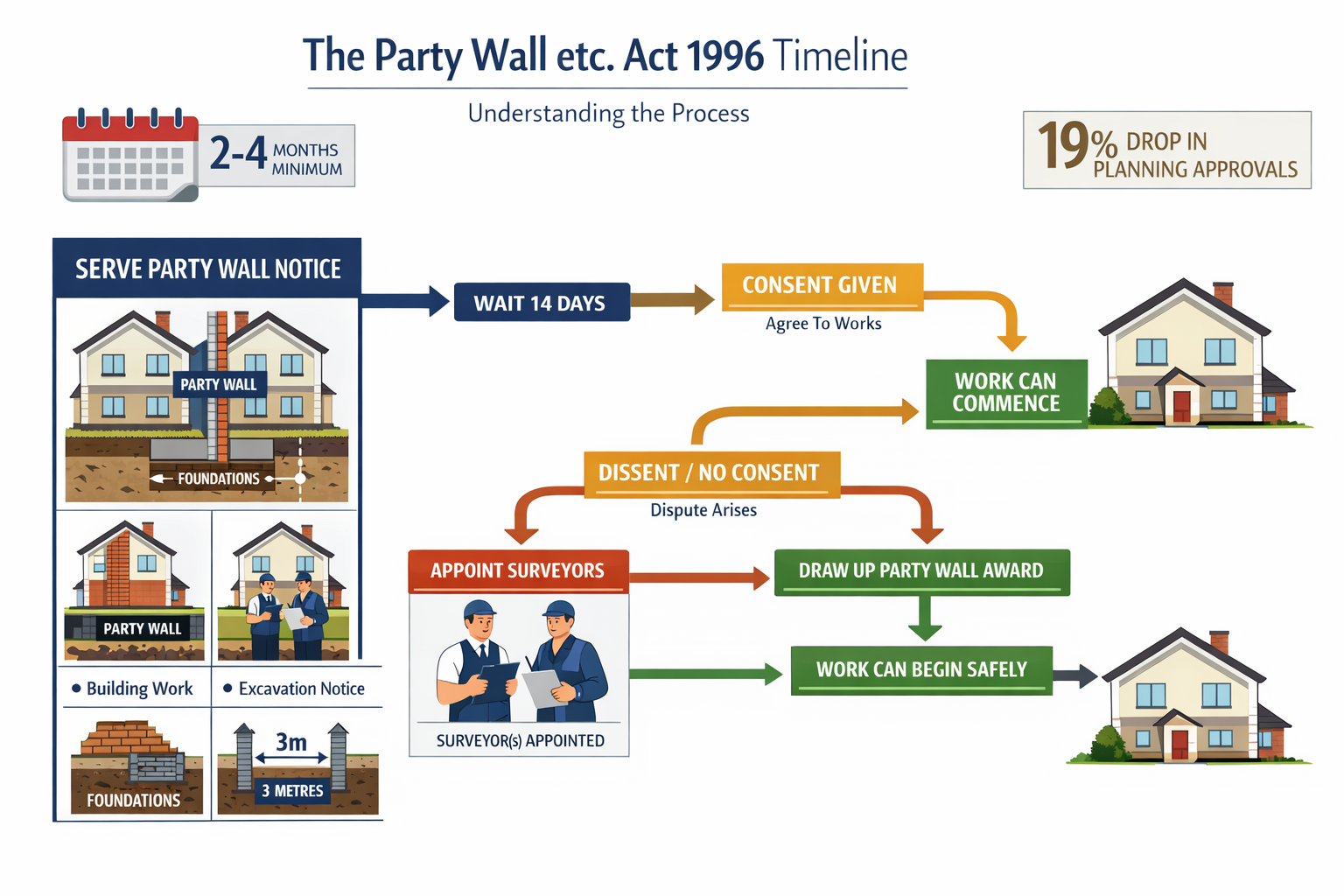
The Act covers three main categories of work:
Type 1: Work Directly to a Party Wall or Structure
- Cutting into a party wall to insert beams or damp-proof courses
- Raising a party wall or rebuilding it
- Underpinning a party wall
- Installing insulation or soundproofing within the party wall structure
Type 2: New Building on or at the Boundary Line
- Constructing a new wall at the boundary
- Building foundations for extensions that straddle or sit on the boundary line
- Any structure that will become a future party wall
Type 3: Excavation Within Three or Six Meters
- Digging within three meters of a neighbour's structure if your excavation will go deeper than their foundations
- Digging within six meters if your excavation will go deeper than their foundations by more than the three-meter rule threshold
This third category catches many homeowners by surprise. Even if you're building entirely on your own land, excavating for a basement or deep foundation extension may require notice for excavation near a neighbour if you fall within these distance and depth parameters.
Why 2026's Market Conditions Amplify Party Wall Risks
The current stabilising housing cycle creates a perfect storm for party wall complications:
🏠 Reduced Mobility = More Extensions
With property transactions down and moving costs prohibitive, homeowners are investing in their current properties. Loft conversions, basement excavations, and rear extensions have become the primary route to additional living space—each potentially triggering party wall requirements.
💷 Financial Pressure = Adversarial Positions
In areas experiencing house price declines, particularly central London where some properties are selling at considerable losses, neighbours may adopt more protective stances regarding adjacent construction. Financial stress reduces goodwill and increases the likelihood of formal surveyor appointments rather than amicable agreements.
⏳ Extended Project Timelines = Greater Friction
With planning consents now taking 18+ months and build costs rising due to the Building Safety Levy (£12.70-£100.35 per m² from October 2026) and the Future Homes Standard (adding 4-8% to costs from late 2027), construction projects are longer and more complex. Extended timelines mean prolonged disruption for neighbours, increasing dispute potential.
📉 Weak Demand = Cost-Cutting Pressure
Suppressed buyer demand and high mortgage rates mean property owners may be tempted to cut corners, including skipping proper party wall procedures. This false economy creates legal exposure and virtually guarantees expensive retrospective compliance.
The True Cost of Party Wall Compliance in 2026
Understanding the financial commitment required for proper party wall compliance helps homeowners budget realistically and avoid nasty surprises.
| Scenario | Typical Cost Range | Timeline |
|---|---|---|
| Single neighbour, agreed surveyor | £1,500 – £3,600 | 2-3 months |
| Two neighbours (mid-terrace), separate surveyors | £3,000 – £7,200 | 2-4 months |
| Complex basement with multiple neighbours | £8,000 – £12,000+ | 4-9 months |
| Dispute resolution with Party Wall Award | Add £2,000 – £5,000 | Add 1-3 months |
These figures reflect 2026 market rates for party wall surveyors in London and the South East, where fees of £750-£1,800 per surveyor per affected neighbour are standard. The building owner (the person doing the work) typically pays all reasonable surveyor fees—both their own surveyor's costs and the adjoining owner's surveyor's costs.
For detailed cost breakdowns, consult our comprehensive party wall cost guide.
Protecting Yourself When Your Neighbour Serves Notice
Your Rights as the Adjoining Owner
When your neighbour serves you with a party wall notice, you have specific legal rights designed to protect your property and interests. Understanding these rights empowers you to respond appropriately rather than reactively.
Right to Consent or Dissent
You have 14 days from receiving the notice to respond. You can:
- Consent to the proposed work (ideally in writing)
- Dissent or not respond at all (both trigger the surveyor appointment process)
- Request additional information about the scope, timing, and methodology
Right to Appoint Your Own Surveyor
If you dissent or have concerns, you're entitled to appoint a party wall surveyor to represent your interests. Your neighbour pays your surveyor's reasonable fees. This isn't adversarial—it's a protective mechanism ensuring professional oversight.
Right to a Schedule of Condition
Before any work begins, you can insist on a schedule of condition for party wall work documenting your property's existing state. This photographic and written record becomes crucial evidence if damage claims arise later.
Right to Compensation
If the work causes damage, loss, or inconvenience, you're entitled to compensation. The Party Wall Award (the formal agreement between surveyors) should specify how damage will be assessed and remedied.
When to Consent vs. When to Appoint a Surveyor
Not every party wall notice requires formal surveyor involvement. Here's how to decide:
Consider Consenting When:
- ✅ The work is minor (e.g., simple beam insertion, standard loft conversion)
- ✅ Your neighbour has communicated well and shown you detailed plans
- ✅ They've offered to arrange a schedule of condition at their expense
- ✅ The builder is reputable with proper insurance
- ✅ The timeline is reasonable and you've been consulted about access
Appoint a Surveyor When:
- ⚠️ The work involves significant structural changes (basement excavation, major underpinning)
- ⚠️ You're concerned about potential damage to your property
- ⚠️ Your neighbour has been uncommunicative or dismissive of your concerns
- ⚠️ The property is a valuable asset or has existing structural issues
- ⚠️ You don't fully understand the technical implications of the proposed work
Remember: appointing a surveyor doesn't make you difficult or obstructive. It's a professional safeguard that costs you nothing (your neighbour pays) and ensures expert oversight.
The Critical Importance of Schedule of Condition
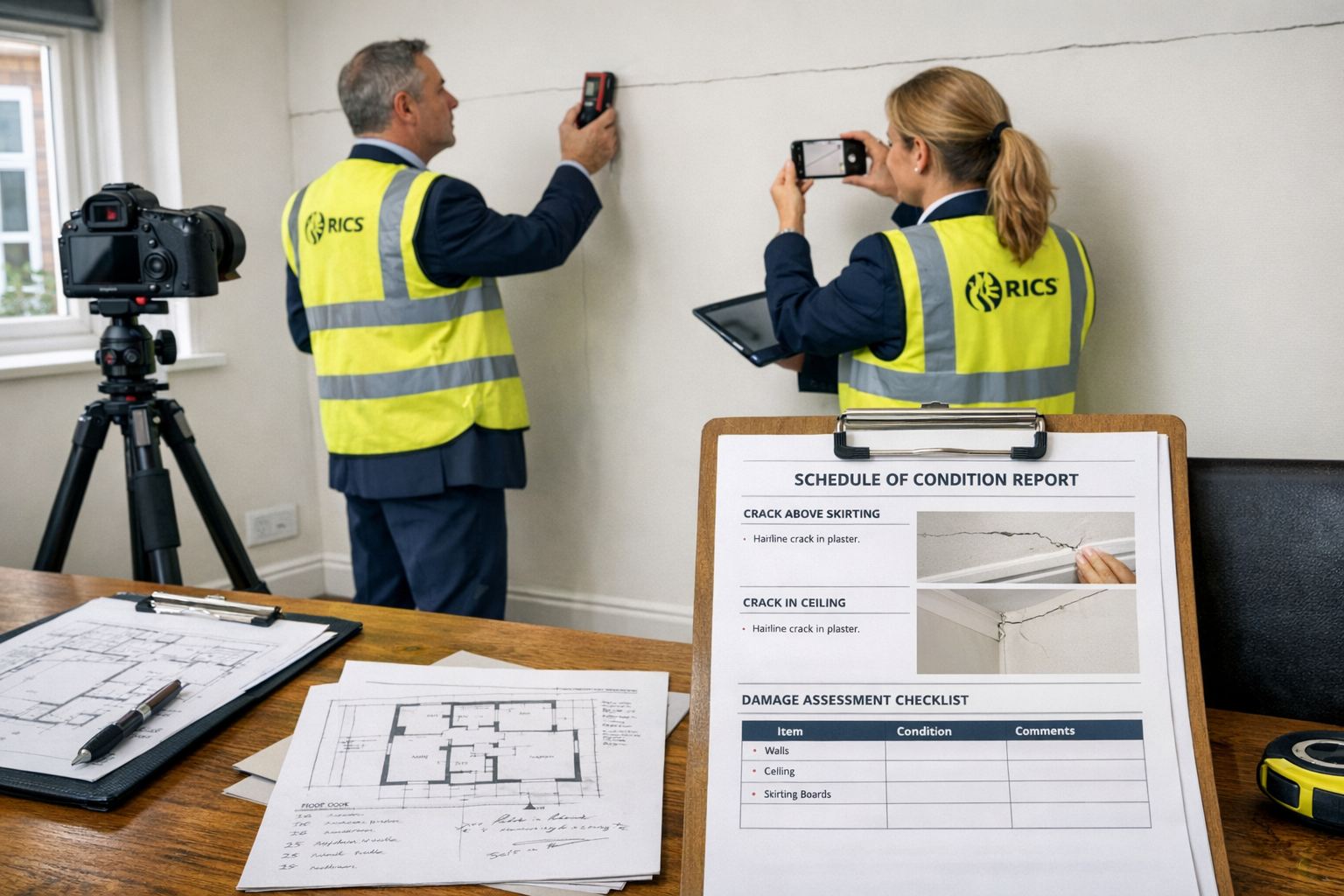
A schedule of condition is your insurance policy against unfounded damage claims and your evidence base for legitimate ones. This detailed record, prepared by a qualified surveyor before work begins, includes:
Photographic Evidence
- High-resolution images of all rooms, particularly those adjacent to or above the party wall
- Close-ups of existing cracks, settlement, decorative condition
- External elevations showing brickwork, render, and structural condition
- Dated and annotated for legal admissibility
Written Documentation
- Room-by-room condition descriptions
- Measurements of existing cracks (width, length, location)
- Structural observations about foundation settlement or movement
- Decorative condition notes
Floor Plans and Annotations
- Marked-up plans showing crack locations
- Identification of vulnerable areas
- Reference points for future comparison
In 2026's litigious environment, where property values are under pressure and financial stakes are high, a professional schedule of condition is non-negotiable protection. Without one, proving that damage resulted from your neighbour's work—rather than pre-existing conditions—becomes extremely difficult.
For leasehold properties, additional considerations apply. Review our guidance on schedule of condition for leasehold properties to understand your specific protections.
Managing Party Wall Risks When You're the Building Owner
Serving Proper Notice: Timeline and Requirements
If you're planning an extension or excavation in 2026, understanding the notice requirements prevents costly delays and legal complications.
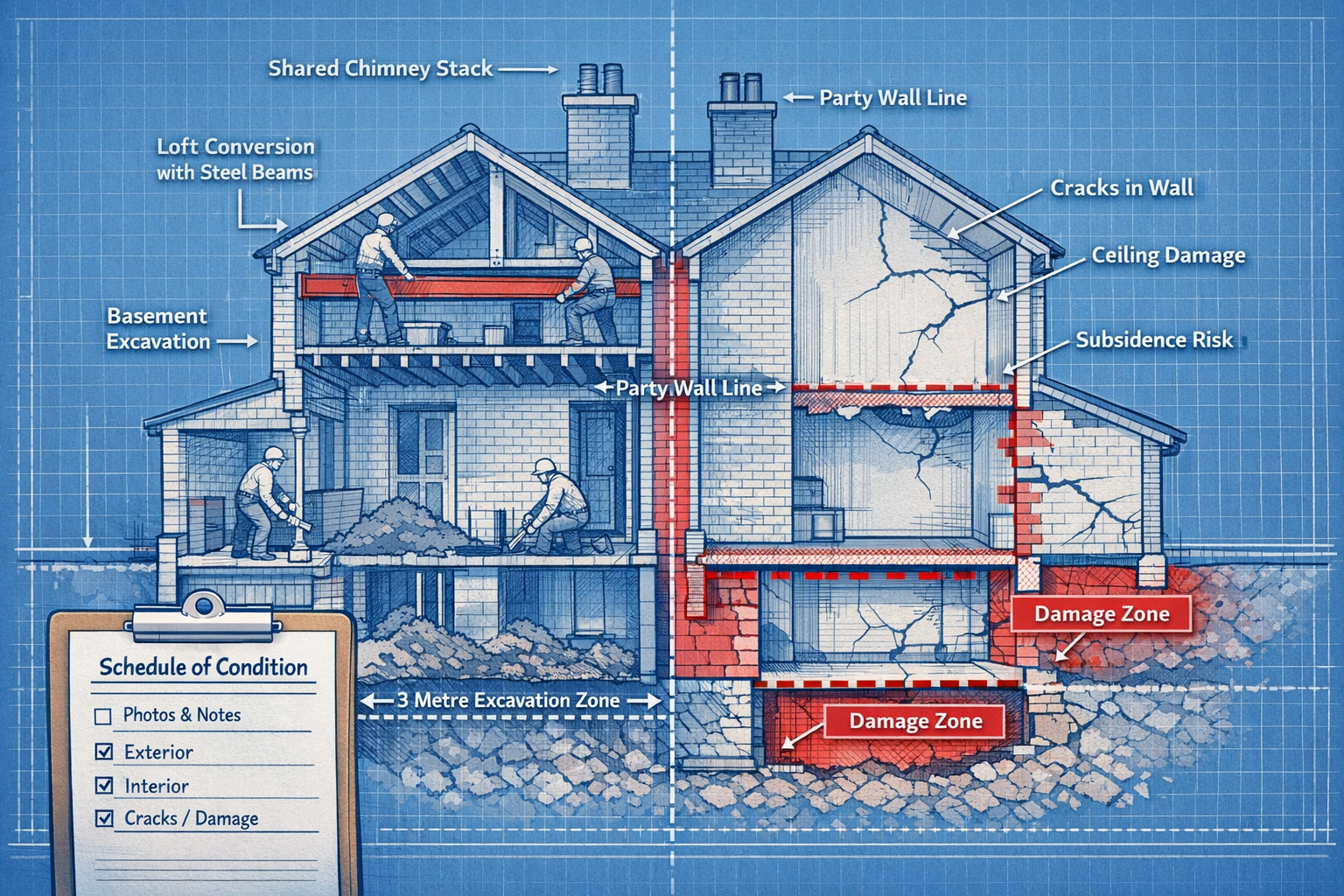
Notice Periods Required:
- Party Structure Notice: Two months' notice for work directly to a party wall
- Party Wall Notice: One month's notice for new building on the boundary
- Notice of Adjacent Excavation: One month's notice for excavation within three or six meters
What Your Notice Must Include:
- Your name and address
- Details of the proposed work with drawings
- Date when work will start
- Explanation of how the work affects the party wall or boundary
Critical Timing Considerations:
The party wall process is completely separate from planning permission. Even Permitted Development extensions that don't require planning approval still require party wall notice if they involve:
- Work to a shared wall
- Building at the boundary
- Foundation excavation within the three or six-meter zones
Start your party wall process at least 2-4 months before your intended construction start date. If neighbours dissent and a Party Wall Award is needed, add another 1-2 months. Difficult cases involving access disputes can extend timelines to 5-9 months.
For specific guidance on loft extensions, see our detailed resource on party wall requirements for loft conversions.
What Happens If You Don't Serve Notice
Skipping the party wall process isn't just risky—it's legally indefensible and financially catastrophic.
Immediate Consequences:
- ⛔ Your neighbour can apply for an injunction to stop work immediately
- ⚖️ Courts grant these injunctions quickly because you're in clear breach of statutory duty
- 💰 You'll face legal costs for both sides
- 🏗️ Work stops completely until compliance is achieved
Ongoing Complications:
- You must complete the party wall process retroactively with zero goodwill from your neighbour
- Neighbours who feel disrespected or blindsided will almost certainly appoint surveyors and adopt adversarial positions
- Any damage claims become far more contentious
- Your builder may refuse to continue without proper agreements in place
- Your insurance may not cover damage or legal costs arising from non-compliance
Long-Term Damage:
- Project delays of 3-6 months are typical
- Compensation claims for neighbour inconvenience
- Permanent relationship breakdown with neighbours
- Potential impact on property value if disputes are noted on property searches
For a comprehensive understanding of consequences, review our analysis of what happens when party wall notice is not served.
Communication Strategies That Prevent Disputes
Most party wall problems stem from poor communication rather than the work itself. Neighbours who feel blindsided by a formal legal notice are far more likely to dissent than those who've been consulted throughout the planning process.
Pre-Notice Communication (2-3 Months Before Formal Notice):
- 🗣️ Have an informal conversation explaining your plans
- 📐 Show preliminary architect drawings
- ⏰ Discuss realistic timelines and expected disruption
- 🤝 Ask about their concerns and preferences
- 📧 Follow up in writing summarizing the discussion
Formal Notice Period:
- 📄 Serve notice professionally but include a friendly cover letter
- 📞 Offer to meet to discuss the formal details
- 🏗️ Provide builder credentials and insurance documentation
- 📅 Propose a schedule of condition at your expense
- 💬 Keep communication channels open
During Construction:
- 📱 Provide direct contact details for you and your builder
- 🚧 Give advance notice of particularly disruptive phases
- 🧹 Maintain site cleanliness and respect shared access
- 🔍 Conduct regular check-ins about noise, dust, and disruption
- ⚡ Address concerns immediately before they escalate
Post-Completion:
- 🔎 Arrange final inspection with their surveyor
- 🎨 Remedy any agreed damage promptly
- 🙏 Thank them for their patience
- 📋 Provide completed drawings showing the work as built
This communication-first approach transforms the party wall process from a legal obligation into a collaborative project management exercise. In 2026's stressed housing market, maintaining positive neighbour relations provides intangible but significant value.
Dealing with Party Wall Damage and Disputes
Identifying and Documenting Damage
Despite best intentions and professional oversight, construction work can cause damage to adjoining properties. Recognizing and documenting damage promptly protects your legal position whether you're the building owner or adjoining owner.
Common Types of Party Wall Damage:
- 🔴 Structural: New or widened cracks in walls, ceilings, or foundations
- 🔴 Cosmetic: Cracked plaster, damaged decorations, disturbed tiling
- 🔴 Settlement: Doors or windows that no longer close properly, floor level changes
- 🔴 Vibration: Damage from excavation or demolition work
- 🔴 Water ingress: Compromised damp-proofing or drainage
Documentation Protocol:
- Photograph immediately with date stamps
- Measure crack widths using a crack width gauge
- Note when damage appeared relative to construction phases
- Inform the building owner and surveyors in writing within 48 hours
- Avoid repairs until surveyors have inspected and agreed causation
- Keep all correspondence documenting the damage and responses
For detailed guidance on damage claims and resolution, consult our resource on damage to property in party wall situations.
The Dispute Resolution Process
When disagreements arise—whether about the work itself, damage claims, or surveyor decisions—the Party Wall Act provides a structured resolution mechanism.
Stage 1: Surveyor Negotiation
The appointed surveyors (or the agreed surveyor if both parties chose the same professional) attempt to resolve the dispute through professional judgment and negotiation. Most issues resolve at this stage.
Stage 2: Third Surveyor Appointment
If the appointed surveyors cannot agree, they select a third surveyor to make a binding determination. The third surveyor's decision is final on technical matters.
Stage 3: Appeal to County Court
Either party can appeal a Party Wall Award to the county court within 14 days, but only on limited grounds:
- The surveyor exceeded their jurisdiction
- The award is unclear or unworkable
- There was procedural unfairness
Appeals are expensive and rarely succeed. Courts generally defer to surveyor expertise on technical matters.
Stage 4: Formal Dispute Resolution
For serious disputes involving allegations of bad faith, negligence, or significant financial claims, parties may need to pursue:
- Professional negligence claims against surveyors
- Breach of contract claims
- Injunction applications for ongoing breaches
Understanding what constitutes a party wall dispute helps parties recognize when professional legal advice (beyond surveyors) becomes necessary.
When to Seek Legal vs. Surveyor Advice
Knowing which professional to consult saves time and money:
Consult a Party Wall Surveyor For:
- ✅ Technical questions about notice requirements
- ✅ Assessing whether proposed work requires party wall procedures
- ✅ Preparing or responding to party wall notices
- ✅ Negotiating Party Wall Awards
- ✅ Damage assessment and remediation specifications
- ✅ Standard dispute resolution between neighbours
Consult a Solicitor For:
- ⚖️ Injunction applications (stopping work or compelling compliance)
- ⚖️ Appeals to county court against Party Wall Awards
- ⚖️ Professional negligence claims against surveyors
- ⚖️ Complex compensation disputes exceeding £10,000
- ⚖️ Situations involving fraud, deliberate damage, or bad faith
- ⚖️ Enforcement of Party Wall Awards when building owners refuse to comply
For comprehensive answers to common questions, review our party wall FAQs.
Special Considerations for 2026's Market Conditions
The Building Safety Levy and Future Homes Standard Impact
Two major regulatory changes launching in 2026-2027 will significantly affect extension projects and party wall procedures:
Building Safety Levy (October 2026)
This new charge adds £12.70-£100.35 per square meter to building costs depending on location. For a typical 30m² rear extension, expect an additional £380-£3,000 in costs. This financial pressure may:
- Motivate homeowners to rush projects before full implementation
- Increase cost-cutting temptations (including party wall procedure shortcuts)
- Reduce budgets available for proper surveyor appointments
- Create more disputes over who pays for damage remediation
Future Homes Standard (Late 2027)
Mandatory from late 2027, this standard adds approximately 4-8% to build costs per home through enhanced insulation, heat pump requirements, and energy efficiency measures. Anticipating this:
- Expect a surge in extension applications in late 2026 and early 2027
- More simultaneous projects in the same street increase party wall complexity
- Higher specification work may create greater structural intervention and damage risk
- Neighbours may be more protective knowing their own future extension costs will be higher
Affordability Pressures and Neighbour Relations
Around 8,500 affordable homes due for construction in 2026 are at risk as housing providers withdraw from Section 106 contracts. This continued supply constraint, combined with mortgage rates above 4.8%, creates affordability pressures that affect party wall dynamics:
Financial Stress Increases Adversarial Positions
Neighbours facing their own financial pressures may:
- Adopt more protective stances regarding adjacent construction
- Be less willing to consent without formal surveyor protection
- Pursue damage claims more aggressively
- Have less tolerance for disruption or inconvenience
Property Value Concerns Heighten Sensitivities
In areas experiencing price declines, particularly central London where some properties sell at considerable losses, neighbours worry that:
- Adjacent construction may further depress values
- Damage may be harder to remedy in a weak market
- Their own future extension plans may be compromised
Proactive Communication Becomes Essential
In this environment, building owners must:
- Budget generously for surveyor fees (assume dissent rather than consent)
- Invest extra time in pre-notice neighbour consultation
- Offer schedule of condition documentation proactively
- Demonstrate financial stability and proper insurance
- Show sensitivity to neighbour concerns about disruption and value
Planning for Multiple Affected Neighbours
Mid-terrace properties and semi-detached houses with rear extensions often affect multiple neighbours simultaneously, multiplying complexity and costs.
Cost Multiplication:
- Two affected neighbours = £3,000-£7,200 in surveyor fees
- Three affected neighbours = £4,500-£10,800 in surveyor fees
- Each additional neighbour adds £1,500-£3,600
Timeline Coordination:
- All notices must be served simultaneously
- The longest response time determines your start date
- One dissenting neighbour can delay the entire project
- Surveyor coordination across multiple parties adds 2-4 weeks
Strategic Approaches:
- Propose a single agreed surveyor for all parties (reduces costs and complexity)
- Stagger communication to identify potential objectors early
- Offer enhanced protections to neighbours most affected by the work
- Consider phasing the project to reduce simultaneous impact
- Budget for worst-case scenario (all neighbours dissent and appoint separate surveyors)
For comprehensive guidance on the party wall framework, visit our main party wall information page.
Practical Checklist: Protecting Yourself in 2026's Party Wall Environment
For Building Owners Planning Extensions
✅ 3-4 Months Before Construction:
- Consult architect and confirm party wall implications
- Identify all potentially affected neighbours
- Budget £1,500-£3,600 per affected neighbour for surveyor fees
- Have informal conversations with neighbours about plans
✅ 2 Months Before Construction:
- Serve formal party wall notices with required details
- Include friendly cover letter and offer to discuss
- Provide builder credentials and insurance documentation
- Offer to arrange schedule of condition at your expense
✅ During Notice Period:
- Respond promptly to neighbour questions
- Appoint your surveyor if neighbours dissent
- Cooperate fully with schedule of condition preparation
- Ensure Party Wall Award is signed before starting work
✅ During Construction:
- Provide direct contact details to neighbours
- Give advance notice of disruptive phases
- Maintain site cleanliness and respect access
- Address concerns immediately
- Document any incidents or damage claims promptly
✅ Post-Completion:
- Arrange final inspection with surveyors
- Remedy any agreed damage within specified timeframes
- Obtain sign-off from adjoining owner surveyors
- Retain all documentation for future property sales
For Adjoining Owners Receiving Notices
✅ Upon Receiving Notice:
- Read carefully and identify what work is proposed
- Check whether work genuinely requires party wall procedure
- Assess potential impact on your property
- Respond within 14 days (or dissent is assumed)
✅ If Considering Consent:
- Request detailed drawings and methodology
- Verify builder credentials and insurance
- Insist on schedule of condition at building owner's expense
- Get everything in writing before consenting
- Understand you can still claim for damage even if you consent
✅ If Appointing a Surveyor:
- Choose an experienced RICS-qualified party wall surveyor
- Understand the building owner pays your surveyor's reasonable fees
- Cooperate with schedule of condition preparation
- Review the draft Party Wall Award carefully
- Raise concerns before the Award is finalized
✅ During Neighbour's Construction:
- Monitor for damage and document immediately
- Maintain communication with your surveyor
- Report concerns promptly in writing
- Avoid making repairs until surveyors assess damage
- Keep records of disruption and inconvenience
✅ If Damage Occurs:
- Photograph and measure damage immediately
- Notify building owner and surveyors within 48 hours
- Do not consent to repairs until causation is established
- Ensure remediation meets the schedule of condition standard
- Obtain written confirmation that repairs are complete
For situations where neighbours proceed without proper party wall agreement, immediate legal advice is essential.
Conclusion
Party Wall Risks in a Flat Market: Protecting Yourself When Neighbours Extend in 2026's 'Stabilising' Housing Cycle represents a critical intersection of legal compliance, financial protection, and neighbour relations. As the UK housing market stabilises but remains fragile, with homeowners choosing to improve rather than move, the volume of extensions—and therefore party wall procedures—will continue to rise throughout 2026 and into 2027.
The stakes are significant. For building owners, failing to comply with the Party Wall etc. Act 1996 can result in immediate injunctions, project delays of 3-9 months, and legal costs running into thousands of pounds. For adjoining owners, failing to protect your interests through proper surveyor appointment and schedule of condition documentation can leave you without recourse when damage occurs.
Yet the party wall process, properly managed, provides a robust framework for enabling necessary development while protecting all parties' legitimate interests. The key success factors in 2026's challenging market environment are:
🗣️ Communication First: Start neighbour conversations 2-3 months before formal notices, explain your plans clearly, and demonstrate respect for their concerns.
💰 Budget Realistically: Plan for £1,500-£3,600 per affected neighbour in surveyor fees, with complex projects potentially exceeding £12,000. These costs are not optional—they're legal requirements.
📋 Document Everything: Insist on professional schedule of condition documentation before any work begins. This evidence becomes invaluable if damage disputes arise.
⏱️ Plan Adequate Timelines: Allow minimum 2-4 months for the party wall process, extending to 5-9 months if complications arise. Don't let construction deadlines pressure you into non-compliance.
👥 Engage Professionals Early: RICS-qualified party wall surveyors bring expertise, objectivity, and dispute resolution skills that protect all parties and facilitate successful project completion.
As the Building Safety Levy launches in October 2026 and the Future Homes Standard approaches in late 2027, construction costs and complexity will only increase. This makes proper party wall procedures more important than ever—both as legal compliance and as relationship management with neighbours who may soon be planning their own extensions.
Next Steps
If you're planning an extension in 2026:
Contact a qualified party wall surveyor at least 3-4 months before your intended construction start date. Early professional advice prevents costly mistakes and ensures smooth project progression.
If you've received a party wall notice:
Don't ignore it or delay your response. Consult a party wall surveyor within the 14-day response period to understand your rights and options. Remember: the building owner pays your surveyor's reasonable fees.
If you're concerned about ongoing neighbour construction:
Document any damage immediately, notify the building owner and surveyors in writing, and seek professional advice before the situation escalates.
For expert guidance on party wall matters, schedule a consultation with our RICS-qualified surveyors who understand the unique challenges of 2026's stabilising housing market. Protecting your property rights and maintaining positive neighbour relations requires professional expertise—invest in it before problems arise, not after.
Contact us today to discuss your party wall situation and ensure you're properly protected in 2026's evolving property landscape.