The UK property market is on the brink of its biggest transformation in decades. For generations, homebuyers in England and Wales have navigated a frustrating process where crucial information about a property's condition often emerges late in the transaction—sometimes after thousands of pounds have been spent on legal fees and surveys. But Building Surveys and the New Homebuying Reforms: How Earlier Condition Reports Will Change UK Transactions are set to revolutionize this system starting in 2026. 🏠
These reforms introduce a fundamental shift: sellers will be required to commission condition reports before marketing their properties, moving transparency from the end of the process to the very beginning. This change promises to reduce the notorious fall-through rates that plague English and Welsh property transactions, while fundamentally altering when and why buyers commission their own building surveys.
Key Takeaways
- Sellers must provide upfront condition reports starting in 2026, disclosing structural condition, defects, and financial information before marketing properties
- Buyer surveys won't disappear but will serve different purposes—providing independent verification and deeper investigation of specific concerns
- Transaction fall-through rates are expected to decrease significantly as problems surface earlier in the process
- The surveying industry anticipates increased demand as condition assessments become mandatory upfront requirements
- Digital infrastructure and professional standards will be enhanced across estate agents, surveyors, and conveyancers
Understanding the Current UK Property Transaction Problem
The traditional English and Welsh property buying process has long been criticized for its inefficiency and high failure rates. Unlike Scotland, which implemented mandatory Home Reports in 2008, England and Wales have operated under a system where detailed property information emerges gradually—often painfully slowly.
The Traditional Timeline Issues
Currently, buyers typically commission their RICS building surveys after making an offer and entering into negotiations. This late-stage discovery of property defects leads to:
- Renegotiations when unexpected issues surface
- Transaction collapse when problems prove too severe
- Wasted costs on legal fees, surveys, and mortgage applications
- Emotional stress for both buyers and sellers
- Chain disruption affecting multiple connected transactions
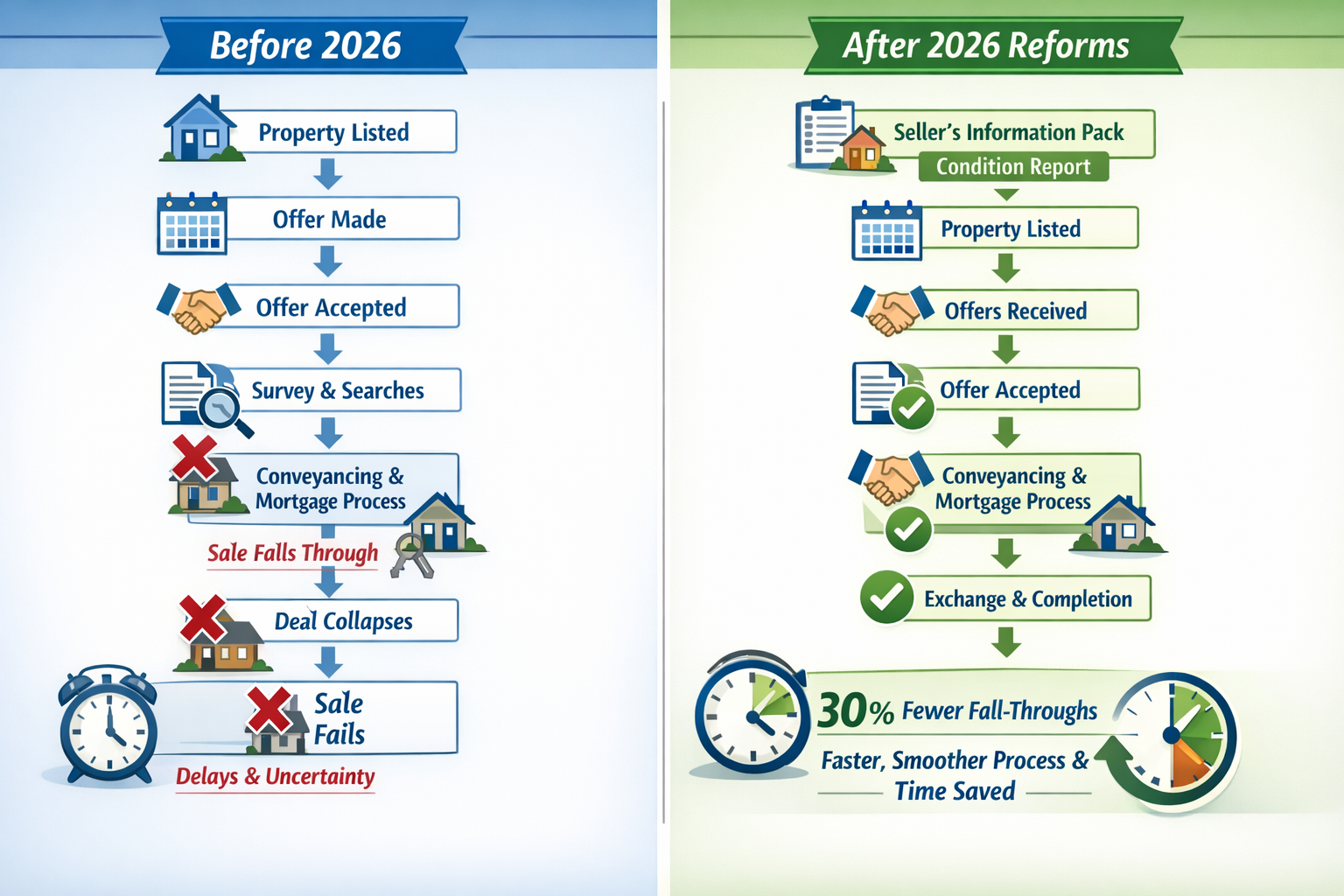
Research shows that approximately 30% of property transactions in England and Wales fall through before completion, with many failures occurring after significant time and money have been invested.
Why Change Is Necessary
The government has identified several critical problems with the current system:
Financial waste: Buyers lose thousands of pounds when transactions collapse after surveys reveal unexpected defects.
Time inefficiency: The average transaction takes 3-4 months, with delays often caused by late information disclosure.
Information asymmetry: Sellers possess knowledge about their property that buyers discover only through expensive investigations.
Market distrust: The opaque process creates suspicion and defensive behavior from all parties.
These challenges have created momentum for reform, with Building Surveys and the New Homebuying Reforms: How Earlier Condition Reports Will Change UK Transactions representing the government's comprehensive response to decades of frustration.
What the 2026 Homebuying Reforms Actually Require
The reforms rolling out from 2026 introduce several interconnected changes designed to create a more transparent, efficient property market. Understanding these requirements is essential for surveyors, estate agents, and buyers preparing for the new landscape.
Mandatory Upfront Seller Surveys
The cornerstone of the reforms is the requirement for sellers to commission condition surveys before marketing their properties. This represents a complete reversal of current practice.
What Must Be Disclosed
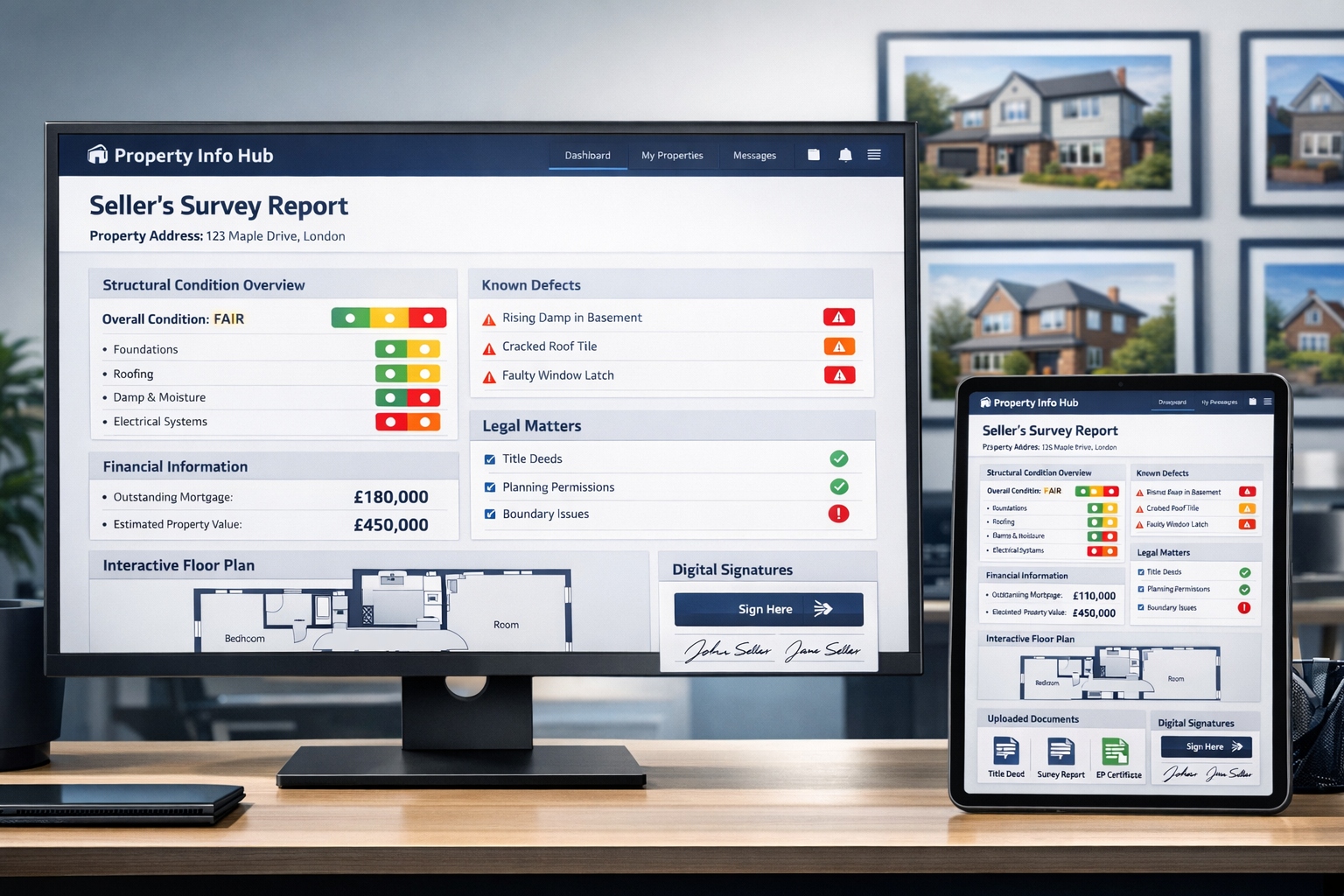
Seller surveys must include:
| Category | Required Information |
|---|---|
| Structural Condition | Overview of property's structural integrity, major systems (roof, walls, foundations) |
| Known Defects | Disclosure of all known issues, previous repairs, ongoing problems |
| Financial Information | Leasehold charges, ground rent, service fees, planned major works |
| Legal Matters | Restrictions, easements, planning permissions, building regulation compliance |
| Environmental Factors | Flood risk, contamination, conservation area status |
This standardized information pack must be verified by qualified professionals and made available to potential buyers from the first viewing.
Phased Implementation Timeline
The reforms won't arrive overnight. Implementation follows a phased approach beginning in 2026:
Phase 1 (Early 2026): Pilot programs in selected regions testing digital platforms and survey standards
Phase 2 (Mid-2026): Gradual rollout of mandatory seller information requirements
Phase 3 (Late 2026-2027): Full implementation across England and Wales with enforcement mechanisms
Phase 4 (2027+): Integration of early binding agreements and reservation systems
This gradual approach allows the industry to adapt while identifying and addressing implementation challenges.
Digital Infrastructure Requirements
Supporting these reforms is a significant investment in digital conveyancing infrastructure. The government is developing:
- Standardized digital platforms for sharing property information
- Secure document repositories accessible to verified parties
- Automated compliance checking for survey standards
- Integration with Land Registry systems
- Consumer-friendly interfaces for accessing property data
These systems aim to reduce administrative burden while improving transparency and speed.

How Building Surveys and the New Homebuying Reforms Will Change UK Transactions for Buyers
For property buyers, these reforms fundamentally alter the decision-making process and the role of independent surveys. Understanding these changes is crucial for making informed choices in the new landscape.
The New Buyer Journey
Under the reformed system, buyers will encounter property information much earlier:
Step 1: Initial Research – Before viewing, buyers can access the seller's condition report, reviewing structural issues and costs.
Step 2: Informed Viewing – Armed with condition information, buyers can ask targeted questions during viewings.
Step 3: Offer Decision – Offers reflect known property conditions, reducing post-offer surprises.
Step 4: Independent Verification – Buyers may commission their own surveys for verification or deeper investigation.
Step 5: Faster Completion – With fewer surprises, transactions proceed more smoothly to completion.
This represents a significant shift from the current "offer first, investigate later" approach.
Will Buyers Still Need Their Own Surveys?
This is the critical question. The short answer: Yes, but for different reasons.
The reforms change when information is shared, not the fundamental need for due diligence. Buyers should still consider commissioning their own building surveys for several important reasons:
Independent Verification
Seller surveys, while required to meet professional standards, are commissioned by the party with a financial interest in selling. An independent survey provides:
- Unbiased assessment from a surveyor working solely for the buyer
- Fresh perspective that might identify issues overlooked or downplayed
- Detailed investigation of specific concerns flagged in the seller's report
- Peace of mind through independent professional advice
Deeper Investigation
Seller surveys will provide an overview of condition, but buyers with specific concerns may want more detailed investigation. For example:
- Specialist defect surveys for particular issues like subsidence or damp
- More comprehensive Level 3 surveys for older or unusual properties
- Targeted investigations of areas the seller's survey identified as needing attention
Lender Requirements
Mortgage lenders will likely continue requiring their own valuations, which are separate from condition surveys. Buyers may find it efficient to commission a combined survey that satisfies both their needs and lender requirements.
Personal Risk Tolerance
Some buyers will simply prefer the security of an independent assessment, particularly for:
- High-value properties where potential repair costs are significant
- Older buildings with greater potential for hidden defects
- Properties with known issues requiring expert cost estimation
- Investment properties where accurate condition assessment affects returns
Cost-Benefit Analysis for Buyers
With sellers providing upfront reports, buyers must weigh the costs and benefits of additional surveys:
Potential Savings:
- Reduced risk of wasted survey costs on properties with deal-breaking defects
- Earlier awareness of issues allows walking away before incurring legal fees
- Better negotiating position from day one
Ongoing Costs:
- Independent survey fees (£400-£1,500 depending on property and survey type)
- Specialist investigations for specific concerns
- Lender valuation fees (often £250-£600)
For many buyers, the optimal approach will be reviewing the seller's report carefully, then commissioning targeted investigations of specific concerns rather than comprehensive surveys of properties in good condition.
Questions Buyers Should Ask
When reviewing seller condition reports, buyers should probe:
✅ Who commissioned the survey? Verify the surveyor's qualifications and independence.
✅ When was it conducted? Recent surveys are more reliable than older assessments.
✅ What level of survey was performed? Understand the depth and limitations of the inspection.
✅ Are there areas of concern? Identify issues requiring further investigation.
✅ What are the estimated repair costs? Assess financial implications of known defects.
✅ Has anything changed since the survey? New issues may have emerged.
Impact on Surveyors and the Property Survey Industry
The surveying profession faces both opportunities and challenges as Building Surveys and the New Homebuying Reforms: How Earlier Condition Reports Will Change UK Transactions reshape the market.
Anticipated Increase in Survey Demand
Industry analysts predict a significant uplift in survey volumes, driven by:
Mandatory seller surveys: Every property marketed will require a condition assessment, creating a baseline demand that doesn't currently exist.
Earlier timing: Surveys commissioned before marketing rather than after offers means more properties receive surveys (including those that don't ultimately sell).
Standardization: Clear requirements for what seller surveys must cover will create consistent demand for specific survey types.
Continued buyer surveys: Independent buyer surveys will continue, particularly for high-value or complex properties.
This could represent a 30-50% increase in overall survey demand, according to industry estimates.
Professional Standards and Accreditation
The reforms emphasize raising professional standards across the industry. Surveyors should expect:
- Enhanced RICS standards for seller condition reports
- Standardized reporting formats ensuring consistency
- Quality assurance mechanisms to verify survey accuracy
- Professional indemnity insurance requirements protecting consumers
- Continuing professional development mandates for qualified surveyors
These standards aim to build consumer confidence in seller-commissioned surveys while maintaining the profession's integrity.
New Service Opportunities
Forward-thinking surveyors can position themselves for success by developing:
Pre-marketing survey packages specifically designed for sellers, balancing thoroughness with cost-effectiveness.
Rapid turnaround services helping sellers get properties to market quickly.
Digital reporting systems compatible with new government platforms.
Hybrid services combining seller surveys with buyer verification inspections.
Specialist follow-up investigations addressing specific concerns flagged in seller reports.
Understanding how long surveys take and optimizing processes will become increasingly important as demand rises.
Challenges to Address
The transition won't be without difficulties:
Capacity constraints: The industry may face surveyor shortages as demand spikes initially.
Pricing pressure: Sellers may seek cheaper surveys, potentially compromising quality.
Liability concerns: Clarity is needed on surveyor liability when multiple parties rely on reports.
Technology adoption: Smaller practices may struggle with digital platform requirements.
Consumer education: Both sellers and buyers need guidance on choosing the right property survey for their needs.
What Estate Agents and Sellers Need to Know
For those marketing properties, the reforms introduce new responsibilities and strategic considerations.
Seller Obligations and Timeline
Sellers must now plan for survey commissioning before marketing, which means:
3-4 weeks before listing: Commission condition survey from qualified surveyor
2-3 weeks before listing: Receive and review survey report, address any urgent issues
1-2 weeks before listing: Compile complete information pack including survey, legal documents, financial information
Listing day: Make all information available to potential buyers digitally and in viewings
This front-loads costs and effort that previously occurred after offers were received.
Cost Implications for Sellers
Upfront survey requirements mean sellers face new expenses:
| Survey Type | Typical Cost | When Required |
|---|---|---|
| Standard Condition Report | £300-£600 | All properties |
| Enhanced Survey (older/complex) | £600-£1,200 | Pre-1900 or unusual construction |
| Specialist Reports (damp, structure) | £200-£500 each | When issues identified |
| Legal Pack Preparation | £200-£400 | All properties |
| Total Upfront Cost | £500-£2,100+ | Before marketing |
While these costs may seem burdensome, they're offset by:
- Faster sales with fewer fall-throughs
- Better prices from confident buyers
- Reduced renegotiation after offers
- Lower overall transaction costs through efficiency
Strategic Advantages
Savvy sellers can use upfront surveys strategically:
Addressing issues proactively: Fixing problems before marketing can increase sale prices beyond repair costs.
Marketing with confidence: Clean surveys become powerful marketing tools demonstrating property quality.
Attracting serious buyers: Transparent information attracts committed buyers rather than speculative offers.
Reducing stress: Knowing potential issues upfront allows better preparation and realistic pricing.
Competitive differentiation: In the transition period, sellers with comprehensive information packs will stand out.
Estate Agent Responsibilities
Agents face new duties under the reforms:
✅ Advising sellers on survey requirements and timing
✅ Coordinating survey commissioning and information gathering
✅ Ensuring compliance with disclosure requirements
✅ Managing digital platforms for information sharing
✅ Educating buyers on how to interpret seller surveys
✅ Facilitating independent buyer surveys when requested
Agents who embrace these changes and develop efficient systems will gain competitive advantages in the reformed market.
Regional Variations: England, Wales, Scotland, and Northern Ireland
It's crucial to understand that Building Surveys and the New Homebuying Reforms: How Earlier Condition Reports Will Change UK Transactions apply specifically to England and Wales only. The UK property market operates under different systems across its constituent nations.
Scotland's Existing System
Scotland has operated under a mandatory Home Report system since 2008, providing a useful preview of how upfront surveys function:
Home Report components:
- Single Survey (property condition report)
- Energy Report (EPC)
- Property Questionnaire
Key features:
- Commissioned by seller before marketing
- Valid for 12 weeks (extendable to 16 weeks)
- Must be provided to prospective buyers
- Standardized format across Scotland
Results: Scotland's system has generally reduced transaction fall-through rates and increased transparency, though debates continue about costs and survey quality.
Northern Ireland's Approach
Northern Ireland follows a different framework without mandatory seller surveys, operating more similarly to the traditional English and Welsh system. The 2026 reforms don't currently extend to Northern Ireland.
Wales-Specific Considerations
While Wales is included in the England and Wales reforms, some Wales-specific factors include:
- Welsh language requirements for documentation
- Different local authority structures
- Specific Welsh housing legislation considerations
- Potential for Wales-specific implementation variations
Preparing for the Transition: Practical Steps
As the reforms approach, all parties should take concrete steps to prepare.
For Buyers
📋 Educate yourself on the new system and what seller reports will include
📋 Budget appropriately for potential independent surveys alongside seller reports
📋 Develop evaluation skills for reviewing seller condition reports critically
📋 Identify trusted surveyors for independent verification if needed
📋 Understand your rights regarding survey quality and disclosure requirements
For Sellers
📋 Plan ahead by commissioning surveys 4-6 weeks before intended marketing
📋 Consider pre-sale repairs for issues that might deter buyers
📋 Gather documentation on previous repairs, guarantees, and building work
📋 Choose qualified surveyors with appropriate RICS accreditation
📋 Work with experienced agents familiar with the new requirements
For Surveyors
📋 Review RICS guidance on seller survey standards as they're published
📋 Invest in technology for digital reporting and platform integration
📋 Develop seller-focused services with appropriate pricing and turnaround times
📋 Enhance professional indemnity insurance to cover new service models
📋 Build capacity to handle anticipated demand increases
📋 Create educational materials helping clients understand survey types and limitations
For Estate Agents
📋 Train staff on new requirements and compliance obligations
📋 Develop workflows for coordinating upfront information gathering
📋 Build surveyor networks to recommend to seller clients
📋 Implement digital systems for information pack management
📋 Prepare marketing materials explaining the reformed process to clients
Common Questions and Concerns
Will seller surveys be truly independent?
This is a legitimate concern. While sellers commission the surveys, professional standards and RICS regulations require surveyors to provide objective, accurate assessments regardless of who pays. Surveyors face professional liability and regulatory consequences for biased or inaccurate reports. However, buyers retaining the right to commission independent surveys provides an important check on this system.
What happens if the seller's survey misses something?
Professional indemnity insurance should cover surveyor errors, though the details of liability frameworks are still being clarified. Buyers who commission their own surveys gain additional protection and recourse if issues are missed.
Can sellers refuse to fix issues identified in surveys?
Yes. Sellers are not required to repair defects, only to disclose them. Buyers can then make informed decisions about whether to proceed, negotiate price adjustments, or walk away. This transparency is actually a key benefit—issues are known upfront rather than discovered late in transactions.
Will this increase property prices?
The impact on prices is unclear. While upfront survey costs may be passed to buyers through higher asking prices, increased market efficiency and reduced transaction failures could offset this. Properties with clean surveys might command premiums, while those with issues might be priced more realistically from the start.
How will this affect property chains?
The reforms should strengthen chains by reducing fall-throughs. When all properties in a chain have upfront condition reports, the risk of collapse from unexpected survey findings decreases significantly, benefiting everyone involved.
Conclusion
Building Surveys and the New Homebuying Reforms: How Earlier Condition Reports Will Change UK Transactions represent the most significant transformation of the English and Welsh property market in generations. By requiring sellers to commission condition surveys before marketing properties, these reforms shift transparency from the end of transactions to the very beginning—a change that promises to reduce fall-through rates, save costs, and create a more efficient market.
For buyers, the reforms mean accessing crucial property information earlier, enabling more informed decisions from the first viewing. While seller surveys will provide valuable baseline information, independent surveys will remain important for verification and deeper investigation, particularly for complex or high-value properties. The key is understanding when additional surveys add value versus when seller reports provide sufficient information.
For surveyors, the changes create significant opportunities alongside challenges. Demand for surveys is expected to increase substantially as every marketed property requires a condition assessment, but the profession must adapt to new standards, digital platforms, and service models focused on seller needs.
For sellers and agents, the reforms require upfront investment in surveys and information gathering, but this front-loading of effort should be rewarded with faster, more reliable transactions and fewer costly fall-throughs.
As the phased implementation begins in 2026, all parties should prepare by educating themselves on the new requirements, developing appropriate systems and workflows, and embracing the cultural shift toward greater transparency. The transition may be challenging, but the long-term benefits of a more efficient, trustworthy property market will ultimately benefit everyone involved in UK property transactions.
Next Steps
✅ Stay informed about implementation timelines and detailed requirements as they're published
✅ Consult professionals including qualified RICS surveyors familiar with the reforms
✅ Plan transactions with the new timelines and requirements in mind
✅ Embrace digital tools that will facilitate the reformed process
✅ Advocate for clarity on outstanding questions about liability, standards, and enforcement
The future of UK property transactions is becoming more transparent, efficient, and buyer-friendly—changes that should ultimately create a healthier, more trustworthy market for all participants. 🏡