{"cover":"Professional landscape format (1536x1024) hero image with bold text overlay 'Building Surveys for Flats in Recovering Southern Markets: Adapting Assessment Protocols as London Stabilises in 2026' in extra large 72pt white sans-serif font with dark shadow and semi-transparent navy overlay box, positioned in upper third. Background shows split composition: left side features modern London flat building facade with scaffolding and survey equipment, right side displays professional surveyor with tablet and laser measuring device inspecting property. Color scheme: deep navy blue, white, amber accents. High contrast, editorial magazine cover quality, professional architectural photography style with subtle depth of field.","content":["Detailed landscape format (1536x1024) illustration showing London property market stabilization data visualization with dual-axis chart displaying house price decline (red downward trend line showing -1.0% annual decline) and flat transaction volume increase (blue upward bars showing 80% growth since 2021). Background features semi-transparent overlay of iconic London skyline with modern apartment blocks. Foreground includes professional surveyor silhouette examining building plans. Text annotations highlight 'First-time buyers 48.3%' and 'Flats: 25% of sales'. Color palette: professional navy, burgundy, gold accents. Clean infographic style with architectural blueprints texture.","Comprehensive landscape format (1536x1024) technical illustration showing modern building survey assessment protocols for flats. Split-screen composition: left panel displays traditional surveyor with clipboard inspecting Victorian conversion flat showing visible defects (damp patches, cracks), right panel shows 2026 surveyor using thermal imaging camera and drone technology on contemporary flat development. Central dividing line features checklist overlay with key assessment areas: cladding safety, leasehold obligations, EPC ratings, fire safety compliance. Color scheme: teal, charcoal grey, safety orange highlights. Technical blueprint aesthetic with annotation callouts and measurement indicators.","Detailed landscape format (1536x1024) professional photograph showing surveyor conducting comprehensive flat inspection in modern London apartment. Scene captures surveyor using moisture meter on wall near window, with tablet displaying digital survey report visible on kitchen counter. Room shows mix of new-build features and potential issues: pristine fitted kitchen, but visible condensation on windows. Background includes London cityscape view through large windows. Foreground features survey equipment: laser distance measurer, thermal camera, inspection torch arranged professionally. Natural lighting, architectural photography style, color grading emphasizing professional blues and warm wood tones. Depth of field highlighting surveyor's focused inspection work."]}

The London property market is experiencing a remarkable shift in 2026. After years of turbulence, flat prices are stabilizing, first-time buyers are returning in record numbers, and the assessment landscape for residential properties is evolving rapidly. For building surveyors operating in southern England, this recovery presents both opportunities and challenges that demand fresh approaches to building surveys for flats in recovering southern markets: adapting assessment protocols as London stabilises in 2026. 🏢
As flats now represent over half of all residential lots sold in London[1], and annual house price inflation has fallen by 1.0% in the 12 months to December 2025[2], surveyors must recalibrate their inspection priorities, valuation frameworks, and reporting standards to serve an emerging buyer demographic with different needs and budgets than previous market cycles.

Key Takeaways
- Flats dominate London transactions in 2026, representing well over half of residential sales with an 80% increase since 2021, requiring surveyors to specialize in multi-unit assessment protocols
- Market stabilization demands revised valuation approaches as London house prices decline 1.0% annually while rental inflation slows to 1.1%, creating unique assessment challenges
- First-time buyers now comprise 48.3% of London sales, up from 22.4% a decade ago, necessitating more detailed explanatory reports for less experienced purchasers
- Leasehold complexities and building safety concerns have intensified post-Grenfell, making cladding, fire safety, and service charge assessments critical survey components
- Technology integration and enhanced reporting standards are essential for competitive surveying practices serving the recovering southern markets
Understanding the 2026 Southern Market Recovery Context
The Flat-Dominated Landscape
The residential property market across southern England, particularly in London, has undergone a fundamental transformation. Flats have increased by almost 80% since 2021 and now represent roughly one quarter of all residential lots sold nationally, with London showing even more pronounced concentration where flats account for "well over half of residential lots sold"[1]. This dramatic shift reflects changing affordability dynamics, demographic preferences, and urban development patterns.
For surveyors conducting RICS building surveys, this means the majority of instructions now involve multi-unit buildings with shared structures, communal areas, and complex leasehold arrangements. The assessment protocols developed primarily for freehold houses require substantial adaptation.
Price Stabilization and Buyer Demographics
London's property market has entered a stabilization phase in 2026, with annual house price inflation falling by 1.0% in the 12 months to December 2025, down from 0.7% the previous period[2]. Simultaneously, rent inflation has slowed to just 1.1% year-over-year as of January 2026[2]. This cooling represents a significant departure from the volatility of previous years.
The buyer profile has shifted dramatically:
- First-time buyers now account for 48.3% of London sales in January 2026, up from just 22.4% a decade ago[3]
- Budgets have expanded, with first-time buyers operating in the £1.5m to £2m range
- Preference has shifted toward family homes near good schools, particularly in outer London boroughs[3]
- Regional markets outside London are gaining momentum as buyers seek affordability in northern England, Wales, and the Midlands[4]
This demographic transformation means surveyors are increasingly serving clients with limited property experience who require more comprehensive guidance and clearer explanations of technical findings.
Building Surveys for Flats in Recovering Southern Markets: Key Assessment Adaptations
Prioritizing Leasehold and Shared Structure Analysis
Traditional building surveys focused primarily on the physical condition of the property itself. In 2026's flat-dominated market, surveyors must expand their scope significantly to address leasehold-specific concerns that directly impact value and future costs.
Essential leasehold assessment components:
| Assessment Area | Key Considerations | Impact on Value |
|---|---|---|
| Lease Length | Remaining years, marriage value threshold | Critical below 80 years |
| Service Charges | Historical trends, major works provisions | Affects affordability |
| Ground Rent | Annual amount, escalation clauses | Influences marketability |
| Building Insurance | Adequacy of cover, cost trends | Risk management |
| Management Quality | Responsiveness, accounts transparency | Long-term satisfaction |
| Reserve Funds | Adequacy for anticipated repairs | Future liability |
When conducting Level 2 homebuyer surveys for flats, surveyors should request and review at least three years of service charge accounts, recent AGM minutes, and any Section 20 notices for major works. This documentation provides crucial context for assessing the building's financial health beyond its physical condition.
Enhanced Building Safety and Cladding Assessments
The legacy of the Grenfell Tower tragedy continues to shape flat assessments in 2026. Building safety has become a paramount concern for lenders, insurers, and purchasers alike. Surveyors must incorporate comprehensive cladding and fire safety evaluations into every flat survey.
Critical building safety elements:
🔥 External Wall Systems (EWS1 Forms)
- Verification of EWS1 certification status
- Assessment of cladding materials and combustibility
- Identification of remediation requirements
- Impact on mortgage availability
🚨 Fire Safety Infrastructure
- Adequacy of fire doors and compartmentation
- Functionality of alarm systems and emergency lighting
- Accessibility and condition of escape routes
- Compliance with current Building Regulations
🏗️ Structural Fire Protection
- Integrity of fire-resistant materials
- Condition of fire barriers between units
- Assessment of retrofitted safety measures
For buildings over 18 meters or with known cladding issues, surveyors should explicitly recommend specialist fire safety assessments and clearly communicate the potential financial implications of remediation works. Understanding the difference between Level 2 and Level 3 surveys becomes crucial when determining the appropriate inspection depth for complex buildings.
Adapting Valuation Frameworks for Market Conditions
The stabilizing market presents unique valuation challenges. With prices declining 1.0% annually in London[2] while transaction volumes for flats increase, surveyors must carefully calibrate their market value assessments and reinstatement cost calculations.
Valuation considerations for 2026:
- Comparable evidence interpretation: Recent sales may not reflect current market sentiment in rapidly adjusting areas
- Lease length impact: More pronounced value effects as buyers become increasingly aware of lease extension costs
- Building safety discount: Quantifying the value impact of cladding issues or missing EWS1 certification
- Service charge capitalization: Accounting for above-average service charges in value assessments
- Location micro-trends: Recognizing that outer London boroughs are outperforming prime central locations[3]
Surveyors working across South East London and South West London should maintain detailed comparable databases segmented by lease length, building type, and service charge levels to provide accurate market context.

Adapting Assessment Protocols as London Stabilises in 2026
Technology Integration for Enhanced Inspections
The recovering market demands greater efficiency and precision from surveying practices. Technology adoption has accelerated among leading firms, enabling more comprehensive assessments within competitive timeframes.
Essential technological tools for 2026 flat surveys:
📱 Digital Inspection Platforms
- Tablet-based survey software with cloud synchronization
- Photographic annotation and measurement tools
- Real-time report generation capabilities
- Client portal access for transparency
🌡️ Advanced Diagnostic Equipment
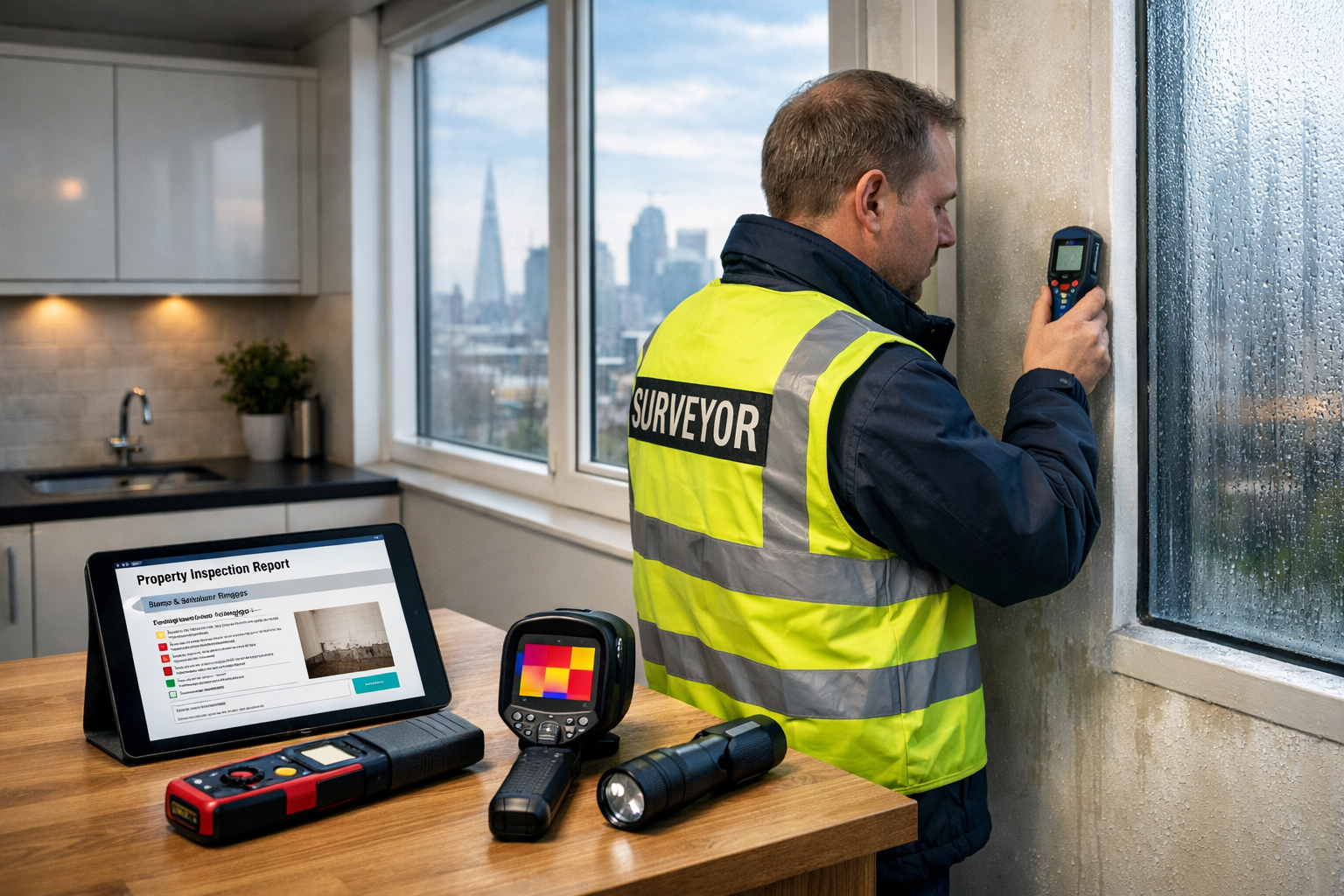
- Thermal imaging cameras for insulation and moisture detection
- Moisture meters with deep-wall penetration capabilities
- Borescopes for concealed space inspection
- Laser distance measurers for accurate dimensioning
🚁 Drone Technology
- Roof and upper-level external inspections without scaffolding
- High-resolution imagery of inaccessible areas
- Cost and time savings for tall buildings
- Enhanced safety for surveyors
When conducting structural surveys of converted Victorian or Edwardian flats—common in southern markets—thermal imaging proves particularly valuable for identifying hidden defects in party walls, concealed damp issues, and inadequate insulation that traditional visual inspection might miss.
Specialized Defect Identification for Flat-Specific Issues
Flats present unique defect patterns that differ substantially from freehold houses. Surveyors must develop expertise in identifying and assessing these flat-specific concerns.
Common flat defects requiring specialized assessment:
Soundproofing and Acoustic Performance
- Party wall and floor/ceiling sound transmission
- Impact on habitability and potential disputes
- Compliance with Building Regulations Part E
- Remediation complexity and costs
Condensation and Ventilation
- Particular concern in modern sealed-unit flats
- Assessment of mechanical ventilation systems
- Identification of mould growth patterns
- Recommendation of appropriate damp surveys when necessary
Communal Systems and Services
- Central heating and hot water systems
- Electrical distribution and metering
- Water supply and drainage infrastructure
- Lift installations and maintenance
Balcony and External Space Safety
- Structural integrity of cantilevered balconies
- Waterproofing effectiveness
- Balustrade safety and compliance
- Shared terrace maintenance responsibilities
For properties showing signs of water ingress or structural movement, surveyors should recommend specialist investigations such as drainage surveys or subsidence surveys to provide clients with comprehensive risk assessment.
Tailored Reporting for First-Time Buyers
With first-time buyers now comprising 48.3% of London sales[3], many with budgets extending to £1.5m-£2m, survey reports must balance technical accuracy with accessibility. These buyers typically lack property experience and require clear guidance on implications, priorities, and costs.
Report enhancements for the 2026 buyer demographic:
✅ Executive Summary with Priority Matrix
- Color-coded urgency ratings (immediate, short-term, long-term)
- Estimated cost ranges for identified defects
- Clear recommendations for further investigations
- Explicit statements on structural integrity
✅ Photographic Evidence with Annotations
- High-quality images of all significant defects
- Annotated diagrams showing defect locations
- Comparative images showing normal vs. defective conditions
- Visual aids for non-technical readers
✅ Plain Language Explanations
- Technical terms defined in accessible language
- Implications clearly stated for each finding
- Prioritized action plans with timelines
- Budget planning guidance
✅ Leasehold-Specific Sections
- Dedicated analysis of lease terms and implications
- Service charge sustainability assessment
- Major works probability and timing
- Lease extension cost estimates when relevant
Understanding how long a homebuyer survey takes helps set appropriate client expectations, particularly important for first-time buyers unfamiliar with the process.
Regional Variations Across Southern Markets
London Submarkets: Central vs. Outer Boroughs
The recovery is not uniform across London. While Central London properties continue to attract international investment, the most significant activity in 2026 centers on outer boroughs where first-time buyers seek family-appropriate flats near quality schools[3].
Assessment considerations by London zone:
Central London (Zones 1-2)
- Higher proportion of purpose-built modern developments
- International buyer considerations (currency fluctuations, investment yields)
- Premium service charge expectations
- Concierge and amenity assessments
- Higher prevalence of new-build snagging issues
Inner London (Zones 2-4)
- Mix of Victorian/Edwardian conversions and modern builds
- Greater variety in lease structures and management quality
- Transport connectivity as key value driver
- More diverse building condition range
Outer London (Zones 5-6)
- Family-focused developments with larger floor areas
- Garden flat prevalence requiring specific assessments
- Lower service charges but potentially less professional management
- Greater proportion of ex-local authority stock
- Parking and outdoor space premiums
Surveyors operating across North London, East London, and other regional hubs must calibrate their assessment priorities according to these submarket characteristics.
Home Counties and Commuter Belt Considerations
Beyond Greater London, the southern recovery extends into the Home Counties where affordability and lifestyle factors drive demand. Towns with strong rail links to London have seen sustained interest from buyers priced out of the capital.
Survey adaptations for Home Counties flats:
- Conversion quality assessment: Many flats in market towns result from house conversions with varying quality standards
- Sound insulation scrutiny: Conversions often lack the acoustic separation of purpose-built blocks
- Parking provision: More critical in car-dependent locations
- Management structure: Greater prevalence of resident management companies requiring assessment
- Local market knowledge: Understanding town-specific value drivers and defect patterns
For surveyors working in locations like chartered surveyors in Surrey or surrounding counties, developing expertise in conversion quality assessment becomes essential.
Professional Development and Market Positioning
Specialized Expertise for Competitive Advantage
As building surveys for flats in recovering southern markets require increasingly specialized knowledge, surveyors must invest in continuous professional development to maintain competitive positioning.
Essential expertise areas for 2026:
🎓 Building Pathology for Multi-Unit Buildings
- Understanding defect patterns in shared structures
- Assessing communal system failures
- Identifying maintenance neglect indicators
- Evaluating remediation feasibility
🎓 Leasehold Law and Practice
- Current legislation and case law developments
- Service charge reasonableness assessment
- Major works consultation requirements
- Lease extension and enfranchisement implications
🎓 Building Safety and Fire Engineering
- Post-Grenfell regulatory landscape
- Cladding assessment methodologies
- Fire risk assessment interpretation
- Remediation cost estimation
🎓 Construction Technology Evolution
- Modern methods of construction (MMC)
- Building performance evaluation
- Energy efficiency assessment
- Smart building systems
Surveyors should consider pursuing additional qualifications in building pathology, fire safety, or leasehold valuation to differentiate their services. Understanding structural survey pricing helps position services appropriately within the recovering market.
Client Communication and Education
The shift toward first-time buyers with substantial budgets but limited property experience creates opportunities for surveyors who excel at client education and communication.
Effective client engagement strategies:
- Pre-inspection consultations: Discussing client concerns and setting appropriate expectations
- Interim updates: Communicating significant findings during inspection when appropriate
- Post-report consultations: Walking clients through findings and recommendations
- Ongoing advisory relationships: Positioning as trusted advisors beyond the initial survey
- Educational content: Providing guides, checklists, and resources for property maintenance
Surveyors who invest in these relationship-building activities often generate substantial referral business and repeat instructions as clients progress through their property ownership journey.
Regulatory Compliance and Professional Standards
RICS Standards and Practice Guidance
The Royal Institution of Chartered Surveyors (RICS) continues to update professional standards to reflect evolving market conditions and building safety priorities. Surveyors must ensure strict compliance with current guidance.
Key RICS standards for flat surveys in 2026:
- RICS Home Survey Standard (current edition): Defines minimum requirements for different survey levels
- RICS Valuation – Global Standards (Red Book): Governs valuation methodology and reporting
- RICS Guidance Note on Surveys of Residential Property: Provides detailed technical guidance
- RICS Building Safety Guidance: Addresses post-Grenfell assessment requirements
When conducting RICS home surveys, adherence to these standards protects both clients and surveyors while maintaining professional credibility.
Insurance and Liability Considerations
The increased complexity of flat assessments, particularly regarding building safety and leasehold issues, elevates professional liability risks. Surveyors must ensure adequate insurance coverage and implement robust risk management protocols.
Risk mitigation strategies:
- Clear scope definition: Explicitly stating survey limitations and exclusions
- Appropriate survey level recommendation: Ensuring clients select suitable survey types for property complexity
- Specialist referrals: Recommending additional investigations when findings exceed surveyor expertise
- Documentation standards: Maintaining comprehensive inspection records and photographic evidence
- Continuing professional development: Staying current with technical knowledge and regulatory changes
For complex properties or those with known issues, recommending comprehensive structural surveys rather than basic homebuyer reports demonstrates professional diligence and reduces liability exposure.
Future Outlook: Sustaining Adaptation Beyond 2026
Emerging Trends Shaping Assessment Protocols
The recovery underway in 2026 will continue to evolve, with several emerging trends likely to influence survey requirements in coming years.
Anticipated developments:
🌱 Energy Efficiency Intensification
- Stricter EPC requirements for rental and sale properties
- Retrofit assessment becoming standard survey component
- Heat pump and renewable energy system evaluation
- Whole-building energy performance modeling
🏘️ Build-to-Rent Sector Growth
- Specialized assessment protocols for institutional landlord stock
- Enhanced amenity and management evaluation
- Different valuation approaches for investment-grade properties
- Tenant experience considerations
💻 Digital Twin and BIM Integration
- Access to digital building models for survey planning
- Enhanced understanding of concealed building elements
- Predictive maintenance insights
- Improved accuracy in defect location and description
🔄 Circular Economy and Sustainability
- Material lifecycle assessment
- Renovation vs. demolition analysis
- Embodied carbon considerations
- Future-proofing evaluation
Surveyors who anticipate and prepare for these trends will maintain competitive advantage as the market continues to mature.
Building Long-Term Market Expertise
Success in building surveys for flats in recovering southern markets requires sustained commitment to market intelligence and local expertise development.
Strategies for building market authority:
- Submarket specialization: Developing deep expertise in specific London boroughs or Home Counties towns
- Building type focus: Specializing in particular flat types (ex-local authority, luxury new-build, period conversions)
- Data-driven insights: Maintaining proprietary databases of defect patterns, repair costs, and market trends
- Professional networking: Building relationships with estate agents, solicitors, and mortgage brokers
- Thought leadership: Publishing market insights and technical guidance to establish authority
By positioning as the go-to expert for specific property types or locations, surveyors can command premium fees and generate consistent instruction flow even as market conditions fluctuate.
Conclusion
Building surveys for flats in recovering southern markets: adapting assessment protocols as London stabilises in 2026 represents both a significant challenge and substantial opportunity for chartered surveyors. The dramatic shift toward flat-dominated transactions, the emergence of first-time buyers with substantial budgets but limited experience, and the ongoing legacy of building safety concerns have fundamentally transformed the assessment landscape.
Successful surveyors in this evolving market will:
✅ Expand technical expertise beyond traditional building pathology to encompass leasehold analysis, building safety assessment, and communal system evaluation
✅ Embrace technology including thermal imaging, drone inspections, and digital reporting platforms to deliver enhanced value efficiently
✅ Prioritize client education through clear, accessible reporting and ongoing advisory relationships that serve the needs of less experienced buyers
✅ Maintain regulatory compliance with evolving RICS standards and building safety requirements while managing professional liability risks
✅ Develop market specialization in specific geographic areas or property types to build authoritative expertise and competitive differentiation
Actionable Next Steps
For surveyors seeking to optimize their practice for the recovering southern markets:
- Audit current assessment protocols against the flat-specific requirements outlined in this article
- Invest in technology upgrades that enable more comprehensive inspections and clearer reporting
- Pursue specialized training in building safety, leasehold valuation, or relevant technical areas
- Review and enhance report templates to better serve first-time buyer clients with limited property experience
- Build strategic relationships with estate agents, solicitors, and brokers active in target submarkets
- Monitor market data on transaction volumes, price trends, and buyer demographics to anticipate shifts
- Consider geographic or typological specialization to develop deep expertise and market authority
The stabilization of London's property market in 2026, combined with the structural shift toward flat-dominated transactions and first-time buyer prevalence, creates a favorable environment for surveyors who adapt their assessment protocols to meet evolving client needs. By embracing these changes and investing in specialized expertise, surveying practices can position themselves for sustained success throughout the recovery and beyond.
For professional assistance with comprehensive flat assessments across southern England, consider engaging local chartered surveyors with specialized expertise in the recovering markets discussed throughout this article.
References
[1] eigpropertyauctions.co.uk – https://www.eigpropertyauctions.co.uk/news/pad/2026/q1
[2] February2026 – https://www.ons.gov.uk/economy/inflationandpriceindices/bulletins/privaterentandhousepricesuk/february2026
[3] March 2026 – https://www.black-brick.com/insights/market-update/march-2026/
[4] mexc – https://www.mexc.com/news/853629