The buy-to-let property market is experiencing a seismic shift in 2026. Institutional landlords are flooding into the rental sector with unprecedented capital, fundamentally transforming how investment properties are assessed and managed. With over 64,000 build-to-rent homes currently under construction and another 139,000 units in planning stages, the landscape demands sophisticated survey protocols that go far beyond traditional homebuyer assessments. Buy-to-Let Property Surveys in 2026: Assessing Institutional Landlord Investment Surge and Risk Protocols represents the new frontier where professional due diligence meets long-term investment strategy. 🏢
This institutional wave isn't just about scale—it's about risk management, portfolio optimization, and data-driven decision-making. Professional investors require comprehensive building surveys that evaluate structural integrity, identify hidden defects, quantify maintenance liabilities, and project long-term operational costs with forensic precision.

Key Takeaways
- Institutional investors are consolidating the buy-to-let market with over 203,000 units in construction or planning, requiring advanced survey protocols beyond standard residential assessments
- Class B properties have emerged as prime institutional targets, offering 20-30% lower rents than luxury units while attracting stable, former-homeowner tenants
- Professional building surveys now incorporate portfolio-level risk assessment, including stock condition surveys and long-term maintenance forecasting
- Sun Belt metros like Jacksonville, Kansas City, and Nashville lead rental market growth, with Jacksonville showing the second-fastest job market expansion nationally
- Single-family rent growth is projected at 2.3% in 2026, significantly outpacing multifamily at 0.3%, reshaping investment strategies
Understanding the Institutional Landlord Investment Surge in 2026
The Scale of Institutional Capital Deployment
The buy-to-let sector in 2026 is witnessing consolidation under dominant institutional operators rather than fragmentation among small-scale landlords. This transformation reflects professional capital's confidence in long-term rental strategies, with deals involving well-capitalized partners and fully subscribed investment offerings.
Current pipeline statistics reveal:
| Development Stage | Number of Units | Primary Markets |
|---|---|---|
| Under Construction | 64,000+ | Sun Belt metros |
| Planning/Pre-Development | 139,000+ | South and West regions |
| Total Pipeline | 203,000+ | Fast-growing metros |
This concentration of development activity demonstrates that institutional investors view rental housing as a stable, recession-resistant asset class worthy of significant capital allocation. Unlike individual landlords who might purchase one or two properties, these organizations are deploying hundreds of millions in coordinated acquisitions.
Why Institutional Money is Flooding Buy-to-Let Markets
Several converging factors are driving this investment surge:
Demographic shifts have created a robust tenant base. Millennials in their peak earning years now represent the largest cohort of renters, seeking quality housing that doesn't consume excessive income portions. Additionally, a growing segment of former homeowners—priced out by rising mortgage rates and property values—represents a stable, creditworthy tenant demographic with longer lease terms and predictable income streams.
Economic conditions favor rental over ownership for many households. With homeownership increasingly unattainable for middle-income families, demand for quality rental accommodation continues strengthening. Institutional investors recognize this structural shift creates long-term occupancy stability that individual landlords historically struggled to achieve.
Portfolio diversification benefits attract pension funds, insurance companies, and real estate investment trusts (REITs). Rental properties provide inflation-hedged income streams with relatively low correlation to stock market volatility, making them attractive for risk-adjusted portfolio construction.
Geographic Concentration and Market Selection
Build-to-rent development concentrates heavily in Sun Belt metros and fast-growing regions, with the South and West accounting for the majority of construction activity. Jacksonville, Kansas City, and Nashville have emerged as the hottest rental markets in 2026, each offering distinct advantages:
- Jacksonville 🌴: Second-fastest job market growth nationally, creating sustained tenant demand
- Kansas City 🏙️: Affordable cost basis with strong employment fundamentals
- Nashville 🎸: Robust population growth driven by corporate relocations
These markets offer institutional investors the Goldilocks combination: strong employment growth, reasonable acquisition costs, favorable landlord-tenant regulations, and populations trending toward renting rather than buying.
Buy-to-Let Property Surveys in 2026: Essential Risk Assessment Protocols
Why Institutional Investors Require Advanced Survey Methodologies
Traditional homebuyer surveys focus on identifying defects that might affect purchase decisions or negotiation leverage. Institutional buy-to-let surveys serve fundamentally different purposes:
Long-term maintenance forecasting: Professional landlords need accurate projections of capital expenditure requirements over 10-20 year holding periods. A comprehensive building survey must identify not just current defects but predict when major building components will require replacement.
Portfolio-level risk aggregation: When acquiring dozens or hundreds of properties, investors need standardized survey data that enables comparative analysis. This requires consistent methodologies across properties, allowing risk managers to identify patterns and allocate capital efficiently.
Regulatory compliance assurance: Institutional landlords face heightened scrutiny regarding tenant safety and property standards. Surveys must verify compliance with fire safety regulations, electrical standards, gas safety requirements, and energy performance mandates.
Insurance underwriting support: Professional landlords securing portfolio-level insurance coverage need detailed survey documentation to negotiate favorable premiums and ensure adequate coverage for identified risks.
Key Survey Components for Buy-to-Let Investment Properties
Structural Integrity Assessment
Beyond basic structural surveys, institutional investors require forensic analysis of building foundations, load-bearing walls, roof structures, and drainage systems. Subsidence surveys become particularly critical when acquiring properties in areas with clay soil or historical ground movement.
Critical structural elements evaluated:
- Foundation type, condition, and settlement indicators
- Load-bearing wall integrity and crack pattern analysis
- Roof structure condition, remaining service life, and replacement cost
- Damp penetration risks and moisture ingress pathways
- Chimney stack stability and pointing condition
Building Services and Systems Analysis
Mechanical, electrical, and plumbing (MEP) systems represent significant operational costs and replacement liabilities. Professional surveys must assess:
- Electrical installations: Age, capacity, safety compliance, and upgrade requirements
- Heating systems: Efficiency ratings, remaining service life, and replacement costs
- Plumbing infrastructure: Pipe materials, water pressure, drainage adequacy
- Ventilation systems: Compliance with building regulations and condensation prevention
For Class B properties—the preferred institutional investment target—these systems often require modernization to meet tenant expectations while maintaining cost-effectiveness.
Damp and Timber Condition Surveys
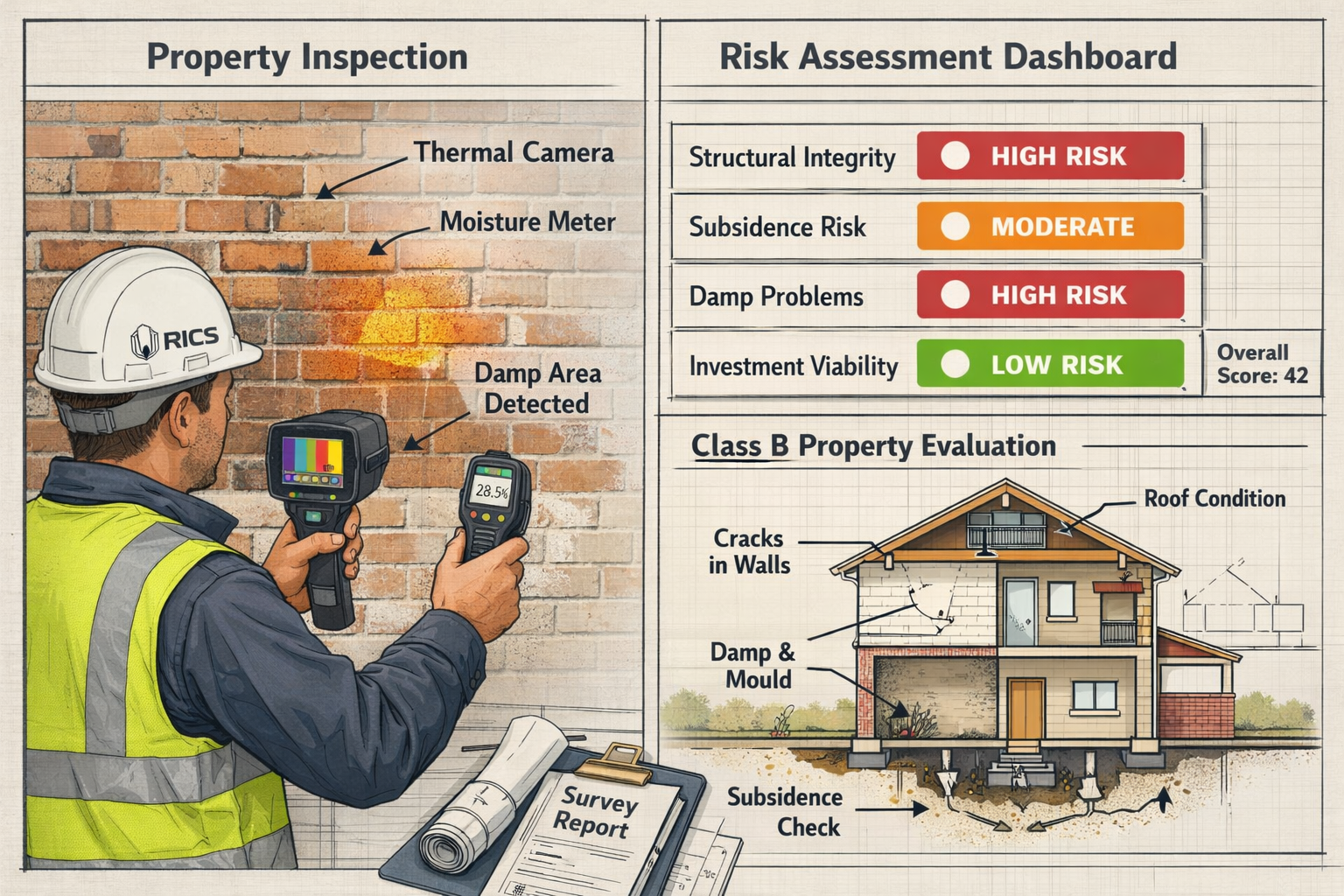
Moisture-related defects represent one of the most significant long-term maintenance liabilities in rental properties. Institutional investors typically commission specialized damp surveys using moisture meters, thermal imaging, and invasive investigation where necessary.
Common damp issues requiring assessment:
- Rising damp from failed or absent damp-proof courses
- Penetrating damp through defective pointing or roofing
- Condensation damp from inadequate ventilation
- Timber decay from prolonged moisture exposure
- Subfloor ventilation adequacy
Comparing Survey Levels for Buy-to-Let Investments
Institutional investors must select appropriate survey levels based on property age, condition, and portfolio strategy. Understanding the difference between Level 2 and Level 3 surveys proves essential for cost-effective due diligence.
Survey level selection matrix:
| Property Characteristics | Recommended Survey Level | Rationale |
|---|---|---|
| Modern (post-2000), standard construction | Level 2 Homebuyer Survey | Cost-effective for low-risk properties |
| Pre-1980, conventional construction | Level 2 with targeted Level 3 elements | Balanced approach for moderate-risk assets |
| Pre-1950, altered, or non-standard construction | Full Building Survey (Level 3) | Comprehensive assessment for high-risk properties |
| Portfolio acquisition (multiple units) | Stock Condition Survey | Standardized methodology for comparative analysis |
Timeline Considerations for Survey Completion
When institutional investors are acquiring multiple properties simultaneously, understanding how long surveys take to complete becomes critical for transaction coordination. Typical timelines range from 5-10 business days for standard surveys to 3-4 weeks for complex building surveys requiring specialist investigations.
Professional investors often implement:
- Concurrent survey scheduling across portfolio acquisitions
- Pre-agreed surveyor panels with guaranteed turnaround times
- Digital reporting platforms for immediate data access
- Standardized survey templates enabling rapid comparative analysis
Investment Strategy Implications: Class B Properties and Risk-Adjusted Returns
The Class B Property Advantage
Class B properties have emerged as the sweet spot for institutional buy-to-let investment in 2026. These mid-tier assets offer compelling advantages:
Rental affordability: With rents 20-30% lower than luxury Class A properties, Class B units attract a broader tenant pool including former homeowners seeking quality accommodation without premium pricing.
Demographic alignment: The growing segment of creditworthy renters priced out of homeownership gravitates toward well-maintained Class B properties offering single-family style living without ownership risks.
Value-add opportunities: Many Class B properties benefit from strategic upgrades—modern kitchens, updated bathrooms, improved energy efficiency—that command rent premiums without requiring Class A-level capital investment.
Operational efficiency: Lower acquisition costs relative to Class A properties enable superior cash-on-cash returns while serving stable, long-term tenant demographics.

Rent Growth Projections and Market Dynamics
Market fundamentals in 2026 favor single-family rental strategies over multifamily investments:
Single-family rent growth: Projected at 2.3% in 2026, reflecting sustained demand from families seeking space, privacy, and suburban locations.
Multifamily rent growth: Nearly flat at 0.3%, constrained by supply absorption from previous years' construction boom and tighter financing conditions prompting developer pullbacks.
This divergence creates strategic opportunities for institutional investors focusing on single-family or small multifamily Class B properties in growth markets rather than large apartment complexes in oversupplied metros.
Risk Mitigation Through Comprehensive Surveys
Professional building surveys enable institutional investors to quantify and price risk rather than simply avoid it. Key risk mitigation strategies include:
Maintenance reserve modeling: Survey findings inform accurate capital reserve calculations, ensuring sufficient funds for anticipated repairs without impacting cash flow projections.
Acquisition price adjustments: Identified defects justify purchase price reductions reflecting remediation costs, protecting investor returns.
Portfolio diversification: Standardized survey data enables investors to balance high-maintenance older properties with newer, lower-maintenance assets within portfolios.
Tenant safety compliance: Thorough surveys identify and remediate safety hazards before tenant occupancy, reducing liability exposure and regulatory risk.
Emerging Survey Technologies and Methodologies
Digital Survey Tools Transforming Due Diligence
Institutional investors in 2026 increasingly leverage advanced survey technologies that enhance accuracy while reducing costs:
Thermal imaging cameras detect hidden moisture, insulation deficiencies, and electrical hotspots invisible to visual inspection. This technology proves particularly valuable for identifying concealed damp issues in Class B properties with aging building envelopes.
Drone surveys provide comprehensive roof condition assessment without scaffolding costs or access challenges. Aerial survey technology enables detailed photographic documentation of roof coverings, chimneys, and high-level building elements.
3D laser scanning creates precise building measurements and spatial documentation, supporting accurate floor area calculations and identifying structural irregularities.
Digital reporting platforms deliver survey findings through interactive dashboards, enabling portfolio managers to analyze data across multiple properties, identify patterns, and prioritize capital allocation.
Standardized Risk Scoring Systems
Leading institutional investors have developed proprietary risk scoring methodologies that translate survey findings into quantitative risk ratings:
- Structural risk scores (0-100): Aggregate foundation, wall, and roof condition indicators
- Systems risk scores (0-100): Evaluate MEP infrastructure age and condition
- Compliance risk scores (0-100): Assess regulatory adherence and safety standards
- Maintenance liability scores (0-100): Project 10-year capital expenditure requirements
These standardized scores enable portfolio-level risk management, allowing investors to maintain balanced risk exposure across hundreds of properties while identifying outliers requiring immediate attention or disposition.
Regulatory Compliance and Professional Standards
RICS Standards for Buy-to-Let Surveys
Professional surveys for institutional buy-to-let investments must adhere to Royal Institution of Chartered Surveyors (RICS) standards, ensuring consistency, competence, and professional accountability. RICS-qualified surveyors provide:
- Professional indemnity insurance protecting investors against survey negligence
- Standardized reporting formats enabling comparative analysis
- Continuing professional development ensuring current knowledge of building pathology and regulations
- Ethical standards preventing conflicts of interest
When commissioning surveys for commercial-scale buy-to-let portfolios, investors should verify surveyors hold appropriate RICS qualifications and maintain professional standards.
Energy Performance and Sustainability Requirements
Energy Performance Certificate (EPC) regulations significantly impact buy-to-let investment viability in 2026. Rental properties must meet minimum energy efficiency standards, with progressive tightening anticipated in coming years.
Survey protocols must evaluate:
- Current EPC ratings and improvement pathways to minimum standards
- Insulation adequacy in walls, roofs, and floors
- Heating system efficiency and upgrade requirements
- Window performance and glazing specifications
- Renewable energy integration opportunities
Properties failing to meet minimum EPC standards require capital investment for compliance, directly impacting investment returns. Comprehensive surveys quantify these costs before acquisition, enabling accurate financial modeling.
Conclusion: Strategic Survey Investment for Long-Term Success
Buy-to-Let Property Surveys in 2026: Assessing Institutional Landlord Investment Surge and Risk Protocols represents far more than routine property inspection—it constitutes the foundation of professional investment due diligence in an increasingly competitive and regulated market.
Institutional investors deploying capital into the 203,000+ unit pipeline currently under construction or in planning must implement sophisticated survey protocols that go beyond identifying current defects to forecasting long-term maintenance liabilities, quantifying regulatory compliance costs, and enabling portfolio-level risk management.
Key strategic imperatives include:
✅ Selecting appropriate survey levels based on property age, condition, and risk profile—balancing comprehensive assessment against cost efficiency
✅ Leveraging advanced survey technologies including thermal imaging, drone inspections, and digital reporting platforms for enhanced accuracy and portfolio scalability
✅ Focusing on Class B properties in high-growth Sun Belt metros where demographic trends, rent growth projections, and acquisition economics align favorably
✅ Implementing standardized risk scoring that translates survey findings into quantitative metrics enabling comparative analysis across portfolios
✅ Ensuring RICS compliance and professional standards that protect investment capital through qualified, insured surveyor engagement
Next Steps for Institutional Investors
Professional landlords entering or expanding within the buy-to-let market in 2026 should:
- Establish surveyor partnerships with firms experienced in portfolio-scale assessments and institutional reporting requirements
- Develop standardized survey specifications ensuring consistent data collection across all property acquisitions
- Integrate survey findings into financial models, capital reserve planning, and portfolio risk management frameworks
- Monitor regulatory developments affecting survey requirements, energy performance standards, and tenant safety obligations
- Invest in digital infrastructure enabling efficient survey data management, analysis, and decision-support
The institutional investment surge transforming buy-to-let markets in 2026 demands equally sophisticated approaches to property assessment. Those implementing comprehensive, technology-enabled survey protocols will identify superior investment opportunities, avoid costly defects, and build resilient portfolios delivering sustainable returns across economic cycles. 📊