
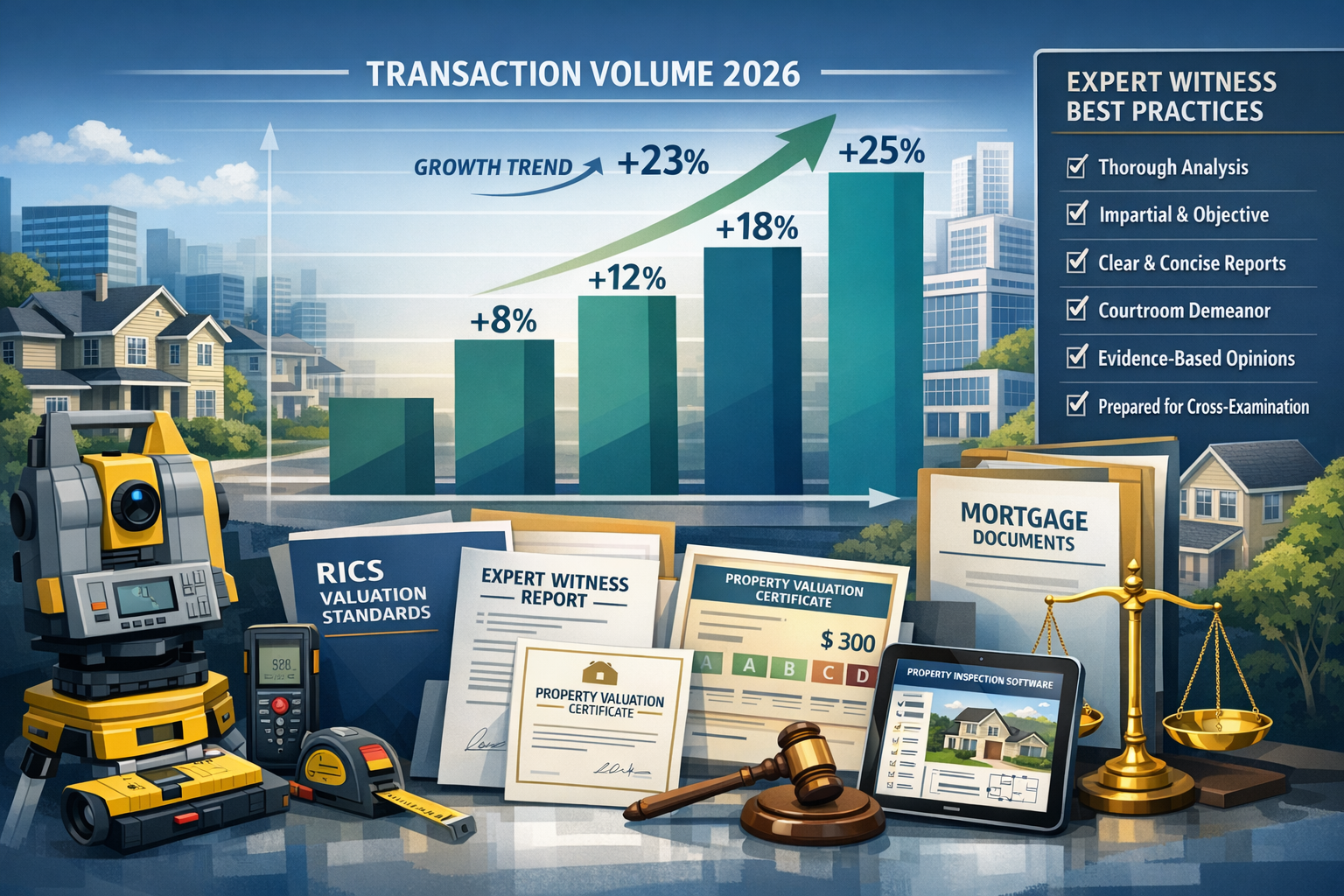
As property markets rebound in 2026, mortgage lenders and borrowers increasingly find themselves at odds over property valuations. With transaction volumes climbing steadily after years of uncertainty, the role of expert witness valuations for mortgage lender disputes has never been more critical. Building survey evidence forms the backbone of these disputes, providing the technical foundation that can make or break a case in court or arbitration. 📊
The surge in property transactions brings with it a corresponding increase in valuation disagreements. When mortgage lenders question property values or borrowers challenge conservative assessments, expert witness testimony backed by comprehensive building surveys becomes essential. Understanding how to construct compelling survey evidence in 2026's evolving market landscape separates successful dispute resolution from costly litigation.
Key Takeaways
- Rising transaction volumes in 2026 are driving increased mortgage lender disputes requiring expert witness valuations with robust building survey evidence
- Comprehensive building surveys must document structural defects, condition issues, and repair costs with forensic-level detail to withstand legal scrutiny
- RICS standards and methodologies provide the framework for credible expert witness testimony in valuation disputes
- Digital documentation tools including thermal imaging, drone surveys, and 3D modeling strengthen evidence presentation in 2026
- Strategic evidence preparation focusing on comparable analysis, defect quantification, and clear valuation adjustments ensures persuasive expert testimony
Understanding the 2026 Mortgage Dispute Landscape
The Transaction Volume Recovery
The property market has experienced remarkable resilience in 2026. Transaction volumes have rebounded significantly, driven by stabilizing interest rates and renewed buyer confidence. This recovery, while positive for the broader economy, has created friction points between mortgage lenders and property valuers.
Lenders remain cautious following previous market volatility, often commissioning conservative valuations to protect their loan-to-value ratios. Borrowers and sellers, meanwhile, point to rising prices and competitive market conditions. This divergence creates the perfect storm for disputes requiring expert witness intervention.
Common Triggers for Valuation Disputes
Several scenarios commonly trigger the need for expert witness valuations in mortgage contexts:
- Down-valuations where lender valuations fall significantly below agreed purchase prices
- Structural defect discoveries that impact lending decisions and property values
- Negligent survey claims against original surveyors who missed critical defects
- Refinancing disagreements over current market values
- Repossession proceedings requiring accurate distressed sale valuations
Each scenario demands different evidence approaches, but all require meticulous building survey documentation.
Building Survey Evidence for Expert Witness Valuations in Mortgage Lender Disputes
The Foundation: Comprehensive Building Surveys
The cornerstone of effective expert witness testimony lies in thorough building survey work. A RICS Level 3 Building Survey provides the detailed investigation necessary for dispute resolution, going far beyond standard mortgage valuations.
Essential survey components include:
| Survey Element | Purpose in Dispute Evidence | Documentation Standard |
|---|---|---|
| Structural assessment | Identifies defects affecting value | Photographic evidence with measurements |
| Defect quantification | Establishes repair cost impacts | Detailed specifications and quotes |
| Condition ratings | Provides objective condition baseline | RICS condition rating system |
| Comparable analysis | Supports valuation adjustments | Market evidence with adjustments |
| Hidden defect investigation | Reveals issues missed in basic surveys | Specialist testing results |
Specialist Investigations That Strengthen Evidence
Beyond general building surveys, targeted specialist investigations add significant weight to expert witness testimony. These focused assessments address specific technical questions that often form the crux of valuation disputes.
Critical specialist surveys include:
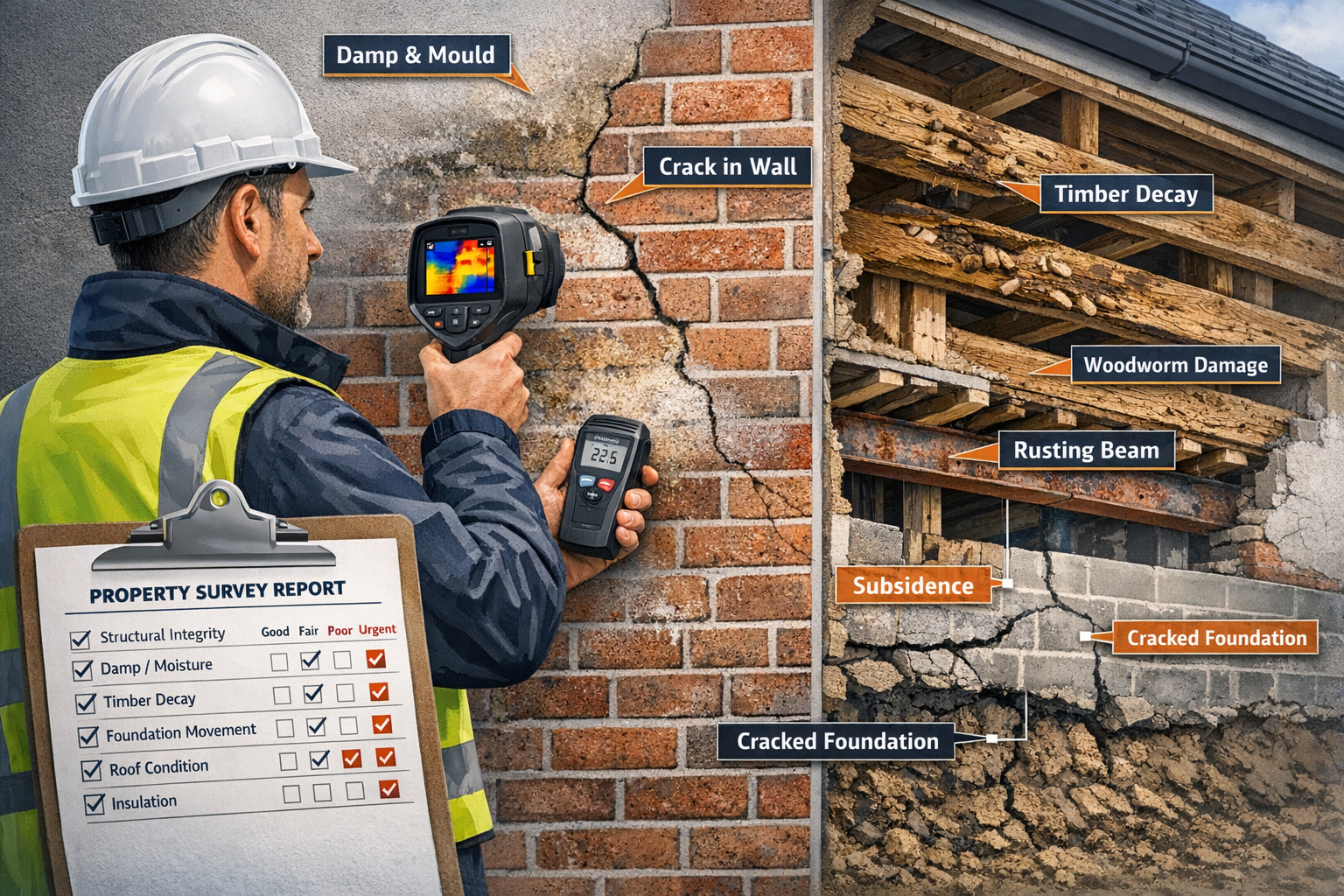
🔍 Structural defect surveys – Specialist defect investigations using advanced diagnostic tools provide irrefutable evidence of structural problems affecting property values.
💧 Damp and moisture surveys – Thermal imaging and moisture meter readings create objective evidence of damp issues that significantly impact valuations.
🏗️ Subsidence investigations – Detailed crack monitoring and structural movement analysis establish the extent and progression of subsidence problems.
🏢 Commercial building assessments – For commercial mortgage disputes, commercial building surveys address unique valuation factors including lease terms, tenant covenants, and investment yields.
Documentation Standards for Legal Scrutiny
Expert witness evidence must withstand rigorous cross-examination. Documentation standards in 2026 have evolved to meet increasingly sophisticated legal challenges.
Best practice documentation includes:
- Timestamped photographic evidence with GPS coordinates and metadata intact
- Video walkthroughs showing defect context and extent
- Thermal imaging reports with calibrated equipment certification
- Moisture readings with equipment calibration certificates
- Comparative market data with source verification
- Repair cost estimates from qualified contractors with detailed specifications
The surveyor's contemporaneous notes, taken during the inspection, often prove crucial when testimony occurs months or years after the initial survey. Digital recording tools ensure nothing is lost or forgotten.
Valuation Methodologies in Mortgage Lender Disputes
The Comparative Method with Defect Adjustments
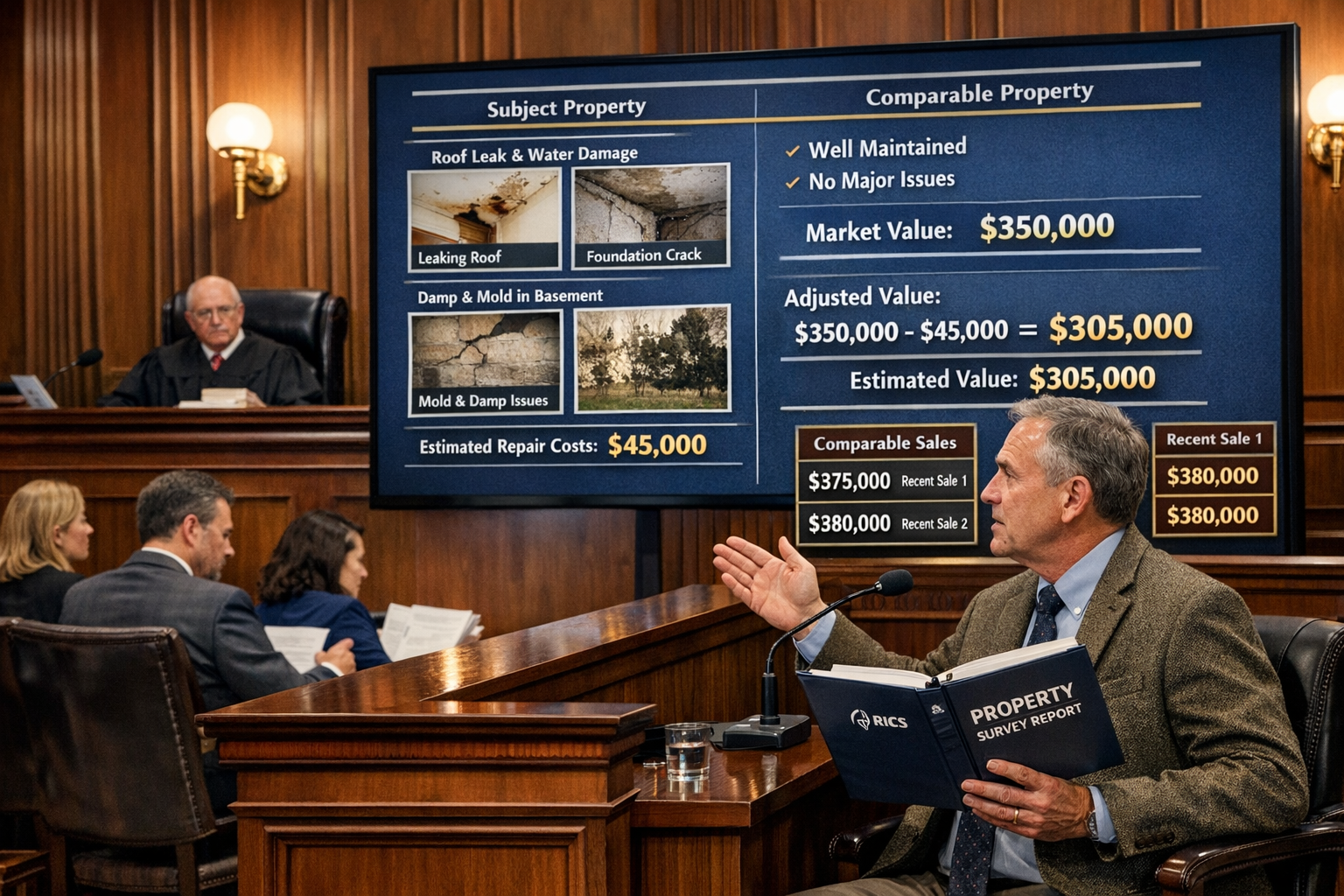
The comparative method forms the primary valuation approach in most residential mortgage disputes. However, expert witnesses must demonstrate how building defects justify adjustments from comparable sales.
Effective defect adjustment methodology:
- Start with comparable properties in similar condition and location
- Document each defect category with repair cost estimates
- Apply market-based adjustments reflecting buyer perception, not just repair costs
- Consider stigma effects for major defects like subsidence or structural movement
- Account for time to remedy and associated holding costs
Expert witnesses must explain why a £20,000 repair might justify a £35,000 valuation reduction – buyers demand discounts beyond mere repair costs to compensate for risk and inconvenience.
Investment and Residual Methods for Complex Cases
Commercial mortgage disputes or development properties require more sophisticated valuation approaches. The investment method considers rental income and yields, while the residual method addresses development potential.
For commercial property valuations, expert witnesses must demonstrate how building condition affects:
- Rental values – defects reducing achievable rents
- Void periods – condition issues extending letting timeframes
- Yield adjustments – risk premiums for properties requiring significant repairs
- Capital expenditure – immediate repair obligations affecting investment returns
Red Book Compliance and Expert Witness Standards
RICS Red Book compliance provides the professional framework for expert witness valuations. In 2026, courts expect expert witnesses to demonstrate adherence to Red Book valuation standards while explaining any necessary departures.
Key Red Book considerations:
✅ Independence – demonstrating no conflict of interest
✅ Competence – relevant experience in property type and dispute context
✅ Assumptions and special assumptions – clearly stated and justified
✅ Basis of value – appropriate for the dispute context (market value, existing use, etc.)
✅ Inspection limitations – disclosed and impact on conclusions explained
Presenting Expert Witness Valuations for Mortgage Lender Disputes: Building Survey Evidence in 2026's Rising Transaction Volume
Report Structure for Maximum Impact
An expert witness report serves dual purposes: educating legal professionals and withstanding opposing expert scrutiny. Structure significantly impacts effectiveness.
Optimal report structure:
- Executive Summary – key conclusions accessible to non-technical readers
- Instructions and Context – demonstrating understanding of legal questions
- Property Description – establishing factual foundation
- Inspection Methodology – building credibility through thorough approach
- Findings and Defects – detailed technical assessment with evidence
- Valuation Analysis – methodical approach with clear reasoning
- Conclusions – direct answers to instructed questions
- Appendices – supporting photographs, documents, and technical data
The report must balance technical rigor with accessibility. Legal professionals need to understand the reasoning without surveying expertise.
Visual Evidence Presentation
In 2026, visual evidence presentation has become increasingly sophisticated. Courts and arbitrators expect high-quality visual materials that clearly communicate technical findings.
Effective visual evidence includes:
📸 Annotated photographs – arrows, circles, and labels highlighting specific defects
📊 Comparison charts – showing valuation adjustments and market data
🎥 Video evidence – walkthrough footage showing defect extent and context
🌡️ Thermal imaging – false-color images revealing hidden moisture and insulation issues
🚁 Drone imagery – roof condition and external defects from aerial perspectives
📐 Technical drawings – illustrating structural issues and proposed repairs
Digital presentation tools allow expert witnesses to present evidence dynamically during testimony, zooming into specific areas and comparing before/after scenarios.
Handling Cross-Examination
The expert witness's credibility often hinges on cross-examination performance. Preparation involves anticipating challenges and maintaining professional composure.
Cross-examination strategies:
- Know the evidence intimately – review all documentation before testimony
- Acknowledge limitations – admitting inspection constraints builds credibility
- Explain technical concepts clearly – avoid jargon without "talking down"
- Maintain independence – resist pressure to advocate for instructing party
- Reference contemporaneous notes – demonstrating thorough inspection process
- Address opposing expert views – respectfully explain disagreements with technical reasoning
"The most effective expert witnesses educate rather than advocate. Courts value independence and clarity over partisan support." – RICS Expert Witness Guidance
Technology and Innovation in 2026 Survey Evidence
Digital Documentation Tools
Technology has transformed how surveyors gather and present building survey evidence. Digital tools available in 2026 provide unprecedented detail and objectivity.
Key technologies include:
🔧 Moisture meters with data logging – creating timestamped records of moisture readings
📱 Survey apps with integrated photography – linking photos directly to report sections
💻 3D laser scanning – creating detailed property models showing defect locations
🌐 Cloud-based collaboration – allowing legal teams real-time access to survey data
🤖 AI-assisted defect detection – identifying potential issues in photographic evidence
These tools enhance both evidence quality and presentation effectiveness in dispute resolution.
Drone Surveys for Inaccessible Areas
Drone surveys have become standard practice for assessing roof conditions and other inaccessible building elements. In expert witness contexts, drone evidence addresses common challenges to survey completeness.
Drone imagery demonstrates thorough inspection methodology, countering arguments that defects were missed due to access limitations. High-resolution aerial photography provides objective evidence of roof condition, chimney defects, and external wall issues.
Data Analytics and Market Evidence
In 2026, expert witnesses increasingly leverage data analytics to support valuation conclusions. Sophisticated market analysis tools provide robust comparable evidence and trend analysis.
Data-driven evidence includes:
- Transaction databases with detailed property characteristics and sale prices
- Defect impact analysis showing typical valuation adjustments for specific defect types
- Market trend modeling demonstrating price movements and market conditions
- Statistical analysis of comparable sales with adjustment justifications
This analytical approach strengthens expert witness credibility, demonstrating systematic methodology rather than subjective opinion.
Best Practices for Expert Witness Surveyors in 2026
Maintaining Professional Independence
Independence forms the bedrock of expert witness credibility. Courts in 2026 scrutinize expert witness relationships with instructing parties more carefully than ever.
Independence safeguards:
- Accepting instructions only within areas of genuine expertise
- Disclosing any previous involvement with the property or parties
- Resisting pressure to modify conclusions to favor instructing party
- Communicating directly with opposing experts when appropriate
- Maintaining separate expert witness and advocacy roles
Expert witnesses owe their primary duty to the court or tribunal, not to the party instructing them.
Continuing Professional Development
The evolving nature of construction technology, valuation methodology, and legal requirements demands ongoing professional development. Expert witnesses must stay current with industry developments.
Essential CPD areas include:
📚 Legal procedure updates – understanding evolving court expectations
🏗️ Construction technology – new building methods and materials
💡 Valuation methodology – emerging approaches and market analysis techniques
⚖️ Expert witness training – report writing and testimony skills
🔍 Specialist investigation techniques – advanced diagnostic tools and methods
RICS registered valuers must maintain CPD records demonstrating ongoing competence in expert witness work.
Building a Credible Track Record
Reputation matters significantly in expert witness work. Surveyors build credibility through consistent, high-quality evidence and professional testimony.
Reputation-building strategies:
- Thorough inspection methodology – never cutting corners on evidence gathering
- Balanced reporting – acknowledging strengths and weaknesses in positions
- Clear communication – making technical matters accessible
- Timely delivery – meeting court deadlines and legal timeframes
- Professional demeanor – maintaining composure under cross-examination
Experienced expert witnesses often receive repeat instructions from legal firms who value reliable, credible testimony.
Common Pitfalls and How to Avoid Them
Insufficient Inspection Scope
The most common weakness in expert witness evidence stems from inadequate inspection scope. Surveyors must ensure their inspection methodology addresses all relevant issues.
Inspection scope considerations:
- Access limitations – documenting areas not inspected and potential implications
- Specialist testing – commissioning additional investigations when needed
- Comparable inspection – viewing comparable properties when possible
- Document review – examining previous surveys, planning documents, and building records
- Stakeholder interviews – speaking with occupiers about defect history
When inspection limitations exist, expert witnesses must clearly state assumptions and their potential impact on conclusions.
Inadequate Comparable Evidence
Valuation opinions without robust comparable evidence rarely withstand scrutiny. Expert witnesses must demonstrate systematic market analysis.
Comparable evidence requirements:
✓ Sufficient quantity – multiple comparables showing consistent market evidence
✓ Genuine comparability – similar location, type, size, and condition
✓ Adjustment transparency – clear explanation of all adjustments made
✓ Source verification – documented evidence sources (Land Registry, agents, etc.)
✓ Time adjustments – accounting for market movements between comparable sales and valuation date
Weak comparable evidence undermines even the most thorough building survey work.
Overstepping Expertise Boundaries
Expert witnesses must recognize the limits of their expertise. Straying into areas beyond professional competence damages credibility.
Common boundary issues:
- Structural engineers opining on valuation impacts without valuation expertise
- Valuers making definitive structural engineering conclusions
- Surveyors commenting on legal matters beyond their remit
- Experts addressing causation issues requiring different expertise
When questions stray beyond expertise, expert witnesses should acknowledge limitations and suggest appropriate additional experts.
The Future of Expert Witness Valuations in Mortgage Disputes
Emerging Trends for Late 2026 and Beyond
The mortgage dispute landscape continues evolving. Several trends will shape expert witness work in coming months.
Key developments include:
🌍 Climate risk assessment – increasing focus on flood risk, climate change impacts, and sustainability
🏡 EPC and energy efficiency – valuation impacts of energy performance becoming more significant
💰 Alternative dispute resolution – growing use of mediation and expert determination
📱 Virtual inspections – hybrid inspection methodologies combining physical and remote elements
🤝 Joint expert appointments – single joint experts reducing costs and streamlining disputes
Expert witnesses must adapt to these evolving requirements while maintaining rigorous evidence standards.
Regulatory and Professional Standards Evolution
Professional standards for expert witness work continue developing. RICS and other professional bodies regularly update guidance reflecting legal developments and best practices.
Surveyors engaged in expert witness work must monitor guidance updates and participate in professional development to maintain competence in this specialized field.
Conclusion
Expert witness valuations for mortgage lender disputes represent a critical intersection of technical surveying expertise, valuation methodology, and legal procedure. As 2026's rising transaction volumes drive increased disputes, the demand for high-quality expert witness services continues growing.
Building survey evidence forms the foundation of credible expert witness testimony. Comprehensive inspections using modern diagnostic tools, meticulous documentation, and clear presentation separate effective expert witnesses from those whose evidence crumbles under scrutiny.
Success in this specialized field requires:
- Technical excellence in building survey methodology and valuation analysis
- Professional independence maintaining objectivity despite partisan pressures
- Communication skills making complex technical matters accessible to legal professionals
- Continuing development staying current with evolving standards and technologies
- Strategic evidence preparation anticipating challenges and building robust cases
For surveyors considering expert witness work, the opportunity to contribute to dispute resolution while applying technical expertise at the highest level offers significant professional satisfaction. The work demands rigor, independence, and clarity – but rewards those qualities with the respect of courts, legal professionals, and clients.
Next Steps for Property Professionals
Whether you're a mortgage lender seeking reliable expert witness support, a legal professional requiring technical expertise for a valuation dispute, or a surveyor looking to develop expert witness capabilities, understanding the evidence standards and methodologies outlined in this article provides essential foundation.
For properties requiring comprehensive survey evidence, consider commissioning RICS building surveys that meet the rigorous standards necessary for potential dispute resolution. Early identification of defects and accurate valuation assessment prevents many disputes from escalating to formal proceedings.
The mortgage lending landscape of 2026 demands expertise, professionalism, and evidence quality. Those who meet these standards will find themselves well-positioned to contribute meaningfully to dispute resolution while protecting the interests of all parties involved in property transactions.