
As London's property market finds its footing in 2026, homeowners across the capital are turning their attention downward. With house prices stabilising and lateral space at a premium, basement conversions have become the go-to solution for adding valuable square footage to terraced and semi-detached properties. Yet beneath the appeal of extra living space lies a critical legal requirement that catches many property owners off guard: Party Wall Agreements for Basement Conversions in London's Stabilising 2026 Market are not optional extras—they're mandatory legal obligations that can make or break your project timeline and budget.
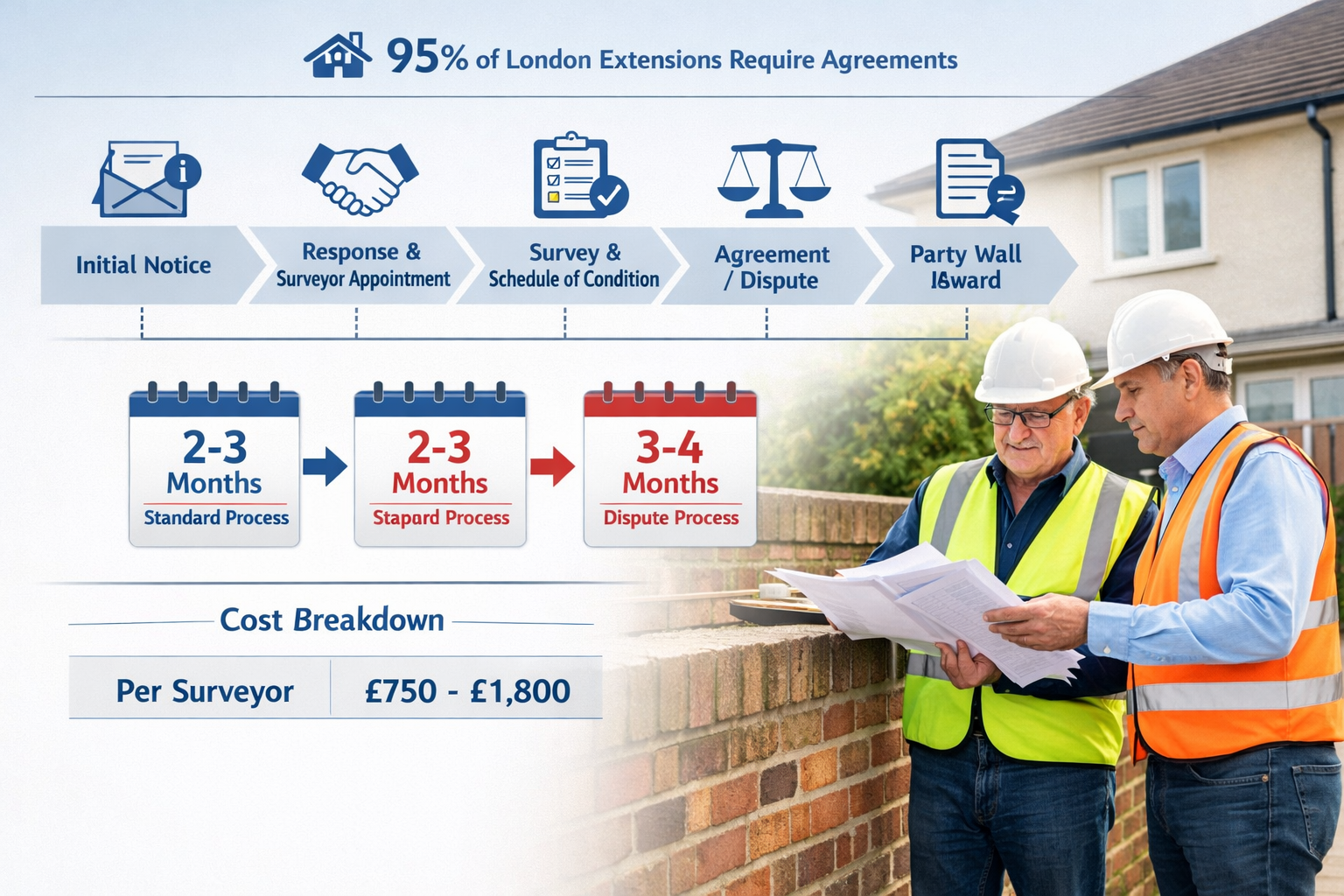
Approximately 95% of London extension projects require party wall agreements, and basement conversions trigger some of the most complex provisions of the Party Wall Act 1996.[1] Whether you're excavating beneath a Victorian terrace in Hampstead or converting a cellar in Battersea, understanding the party wall process is essential for avoiding costly delays, neighbour disputes, and potential legal complications.
Key Takeaways
- Budget realistically: Expect to pay £1,500–£3,600 per affected neighbour for party wall agreements, with mid-terrace properties potentially facing total costs of £3,000–£7,200 or more for complex structural work.[1]
- Start early: Allow 2–3 months minimum for straightforward agreements, or 3–4 months if a Party Wall Award is required—difficult cases can extend to 5–9 months.[1]
- Excavation triggers mandatory notices: If you're digging within 3 metres of a neighbour's foundation while going deeper, or within 6 metres at certain angles, you must serve party wall notices—almost all London basement excavations meet these criteria.[1]
- Permitted Development doesn't exempt you: Even basement extensions that don't require planning permission must still comply with the Party Wall Act 1996.[1]
- Professional surveyors are essential: RICS-qualified party wall surveyors protect both parties' interests and ensure legally binding agreements that prevent future disputes.
Understanding Party Wall Agreements for Basement Conversions in London's Stabilising 2026 Market
What Is the Party Wall Act 1996?
The Party Wall Act 1996 remains the cornerstone legislation governing basement conversion agreements across England and Wales. This Act grants property owners the legal right to undertake certain building works while simultaneously protecting neighbouring properties from potential damage or disruption.[2]
For basement conversions specifically, the Act addresses three main scenarios:
- Building on or astride a boundary line (Section 1)
- Working directly on an existing party wall (Section 2)
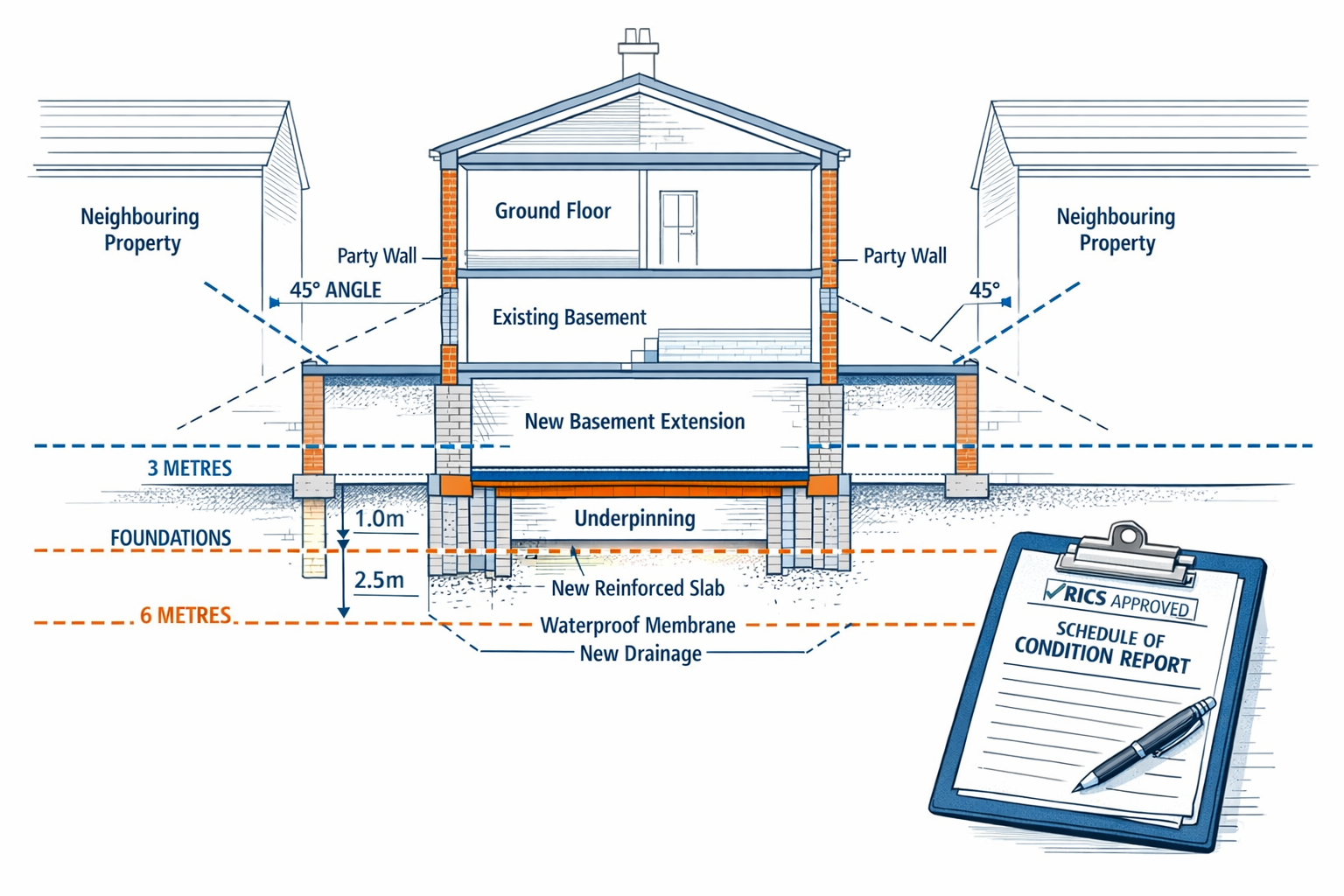
- Excavating within specified distances of neighbouring foundations (Section 6)
Most London basement conversions fall under Section 6, which requires formal notices when excavation work occurs within proximity to adjoining properties. Understanding these party wall requirements is crucial before commencing any basement project.
Why Basement Conversions Almost Always Require Party Wall Agreements
London's dense urban fabric means that basement excavations rarely occur in isolation. The typical terraced property shares structural connections with neighbours on both sides, and excavating beneath your property inevitably affects the ground stability and foundation support of adjoining buildings.
The excavation distance triggers are particularly relevant:
- 3-metre rule: Notice required if excavating within 3 metres of a neighbouring structure while going below their foundation level
- 6-metre rule: Notice required if excavating within 6 metres while your excavation falls within a 45-degree angle from the bottom of their foundation[1]
Given that most London terraced properties sit mere centimetres from their neighbours, and basement excavations typically extend 2–3 metres below existing foundations, these triggers apply to virtually every basement conversion project. For detailed information about distance requirements, consult our guide on the three-metre rule.
The Role of RICS Surveyors in 2026
In 2026's stabilising market, professional RICS-qualified party wall surveyors play an indispensable role in facilitating basement conversions. Once appointed under the Party Wall Act, these surveyors work to benefit the party wall structure itself rather than either property owner's specific interests—a crucial distinction that ensures impartiality.[2]
Their responsibilities include:
✅ Drafting and serving formal notices to affected neighbours
✅ Conducting pre-work condition surveys (schedules of condition)
✅ Preparing Party Wall Awards that legally bind all parties
✅ Mediating disputes between building owners and adjoining owners
✅ Monitoring construction work to ensure compliance with agreed terms
✅ Assessing and resolving damage claims if issues arise during construction
The Party Wall Process for Basement Conversions: Step-by-Step Timeline
Step 1: Initial Assessment and Planning (Weeks 1–2)
Before serving any notices, engage a qualified party wall surveyor to assess your proposed basement conversion. They'll determine:
- Which neighbours require notification
- Which sections of the Party Wall Act apply
- Estimated costs and timelines
- Potential complications or concerns
Pro tip: Begin this process immediately after receiving planning approval rather than waiting until you're ready to start construction. This parallel approach can save months on your overall project timeline.[1]
Step 2: Serving Party Wall Notices (Week 3)
Your surveyor will prepare and serve formal notices to all affected neighbours. For basement excavations, this typically involves a Section 6 Notice detailing:
- The nature and extent of excavation work
- Proposed construction methods
- Expected start date (must be at least 2 months in the future)
- Details of your appointed surveyor
Notices must be served at least two months before work commences for excavations, though many surveyors recommend serving three months ahead to allow for potential complications.[1]
Step 3: Neighbour Response Period (Weeks 4–12)
Your neighbours have 14 days to respond in one of three ways:
- Consent in writing – The simplest outcome, though relatively rare in London
- Dissent or fail to respond – Triggers the need for a Party Wall Award
- Raise concerns or objections – Requires negotiation and surveyor mediation
If your neighbour consents promptly and has no concerns, the process may conclude within 2–3 months. However, if they dissent (or simply don't respond), you'll need to proceed with a formal Party Wall Award, extending the timeline to 3–4 months or longer.[1]
Understanding what happens if no party wall agreement is reached can help you prepare for various scenarios.
Step 4: Schedule of Condition Survey (Weeks 6–10)
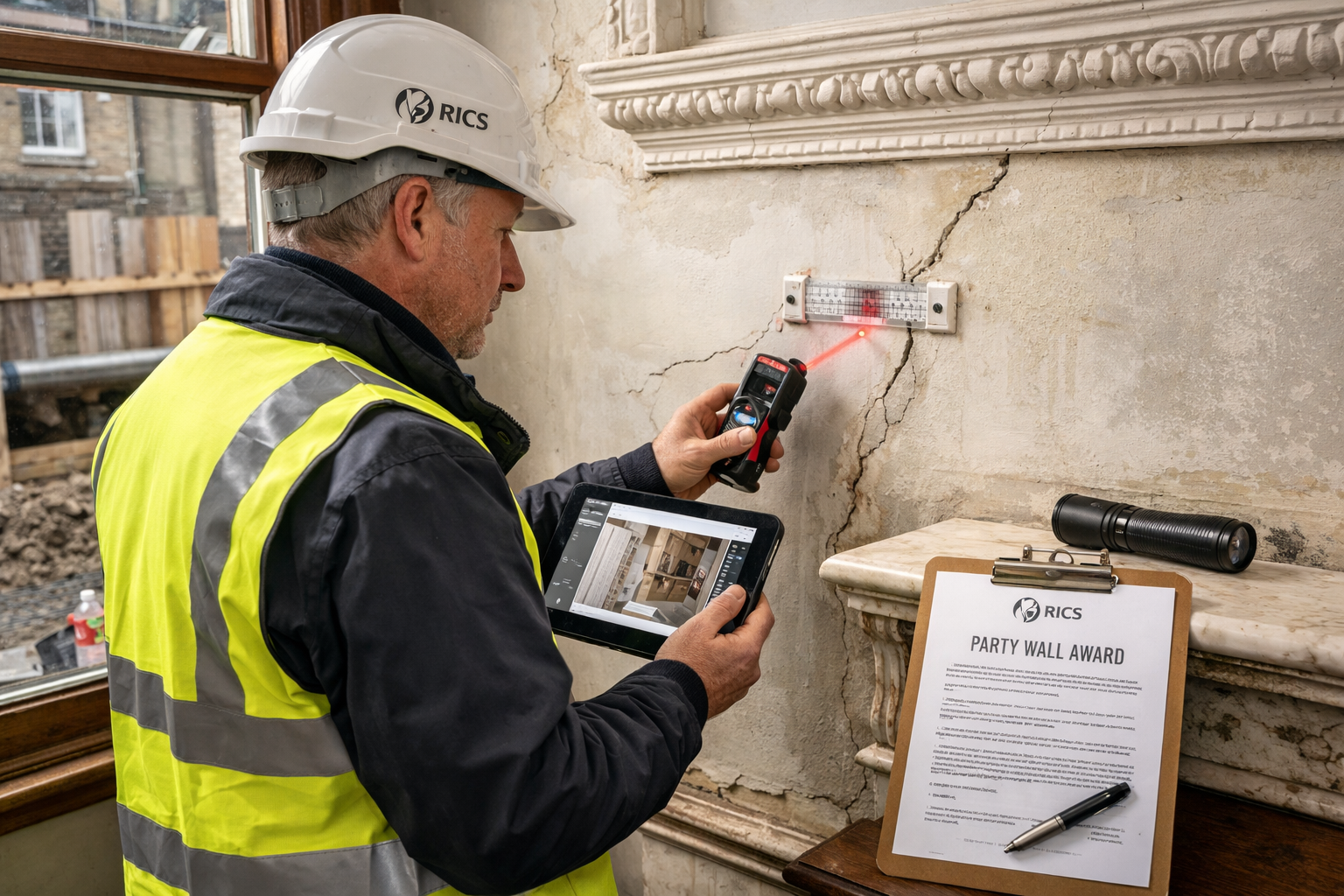
A schedule of condition represents one of the most critical components of party wall agreements for basement conversions. This detailed inspection documents the current state of your neighbour's property, including:
- Walls (internal and external)
- Floors and ceilings
- Visible cracks or defects
- Structural elements potentially affected by excavation
The survey typically includes photographs, written descriptions, and sometimes video documentation. This baseline record protects both parties: it demonstrates pre-existing conditions and provides evidence if damage to property occurs during construction.[2]
Learn more about schedule of condition requirements for party wall work.
Step 5: Party Wall Award Preparation (Weeks 8–14)
If your neighbour dissents or doesn't respond, the appointed surveyors (yours and theirs, or a single agreed surveyor) will prepare a Party Wall Award. This legally binding document specifies:
📋 Permitted works and construction methods
📋 Working hours and access arrangements
📋 Protective measures to prevent damage
📋 Monitoring protocols during construction
📋 Dispute resolution procedures if issues arise
📋 Cost responsibilities for surveyor fees
Once agreed by both surveyors, the Award is binding and cannot be rescinded except by application to the County Court—a rare and expensive process.[2] For comprehensive information about awards, see our guidance for party wall awards.
Step 6: Construction Commencement (Month 3–4+)
Only after the Party Wall Award is finalized can excavation work legally commence. During construction, your surveyor may conduct periodic inspections to ensure compliance with the Award's terms and monitor for any signs of damage to neighbouring properties.
Costs of Party Wall Agreements for Basement Conversions in London's Stabilising 2026 Market
Current Fee Structures in 2026
Party wall costs have remained relatively stable through London's 2026 market stabilisation, though they represent a significant budget consideration for basement projects.
Per-surveyor costs:
- Your surveyor: £750–£1,800 per affected neighbour
- Neighbour's surveyor: £750–£1,800 per affected neighbour
- Total per neighbour: £1,500–£3,600[1]
Budget Planning for Different Property Types
| Property Type | Affected Neighbours | Typical Total Cost |
|---|---|---|
| End-of-terrace | 1 | £1,500–£3,600 |
| Mid-terrace | 2 | £3,000–£7,200 |
| Semi-detached | 1 | £1,500–£3,600 |
| Detached (close to boundary) | 1–2 | £1,500–£7,200 |
For complex basement structural work involving significant underpinning, multiple party walls, or difficult neighbour relationships, total costs can exceed £12,000.[1]
What Influences Party Wall Costs?
Several factors affect the final bill:
🏗️ Complexity of excavation – Deeper basements require more detailed assessments
🏘️ Number of affected properties – Mid-terrace homes face higher costs
⏱️ Timeline pressures – Rush jobs command premium fees
🤝 Neighbour cooperation – Disputes require additional surveyor time
📍 Location within London – Central London typically sees higher fees
🔍 Property condition – Older properties need more extensive condition surveys
Who Pays for Party Wall Agreements?
The building owner (the person undertaking the basement conversion) is responsible for all party wall costs, including:
- Their own surveyor's fees
- The adjoining owner's surveyor's fees
- The cost of the Party Wall Award preparation
- Schedule of condition surveys
- Any necessary remedial work if damage occurs
This cost structure surprises many homeowners, but it reflects the legal principle that those benefiting from building work should bear its associated costs.[1]
Common Challenges and How to Avoid Them
Challenge 1: Late Notice Service
The problem: Many homeowners don't realize they need party wall agreements until contractors are ready to start work, only to discover they face a 2–4 month delay.
The solution: Engage a party wall surveyor immediately after receiving planning permission, or even during the planning phase. Parallel processing saves valuable time and prevents costly contractor delays.[1]
Challenge 2: Neighbour Disputes
The problem: Neighbours may object to basement conversions due to noise concerns, structural worries, or simple opposition to the project.
The solution: Early, transparent communication helps tremendously. Consider:
- Sharing detailed plans before serving formal notices
- Explaining protective measures you'll implement
- Offering to address specific concerns in the Party Wall Award
- Maintaining professional, courteous communication throughout
If disputes escalate, the Party Wall Act provides formal dispute resolution mechanisms through independent third-party surveyors.[2]
Challenge 3: Underestimating Costs
The problem: Homeowners budget for construction but overlook the £3,000–£7,200+ party wall costs for mid-terrace properties.
The solution: Include party wall fees in your initial budget planning, and add a 20% contingency for unexpected complications or additional surveyor time.
Challenge 4: Incomplete Schedules of Condition
The problem: Rushed or inadequate condition surveys fail to document pre-existing defects, leading to disputes when cracks appear during construction.
The solution: Insist on comprehensive photographic and written documentation of all potentially affected areas. Video walkthroughs provide additional protection for both parties.[2]
Challenge 5: Proceeding Without Proper Notices
The problem: Some homeowners mistakenly believe that Permitted Development rights exempt them from party wall requirements, or they simply start work without serving notices.
The solution: Understand that Permitted Development does not exempt you from the Party Wall Act. If you're building on a boundary, working on a party wall, or excavating near foundations, you must comply with the Act regardless of planning status.[1]
Failing to serve proper notices can result in:
- Injunctions stopping your work
- Legal costs and court proceedings
- Damage claims from neighbours
- Difficulty selling your property in the future
Learn more about consequences of party wall notice not served.
Party Wall Agreements Across London's Diverse Neighbourhoods
London's varied housing stock presents different party wall considerations depending on location and property type.
Victorian and Edwardian Terraces
Common in areas like Hampstead, Battersea, and Camden, these properties typically feature:
- Shallow original foundations (often just 0.5–1 metre deep)
- Shared party walls with limited structural independence
- Older brickwork requiring careful underpinning
- Higher risk of settlement during adjacent excavation
Party wall consideration: Expect particularly detailed schedules of condition and potentially more conservative excavation methods to protect these historic structures.
Post-War Semi-Detached Properties
Found throughout West London, Harrow, and Bromley, these homes often feature:
- Deeper, more substantial foundations
- Greater structural independence from neighbours
- More straightforward party wall processes
- Lower risk of damage during excavation
Party wall consideration: While still requiring full compliance, these properties typically experience smoother party wall processes with fewer complications.
Modern Townhouses and Conversions
Increasingly common in East London and South East London, newer properties may include:
- Purpose-designed party wall structures
- Modern foundation systems
- Existing basement or semi-basement spaces
- Better documentation of original construction
Party wall consideration: Modern construction standards can simplify the process, though you still need full compliance with the Party Wall Act.
The 2026 Market Context: Why Basement Conversions Remain Popular
Property Market Stabilisation
After several years of volatility, London's property market has found greater stability in 2026. This stabilisation has several implications for basement conversions:
📊 Predictable property values make renovation investments more calculable
📊 Reduced transaction volumes encourage homeowners to improve rather than move
📊 Stable interest rates make financing extensions more attractive than larger mortgages
📊 Space premiums continue to justify the cost of basement conversions
Return on Investment Considerations
Well-executed basement conversions typically add 15–25% to property values in prime London locations, often delivering better returns than moving to a larger property when transaction costs are considered.
However, the total project cost—including party wall fees—must be factored into ROI calculations:
Typical basement conversion budget:
- Construction costs: £80,000–£150,000+
- Party wall agreements: £3,000–£7,200 (mid-terrace)
- Planning and building control: £3,000–£5,000
- Professional fees (architects, structural engineers): £10,000–£20,000
- Total: £96,000–£182,000+
For properties valued at £800,000–£1,200,000 (typical for London terraces), a 20% value increase (£160,000–£240,000) provides substantial returns despite the significant upfront investment.
Best Practices for Party Wall Agreements for Basement Conversions in London's Stabilising 2026 Market
1. Engage Professionals Early
Don't wait until you're ready to break ground. Engage RICS-qualified party wall surveyors during the planning phase to:
- Identify all affected neighbours
- Estimate realistic timelines and costs
- Advise on potential complications
- Coordinate with your architect and structural engineer
For comprehensive surveying services across London, consider chartered surveyors in London with specific party wall expertise.
2. Choose the Right Surveyor
Look for surveyors with:
✅ RICS accreditation and party wall specialization
✅ Local experience in your London neighbourhood
✅ Basement conversion expertise rather than general party wall work
✅ Strong communication skills to facilitate neighbour relationships
✅ Transparent fee structures with no hidden costs
3. Communicate Proactively with Neighbours
Before serving formal notices:
- Discuss your plans informally
- Share architectural drawings
- Explain the party wall process
- Address concerns openly
- Offer reassurance about protective measures
Good neighbour relations can dramatically smooth the party wall process and prevent disputes.
4. Document Everything
Maintain comprehensive records of:
- All notices served and responses received
- Correspondence with neighbours and surveyors
- Condition survey photographs and reports
- Party Wall Award documents
- Construction monitoring reports
This documentation protects you legally and provides evidence if disputes arise.
5. Budget Realistically
Include in your budget:
- Surveyor fees for all affected neighbours
- Contingency for dispute resolution (add 20%)
- Potential remedial work if minor damage occurs
- Extended timeline costs if delays occur
6. Respect the Process
The Party Wall Act exists to protect all parties. Don't:
❌ Start work before agreements are finalized
❌ Pressure neighbours to consent quickly
❌ Attempt to bypass requirements
❌ Dismiss neighbour concerns as unreasonable
Instead, work within the legal framework to achieve compliant, timely outcomes.
Related Party Wall Considerations
While basement conversions represent the most complex party wall scenarios, other common projects also require agreements:
Loft Conversions
Party wall requirements for loft conversions apply when work affects the party wall structure or roof line.
Shared Structures
Properties with shared chimneys and chimney stacks require special consideration during any structural alterations.
Conclusion
Party Wall Agreements for Basement Conversions in London's Stabilising 2026 Market represent a mandatory legal requirement that demands careful planning, realistic budgeting, and professional expertise. With approximately 95% of London extension projects requiring party wall compliance, understanding the process is essential for any homeowner considering a basement conversion.[1]
The key to success lies in early engagement with qualified RICS surveyors, transparent communication with neighbours, and realistic expectations about costs (£3,000–£7,200+ for mid-terrace properties) and timelines (2–4 months minimum).[1] While the process may seem daunting, proper party wall agreements protect all parties, prevent costly disputes, and ensure your basement conversion proceeds legally and smoothly.
Your Next Steps
- Consult a qualified party wall surveyor before finalizing basement conversion plans
- Budget appropriately for both surveyor fees and potential contingencies
- Start the process early – ideally during or immediately after planning approval
- Communicate proactively with neighbours to build goodwill
- Document everything to protect your interests throughout the process
For professional guidance on party wall matters for your basement conversion project, contact experienced chartered surveyors who understand London's unique property landscape and can navigate the complexities of the Party Wall Act 1996 on your behalf.
The investment in proper party wall agreements pays dividends through smoother construction, protected neighbour relationships, and legal compliance that adds value to your property for years to come.
References
[1] Party Wall Agreement London 2026 – https://www.mayfairstudio.co.uk/blog/party-wall-agreement-london-2026
[2] Party Wall Agreements For Basement Conversions – https://www.olbc.co.uk/party-wall-agreements-for-basement-conversions/
[3] Party Wall Agreements Uk Complete Guide London And Essex Property Owners – https://ngconstructionltd.co.uk/advice/party-wall-agreements-uk-complete-guide-london-and-essex-property-owners