
{"cover":"Professional landscape format (1536x1024) hero image featuring bold text overlay 'Building Survey Standards Post-RICS Retrofit Summit: Strengthening Quality Assessments for Energy Efficiency and Net Zero Compliance' in extra large 70pt white sans-serif font with dark shadow and semi-transparent navy overlay box, positioned in upper third. Background shows modern UK residential property cross-section revealing insulation layers, thermal imaging overlay in orange and blue gradients, RICS professional surveyor with tablet conducting energy assessment, architectural blueprints, EPC rating certificates from G to A displayed prominently. Color scheme: deep navy blue, white, vibrant orange accents, professional teal highlights. High contrast, editorial magazine cover quality, architectural photography style with technical precision, embodying professional standards and energy efficiency transformation.","content":["Landscape format (1536x1024) detailed infographic showing the RICS Residential Retrofit Surveying AssocRICS pathway framework with three interconnected pillars: retrofit testing and monitoring (thermal imaging camera icon), building pathology assessment (magnifying glass over building fabric), and risk evaluation (shield with checklist). Central circular badge displaying 'AssocRICS Retrofit Professional' certification. Visual flow arrows connecting competency requirements including whole-house assessment protocols, data-driven quality controls, and consumer-centered delivery models. Color-coded sections in professional blue, green, and orange with white text annotations. Clean modern design with RICS branding elements, professional certification aesthetic, technical precision.","Landscape format (1536x1024) comparison visualization showing 'Before and After RICS Summit Standards' split-screen layout. Left side depicts fragmented component-based retrofit approach with disconnected icons (single window, isolated insulation, standalone boiler) in muted gray tones with red X marks. Right side shows integrated whole-house assessment approach with interconnected systems diagram featuring building envelope, heating systems, ventilation, moisture management, and energy monitoring flowing together in cohesive green and blue gradient. Central divider displays 'Quality in Retrofit Summit 2026' banner. Data visualization elements showing improved performance metrics, consumer protection frameworks, and professional accountability measures. Professional architectural illustration style with technical diagrams and performance indicators.","Landscape format (1536x1024) detailed dashboard visualization displaying Home Survey Standard 2nd Edition updates with three-column layout. Column 1: 'Mandatory Requirements (Must)' in bold red with checklist items for energy efficiency assessments, retrofit compliance verification, thermal performance evaluation. Column 2: 'Recommended Practices (Should)' in amber with best practice guidelines for whole-house surveys, stock condition assessments, monitoring protocols. Column 3: 'Enhanced Consumer Clarity' in green showing simplified reporting templates, EPC integration requirements, Net Zero compliance frameworks. Background features surveyor examining property with thermal imaging device, modern UK residential building facade, digital survey tools and tablets. Professional color scheme: navy, red, amber, green with white text. Clean infographic style with icons, progress indicators, and regulatory compliance badges including Awaab's Law integration elements."]}
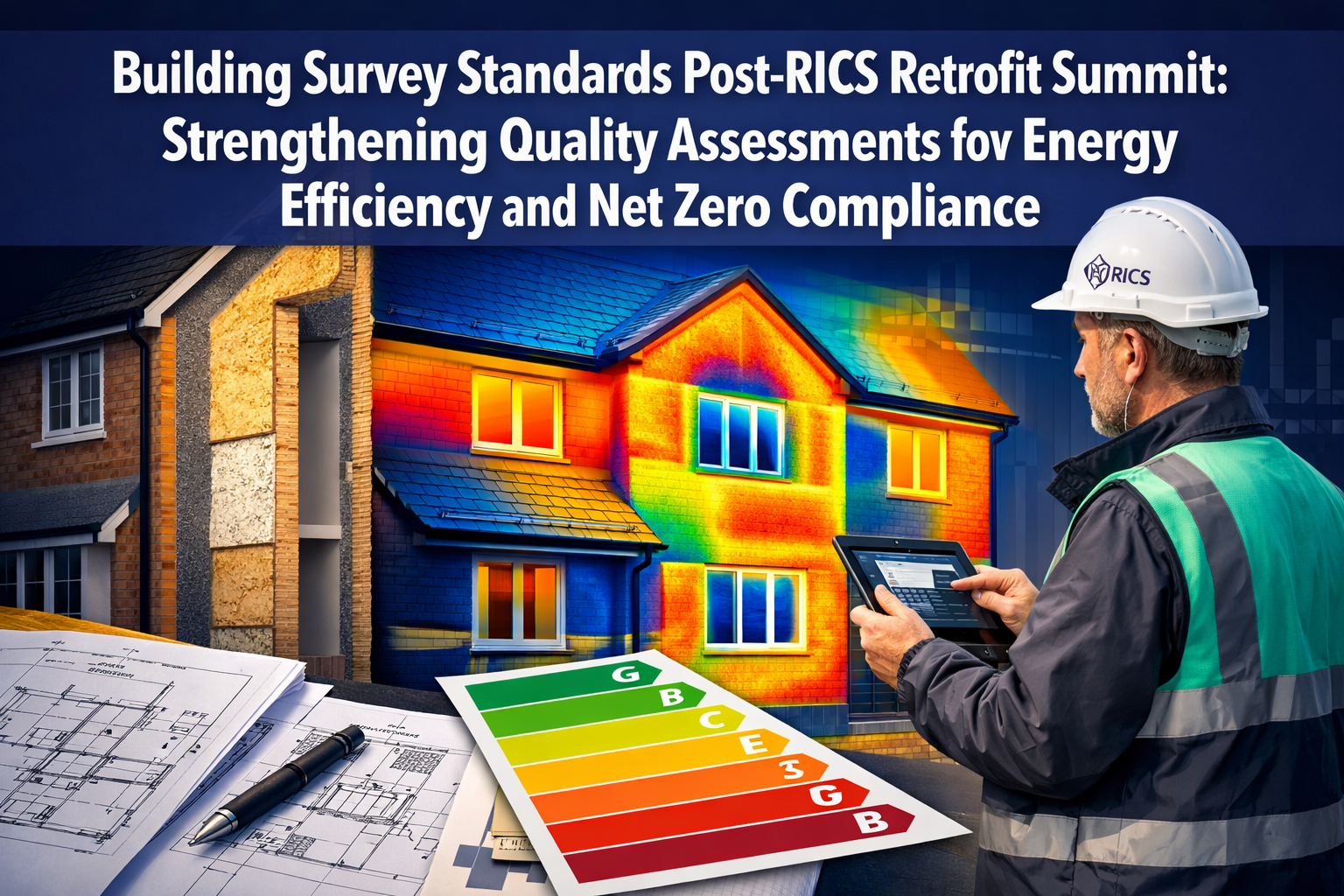
The UK's property sector stands at a critical junction in 2026. With ambitious Net Zero targets looming and consumer expectations rising, the Royal Institution of Chartered Surveyors (RICS) has identified an urgent need to strengthen home survey standards and provide clarity on retrofit assessments. The landmark Quality in Retrofit Summit held at RICS' Surveyor's House in January 2026 brought together industry leaders to establish what surveyors must implement to meet both consumer expectations and regulatory requirements for energy-efficient properties.[3]
The message from RICS President Nicholas Maclean OBE was unequivocal: "ambition at scale depends on quality and competence."[1] As the government's Warm Homes Plan rolls out and Awaab's Law compliance becomes mandatory, Building Survey Standards Post-RICS Retrofit Summit: Strengthening Quality Assessments for Energy Efficiency and Net Zero Compliance represents not just an evolution of professional practice—it's a fundamental transformation in how surveyors approach property assessment.
Key Takeaways
- 🏗️ RICS launched a dedicated AssocRICS Residential Retrofit Surveying pathway in 2026, creating a specialized entry route for retrofit professionals focused on whole-house assessments and energy efficiency compliance[2][3]
- 📊 The Home Survey Standard 2nd edition is undergoing revision to distinguish mandatory requirements from recommended practices, reflecting consumer insights and technological advances in energy performance assessment[4]
- 🎯 A three-pillar retrofit framework targets low-income households, universal investment options, and renter protections—creating unprecedented professional opportunities for qualified surveyors[1]
- ⚠️ Significant skills gaps exist between traditional residential surveyors and retrofit practitioners, with industry experts criticizing inadequate short-course qualifications[3]
- 🔍 Data-driven monitoring and independent professional roles are positioned as essential foundations for delivering quality retrofit outcomes at scale[2][3]
Understanding Building Survey Standards Post-RICS Retrofit Summit: The New Professional Landscape
The Quality in Retrofit Summit: A Watershed Moment
The January 20, 2026 Quality in Retrofit Summit represented a sell-out event that brought together built environment professionals to establish high-quality retrofit outcomes standards.[3] Co-hosted by RICS and The Retrofit Academy, the summit addressed a fundamental challenge: how to deliver energy efficiency improvements at the scale required for Net Zero while maintaining professional standards and consumer protection.
The summit identified that independence in professional roles must be prioritized. RICS leadership emphasized that "any professional sector brings independence," positioning the institution's role as ensuring professional integrity from the start to the end of building interventions.[2] This addresses long-standing trust deficits in retrofit delivery, where consumers have historically faced inconsistent quality and unregulated practitioners.
The RICS Residential Retrofit Surveying Pathway
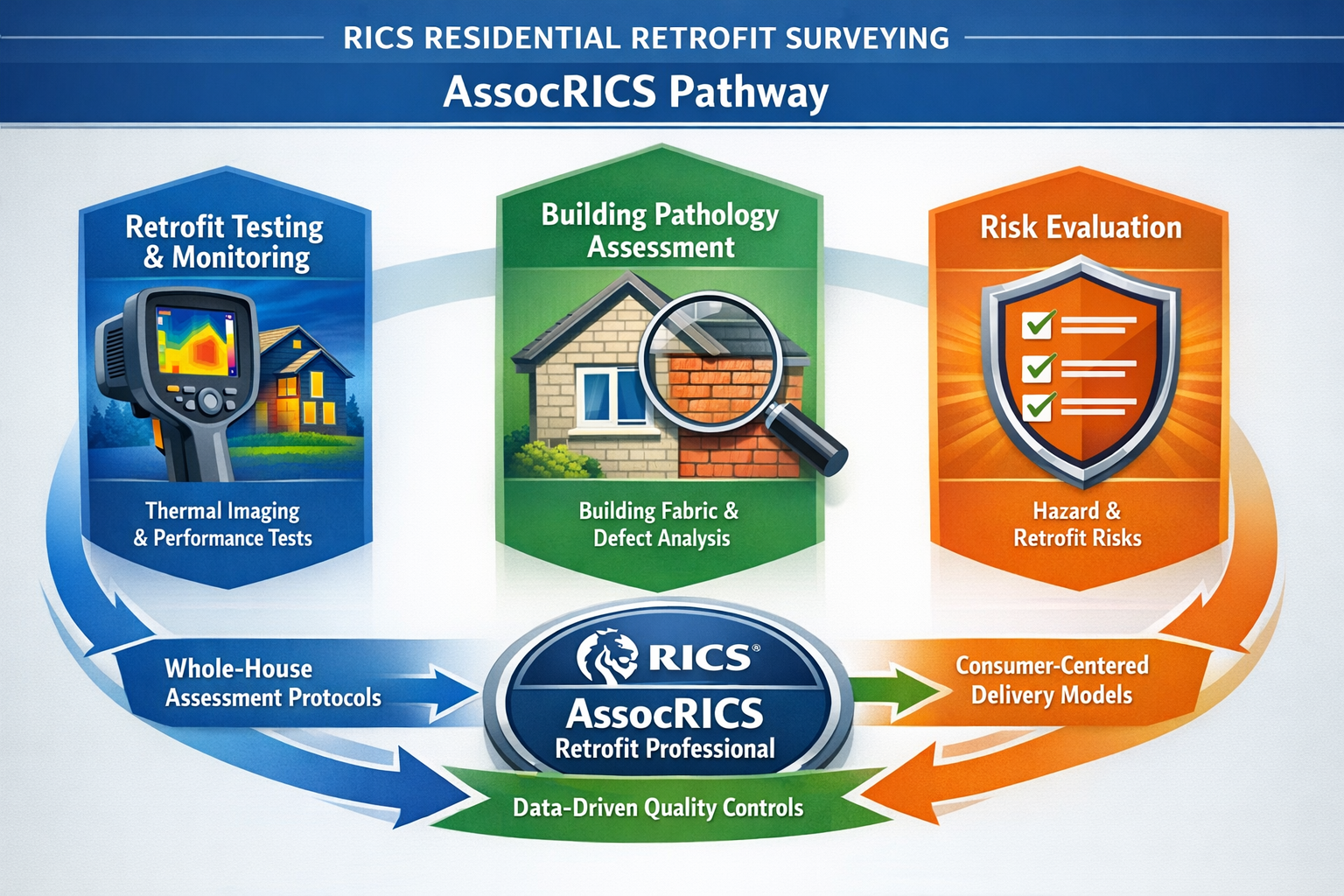
In response to identified skills gaps, RICS launched the Residential Retrofit Surveying (AssocRICS) pilot pathway in consultation with The Retrofit Academy and industry partners.[2][3] Already experiencing oversubscription, this dedicated entry route focuses on mainstream retrofit work and requires demonstrated competence in:
- Retrofit testing and monitoring protocols
- Building pathology assessment and diagnosis
- Risk evaluation for retrofit interventions
- Whole-house assessment methodologies
- Energy performance verification
This pathway represents a significant departure from traditional surveying qualifications. Industry experts at the summit noted that existing 3-day and 5-day courses for Domestic Energy Assessor and Retrofit Assessor qualifications are insufficient, with a large gap existing between residential surveyors and retrofit practitioners.[3]
For professionals seeking to understand comprehensive property assessment approaches, RICS Building Surveys Level 3 provides a foundation that can be enhanced with retrofit-specific competencies.
Home Survey Standard 2nd Edition: Clarity and Consumer Focus
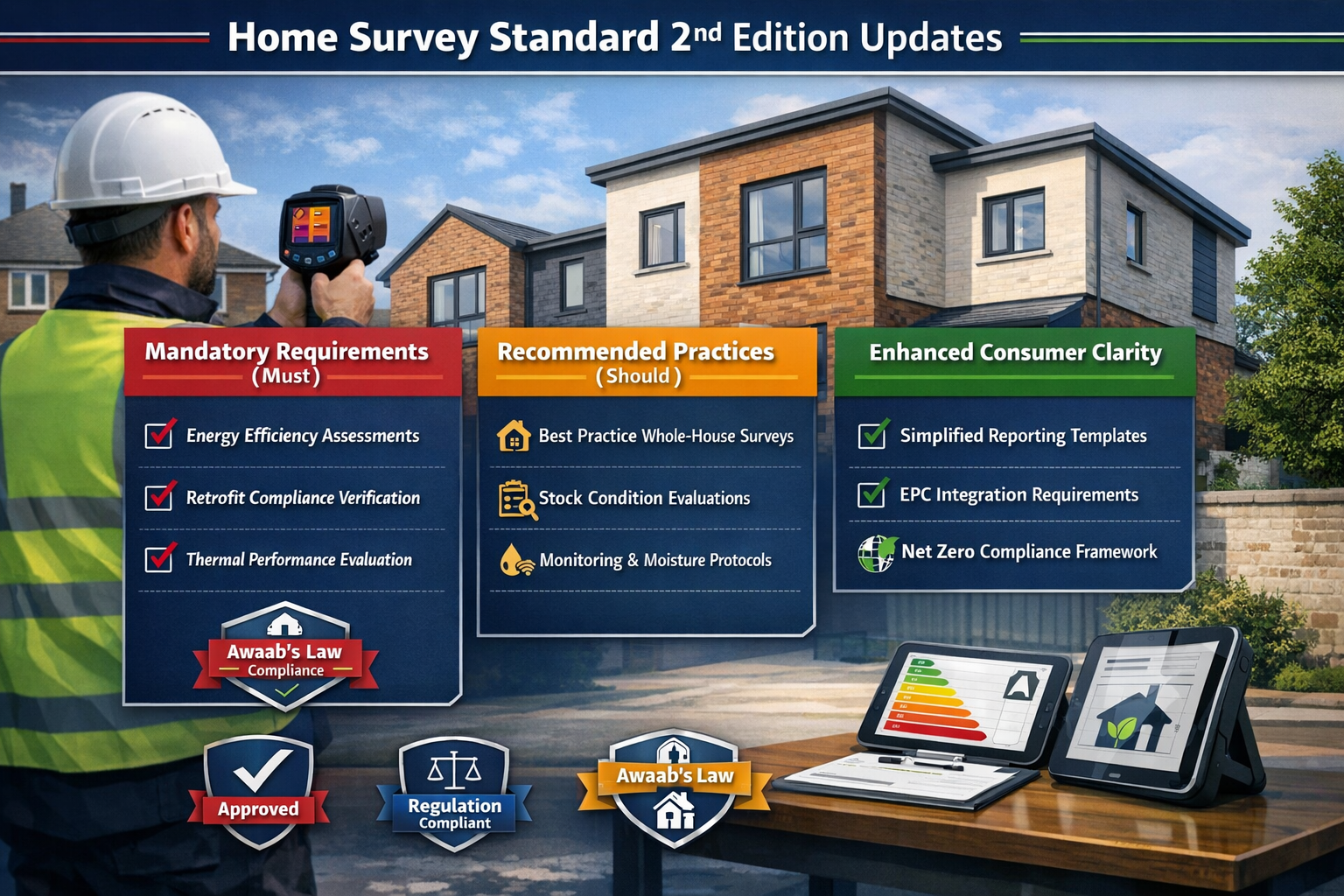
The Home Survey Standard 2nd edition is undergoing revision to strengthen areas of home surveys and provide clarification reflecting consumer insight and technological changes.[4] Feedback from industry practitioners highlighted a consistent theme: the need to distinguish between mandatory requirements ('musts') and recommended practices ('shoulds').
This distinction becomes particularly important when surveyors assess properties for energy efficiency and retrofit potential. The revised standard aims to provide:
✅ Clearer requirements for energy performance assessment
✅ More concise reporting on retrofit opportunities
✅ Enhanced consumer understanding of survey findings
✅ Integration of EPC data and Net Zero compliance pathways
✅ Technological updates reflecting thermal imaging and diagnostic tools
The January 2026 RICS UK Residential Market Survey indicated tentative signs that the property market may be turning a corner,[4] suggesting potential increased activity in retrofit-related surveying work as buyers increasingly prioritize energy-efficient properties.
Building Survey Standards Post-RICS Retrofit Summit: Implementation Framework for Quality Assessments
The Three-Pillar Retrofit Framework
The government's Warm Homes Plan establishes a three-pillar framework that creates new professional opportunities for surveyors:[1]
| Pillar | Target Audience | Surveyor Role |
|---|---|---|
| Pillar 1 | Low-income households | Conduct pre-retrofit assessments, verify eligibility, ensure quality delivery of fully funded upgrades |
| Pillar 2 | Universal households | Provide independent assessments for investment decisions, evaluate retrofit proposals, monitor implementation |
| Pillar 3 | Renters | Carry out compliance inspections, enforce minimum standards, verify landlord obligations |
This framework positions surveyors at the center of retrofit delivery, requiring competence in assessments, surveys, and compliance activities that extend beyond traditional building survey scope.
Professionals conducting stock condition surveys will find their expertise particularly relevant for neighbourhood-level retrofit planning programmes that require systematic property assessment across multiple units.
Whole-House Assessment Approach
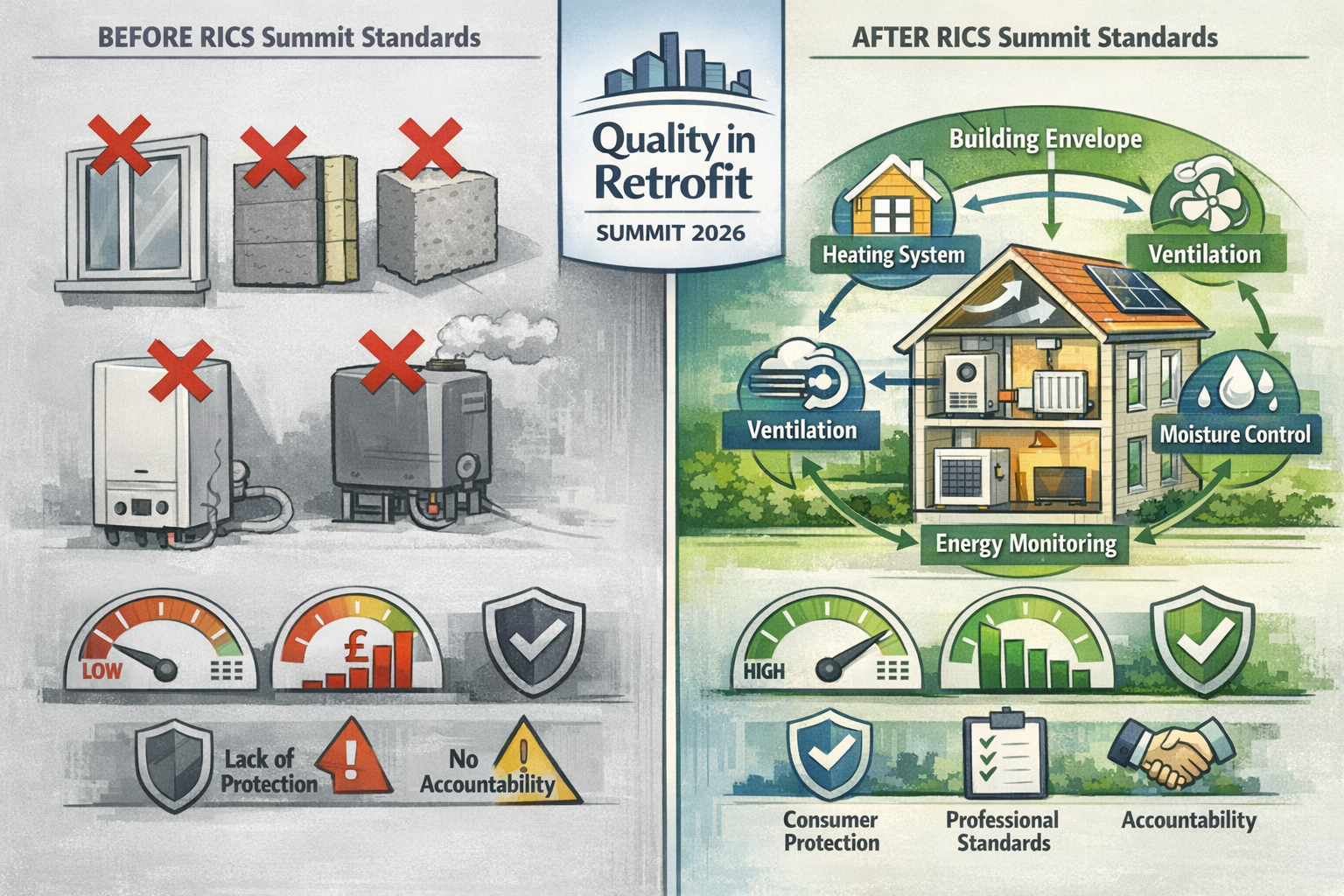
Building Survey Standards Post-RICS Retrofit Summit: Strengthening Quality Assessments for Energy Efficiency and Net Zero Compliance mandates a shift from fragmented, component-based approaches to holistic solutions. Surveyors now play central roles in whole-house assessments that evaluate:
🏠 Building fabric performance – thermal bridging, air tightness, insulation effectiveness
💨 Ventilation systems – moisture management, indoor air quality, condensation risk
🔥 Heating systems – efficiency, compatibility with building fabric, renewable integration
💧 Moisture dynamics – damp risk, mould prevention, Awaab's Law compliance
📈 Energy performance – actual vs. predicted consumption, monitoring protocols
🎯 Occupant behavior – usage patterns, comfort requirements, affordability constraints
This comprehensive approach requires surveyors to understand the interdependencies between building systems. For example, improving insulation without addressing ventilation can create condensation and mould issues—precisely the health hazards that Awaab's Law seeks to prevent.
Awaab's Law Compliance Integration
Surveyors are being positioned to support compliance with Awaab's Law by managing damp and mould risks, carrying out condition surveys, and enforcing minimum standards.[1] This embeds health and safety outcomes into retrofit work, creating legal obligations for property owners and professional responsibilities for surveyors.
The law requires:
- Timely investigation of damp and mould reports
- Remedial action within specified timeframes
- Root cause analysis rather than cosmetic treatment
- Preventive measures in retrofit planning
Professionals offering damp surveys must now integrate retrofit assessment competencies to provide comprehensive solutions that address both immediate moisture issues and long-term energy efficiency improvements.
Data-Driven Monitoring and Quality Controls
The Retrofit Academy and industry leaders at the summit stressed that "data is king," prioritizing robust monitoring systems to ensure quality is built into retrofit projects.[3] This enables early identification when interventions underperform, protecting both consumers and professional reputations.
Effective monitoring protocols include:
📊 Pre-retrofit baseline measurements – energy consumption, thermal performance, indoor environmental quality
🔍 Installation quality verification – workmanship standards, material specifications, building regulation compliance
📈 Post-retrofit performance evaluation – actual vs. predicted savings, comfort improvements, unintended consequences
⚡ Ongoing monitoring – seasonal performance, degradation tracking, maintenance requirements
Surveyors conducting RICS Building Surveys increasingly incorporate energy performance monitoring equipment, including thermal imaging cameras, air tightness testing apparatus, and moisture meters, to provide data-driven assessments.
Strengthening Quality Assessments: Practical Implementation for Surveyors
Enhanced Competency Requirements
The Building Survey Standards Post-RICS Retrofit Summit: Strengthening Quality Assessments for Energy Efficiency and Net Zero Compliance framework establishes enhanced competency requirements for surveyors working in the retrofit sector:
Technical Competencies:
- Building physics and thermodynamics
- Moisture dynamics in traditional and modern construction
- Renewable heating system integration
- Ventilation strategy design
- Heritage building retrofit considerations
- Building pathology specific to energy efficiency measures
Professional Competencies:
- Independent professional judgment
- Consumer-centered communication
- Risk assessment and mitigation
- Quality assurance protocols
- Regulatory compliance verification
- Multi-disciplinary coordination
Ethical Competencies:
- Conflict of interest management
- Independence from product suppliers
- Transparent fee structures
- Consumer protection prioritization
- Professional accountability
These competencies ensure that surveyors can deliver the independent professional roles that RICS leadership identified as essential for restoring trust in retrofit delivery.[2]
Consumer-Centered Delivery Model
The Residential Retrofit Standard places consumers at the center of delivery while aligning with pre-existing national frameworks and promoting best practices across UK retrofit services.[1] This requires surveyors to:
💬 Communicate clearly – translate technical findings into accessible language
🎯 Prioritize consumer needs – align recommendations with budgets, comfort requirements, and lifestyle
⚖️ Provide balanced advice – present options with honest assessments of costs, benefits, and risks
🛡️ Protect consumer interests – maintain independence from contractors and product suppliers
📋 Document comprehensively – create records that support informed decision-making
For commercial properties, RICS Commercial Building Surveys must similarly integrate energy efficiency assessments to meet corporate Net Zero commitments and regulatory requirements.
Addressing the Skills Gap
The summit identified a significant skills gap between traditional residential surveyors and retrofit practitioners.[3] Bridging this gap requires:
Continuous Professional Development (CPD):
- Retrofit-specific technical training
- Building physics education
- Energy modeling software proficiency
- Monitoring equipment operation
- Regulatory framework updates
Practical Experience:
- Supervised retrofit assessments
- Post-occupancy evaluation participation
- Cross-disciplinary project involvement
- Failure case study analysis
- Consumer interaction experience
Professional Networking:
- Engagement with retrofit specialists
- Collaboration with energy assessors
- Coordination with building control
- Liaison with consumer protection bodies
- Participation in industry forums
The RICS AssocRICS Residential Retrofit Surveying pathway provides a structured route for developing these competencies, but experienced surveyors must also invest in upskilling to remain relevant in the evolving market.
Technology Integration in Quality Assessments
Modern retrofit assessment requires surveyors to integrate advanced diagnostic technologies:
🌡️ Thermal Imaging – identifies heat loss, thermal bridging, insulation defects, air leakage
💨 Blower Door Testing – quantifies air tightness, locates infiltration points, verifies installation quality
💧 Moisture Meters – detects hidden dampness, monitors drying processes, prevents mould risk
📊 Energy Monitoring – tracks consumption patterns, validates predicted savings, identifies performance gaps
🚁 Drone Surveys – assesses roof condition, solar potential, external fabric defects
Professionals offering drone surveys can expand services to include thermal imaging overlays that reveal energy efficiency issues invisible to conventional inspection methods.
Regional Implementation Variations
While Building Survey Standards Post-RICS Retrofit Summit: Strengthening Quality Assessments for Energy Efficiency and Net Zero Compliance establishes national frameworks, regional variations affect implementation:
Urban Areas:
- Higher proportion of leasehold properties requiring collective approaches
- Heritage building constraints in conservation areas
- Terraced housing presenting party wall considerations
- Higher land values justifying comprehensive retrofit investment
Rural Areas:
- Off-gas grid properties requiring alternative heating solutions
- Traditional construction methods requiring specialist knowledge
- Lower property values affecting retrofit viability
- Limited contractor availability for quality installation
Surveyors operating across regions—from chartered surveyors in London to chartered surveyors in Surrey—must adapt assessment approaches to local building stock characteristics and market conditions.
Professional Accountability and Quality Assurance
Independence and Professional Integrity
RICS leadership's emphasis on independence addresses historical issues where retrofit assessors had financial interests in recommended solutions.[2] The strengthened standards require:
🔒 Separation of assessment and installation – surveyors must not profit from retrofit work they recommend
💰 Transparent fee structures – consumers must understand how surveyors are compensated
📋 Disclosure of conflicts – any relationships with contractors or suppliers must be declared
⚖️ Professional indemnity insurance – adequate coverage for retrofit assessment advice
🎓 Continuing competence – ongoing CPD in retrofit technologies and standards
This professional accountability framework protects consumers while elevating the surveying profession's role in delivering trustworthy retrofit advice.
Quality Assurance Protocols
Robust quality assurance protocols ensure that Building Survey Standards Post-RICS Retrofit Summit: Strengthening Quality Assessments for Energy Efficiency and Net Zero Compliance translates into consistent practice:
Pre-Assessment Phase:
- Client brief clarification
- Scope definition
- Limitations identification
- Fee agreement transparency
- Independence confirmation
Assessment Phase:
- Systematic inspection protocols
- Diagnostic testing procedures
- Photographic documentation
- Measurement recording
- Risk identification
Reporting Phase:
- Standardized report formats
- Clear prioritization of recommendations
- Cost-benefit analysis
- Risk communication
- Consumer-accessible language
Post-Report Phase:
- Client queries response
- Contractor liaison
- Installation monitoring
- Performance verification
- Outcome documentation
Professionals conducting specialist defect surveys can apply similar systematic approaches to retrofit-specific assessments, ensuring comprehensive coverage of energy efficiency issues.
Professional Liability Considerations
Enhanced retrofit assessment responsibilities create new professional liability exposures:
⚠️ Performance prediction accuracy – surveyors must qualify energy savings estimates
⚠️ Unintended consequences – condensation, mould, and overheating risks must be identified
⚠️ Regulatory compliance – building regulation and planning permission requirements must be addressed
⚠️ Cost estimation – realistic budget guidance must account for contingencies
⚠️ Technology selection – recommendations must consider product longevity and maintenance
Professional indemnity insurance policies may require specific endorsements for retrofit assessment work, and surveyors should verify coverage adequacy before offering these services.
Future Outlook: Evolving Standards and Market Opportunities
Market Growth Projections
The UK residential market showing recovery signals in early 2026[4] coincides with increasing consumer awareness of energy costs and environmental responsibilities. This creates significant market opportunities for surveyors who develop retrofit assessment competencies:
📈 Growing demand for pre-purchase retrofit assessments
💼 Expanding opportunities in social housing stock condition programmes
🏢 Commercial sector Net Zero compliance verification
🏘️ Neighbourhood-scale retrofit planning projects
📋 Regulatory compliance inspection services for Awaab's Law and EPC requirements
Surveyors positioned to deliver comprehensive assessments—from homebuyer surveys enhanced with retrofit evaluation to specialized structural surveys addressing energy efficiency—will capture this growing market.
Technology and Innovation Trajectory
Emerging technologies will continue transforming retrofit assessment practices:
🤖 AI-powered analysis – automated defect detection from thermal imaging
📱 Mobile applications – real-time data collection and cloud-based reporting
🔗 Digital twins – building performance modeling and scenario testing
🌐 IoT sensors – continuous monitoring of temperature, humidity, and energy consumption
📊 Big data analytics – benchmarking performance across building typologies
Surveyors who embrace these technologies while maintaining professional judgment and consumer focus will lead the evolving retrofit assessment sector.
Regulatory Evolution
The Building Survey Standards Post-RICS Retrofit Summit: Strengthening Quality Assessments for Energy Efficiency and Net Zero Compliance framework will continue evolving as:
- EPC requirements become more stringent for rental properties
- Building regulations expand energy efficiency standards
- Planning policies mandate retrofit consideration in development
- Consumer protection legislation strengthens quality assurance requirements
- Professional standards integrate emerging best practices
Surveyors must maintain awareness of regulatory changes through professional bodies, industry publications, and CPD activities to ensure ongoing compliance and service relevance.
Cross-Disciplinary Collaboration
Effective retrofit delivery requires collaboration across disciplines:
👷 Architects – design integration and aesthetic considerations
🔧 Building services engineers – heating, ventilation, and renewable systems
🏗️ Structural engineers – load-bearing implications of retrofit measures
⚡ Energy assessors – EPC calculations and modeling
🎨 Heritage specialists – conservation area and listed building constraints
👨🏫 Occupant engagement specialists – behavior change and user education
Surveyors who develop collaborative working relationships and understand multi-disciplinary perspectives will deliver more comprehensive and effective retrofit assessments.
Conclusion
Building Survey Standards Post-RICS Retrofit Summit: Strengthening Quality Assessments for Energy Efficiency and Net Zero Compliance represents a fundamental transformation in how surveyors approach property assessment in 2026 and beyond. The Quality in Retrofit Summit established clear expectations: professional competence, independence, data-driven monitoring, and consumer-centered delivery must form the foundation of retrofit assessment practice.[1][2][3]
The launch of the RICS Residential Retrofit Surveying pathway, revision of the Home Survey Standard, and integration of Awaab's Law compliance create both challenges and opportunities for the surveying profession. Surveyors who invest in developing retrofit-specific competencies, embrace technological innovation, and maintain unwavering professional integrity will be positioned to lead the UK's Net Zero transition.
Actionable Next Steps for Surveyors:
✅ Evaluate current competencies against the RICS Residential Retrofit Surveying pathway requirements
✅ Invest in CPD focusing on building physics, moisture dynamics, and energy efficiency technologies
✅ Acquire diagnostic equipment including thermal imaging cameras and moisture meters
✅ Review professional indemnity insurance to ensure adequate coverage for retrofit assessment work
✅ Develop consumer communication skills to translate technical findings into accessible advice
✅ Build cross-disciplinary networks with architects, engineers, and energy assessors
✅ Monitor regulatory developments affecting retrofit standards and compliance requirements
✅ Consider AssocRICS pathway enrollment to formalize retrofit assessment credentials
The message from RICS President Nicholas Maclean OBE remains clear: "ambition at scale depends on quality and competence."[1] Surveyors who rise to meet these enhanced standards will not only advance their professional practices but also contribute meaningfully to the UK's energy efficiency transformation and Net Zero goals.
For property owners and buyers seeking comprehensive assessments that integrate energy efficiency considerations, engaging qualified chartered surveyors with demonstrated retrofit competencies ensures professional, independent advice that protects investments while supporting environmental objectives.
References
[1] Retrofit Leaders Meet Rics Hq Discuss Importance Transformative Projects – https://www.rics.org/news-insights/retrofit-leaders-meet-rics-hq-discuss-importance-transformative-projects
[2] Sparks Of 2026 9 Rics And The Return Of Professional Trust In Retrofit – https://www.refurbandretrofit.com/sparks-of-2026-9-rics-and-the-return-of-professional-trust-in-retrofit/
[3] Quality In Retrofit Summit 2026 – https://retrofitacademy.org/quality-in-retrofit-summit-2026/
[4] Home Survey Standard 2nd Edition A Progress Update – https://www.rics.org/news-insights/home-survey-standard-2nd-edition-a-progress-update
[5] Building Surveys For Energy Performance Certificates In 2026 Navigating Epc Upgrades And Retrofit Mandates For Uk Buyers – https://nottinghillsurveyors.com/blog/building-surveys-for-energy-performance-certificates-in-2026-navigating-epc-upgrades-and-retrofit-mandates-for-uk-buyers
[6] Rics Building Surveying Conference – https://www.rics.org/training-events/conferences/rics-building-surveying-conference