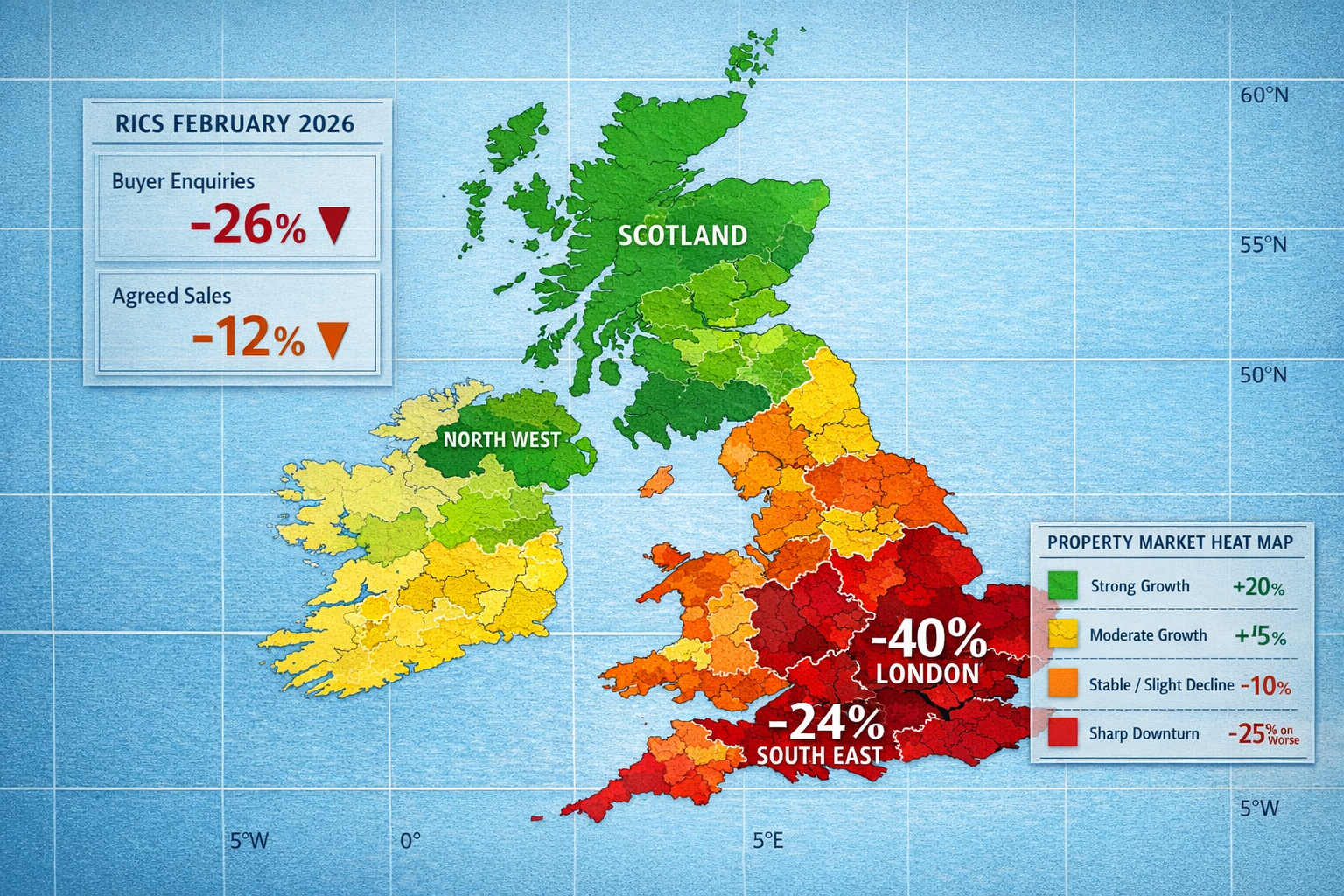
Buyer enquiries plummeted to a stark -26% net balance in February 2026, marking the sharpest monthly decline since the beginning of the year and signaling a profound shift in UK residential market dynamics.[1] This dramatic deterioration, down from -15% in January, has sent ripples through the property valuation sector, forcing chartered surveyors and valuation professionals to fundamentally reassess their methodologies amid geopolitical uncertainty and regional market divergence. The Valuation Strategies for Weak Buyer Enquiries in Spring 2026: RICS February Insights for Cautious Markets reveal that traditional valuation approaches must now account for unprecedented volatility, with Middle East geopolitical escalation specifically cited as dampening buyer sentiment across key regions.[2]

For property professionals navigating this cautious spring market, understanding how to adjust valuation methodologies while maintaining accuracy has become critical. The RICS UK Residential Survey for February 2026 exposes not just weak demand, but a complex tapestry of regional divergence, subdued sales expectations, and rental market pressures that collectively demand sophisticated valuation responses. This comprehensive analysis explores evidence-based strategies for maintaining valuation integrity when buyer enquiries weaken, drawing directly from RICS data and expert surveyor commentary.
Key Takeaways
- Buyer enquiries dropped to -26% net balance in February 2026, requiring valuers to adjust comparable evidence weighting and increase caution in forward-looking assessments
- Profound regional divergence exists, with London at -40% price pressure while North West England and Scotland show firmer trends, necessitating location-specific valuation approaches
- Near-term price expectations fell to -18% while 12-month outlook remains at +33%, creating a split-horizon challenge for valuation timeframes and methodology selection
- Geopolitical factors directly impact market confidence, requiring valuers to incorporate external risk factors into uncertainty clauses and valuation assumptions
- Supply-demand imbalances persist with new instructions at +2% against weak buyer demand, affecting comparable selection and market absorption period calculations
Understanding the February 2026 Market Context for Valuation Adjustments
The February 2026 RICS data paints a sobering picture of market conditions that directly impact property valuation accuracy and methodology. Beyond the headline -26% buyer enquiry figure, agreed sales remained subdued at -12% net balance, while near-term sales expectations softened further to -2%, marking the weakest reading since November 2025.[1]
The Geopolitical Dimension
What makes spring 2026 particularly challenging for valuers is the explicit connection between Middle East geopolitical escalation and dampened buyer sentiment.[2] This external shock factor introduces uncertainty that cannot be captured through traditional comparable analysis alone. When geopolitical events directly influence purchasing decisions, valuers must:
- Expand uncertainty clauses in valuation reports to acknowledge external risk factors beyond typical market variables
- Shorten comparable evidence timeframes to reflect rapidly changing sentiment rather than relying on 6-12 month historical data
- Increase emphasis on current market evidence over historical trends when geopolitical factors create sentiment shifts
The Capital Economics analysis of the RICS survey specifically notes that the conflict contributed to weakened market confidence in early spring 2026, creating a valuation environment where sentiment matters as much as fundamentals.[2]
Price Momentum and Regional Divergence
Headline house prices posted a -12% net balance nationally in February, remaining broadly flat despite significant regional variation.[1] However, this national figure masks the most critical insight for valuation professionals: the profound regional divergence that demands location-specific strategies.
| Region | Price Pressure (Net Balance) | Valuation Implication |
|---|---|---|
| London | -40% | Severe downward pressure; increase adjustment factors |
| South East | -24% | Moderate weakness; cautious comparable selection |
| East Anglia | -26% | Significant softening; reduce optimistic adjustments |
| North West England | Positive trend | Firmer pricing; standard methodology applicable |
| Scotland | Positive trend | Stable market; conventional approaches valid |
| Northern Ireland | Positive trend | Resilient pricing; limited caution required |
This divergence represents the most striking feature requiring differentiated valuation strategies by region, as noted in professional surveyor analysis.[3] A one-size-fits-all approach to valuation adjustments in spring 2026 would fundamentally misrepresent market realities.
London's Confidence Collapse
Perhaps most alarming for valuers working in the capital, London's 12-month price expectations collapsed to +7% from +56% previously.[1] This dramatic shift in forward-looking confidence requires specific adjustments to valuation approaches in London and surrounding areas:
✅ Reduce reliance on growth assumptions in development appraisals and investment valuations
✅ Increase weighting on current market evidence rather than projected appreciation
✅ Apply higher risk premiums to yields and discount rates for London properties
✅ Shorten valuation validity periods given rapid sentiment changes
The contrast between London's weakened outlook and more resilient regional markets creates a valuation landscape where geographic specificity matters more than ever.
Core Valuation Strategies for Weak Buyer Enquiries in Spring 2026
When buyer enquiries weaken dramatically, as evidenced by the -26% reading in February 2026, valuation professionals must implement specific methodological adjustments to maintain accuracy and credibility. The Valuation Strategies for Weak Buyer Enquiries in Spring 2026: RICS February Insights for Cautious Markets center on three fundamental principles: evidence recency, adjustment conservatism, and uncertainty transparency.
Strategy 1: Recalibrating Comparable Evidence Selection
Traditional valuation practice typically draws on comparable sales from the preceding 6-12 months. However, when buyer enquiries deteriorate sharply within a single month, this timeframe becomes problematic. The RICS February data shows buyer enquiries fell from -15% to -26% in just one month, suggesting market conditions can shift faster than historical comparable evidence reflects.[1]
Practical adjustments include:
- Narrowing comparable timeframes to 3-6 months maximum for residential valuations in weak demand areas
- Prioritizing agreed sales over asking prices, particularly given the -12% agreed sales balance indicating pricing resistance
- Applying time adjustments more aggressively to older comparables, potentially 0.5-1.0% per month in weakening markets versus standard 0.25% monthly adjustments
- Weighting recent evidence more heavily in the valuation reconciliation process, even if sample size is smaller
For RICS building surveys that include valuation components, this recalibration ensures that market value opinions reflect current buyer behavior rather than outdated transaction evidence.
Strategy 2: Adjusting for Supply-Demand Imbalances
The February 2026 RICS data reveals a critical supply-demand dynamic: new instructions remained at +2% (neutral balance) while buyer enquiries collapsed to -26%.[1] This creates a growing inventory of available properties relative to demand, with direct implications for valuation.
Key considerations:
📊 Market absorption periods are extending – Properties take longer to sell, affecting liquidity assumptions
📊 Vendor pricing expectations may be unrealistic – New listings may not reflect weakened demand
📊 Comparable asking prices may overstate market value – Increased gap between asking and achieved prices
When supply continues at neutral levels while demand plummets, valuers should:
- Increase skepticism toward asking price comparables, favoring actual transaction evidence
- Apply downward adjustments to recent comparables that may have benefited from stronger demand conditions
- Consider market conditions clauses that explicitly note the supply-demand imbalance and its impact on marketing periods
- Extend assumed marketing period assumptions in valuation reports from typical 3-6 months to 6-12 months in affected areas
This approach aligns with professional valuation report standards while acknowledging current market realities.
Strategy 3: Geographic Differentiation in Methodology
The profound regional divergence documented in the RICS February survey demands that valuation strategies explicitly account for location-specific conditions. A property in London (where price pressure stands at -40%) requires fundamentally different adjustments than one in North West England (showing positive trends).[1]
Regional strategy framework:
For High-Pressure Negative Markets (London, South East, East Anglia):
- Apply conservative adjustment factors of 5-10% downward to comparable evidence from stronger market periods
- Increase uncertainty ranges in valuation reports (e.g., ±5% rather than ±3%)
- Emphasize current market conditions and weak demand in assumptions sections
- Consider multiple valuation scenarios (pessimistic, realistic, optimistic) for complex instructions
For Stable/Positive Markets (North West, Scotland, Northern Ireland):
- Maintain standard valuation methodologies with minimal demand-related adjustments
- Apply conventional comparable timeframes and adjustment factors
- Use typical uncertainty ranges and market condition statements
- Focus on property-specific factors rather than demand-side concerns
This differentiated approach ensures that valuation pricing reflects genuine local market conditions rather than applying national trends inappropriately.

Strategy 4: Incorporating Forward-Looking Indicators
The RICS data reveals a critical split between near-term and medium-term expectations: near-term price expectations fell to -18% while 12-month expectations remain positive at +33%.[1] This creates a valuation challenge around timeframe and purpose.
For immediate market value opinions (mortgage valuations, purchase decisions):
- Weight near-term expectations heavily, applying cautious adjustments
- Acknowledge the -18% near-term outlook in market conditions commentary
- Reduce reliance on medium-term growth assumptions
For investment and development valuations with longer horizons:
- Balance near-term weakness against medium-term recovery expectations
- Apply higher discount rates to account for near-term uncertainty
- Structure cash flow assumptions to reflect delayed recovery rather than immediate growth
- Consider sensitivity analysis showing impact of delayed recovery scenarios
The 12-month sales expectations of +17% (down from +35% previously) suggest gradual recovery rather than sharp rebound, requiring valuation models that reflect this measured trajectory.[5]
Strategy 5: Transparency in Uncertainty and Assumptions
When market conditions weaken as dramatically as evidenced in February 2026, professional responsibility demands greater transparency in valuation uncertainty. The RICS Valuation Standards (Red Book) emphasize that valuers must communicate material uncertainty clearly.
Enhanced transparency practices include:
🔍 Explicit market conditions statements – Detailed commentary on buyer enquiry weakness, geopolitical factors, and regional divergence
🔍 Expanded assumptions sections – Clear articulation of comparable selection rationale and adjustment factors applied
🔍 Uncertainty clauses – Formal material uncertainty declarations where market evidence is limited or contradictory
🔍 Shortened validity periods – Reducing standard 3-6 month valuation validity to 1-3 months in rapidly changing markets
Expert commentary from Tim Green FRICS noted that while there was "increased early 2026 market activity," he cautioned that "Spring has not quite arrived yet," with recovery expected to be "led from the first-time buyer range."[1] This type of nuanced market understanding should inform valuation assumptions and be communicated clearly to clients.
Practical Implementation: Adjusting Valuation Methodologies in Cautious Markets
Implementing the Valuation Strategies for Weak Buyer Enquiries in Spring 2026: RICS February Insights for Cautious Markets requires practical changes to day-to-day valuation workflows and report structures. This section translates the strategic principles into actionable methodological adjustments.
Comparable Analysis Adjustments
When conducting comparable analysis in weak demand environments, the standard approach of identifying similar properties sold within reasonable timeframes and making adjustments for differences must be refined:
Traditional Approach:
- Identify 3-5 comparable sales from past 6-12 months
- Apply standard adjustment factors for size, condition, location
- Reconcile to single point value or narrow range
Spring 2026 Adjusted Approach:
- Identify 5-8 comparable sales, prioritizing most recent 3-6 months
- Segregate comparables by transaction date – pre-January 2026 vs. post-January 2026
- Apply time adjustments of 0.5-1.0% per month to older comparables in weak markets
- Weight recent evidence at 60-70% of analysis versus 40-50% typically
- Apply demand-adjustment factor of 2-5% downward to comparables from stronger demand periods
- Reconcile to value range rather than point estimate, with explicit acknowledgment of market uncertainty
For commercial building surveys and valuations, similar principles apply with adjustments scaled to commercial market dynamics.
Investment Valuation Modifications
Investment property valuations face particular challenges when buyer enquiries weaken, as both rental and capital value components may be affected. The RICS February data shows landlord instructions at -27% (firmly negative) despite tenant demand at +2%, creating acute rental supply shortages.[1]
Yield adjustments:
- Increase yields by 25-50 basis points for properties in high-pressure negative markets to reflect increased risk and reduced liquidity
- Maintain yields for properties in stable regional markets with positive price trends
- Apply higher exit yields in DCF models to reflect uncertainty in medium-term market recovery
Rental growth assumptions:
- Reduce rental growth assumptions by 0.5-1.0% annually in areas with weak buyer enquiries, as rental demand may soften if economic conditions deteriorate
- Maintain or increase rental growth in areas with acute supply shortages (noting the -27% landlord instructions figure)
- Consider rental growth sensitivity analysis showing impact of flat or negative rental growth scenarios
Development Appraisal Considerations
Development appraisals and residual valuations are particularly sensitive to demand-side weaknesses, as they rely on forward-looking assumptions about sales rates and pricing. When buyer enquiries stand at -26%, development appraisals require:
Sales rate adjustments:
- Extend assumed sales periods by 25-50% compared to historical norms (e.g., if typically 12 months, assume 15-18 months)
- Apply phased pricing assumptions that reflect near-term weakness (-18% price expectations) followed by gradual recovery
- Increase contingency allowances for extended holding costs and marketing expenses
GDV (Gross Development Value) adjustments:
- Reduce unit pricing assumptions by 5-10% for schemes in London and South East given -40% and -24% price pressure respectively
- Apply conservative growth assumptions aligned with the +33% 12-month expectation rather than historical growth rates
- Consider alternative use scenarios if residential sales assumptions become too uncertain
The 12-month sales expectations of +17% (down from +35%) suggest that development schemes should be underwritten with conservative absorption assumptions rather than optimistic recovery scenarios.[5]
Report Structure and Communication
The way valuation findings are communicated becomes critical when market conditions are uncertain. Enhanced report structures for spring 2026 should include:
Market Conditions Section (Expanded):
- Specific reference to RICS February 2026 survey data on buyer enquiries and regional divergence
- Commentary on geopolitical factors affecting buyer sentiment
- Clear statement of how market conditions have influenced valuation approach
Assumptions Section (Enhanced):
- Explicit statement of comparable selection criteria and timeframe rationale
- Explanation of any demand-related adjustment factors applied
- Clarification of forward-looking assumptions and their basis
Uncertainty Section (Prominent):
- Material uncertainty declaration if market evidence is limited or contradictory
- Shortened valuation validity period with explanation
- Recommendation for revaluation if market conditions change materially
Comparable Evidence Appendix (Detailed):
- Tabular presentation showing transaction dates, prices, adjustments applied
- Clear differentiation between recent and older comparables
- Explanation of weighting applied to different evidence categories
For clients seeking RICS home surveys with valuation components, this enhanced transparency builds confidence and manages expectations in uncertain markets.

Technology and Data Integration
Modern valuation practice increasingly relies on technology platforms and data analytics. In weak demand environments, technology can enhance valuation accuracy through:
Automated valuation model (AVM) integration:
- Use AVMs as cross-check rather than primary valuation method given their reliance on historical data
- Adjust AVM outputs downward by 3-5% in weak demand markets to account for lag in model updates
- Compare AVM confidence intervals with manual valuation uncertainty ranges
Market data platforms:
- Prioritize platforms offering real-time agreed sale data rather than asking price indices
- Track days-on-market trends as leading indicator of demand weakness
- Monitor price reduction frequency as evidence of vendor pricing adjustment to weak demand
Geographic information systems (GIS):
- Map regional divergence using RICS survey data to inform location-specific adjustments
- Identify micro-market variations within broader regions showing weakness
- Analyze proximity to employment centers and transport links as resilience factors
Quality Assurance and Peer Review
When implementing adjusted valuation methodologies, enhanced quality assurance processes protect against over-correction or inappropriate adjustments:
✓ Peer review all valuations in high-pressure negative markets by senior valuers
✓ Document adjustment rationale comprehensively in working papers
✓ Compare adjustments across similar properties to ensure consistency
✓ Track valuation outcomes against subsequent transaction evidence to validate methodology
✓ Regular methodology review meetings to assess whether adjustments remain appropriate as market evolves
The goal is methodological rigor that responds to genuine market changes while avoiding reactive over-adjustment that could undervalue properties unnecessarily.
Sector-Specific Considerations and Regional Strategies
The Valuation Strategies for Weak Buyer Enquiries in Spring 2026: RICS February Insights for Cautious Markets must be tailored to specific property sectors and regional contexts to maximize accuracy and relevance.
Residential Sector Nuances
Within the residential sector, different property types respond differently to weak buyer enquiries:
First-Time Buyer Properties:
Expert commentary suggests recovery will be "led from the first-time buyer range," indicating this segment may show relative resilience.[1] Valuation implications include:
- Less aggressive downward adjustments for properties under £300,000 in regional markets
- Maintained or slightly reduced growth assumptions given this segment's relative strength
- Shorter marketing period assumptions compared to higher-value properties
Prime London and South East Properties:
With London showing -40% price pressure and 12-month expectations collapsing from +56% to +7%, this segment requires maximum caution:[1]
- Aggressive downward adjustments of 10-15% to comparables from 2025
- Extended marketing periods of 12-18 months rather than typical 6-9 months
- Increased uncertainty ranges of ±7-10% reflecting genuine market volatility
- Explicit geopolitical risk commentary in market conditions sections
Regional Family Homes:
Areas showing positive trends (North West, Scotland, Northern Ireland) may see family homes maintain value:
- Standard valuation methodologies with minimal demand-related adjustments
- Conventional marketing periods and growth assumptions
- Focus on property-specific factors rather than demand-side concerns
Commercial Property Considerations
While the RICS February survey focuses primarily on residential markets, commercial property valuations face parallel challenges when economic uncertainty affects buyer confidence. For those conducting commercial building surveys and valuations:
Office Properties:
- Increase yields by 50-75 basis points in areas with weak residential buyer enquiries (often correlating with economic uncertainty)
- Reduce rental growth assumptions to reflect potential occupier caution
- Apply higher vacancy assumptions in cash flow models
Retail Properties:
- Maintain cautious yield assumptions given ongoing structural challenges
- Focus on covenant strength of tenants more than location factors
- Consider alternative use potential given weak retail fundamentals
Industrial and Logistics:
- Less aggressive adjustments as this sector shows relative resilience
- Maintain positive rental growth assumptions in well-located assets
- Standard yield assumptions unless specific local factors suggest otherwise
Regional Strategy Matrix
The profound regional divergence in the RICS February data demands a structured approach to regional valuation strategies:
London and South East Strategy:
- Primary focus: Demand weakness and sentiment deterioration
- Key adjustments: Aggressive comparable time adjustments, extended marketing periods, increased uncertainty
- Monitoring: Track weekly market data for signs of stabilization
- Validation: Increased peer review and senior oversight
East Anglia Strategy:
- Primary focus: Moderate demand weakness (-26% price pressure)
- Key adjustments: Moderate comparable adjustments, cautious growth assumptions
- Monitoring: Monthly market review to assess trajectory
- Validation: Standard peer review processes
North West, Scotland, Northern Ireland Strategy:
- Primary focus: Maintaining accuracy without over-correction
- Key adjustments: Minimal demand-related adjustments, standard methodologies
- Monitoring: Quarterly market review to confirm continued resilience
- Validation: Focus on property-specific factors and comparable quality
This regional differentiation ensures that valuation strategies respond to actual local market conditions rather than applying national trends inappropriately.
Rental Market Implications
The rental market dynamics revealed in the RICS February survey have direct implications for buy-to-let valuations and investment property assessments. With landlord instructions at -27% but tenant demand at +2%, acute supply shortages are emerging.[1]
Buy-to-let valuation adjustments:
- Maintain or increase rental income assumptions by 2-3% annually given supply constraints
- Reduce yield assumptions by 25 basis points to reflect strong rental demand offsetting weak sales market
- Highlight rental market strength as mitigating factor against capital value uncertainty
- Consider rental yield as primary return driver rather than capital appreciation in current environment
Portfolio valuations:
- Differentiate between assets held for income vs. trading with different adjustment approaches
- Apply lower adjustments to income-producing assets with secure tenancies
- Increase adjustments to vacant properties intended for sale given weak buyer enquiries
New Build and Development Property
New build properties face particular challenges in weak demand environments, as they compete with established housing stock while often commanding premium pricing:
New build valuation considerations:
- Apply new build premium skeptically, potentially reducing from typical 5-10% to 2-5% or eliminating entirely
- Increase emphasis on developer incentives (stamp duty contributions, furniture packages) as evidence of pricing pressure
- Extend assumed marketing periods as new builds typically take longer to sell in weak markets
- Consider Help to Buy scheme availability and other government support as relevant factors
Off-plan valuations:
- Apply significant uncertainty clauses given extended timeframe to completion
- Reduce growth assumptions to reflect the +33% 12-month expectation rather than historical rates
- Consider construction risk alongside market risk in uncertainty assessment
- Recommend periodic revaluation as scheme progresses and market conditions evolve
For clients seeking desktop house valuations, it's particularly important to note limitations when market conditions are uncertain, as these rely heavily on automated data that may lag current conditions.
Conclusion: Maintaining Valuation Integrity in Uncertain Markets
The Valuation Strategies for Weak Buyer Enquiries in Spring 2026: RICS February Insights for Cautious Markets demonstrate that professional valuation practice must evolve rapidly to reflect genuine market conditions while maintaining methodological rigor. The February 2026 RICS data, showing buyer enquiries at -26%, agreed sales at -12%, and profound regional divergence, creates a complex environment where traditional approaches require thoughtful adjustment.[1]
The key principles underpinning effective valuation strategies in this cautious spring market are:
🎯 Evidence recency – Prioritizing recent comparable transactions and applying aggressive time adjustments to older evidence
🎯 Geographic specificity – Differentiating between high-pressure negative markets (London at -40%) and resilient regional markets
🎯 Conservative adjustments – Applying downward adjustments to comparables from stronger demand periods while avoiding over-correction
🎯 Transparency in uncertainty – Clearly communicating market conditions, assumptions, and limitations to clients
🎯 Forward-looking balance – Weighing near-term weakness (-18% expectations) against medium-term recovery (+33% at 12 months)
For property professionals, the practical implementation of these strategies requires systematic changes to comparable selection, adjustment factors, report structures, and quality assurance processes. The split between near-term caution and medium-term optimism in the RICS data suggests that valuation approaches must be purpose-specific, with immediate market value opinions applying more conservative adjustments than longer-term investment valuations.
Actionable Next Steps
For chartered surveyors and valuation professionals navigating spring 2026 markets:
- Review and update valuation templates to include enhanced market conditions sections and expanded uncertainty clauses
- Implement regional strategy frameworks that differentiate between high-pressure negative markets and resilient areas
- Establish peer review protocols for all valuations in areas showing significant demand weakness
- Monitor RICS monthly survey data to track whether buyer enquiry trends improve or deteriorate further
- Communicate proactively with clients about market conditions and their impact on valuation certainty
- Consider professional development focused on valuation in uncertain markets and Red Book compliance
- Document methodology adjustments comprehensively to support professional indemnity insurance claims if challenged
For property buyers, sellers, and investors, understanding that valuations in spring 2026 carry greater uncertainty than in stable markets is essential. Engaging qualified professionals who understand and implement appropriate valuation strategies provides the best protection against over-paying or under-pricing in this cautious environment.
The geopolitical factors cited by RICS as dampening buyer sentiment may evolve rapidly, potentially improving or further deteriorating market conditions.[2] Valuations conducted in this environment should therefore include shortened validity periods and recommendations for revaluation if circumstances change materially. The professional surveyor's role is not to predict political outcomes, but to accurately reflect their current impact on market behavior and pricing.
As Tim Green FRICS noted, while there are signs of activity, "Spring has not quite arrived yet."[1] Valuation strategies must therefore balance the evidence of current weakness with the reasonable expectation of gradual recovery, maintaining professional skepticism while avoiding excessive pessimism. The +17% 12-month sales expectations and +33% price expectations suggest the market anticipates improvement, but at a measured pace that requires patient, evidence-based valuation approaches.[5]
By implementing the strategies outlined in this analysis, valuation professionals can maintain accuracy and credibility while serving clients effectively through this period of market uncertainty. The RICS February 2026 insights provide the evidence base; professional judgment and methodological rigor provide the pathway to reliable valuations in cautious markets.
References
[1] UK Residential Survey February 2026 – https://www.rics.org/news-insights/uk-residential-survey-february-2026
[2] UK RICS Residential Market Survey Feb 2026 – https://www.capitaleconomics.com/publications/uk-housing-market-update/uk-rics-residential-market-survey-feb-2026
[3] Valuation Impacts of February 2026 RICS Survey Strategies for Regional Price Divergence in UK Markets – https://nottinghillsurveyors.com/blog/valuation-impacts-of-february-2026-rics-survey-strategies-for-regional-price-divergence-in-uk-markets
[4] UK Residential Market Survey February 2026 – https://www.rics.org/content/dam/ricsglobal/documents/market-surveys/uk-residential-market-survey/UK-Residential-Market-Survey_February-2026.pdf
[5] UK Economy Property Update February 2026 – https://www.rics.org/content/dam/ricsglobal/documents/market-surveys/uk-economy-property-update-february-2026.pdf