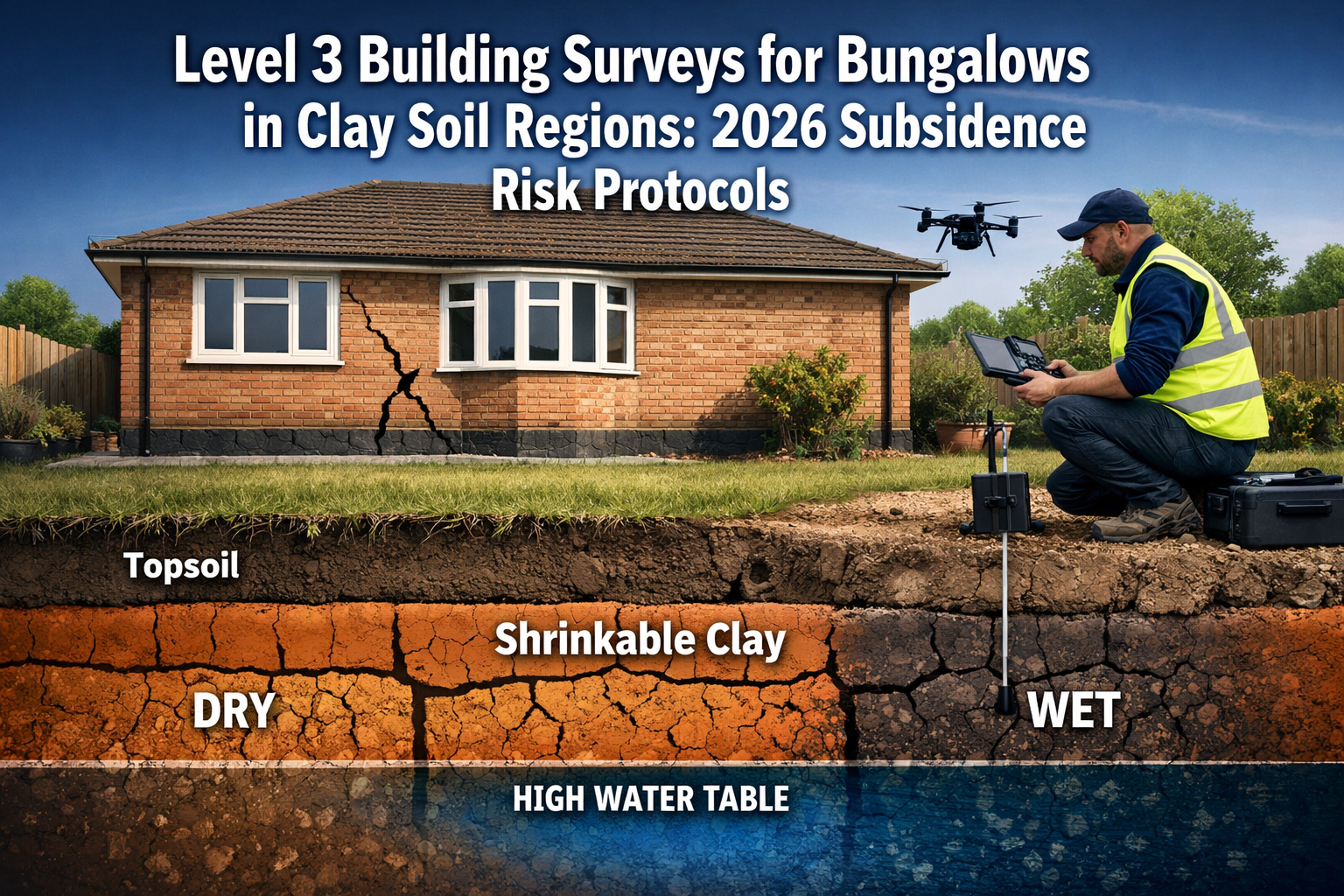
Bungalows constructed on shrinkable clay soils experience subsidence claims at rates three times higher than properties on stable ground—yet most buyers remain unaware of the advanced assessment protocols now standard in 2026. As climate patterns intensify seasonal moisture fluctuations across southern England, the traditional visual inspection approach has become dangerously inadequate for detecting foundation movement in single-story properties.
Level 3 Building Surveys for Bungalows in Clay Soil Regions: 2026 Subsidence Risk Protocols Beyond Basic Checks represent the evolution of property assessment methodology, incorporating drone technology, digital movement monitoring, and soil-specific risk analysis that extends far beyond conventional crack measurement. These comprehensive evaluations provide buyers with the forensic-level detail necessary to understand long-term structural integrity in high-risk geological zones.
Key Takeaways
- 🏠 Clay soil composition significantly increases subsidence vulnerability in bungalows, with seasonal moisture variation causing foundation movement that requires specialized Level 3 assessment protocols beyond standard visual checks
- 📊 Advanced monitoring techniques in 2026 include drone roof inspections, digital crack monitoring sensors, and ground-penetrating radar that detect movement patterns invisible to traditional surveys
- 💰 Level 3 surveys cost £700–£1,200 for bungalows in clay regions, with additional structural engineer reports (£500–£1,500) recommended when subsidence indicators are identified[2]
- 🔍 Unique bungalow vulnerabilities include roof spread from large unsupported spans, lower ground clearance increasing damp risk, and foundation pressure from single-story design that demands specific assessment criteria
- ⚡ 2026 protocols mandate soil composition analysis, tree proximity mapping, drainage system evaluation, and 12-month movement monitoring recommendations for properties showing early subsidence signs
Understanding Clay Soil Subsidence Risk in Bungalow Properties
Clay soils behave fundamentally differently from sand, chalk, or gravel substrates. Their shrink-swell characteristics create a dynamic foundation environment that poses specific challenges for bungalow structures. When clay dries during summer months, it contracts and pulls away from foundations. During wet winter periods, it expands and exerts pressure on structural elements.
This cyclical movement becomes particularly problematic in southern England regions where clay composition dominates the geological landscape. Properties in areas including London, Essex, Kent, and Surrey face elevated risk factors that demand specialized assessment approaches[1][3].
Why Bungalows Face Disproportionate Subsidence Risk
Single-story construction creates unique structural dynamics that differ significantly from multi-story properties:
Foundation Load Distribution 🏗️
- Wider footprint relative to height creates different stress patterns
- Large roof spans without intermediate support transfer substantial weight to perimeter walls
- Foundation pressure concentrates along outer edges rather than distributing through multiple floors
Roof Spread Vulnerability
Heavy roof structures without adequate internal bracing can push exterior walls outward—a phenomenon called roof spread. This structural movement mimics subsidence symptoms but originates from inadequate roof support rather than foundation settlement[2].
Lower Ground Clearance Issues
Bungalows typically sit closer to ground level than two-story properties, creating:
- Reduced ventilation beneath suspended floors
- Increased rising damp penetration risk
- Greater exposure to ground moisture fluctuations
- Limited visual access to foundation areas during inspections
Extension Complications
Many bungalows have been extended over decades, often without proper building control oversight. These additions frequently feature:
- Shallow foundations inadequate for clay soil conditions
- Poor connection details to original structure
- Different foundation depths creating differential movement
- Non-compliant construction methods that compromise structural integrity[2]
Clay Soil Subsidence Mechanisms
Understanding how subsidence develops in clay regions helps explain why Level 3 Building Surveys employ such comprehensive assessment protocols.
| Subsidence Trigger | Mechanism | Bungalow Impact |
|---|---|---|
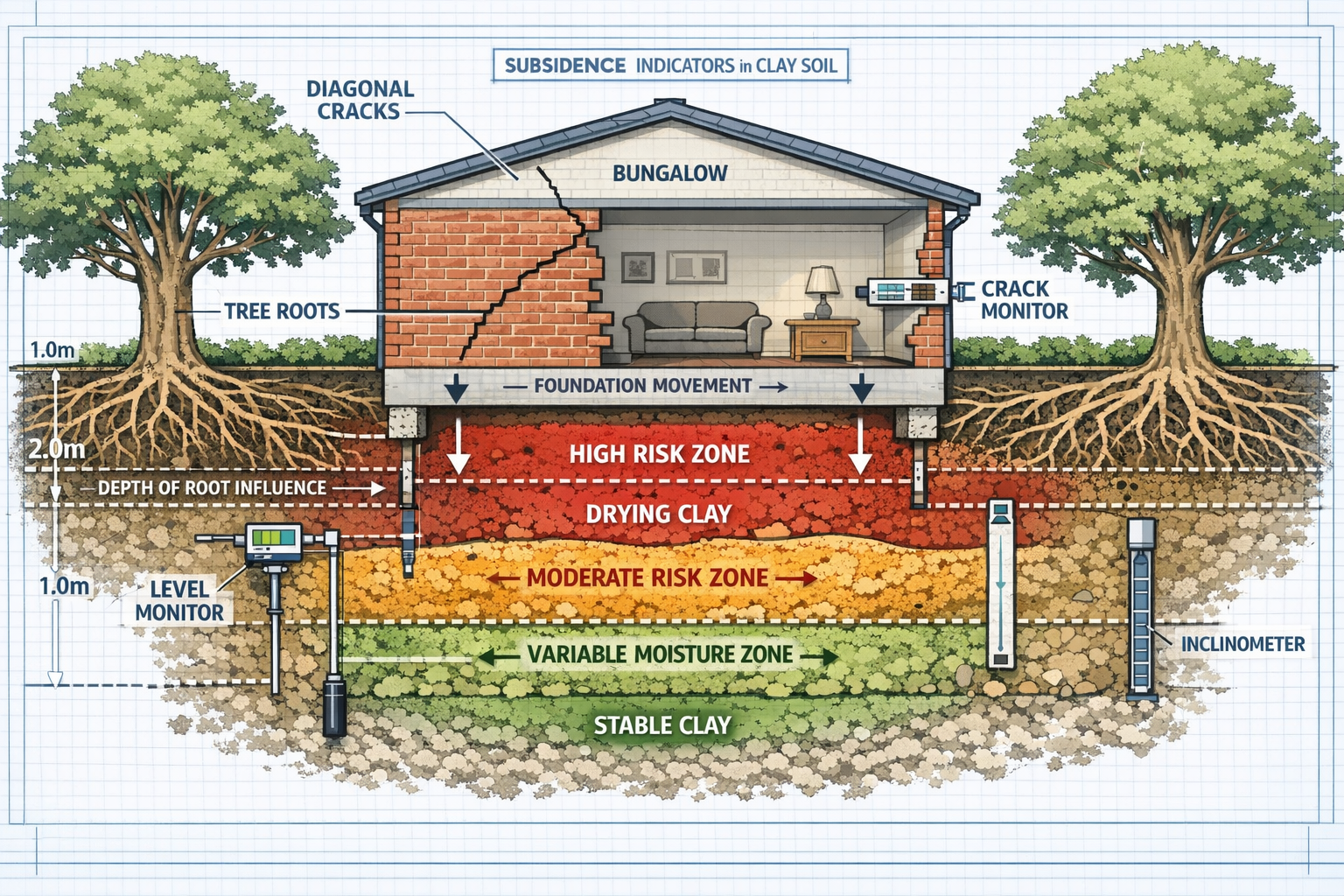
| Vegetation | Tree roots extract moisture from clay, causing shrinkage up to 20m from trunk | Foundation settlement, diagonal cracking, door/window distortion |
| Drainage Leaks | Persistent water flow erodes soil particles, creating voids beneath foundations | Sudden localized settlement, stepped cracking in brickwork |
| Seasonal Variation | Wet/dry cycles cause repeated expansion/contraction | Progressive foundation movement, cumulative structural stress |
| Soil Desiccation | Extended dry periods cause deep clay shrinkage | Widespread settlement affecting entire property footprint |
Research indicates that bungalows on clay soils face elevated subsidence risk due to seasonal moisture variation causing foundation movement that standard surveys often miss during single-visit inspections[1].
Level 3 Building Surveys for Bungalows in Clay Soil Regions: Advanced Assessment Components
The 2026 protocols for Level 3 Building Surveys for Bungalows in Clay Soil Regions extend significantly beyond the visual inspection methodology that characterized earlier survey approaches. These comprehensive assessments incorporate multiple specialized investigation techniques designed specifically for subsidence risk evaluation.
Core Assessment Elements
Structural Movement Analysis 🔍
Surveyors conducting surveys for subsidence examine multiple indicators that reveal foundation movement patterns:
- Crack mapping and measurement: Width, length, direction, and pattern analysis using digital calipers
- Crack dating assessment: Distinguishing historic settlement from active movement through dust accumulation, paint bridging, and mortar freshness
- Diagonal versus vertical cracking: Identifying subsidence-specific patterns versus thermal movement
- Internal and external correlation: Matching interior plasterwork damage with exterior brickwork cracking
- Door and window distortion: Measuring frame alignment and operational functionality
Surveyors specifically assess subsidence risk by examining cracks, movement, and drainage issues that signal foundation problems in bungalows[2]. The distinction between cosmetic cracking and structural movement requires expert interpretation that considers crack width, location, and progression patterns.
Foundation Exposure and Examination
Where accessible, Level 3 surveys include:
- Trial pit excavation to expose foundation depth and condition
- Foundation material assessment (concrete quality, brick type, construction method)
- Depth measurement relative to clay shrinkage zone (typically 1.0-1.5m in high-plasticity clay)
- Underpinning evidence from previous remedial work
- Foundation design adequacy for current loading and soil conditions
Roof Structure Assessment
Given that large roof spans create pressure on foundations[2], detailed roof examination includes:
- Rafter spread indicators (wall plate movement, rafter foot displacement)
- Collar tie and purlin condition
- Ridge beam support adequacy
- Roof-to-wall connection integrity
- Load distribution to perimeter walls
Soil and Site-Specific Analysis
Ground Conditions Evaluation
Level 3 surveys in clay regions incorporate soil and water contamination assessment alongside subsidence risk factors:
- Clay type identification (London Clay, Gault Clay, Oxford Clay characteristics)
- Plasticity index estimation
- Seasonal moisture variation potential
- Historical ground movement records for locality
- Site topography and natural drainage patterns
Vegetation Proximity Mapping 🌳
Trees represent the primary subsidence trigger in clay soil areas. Advanced protocols include:
- Species identification and mature height potential
- Distance measurement from property (critical within 1.5x mature height)
- Root barrier presence or absence
- Historical tree removal evidence
- Hedge and shrub proximity assessment
- Water demand classification (high-demand species like oak, willow, poplar pose greatest risk)
Drainage System Evaluation
Comprehensive drainage survey components include:
- Surface water management adequacy
- Soakaway location and condition
- Gutter and downpipe condition
- Ground-level drainage falls
- Evidence of water pooling near foundations
- Drain run locations relative to foundations
Damp and Moisture Assessment
Lower ground clearance makes bungalows prone to rising damp[2], requiring enhanced moisture investigation:
- Electronic moisture meter readings at multiple wall locations
- Damp meter profiling to distinguish rising damp from penetrating moisture
- Floor void ventilation adequacy
- Ground level relative to internal floor level
- Damp-proof course presence, type, and condition
- Damp surveys using thermal imaging to detect hidden moisture patterns
2026 Subsidence Risk Protocols: Advanced Technology Integration
The evolution of surveying technology has transformed subsidence risk assessment capabilities. Level 3 Building Surveys for Bungalows in Clay Soil Regions: 2026 Subsidence Risk Protocols now routinely incorporate digital tools that provide quantitative data impossible to obtain through visual inspection alone.

Drone-Based Roof Inspection 🚁
Aerial survey technology addresses the unique challenges of bungalow roof assessment:
Benefits for Clay Soil Region Properties:
- Complete roof covering condition without scaffolding access
- Thermal imaging overlay detecting moisture penetration
- Ridge and hip alignment measurement revealing structural movement
- Chimney stack verticality assessment
- Valley gutter condition evaluation
- Roof spread visual indicators from aerial perspective
Drone inspections prove particularly valuable for bungalows where roof access via ladder presents safety concerns and where roof spread represents a primary structural risk factor.
Digital Crack Monitoring Systems
Traditional "tell-tales" (glass strips placed across cracks) have given way to sophisticated digital monitoring:
Electronic Crack Monitors:
- Continuous measurement recording at 0.01mm precision
- Temperature-compensated readings eliminating thermal movement false positives
- Remote data transmission enabling long-term tracking
- Automated alerts when movement thresholds are exceeded
- Multi-axis measurement capturing horizontal and vertical displacement
These systems enable surveyors to distinguish between:
- Active subsidence: Progressive movement exceeding 3mm annually
- Historic settlement: Stabilized movement showing no current progression
- Seasonal fluctuation: Cyclical movement within acceptable tolerance
Ground-Penetrating Radar (GPR)
GPR technology reveals subsurface conditions without excavation:
- Void detection beneath floor slabs
- Drainage run mapping
- Foundation depth profiling
- Soil density variation identification
- Underground service location
- Historical disturbance evidence
For bungalows in clay regions, GPR provides critical data about foundation adequacy and soil conditions that influence long-term subsidence risk.
Laser Scanning and 3D Modeling
Advanced Level 3 surveys increasingly employ terrestrial laser scanning:
- Precise dimensional measurement of entire property
- Wall verticality analysis detecting bulging or leaning
- Floor level mapping revealing differential settlement
- Baseline documentation for future comparison
- Virtual inspection capability for specialist consultants
Thermal Imaging Applications
Infrared thermography detects temperature differentials indicating:
- Hidden moisture penetration behind finishes
- Insulation deficiencies in roof structures
- Air leakage patterns
- Heating system defects
- Structural thermal bridging
For bungalows with lower ground clearance, thermal imaging identifies rising damp patterns and moisture ingress that contribute to foundation deterioration.
Interpreting Survey Results: Risk Categories and Recommendations
Level 3 survey reports categorize findings using a traffic light system that helps buyers understand severity:
Risk Classification Framework
🟢 Low Risk (Condition Rating 1)
- No significant defects
- Routine maintenance only
- Normal wear appropriate to age
- No subsidence indicators
- Suitable for standard mortgage approval
🟡 Moderate Risk (Condition Rating 2)
- Defects requiring repair or replacement
- Non-urgent but should be addressed
- Minor cracking within acceptable limits
- Monitoring recommended
- May require repair cost negotiation
🔴 High Risk (Condition Rating 3)
- Serious defects requiring immediate attention
- Structural movement evidence
- Active subsidence indicators
- Urgent investigation needed
- Specialist structural engineer referral essential
When Specialist Reports Become Necessary
Survey findings may trigger recommendations for additional investigation:
Structural Engineer Assessment (£500–£1,500)
Required when surveys identify:
- Progressive crack patterns
- Foundation movement evidence
- Roof spread indicators
- Differential settlement
- Load-bearing wall concerns
Structural surveys by chartered engineers provide detailed analysis including:
- Structural calculations
- Foundation design review
- Remedial specification
- Cost estimates for repairs
- Monitoring protocol recommendations
12-Month Movement Monitoring
For properties showing potential subsidence signs but unclear progression, surveyors recommend:
- Installation of crack monitoring equipment
- Quarterly measurement recording
- Seasonal variation documentation
- Annual assessment review
- Decision-making data for remedial action
This approach proves particularly valuable in clay soil regions where seasonal movement complicates immediate risk assessment.
Understanding Survey Costs and Value
As of 2026, Level 3 Building Surveys for bungalows typically cost £700–£1,200 depending on property size and complexity[2]. While this represents significant expenditure, the value proposition includes:
✅ Negotiating leverage: Identifying £10,000+ repair requirements before purchase
✅ Insurance clarity: Understanding subsidence history affecting future premiums
✅ Long-term planning: Anticipating maintenance requirements over ownership period
✅ Purchase confidence: Making informed decisions about structural integrity
✅ Legal protection: Professional documentation if defects emerge post-purchase
For properties in clay soil regions with subsidence risk factors, the comprehensive assessment provided by Level 3 surveys far exceeds the capabilities of Level 2 surveys, which focus primarily on visible defects without detailed investigation.
Subsidence Remediation: What Buyers Need to Know
Understanding remediation options helps buyers evaluate properties where subsidence has been identified and repaired.
Common Remediation Approaches
Underpinning
- Traditional mass concrete underpinning extends foundation depth below clay shrinkage zone
- Costs typically £10,000–£50,000 depending on extent
- Requires Building Control approval and structural engineer design
- Provides long-term solution when properly executed
- Insurance companies often require 10-year guarantee
Resin Injection
- Modern alternative involving expanding resin stabilizing soil beneath foundations
- Less disruptive than traditional underpinning
- Costs £5,000–£15,000 for typical application
- Effectiveness depends on soil conditions and void extent
- Not suitable for all subsidence scenarios
Tree Management
- Removal or pruning of vegetation causing soil desiccation
- Root barrier installation preventing future root encroachment
- Monitoring period (typically 12 months) to confirm stabilization
- Most cost-effective when trees are clear causative factor
- May require neighbor cooperation if trees on adjacent property
Insurance Implications
Properties with subsidence history face specific insurance considerations:
- Premium increases: 20-50% higher buildings insurance costs common
- Excess levels: Subsidence claims may carry £1,000+ excess
- Monitoring requirements: Insurers may mandate periodic inspection
- Disclosure obligations: Future sale requires subsidence history declaration
- Specialist insurers: Standard providers may decline cover
Making Informed Purchase Decisions in Clay Soil Regions
Armed with comprehensive Level 3 survey findings, buyers can approach property purchases strategically:
Negotiation Strategies
Price Reduction Requests
- Documented repair costs provide objective negotiation basis
- Subsidence risk typically justifies 5-15% price reduction
- Historic subsidence with completed remediation: 3-8% reduction
- Active subsidence requiring immediate work: 10-20% reduction
Retention Arrangements
- Funds held by solicitor pending repair completion
- Protects buyer while allowing transaction to proceed
- Requires seller agreement and clear remediation specification
Insurance-Backed Guarantees
- Remediation work should include 10-year insurance-backed warranty
- Provides recourse if repairs prove inadequate
- Transferable to future owners
- Essential for mortgage approval
When to Walk Away
Certain survey findings indicate unacceptable risk:
❌ Active subsidence with unclear cause
❌ Multiple failed remediation attempts
❌ Structural movement exceeding 10mm annually
❌ Foundation design fundamentally inadequate for soil conditions
❌ Uninsurable subsidence risk
Professional surveyors provide clear recommendations about property suitability based on identified defects and remediation feasibility.
Regional Considerations for Clay Soil Subsidence
Subsidence risk varies significantly across UK regions based on geological and climatic factors:
High-Risk Areas
London and Southeast England
- London Clay formation dominates geology
- High plasticity clay with significant shrink-swell potential
- Mature tree coverage in established neighborhoods
- Climate change increasing summer drought frequency
Thames Valley
- Gault Clay and Oxford Clay formations
- Flat topography with poor natural drainage
- Extensive bungalow development in 1960s-1980s
- Historic subsidence claims concentration
East Anglia
- Boulder Clay (glacial till) with variable characteristics
- Agricultural drainage affecting water table
- Exposed location increasing soil desiccation
- Limited tree coverage but intensive agriculture
Lower-Risk Areas
Properties on chalk, limestone, sandstone, or granite foundations experience significantly lower subsidence rates. However, localized clay pockets exist even in predominantly stable geological regions, emphasizing the importance of site-specific assessment.
The Future of Subsidence Risk Assessment
Emerging technologies continue advancing survey capabilities:
Artificial Intelligence Analysis
- Machine learning algorithms identifying crack patterns
- Predictive modeling of subsidence progression
- Automated risk scoring based on multiple data inputs
Satellite Monitoring
- InSAR (Interferometric Synthetic Aperture Radar) detecting millimeter-scale ground movement
- Regional subsidence mapping
- Long-term trend analysis
- Early warning systems for developing problems
Climate Adaptation Protocols
- Drought frequency modeling
- Soil moisture prediction
- Vegetation management strategies
- Foundation design evolution for changing conditions
These innovations will further enhance the comprehensive approach already characteristic of Level 3 Building Surveys for Bungalows in Clay Soil Regions: 2026 Subsidence Risk Protocols Beyond Basic Checks.
Conclusion
Bungalows constructed on shrinkable clay soils demand specialized assessment protocols that extend far beyond conventional property surveys. The unique structural characteristics of single-story design—including wide roof spans, lower ground clearance, and concentrated foundation loading—combine with clay soil dynamics to create subsidence vulnerabilities requiring expert evaluation.
Level 3 Building Surveys for Bungalows in Clay Soil Regions: 2026 Subsidence Risk Protocols Beyond Basic Checks provide buyers with the comprehensive analysis necessary to make informed purchase decisions. Advanced technologies including drone inspections, digital movement monitoring, ground-penetrating radar, and thermal imaging deliver quantitative data that transforms subsidence risk assessment from subjective visual inspection to objective measurement and analysis.
The investment in a thorough Level 3 survey—typically £700–£1,200—provides invaluable protection against purchasing properties with hidden structural defects that could cost tens of thousands to remediate. For bungalows in clay regions, this comprehensive assessment represents essential due diligence rather than optional enhancement.
Actionable Next Steps
For buyers considering bungalow purchases in clay soil regions:
- Commission a Level 3 survey from RICS-qualified chartered surveyors experienced in subsidence assessment
- Request specific clay soil protocols including vegetation mapping and drainage evaluation
- Obtain specialist structural engineer reports if survey identifies subsidence indicators
- Verify insurance availability and costs before proceeding with purchase
- Negotiate price adjustments based on documented defects and remediation requirements
- Consider 12-month monitoring for properties showing unclear movement patterns
- Review choosing the right property survey guidance to understand assessment options
The comprehensive approach embodied in 2026 subsidence risk protocols ensures buyers understand exactly what they're purchasing, enabling confident decision-making even in challenging geological environments. For bungalows on clay soils, thorough professional assessment isn't merely advisable—it's essential.
References
[1] Building Survey Protocols For Bungalows Advanced Level 3 Assessments For Subsidence And Structural Risks In 2026 – https://nottinghillsurveyors.com/blog/building-survey-protocols-for-bungalows-advanced-level-3-assessments-for-subsidence-and-structural-risks-in-2026
[2] Survey For Bungalows 2025 – https://surveymatch.co.uk/survey-for-bungalows-2025/
[3] Building Survey Checklists For Bungalow Purchases 2026 Rics Guidance On Structural Risks And Costs – https://nottinghillsurveyors.com/blog/building-survey-checklists-for-bungalow-purchases-2026-rics-guidance-on-structural-risks-and-costs