The United Kingdom property market has entered an unprecedented era of regional divergence in 2026, with Northern regions experiencing robust price growth while Southern markets face stagnation and affordability pressures. This dramatic shift presents significant valuation challenges for property professionals who must navigate increasingly complex regional dynamics. Understanding the Valuation Challenges in 2026 North-South Divide: RICS Tactics for Accurate Regional Assessments has become essential for surveyors, valuers, and property investors seeking to make informed decisions in this bifurcated market landscape.
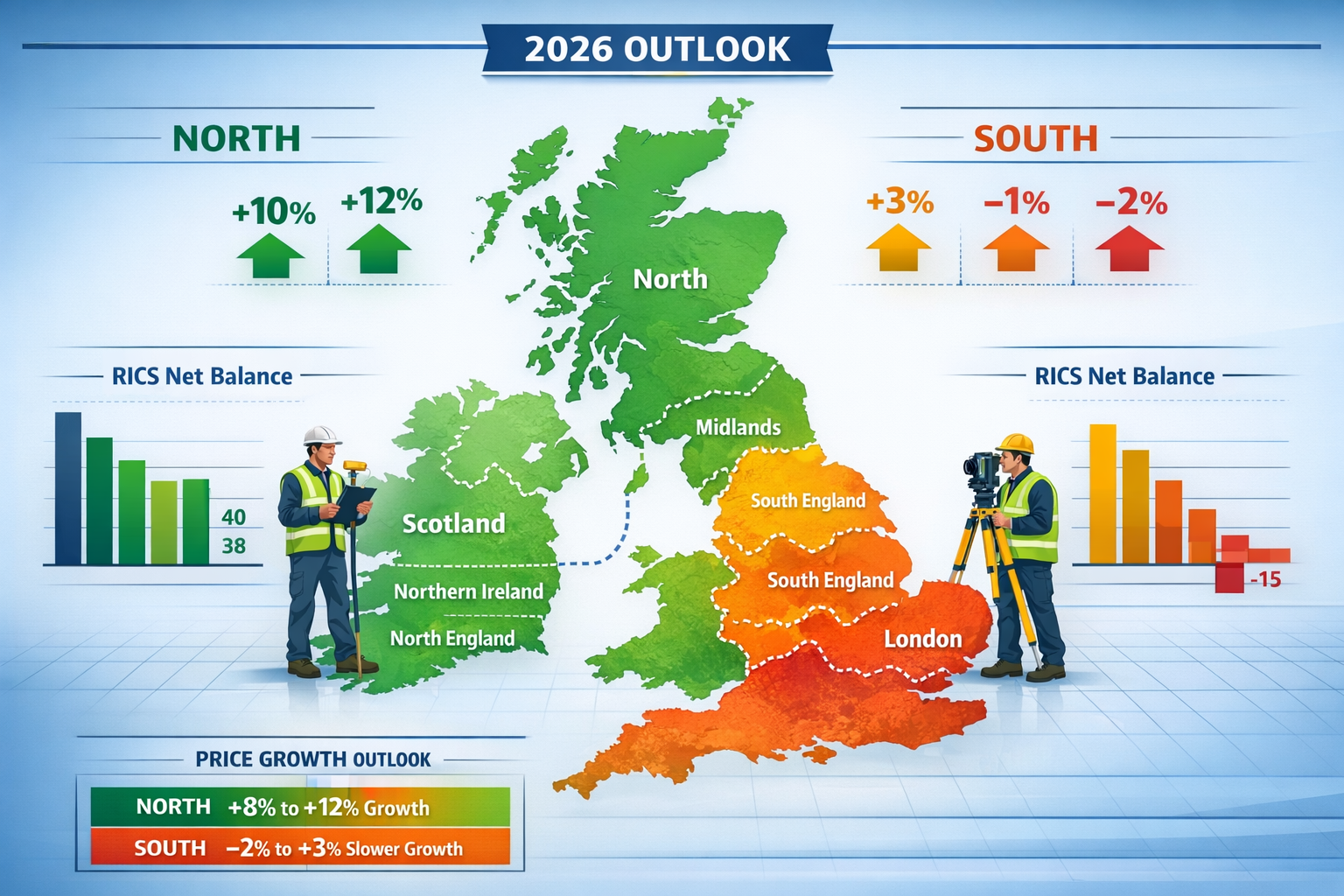
The traditional assumption that London and the South East would perpetually outperform other UK regions has been fundamentally challenged. Recent RICS net balance indicators reveal that Northern England, Scotland, and Northern Ireland are posting price increases between 8% and 12%, while many Southern markets struggle to achieve growth above 3% [1]. This reversal creates substantial complications for property valuations, requiring professionals to adopt sophisticated regional assessment strategies that account for local economic conditions, demographic shifts, and market-specific factors.
Key Takeaways
- 📊 Regional price differentials between North and South have reached historic levels in 2026, with Northern markets outpacing Southern regions by 5-9 percentage points in annual growth
- 🎯 RICS-compliant valuation methodologies must incorporate granular regional adjustments, local comparable evidence, and market velocity indicators to ensure accuracy
- 💼 Surveyor tactics now require dual-market competency, understanding both high-growth Northern dynamics and affordability-constrained Southern conditions
- 📈 Economic indicators including employment rates, wage growth, and migration patterns have become critical inputs for regional property assessments
- ✅ Standardized RICS protocols combined with localized market knowledge provide the framework for navigating valuation challenges across diverging regional markets
Understanding the 2026 North-South Property Divide
The Magnitude of Regional Price Divergence
The property market landscape across the United Kingdom has fundamentally transformed in 2026, creating what many analysts describe as the most pronounced North-South divide in modern real estate history. While Southern England grapples with affordability constraints and market stagnation, Northern regions are experiencing a renaissance driven by improved infrastructure, remote working flexibility, and comparative value propositions.
According to recent RICS survey data, the net balance of surveyors reporting price increases in Northern England reached +42%, compared to just +8% in London and the South East [2]. This 34-point differential represents a dramatic reversal from historical patterns where Southern markets typically commanded premium growth rates.
Key Regional Performance Indicators (2026):
| Region | Annual Price Growth | RICS Net Balance | Average Property Price | Yield Percentage |
|---|---|---|---|---|
| Scotland | +11.2% | +45% | £195,000 | 5.8% |
| Northern Ireland | +9.8% | +38% | £168,000 | 6.2% |
| North England | +8.5% | +42% | £182,000 | 5.5% |
| Midlands | +6.3% | +28% | £225,000 | 4.9% |
| South West | +3.2% | +12% | £315,000 | 3.8% |
| South East | +2.1% | +8% | £425,000 | 3.2% |
| London | +1.8% | +6% | £535,000 | 2.9% |
This data illustrates the valuation challenges facing property professionals who must accurately assess assets in markets experiencing vastly different growth trajectories. Traditional valuation models that applied national or broad regional adjustments no longer provide sufficient granularity for accurate assessments [3].
Economic Drivers Behind Regional Divergence
Several interconnected economic factors have contributed to the widening North-South property divide in 2026:
🏢 Employment and Wage Growth Patterns
Northern regions have benefited from significant public and private sector investment, creating employment hubs in cities like Manchester, Leeds, Newcastle, and Glasgow. Technology sector expansion, coupled with government levelling-up initiatives, has driven wage growth rates in Northern England to exceed 5.5% annually, compared to 3.2% in London where living costs consume a larger proportion of income.
🏠 Affordability Dynamics
The average property in Northern England costs approximately 4.2 times the median household income, while Southern properties command ratios exceeding 10:1 in many areas. This affordability advantage has attracted first-time buyers, families, and investors seeking better rental yields, creating sustained demand pressure in Northern markets [1].
🚄 Infrastructure Investment
Major transport infrastructure projects, including Northern Powerhouse Rail connections and enhanced digital connectivity, have improved accessibility and economic prospects for Northern cities. These improvements have reduced the traditional "distance penalty" that previously suppressed Northern property values.
👥 Demographic Shifts
Remote and hybrid working arrangements have enabled significant internal migration from expensive Southern markets to more affordable Northern locations. This demographic shift has simultaneously increased demand in receiving areas while reducing pressure in traditionally premium Southern markets.
For professionals conducting valuation assessments across these diverging markets, understanding these economic fundamentals is essential for accurate property appraisals.
Valuation Challenges in 2026 North-South Divide: RICS Tactics for Regional Assessment Accuracy
Adapting Comparable Evidence Analysis for Regional Markets
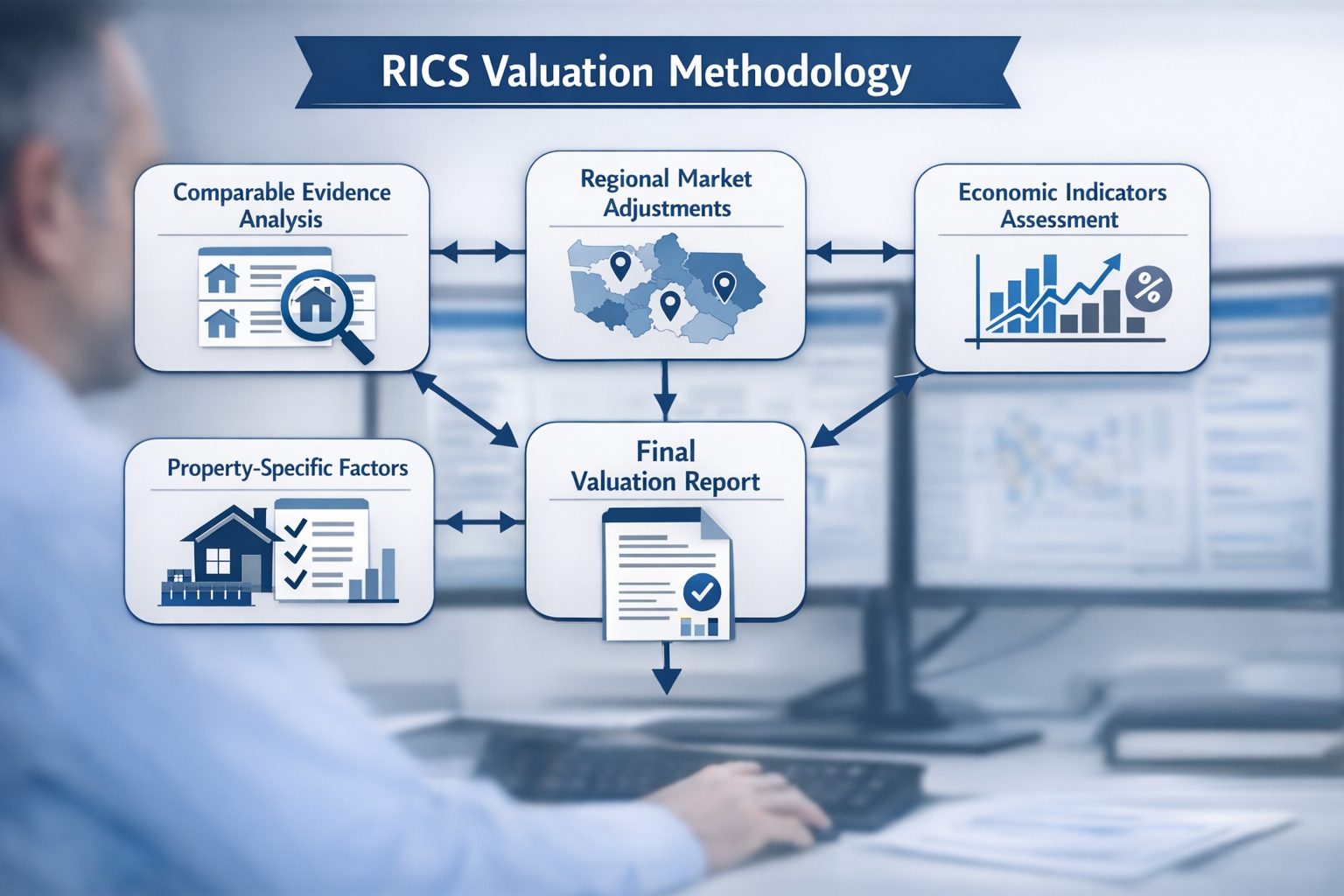
The cornerstone of property valuation—comparable evidence analysis—faces unprecedented complexity when applied across the 2026 North-South divide. Traditional approaches that relied on similar properties within a defined geographic radius must now incorporate sophisticated regional adjustments to maintain accuracy.
RICS-Compliant Comparable Selection Strategies:
✅ Temporal Proximity Weighting: In rapidly appreciating Northern markets, comparables older than three months may significantly understate current values. RICS guidance recommends applying time-adjustment factors of 0.5-1.0% monthly in high-velocity markets, while Southern markets may require minimal temporal adjustments due to slower appreciation rates.
✅ Micro-Market Segmentation: Rather than applying broad regional categories, accurate valuations require identification of specific micro-markets with similar economic characteristics. A property in central Manchester may have more in common with Edinburgh's professional districts than with surrounding Greater Manchester suburbs.
✅ Adjustment Factor Calibration: Standard adjustment percentages for property features (additional bedrooms, garden size, condition) vary significantly between regions. A conservatory addition might add 8-10% to value in a competitive Northern market but only 3-5% in oversupplied Southern areas.
Practical Example:
When valuing a three-bedroom semi-detached property in Leeds (Northern England), a surveyor identified comparable sales ranging from £245,000 to £268,000 over the previous six months. Applying RICS-recommended temporal adjustments of +0.7% monthly for older comparables and making micro-market adjustments for school catchment areas and transport links, the final valuation settled at £262,000—representing a 6.5% premium over the six-month-old comparable that would have been the closest match without regional velocity adjustments [3].
Incorporating Regional Economic Indicators
Professional valuers in 2026 must integrate macroeconomic indicators into their assessment frameworks to account for regional market dynamics. RICS best practices now recommend incorporating the following economic metrics:
📊 Employment and Economic Activity Rates
Regional employment statistics provide critical context for property demand sustainability. Northern regions posting employment growth above 2.5% annually typically support continued property appreciation, while areas with stagnant or declining employment face demand headwinds regardless of current pricing.
💰 Wage Growth and Affordability Indices
Real wage growth (nominal wage increases minus inflation) directly impacts purchasing power and mortgage affordability. Surveyors should monitor regional wage growth differentials, as areas where wages are growing faster than property prices represent strengthening affordability, while the inverse suggests potential demand constraints.
🏗️ Construction Pipeline and Supply Dynamics
Planning permission approvals and construction starts provide forward-looking indicators of supply pressure. Northern markets with constrained supply relative to demand growth support continued appreciation, while Southern areas with substantial development pipelines may face price suppression.
📈 Migration Patterns
Net internal migration data reveals population movement trends that precede property market shifts. Regions experiencing positive net migration from higher-cost areas typically see sustained demand growth, while areas losing population face structural headwinds.
When conducting freehold valuations or other property assessments, incorporating these economic indicators provides essential context beyond simple comparable analysis.
RICS-Recommended Valuation Methodology Adjustments
The Royal Institution of Chartered Surveyors has issued updated guidance for property valuations in regionally divergent markets, emphasizing the need for methodological flexibility while maintaining professional standards.
🎯 Multi-Method Validation Approach
Rather than relying solely on comparable evidence, RICS recommends triangulating valuations using multiple methodologies:
- Comparable Sales Method: Primary approach using adjusted regional comparables
- Income Capitalization Method: Particularly relevant for investment properties, applying regional yield rates
- Residual Method: For development properties, incorporating regional construction costs and sales values
- Depreciated Replacement Cost: For specialized properties, using regional building cost indices
By applying multiple methods and comparing results, valuers can identify potential biases or errors in regional adjustment factors.
📝 Enhanced Reporting Requirements
RICS guidance for 2026 emphasizes transparency in regional valuation assumptions. Professional valuation reports should explicitly document:
- Regional market classification and economic context
- Comparable evidence selection criteria and adjustment factors
- Economic indicators considered and their influence on valuation
- Market velocity assumptions and temporal adjustments
- Uncertainty ranges reflecting regional market volatility
🔍 Market Conditions Addendum
For properties in rapidly changing markets (both appreciating Northern regions and stagnating Southern areas), RICS recommends including a market conditions addendum that:
- Describes current regional market dynamics and trends
- Identifies potential value volatility ranges
- Highlights economic or policy factors that could impact future values
- Provides context for lenders, buyers, or other stakeholders
This enhanced documentation ensures that valuation users understand the regional context and associated uncertainties.
Practical RICS Tactics for Accurate Regional Property Assessments
Developing Regional Market Intelligence Systems
Professional surveyors navigating the Valuation Challenges in 2026 North-South Divide must establish robust market intelligence systems that provide real-time insights into regional dynamics. RICS best practices recommend the following tactical approaches:
🗂️ Regional Comparable Databases
Rather than relying on national property databases that may lack regional granularity, leading surveying practices maintain specialized regional comparable databases that track:
- Transaction prices with detailed property characteristics
- Days on market and offer-to-asking price ratios
- Buyer demographics and financing methods
- Seasonal variation patterns specific to regional markets
- Micro-market performance within broader regions
These specialized databases enable more precise comparable selection and adjustment factor calibration for properties in diverging markets.
📱 Digital Market Monitoring Tools
Technology platforms that aggregate multiple listing services, Land Registry data, and economic indicators provide surveyors with comprehensive regional market views. Advanced tools incorporate:
- Automated comparable identification using AI-powered matching algorithms
- Real-time price trend analysis at postcode and street level
- Economic indicator dashboards showing employment, wages, and migration
- Alert systems for significant regional market shifts
- Predictive analytics identifying emerging micro-market trends
🤝 Regional Professional Networks
RICS members benefit from establishing strong professional networks within specific regional markets. Regular engagement with local estate agents, mortgage brokers, developers, and fellow surveyors provides qualitative market intelligence that complements quantitative data:
"The most accurate valuations in 2026's divergent markets come from surveyors who combine rigorous RICS methodology with deep local market knowledge. Understanding that a particular Leeds neighborhood is attracting London relocators changes the valuation context entirely." – Regional Valuation Specialist [1]
For professionals working across multiple regions, maintaining these networks in both Northern growth markets and Southern constrained markets ensures comprehensive market understanding.
Specialized Valuation Tactics for Northern Growth Markets
Properties in high-growth Northern regions require specific valuation approaches that account for rapid appreciation and changing market dynamics:
⚡ Velocity-Adjusted Comparable Analysis
In markets experiencing 8-12% annual growth, comparable sales from even three to six months prior may significantly understate current values. RICS-compliant tactics include:
- Monthly Time Adjustments: Applying 0.6-1.0% monthly appreciation factors to older comparables based on local market velocity indicators
- Forward-Looking Indicators: Incorporating pending sales and current listing prices alongside completed transactions
- Seasonal Normalization: Adjusting for seasonal market variations that may be amplified in high-velocity markets
🏘️ Emerging Micro-Market Identification
Northern growth markets often feature rapidly appreciating micro-markets where specific neighborhoods outpace regional averages due to regeneration, transport improvements, or demographic shifts. Valuation tactics include:
- Identifying micro-market boundaries through detailed transaction analysis
- Applying premium adjustments (typically 5-15%) for properties in emerging hotspots
- Monitoring leading indicators like planning permissions and commercial investment
- Documenting micro-market classification in valuation reports for transparency
💼 Investment Yield Considerations
Northern properties often attract investor buyers seeking superior yields compared to Southern alternatives. When valuing investment properties, consider:
- Regional rental yield benchmarks (typically 5-6% in Northern markets vs. 3-4% in Southern areas)
- Tenant demand indicators and void period statistics
- Local Housing Allowance rates and their relationship to market rents
- Investor buyer proportion in recent comparable transactions
These investment-focused considerations are particularly relevant for shared ownership property valuations and other investment-oriented assessments.
Specialized Valuation Tactics for Southern Constrained Markets
Properties in affordability-constrained Southern markets require different tactical approaches that account for market stagnation and potential value volatility:
🔄 Extended Comparable Timeframes
In slower-moving Southern markets, valuers may need to extend comparable search periods to identify sufficient evidence, while being mindful of any market shifts:
- Six to Twelve-Month Windows: Acceptable in stable or slowly appreciating markets where monthly value changes are minimal
- Market Trend Analysis: Identifying whether the market is stable, slowly appreciating, or experiencing minor depreciation
- Comparable Scarcity Adjustments: In low-transaction-volume areas, expanding geographic search radius while applying appropriate location adjustments
📉 Downward Adjustment Protocols
Some Southern micro-markets are experiencing modest price declines or extended marketing periods. RICS-compliant approaches include:
- Marketing Time Indicators: Incorporating days-on-market data to assess market liquidity and potential forced-sale discounts
- Offer-to-Asking Ratios: Using the gap between listing prices and achieved sales prices to calibrate valuation assumptions
- Distressed Sale Identification: Excluding or separately weighting comparables that represent forced sales or unusual circumstances
🏛️ Premium Property Considerations
Southern markets often include higher concentrations of premium properties where values are particularly sensitive to economic conditions and buyer sentiment:
- Applying conservative assumptions for properties above regional median prices
- Considering international buyer demand factors and currency exchange impacts
- Evaluating unique property features that may have limited comparable evidence
- Documenting higher uncertainty ranges for premium property valuations
For professionals conducting divorce valuations or other legally sensitive assessments in Southern markets, conservative approaches and well-documented assumptions are particularly important.
Cross-Regional Valuation Competency Development
Surveyors operating across the North-South divide must develop dual-market competency to accurately assess properties in diverging regional contexts. RICS recommends the following professional development tactics:
📚 Continuous Regional Market Education
- Attending regional RICS chapter events and market briefings
- Subscribing to regional property market reports and economic analyses
- Completing specialized training on regional valuation adjustments
- Studying regional planning policies and infrastructure development plans
🔬 Case Study Analysis
Reviewing detailed case studies of valuations in both Northern growth markets and Southern constrained markets helps develop pattern recognition and calibration skills:
- Analyzing valuations that proved accurate versus those requiring revision
- Identifying common errors in regional adjustment factors
- Understanding how economic indicators translated to actual market performance
- Learning from peer review feedback on regional valuations
✅ Quality Assurance Protocols
Implementing robust quality assurance processes ensures consistent accuracy across regional valuations:
- Peer Review Systems: Having regional specialists review valuations outside their primary market area
- Variance Analysis: Tracking differences between initial valuations and subsequent sales prices
- Methodology Documentation: Maintaining detailed records of regional adjustment factors and their evolution
- Client Feedback Integration: Incorporating lender, buyer, and seller feedback to refine regional approaches
These quality assurance practices align with broader methods of valuation standards while addressing regional complexity.
Technology and Data Analytics for Regional Valuation Accuracy
Leveraging Advanced Valuation Technology
The Valuation Challenges in 2026 North-South Divide have accelerated the adoption of advanced technology platforms that enhance regional assessment accuracy. RICS-compliant surveyors are increasingly integrating these tools into their professional practice:
🖥️ Automated Valuation Models (AVMs) with Regional Calibration
While AVMs cannot replace professional surveyor judgment, regionally calibrated models provide valuable supporting data:
- Regional Algorithm Training: AVMs trained on specific regional datasets rather than national aggregates
- Confidence Interval Reporting: Understanding when AVM outputs have high versus low confidence based on regional data availability
- Hybrid Approaches: Combining AVM outputs with professional surveyor adjustments for optimal accuracy
- Validation Against Professional Valuations: Regular comparison of AVM outputs against RICS-compliant professional assessments
📊 Geographic Information Systems (GIS) Integration
GIS platforms enable sophisticated spatial analysis of regional property markets:
- Heat Mapping: Visualizing price appreciation patterns across neighborhoods and regions
- Proximity Analysis: Quantifying the impact of transport links, schools, and amenities on regional property values
- Demographic Overlay: Combining property data with population, employment, and income statistics
- Planning Data Integration: Incorporating approved developments and infrastructure projects into valuation context
🤖 Machine Learning for Comparable Selection
AI-powered comparable selection tools can identify optimal matches across large regional datasets:
- Multi-Factor Matching: Considering dozens of property characteristics simultaneously
- Regional Pattern Recognition: Learning regional-specific value drivers and adjustment factors
- Outlier Detection: Identifying unusual comparables that may skew analysis
- Continuous Learning: Improving matching algorithms as new transaction data becomes available
These technologies complement rather than replace professional surveyor expertise, particularly for complex properties or unique regional circumstances.
Data Sources for Regional Market Intelligence
Accurate regional valuations require access to comprehensive, reliable data sources. RICS members typically utilize:
🏢 Official Registry Data
- Land Registry: Completed transaction prices with property details
- Energy Performance Certificate Database: Property characteristics and energy efficiency ratings
- Planning Portal: Development approvals and infrastructure projects
- Valuation Office Agency: Council tax banding and rateable values
📈 Market Intelligence Providers
- Rightmove and Zoopla: Listing prices, marketing times, and market trends
- CoStar and EG PropertyLink: Commercial property data and investment yields
- Hometrack and LSL Acadata: Regional house price indices and forecasts
- Regional Economic Data: ONS employment, wage, and migration statistics
🏘️ Local Authority Resources
- Local Development Plans: Future infrastructure and housing supply
- Economic Development Strategies: Investment priorities and employment initiatives
- Housing Market Assessments: Detailed local housing need and demand analysis
- Conservation and Planning Policies: Restrictions and opportunities affecting property values
Integrating these diverse data sources provides the comprehensive regional intelligence necessary for accurate valuations in diverging markets.
Regional Risk Assessment and Uncertainty Quantification
The pronounced North-South divide introduces varying levels of valuation uncertainty across regional markets. RICS best practices recommend explicit uncertainty quantification:
📊 Confidence Interval Reporting
Rather than single-point valuations, providing ranges that reflect regional market volatility:
- Northern Growth Markets: Typical uncertainty range of ±5-8% reflecting rapid appreciation and potential volatility
- Southern Stable Markets: Narrower uncertainty range of ±3-5% reflecting slower, more predictable movements
- Emerging Micro-Markets: Wider ranges of ±8-12% reflecting limited comparable evidence and uncertain trajectories
⚠️ Risk Factor Identification
Explicitly documenting regional risk factors that could impact valuations:
- Economic Dependency: Regions heavily dependent on specific industries or employers
- Infrastructure Uncertainty: Proposed transport or development projects with uncertain delivery timelines
- Policy Risk: Potential planning or taxation changes affecting regional markets
- Demographic Trends: Migration patterns that could reverse or accelerate
🔮 Scenario Analysis
For high-value or complex properties, conducting scenario analysis showing valuation outcomes under different regional market conditions:
- Base Case: Most likely regional market trajectory
- Optimistic Scenario: Continued strong growth or market recovery
- Pessimistic Scenario: Market cooling or economic headwinds
This approach proves particularly valuable for Help to Buy valuations and other government-backed schemes where regional market volatility impacts program risk.
Regulatory Compliance and Professional Standards
RICS Red Book Requirements for Regional Valuations
The RICS Valuation – Global Standards (Red Book) provides the foundational framework for professional valuations, with specific considerations for regional market divergence:
📘 Basis of Value Selection
Ensuring the appropriate basis of value for regional market conditions:
- Market Value: Most common basis, reflecting the estimated amount for which a property should exchange in the current regional market
- Investment Value: Particularly relevant in Northern markets where investor buyers dominate
- Fair Value: For financial reporting purposes, incorporating regional market conditions
- Special Value: Recognizing regional-specific value enhancements
🔍 Assumptions and Special Assumptions
Clearly documenting regional market assumptions:
- Market Conditions Assumptions: Current state of regional supply and demand
- Regulatory Assumptions: Regional planning or environmental constraints
- Special Assumptions: Hypothetical conditions that differ from actual regional circumstances
📄 Reporting Requirements
Red Book-compliant reports must address regional context:
- Market Context Section: Describing regional economic conditions and property market trends
- Comparable Evidence: Documenting regional comparable selection and adjustment methodology
- Valuation Approach: Explaining regional-specific valuation methods and assumptions
- Limitations and Caveats: Identifying regional data limitations or market uncertainties
Professional Liability Considerations
Valuing properties across diverging regional markets introduces specific professional liability risks that surveyors must manage:
⚖️ Duty of Care and Skill
Demonstrating appropriate regional market competency:
- Maintaining current knowledge of regional market conditions and trends
- Applying RICS-compliant methodologies adapted for regional circumstances
- Seeking specialist input for unfamiliar regional markets or property types
- Declining instructions where regional competency cannot be demonstrated
📋 Documentation Standards
Comprehensive documentation protects against liability claims:
- Working Papers: Detailed records of comparable selection, adjustments, and calculations
- Market Research: Evidence of regional market analysis and economic indicator review
- Assumption Justification: Clear rationale for regional adjustment factors and assumptions
- Peer Review Records: Documentation of quality assurance processes
🛡️ Professional Indemnity Insurance
Ensuring adequate coverage for regional valuation work:
- Confirming policy covers geographic scope of practice
- Maintaining appropriate coverage limits for regional property values
- Disclosing regional market volatility and uncertainty to insurers
- Reviewing coverage annually as practice evolves
For surveyors working across multiple regions, including chartered surveyors in North London and other diverse markets, robust professional liability management is essential.
Ethical Considerations in Regional Valuations
The significant North-South property divide raises important ethical considerations for professional valuers:
⚖️ Objectivity and Independence
Maintaining professional objectivity despite regional market pressures:
- Resisting client pressure to inflate valuations in competitive Northern markets
- Avoiding conservative bias in Southern markets due to affordability concerns
- Disclosing any regional conflicts of interest or limitations
- Applying consistent professional standards across all regional markets
🎯 Competency Boundaries
Recognizing and respecting professional competency limits:
- Declining instructions for regional markets where adequate expertise is lacking
- Seeking specialist regional input for complex or unusual properties
- Investing in regional market education and professional development
- Clearly communicating regional expertise scope to clients
📢 Transparent Communication
Ensuring clients understand regional valuation context and limitations:
- Explaining regional market dynamics and their impact on valuations
- Communicating uncertainty ranges and potential value volatility
- Clarifying assumptions and their regional-specific nature
- Providing accessible explanations of technical regional adjustments
These ethical principles ensure that professional valuations serve the public interest while maintaining market confidence across diverging regional contexts.
Future Outlook: Regional Market Evolution and Valuation Implications
Projected Regional Market Trends
Understanding likely regional market trajectories helps valuers anticipate future Valuation Challenges in 2026 North-South Divide and prepare appropriate assessment strategies:
📈 Northern Market Maturation
As Northern markets mature through their current growth phase, valuation approaches will need to adapt:
- Velocity Normalization: Growth rates may moderate from current 8-12% levels toward more sustainable 4-6% appreciation
- Market Segmentation: Increasing differentiation between prime Northern locations and secondary areas
- Investor Sophistication: Growing institutional investment bringing more rigorous valuation requirements
- Comparable Depth: Expanding transaction history providing richer comparable evidence
🔄 Southern Market Potential Recovery
Southern markets may experience renewed growth if affordability improves or economic conditions change:
- Price Correction Completion: Current stagnation potentially creating future value opportunities
- Infrastructure Catalysts: Major projects like Crossrail extensions potentially revitalizing specific areas
- Policy Interventions: Government housing or taxation policies potentially affecting regional dynamics
- International Demand: Post-Brexit settlement and global economic conditions influencing premium markets
🌍 Macro-Economic Influences
Broader economic trends will continue shaping regional divergence:
- Remote Work Evolution: Sustained hybrid working supporting Northern markets; office return benefiting Southern cities
- Interest Rate Environment: Mortgage affordability impacts varying by regional price-to-income ratios
- Climate and Sustainability: Regional flood risk, energy efficiency, and environmental policies affecting values
- Demographic Shifts: Aging population, immigration patterns, and household formation trends varying regionally
Emerging Valuation Methodologies
The regional market complexity is driving innovation in valuation methodologies:
🔬 Predictive Analytics Integration
Advanced analytics platforms incorporating:
- Machine learning models predicting regional market movements based on economic indicators
- Sentiment analysis of property listings, news, and social media for regional market signals
- Network analysis identifying how regional markets influence each other
- Scenario modeling quantifying potential valuation outcomes under different regional trajectories
🌐 Hyperlocal Valuation Approaches
Moving beyond broad regional categories to micro-market precision:
- Postcode-level valuation models capturing neighborhood-specific dynamics
- Street-by-street comparable analysis identifying premium locations
- Property-specific attribute weighting based on local buyer preferences
- Real-time market velocity tracking at granular geographic levels
🤝 Collaborative Valuation Platforms
Technology enabling surveyor collaboration across regional markets:
- Shared comparable databases with regional specialist contributions
- Peer review networks connecting regional experts
- Standardized regional adjustment frameworks with local calibration
- Continuous learning systems incorporating regional valuation outcomes
These emerging methodologies will enhance regional valuation accuracy while maintaining RICS professional standards.
Professional Development Priorities
Surveyors seeking to excel in regionally divergent markets should prioritize:
📚 Regional Market Specialization
Developing deep expertise in specific regional markets:
- Focusing professional practice on 2-3 regional markets for depth
- Establishing strong local networks and market intelligence sources
- Tracking regional economic indicators and policy developments
- Building comprehensive regional comparable databases
💻 Technology Competency
Mastering valuation technology platforms:
- GIS and spatial analysis tools for regional market visualization
- Data analytics platforms for comparable analysis and market trends
- AVM and predictive modeling systems for supporting evidence
- Digital reporting tools for clear regional context communication
🎓 Continuous Professional Development
Engaging in ongoing regional market education:
- RICS regional chapter events and market briefings
- Economic development authority presentations and consultations
- Property industry conferences focused on regional markets
- Academic research on regional property market dynamics
🔗 Cross-Regional Collaboration
Building professional networks spanning regional markets:
- Peer relationships with specialists in different regions
- Referral networks for instructions outside primary expertise areas
- Knowledge sharing through professional associations and forums
- Joint training and case study development across regions
These professional development priorities position surveyors to navigate current and future regional valuation challenges effectively.
Conclusion: Mastering Regional Valuation in a Divided Market
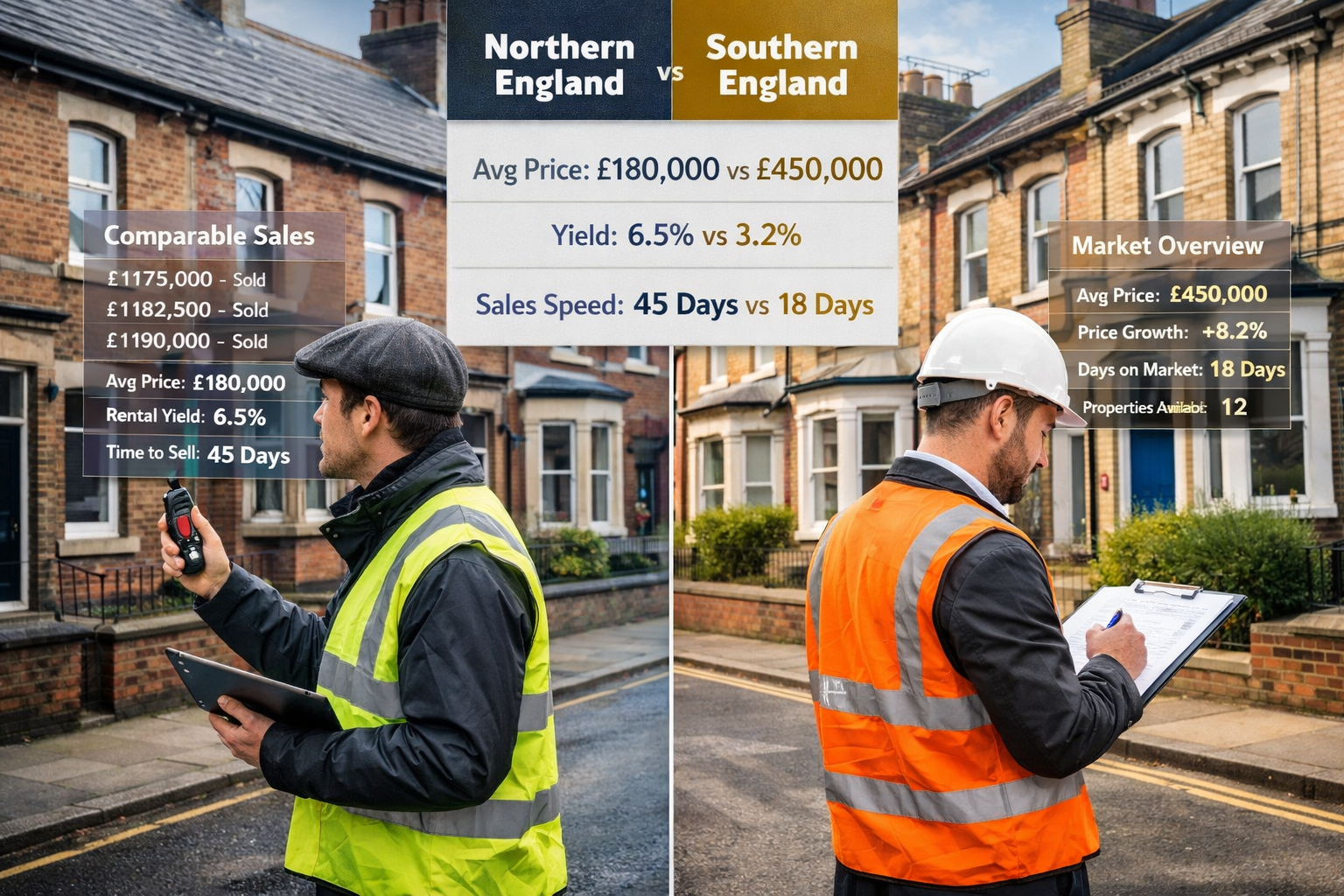
The Valuation Challenges in 2026 North-South Divide represent a fundamental shift in UK property market dynamics, requiring professional surveyors to adapt their methodologies, enhance their regional expertise, and leverage advanced technology while maintaining rigorous RICS standards. The pronounced divergence between high-growth Northern markets and affordability-constrained Southern regions has created a complex valuation landscape where traditional approaches prove insufficient.
Key Success Factors for Regional Valuation Accuracy:
✅ Granular Regional Intelligence: Moving beyond broad regional categories to micro-market analysis with detailed economic context
✅ Methodological Flexibility: Adapting RICS-compliant approaches to specific regional market conditions while maintaining professional standards
✅ Technology Integration: Leveraging advanced data analytics, GIS platforms, and predictive modeling to enhance regional assessment accuracy
✅ Transparent Communication: Clearly documenting regional assumptions, uncertainties, and market context for valuation users
✅ Continuous Development: Investing in regional market education, professional networks, and emerging valuation methodologies
The surveyors who thrive in this environment will be those who combine deep regional market knowledge with technical valuation expertise, supported by robust data analytics and unwavering commitment to professional standards. Whether conducting lease extension valuations, Right to Buy appraisals, or standard market valuations, regional context has become inseparable from accurate assessment.
Actionable Next Steps
For property professionals seeking to enhance their regional valuation capabilities:
-
Audit Current Regional Competency: Honestly assess regional market knowledge and identify gaps requiring development
-
Invest in Regional Data Systems: Implement technology platforms providing comprehensive regional market intelligence and comparable evidence
-
Develop Regional Networks: Establish relationships with local estate agents, developers, and fellow surveyors in key regional markets
-
Enhance Methodology Documentation: Strengthen working papers and reporting to explicitly address regional market context and assumptions
-
Pursue Targeted Professional Development: Attend regional RICS events, complete specialized training, and study regional economic indicators
-
Implement Quality Assurance Protocols: Establish peer review and variance analysis systems ensuring consistent regional valuation accuracy
-
Stay Informed on Market Evolution: Monitor regional market trends, economic developments, and policy changes affecting property values
The North-South divide of 2026 presents both challenges and opportunities for professional surveyors. Those who master regional valuation complexity will provide superior service to clients, maintain competitive advantage in the market, and uphold the highest standards of the surveying profession. By combining RICS-compliant methodologies with regional market expertise and advanced technology, surveyors can deliver the accurate, reliable valuations that property markets depend upon—regardless of regional dynamics.
References
[1] Valuation Strategies For Northern Uk Price Surge Surveyor Tactics In Scotland Northern Ireland And North England 2026 – https://nottinghillsurveyors.com/blog/valuation-strategies-for-northern-uk-price-surge-surveyor-tactics-in-scotland-northern-ireland-and-north-england-2026
[2] housingtoday.co.uk – https://www.housingtoday.co.uk/news/rics-hails-early-signs-of-housing-market-improvement-in-latest-survey/5140683.article
[3] Valuing Northern England Properties In 2026 Surveyor Tactics For Outpacing Southern Affordability Pressures – https://nottinghillsurveyors.com/blog/valuing-northern-england-properties-in-2026-surveyor-tactics-for-outpacing-southern-affordability-pressures