

Agreed sale prices are now running at least 5% below asking prices across much of England and Wales — a figure that would have been unthinkable during the frenzied conditions of 2022 and early 2024 [2]. That single statistic captures the essence of where the UK housing market stands in 2026: a market in transition, where the balance of power has shifted, professional survey demand is rising, and the accuracy of property valuations is under greater scrutiny than it has been for years. Understanding the UK residential market recovery — its implications for survey demand, valuation accuracy and buyer negotiation power — is now essential for anyone buying, selling, or advising on residential property.
Key Takeaways
- New buyer enquiries fell to a net balance of -26% in February 2026, signalling a cautious market despite early recovery signals [1].
- Agreed prices are typically 5% or more below asking prices, giving buyers meaningful negotiation leverage [2].
- Regional divergence is stark: London's 12-month price expectations dropped from +56% to +7% between January and February 2026 [3].
- Surveyors face increased professional liability risk if valuation methodologies are not updated to reflect current market volatility [4].
- Professional building surveys are becoming a primary tool for buyers seeking evidence to support price renegotiations.
What the Latest RICS Data Reveals About the UK Residential Market Recovery
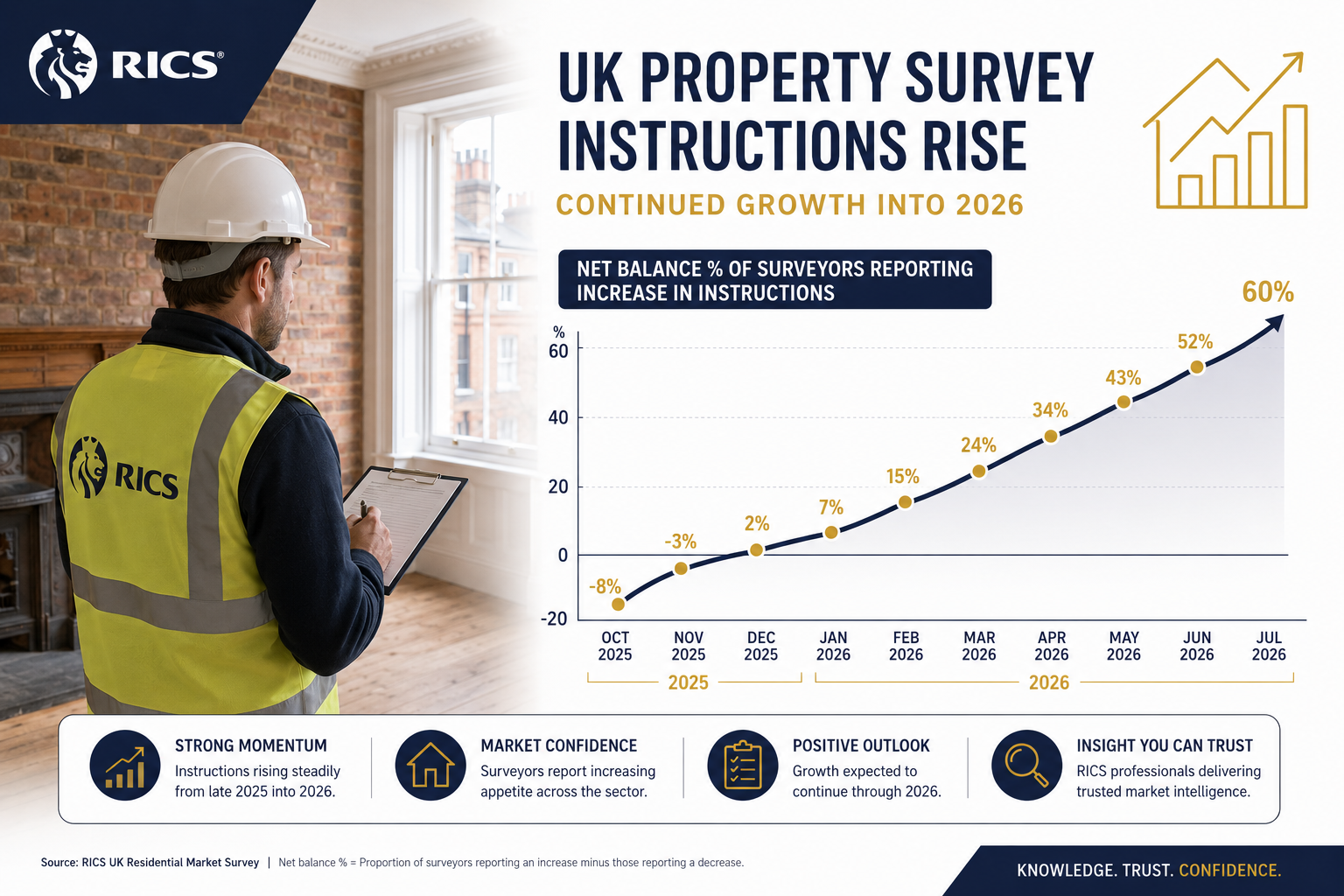
The RICS UK Residential Market Survey for Q1 2026 paints a nuanced picture. On the surface, the word "recovery" suggests upward momentum. In practice, the data reveals a market that is stabilising rather than accelerating, with several competing forces pulling in different directions.
Buyer Demand Is Softening Despite Recovery Signals
New buyer enquiries fell to a net balance of -26% in February 2026, a sharp deterioration from -15% in January [1]. Near-term sales expectations also turned negative, recording a net balance of -2% in February — the weakest reading since November 2025 [1]. These figures suggest that while the worst of the post-2023 correction may be behind the market, a clean, sustained recovery is far from guaranteed.
Geopolitical uncertainty is playing a meaningful role. Tensions in international markets and broader economic caution are weighing on buyer confidence, adding to a sentiment that is cautious rather than optimistic [2]. Sellers who entered 2026 expecting a swift rebound are finding the market more resistant than anticipated.
House Prices Have Plateaued — And That Changes Everything
House prices have broadly plateaued since autumn 2025 [2]. The competitive bidding practices that defined the pandemic-era market — sealed bids, gazumping, properties selling within 48 hours — have largely disappeared. In their place is a more measured environment where buyers have time to conduct proper due diligence.
This plateau is not uniform. Regional divergence is significant. London's 12-month price expectations collapsed from a net balance of +56% in January 2026 to just +7% in February — a dramatic correction in sentiment within a single month [3]. Markets in the North and Midlands have shown greater resilience, reflecting continued demand from first-time buyers and remote workers seeking affordability.
Rental Market Pressures Are Indirectly Supporting Owner-Occupier Demand
One underappreciated dynamic is the continued tightening of the rental market. Landlord instructions fell to -27% in February 2026, meaning fewer rental properties are coming to market [3]. This supply squeeze is pushing renters toward owner-occupation — not out of confidence, but out of necessity. This creates a floor of demand beneath the sales market even as headline sentiment remains weak.
Implications for Survey Demand: Why More Buyers Are Commissioning Professional Reports
The shift in market conditions has had a direct and measurable impact on the demand for professional surveys. When properties were selling above asking price within days, many buyers — under pressure to move fast — skipped or minimised survey instructions. That dynamic has reversed.
A Slower Market Creates Space for Due Diligence
With properties sitting on the market for longer and buyers facing less competitive pressure, there is now both the time and the financial incentive to commission a thorough survey before exchange. A RICS home survey or a full Level 3 RICS building survey can take several days to arrange and complete, a timeline that was impractical in the heat of a competitive market but is entirely manageable today.
Buyers who are uncertain which level of inspection is appropriate can benefit from guidance on choosing the right property survey — a decision that depends on the age, construction type, and condition of the property in question.
Structural and Specialist Surveys Are Seeing Increased Instructions
Beyond standard homebuyer reports, demand for specialist investigations is growing. Buyers who are purchasing older stock — particularly Victorian and Edwardian terraces that make up a large proportion of UK housing — are increasingly requesting structural surveys and targeted investigations such as damp surveys and drainage surveys.
This trend reflects a broader shift in buyer psychology. Rather than viewing a survey as a formality or a box-ticking exercise, buyers in 2026 are treating survey findings as actionable intelligence — evidence that can be used to renegotiate price, request remediation, or walk away from a problematic purchase.
The key categories of survey seeing increased demand include:
- Full structural building surveys for period properties
- Specific defect reports targeting known or suspected issues
- Damp and timber investigations in older housing stock
- Drainage and drainage-adjacent structural assessments
- Subsidence investigations in areas with known ground movement risk
For buyers concerned about particular structural issues, a specific defect report can provide targeted, cost-effective analysis without the expense of a full-level survey.
Valuation Accuracy in a Transitional Market: Challenges and Professional Responsibilities
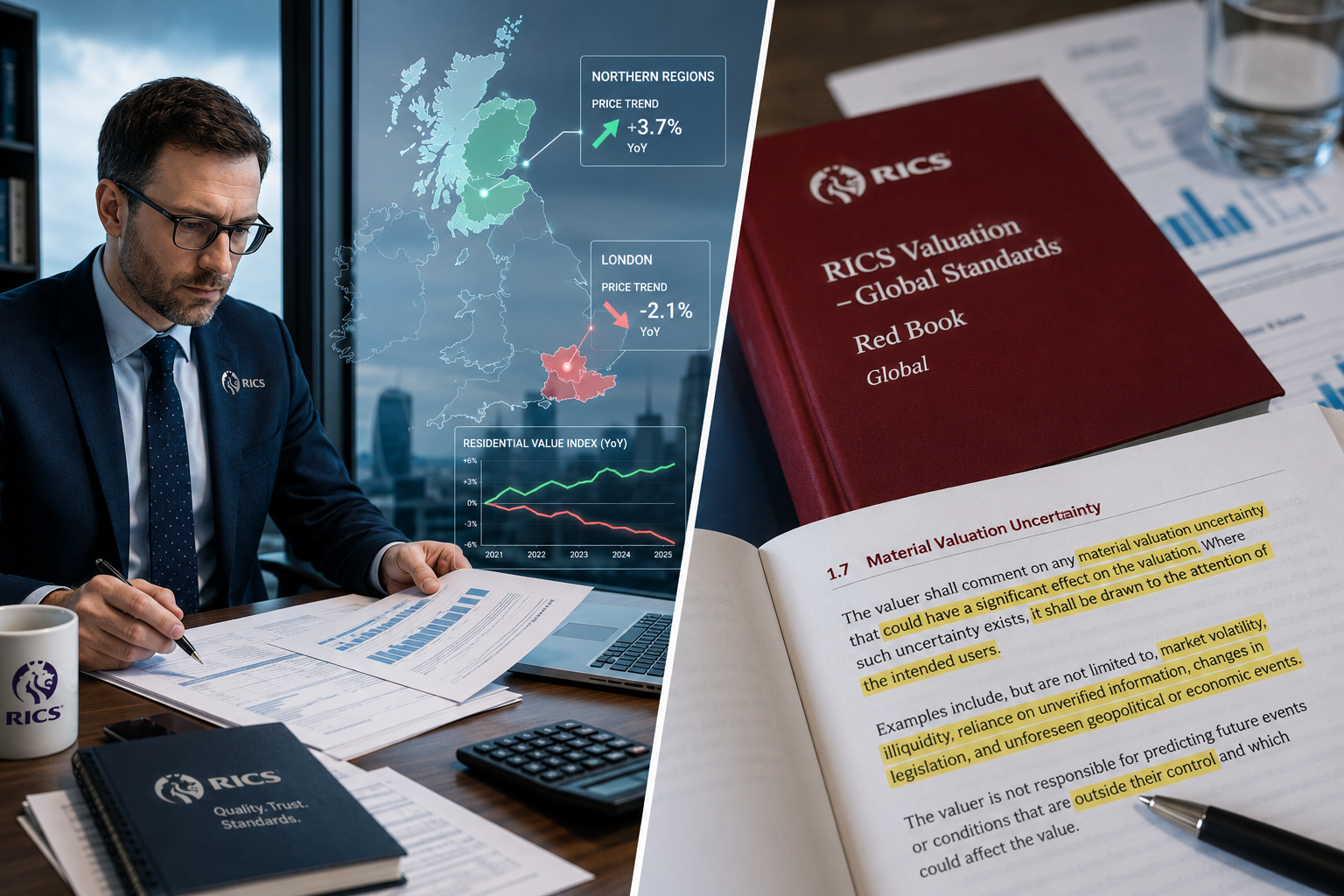
The UK residential market recovery — with its implications for survey demand, valuation accuracy and buyer negotiation power — creates a specific and demanding environment for RICS-registered valuers. Accurate valuation in a stable, rising market is challenging enough. In a market characterised by regional divergence, softening demand, and price plateaus, the technical demands are considerably higher.
Why Standard Comparable Evidence Is Less Reliable Right Now
Valuation methodology relies heavily on comparable transactions — recent sales of similar properties in the same area. In a transitional market, this approach carries inherent risks. Comparables from six to twelve months ago may reflect conditions that no longer exist. A property that sold at a premium in mid-2025 may not represent fair value in early 2026, particularly in markets like London where sentiment has shifted sharply [3].
Surveyors who fail to account for this temporal gap — who apply comparable evidence without adequate adjustment for current market conditions — expose themselves to professional liability risk [4]. The RICS guidance is clear: valuers must exercise judgment and apply appropriate risk weighting when market conditions are in flux.
Regional Divergence Demands Localised Expertise
The dramatic difference between London's price expectations and those in other regions underlines a fundamental point: national averages are increasingly misleading. A valuer operating in Surrey faces a different set of market signals than one working in Yorkshire. Local knowledge, combined with up-to-date market intelligence, is not a luxury — it is a professional requirement.
This is one reason why engaging local chartered surveyors with deep knowledge of specific micro-markets is more valuable than ever. A surveyor who understands the nuances of a particular postcode — its stock type, its buyer profile, its recent transaction history — will produce a more reliable valuation than one applying a generic national framework.
The Role of Red Book Valuations in a Volatile Market
For mortgage purposes, probate, shared ownership, and other formal requirements, a Red Book valuation prepared in accordance with RICS Valuation — Global Standards is the benchmark. In a transitional market, lenders are paying close attention to how valuers are justifying their figures, particularly where there is a significant gap between asking price and agreed price.
"Surveyors who fail to update their valuation methodologies during market transitions expose themselves to increased professional liability risks." [4]
This is not merely a theoretical concern. Where a valuation is later shown to have been materially inaccurate — either too high or too low — the consequences for the professional can be significant. The current environment demands rigorous documentation of methodology, clear commentary on market conditions, and transparent acknowledgment of uncertainty where it exists.
Buyer Negotiation Power: How Survey Findings Are Reshaping Price Conversations
Perhaps the most practically significant implication of the current market conditions is the enhanced negotiation power available to buyers — and the central role that professional surveys now play in exercising it.
The 5% Gap: A New Benchmark for Negotiation
With agreed prices running at 5% or more below asking prices [2], the expectation that buyers will negotiate has become normalised. Sellers who priced optimistically in anticipation of a recovery are finding that the market will not support those aspirations. This creates a structural opportunity for buyers who can substantiate their offers with professional evidence.
A survey that identifies material defects — whether damp penetration, structural movement, roof deterioration, or drainage failure — provides precisely that evidence. Rather than a buyer simply asserting that a property is overpriced, a surveyor's report gives a professional, independent basis for a price reduction request.

Translating Survey Findings into Negotiation Leverage
Not all survey findings carry equal weight in a negotiation. Buyers and their advisers need to understand which issues are likely to move a seller and which are standard maintenance items that a seller can reasonably dismiss.
| Finding Type | Negotiation Impact | Example |
|---|---|---|
| Structural defects | High | Subsidence, cracked lintels, failing roof structure |
| Damp and timber decay | Medium-High | Rising damp, wet rot, woodworm infestation |
| Drainage issues | Medium | Collapsed drains, root ingress, inadequate fall |
| Cosmetic issues | Low | Dated decoration, minor cracks, worn fixtures |
| Energy efficiency | Medium | Poor insulation, ageing boiler, single glazing |
A full RICS building survey will categorise findings using a traffic-light condition rating system. Condition 3 items — those requiring urgent attention — are the most powerful negotiation tools. Buyers should request remediation costs from qualified contractors before entering renegotiation, so that any price reduction request is grounded in specific, verifiable figures rather than vague estimates.
When to Commission a Survey Before Making an Offer
In a slower market, some buyers are commissioning surveys — or at least preliminary structural assessments — before finalising their offer, rather than after. This approach carries a cost if the transaction falls through, but it provides a clearer picture of the property's true condition and reduces the risk of post-exchange surprises.
For properties with obvious structural concerns, a residential structural engineering survey can identify the nature and likely cost of any remediation before the buyer is legally committed. This is particularly relevant for properties showing signs of subsidence or significant movement — issues that can be expensive to resolve and difficult to insure.
The Psychology of Negotiation in a Plateauing Market
Sellers in 2026 are in a psychologically different position than they were in 2022. Many have already adjusted their expectations downward. A well-presented survey report, delivered professionally and without confrontation, is more likely to result in a constructive price conversation than it would have been in a seller's market.
Practical steps for buyers using survey findings in negotiation:
- Obtain the full survey report before approaching the seller
- Obtain at least two contractor quotes for Condition 3 items
- Present findings factually, referencing the surveyor's professional assessment
- Separate genuine structural concerns from cosmetic issues in the conversation
- Be prepared to walk away if the seller will not acknowledge material defects
What Buyers, Sellers, and Surveyors Should Do Now
The UK residential market recovery — with its complex implications for survey demand, valuation accuracy and buyer negotiation power — requires each party in a transaction to adapt their approach.
For buyers:
- Commission a survey appropriate to the property's age and condition before exchange
- Use survey findings as a structured basis for negotiation, not just reassurance
- Engage local surveyors with specific knowledge of the target market
- Factor in the cost of remediation when assessing overall purchase viability
For sellers:
- Price realistically from the outset, accounting for the current 5%-below-asking norm
- Consider a pre-sale survey to identify and address issues before they become negotiation leverage for buyers
- Be prepared for longer transaction timelines and more rigorous buyer due diligence
For surveyors and valuers:
- Update comparable evidence methodologies to reflect current market conditions
- Apply appropriate risk weighting in valuations, particularly in volatile regional markets
- Document methodology thoroughly to manage professional liability exposure
- Communicate uncertainty clearly in reports, particularly where comparable evidence is limited
Conclusion
The UK residential market in 2026 is neither in freefall nor in full recovery. It is a market in careful transition — one where buyers have regained meaningful leverage, where professional surveys are no longer optional extras but essential tools, and where the accuracy of valuations carries greater professional and financial weight than it has for several years.
For buyers, the message is clear: the current environment rewards preparation. A thorough survey, conducted by a qualified and locally experienced chartered surveyor, provides both protection and negotiating power. For sellers, realistic pricing and transparency about condition are the most effective strategies in a market where buyers have both the time and the evidence to push back. For surveyors and valuers, the challenge is to maintain methodological rigour in conditions where comparable evidence is less reliable and regional divergence is pronounced.
The practical next steps are straightforward. Buyers should engage a RICS-registered surveyor early in the transaction process, select the survey level appropriate to the property, and treat the resulting report as a working document rather than a filing exercise. Those purchasing older or more complex properties should consider specialist investigations alongside a standard survey. And anyone involved in the valuation of residential property should ensure their methodology reflects the realities of the current market — not the conditions of twelve months ago.
References
[1] Buyer Demand Slips Amid Doubts For A Housing Market Recovery Rics – https://www.mortgagesolutions.co.uk/mortgage-news/2026/03/12/buyer-demand-slips-amid-doubts-for-a-housing-market-recovery-rics/?utm_source=openai
[2] Uk House Prices Plateau As Competitive Bidding Disappears – https://www.propertywire.com/news/uk-house-prices-plateau-as-competitive-bidding-disappears/?utm_source=openai
[3] Rics Uk Residential Market Survey Q1 2026 Valuation Strategies For Emerging Price Recovery Signals In Building Surveys – https://nottinghillsurveyors.com/blog/rics-uk-residential-market-survey-q1-2026-valuation-strategies-for-emerging-price-recovery-signals-in-building-surveys?utm_source=openai
[4] What The 2026 Rics Residential Market Turnaround Means For Valuation Surveyors Risk Weighting Commentary And Client Advice – https://princesurveyors.co.uk/blog/what-the-2026-rics-residential-market-turnaround-means-for-valuation-surveyors-risk-weighting-commentary-and-client-advice/?utm_source=openai