
Canterbury & Kent
RICS 8th Edition Party Wall Guidance: Post-Consultation Changes and Immediate 2026 Implementation for Surveyors
Over 500,000 construction projects in England and Wales trigger the Party Wall etc. Act 1996 every year — yet a significant proportion of awards and notices still contain procedural errors that expose surveyors to professional liability. The launch of the RICS 8th Edition Party Wall Guidance: Post-Consultation Changes and Immediate 2026 Implementation for Surveyors signals the most comprehensive overhaul of professional practice standards in over a decade, and the window to adapt is narrowing fast.
RICS launched its formal consultation on the draft 8th edition of Party Wall Legislation and Procedure in April 2026, running for approximately eight weeks across April and May [1]. The revised guidance touches everything from fee practices and Third Surveyor protocols to ESG integration and updated draft awards. For surveyors operating in 2026, understanding these changes is not optional — it is a professional obligation.

Key Takeaways 📌
- The RICS 8th Edition consultation ran April–May 2026, with immediate implementation expectations for practising surveyors [1].
- Enhanced appendices, revised letters of appointment, and an updated draft award form core structural changes [1].
- A party wall surveyor’s appointment is personal and statutory — independent of client instruction [1].
- ESG considerations are now formally woven into party wall procedure guidance.
- Surveyors must audit their notice templates, award drafts, and fee disclosure practices before June 2026 deadlines.
What Drove the Need for an 8th Edition?
The 7th edition of RICS’s party wall guidance had served practitioners well, but the construction landscape has shifted considerably. Three converging pressures made a revision unavoidable:
- Regulatory evolution — RICS’s own conduct standards have tightened significantly, demanding greater transparency in fee arrangements and professional independence.
- ESG expectations — Clients, lenders, and local authorities increasingly expect sustainability considerations to feature in construction planning, including works that trigger party wall procedures.
- Dispute frequency — The volume of party wall disputes reaching the Third Surveyor or the courts has risen, highlighting inconsistencies in how surveyors serve notices and draft awards.
The result is a guidance document that is both more prescriptive and more protective — for surveyors and the parties they serve.
💬 “The 8th edition reflects the profession’s commitment to consistency, transparency, and public trust in party wall procedures.” — RICS, 2026 [1]
Core Structural Changes in the RICS 8th Edition Party Wall Guidance: Post-Consultation Changes and Immediate 2026 Implementation for Surveyors
1. Enhanced Appendices
The revised appendices represent one of the most practically useful upgrades in the 8th edition. They include:
- Updated draft party wall awards with clearer clause structures and mandatory ESG compliance checkpoints.
- Revised letters of appointment that explicitly state the statutory and personal nature of a surveyor’s role [1].
- Revised terms of engagement that address fee transparency, conflict of interest disclosure, and communication standards.
These appendices are designed to be used directly in practice, reducing the risk of surveyors inadvertently producing awards that are legally vulnerable. For a detailed overview of what a properly structured award should contain, the guidance on party wall awards provides a strong practical foundation.
2. Strengthened Conduct and Regulatory Guidance
The 8th edition places significant emphasis on professional conduct, particularly around:
| Area | Key Change |
|---|---|
| Fee practices | Mandatory disclosure of fee basis and any referral arrangements |
| Third Surveyor use | Clearer criteria for when referral is appropriate and obligatory |
| Service of notices | Stricter procedural requirements for valid service |
| Public engagement | Guidance on communicating with adjoining owners in plain language |
The guidance makes clear that surveyors must not allow client pressure to compromise their statutory independence [1]. This is a direct response to documented cases where building owner surveyors were found to have acted in ways that favoured their appointing client over the procedural integrity of the award.
3. The Statutory and Personal Nature of Appointment
Perhaps the most emphatic clarification in the 8th edition is the restatement that a party wall surveyor’s appointment is personal and statutory, not contractual in the conventional sense [1]. This has several practical implications:
- A surveyor cannot be instructed by their client to withdraw from an appointment once the statutory process has begun.
- Fee disputes between a surveyor and their appointing owner do not suspend or invalidate the surveyor’s statutory duties.
- The surveyor’s primary obligation is to the process and the Act, not to the party who appointed them.
This principle has always underpinned the Party Wall etc. Act 1996, but its explicit restatement in the 8th edition gives surveyors a clear professional basis to resist inappropriate client pressure.
ESG Integration: What It Means for Party Wall Practice
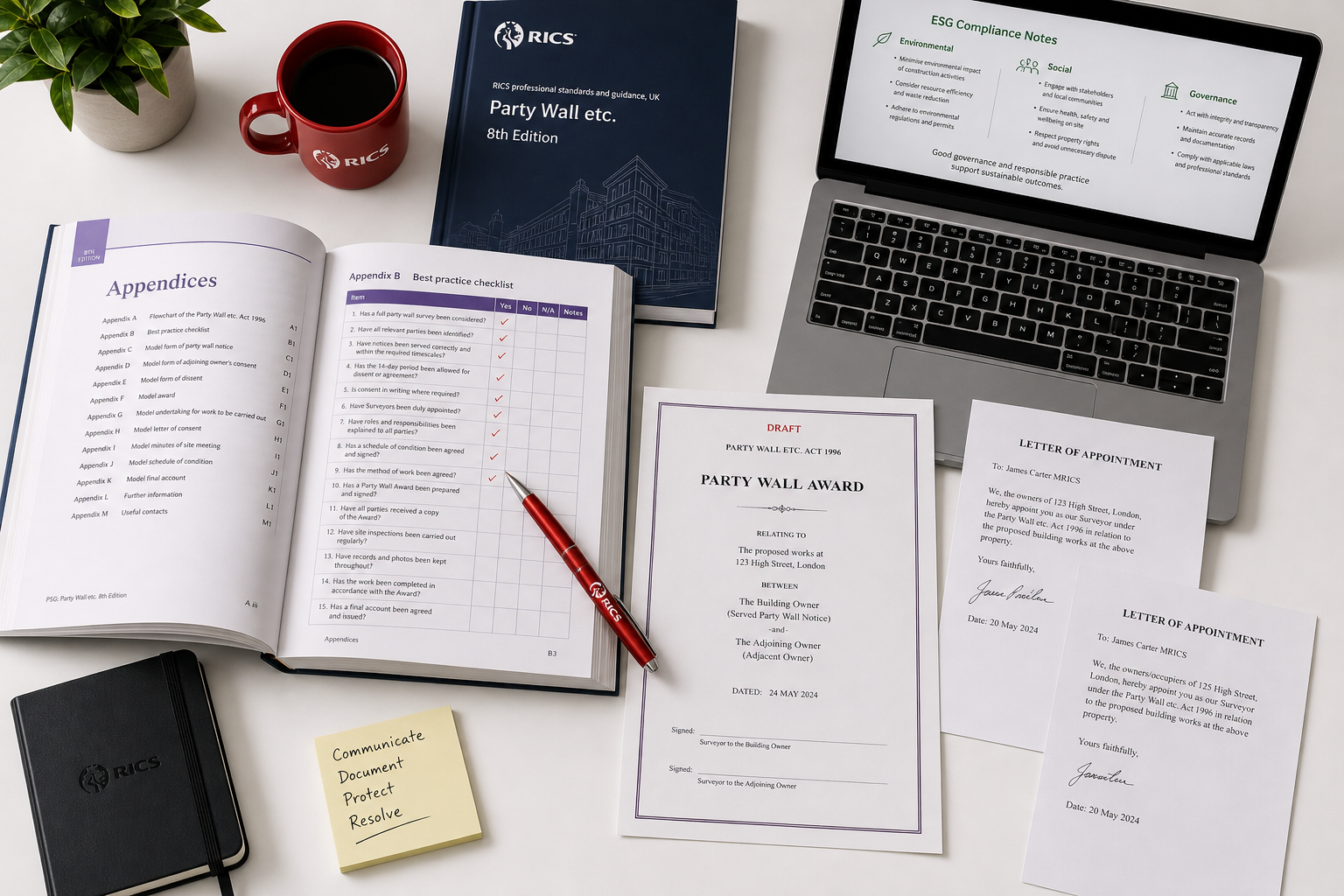
The inclusion of ESG (Environmental, Social, and Governance) considerations in party wall guidance is new territory for the profession. The 8th edition does not impose rigid ESG obligations — the Party Wall etc. Act 1996 itself has no environmental provisions — but it does encourage surveyors to:
- Flag sustainability issues observed during schedule of condition inspections, such as inadequate insulation at party wall junctions.
- Reference relevant planning conditions that carry environmental requirements when drafting awards.
- Document material choices proposed by the building owner where these may affect the adjoining owner’s property in terms of thermal or acoustic performance.
This is particularly relevant for projects involving shared structural elements. Surveyors working on projects with shared chimneys and chimney stacks should be especially attentive, as these structures frequently intersect with energy efficiency and heritage considerations.
ESG Checklist for Party Wall Awards (2026)
✅ Has the building owner’s proposed specification been reviewed for material sustainability?
✅ Are any planning conditions with environmental requirements referenced in the award?
✅ Has the schedule of condition noted the thermal and acoustic performance of the party wall?
✅ Are waste management and working hours conditions included to address social impact on the adjoining owner?
✅ Has the surveyor documented any ESG-related observations separately for their file?
Immediate 2026 Implementation: What Surveyors Must Do Now
The RICS 8th Edition Party Wall Guidance: Post-Consultation Changes and Immediate 2026 Implementation for Surveyors carries an expectation of immediate adoption following the close of the April–May 2026 consultation [1][2]. There is no extended grace period. Surveyors who continue to use 7th edition templates or outdated procedures after the guidance is finalised risk:
- Professional conduct complaints to RICS.
- Awards being challenged as procedurally deficient.
- Personal liability exposure where non-compliance causes loss to a party.
Pre-June 2026 Compliance Checklist for Surveyors
📋 Notice Templates
- Update all notice templates to reflect 8th edition service requirements.
- Ensure notices for excavation works comply with updated proximity rules — see the notice for excavation near a neighbour guidance for current requirements.
- Confirm that notices are being served by a method that satisfies the Act’s valid service provisions.
📋 Letters of Appointment
- Replace all existing appointment letters with the 8th edition revised versions.
- Ensure the letter explicitly states the statutory and personal nature of the appointment [1].
- Include fee disclosure in the appointment letter, not just in a separate fee proposal.
📋 Award Drafting
- Use the updated draft award from the 8th edition appendices as the base document.
- Include ESG checkpoint clauses where relevant to the works.
- Ensure the Third Surveyor’s details are correctly recorded and the referral mechanism is clearly explained.
📋 Fee Practices
- Review all fee arrangements for compliance with the 8th edition’s transparency requirements.
- Ensure any referral arrangements are disclosed in writing to the appointing party.
- Consider how party wall costs are communicated to clients to align with the new public engagement guidance.
📋 File Management
- Retain a copy of the 8th edition guidance on file for reference during each instruction.
- Document any ESG observations made during schedule of condition inspections.
- Record all communications with adjoining owners to demonstrate compliance with the public engagement guidance.
The Third Surveyor: Clarified Role and Referral Criteria
One of the more practically significant updates in the 8th edition concerns the Third Surveyor. The revised guidance provides clearer criteria for when referral to the Third Surveyor is not just permitted but required. Key scenarios include:
- Where the two appointed surveyors cannot agree on a matter within a reasonable timeframe.
- Where one surveyor believes the other is acting in a manner that compromises the statutory process.
- Where a party seeks to use the Third Surveyor to resolve a dispute about fees.
The guidance also addresses the selection of the Third Surveyor, reinforcing that selection should occur at the outset of the appointment, not when a dispute arises. This prevents delay and ensures the Third Surveyor is already familiar with the project context.
Surveyors who are unclear on the full scope of what constitutes a party wall dispute should review this alongside the 8th edition’s updated Third Surveyor provisions.
Notices, Awards, and the Consequences of Non-Compliance
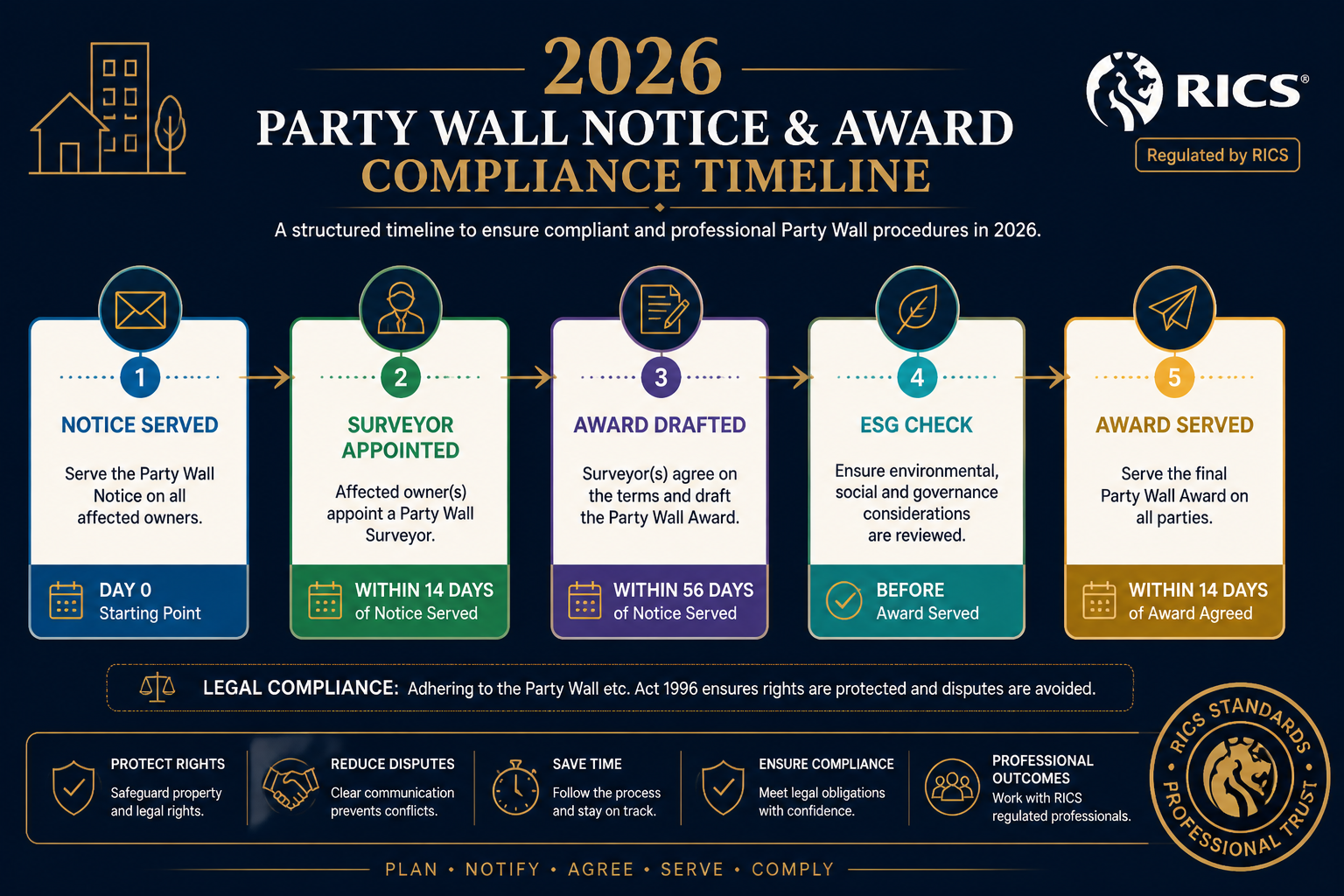
The 8th edition’s updated guidance on service of notices is particularly important given the volume of procedural errors identified in recent years. Key points include:
- Notices must be served on all adjoining owners, including those with a legal interest in the property (not just the occupier).
- The method of service must be documented and must comply with the Act’s requirements.
- Where a notice has not been served correctly, the entire process may need to restart — a costly and time-consuming outcome.
For projects where a party wall notice was never served at all, the consequences can be severe. The implications of no party wall agreement and the risks associated with a party wall notice not being served are well-documented, and the 8th edition strengthens the guidance around prevention.
The Three-Metre Rule: Updated Context
The 8th edition also provides updated context around excavation works and proximity to neighbouring structures. Surveyors must be confident in applying the three-metre rule correctly, particularly as basement and foundation works become more common in urban areas where plot sizes are constrained.
RICS 8th Edition Party Wall Guidance: Post-Consultation Changes and Immediate 2026 Implementation — Sector-Wide Impact
The impact of the 8th edition extends beyond individual surveyors. The guidance has implications for:
- Developers and building owners — who must understand that their surveyor’s statutory independence cannot be overridden by contractual instruction.
- Adjoining owners — who benefit from stronger public engagement requirements and more transparent award drafting.
- Solicitors and conveyancers — who advise on property transactions where party wall matters are unresolved.
- Insurers — who underwrite professional indemnity policies for surveyors and will likely reference 8th edition compliance in future policy assessments.
For surveyors working across London and the South East — where party wall matters are particularly frequent given the density of terraced and semi-detached housing — the practical workload of updating templates and procedures is real but manageable with a structured approach. Chartered surveyors in London and central London are likely to feel the immediate pressure of these changes most acutely.
Conclusion: Act Before the Deadline 🏁
The RICS 8th Edition Party Wall Guidance: Post-Consultation Changes and Immediate 2026 Implementation for Surveyors is not a distant regulatory update — it is an immediate professional obligation. The April–May 2026 consultation has closed, and the profession is expected to adopt the revised standards without delay [1][2].
Actionable next steps for surveyors:
- Download the finalised 8th edition from the RICS website as soon as it is published and review all appendices.
- Audit your current templates — notices, letters of appointment, and award drafts — against the 8th edition requirements.
- Update fee disclosure practices to meet the new transparency requirements before serving any further notices.
- Train your team on the statutory independence principle and the updated Third Surveyor referral criteria.
- Incorporate ESG checkpoint clauses into your standard award template.
- Document everything — the 8th edition’s emphasis on public engagement and conduct means a clear paper trail is more important than ever.
The profession has been given clear direction. Surveyors who move quickly to implement these changes will not only protect themselves from liability — they will deliver a demonstrably higher standard of service to the parties who depend on them.
References
[1] Rics Launches Consultation On Updated Party Wall Practice Guidance – rics.org
[2] Rics Consults On Updated Party Wall Practice Guidance – lexisnexis.co.uk
Related services from Canterbury Surveyors
- Party wall surveyors in Canterbury & Kent
- Building expert witness surveyors
- Structural engineers in Canterbury & Kent
Get a fixed-fee quote or call 0204 579 8270.