

A property that has undergone underpinning for subsidence can sell for between 5% and 20% less than an equivalent unaffected home — even when the structural repairs are certified complete and carry a full guarantee. That gap between repair cost and restored market value is precisely where the discipline of re-valuing post-remedial works becomes critical, and where many surveyors still lack a consistent framework.
This article sets out a structured approach to re-valuing post-remedial works: how surveyors should treat historic defects once repairs are completed, covering the assessment of evidence, residual stigma, insurance implications, and the documentation of professional assumptions.
Key Takeaways
- Completed repairs do not automatically restore a property to its pre-defect market value; residual stigma must be quantified separately.
- Surveyors should conduct dual "as-is" and "as-repaired" assessments to map the full value trajectory of a remediated property.
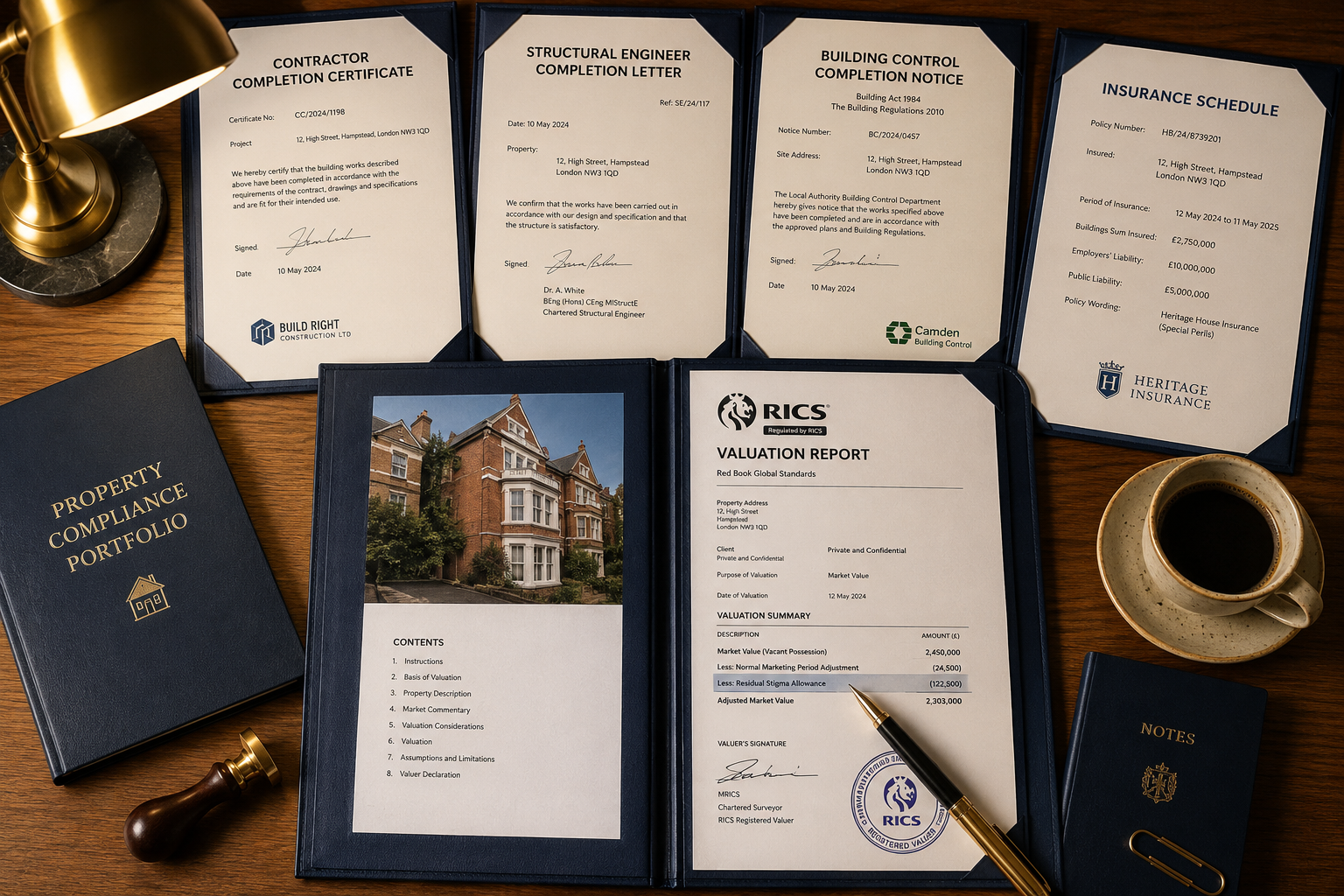
- Robust documentation — including contractor certificates, structural engineer sign-offs, and building control notices — is essential to support any post-remedial valuation.
- Diminution in value (DIV) analysis remains the most defensible method for quantifying the gap between repair cost and market value recovery.
- RICS Valuation Global Standards require that all material assumptions about a property's condition are explicitly stated in the valuation report.
Why Completed Repairs Do Not Automatically Restore Full Value
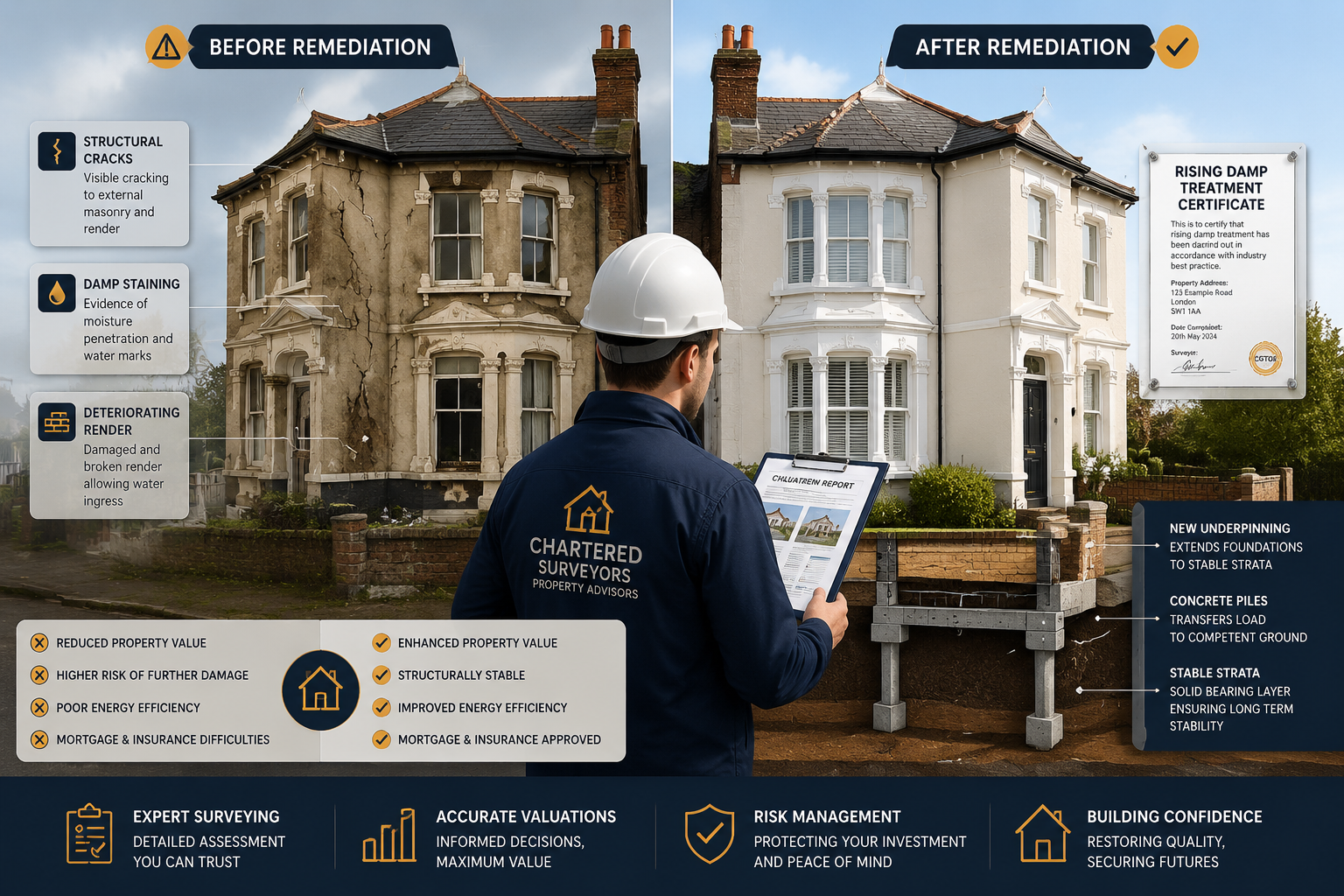
The instinct among many buyers, sellers, and even some practitioners is to treat a property with a completion certificate for remedial works as equivalent to one that never had a defect. That assumption is commercially and professionally dangerous.
Historic defects leave a trace in three distinct ways:
- Market perception — Buyers who discover a property has a history of subsidence, rising damp, or structural movement often discount their offer or withdraw entirely, regardless of the quality of the repair.
- Insurability — Insurers frequently impose higher premiums, exclusion clauses, or reduced cover on properties with a documented history of structural problems, even post-repair.
- Resale risk — A buyer who purchases a remediated property must disclose its history to future buyers, perpetuating the stigma through successive transactions.
These three factors mean that re-valuing post-remedial works requires surveyors to treat historic defects once repairs are completed as a distinct valuation exercise — not simply a re-inspection to confirm the work is done.
"The cost of repair and the diminution in value are two separate and independent measures. Conflating them is one of the most common errors in post-remedial valuation practice."
This distinction is well-established in case law and professional guidance. Courts have consistently held that a claimant is entitled to recover both the cost of repair and any residual loss in market value that persists after those repairs are complete [1].
The Core Framework: As-Is and As-Repaired Assessments
A structured approach to re-valuing post-remedial works begins with a dual appraisal methodology. Surveyors should produce two distinct valuations:
The As-Is Valuation
This reflects the property's current open market value in its actual condition at the date of inspection. If repairs are still in progress, this figure captures the discounted value of a property with outstanding defects. If repairs are complete but documentation is incomplete, the as-is figure will reflect that uncertainty.
The As-Repaired Valuation
This projects the property's value assuming all remedial works have been completed to the required standard, all documentation is in order, and a reasonable purchaser has full knowledge of the repair history [4]. Critically, this is not the same as the value of an equivalent property with no defect history. The as-repaired figure must still account for residual stigma where market evidence supports a discount.
Comparison table: Key differences between the two assessments
| Factor | As-Is Valuation | As-Repaired Valuation |
|---|---|---|
| Condition assumed | Current, including defects | Post-repair, fully certified |
| Documentation required | Schedule of outstanding works | Completion certificates, guarantees |
| Stigma discount applied | Typically larger | Residual stigma only |
| Primary use | Insurance claims, litigation | Mortgage lending, sale pricing |
| RICS basis of value | Market Value | Market Value (subject to assumptions) |
This dual approach is particularly important for RICS building surveys where the surveyor must advise a buyer on both current condition and the likely impact of disclosed historic defects on long-term value.
Quantifying Residual Stigma: The Diminution in Value Method
Residual stigma is the persistent discount that the market applies to a property even after technically successful remediation. It is not speculative — it is measurable through comparable evidence and professional judgment.
How to Calculate Diminution in Value Post-Remediation
The diminution in value (DIV) approach compares the market value of the subject property in its remediated state against the market value of a directly comparable property with no defect history [1]. The difference, expressed as a percentage or absolute figure, represents the stigma-related loss.
Steps in a DIV assessment for post-remedial works:
- Establish the unaffected comparable value using recent sales of similar properties with no defect history in the same locality.
- Assess the remediated property's market value based on available evidence, buyer sentiment, and any disclosed sale prices of similar remediated properties.
- Calculate the gap between step one and step two.
- Document the assumptions underpinning each figure, including the age and quality of the repair, the nature of the original defect, and the availability of guarantees.
For properties with a history of subsidence, the stigma discount in the UK market typically ranges from 5% to 25%, depending on the severity of the original movement, the type of underpinning used, and the local market's familiarity with the issue. Damp-related defects generally attract a smaller but still material discount of 3% to 10% post-remediation.
Surveyors undertaking this work should consider commissioning or reviewing a specialist defect survey to confirm the technical adequacy of the repair before forming a view on residual stigma.

Evidence of Successful Repair: What Surveyors Must Verify
A post-remedial valuation is only as reliable as the evidence underpinning it. Surveyors should not assume that a property has been successfully repaired simply because the visible signs of a defect have been addressed. A structured evidence review is essential [5].
Documentation Checklist for Post-Remedial Valuations
Structural defects (subsidence, settlement, cracking):
- Structural engineer's completion report confirming the cause of movement has been addressed
- Building control completion notice for any underpinning or structural works
- Specialist contractor's guarantee (typically 10 to 25 years for underpinning)
- Monitoring data showing stabilisation, where movement was ongoing
- Insurance-backed guarantee (IBG) from a recognised provider
Damp and timber defects:
- Damp-proofing contractor's guarantee (typically 20 to 30 years)
- Evidence of chemical damp proof course installation or membrane specification
- Timber treatment certificates for any dry rot or wet rot remediation
- Building regulation compliance where structural timbers were replaced
Drainage and ground-related defects:
- CCTV drainage survey report confirming remediation of root intrusion, collapse, or misalignment
- Ground investigation report where contamination or instability was identified
Where documentation is missing or incomplete, the surveyor must either qualify the valuation accordingly or recommend that the client obtain the missing evidence before proceeding. An incomplete documentation trail is itself a valuation risk that must be reflected in the figures [5].
For properties where drainage was identified as a contributing factor to structural movement, a drainage survey should form part of the post-remedial evidence base.
Insurance Implications in Post-Remedial Valuations
Insurance is one of the most practically significant consequences of a property's defect history, and it directly affects market value. Surveyors conducting re-valuing post-remedial works assessments must address insurance explicitly, not as a footnote.
Key Insurance Considerations
Buildings insurance availability: Some mainstream insurers will decline to quote on properties with a subsidence history, regardless of the quality of the repair. Others will quote but with a subsidence exclusion or a materially higher excess. Either outcome reduces the pool of mortgage-eligible buyers and therefore suppresses market value.
Reinstatement cost valuation: Where remedial works have altered the property's construction — for example, the introduction of a new drainage system, underpinning, or replacement structural elements — the reinstatement cost for insurance purposes may have changed. Surveyors should ensure that any reinstatement cost valuation reflects the property's current specification, not its pre-repair condition.
Insurance-backed guarantees: The existence of a valid IBG from a recognised provider (such as NHBC, LABC Warranty, or a specialist provider) can meaningfully reduce the insurance-related stigma discount, as it provides the buyer with a form of protection that partially substitutes for standard buildings insurance cover on the remediated elements.
Surveyors should note that the absence of an IBG where one would normally be expected is itself a negative valuation factor, as it signals either poor-quality remediation or a contractor who could not obtain the necessary backing.
Documenting Assumptions: The RICS Standard and Professional Liability
The most common source of professional negligence claims in post-remedial valuation work is not an incorrect figure — it is an undocumented assumption. RICS Valuation Global Standards (the Red Book) require that all special assumptions and material assumptions are clearly stated, explained, and agreed with the client before the valuation is issued [2].
How to Document Assumptions Correctly
State what you have relied upon. If the valuation assumes that a structural engineer's completion report confirms successful underpinning, name the report, its date, and its author. Do not simply state "repairs have been completed."
State what you have not verified. If drainage records were unavailable, or if the IBG could not be located, the valuation must say so and explain how this uncertainty has been reflected in the figure.
State the basis of the stigma allowance. Identify the comparable evidence used, the percentage discount applied, and the rationale for that figure. Where no direct comparables exist, explain the methodology used to derive the estimate.
Agree special assumptions in writing. Where the valuation is conducted on the basis that works will be completed to a specified standard, this must be agreed with the client in writing before the report is issued, not added as a caveat after the fact [2].
Surveyors who are instructed in contentious post-remedial cases — for example, where a buyer and seller disagree on the residual value impact of a historic defect — may be required to produce a formal expert witness report. The standards for such reports are distinct from those for standard valuation work, and surveyors should ensure they are familiar with the requirements before accepting such instructions. Detailed guidance on this type of instruction is available from specialists in expert witness surveying.
Heritage Properties: A Special Case in Post-Remedial Valuation
Listed buildings and properties within conservation areas present additional complexity when re-valuing post-remedial works. The nature of permissible repairs is constrained by heritage legislation, and the use of non-traditional materials or methods — even where technically superior — can itself reduce value by compromising a property's heritage integrity [3].
Specific considerations for heritage assets:
- Repairs using modern materials (cement render, chemical damp-proof courses, modern insulation) may be inappropriate for listed buildings and can trigger enforcement action, which must be disclosed in the valuation.
- Traditional lime-based repairs, while more sympathetic to historic fabric, may not carry the same guarantees as modern systems, affecting the insurability and stigma discount analysis.
- The heritage premium that a listed building commands in the market may be partially or fully eroded if remedial works have altered its character or authenticity.
Surveyors valuing listed buildings post-remediation should consult Historic England guidance and, where appropriate, seek input from a conservation architect before finalising their assumptions [3].
Practical Steps for Surveyors: A Post-Remedial Valuation Protocol
Drawing together the frameworks above, the following protocol reflects best practice for re-valuing post-remedial works and treating historic defects once repairs are completed.
Step 1 — Obtain and review all remediation documentation before forming any view on value. Identify gaps and request missing items from the client or their solicitor.
Step 2 — Conduct a physical inspection of the remediated areas, noting the visible quality of the repair, any signs of recurrence, and any areas that could not be inspected.
Step 3 — Establish the unaffected comparable value using recent, local sales evidence for properties with no defect history.
Step 4 — Assess residual stigma using market evidence, professional judgment, and any available data on sales of similar remediated properties in the area.
Step 5 — Address insurance explicitly, confirming the availability of buildings insurance and the existence of any IBG, and reflecting the insurance position in the valuation figure.
Step 6 — Document all assumptions in accordance with RICS Red Book requirements, distinguishing between material assumptions (facts relied upon) and special assumptions (hypothetical conditions).
Step 7 — Issue the report with a clear narrative explaining the relationship between the repair history, the current condition, the stigma discount applied, and the resulting market value figure.
For buyers seeking an initial assessment of a property's condition before commissioning a full post-remedial valuation, a homebuyer survey can provide a useful starting point, though it will not substitute for the more detailed analysis described above.
Surveyors working across the South East and London — areas with high concentrations of Victorian and Edwardian housing stock where subsidence and damp are endemic — will find that a consistent post-remedial framework is particularly valuable. Teams covering areas such as Surrey and South East London regularly encounter properties where the repair history is the single most significant valuation variable.
Conclusion
Re-valuing post-remedial works — and treating historic defects correctly once repairs are completed — is one of the most technically demanding tasks a surveyor undertakes. The repair itself does not close the valuation question; it opens a new one. What remains after the scaffolding comes down is a property carrying a documented history, a residual market stigma, and a set of insurance implications that must all be reflected in a defensible, well-documented valuation.
Actionable next steps for surveyors and property professionals in 2026:
- Adopt a formal dual assessment (as-is and as-repaired) as standard practice for all instructions involving a disclosed repair history.
- Build a documentation checklist into your instruction acceptance process so that missing certificates are identified before the inspection, not after.
- Develop a local comparable database for remediated properties in your primary market area to support evidence-based stigma discounts.
- Review your report templates to ensure that material assumptions and special assumptions are clearly separated and meet current RICS Red Book requirements.
- Where instructions involve litigation or disputed claims, confirm your competence as an expert witness before accepting the instruction.
A thorough, evidence-based approach to post-remedial valuation protects clients, supports market confidence, and reduces the professional liability risk that comes with undocumented assumptions. The framework exists — applying it consistently is the professional obligation.
References
[1] Diminution In Value Calculations Expert Witness Reports For Property Damage Claims – https://www.canterburysurveyors.com/blog/diminution-in-value-calculations-expert-witness-reports-for-property-damage-claims/?utm_source=openai
[2] Rics Valuation – https://hardingsurveyors.co.uk/valuations/rics-valuation?utm_source=openai
[3] Valuing Heritage Assets – https://ww3.rics.org/uk/en/journals/property-journal/valuing-heritage-assets.html?utm_source=openai
[4] As Is As Repaired Appraisals – https://bostonappraisal.com/as-is-as-repaired-appraisals/?utm_source=openai
[5] Subject To Appraisals Repairs Re Inspections And Conditions – https://legalclarity.org/subject-to-appraisals-repairs-re-inspections-and-conditions/?utm_source=openai