

Residential extension applications in England and Wales surged by over 18% in the first quarter of 2026 as the housing market recovery gathered pace — and with that surge came a sharp rise in Party Wall Act disputes, many of which were entirely avoidable. For homeowners planning to extend, understanding Party Wall Surveys for Residential Extensions: Notice Requirements, Timeline Management, and Neighbor Relations in 2026 is no longer optional. It is the difference between a project that runs smoothly and one that stalls in legal wrangling before a single brick is laid.
The Party Wall etc. Act 1996 governs how building owners must notify and protect their neighbours when carrying out works that affect shared structures or boundaries. Despite being nearly three decades old, the Act remains widely misunderstood. Homeowners frequently underestimate notice periods, serve incomplete notices, or skip the process altogether — each of which carries serious legal and financial consequences [1].
Key Takeaways
- Three distinct notice types apply to residential extensions, each with different minimum notice periods ranging from one to two months.
- A valid party wall notice must include specific mandatory information; an incomplete notice has no legal standing.
- Neighbours have 14 days to respond to a notice; failure to respond triggers a deemed dispute requiring surveyor involvement.
- A party wall agreement (known as an Award) protects both parties and is not an obstacle — it is a safeguard.
- Early, transparent communication with neighbours reduces the risk of formal disputes and project delays.
Understanding the Three Notice Types Under the Party Wall Act
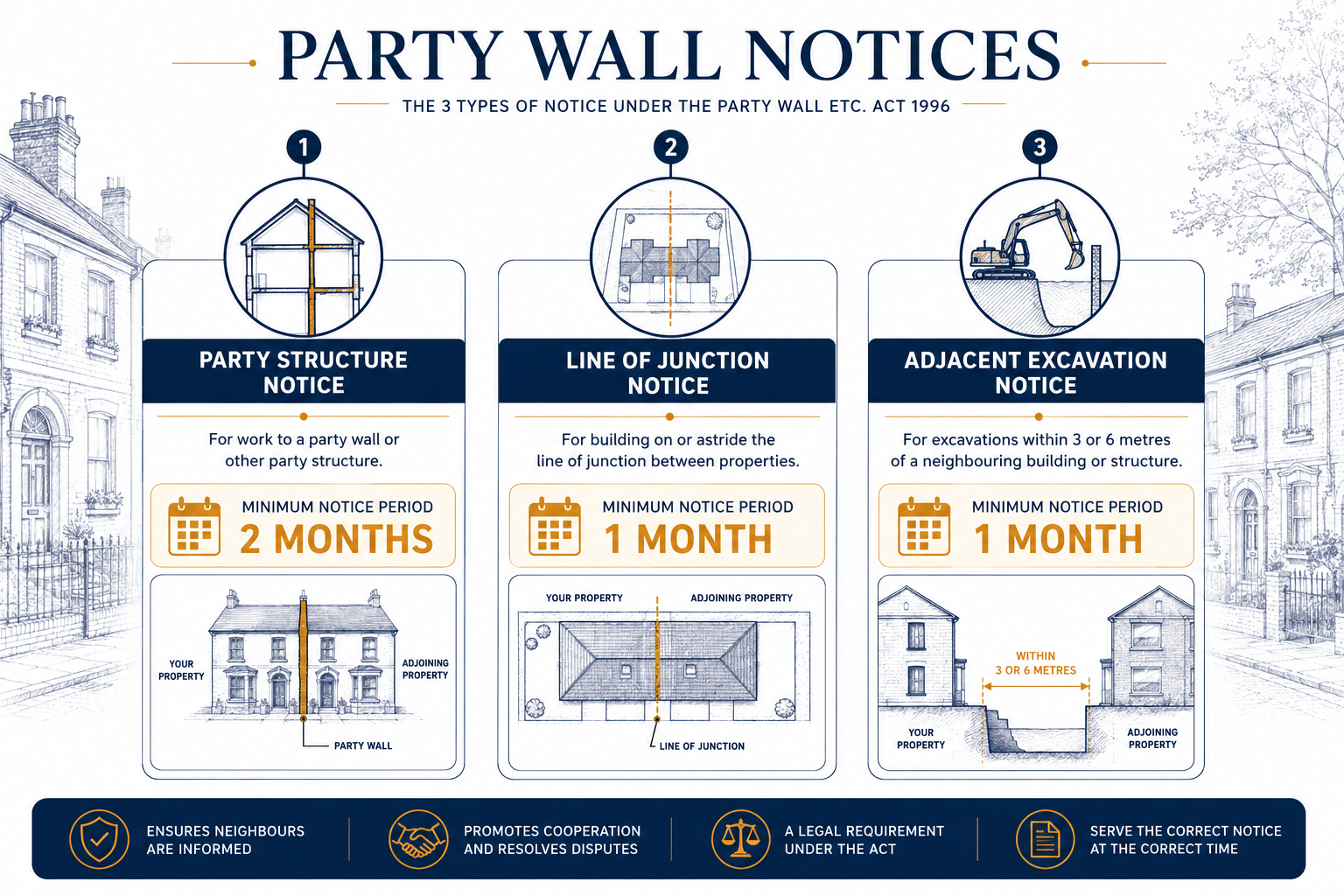
The foundation of Party Wall Surveys for Residential Extensions: Notice Requirements, Timeline Management, and Neighbor Relations in 2026 lies in knowing which notice applies to which type of work. The Act defines three distinct notice categories, and serving the wrong one — or none at all — can invalidate the entire process [1].
Party Structure Notice (Section 2)
A Party Structure Notice is required whenever a building owner intends to carry out work directly on an existing party wall. Common examples relevant to residential extensions include:
- Cutting into the party wall to insert steel beams or padstones
- Raising or underpinning the party wall
- Removing chimney breasts that form part of the shared structure
- Adding or removing flashings
This notice must be served at least two months before the proposed start date of the works. It is the most commonly required notice for rear and side extensions in terraced and semi-detached properties [1].
For guidance on how insulation in a party wall interacts with these obligations, it is worth reviewing the specific requirements before serving notice.
Line of Junction Notice (Section 1)
Where a building owner intends to build a new wall at or astride the boundary line between two properties, a Line of Junction Notice applies. This is relevant when an extension involves constructing a new wall on or immediately adjacent to the shared boundary. The required notice period here is one month [1].
Adjacent Excavation Notice (Section 6)
This notice is triggered when excavation work is planned within a certain distance of a neighbouring structure. The rules are distance and depth dependent:
| Distance from Neighbour's Structure | Depth Trigger |
|---|---|
| Within 3 metres | Excavation deeper than the neighbour's foundations |
| Within 6 metres | Excavation meeting a specific depth/angle criterion |
A one-month notice period applies, and the notice must be accompanied by plans showing the proposed depth and proximity to the adjoining structure [2]. For a detailed explanation of how these proximity rules work in practice, the three-metre rule for party walls is an important reference point. Similarly, homeowners planning groundworks should read about the requirements for notice for excavation near a neighbour.
What Must a Valid Notice Contain?
Regardless of which notice type applies, the Act specifies mandatory content. A notice that omits any of the following has no legal standing [2]:
- Full name and address of the building owner serving the notice
- Address of the property where the works will take place
- Clear description of the proposed works, sufficient for the adjoining owner to understand what is planned
- Proposed start date of the works
- For Section 6 notices: plans and sections showing the depth of excavation and its proximity to the neighbouring structure
Notices must be served in writing. Acceptable methods include:
- Personal delivery to the adjoining owner
- Post (recorded delivery is strongly recommended)
- Email — but only where the adjoining owner has previously given written consent to receive notices electronically [2]
"Serving a defective notice is legally equivalent to serving no notice at all. The building owner who skips this step or gets it wrong faces injunctions, project delays, and potential liability for any damage caused." [3]
Timeline Management for Party Wall Surveys for Residential Extensions: Notice Requirements, Timeline Management, and Neighbor Relations in 2026
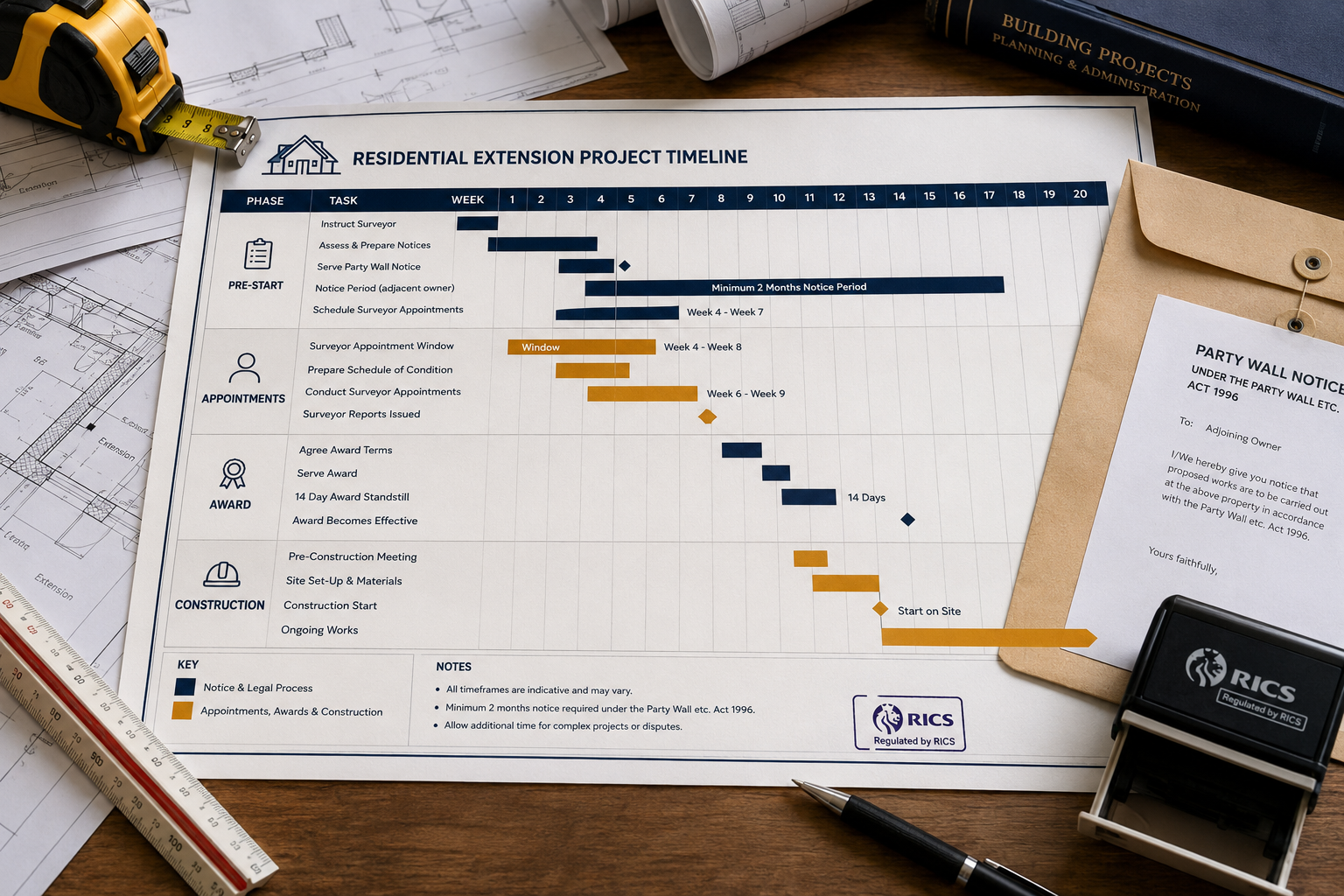
One of the most damaging mistakes homeowners make is treating the party wall process as something to deal with after planning permission is granted. In reality, the party wall timeline must run in parallel with — and often ahead of — the planning and construction programme [4].
The Response Window and What Happens Next
Once a valid notice is served, the adjoining owner has 14 days to respond. Three outcomes are possible:
- Consent in writing — Work can proceed under the terms of the consent. This is the fastest outcome and requires no surveyor involvement.
- Counter-notice — The adjoining owner may request modifications to the proposed works. The building owner then has 14 days to respond.
- Dissent (or no response) — If the adjoining owner dissents, or simply does not respond within 14 days, a dispute is deemed to have arisen under the Act. This triggers the appointment of a party wall surveyor [3].
Surveyor Appointment and the Party Wall Award
When a dispute is deemed to exist, both parties must appoint surveyors. There are two options:
- Each party appoints their own surveyor (the most common arrangement)
- Both parties agree to appoint a single agreed surveyor
The surveyors then prepare a Party Wall Award — a legally binding document that sets out the rights and responsibilities of both parties, the permitted scope of works, working hours, and provisions for making good any damage [5].
The Award process typically takes four to eight weeks from surveyor appointment, though complex projects can take longer. This timeline must be factored into the overall construction programme from day one.
A Realistic Party Wall Timeline for a Rear Extension
| Stage | Typical Duration |
|---|---|
| Serve Party Structure Notice | Day 0 |
| Adjoining owner response window | 14 days |
| Surveyor appointment (if dispute) | 1-2 weeks |
| Schedule of condition survey | 1-2 weeks |
| Party Wall Award drafted and agreed | 3-6 weeks |
| Construction permitted to begin | After Award served |
Understanding party wall costs at the outset helps homeowners budget accurately for surveyor fees, which are typically paid by the building owner [4].
Consequences of Failing to Serve Notice
Proceeding without serving the correct notice is a serious legal risk. Adjoining owners can apply to the courts for an injunction to halt works. They can also seek compensation for any damage caused, without the protection that a properly executed Award would have provided for the building owner. Detailed information on the risks of party wall notice not being served outlines the full range of legal consequences [4].

Neighbour Relations: The Human Side of Party Wall Surveys for Residential Extensions: Notice Requirements, Timeline Management, and Neighbor Relations in 2026
The legal framework exists to protect both parties, but the practical reality is that most party wall disputes arise not from genuine disagreement about the works themselves, but from poor communication and a perceived lack of respect [6]. In 2026, with extension activity at elevated levels, maintaining positive neighbour relations is both a legal and a practical priority.
Talk Before You Serve
The single most effective step a building owner can take is to speak with their neighbour before serving any formal notice. A brief, honest conversation explaining what is planned, why, and for how long, can transform a neighbour from an anxious recipient of legal paperwork into a cooperative participant in the process [6].
Key points to cover in that initial conversation:
- What the extension involves and how it will affect the shared wall or boundary
- The likely construction timeline and working hours
- How dust, noise, and access will be managed
- The purpose of the party wall notice and why it is a legal requirement, not a threat
The Schedule of Condition: Protecting Both Parties
A schedule of condition report is a photographic and written record of the adjoining property's condition before works begin. It is one of the most important tools for preserving good neighbour relations because it provides an objective baseline if any damage claim arises later.
Without a schedule of condition, disputes about whether a crack existed before or after construction can become deeply personal and adversarial. With one in place, the facts speak for themselves. For leasehold properties, the specific requirements around a schedule of condition for leasehold properties add an additional layer of consideration.
When Disputes Do Arise
Even with the best intentions, disputes can occur. Understanding what constitutes a party wall dispute and the formal resolution process helps both parties approach the situation constructively rather than confrontationally.
The surveyor-led Award process is specifically designed to be proportionate and fair. It is not a court proceeding. Both parties' interests are considered, and the Award is legally binding on both sides. Homeowners who resist the process or attempt to bypass it invariably create larger problems than those they sought to avoid [3].
Practical Tips for Maintaining Good Relations During Construction
- Provide neighbours with a written construction programme so they know when the noisiest or most disruptive phases will occur
- Nominate a single point of contact on site for the neighbour to raise concerns
- Respond promptly to any concerns raised — delays in communication escalate minor issues into formal complaints
- Keep the site tidy and minimise dust and debris affecting the adjoining property
- Notify neighbours in advance of any deviation from the agreed programme
Conclusion
As residential extension activity continues to rise through 2026, the party wall process demands the same level of planning attention as design, planning permission, and procurement. Serving the correct notice type, meeting the required notice periods, and engaging professionally with neighbours are not bureaucratic hurdles — they are the foundations of a legally protected, dispute-free project.
Actionable next steps for homeowners planning an extension in 2026:
- Identify which notice types apply to your specific works before approaching a designer or contractor.
- Build the party wall timeline into your overall project programme from the outset — do not treat it as an afterthought.
- Speak with your neighbours before serving formal notice; transparency at this stage prevents the vast majority of disputes.
- Instruct a qualified RICS party wall surveyor early, particularly if the works are complex or the adjoining owner has expressed concerns.
- Commission a schedule of condition survey before works begin, regardless of whether the adjoining owner consents or dissents.
The Party Wall etc. Act 1996 exists to protect everyone involved. Used correctly, it is a practical framework that enables construction to proceed with confidence and clarity on all sides.
References
[1] Party Wall Notice Explained – https://www.surveyofpartywall.co.uk/party-wall-notice-explained/?utm_source=openai
[2] Party Wall Notice – https://ourpartywall.co.uk/guides/party-wall-notice?utm_source=openai
[3] Party Wall Notice Requirements Service And Counter Notices – https://legalclarity.org/party-wall-notice-requirements-service-and-counter-notices/?utm_source=openai
[4] Party Wall Act Compliance During The 2026 Housing Uptick Managing Neighbor Disputes As Extension And Renovation Projects Surge – https://www.canterburysurveyors.com/blog/party-wall-act-compliance-during-the-2026-housing-uptick-managing-neighbor-disputes-as-extension-and-renovation-projects-surge/?utm_source=openai
[5] Party Wall Notices – https://plansmadeeasy.org/party-wall-notices/?utm_source=openai
[6] Party Wall Notice Essentials For 2026 Home Extensions Free Templates Timelines And Neighbour Consent Strategies – https://kingstonsurveyors.com/party-wall-notice-essentials-for-2026-home-extensions-free-templates-timelines-and-neighbour-consent-strategies/?utm_source=openai