Nearly one in three party wall disputes handled by surveyors in England and Wales involves garden or boundary works — yet most homeowners commissioning landscaping projects have no idea their plans carry legal obligations under the Party Wall etc. Act 1996. A sloped garden, a new terrace, or a retaining wall near the boundary can quietly cross a legal threshold that demands formal notice, surveyor involvement, and documented agreements before a single spade enters the ground.
Understanding Party Wall Risks in Retaining Walls and Garden Works: When Landscaping Projects Trigger Legal Duties is not just useful knowledge for property professionals — it is essential for any homeowner, contractor, or developer planning works near a shared boundary. Getting it wrong can mean injunctions, costly delays, and neighbour disputes that outlast the landscaping itself.
Key Takeaways 📋
- Not all garden walls are covered by the Party Wall Act, but retaining walls and boundary structures often are — and the distinction matters enormously.
- Excavation near neighbouring foundations triggers strict notice requirements under the Act, even when the work appears to be purely cosmetic landscaping.
- The 3-metre and 6-metre rules define when excavation works require formal notice to adjoining owners.
- Failing to serve notice exposes building owners to injunctions, liability for damage, and potential legal costs.
- A schedule of condition recorded before works begin is one of the most effective tools for protecting all parties involved.
What the Party Wall Act Actually Covers in Gardens
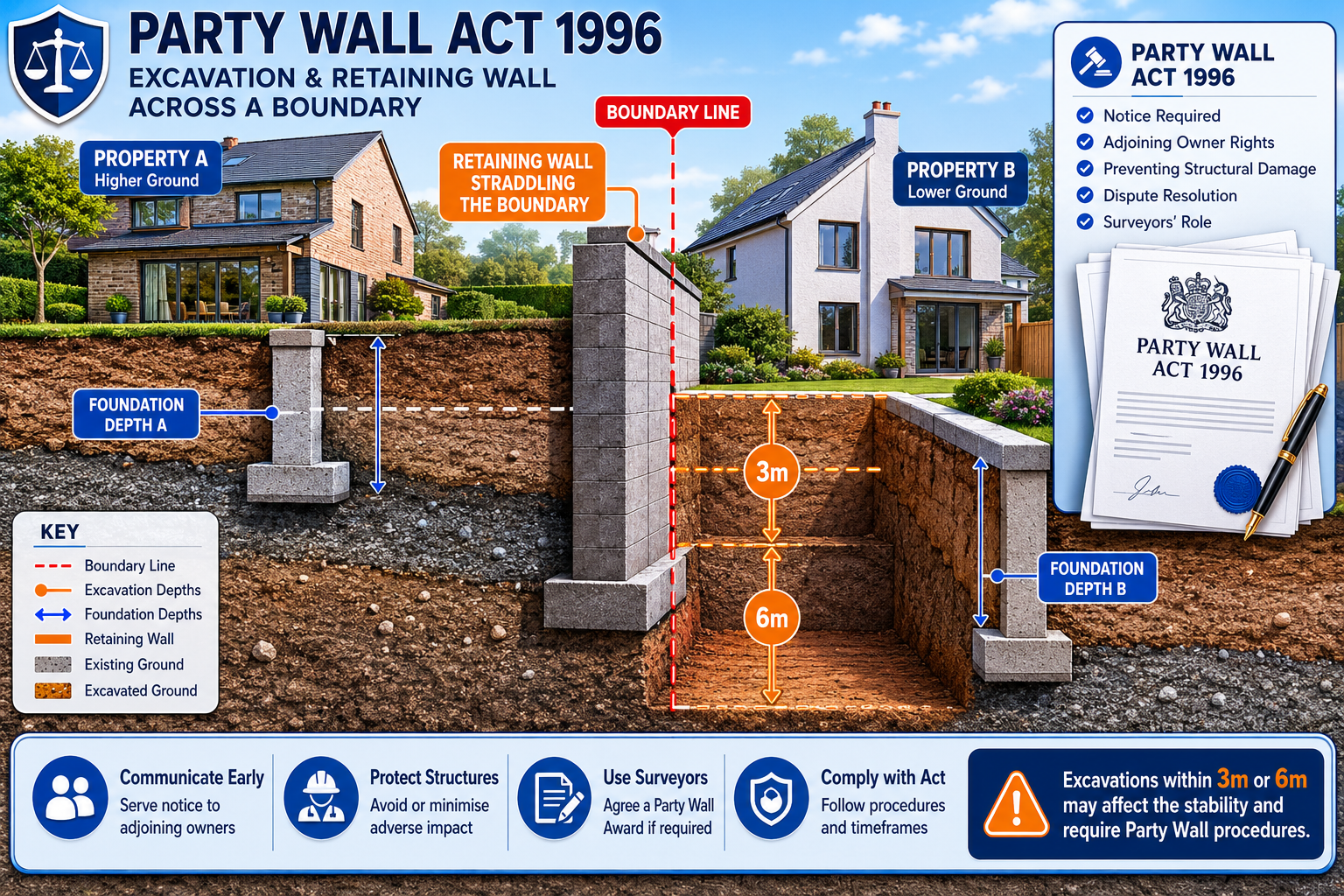
The Party Wall etc. Act 1996 is widely associated with loft conversions and house extensions, but its reach extends well into the garden. Three distinct categories of work fall under the Act's jurisdiction [2]:
- New walls built on the line of junction (the boundary between two properties)
- Works to existing party walls or structures, including cutting into, raising, or underpinning them
- Excavations within specified distances of an adjoining owner's building or structure
Party Fence Walls vs. Ordinary Fences
A critical distinction exists between a party fence wall and a simple garden fence or hedge. Under the Act, a party fence wall is a masonry or brick wall that straddles the boundary and is used by both owners — for example, a garden wall built on the dividing line between two properties [3].
💡 Key distinction: Fences and hedges are not covered by the Party Wall Act. Only masonry walls that sit on or straddle the boundary qualify as party fence walls.
This means that replacing a timber fence with a brick boundary wall automatically triggers the Act's notice requirements — a fact that surprises many homeowners and even some contractors.
When Garden Walls Become Party Structures
| Structure Type | Covered by Act? | Notice Required? |
|---|---|---|
| Timber or panel fence | ❌ No | No |
| Hedge or planted boundary | ❌ No | No |
| Brick/masonry wall on boundary | ✅ Yes | Yes |
| Retaining wall on boundary | ✅ Likely | Yes |
| Retaining wall entirely within one property | ⚠️ Depends on excavation depth | Possibly |
| Garden wall repairs (minor) | ⚠️ Depends on scope | Possibly |
The complexity multiplies when level changes are involved. A retaining wall that sits entirely within one owner's land can still trigger the Act if its construction requires excavation close to a neighbour's foundations [2].
The Grey Zone: Retaining Walls, Level Changes, and Party Wall Risks in Retaining Walls and Garden Works: When Landscaping Projects Trigger Legal Duties
This is where the law becomes genuinely nuanced — and where most disputes originate.
The 3-Metre and 6-Metre Rules Explained
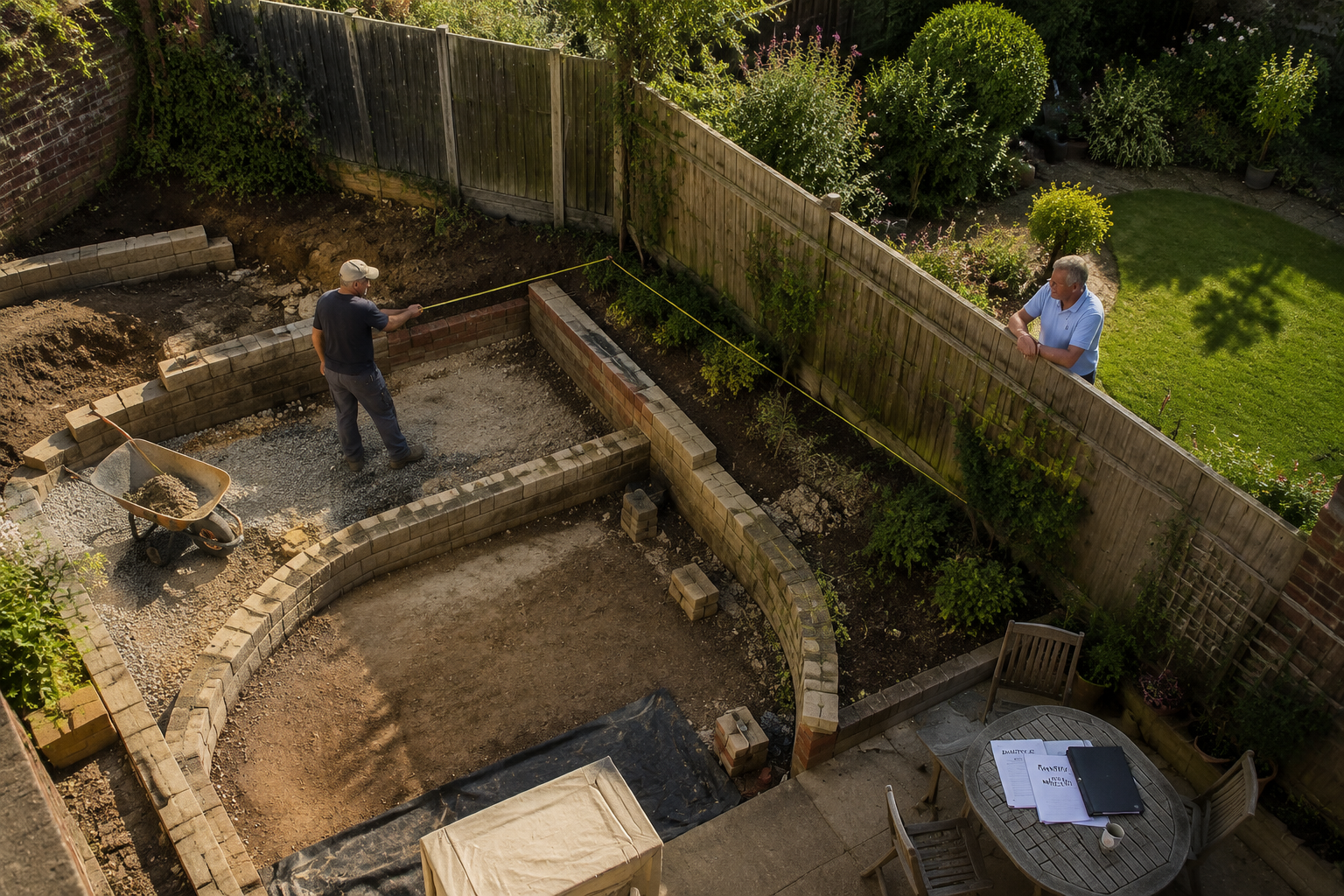
The Act establishes two excavation thresholds that determine when notice must be served on an adjoining owner [2]:
3-Metre Rule: If excavation is planned within 3 metres of an adjoining building or structure, and the excavation will go deeper than the bottom of the neighbour's foundations, a formal notice must be served. For more detail on how this applies in practice, see this guide on what the three-metre rule means for party wall works.
6-Metre Rule: If excavation is planned within 6 metres of an adjoining building, and the excavation intersects a 45-degree line drawn downward from the base of the neighbour's nearest foundation, notice is again required.
These rules apply directly to landscaping projects. Installing a retaining wall to create a raised terrace, digging out a sunken garden, or constructing a basement-level patio can all trigger these thresholds — especially in urban gardens where properties sit close together.
Why Retaining Walls Are Particularly Risky
Retaining walls introduce a unique set of hazards that go beyond ordinary boundary disputes:
- Lateral soil pressure from retained earth can exert significant force on neighbouring structures over time
- Changes in drainage patterns caused by new retaining structures can affect adjacent foundations
- Undermining of existing structures during excavation can cause cracking, subsidence, or collapse [4]
- Height and loading requirements mean that retaining walls holding back more than four feet of unbalanced fill typically require professional engineering review [4]
Retaining walls holding back substantial quantities of earth are not just a party wall matter — they are a structural and safety concern. Property owners have a duty to keep such structures in safe condition, and where a retaining wall sits on or near a shared boundary, both parties may share maintenance responsibilities [5].
For those concerned about the structural implications of excavation near a boundary, a notice for excavation near a neighbour sets out the formal process for protecting all parties.
Terracing, Raised Beds, and Sunken Gardens
Many homeowners assume that because their landscaping plans involve only "garden features," the Party Wall Act does not apply. This assumption is dangerous. Consider these scenarios:
Scenario A: A homeowner in a terraced property wants to create a split-level garden with a 1.2-metre retaining wall running parallel to the boundary, 2 metres from the neighbour's rear extension. If the excavation for the wall's foundations goes deeper than the extension's footings, a formal notice is required.
Scenario B: A property owner wants to lower the ground level of their garden by 600mm to create a sunken seating area. The excavation runs within 3 metres of the neighbour's outbuilding. Again, notice obligations are triggered.
Scenario C: A shared garden wall between two semi-detached properties needs to be raised by 300mm to support a new trellis. This constitutes works to a party fence wall and requires a party wall notice.
Serving Notice, Surveyors, and What Happens When Things Go Wrong
How to Serve a Party Wall Notice Correctly
Before any notifiable work begins, the building owner must serve a written party wall notice on all affected adjoining owners [2]. The notice must include:
- The building owner's name and address
- A description of the proposed works
- The intended start date
- A statement that the notice is served under the Party Wall etc. Act 1996
Notice periods vary depending on the type of work:
| Work Type | Minimum Notice Period |
|---|---|
| Works to an existing party wall | 2 months |
| New wall on line of junction | 1 month |
| Excavation near neighbouring foundations | 1 month |
The adjoining owner then has 14 days to respond. Consent in writing allows work to proceed. If no response is received — or if the adjoining owner dissents — a dispute is deemed to have arisen, triggering the surveyor appointment process [2].
The Surveyor Appointment Process
When a dispute arises, both parties must appoint surveyors to resolve it. This can be:
- Two surveyors — one appointed by each party
- An agreed surveyor — a single surveyor appointed jointly by both parties
The surveyors produce a party wall award (also called a determination), which sets out the terms under which work may proceed, any protective measures required, and the rights of access for inspection [2].
⚠️ Important: The cost of the surveyor process is typically borne by the building owner carrying out the works — not the neighbour who dissented.
The Schedule of Condition: A Critical Protective Step
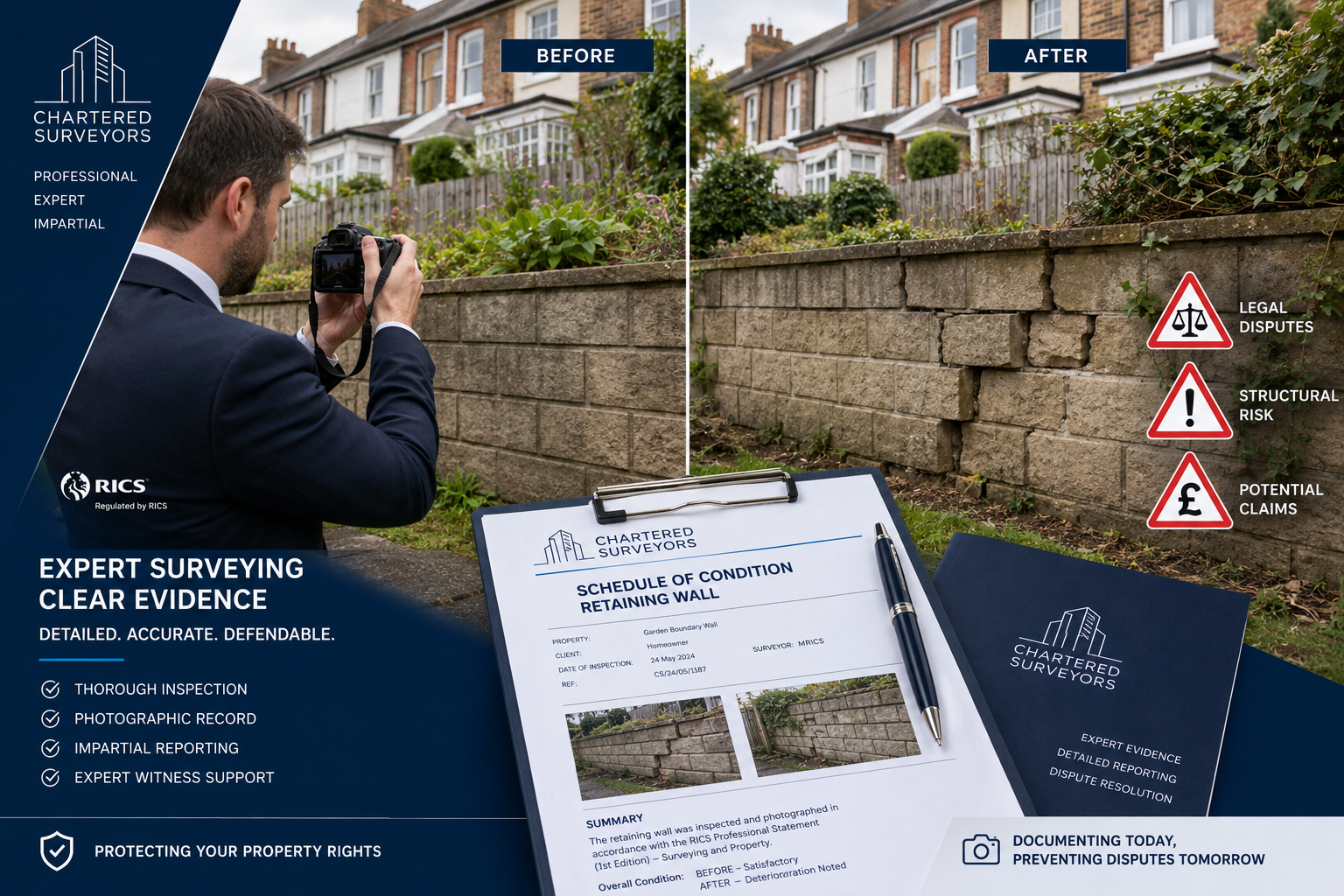
One of the most important tools in any party wall process is the schedule of condition. This is a detailed photographic and written record of the adjoining owner's property — particularly walls, floors, ceilings, and garden structures — taken before works begin.
Its value cannot be overstated. Without a schedule of condition, any crack or defect discovered after landscaping works are complete becomes a matter of dispute: was it caused by the works, or was it pre-existing? A properly prepared schedule removes that ambiguity.
For adjoining owners worried about damage to property in party wall situations, the schedule of condition is the primary line of defence.
Consequences of Failing to Serve Notice
Proceeding without serving the required notice is a serious legal error [2]. The consequences can include:
- 🚫 Court injunctions to stop work immediately
- 💰 Liability for all damage caused to the adjoining property
- ⚖️ Legal costs awarded against the building owner
- 🔨 Mandatory remediation works at the building owner's expense
- 📉 Complications on sale — solicitors routinely ask about party wall compliance
The absence of a party wall notice does not make the Act disappear. If a neighbour discovers that notifiable works were carried out without notice, they can still pursue remedies through the courts. Understanding the risks of a party wall notice not served situation is essential for anyone who has already started — or is about to start — garden works near a boundary.
How Surveyors Should Advise Owners and Contractors
For chartered surveyors advising clients on landscaping projects, the key questions to ask are:
- Does any excavation come within 3 or 6 metres of a neighbouring structure?
- Will any new masonry wall be built on or straddle the boundary?
- Are any works being carried out to an existing party fence wall?
- Will the works alter drainage patterns that could affect neighbouring land?
- Is there an existing retaining wall near the boundary that will be modified or removed?
If the answer to any of these questions is yes, the Party Wall Act is likely engaged. Surveyors acting as expert witnesses in party wall disputes involving garden works will often find that the root cause of the conflict was a failure to ask these questions at the planning stage.
Contractors, meanwhile, should never assume that planning permission or building regulations approval substitutes for party wall compliance. These are entirely separate legal frameworks. A project can be fully permitted under planning law and still be unlawful under the Party Wall Act if the notice process has not been followed.
Soil, Water, and Ground Conditions
Landscaping projects that involve significant earthworks can also affect soil stability and drainage in ways that harm neighbouring properties. Changes to ground levels, the introduction of hard landscaping, or the removal of established planting can alter water runoff and increase the risk of soil movement near boundaries. For projects where these risks are present, a soil and water contamination assessment may be warranted alongside the party wall process.
Practical Guidance for Homeowners and Contractors in 2026
The volume and complexity of garden-related party wall disputes has increased significantly in recent years, driven by the growing popularity of outdoor living projects and the intensification of urban residential gardens. In 2026, with permitted development rights still allowing substantial garden structures without planning permission, the party wall framework carries more weight than ever as the primary regulatory check on boundary works.
Before starting any landscaping project near a boundary, follow these steps:
- ✅ Identify the exact position of the boundary using title deeds and Land Registry data
- ✅ Measure the distance from proposed excavations to all neighbouring structures
- ✅ Determine whether any existing boundary walls are party fence walls
- ✅ Consult a chartered surveyor experienced in party wall matters
- ✅ Serve the correct notices with the correct notice periods
- ✅ Commission a schedule of condition before works begin
- ✅ Keep records of all correspondence with adjoining owners
For adjoining owners who receive a party wall notice relating to garden or retaining wall works, the advice is equally clear: do not ignore it. Responding promptly — either with consent or by appointing a surveyor — protects rights and ensures that any damage caused by the works can be properly attributed and remedied.
Conclusion: Act Before the Spade Goes In
Party Wall Risks in Retaining Walls and Garden Works: When Landscaping Projects Trigger Legal Duties are not theoretical concerns — they are live legal obligations that apply to thousands of garden projects every year across England and Wales. The grey areas around retaining walls, level changes, and boundary landscaping are precisely where disputes are most likely to arise and most difficult to resolve once work has started.
The message for homeowners is straightforward: check before you dig. The message for surveyors and contractors is equally clear: advise proactively, document thoroughly, and never assume that garden works fall outside the Act's scope.
Actionable Next Steps
- 📞 Consult a chartered surveyor before finalising any landscaping design that involves boundary works or excavation
- 📄 Serve the correct party wall notice with appropriate notice periods — do not rely on informal neighbour agreements
- 📸 Commission a schedule of condition to protect both parties before works begin
- 🔍 Review your title deeds to confirm boundary positions and any existing party wall agreements
- 🏗️ Instruct a structural engineer if the retaining wall will hold back more than 1.2 metres of earth or is within 3 metres of a neighbouring structure
Taking these steps costs a fraction of the expense of resolving a party wall dispute after the fact — and protects the relationship with neighbours that no legal process can fully restore.
References
[1] Your Party Wall Rights And Responsibilities – https://legalclarity.org/your-party-wall-rights-and-responsibilities/?utm_source=openai
[2] The Party Wall Etc Act 1996 Explanatory Booklet – https://www.gov.uk/government/publications/preventing-and-resolving-disputes-in-relation-to-party-walls/the-party-wall-etc-act-1996-explanatory-booklet?adlt=strict&utm_source=openai
[3] Party Walls – https://www.rics.org/consumer-guides/party-walls?utm_source=openai
[4] Retaining Wall Regulations Height Tiering And Engineering – https://legalclarity.org/retaining-wall-regulations-height-tiering-and-engineering/?utm_source=openai
[5] Retaining Walls – https://www.nyc.gov/site/buildings/property-or-business-owner/retaining-walls.page?utm_source=openai