
A single build-to-rent development in central London can sit adjacent to 40 or more separately owned properties — each with its own freeholder, head-lessee, and long-leaseholders. Under the Party Wall etc. Act 1996, every one of those ownership layers may be entitled to a notice, a surveyor appointment, and a formal award. Managing party wall procedures for build-to-rent and multi-landlord blocks: coordinating awards across dozens of adjoining owners is one of the most technically demanding tasks a party wall surveyor faces in 2026 — and getting it wrong can halt a multi-million-pound project in its tracks.
This article explains how experienced surveyors and developers navigate the legal framework, manage complex ownership structures, and keep timelines and costs under control.
Key Takeaways 📌
- Every qualifying adjoining owner — including freeholders, head-lessees, and long-leaseholders — must receive a valid party wall notice before work begins.
- Early engagement with all ownership layers dramatically reduces disputes and delays.
- An agreed surveyor or a small coordinated panel can manage dozens of awards efficiently without spiralling costs.
- Phased award strategies allow construction to progress on completed sections while negotiations continue elsewhere.
- Non-compliance with the Act carries serious legal and financial consequences, including injunctions that stop work entirely.
Understanding the Legal Landscape: Who Counts as an Adjoining Owner?

The Party Wall etc. Act 1996 defines an "adjoining owner" as any person with a freehold or leasehold interest of more than one year in land that adjoins the building owner's land [6]. In a standard semi-detached house, that typically means one neighbour. In a build-to-rent or multi-landlord block, the picture is dramatically more complex.
Ownership Layers in Multi-Landlord Blocks
A single adjoining property in an urban block might involve:
| Ownership Layer | Role Under the Act | Typical Scenario |
|---|---|---|
| Freeholder | Adjoining owner | Institutional investor or local authority |
| Head-lessee | Adjoining owner | Property company on a 125-year lease |
| Long-leaseholder | Adjoining owner | Individual flat owner with 80+ years remaining |
| Mortgagee | May need notification | Lender with registered charge |
💡 Pull Quote: "Where a building has multiple floors with different long-leaseholders, each flat owner whose property abuts the party wall is a separate adjoining owner — all must receive notice."
This means a developer constructing a new build-to-rent tower beside a Victorian mansion block could face 30, 40, or even 50 individual adjoining owners across just two or three neighbouring properties. Each is entitled to their own notice, their own surveyor appointment, and — if a dispute arises — their own award [4].
What Triggers the Obligation?
Three categories of work trigger the Act:
- Works to an existing party wall or party structure (Section 2) — including cutting in, raising, underpinning, or inserting beams.
- New building on or at the boundary line (Section 1) — such as a new boundary wall.
- Excavation near neighbouring buildings (Section 6) — within 3 or 6 metres, depending on depth. See our detailed guide on notice requirements for excavation near a neighbour for more on this trigger.
For large build-to-rent schemes, all three triggers often apply simultaneously, compounding the notice-serving challenge.
Practical Strategies for Party Wall Procedures for Build-to-Rent and Multi-Landlord Blocks: Coordinating Awards Across Dozens of Adjoining Owners

Managing dozens of parallel award processes requires a systematic approach. Ad hoc management — serving notices as issues arise — leads to staggered timelines, inconsistent awards, and cost overruns. The following strategies reflect best practice in 2026.
1. Conduct a Comprehensive Ownership Audit Early
Before a single notice is served, the developer's party wall surveyor should:
- Obtain official copies of all title registers for every adjoining property from HM Land Registry.
- Identify every qualifying interest — freeholders, head-lessees, and long-leaseholders with leases exceeding one year.
- Map ownership against the works footprint — not every leaseholder in an adjoining block will be affected. Only those whose demise directly abuts the party wall or excavation zone need to be served.
- Check for mortgagees who may need to be informed even if they are not strictly "adjoining owners."
This audit typically takes one to two weeks but saves months of remedial work later. A missed owner can invalidate an award or trigger an injunction [6].
2. Serve Notices in Coordinated Batches
Rather than serving all notices on the same day (which triggers simultaneous 14-day response windows across dozens of owners), experienced surveyors often phase notice service to align with the construction programme:
- Phase 1: Notices to owners directly affected by foundation and excavation works.
- Phase 2: Notices to owners affected by structural frame and party wall alterations.
- Phase 3: Notices for upper-level works and roof-level party structures.
This approach ensures that awards are in place just ahead of each construction phase, without creating a bottleneck of 50 simultaneous dispute processes at the outset.
3. Pursue an Agreed Surveyor Where Possible
Under the Act, if an adjoining owner dissents or fails to respond within 14 days, a dispute is deemed to have arisen and surveyors must be appointed [2]. There are two routes:
- Each party appoints their own surveyor, who then jointly select a third surveyor as arbiter.
- Both parties agree on a single "agreed surveyor" to act impartially for both sides [2].
For build-to-rent schemes, the agreed surveyor model offers significant advantages:
✅ Reduces the number of separate surveyors involved
✅ Speeds up award preparation
✅ Cuts costs — the building owner typically bears reasonable surveyor fees [1]
✅ Produces consistent, coherent awards across multiple adjoining owners
Institutional landlords and professional property companies — common in multi-landlord blocks — are often receptive to this approach, particularly when the developer's surveyor has a strong reputation and the scope of works is clearly documented.
4. Use a Lead Surveyor Panel Model
Where an agreed surveyor is not achievable across all owners, a panel model works well. The developer appoints one experienced party wall surveyor as lead. Adjoining owners are encouraged — though not compelled — to appoint from a pre-approved panel of surveyors familiar with the scheme. The lead surveyor coordinates:
- A master schedule of condition covering all affected properties (see our guide on schedule of condition for leasehold properties for what this involves).
- Template award documents adapted for each adjoining owner's specific concerns.
- A shared access protocol so that condition surveys can be conducted efficiently across multiple flats.
This model is particularly effective when long-leaseholders — who may have little experience of party wall matters — are involved. A familiar, well-briefed panel surveyor can explain the process clearly and reduce unnecessary dissents driven by misunderstanding rather than genuine concern.
5. Address the "Deemed Dispute" Problem Proactively
One of the most common causes of delay in multi-landlord scenarios is the deemed dispute. If an adjoining owner simply does not respond to a notice within 14 days, a dispute is automatically deemed to have arisen [2]. In a block with 40 leaseholders, even a 20% non-response rate creates eight simultaneous deemed disputes.
Proactive steps to reduce non-responses include:
- Personal delivery of notices where possible, with a follow-up letter explaining the process in plain English.
- Holding a residents' information session — particularly effective in blocks managed by a residents' management company.
- Providing a clear FAQ document alongside the formal notice, directing owners to resources such as party wall frequently asked questions.
- Engaging the managing agent or residents' management company as a communication channel.
Early engagement is consistently cited by practitioners as the single most effective tool for reducing disputes and delays [5].
Managing Costs, Timelines, and Disputes Across Complex Ownership Structures
Cost Allocation in Multi-Award Scenarios
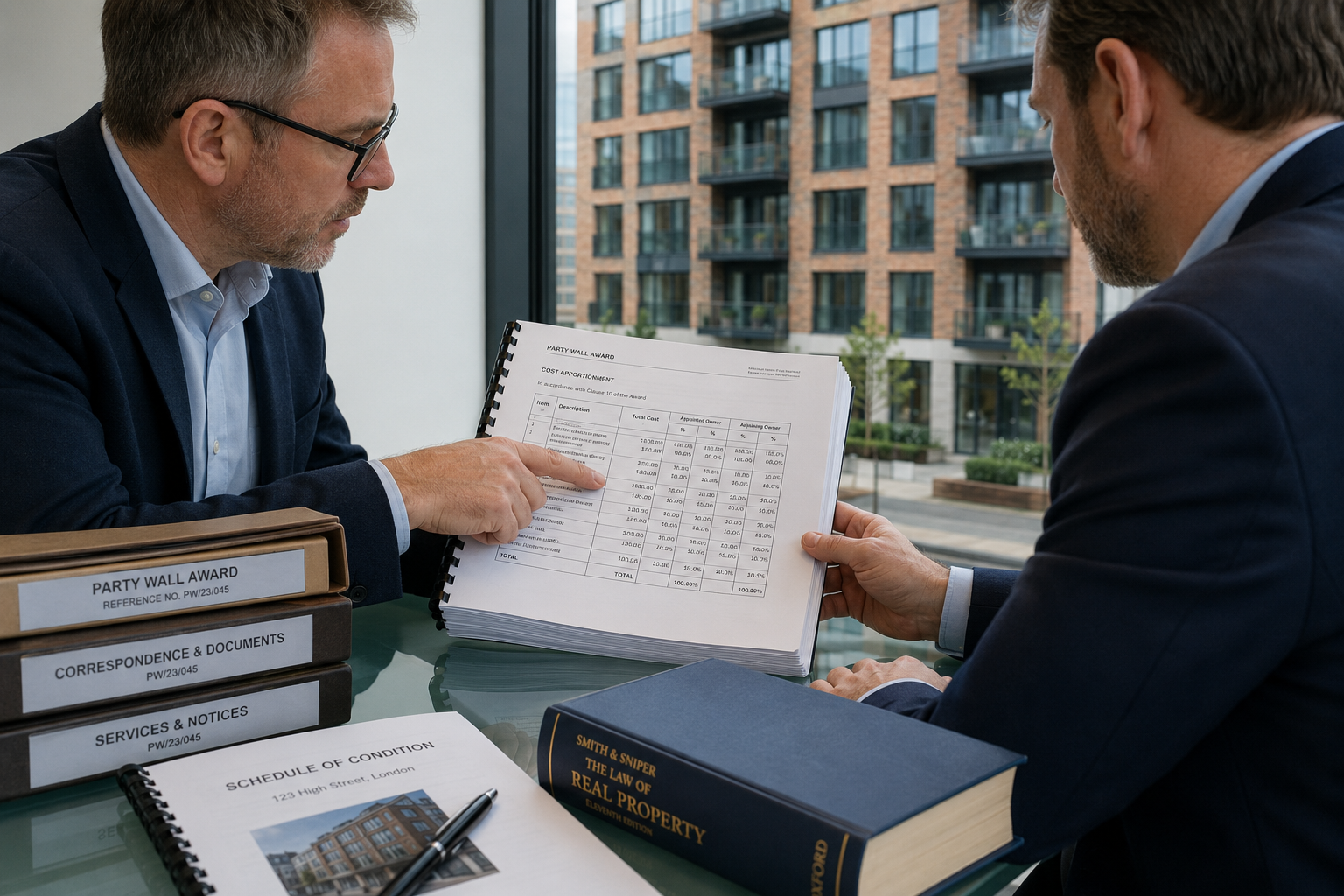
The general principle is clear: the building owner pays the reasonable costs of the party wall process, including adjoining owners' surveyor fees [1]. In a multi-landlord scenario, this can represent a substantial budget line. Developers should plan for:
- Individual surveyor fees for each separately represented adjoining owner.
- Condition survey costs across potentially dozens of properties.
- Third surveyor fees if any disputes escalate.
- Legal costs if awards are appealed in the county court.
💡 Pull Quote: "A well-managed party wall process on a large build-to-rent scheme typically costs less than one week's delay caused by an injunction from a missed owner."
Where works benefit both parties — for example, underpinning that also stabilises the adjoining building — costs can be apportioned accordingly [1]. This is worth exploring in negotiations with institutional adjoining owners.
For a fuller breakdown of what to expect, our guide on party wall costs covers surveyor fees, award preparation costs, and how apportionment works in practice.
What a Party Wall Award Must Contain
Each award is a legally binding document [1] that sets out:
- The precise scope of works — referenced to approved drawings.
- The method and sequence of construction — especially important for works affecting shared structures like shared chimney stacks or party floors.
- Hours of working and noise/vibration controls.
- Access rights for the building owner's contractors.
- The schedule of condition — a photographic and written record of the adjoining property's pre-works state.
- Dispute resolution provisions — what happens if damage occurs.
- A commencement deadline — works must typically begin within 12 months of the award being served, or a new award is required [1].
In multi-landlord scenarios, awards must be carefully tailored. A long-leaseholder on the ground floor has different concerns from one on the sixth floor. Template awards save time but must be adapted to reflect each owner's specific exposure to the works.
Handling Damage Claims
Despite the best precautions, damage to adjoining properties does occur. The Act provides a clear framework: the building owner is liable for damage caused by notifiable works [6]. The schedule of condition is the critical document — it establishes the pre-works baseline against which any claim is assessed. For more on how this process works, see our resource on damage to property in party wall disputes.
In multi-landlord blocks, damage claims can multiply quickly. A single incident of settlement or vibration damage might affect multiple flats simultaneously. Having a coordinated surveyor panel with consistent condition records across all properties is invaluable in resolving these claims efficiently.
Appealing an Award
Any party can appeal a Party Wall Award to the county court within 14 days of receiving it [2]. After that period, the award becomes final and binding. In practice, appeals are relatively rare — most disputes are resolved at the award stage. However, in large multi-landlord schemes, the statistical likelihood of at least one appeal increases with the number of awards issued.
Developers should budget time and cost contingency for the possibility of an appeal, particularly where:
- Works involve significant structural intervention.
- An adjoining owner has a history of obstructing the process. See our article on obstruction in party wall proceedings for guidance on this scenario.
- The award involves contentious cost apportionment.
The Consequences of Non-Compliance
Proceeding without a valid award — or failing to serve notices on all qualifying adjoining owners — is not a minor procedural oversight. The consequences can include:
- Injunctions stopping work immediately.
- Trespass claims if works cross the boundary without authorisation.
- Damages claims that are not capped by the Act's framework.
- Reputational damage with institutional investors and planning authorities [6].
If notices were not served correctly, it is not too late to act — but the sooner the issue is addressed, the better. Our guide on what happens with no party wall agreement explains the options available.
The Role of RICS Guidance and Professional Standards
The Royal Institution of Chartered Surveyors (RICS) has been developing the 8th edition of its Party Wall Legislation & Procedure guidance, which addresses the evolving complexity of party wall work in large-scale developments [3]. Key themes in the updated guidance include:
- Thorough pre-works assessment — surveyors must review all relevant documents, existing conditions, and the potential impact of works before preparing an award [3].
- Consistent record-keeping — particularly important in multi-owner scenarios.
- Impartiality — surveyors acting as agreed surveyors must maintain independence from both parties [7].
Appointing RICS-registered surveyors with demonstrable experience in large-scale or institutional party wall work is strongly recommended for build-to-rent projects [7]. The complexity of coordinating awards across dozens of adjoining owners demands practitioners who understand both the legal framework and the practical realities of large construction programmes.
Conclusion: Actionable Next Steps for Developers and Surveyors
Party wall procedures for build-to-rent and multi-landlord blocks — coordinating awards across dozens of adjoining owners — demand a level of project management discipline that goes well beyond standard residential party wall practice. The legal obligations are non-negotiable, but the process can be managed efficiently with the right approach.
Here are the key actions to take:
- Commission an ownership audit immediately — before design is finalised, map every qualifying adjoining owner against the works footprint.
- Appoint an experienced lead party wall surveyor early — ideally at RIBA Stage 2 or 3, not at tender stage.
- Phase notice service to align with the construction programme and avoid a bottleneck of simultaneous disputes.
- Invest in proactive communication with adjoining owners, managing agents, and residents' management companies to reduce deemed disputes.
- Use agreed surveyor appointments wherever institutional or professional adjoining owners will accept them.
- Budget realistically for surveyor fees, condition surveys, and contingency for appeals.
- Ensure every award contains a robust schedule of condition — this is the primary protection against costly and protracted damage claims.
The party wall process, managed well, protects everyone: the developer's programme, the adjoining owners' properties, and the long-term reputation of the build-to-rent scheme. Managed poorly, it can become the single biggest cause of delay and cost overrun on an otherwise well-planned project.
For specialist advice on complex party wall matters, contact Canterbury Surveyors to discuss your specific project requirements.
References
[1] Party Wall Awards – https://www.partywallslimited.com/services/party-wall-awards?utm_source=openai
[2] If You Can't Agree – https://www.gov.uk/party-walls-building-works/if-you-cant-agree?utm_source=openai
[3] RICS Party Wall Legislation & Procedure 8th Edition Consultation – https://consultations.rics.org/party_walls_8th_edition_guidance/viewCompoundDoc?docid=16799988&partid=16802804&pfv=y&utm_source=openai
[4] Your Party Wall Rights and Responsibilities – https://legalclarity.org/your-party-wall-rights-and-responsibilities/?utm_source=openai
[5] Knowledge Article: Party Wall Agreements – https://www.aylingassociates.com/knowledge-article-party-wall-agreements.html?utm_source=openai
[6] The Party Wall Etc. Act 1996 Explanatory Booklet – https://www.gov.uk/government/publications/preventing-and-resolving-disputes-in-relation-to-party-walls/the-party-wall-etc-act-1996-explanatory-booklet?adlt=strict&utm_source=openai
[7] RICS Consumer Guide: Party Walls – https://www.rics.org/consumer-guides/party-walls?utm_source=openai