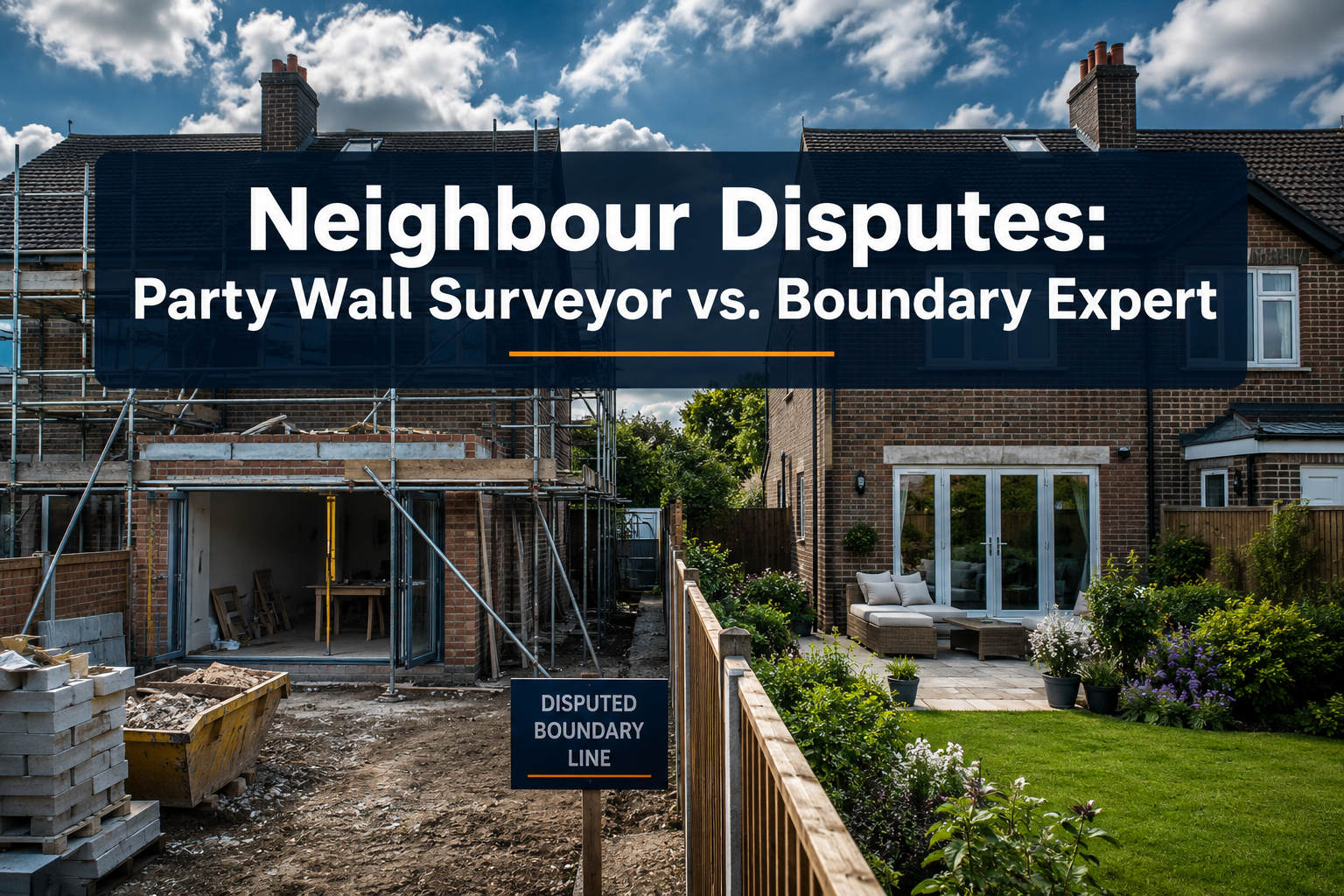

Fewer than 20% of divorcing couples in England and Wales reach a clean financial settlement without some form of professional property valuation dispute — yet the role of the party wall expert witness in these proceedings remains widely misunderstood, even among legal practitioners. When a matrimonial home shares a boundary with a neighbour's property, or when one spouse has carried out works affecting a party wall, the complexity of the settlement multiplies significantly. Understanding Party Wall Expert Witness Roles in Matrimonial Property Disputes: Valuation Strategies and RICS Standards is no longer optional for surveyors, solicitors, or separating couples navigating high-stakes property division.
This guide is written for surveyors, legal professionals, and property owners who need a clear, authoritative framework for navigating this specialist intersection of party wall law, matrimonial finance, and RICS-regulated valuation practice.
Key Takeaways 📌
- A party wall expert witness must prioritise their duty to the court above the interests of the appointing party — a non-negotiable RICS requirement [1]
- Neutral, RICS-compliant valuations are essential for fair matrimonial settlements, especially where party wall disputes have affected property value
- The 8th edition of RICS Party Wall Legislation and Procedure is currently under consultation (2026), bringing updated practice standards [2]
- Party wall issues — including damage, unresolved awards, and boundary ambiguity — can materially affect matrimonial property valuations and tax outcomes
- Surveyors must demonstrate competence, independence, and formal training in expert witness conduct before accepting court appointments [1]
Understanding the Expert Witness Role in Matrimonial Property Cases
What Does a Party Wall Expert Witness Actually Do?
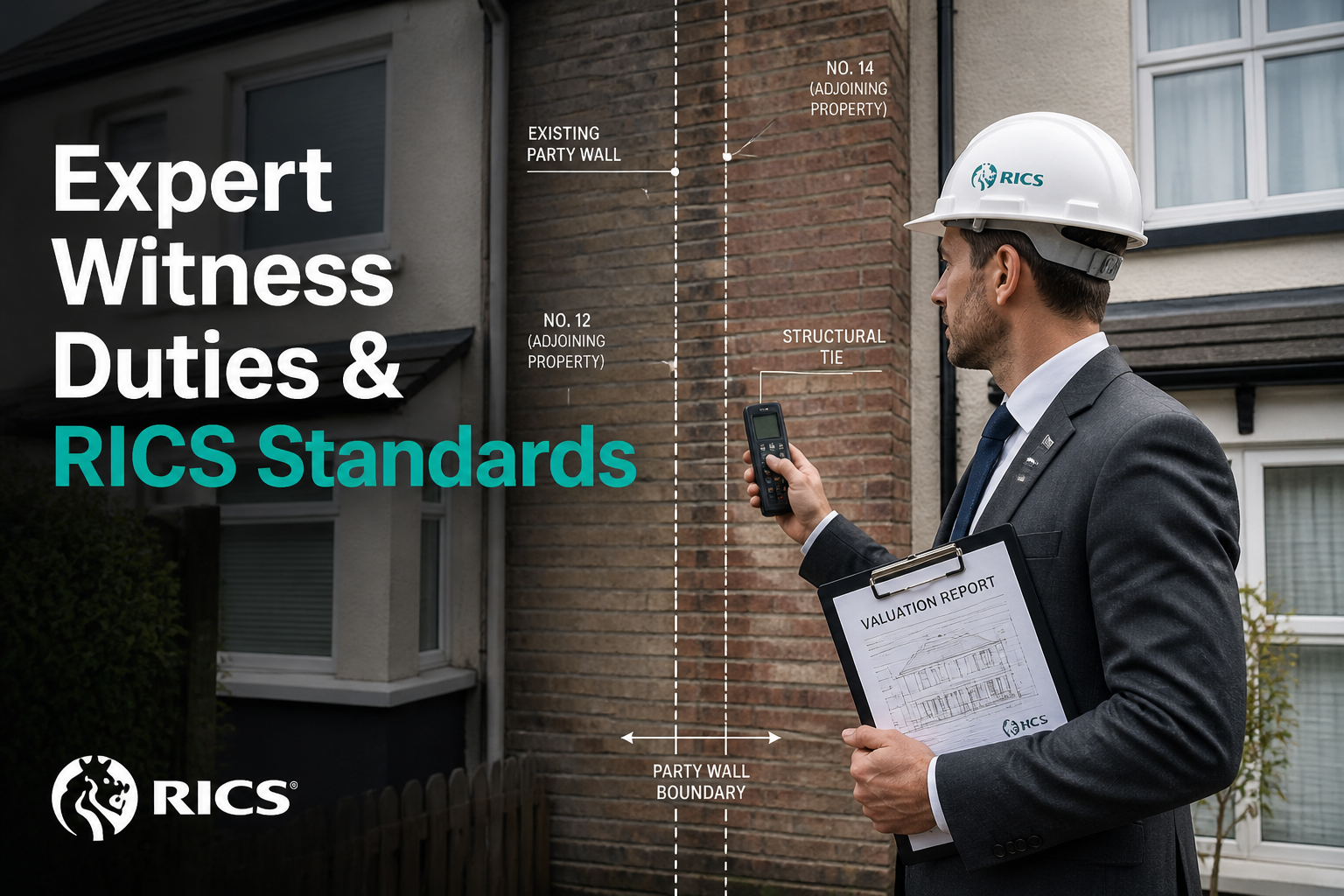
A party wall expert witness is a chartered surveyor appointed to provide independent, court-admissible evidence on matters relating to party walls, shared boundaries, and associated structural or valuation issues. In matrimonial proceedings, this role becomes especially critical when:
- The matrimonial home is a terraced or semi-detached property with shared walls
- One spouse has commissioned building works (loft conversions, extensions, excavations) that triggered party wall obligations
- A party wall dispute is unresolved at the time of separation, creating a liability that affects the property's market value
- There are competing valuations between spouses, and the court requires an independent expert to resolve the discrepancy
In February 2024, RICS issued a formal practice alert reinforcing that expert witnesses must follow RICS rules, the Civil Procedure Rules (CPR), and all relevant court rules [1]. This is not guidance — it is a professional obligation.
💬 "An expert's duty is to the court rather than their appointing party, meaning experts must remain independent even when appointed and paid by a specific party to a claim." — RICS Expert Witness Practice Alert [1]
The Duty of Independence: Why It Matters in Divorce Cases
Matrimonial disputes are emotionally charged. Spouses may each appoint their own surveyor, and the temptation — conscious or otherwise — is for each expert to favour their client's position. RICS standards are unambiguous: the expert's primary duty is to the court, not the client [1].
This principle has direct practical consequences:
| Scenario | Compliant Approach | Non-Compliant Approach |
|---|---|---|
| Spouse A's surveyor finds a party wall defect | Report it neutrally with evidence | Downplay it to inflate property value |
| Competing valuations differ by 15% | Explain methodology transparently | Adjust figures to match client's preferred outcome |
| Unresolved party wall award exists | Quantify liability clearly | Omit from valuation report |
| Court requests single joint expert | Accept appointment and act neutrally | Advocate for appointing party |
For surveyors considering this type of work, reviewing the standards and scope of expert witness services is an essential first step before accepting any court appointment.
Competence and Training Requirements
RICS mandates that expert witnesses must demonstrate competence and skill in their specific field, and that training in expert witness conduct is necessary to understand legal process, applicable rules, and court expectations [1]. For party wall matters in matrimonial cases, this means surveyors should have:
- ✅ Formal qualifications as a party wall surveyor (ideally MRICS or FRICS)
- ✅ Practical experience with party wall awards and schedules of condition
- ✅ Training in CPR Part 35 (expert witness obligations)
- ✅ Understanding of matrimonial finance law as it relates to property
- ✅ Experience producing court-compliant reports
Valuation Strategies for Matrimonial Property with Party Wall Complications
How Party Wall Issues Affect Matrimonial Property Value
Party wall complications are not merely procedural inconveniences — they can have a direct and quantifiable impact on market value. Courts and family law practitioners need surveyors to identify and quantify these impacts clearly.
Common value-affecting party wall issues include:
1. Unresolved Party Wall Awards
If works have been carried out without a proper award, or if an existing award is disputed, this creates a legal encumbrance on the property. Buyers and lenders treat unresolved party wall matters as risk factors. Understanding the implications of proceeding without a party wall agreement is essential context for any valuation in this scenario.
2. Structural Damage Attributable to Party Wall Works
Where one spouse commissioned works — such as a loft conversion or rear extension — and those works caused damage to the shared wall or the adjoining property, the cost of remediation must be factored into the matrimonial valuation. Surveyors should be familiar with how damage to property in party wall situations is assessed and documented.
3. Incomplete Schedules of Condition
A schedule of condition records the pre-works state of a property. Where this document is missing or disputed, establishing the baseline for any damage claim becomes contentious — and this uncertainty affects value.
4. Excavation Near Boundaries
Works involving excavation close to a neighbour's foundations trigger specific obligations under the Party Wall etc. Act 1996. Where these obligations were not met, there may be ongoing liability. The three-metre rule for excavation notices is a key reference point for surveyors assessing this risk.
Core Valuation Methodologies for Matrimonial Settlements
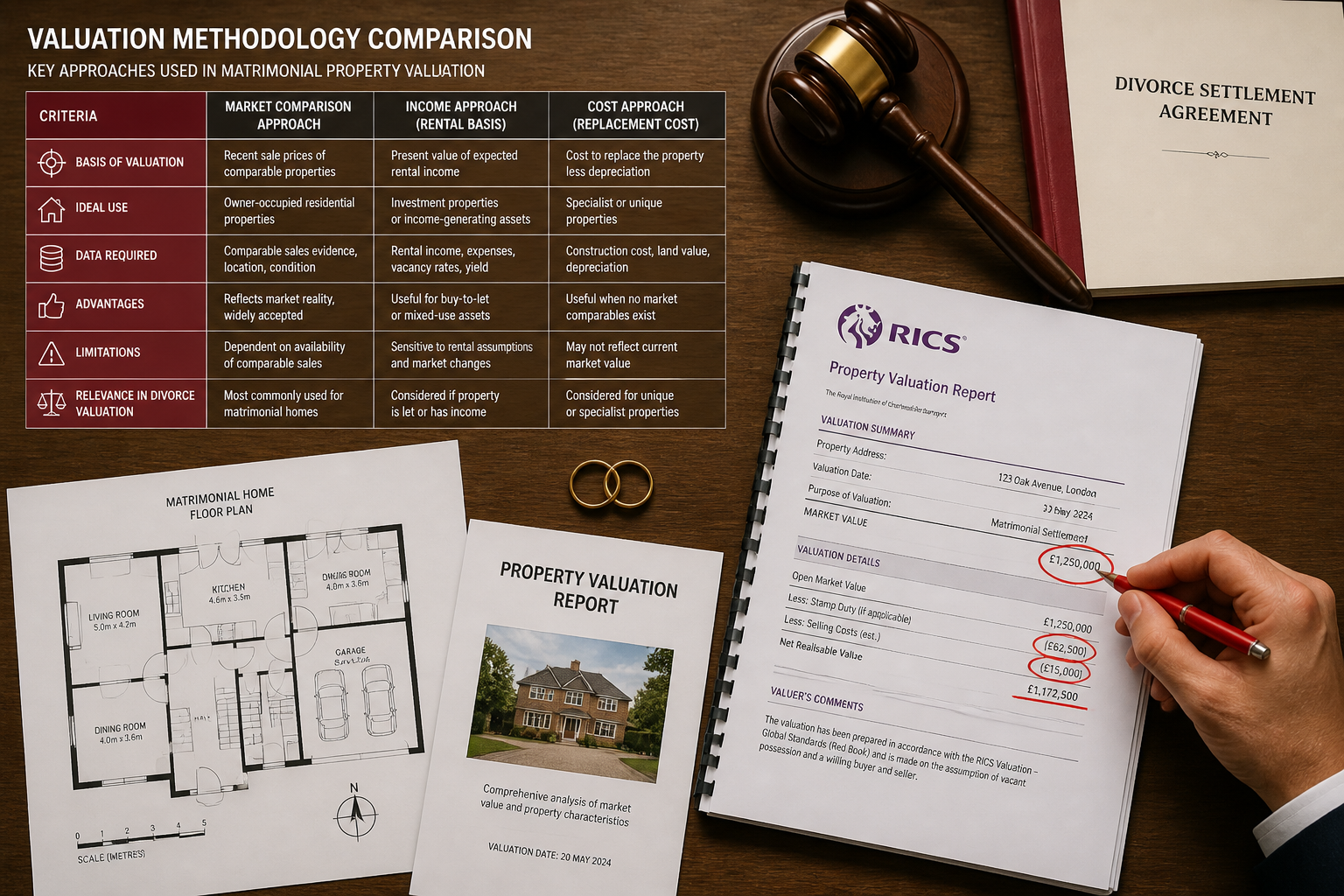
When preparing a valuation for matrimonial proceedings, the surveyor must select the most appropriate methodology and justify that choice in their expert report. The principal methods of valuation applicable to residential matrimonial property include:
Comparable Sales (Market) Method
The most widely used approach for residential property. The surveyor identifies recent sales of comparable properties, adjusts for differences (size, condition, location, party wall status), and derives an opinion of market value. Any party wall defects or unresolved disputes must be reflected as downward adjustments.
Depreciated Replacement Cost
Rarely used for residential property but may be relevant where the property has been significantly altered by party wall works or where specialist elements (such as a newly built extension) need to be valued separately.
Residual Method
Applicable where the property has development potential — for example, where an agreed party wall award has enabled a loft conversion that adds value. The surveyor calculates the gross development value minus costs to arrive at a residual land/property value.
📊 Key principle: All valuation methodologies must be applied consistently and transparently. In matrimonial proceedings, the court will scrutinise methodology, so surveyors must document their reasoning thoroughly.
Probate and Tax Implications
Matrimonial property settlements do not occur in a tax vacuum. Expert witnesses and instructing solicitors must be aware of several fiscal dimensions:
Capital Gains Tax (CGT)
The transfer of property between spouses as part of a divorce settlement can trigger CGT. The no gain/no loss rule applies during the tax year of separation, but this window is limited. Where party wall works have added value to the property (e.g., a completed loft conversion), the gain attributable to those works must be calculated accurately.
Stamp Duty Land Tax (SDLT)
Transfers pursuant to a court order in matrimonial proceedings are generally exempt from SDLT. However, the structure of the settlement matters, and surveyors should flag any ambiguities to the instructing solicitor.
Inheritance Tax (IHT) / Probate Valuations
Where a matrimonial dispute overlaps with a probate matter — for example, where a spouse has died during proceedings — the expert witness may be required to provide a probate valuation as well as a matrimonial valuation. These are distinct exercises with different legal frameworks, and the surveyor must be clear about which instruction they are fulfilling.
RICS Standards, the 2026 Consultation, and Best Practice for Expert Witnesses
The Evolving RICS Framework: What Surveyors Need to Know in 2026
The regulatory landscape for Party Wall Expert Witness Roles in Matrimonial Property Disputes: Valuation Strategies and RICS Standards is actively evolving. In 2026, RICS launched a consultation on the draft 8th edition of Party Wall Legislation and Procedure, which will replace the 7th edition and provide updated practice guidance for RICS members handling party wall matters in England and Wales [2].
Key areas expected to be addressed in the updated guidance include:
- Clarified procedures for party wall awards and their enforcement
- Updated standards for schedules of condition and photographic evidence
- Guidance on digital documentation and remote inspection protocols
- Reinforced independence requirements for surveyors acting as experts
Surveyors involved in matrimonial cases should monitor the outcome of this consultation closely, as the new edition will directly affect how expert evidence is prepared and presented. The existing guidance for party wall awards remains the current reference point until the 8th edition is formally adopted.
Preparing a Court-Compliant Expert Witness Report
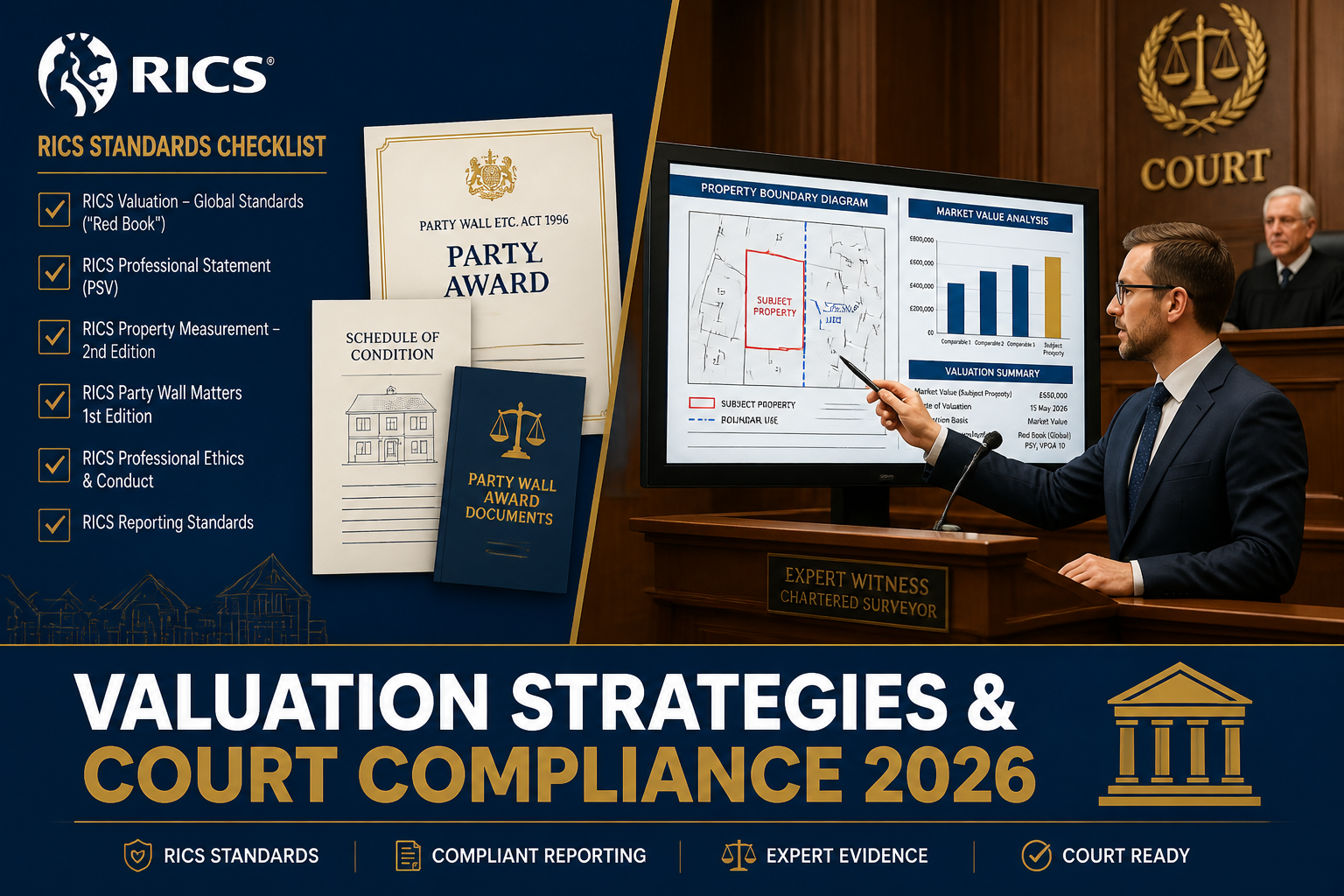
A party wall expert witness report for matrimonial proceedings must meet the requirements of CPR Part 35 and the associated Practice Direction. The following structure is recommended:
Report Structure Checklist ✅
- Expert's declaration — confirming duty to the court, not the client
- Qualifications and experience — demonstrating competence in party wall and valuation matters
- Instructions received — clearly stating what the expert was asked to opine on
- Documents reviewed — listing all materials considered (title deeds, party wall awards, schedules of condition, etc.)
- Inspection details — date, access arrangements, scope of inspection
- Factual findings — objective description of the property and any party wall issues
- Expert opinion — valuation and/or assessment of party wall matters, with methodology explained
- Areas of uncertainty — where the expert's opinion is qualified or limited
- Statement of truth — mandatory under CPR
Single Joint Expert vs. Party-Appointed Expert
In matrimonial proceedings, the court may direct that a single joint expert (SJE) be appointed rather than allowing each party to instruct their own surveyor. This is increasingly common in financial remedy proceedings as it reduces cost and delay.
| Appointment Type | Advantages | Considerations |
|---|---|---|
| Single Joint Expert | Cost-effective, reduces conflict | Must be acceptable to both parties |
| Party-Appointed Expert | Each party controls their own evidence | Risk of conflicting reports; court may appoint SJE anyway |
| Court-Appointed Expert | Highest level of independence | Rare; usually reserved for complex cases |
Where a SJE is appointed, the surveyor must be particularly rigorous about maintaining independence and responding to questions from both parties' solicitors with equal transparency.
Practical Steps for Surveyors Accepting Matrimonial Instructions
Before accepting an expert witness instruction in a matrimonial property case involving party wall issues, surveyors should:
- Confirm competence — Do you have the specific expertise required? Party wall and matrimonial valuation are distinct specialisms [1]
- Check for conflicts of interest — Have you previously acted for either party or their neighbours?
- Clarify the instruction — Are you being asked to value the property, assess party wall liability, or both?
- Agree terms of engagement — Including fees, timescales, and what happens if the case settles
- Document everything — From initial instructions to final report, maintain a complete audit trail
- Understand the party wall FAQs relevant to the specific property type and works involved
Conclusion: Actionable Next Steps for Surveyors and Legal Professionals
The intersection of party wall law, matrimonial finance, and RICS-regulated expert witness practice demands a level of specialist knowledge that goes well beyond standard surveying competence. As the 2026 RICS consultation on the 8th edition of Party Wall Legislation and Procedure progresses [2], and as courts continue to enforce the strict independence requirements reinforced by RICS in 2024 [1], the bar for expert witness work in this field is rising.
For surveyors, the message is clear: invest in formal expert witness training, stay current with RICS guidance updates, and never compromise independence for a client relationship. The court is your primary audience — not the spouse who is paying your fee.
For solicitors and legal professionals, appointing a surveyor with genuine dual expertise in party wall matters and matrimonial property valuation will produce more robust, court-ready evidence and reduce the risk of expensive adjournments caused by inadequate reports.
For divorcing couples, understanding that party wall issues — unresolved awards, structural damage, missing schedules of condition — can materially affect the value of your home is the first step toward a fair settlement.
Immediate Action Steps 🎯
- ✅ Surveyors: Review the RICS expert witness practice alert and ensure your CPR Part 35 training is current
- ✅ Solicitors: When instructing a party wall expert for matrimonial proceedings, request evidence of both party wall and valuation experience
- ✅ Property owners: Before separation, commission a schedule of condition if any party wall works are planned or ongoing
- ✅ All parties: Monitor the RICS 8th edition consultation outcome, expected to be finalised in 2026 [2]
For specialist support with party wall expert witness appointments, property valuations for matrimonial proceedings, or any related surveying services, contact a qualified chartered surveyor with the relevant expertise as early as possible in the process.
References
[1] Expert Witness Duties Responsibilities – https://ww3.rics.org/uk/en/journals/built-environment-journal/expert-witness-duties-responsibilities.html
[2] Rics Launches Consultation On Updated Party Wall Practice Guidance – https://www.rics.org/news-insights/rics-launches-consultation-on-updated-party-wall-practice-guidance
[3] Schedules Of Condition In Party Wall Disputes Photography Documentation And Evidence Standards For Surveyors – https://nottinghillsurveyors.com/blog/schedules-of-condition-in-party-wall-disputes-photography-documentation-and-evidence-standards-for-surveyors