

Between 2,900 and 5,800 mid-rise residential buildings in England alone are estimated to require remediation for life-safety fire risks — and that figure covers only cladding defects in one height band [5]. Beneath this headline crisis lies a far broader landscape of structural failures, damp ingress, subsidence, and concealed defects quietly eroding the value and safety of UK homes every day. Major Defects Reports in Building Pathology: 30+ Years Expertise for UK Residential Diagnosis 2026 represents the gold standard for identifying, classifying, and resolving these issues before they become catastrophic — and in a property market where prices are stabilising after years of turbulence, the stakes for buyers and owners have never been higher.
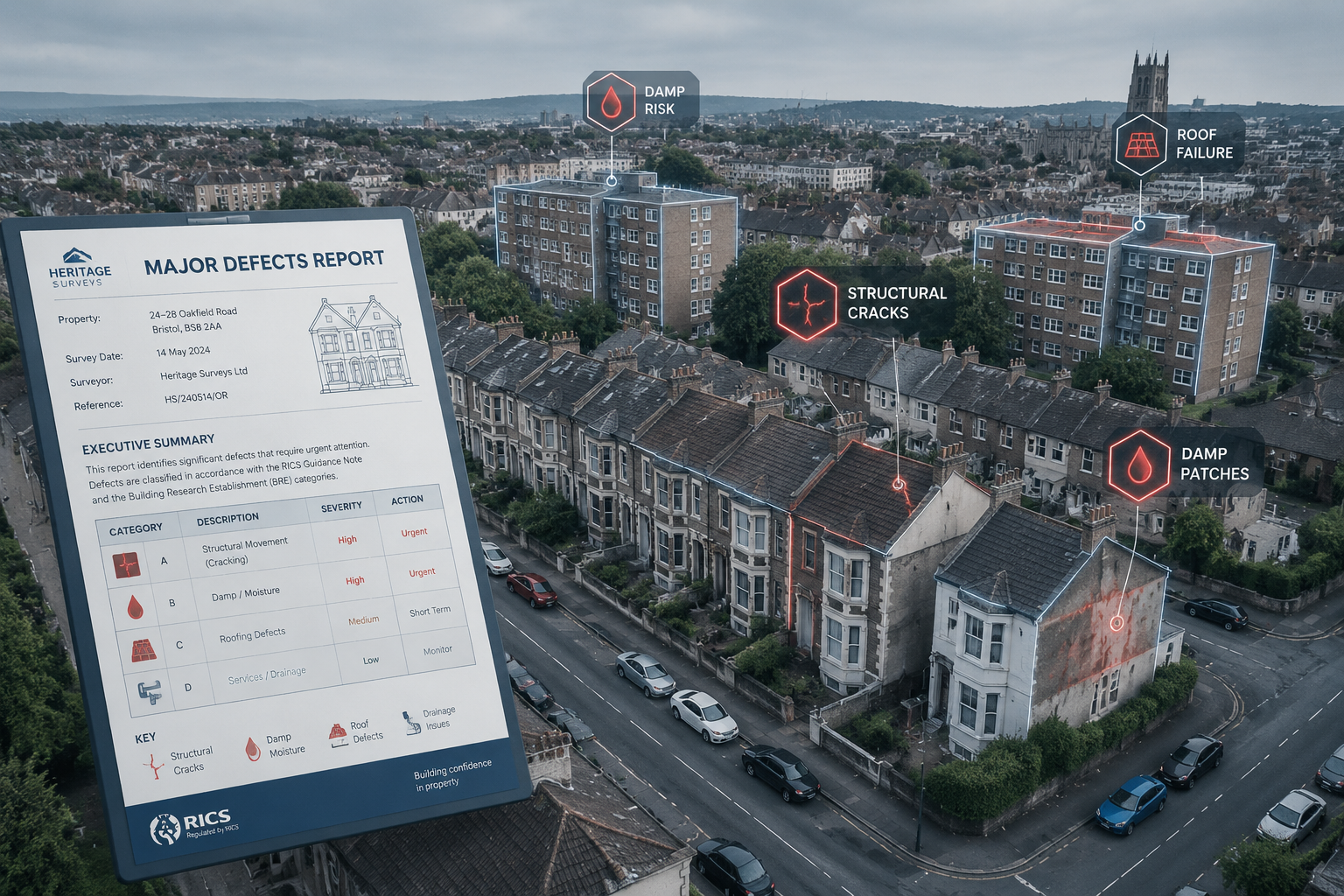
Key Takeaways
- 🏚️ Building pathology is the systematic study of building defects — their causes, diagnosis, and remediation — drawing on interdisciplinary expertise across structural engineering, materials science, and surveying [2].
- 🔍 Major defects are classified as either patent (visible on inspection) or latent (hidden, such as foundation failures) — each requiring different diagnostic approaches [2].
- 📋 A professional Major Defects Report goes beyond a standard survey, providing cause diagnosis, remedial recommendations, and — where needed — court-tested forensic evidence [3].
- 🏗️ The UK government's 2026 remediation data confirms that ACM cladding identification is now largely complete for high-rise buildings, but mid-rise and lower buildings remain significantly under-assessed [5].
- 💷 In a stabilising price environment, commissioning a specialist defects report before purchase or sale is one of the most cost-effective risk management tools available to UK property stakeholders.
What Is Building Pathology and Why Does It Matter in 2026?
Building pathology is defined as the study and understanding of buildings, specifically focusing on defects and their remedial solutions [2]. Think of it as medicine for buildings: just as a doctor diagnoses illness by examining symptoms, causes, and patient history, a building pathologist investigates a structure's condition through observation, testing, and evidence-led analysis.
Defects arise from a wide range of factors:
| Defect Origin | Common Examples |
|---|---|
| Poor design | Inadequate drainage details, thermal bridging |
| Material failure | Spalling concrete, failing render systems |
| Specification errors | Wrong mortar mix, incompatible materials |
| Workmanship | Poorly installed DPC, substandard pointing |
| Inadequate maintenance | Blocked gutters causing penetrating damp |
| Improper use | Overloading floors, unauthorised alterations |
| Environmental factors | Subsidence from tree roots, flood damage |
"Building pathology is not simply about finding problems — it is about understanding why they exist and how to resolve them permanently." [4]
The 2026 Building Pathology Conference reinforces this view, emphasising an interdisciplinary, holistic approach to understanding building performance and investigating failures [4]. This matters enormously for UK residential diagnosis, where a single missed defect can translate into tens of thousands of pounds in remediation costs.
The 2026 UK Context: A Market Demanding Precision
The UK property market in 2026 is characterised by price stabilisation following years of post-pandemic volatility and interest rate pressure. In this environment, buyers are more cautious, lenders are more rigorous, and sellers face greater scrutiny. A property flagged with a major defect — whether structural movement, unsafe cladding, or concealed damp — can stall or collapse a transaction entirely.
The government's February 2026 data release confirms that building safety remediation programmes — covering ACM cladding, the Building Safety Fund (BSF), and the Cladding Safety Scheme (CSS) — remain active and evolving [1]. Local authority enforcement action against non-compliant buildings is being tracked and published monthly [1], signalling a regulatory environment that is tightening, not relaxing.
For residential buyers, owners, and leaseholders, this makes specialist major defects reporting not a luxury but a necessity.
Understanding Major Defects: Classification, Diagnosis, and the Pathologist's Toolkit
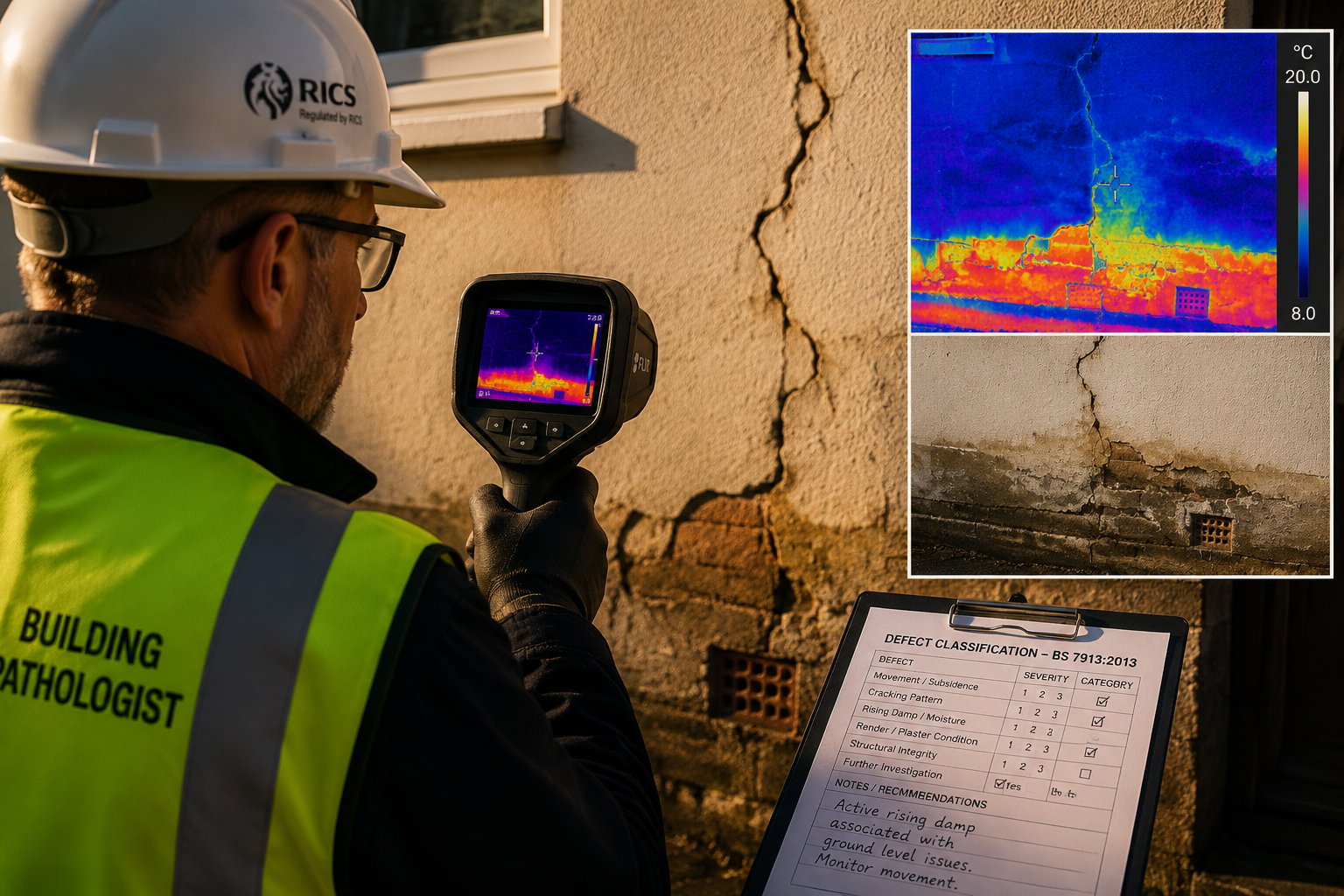
Not all defects are created equal. Professional building pathology draws a critical distinction between two categories [2]:
Patent Defects 🔎
These are defects discoverable through reasonable inspection — visible cracks, sagging rooflines, stained ceilings, or peeling render. A competent surveyor conducting a RICS specialist defect survey should identify patent defects during a standard site visit.
Latent Defects 🕳️
These are defects not reasonably discoverable without specialist investigation — foundation failures, concealed structural movement, hidden rot within floor joists, or sub-floor drainage failures [2]. Latent defects are the silent destroyers of property value and the primary reason why a standard mortgage valuation is wholly inadequate for risk assessment.
The Diagnostic Process: What a Major Defects Report Contains
A professional defect diagnosis report is structured to deliver three core outputs [6]:
- Observation and description — a systematic record of all identified defects, with photographic evidence and location mapping
- Diagnosis of cause — determining whether the defect stems from design failure, material degradation, workmanship error, or environmental action
- Remedial recommendations — specific, costed guidance on how to resolve each defect, including priority sequencing
For complex cases — particularly those involving litigation, insurance disputes, or party wall matters — forensic building diagnostics backed by chartered credentials and court-tested methodology provide an additional layer of evidential rigour [3]. This is where building pathology intersects with expert witness surveying, a specialist service increasingly called upon in 2026 as building safety disputes work through the courts.
Common Major Defects in UK Residential Properties
The following defects most frequently trigger a Condition Rating 3 (serious/urgent action required) classification in UK building surveys:
- 🏗️ Structural movement and subsidence — particularly in clay-rich soils across southern England
- 💧 Rising and penetrating damp — often misdiagnosed and incorrectly treated
- 🪵 Timber decay and woodworm — concealed within floors, roofs, and wall plates
- 🔥 Unsafe cladding systems — ACM and other combustible materials on mid- and high-rise buildings
- 🏠 Roof failure — deteriorated coverings, failed flashings, inadequate ventilation
- ⚡ Electrical and gas installation defects — particularly in pre-1970s housing stock
- 🧱 Failed cavity wall insulation — causing cold bridging and interstitial condensation
For damp-specific investigations, understanding the cost of a damp and timber report is an important first step for property owners suspecting moisture-related issues.
Major Defects Reports in Building Pathology: 30+ Years Expertise for UK Residential Diagnosis 2026 — Choosing the Right Survey
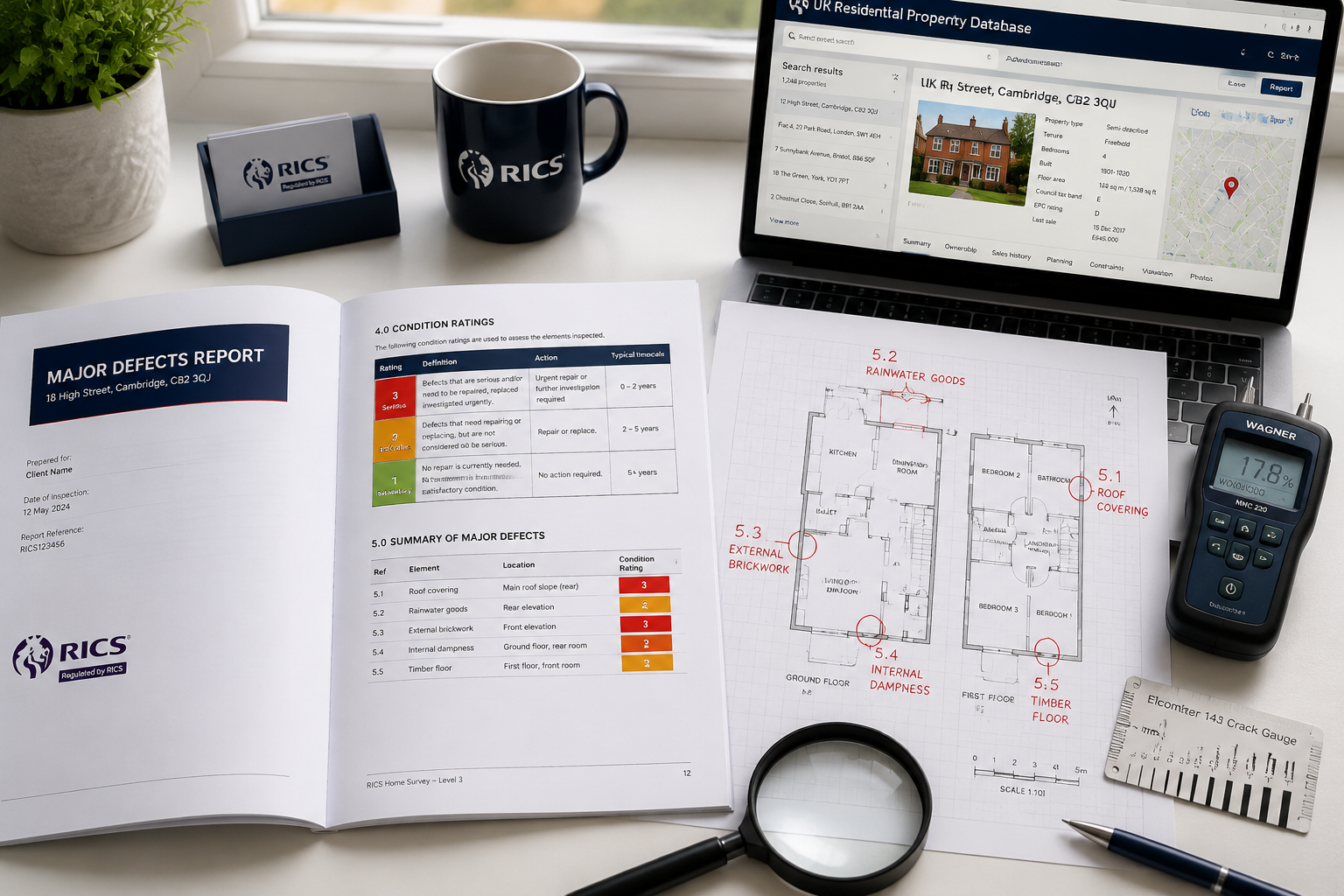
With multiple survey products available in the UK market, selecting the right level of investigation is critical. The table below maps common scenarios to the appropriate survey type:
| Scenario | Recommended Survey | Key Output |
|---|---|---|
| Pre-purchase, standard property | RICS Home Survey Level 2 | Condition ratings, key risks |
| Pre-purchase, older/complex property | RICS Building Survey (Level 3) | Full structural assessment |
| Specific defect investigation | RICS Specialist Defect Survey | Cause diagnosis + remediation plan |
| Litigation/insurance dispute | Expert Witness Report | Court-compliant forensic evidence |
| Subsidence concern | Subsidence Survey | Movement monitoring + cause analysis |
Why 30+ Years of Expertise Changes Everything
Experience in building pathology is not merely a marketing credential — it is a functional advantage. A surveyor with three decades of UK residential diagnosis has encountered:
- Generational material failures — asbestos-containing materials, high-alumina cement concrete, calcium silicate bricks, and black ash mortar, each with distinct failure signatures
- Evolving regulatory landscapes — from the 1984 Building Regulations through to the Building Safety Act 2022 and its 2026 implementation milestones
- Regional construction traditions — flint walls in Kent, sandstone in the North, timber-framed vernacular across the South East — each demanding localised diagnostic knowledge
This depth of pattern recognition cannot be replicated by algorithmic tools or junior surveyors working from checklists. It is precisely why Major Defects Reports in Building Pathology: 30+ Years Expertise for UK Residential Diagnosis 2026 commands a premium — and why that premium consistently delivers a positive return on investment.
The Cladding Crisis: What 2026 Data Tells Us
The government's March 2026 technical note confirms that between 2,900 and 5,800 mid-rise residential buildings (11–18 metres height) in England require remediation for cladding-related life-safety fire risks — representing 7.5–9.9% of the estimated 39,000–59,000 buildings in this height category [5]. Crucially, the MHCLG has now confirmed confidence that the vast majority of high-rise buildings with ACM cladding have been identified [5].
However, identification is not remediation. The Waking Watch Relief and Replacement Funds continue to support leaseholders in buildings awaiting remediation [1], and the Cladding Safety Scheme remains active. For leaseholders in affected buildings, understanding the interaction between building safety obligations and leasehold rights is essential.
Freetec-Style Reporting: Flagging Serious Flaws with Specialist Referrals
The most effective major defects reports adopt what might be called a Freetec-style approach — a methodology characterised by:
✅ Systematic, granular inspection — no element is treated as too minor to document
✅ Clear severity classification — defects ranked by urgency and financial impact
✅ Specialist referral triggers — explicit recommendations for structural engineers, damp specialists, or fire safety consultants where the defect exceeds the generalist surveyor's scope
✅ Cost-range estimates — indicative remediation costs to inform negotiation and budgeting
✅ Plain-English explanations — accessible to clients without technical backgrounds
This approach aligns directly with the interdisciplinary ethos of the 2026 Building Pathology Conference [4], which emphasises that no single professional discipline can address the full complexity of building failure in isolation.
When to Commission a Major Defects Report
Before purchase: A specialist defects report provides negotiating leverage and prevents costly surprises post-completion. In a stabilising market, sellers are more willing to adjust pricing or undertake remediation than during boom conditions.
Before sale: Proactively identifying and resolving major defects — or disclosing them transparently — reduces the risk of abortive transactions and legal disputes post-sale.
During ownership: Periodic condition assessments catch deterioration early, when remediation costs are lowest. This is particularly relevant for building surveys on older UK stock.
During disputes: When defects are contested — between buyer and seller, landlord and tenant, or neighbour and neighbour — a forensic-quality report from a qualified expert witness surveyor provides the evidential foundation for resolution.
Conclusion: Actionable Next Steps for UK Property Stakeholders in 2026
The convergence of a stabilising property market, tightening building safety regulation, and growing public awareness of structural risk makes 2026 a pivotal year for building pathology in the UK. Major Defects Reports in Building Pathology: 30+ Years Expertise for UK Residential Diagnosis 2026 is not simply a survey product — it is a risk management framework that protects financial investment, personal safety, and legal standing.
Actionable Next Steps ✅
- Identify your survey need — use the table above to match your scenario to the right investigation level
- Commission early — before exchange of contracts, not after; before litigation escalates, not during
- Demand specialist referrals — a good major defects report should tell you who else needs to be involved, not just what is wrong
- Understand the cladding landscape — if purchasing a flat in a building over 11 metres, verify remediation status before proceeding
- Budget for remediation — use cost estimates in the report to negotiate purchase price reductions or plan maintenance expenditure
- Seek expert witness support — for disputed defects, court-compliant forensic evidence is the most efficient path to resolution [3]
The buildings that receive expert attention today are the ones that remain safe, valuable, and insurable tomorrow. With over 30 years of residential diagnostic expertise available through qualified UK building pathologists, there is no justification for proceeding with a significant property transaction without one.
References
[1] Building Safety Remediation Monthly Data Release February 2026 – https://www.gov.uk/government/publications/building-safety-remediation-monthly-data-release-february-2026
[2] Building Pathology – https://andrews-eades.co.uk/surveying-services/building-pathology/
[3] Building Pathology Diagnostics – https://buildingpathologydiagnostics.co.uk
[4] Building Pathology Conference 2026 – https://handr.co.uk/about-us/building-pathology-conference-2026/
[5] Building Safety Remediation Technical Note March 2026 – https://www.gov.uk/government/publications/building-safety-remediation-monthly-data-release-march-2026/building-safety-remediation-technical-note-march-2026
[6] Building Pathology Defect Diagnosis Surveys – https://purebc.co.uk/building-pathology-defect-diagnosis-surveys/
