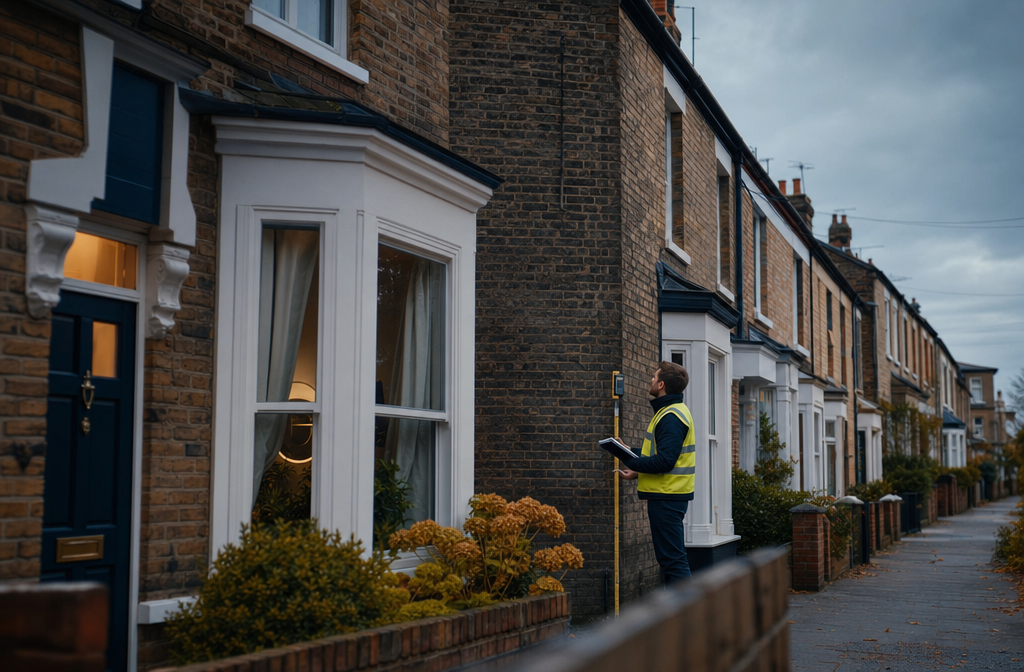

Roughly one in five property transactions in England and Wales involves a converted or non-standard construction property — yet a significant proportion of buyers still commission only a basic visual inspection before exchanging contracts. That mismatch between survey depth and property complexity is one of the most consistent drivers of post-purchase disputes and unexpected repair bills. Understanding Homebuyer vs Building Surveys: Choosing the Right Level for 2026 Urban Conversions and Non-Standard Builds is no longer a niche concern for specialist buyers; it is a practical necessity for anyone navigating the current urban property market.
This article breaks down the RICS Level 2 and Level 3 survey frameworks, explains exactly where each falls short or excels, and provides clear checklists for buyers considering loft conversions, warehouse adaptations, adaptive reuse schemes, and other non-standard builds in 2026.
Key Takeaways
- A Level 2 HomeBuyer Report suits conventional properties in reasonable condition; it is rarely sufficient for converted or non-standard buildings.
- A Level 3 Building Survey provides a thorough structural and fabric assessment and is the recommended choice for older, altered, or non-standard properties.
- The 2026 RICS Home Survey Standard (second edition) introduces new frameworks for "additional risk" dwellings, including retrofit and historic buildings.
- Non-standard construction — timber frames, steel portals, thatched roofs, concrete panels — can affect mortgage approval and insurance, making a deeper survey essential.
- Knowing when to escalate beyond a Level 3 to a full structural engineering assessment can save buyers from catastrophic financial exposure.
Understanding the RICS Survey Levels in 2026
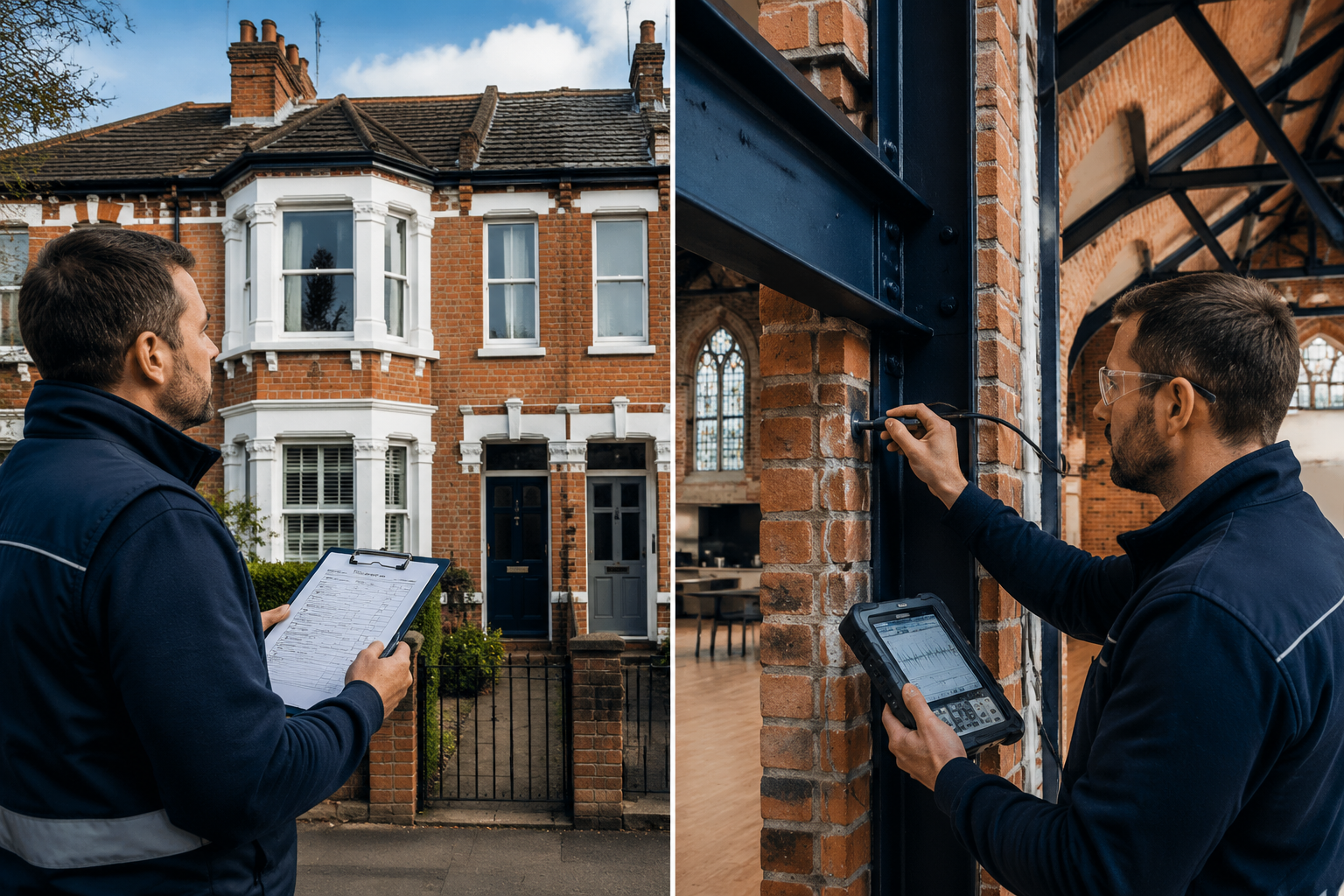
The Royal Institution of Chartered Surveyors (RICS) structures residential surveys into three levels. Level 1 is a basic condition report. Level 2 is the HomeBuyer Report. Level 3 is the full Building Survey. In May 2026, RICS published the second edition of its Home Survey Standard, which updated guidance across all three levels, integrated frameworks for technology-assisted inspections including AI-supported analysis and drone surveys, and introduced specific protocols for what it terms "additional risk" dwellings — a category that explicitly includes historic buildings and retrofit homes [1].
Level 2: The RICS HomeBuyer Report
The RICS HomeBuyer Report is a standardised document produced after a visual, non-invasive inspection of accessible areas. It uses a traffic-light condition rating system (1 = no repair needed, 2 = repair or replacement needed soon, 3 = urgent attention required). It covers the main elements of the property — roof, walls, floors, windows, services — but does not involve opening up areas, lifting floorboards, or probing behind finishes [2].
Suited to:
- Conventional brick or stone-built properties
- Properties constructed after approximately 1930
- Properties in reasonable condition with no obvious major defects
- Standard two-storey houses, bungalows, and modern flats
Not suited to:
- Properties with significant alterations or extensions
- Converted commercial or industrial buildings
- Non-standard construction types
- Properties showing visible signs of structural movement, damp, or neglect
A HomeBuyer Report typically takes two to four hours on site. For a clear breakdown of what to expect during the process, the guide on how long a HomeBuyer Survey takes is a useful reference.
Level 3: The RICS Building Survey
The RICS Building Survey (Level 3) is a comprehensive assessment of the property's structure, fabric, and condition. Unlike the HomeBuyer Report, it is not a standardised template; the surveyor tailors the report to the specific property. It includes a detailed description of defects, their likely causes, the urgency of repair, and indicative cost ranges [2].
The inspection is more thorough. Surveyors will inspect roof voids where accessible, probe timber elements for rot and insect damage, assess drainage and outbuildings, and comment on the implications of any alterations or conversions [4]. Where safe and practical, they may lift inspection hatches or examine sub-floor voids.
Suited to:
- Properties over 80 years old
- Any property with a conversion, significant extension, or structural alteration
- Non-standard construction (timber frame, steel frame, prefabricated concrete, thatched roofs)
- Properties showing signs of movement, damp, or previous repair
- High-value properties where the cost of the survey is proportionate to the financial risk
"A Building Survey is not simply a longer HomeBuyer Report — it is a fundamentally different type of assessment that examines the 'why' behind defects, not just the 'what'."
Why Urban Conversions Demand a Deeper Assessment
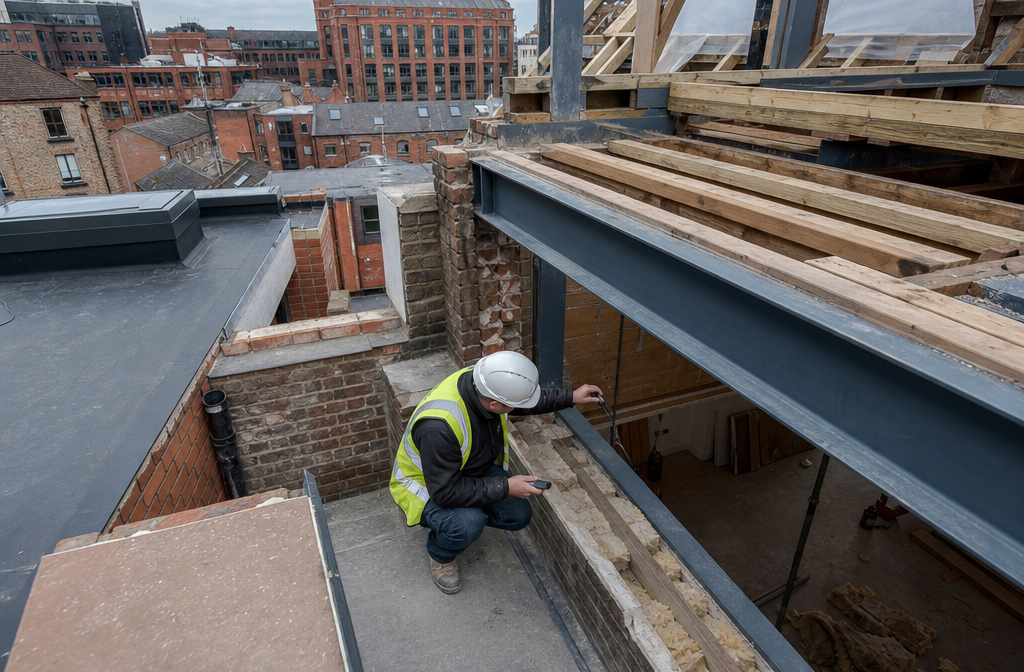
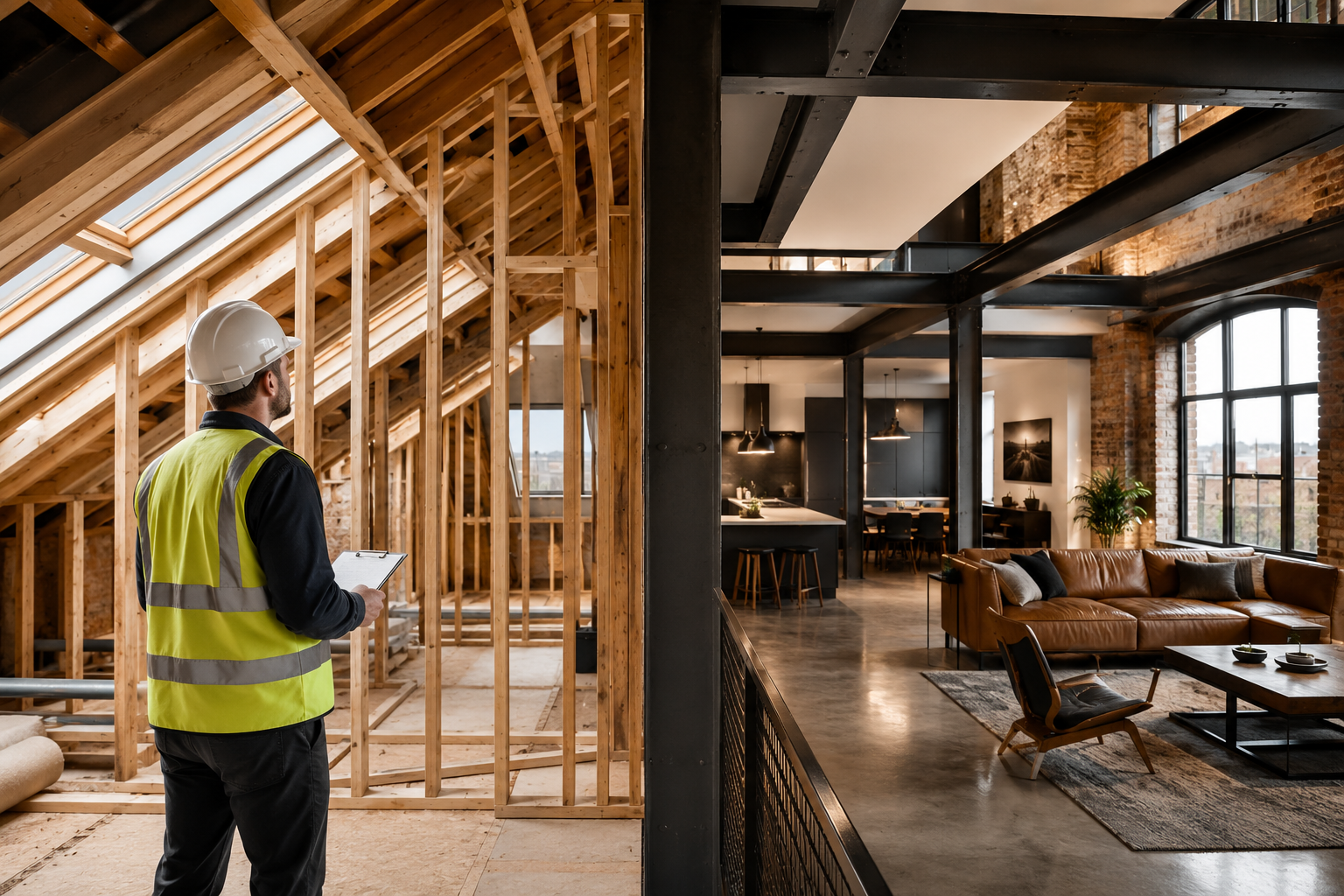
The urban property market in 2026 is defined by adaptive reuse. Former factories, schools, churches, and office blocks are being converted into residential units at a pace not seen in previous decades. Loft conversions in Victorian and Edwardian terraces remain a staple of the London and South East market. Each of these scenarios introduces risks that a standard HomeBuyer Report is structurally incapable of identifying.
Common Risks in Loft Conversions
A loft conversion that was carried out without proper building regulations approval — or one where approval was granted but workmanship was poor — can present serious structural and safety issues. Key concerns include:
- Inadequate structural support: Original ceiling joists are rarely strong enough to serve as floor joists for a habitable room. If steel beams or upgraded timbers were not installed correctly, deflection and cracking can follow.
- Compromised fire separation: Building regulations require specific fire-resistant construction between the new floor and the rooms below. Poorly executed conversions may lack compliant fire doors, protected stairwells, or adequate compartmentation.
- Roof structure alteration: Removing or cutting into rafters and purlins without proper structural calculation weakens the roof. Signs include ridge sagging, rafter spread, and cracking at eaves level.
- Thermal and moisture performance: Inadequate insulation or vapour control layers in a converted roof space can lead to interstitial condensation and subsequent timber decay.
A Level 3 Building Survey will examine all of these elements in detail and flag the absence of building regulations completion certificates, which is a significant legal and financial risk [6].
Risks Specific to Commercial-to-Residential Conversions
Warehouse, factory, and office conversions introduce a different set of challenges. These buildings were not designed for domestic use, and the adaptation process — however skilled — can leave legacy issues:
- Non-standard structural systems: Steel portal frames, post-tensioned concrete slabs, and precast floor panels behave differently from domestic construction. Their inspection requires specific knowledge.
- Contamination: Former industrial sites may have ground contamination, asbestos-containing materials in floor tiles, ceiling panels, or pipe lagging, and residual chemical deposits in drainage systems.
- Acoustic performance: Converted commercial buildings frequently underperform on sound insulation between units, particularly where original concrete floors have been retained.
- Services integration: Domestic heating, hot water, and electrical systems retrofitted into commercial shells can be complex and non-compliant if not properly designed.
For properties with drainage concerns, a drainage survey alongside the building survey is strongly advisable.
The Non-Standard Construction Problem
Non-standard construction is a broad term covering any building method that departs from traditional brick or stone with timber floors and roof. In the UK, this includes:
| Construction Type | Common Issues | Mortgage Risk |
|---|---|---|
| Timber frame (pre-1965) | Rot, insect attack, fire risk | High |
| Steel frame | Corrosion, thermal bridging | Medium-High |
| Prefabricated concrete (PRC) | Carbonation, reinforcement corrosion | Very High |
| Thatched roof | Fire risk, vermin, lifespan | High |
| In-situ concrete | Cracking, HAC degradation | Medium |
| Mundic block (South West) | Aggregate breakdown | Very High |
Properties with non-standard construction methods present hidden risks that a Level 2 inspection simply cannot uncover [3]. Lenders frequently decline mortgage applications on non-standard properties, or impose restrictive conditions, until a satisfactory Level 3 survey has been provided. For specialist guidance on non-standard construction assessments, engaging a surveyor with specific experience in the relevant construction type is essential.
Homebuyer vs Building Surveys: Choosing the Right Level for 2026 Urban Conversions and Non-Standard Builds — A Practical Decision Framework
The question of which survey level to commission is not simply about budget. It is about matching the depth of investigation to the complexity and risk profile of the specific property. The following checklist helps buyers make that determination.
Decision Checklist: When to Choose Level 3
Commission a full Building Survey if any of the following apply:
- The property was built before 1945
- There is a loft conversion, basement conversion, or rear extension
- The property was previously a commercial, industrial, or institutional building
- The construction uses timber frame, steel frame, prefabricated concrete, or any other non-standard method
- There are visible cracks in external or internal walls
- There is evidence of damp, staining, or previous water ingress
- The property has a flat roof covering more than 25% of its footprint
- The property has a thatched, slate, or other specialist roof covering
- The property is listed or in a conservation area
- The asking price is above the regional average (the survey cost is proportionate)
- The property has been empty for more than six months
When a Level 2 HomeBuyer Report May Suffice
A Level 2 survey remains appropriate when:
- The property is a post-1980 conventional brick-built house or flat
- There are no visible defects or signs of alteration
- The property is in demonstrably good condition
- The buyer is experienced and has had a thorough independent viewing
Even in these cases, buyers should be aware that a HomeBuyer Report does not include a structural analysis, does not inspect behind finishes, and does not assess the full extent of any defects found [4].
When to Escalate Beyond Level 3
A Level 3 Building Survey is comprehensive, but it is not a structural engineering assessment. There are scenarios where a separate structural survey or residential structural engineering report is warranted:
- Significant cracking consistent with subsidence or heave
- Evidence of past or ongoing structural movement
- Proposed alterations that require load-bearing wall removal
- Concerns about the adequacy of foundations
- Properties on or near former mine workings, landfill, or areas of known ground instability
For buyers concerned about subsidence specifically, a dedicated subsidence survey provides the targeted analysis that a general building survey cannot replicate.
Homebuyer vs Building Surveys: Choosing the Right Level for 2026 Urban Conversions and Non-Standard Builds — Cost, Technology, and the Updated RICS Standard

Cost Comparison
Building Surveys cost more than HomeBuyer Reports, and that difference is justified by the depth of work involved [5]. As a general guide for 2026:
| Survey Type | Typical Cost Range (UK) | Time on Site |
|---|---|---|
| Level 2 HomeBuyer Report | £400 – £900 | 2-4 hours |
| Level 3 Building Survey | £700 – £1,800+ | 4-8 hours |
| Structural Engineering Report | £500 – £2,000+ | Variable |
For complex properties — large Victorian terraces, converted commercial buildings, listed structures — costs at the upper end of the Level 3 range are common. The investment is modest relative to the financial exposure of purchasing a property with unidentified structural defects. For a detailed breakdown of structural assessment costs, the guide on structural survey pricing provides current market context.
Technology in 2026 Surveys
The updated 2026 RICS Home Survey Standard formally acknowledges the role of technology in improving survey accuracy and efficiency [1]. Surveyors are increasingly using:
- Drone inspections for inaccessible roof areas, high-level facades, and chimney stacks
- Thermal imaging cameras to detect moisture, missing insulation, and cold bridges
- AI-assisted report analysis to cross-reference defect patterns and flag additional risk factors
- Moisture meters and hygrometers for quantified damp assessment
These tools do not replace professional judgment, but they extend the surveyor's ability to identify issues that would otherwise remain hidden during a visual inspection. Buyers commissioning surveys on complex urban conversions should ask prospective surveyors which technologies they routinely deploy.
The "Additional Risk Dwelling" Framework
One of the most significant changes in the 2026 RICS Home Survey Standard is the introduction of a structured framework for what RICS terms "additional risk" dwellings [1]. This category includes:
- Historic and listed buildings
- Retrofit and energy-upgraded homes
- Properties with non-standard construction
- Buildings that have undergone significant adaptive reuse
Under this framework, surveyors are required to apply enhanced inspection protocols and provide more detailed commentary on the implications of the property's specific risk profile. For buyers, this means that a Level 3 survey on an "additional risk" dwelling in 2026 should be more informative and actionable than surveys conducted under previous standards.
Damp: A Persistent Issue in Conversions
Damp is one of the most frequently misdiagnosed defects in converted properties. Rising damp, penetrating damp, and condensation have different causes and different remedies, and conflating them leads to expensive and ineffective treatment. A Level 3 Building Survey will assess damp in context, but for properties with significant moisture concerns, a specialist damp survey provides a more targeted diagnosis. Understanding the cost of a damp survey helps buyers budget appropriately when commissioning multiple specialist assessments alongside a building survey.
Conclusion
The decision between a HomeBuyer Report and a Building Survey is not a question of preference — it is a question of risk management. For the vast majority of urban conversions, loft conversions, adaptive reuse schemes, and non-standard construction types that characterise the 2026 property market, a Level 2 HomeBuyer Report provides an insufficient level of scrutiny. The financial and legal consequences of missing a structural defect, an uncertified conversion, or a non-standard material failure can far exceed the cost difference between survey levels.
Actionable next steps for buyers in 2026:
- Identify the property type accurately before commissioning any survey — age, construction method, and alteration history all determine the appropriate level.
- If any item on the Level 3 checklist above applies, commission a Building Survey as a baseline minimum.
- Ask the surveyor directly whether the property falls within the RICS "additional risk" framework and what enhanced protocols they will apply.
- For properties showing signs of structural movement, commission a separate structural engineering assessment alongside the building survey.
- Budget for specialist add-ons — damp surveys, drainage surveys, roof surveys — where the property warrants them.
- Work with a local chartered surveyor who has demonstrable experience with the specific construction type or conversion category in question.
Choosing the right survey level is not a cost to minimise — it is the most reliable form of due diligence available before one of the largest financial commitments most people will ever make.
References
[1] Home Survey Standards – https://www.rics.org/profession-standards/rics-standards-and-guidance/sector-standards/building-surveying-standards/home-surveys/home-survey-standards?utm_source=openai
[2] House Surveys UK: The Costs, Types and Benefits of an RICS Home Survey – https://www.rics.org/consumer-guides/house-surveys-uk-the-costs-types-and-benefits-of-an-rics-home-survey?utm_source=openai
[3] Non-Standard Construction and Building Surveys: Identifying Hidden Risks in Converted and Altered Properties – https://princesurveyors.co.uk/blog/non-standard-construction-and-building-surveys-identifying-hidden-risks-in-converted-and-altered-properties/?utm_source=openai
[4] Homebuyer Report vs Building Survey: Which Do You Need – https://www.surveymerchant.com/blog/homebuyer-report-vs-building-survey-which-do-you-need?utm_source=openai
[5] Homebuyer Report vs Building Survey: Which Do You Really Need – https://www.cjbloor.co.uk/advice/rics-home-survey/homebuyer-report-vs-building-survey-which-do-you-really-need/?utm_source=openai
[6] What Is the Difference Between a Homebuyer Report and a Building Survey – https://www.reallymoving.com/surveyors/faq/what-is-the-difference-between-a-homebuyer-report-and-a-building-survey?utm_source=openai
[7] Full Survey vs Homebuyer Report: Key Differences – https://strutsurveyors.com/full-survey-vs-homebuyer-report-key-differences-strut/?utm_source=openai