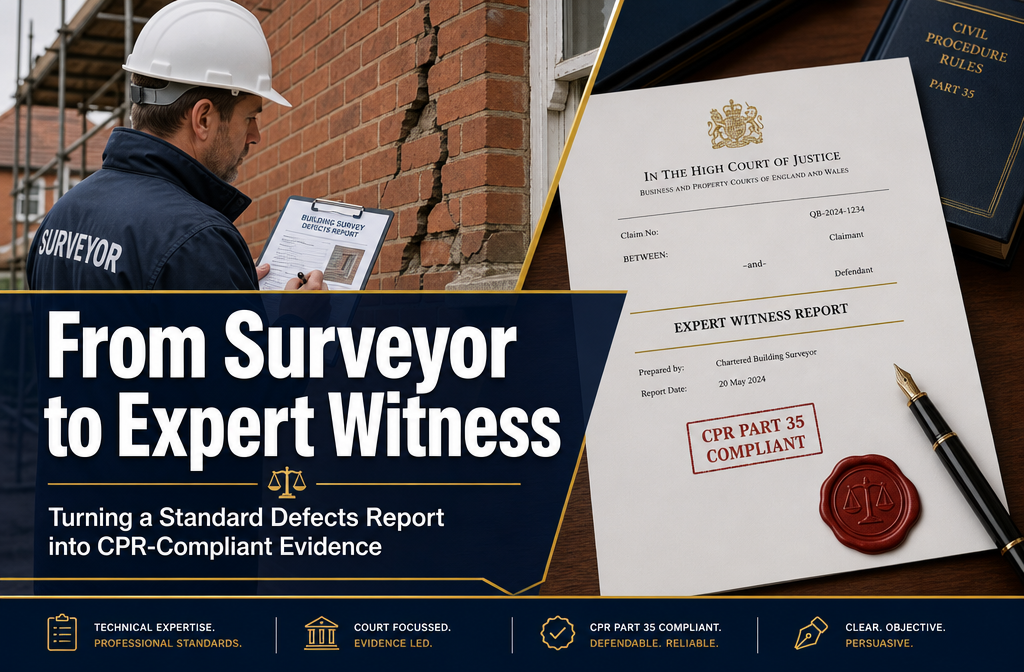
Only 38% of expert witness reports submitted in UK civil proceedings fully satisfy CPR Part 35 requirements on first submission — yet the majority of surveyors who face this compliance gap already hold the factual evidence they need. [2] The problem is rarely a shortage of data. It is a structural one: the original report was written for a client, not a court.
This guide walks through exactly how to bridge that gap. The process of going from surveyor to expert witness: turning a standard defects report into CPR‑compliant evidence without starting again is more achievable than most practitioners assume — provided the conversion follows a clear, methodical sequence.
Key Takeaways 📋
- CPR Part 35 does not require a fresh inspection — it requires the final document to meet specific structural and declaratory standards.
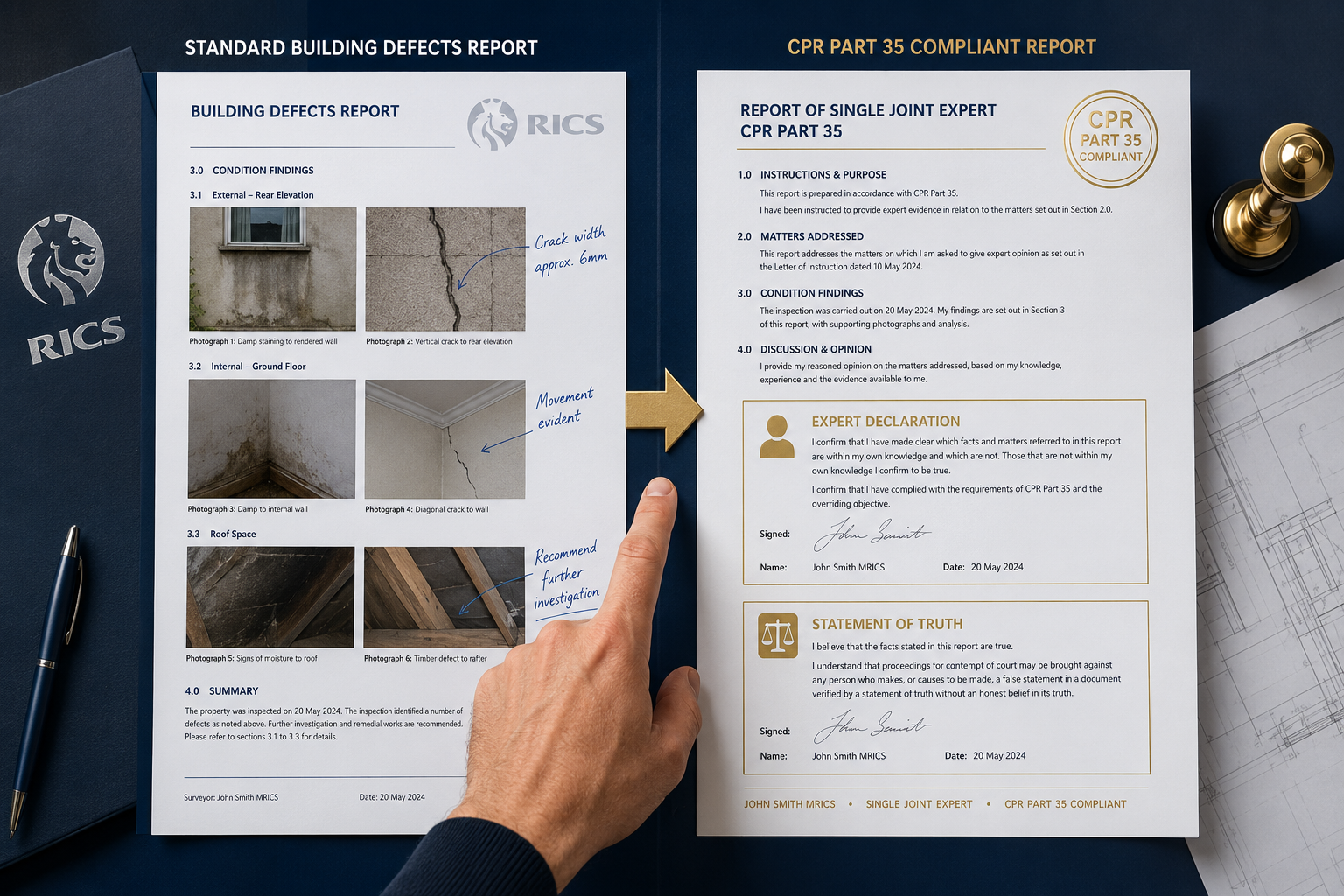
- A standard defects or building survey report already contains the factual core that courts need; the conversion work is largely architectural.
- Seven mandatory elements must be present in every CPR‑compliant expert report, and most can be added as discrete sections.
- Surveyors must shift their declared duty from "client" to "court" — this is the single most critical change.
- Early awareness of potential litigation allows surveyors to future-proof reports at the drafting stage, saving significant rework later.
Why Standard Defects Reports Fall Short of CPR Part 35
A typical specific defect report is written with a paying client in mind. Its purpose is to describe what is wrong, explain why, and recommend remediation. That is entirely appropriate for its intended audience.
But when a dispute escalates — a neighbour challenges the cause of subsidence, a landlord contests a dilapidations claim, or a buyer pursues a professional negligence action — the same document is suddenly expected to serve a court. Courts have different needs. They need to know:
- Who the expert is and why they are qualified to opine
- What specific issues they were asked to address
- What facts and assumptions underpin their conclusions
- How they reached those conclusions (methodology)
- What the range of reasonable expert opinion looks like
- What documents they relied upon
- That the expert's duty is to the court, not the instructing party [6]
A standard defects report typically addresses none of these requirements explicitly. That does not mean the underlying evidence is useless — it means the report needs a structural retrofit, not a demolition. [2]
💡 Pull Quote: "The factual core of a good defects report is already court-ready. What it lacks is the CPR framework around it."
The Seven Non-Negotiable Elements of a CPR Part 35 Report
Before beginning any conversion, it helps to treat CPR Part 35 and Practice Direction 35 as a checklist. Every compliant expert report must contain these seven elements:
| # | Required Element | Typically Missing from Standard Report? |
|---|---|---|
| 1 | Expert's qualifications and experience | Often absent or minimal |
| 2 | Statement of the issues addressed | Rarely explicit |
| 3 | Facts and assumptions relied upon | Partially present |
| 4 | Methodology and reasoning | Present but not labelled |
| 5 | Range of opinion (where appropriate) | Almost always absent |
| 6 | List of documents relied upon | Sometimes present |
| 7 | Statement of truth + duty to the court | Almost always absent |
Understanding which elements are already present — even if unlabelled — is the first step in the conversion process. [4]
From Surveyor to Expert Witness: Turning a Standard Defects Report into CPR‑Compliant Evidence Without Starting Again — The Step-by-Step Process
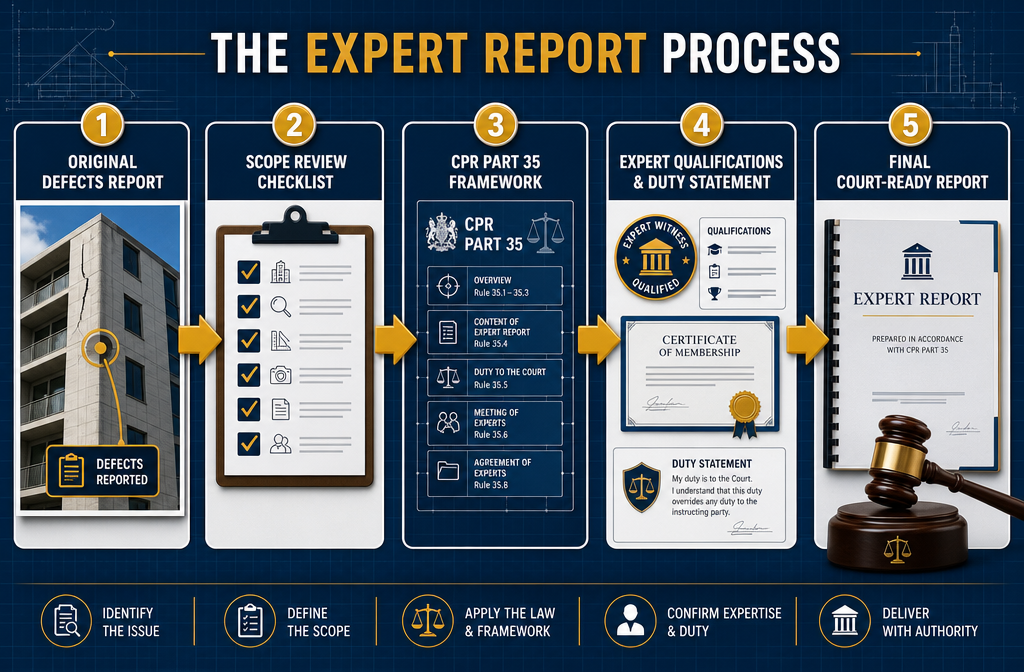
Step 1: Audit the Existing Report Against the CPR Checklist
Print the original report and work through the seven elements above. Highlight every passage that already satisfies — even partially — a CPR requirement. Most surveyors find that:
- Factual observations (photographs, measurements, descriptions of defects) are present and usable
- Causation analysis exists but is written as advice rather than reasoned opinion
- Recommendations can be reframed as conclusions
- Qualifications are absent or buried in a footer
This audit typically takes 30–60 minutes and immediately clarifies how much new writing is actually needed. [1]
Step 2: Reframe the Scope of Instruction
A standard report opens with something like: "This report has been prepared for [Client Name] following an inspection on [date]."
A CPR‑compliant report must open — or contain near the start — a clear statement of:
- Who instructed the expert (and in what capacity)
- The specific questions or issues the expert has been asked to address
- The legal proceedings to which the report relates (case name, court, claim number if known)
This section can be written fresh and inserted as a new introductory section. It does not require re-inspection. [2]
Step 3: Add a Qualifications and Experience Section
Courts need to assess whether the expert is genuinely qualified to opine on the issues at hand. This section should include:
- Professional qualifications (e.g., MRICS, FRICS)
- Relevant experience (years in practice, types of cases handled)
- Any specialist expertise relevant to the specific defect type (e.g., structural movement, damp, non-standard construction)
For surveyors working across structural surveys and defect investigations, this section is usually straightforward to draft from a CV or professional profile.
Step 4: Restructure Causation Analysis as Reasoned Expert Opinion
This is where the most substantive editing occurs — but it is editing, not rewriting from scratch.
In a standard defects report, causation language often reads:
"The cracking is consistent with differential settlement, likely caused by tree root activity near the foundation."
For CPR compliance, the same finding must be expressed as:
"In my opinion, the cracking pattern observed is consistent with differential settlement. I base this opinion on [specific observations]. The most probable cause, in my view, is tree root activity affecting the shallow foundation. I have considered alternative causes including [X and Y] and regard these as less probable for the following reasons…"
The facts have not changed. The structure of how they are presented has. [4]
Step 5: Add a Range of Opinion Section 🔍
CPR Practice Direction 35 requires that where there is a range of expert opinion on an issue, the expert must summarise that range and give reasons for their own view. This is one of the most commonly omitted elements in converted reports. [2]
For defect disputes, this typically means:
- Acknowledging that other surveyors might attribute the defect to a different cause
- Explaining why the evidence supports one interpretation over others
- Being explicit about areas of genuine uncertainty
This section demonstrates intellectual honesty and significantly strengthens the report's credibility in court. [6]
Step 6: Compile the Documents Relied Upon
List every document, photograph, test result, third-party report, or published guidance that informed the expert's opinions. This includes:
- The original inspection photographs
- Any monitoring survey data (relevant where monitoring surveys were conducted)
- Manufacturer specifications or building regulations guidance
- Previous reports by other parties
This list should be appended as a schedule. It is rarely necessary to re-gather documents — they already exist. [1]
Step 7: Add the Statement of Truth and Duty to the Court
This is the single most important addition and the one most often overlooked. Without it, the report is not CPR‑compliant regardless of its content quality.
The statement must confirm:
- The expert understands their duty is to the court, not the instructing party
- The expert has complied with that duty
- The report is true to the best of the expert's knowledge and belief
- The expert is aware of the consequences of making a false statement
Standard wording (per CPR PD35):
"I confirm that I have made clear which facts and matters referred to in this report are within my own knowledge and which are not. Those that are within my own knowledge I confirm to be true. The opinions I have expressed represent my true and complete professional opinions on the matters to which they refer."
This paragraph takes two minutes to add. Its absence can result in the report being inadmissible. [5]
When Re-Inspection Is — and Is Not — Required
One of the most common anxieties surveyors face when converting a report is whether they need to return to the property. The honest answer is: sometimes, but less often than assumed.
Re-inspection is generally NOT required when:
- The original inspection was thorough and well-documented
- The defects in question have not materially changed
- The photographs and measurements taken are sufficient to support the opinions expressed
- The issues in dispute fall within the scope of the original inspection
Re-inspection IS advisable when:
- Significant time has passed and conditions may have changed
- The dispute raises issues not addressed in the original report
- The opposing party's expert has identified defects that were not observed
- A solid floor slab survey or other specialist investigation is needed to address a specific technical question
In many cases, a brief supplementary site visit — rather than a full re-inspection — is sufficient to address any gaps. [3]
From Surveyor to Expert Witness: Turning a Standard Defects Report into CPR‑Compliant Evidence Without Starting Again — Common Pitfalls to Avoid
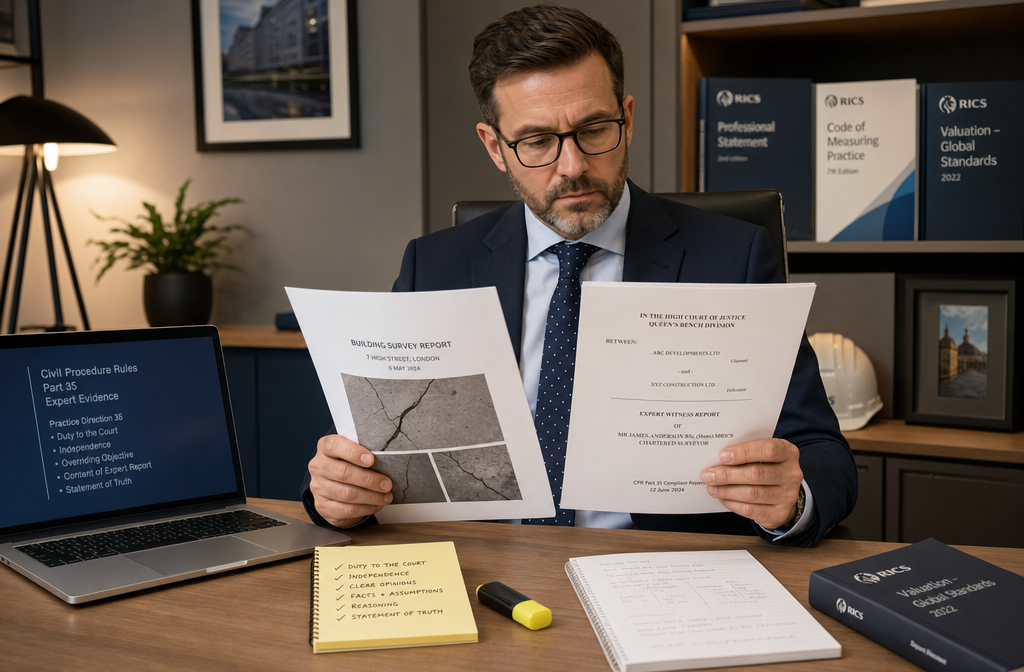
Even experienced surveyors make avoidable errors during the conversion process. The most common include:
❌ Pitfall 1: Retaining Client-Focused Language
Phrases like "we recommend" or "in our client's interest" signal advocacy rather than independence. Every instance must be replaced with neutral, court-directed language.
❌ Pitfall 2: Conflating Facts with Opinions
Courts need to know clearly which statements are observed facts and which are expert opinions. Use explicit signposting: "I observed…" vs. "In my opinion…"
❌ Pitfall 3: Ignoring the Opposing Expert's Position
If the other side has already served an expert report, the converted report should — where possible — address the points raised. Ignoring them weakens credibility. [4]
❌ Pitfall 4: Overstating Certainty
Expert witnesses who express absolute certainty on genuinely contested technical questions are viewed with suspicion by courts. Appropriate qualification of opinions is a sign of professional integrity, not weakness. [9]
❌ Pitfall 5: Failing to Declare Conflicts of Interest
If the surveyor has any prior relationship with either party, this must be declared explicitly. Omitting it — even inadvertently — can be fatal to the report's admissibility. [5]
Future-Proofing: Writing Defect Reports That Convert Easily
The most efficient approach is to anticipate the possibility of litigation at the drafting stage. Surveyors who regularly produce expert witness reports develop habits that make conversion almost seamless:
- Use numbered paragraphs — courts and lawyers reference specific paragraphs
- Separate observations from opinions clearly in the document structure
- Photograph everything with date-stamped images and location references
- Note the methodology used for any measurements or tests
- Record what was NOT inspected and why — limitations sections are valuable in court
These habits add minimal time to the original report but dramatically reduce the effort required if litigation follows. [1]
For surveyors operating across London and the South East — whether providing chartered surveyor services in Surrey or in South East London — the volume of residential and commercial disputes makes this preparation increasingly valuable in 2026. [7]
The Duty Shift: From Client Adviser to Court Expert
Perhaps the most profound change involved in going from surveyor to expert witness is not structural — it is psychological. The surveyor's primary duty shifts from serving the client to serving the court.
This does not mean being unhelpful to the instructing party. It means that if the evidence points in an inconvenient direction, the expert must say so. Courts have repeatedly criticised expert witnesses who function as "hired guns." [9]
RICS guidance reinforces this: an expert witness must be, and must be seen to be, independent. [10] Surveyors who have built a reputation for robust, independent expert witness services consistently report that this independence — far from alienating clients — actually increases instructing solicitors' confidence in them.
💡 Pull Quote: "The expert's duty to the court overrides any obligation to the person who pays the fee. This is not a limitation — it is the source of the expert's authority."
Conclusion: A Practical Roadmap for 2026
The process of going from surveyor to expert witness: turning a standard defects report into CPR‑compliant evidence without starting again is achievable in seven structured steps. The factual work — the inspection, the photographs, the causation analysis — is already done. What remains is largely architectural: adding the right sections, reframing the right language, and making the right declarations.
Actionable next steps for surveyors in 2026:
- ✅ Audit your existing report against the CPR Part 35 seven-element checklist today
- ✅ Draft a qualifications section that can be adapted for any future expert instruction
- ✅ Adopt numbered paragraphs and explicit fact/opinion separation in all future reports
- ✅ Add a range of opinion section whenever causation is genuinely contested
- ✅ Never submit a report to court without the CPR statement of truth and duty declaration
- ✅ Seek specialist advice from an experienced expert witness surveyor if the dispute involves complex structural or valuation questions
The gap between a good defects report and a court-ready expert report is smaller than most surveyors think. Closing it methodically — rather than starting again — saves time, preserves the integrity of the original evidence, and positions the surveyor as a credible, independent voice in proceedings.
References
[1] Building Your Expert Witness Practice In 2026 Specializations In Party Wall Defects And Valuations – https://www.canterburysurveyors.com/blog/building-your-expert-witness-practice-in-2026-specializations-in-party-wall-defects-and-valuations/
[2] Expert Witness Reports For Defective Construction Claims Surveyor Protocols And Cpr Part 35 Compliance In 2026 Disputes – https://manchestersurveyors.com/expert-witness-reports-for-defective-construction-claims-surveyor-protocols-and-cpr-part-35-compliance-in-2026-disputes/
[3] Defect Expert Witness – https://seakexperts.com/keywords/defect-expert-witness
[4] Expert Witness Surveyors In Professional Negligence Claims Cpr Part 35 Compliance And Diminution In Value Calculations – https://nottinghillsurveyors.com/blog/expert-witness-surveyors-in-professional-negligence-claims-cpr-part-35-compliance-and-diminution-in-value-calculations
[5] Expert Witness Preparation For 2026 Party Wall Disputes Building Cases Amid Rising Construction Activity – https://partywallsurveyorlondon.uk/blogs/expert-witness-preparation-for-2026-party-wall-disputes-building-cases-amid-rising-construction-activity/
[6] Expert Witness Report Main – https://www.risaltd.co.uk/expert-witness-report-main
[7] Expert Witness Preparation For New Awaabs Law Hazards Electrical Fire And Structural Risks In 2026 Prs Disputes – https://kingstonsurveyors.com/expert-witness-preparation-for-new-awaabs-law-hazards-electrical-fire-and-structural-risks-in-2026-prs-disputes/
[9] A Post Sullivan World Requires A Strong Expert Report – https://www.marshalldennehey.com/thought-leadership/a-post-sullivan-world-requires-a-strong-expert-report
[10] Expert Witness Testimonies In 2026 Northern Housing Boom Disputes Rics Guidelines For Surveyors – https://wimbledonsurveyors.com/expert-witness-testimonies-in-2026-northern-housing-boom-disputes-rics-guidelines-for-surveyors/